Seattle: A Beautiful Farewell
“Oh! Look! The mountain is out!”
When someone says ‘the mountain,’ everyone knows what mountain you are talking about. It’s the granddaddy of all mountains, Mount Rainier:
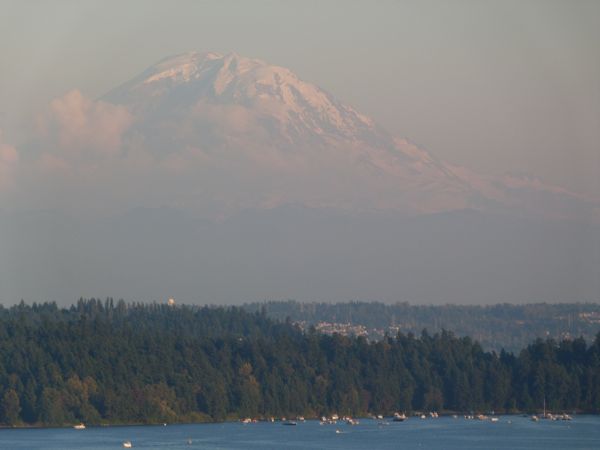
Mount Rainier often shrouds itself in clouds and fog. A day when the mountain is out lifts everyones spirits. It was a beautiful last sight of Seattle.
Pacific Northwest Natives Have DNA Link 5,000 years
Don’t you love technology? It’s like working on a complex puzzle, and all of a sudden seeing how disparate pieces relate 🙂 This is a fascinating discovery from AOL/Huffpost:
Ancient DNA Linked To Living Descendants In Genetic Study
The Huffington Post | By Macrina Cooper-White Posted: 07/09/2013 2:24 pm EDT | Updated: 07/09/2013 9:12 pm EDT
What if you could trace your ancestry back to around 5,000 years ago? Researchers were able to do just that in a fascinating new DNA study, which found adirect genetic link between the ancient remains of Native Americans and their living relatives.
“It’s very exciting to be able to have scientific proof that corroborates what our ancestors have been telling us for generations,” study co-author and participant Joycelynn Mitchell said in a written statement. “It’s very amazing how fast technology is moving to be able to prove this kind of link with our past.”
In the study, U.S. and Canadian researchers used mitochondrial genome (mitogenome) sequencing to analyze DNA inherited exclusively through mothers. Looking at the mitogenome is cheap, easier to sequence than nuclear DNA, and skirts around the problem that European men mixed with Native American women.
The researchers collected DNA from 60 living indigenous people belonging to the Tsimshian, Haida and Nisga’a tribes in the northern coast of British Columbia. The tribes’ oral histories and archaeological sites indicate they have lived in the region for generations, which made them good candidates for tracing their lineage back so many years.
Complete mitogenomes were extracted from the remains of four Mid-Holocene individuals found in British Columbia’s Lucy Islands and Dodge Island, and then that information was compared to the DNA of the study participants.
What was found? The research team discovered one of the living individuals carried this same “mitogenomic signature” as a young adult female who lived on Dodge Island 2,500 years ago — which also matched the mitogenome of the remains of a woman who lived in the Lucy Islands 5,500 years ago. Wow.
Three other living participants had mitogenomes that linked back to the remains of another individual found on Dodge Island, who may have lived around 5,000 years ago.
“This is the beginning of the golden era for ancient DNA research because we can do so much now that we couldn’t do a few years ago because of advances in sequencing technologies,” study co-author Dr. Ripan Malhi, an anthropology professor at the University of Illinois and Institute for Genomic Biology professor, said in a written statement. “We’re just starting to get an idea of the mitogenomic diversity in the Americas, in the living individuals as well as the ancient individuals.”
The new study was published online on June 3, 2013 in the journal PLoSONE.
It’s Why We’re Here: Lunch at Taco Rock
There is a graciousness in Pensacola that reminds me of life in the Middle East, although the local Pensacolians would be astounded to be compared with the Middle East. If you look closely, though, you can see the similarities.

There is politeness and civility toward others, even strangers. When workmen are in your home, you offer them ice water, or iced tea, and you ask about their families before they start work. It seems to us that when we call for help, we get the same service people coming to our house; I don’t think it is an accident.
People chat a little before they get down to business. I think many a Pensacolian would feel comfortable in the souks, sitting and drinking a little tea before they start to discuss the appropriate price level for the bauble they are considering. They ask about a person’s health, and they ask about your family. They take meals to those who are suffering or recovering.
People spend time with family. Families go to church together, families have meals together, families share child rearing. Multi-generations live near one another. People who went to school together more than fifty years ago form their own kind of family, sharing deeply, attending the funerals of one another’s kin. Funerals are well attended. Very Arab, if only they knew.
There are pockets in the United States where you find groups of Arab nationals; Pensacola has these groups, even a discreet mosque or two. There are stores selling international supplies, including zaat’r and sumak and harissa, chana dal, bulger, wuhammara . . . and restaurants billing themselves as ‘Mediterannean’ whose food would be recognizable to those in the Levant and the Gulf.

There is almost always a breeze off the Gulf to fight the heat and humidity and mosquitoes, and, by the grace of God, there is air conditioning and ice water coming out of the refrigerators. Life is sweet.
Life is all the sweeter because we can get together with our son and his family on the spur of the moment, and end up at a great family place like Taco Rock, where our little grandson can get down when he gets restless, and where there is plenty of time for us to chat, discuss Django Unchained, discuss new developments in entertainment technology, discuss upcoming vacations and arrangements – there is that great luxury of time together, and tasty food at reasonable prices. LOL, this is the Pensacola equivalent of a Michelin Red R, good local cuisine at reasonable prices. Hmmmm, Mexican is probably not qualified as good local food at reasonable prices, but close enough . . .


He is such a delight, our little grandson, who calls the coming baby “that little girl,” as in “when that little girl comes, I’m going to teach her how to float on her back!”
This week, there is another parade! Pensacola must be the parade capital of the world; so many parades! We’ll pick up our grandson, stand on the corner and wave our arms until they throw us some beads. Great fun and good exercise. 🙂


This post is really a great excuse to post some new photos of our grandson 🙂
The Lord Laughs at the Wicked
When I start to fret about those in high places who oppress the poor and the workers, whose lives are so far from worrying about a roof over their head and food to eat that they will pass still laws further oppressing the poor and homeless, I take consolation in this psalm.

The Pensacola City Council is passing a draconian measure against the homeless. I’ve been so proud of Pensacola, and the citizen response to the homeless, the beds Pensacola provides, the meals the citizens, through a variety of church and social agencies, hand out. Their response is humane, and compassionate.
The homeless are attracted by the moderate climate; they are here in droves. They panhandle at the intersections, they approach you at downtown attractions. They often have dogs. For the most part, they greet people cheerfully or respectfully, and they aren’t aggressive.

They are, in truth, a kind of plague on Pensacola, but as a traveler, I have brushed my teeth in many a restroom, changed my clothes, even had to rise out a coffee stained outfit before my next flight once – these are things for which the homeless will be charged with an offense against the law. If I were without a place for the night, I might look for a safe public restroom in which to sleep, especially if I had a child with me, as so many women did when I worked with homeless women.
I understand the problem.
But I also understand the desperation of those who have little, and that very little – a public restroom, a safe place to sleep outdoors – are being taken away from them by this statute. It’s heartless, and if there is truly an accounting at the end of our lives, and an afterlife, I fear for those who put additional burdens on the poorest of the poor.
Psalm 37
Of David.
1 Do not fret because of the wicked;
do not be envious of wrongdoers,
2 for they will soon fade like the grass,
and wither like the green herb.
3 Trust in the Lord, and do good;
so you will live in the land, and enjoy security.
4 Take delight in the Lord,
and he will give you the desires of your heart.
5 Commit your way to the Lord;
trust in him, and he will act.
6 He will make your vindication shine like the light,
and the justice of your cause like the noonday.
7 Be still before the Lord, and wait patiently for him;
do not fret over those who prosper in their way,
over those who carry out evil devices.
8 Refrain from anger, and forsake wrath.
Do not fret—it leads only to evil.
9 For the wicked shall be cut off,
but those who wait for the Lord shall inherit the land.
10 Yet a little while, and the wicked will be no more;
though you look diligently for their place, they will not be there.
11 But the meek shall inherit the land,
and delight in abundant prosperity.
12 The wicked plot against the righteous,
and gnash their teeth at them;
13 but the Lord laughs at the wicked,
for he sees that their day is coming.
14 The wicked draw the sword and bend their bows
to bring down the poor and needy,
to kill those who walk uprightly;
15 their sword shall enter their own heart,
and their bows shall be broken.
16 Better is a little that the righteous person has
than the abundance of many wicked.
17 For the arms of the wicked shall be broken,
but the Lord upholds the righteous.
18 The Lord knows the days of the blameless,
and their heritage will abide for ever;
19 they are not put to shame in evil times,
in the days of famine they have abundance.
20 But the wicked perish,
and the enemies of the Lord are like the glory of the pastures;
they vanish—like smoke they vanish away.
21 The wicked borrow, and do not pay back,
but the righteous are generous and keep giving;
22 for those blessed by the Lord shall inherit the land,
but those cursed by him shall be cut off.
23 Our steps* are made firm by the Lord,
when he delights in our* way;
24 though we stumble,* we* shall not fall headlong,
for the Lord holds us* by the hand.
25 I have been young, and now am old,
yet I have not seen the righteous forsaken
or their children begging bread.
26 They are ever giving liberally and lending,
and their children become a blessing.
27 Depart from evil, and do good;
so you shall abide for ever.
28 For the Lord loves justice;
he will not forsake his faithful ones.
The righteous shall be kept safe for ever,
but the children of the wicked shall be cut off.
29 The righteous shall inherit the land,
and live in it for ever.
30 The mouths of the righteous utter wisdom,
and their tongues speak justice.
31 The law of their God is in their hearts;
their steps do not slip.
32 The wicked watch for the righteous,
and seek to kill them.
33 The Lord will not abandon them to their power,
or let them be condemned when they are brought to trial.
34 Wait for the Lord, and keep to his way,
and he will exalt you to inherit the land;
you will look on the destruction of the wicked.
35 I have seen the wicked oppressing,
and towering like a cedar of Lebanon.*
36 Again I* passed by, and they were no more;
though I sought them, they could not be found.
37 Mark the blameless, and behold the upright,
for there is posterity for the peaceable.
38 But transgressors shall be altogether destroyed;
the posterity of the wicked shall be cut off.
39 The salvation of the righteous is from the Lord;
he is their refuge in the time of trouble.
40 The Lord helps them and rescues them;
he rescues them from the wicked, and saves them,
because they take refuge in him.
Mayor Emory Valentine Doesn’t Get His Way

It all started with a conversation with my Mom, during which, in a hushed voice, she told me about a neighbor “who had gotten a blue card.” A blue card? I had never heard of a blue card.
“It meant she had to leave the state!” Mom said.
Such a small thing, and such a journey it has led me on, trying to find out about the blue card and how it functioned. It led me to The History of the Juneau Alaska Police Department, and reading through that led to an hour of hilarity reading through the struggles of a small frontier town trying to bring order out of chaos and fight the battles of sewers, garbage, untethered horses, bawdy houses, and law enforcement.
Here are some examples of early actions:
1904
September, 1904 – George Kyrage (“George the Greek”) was elected to the Council and served with Mayor George Forrest, Councilmen Henry Shattuck, John Reck, Louis Lund, J.P. Jorgenson, and Henry States. Kyrage was named chairman of the Police Committee and found himself squarely between those who wanted prosperity through a wide open town, and those who demanded strict enforcement of a new ordinance prohibiting women loitering in saloons.
1910
January 7, 1910 – The conduct of a man named Al Graham was discussed and the Council ordered that he be given a “Blue Ticket”.
April 15, 1910 – The applicants for City Marshal were as follows: Charles Biernoth, W.G. Harris, Charles Meline, Mike McKenna, William Steinbeck, John Sweeney, Fred LaMarche Holmberg, and J.T. Martin. Charles Biernoth received the majority of the votes and was elected.
May 6, 1910 – City Marshal Charles Biernoth was asked to resign.
1913
April 18, 1913 – Mr. Nolan appeared before the Council and protested that the women of ill fame were allowed to live in the vicinity of the saw-mill outside of the restricted district, and the matter was referred to the Police Committee and the Chief of Police.
1914
January 2, 1914 – The City Attorney was instructed to prepare an ordinance against expectorating on the sidewalks of the City of Juneau.
-An ordinance was passed that provided punishment for pimps and moques to be set at not more than one hundred dollars.
City refuses to clean up red light district
February 6, 1914 – Councilman H.J. Raymond said that the last Grand Jury: wanted the City of Juneau to do something about cleaning up the red light district in the City. It was moved that the Chief of Police be ordered to close up every bawdy house in the City; but the motion died for lack of a second. It was then moved that the Chief of Police be instructed to stop the sale of liquor in all houses of prostitution in the City of Juneau; and again the motion died for lack of a second. It was then moved and seconded that a letter be forwarded to John Rustgard, US District Attorney, First Division of Alaska, stating that the City authorities of Juneau will be glad to lend all the aid they can in the enforcement of the law in the sale of liquor in houses of prostitution in the City of Juneau.
May 14, 1914 – A day’s labor in the Municipality of Juneau was set at eight (8) hours, common laborers were paid 35 cents per hour, and could work any number of additional hours at the same rate per hour.
1915
January 27, 1915 – A special meeting was called to hear charges of misconduct in office that have been made against Chief of Police William McBride. The Council requested that witnesses give their testimony. Harry Grove was duly sworn and testified and Charles Freegrove, Helen, and J.H. Gilpatrick were called and questioned by different councilmen. The hearing was then continued to a subsequent meeting of the Council.
January 29, 1915 – The Clerk read the resignation of William McBride from the office of the Chief of Police of the City of Juneau which took effect on February 1, 1915.
-A proposed ordinance was presented entitled “An ordinance requiring horses to be tied”.
July 7, 1916 – S.A. Judd protested that the Chief of Police had ordered him to leave town.
It makes for fascinating reading. Then I came across this sequence of reports, but for all my Googling, I cannot find out what the charges were against Chief of Police W.S. Harding:
1917
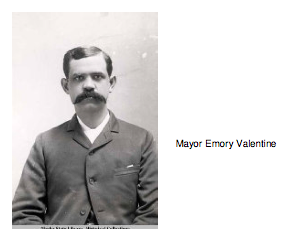
April 11, 1917 – Mayor Valentine declared that grave and serious charges have been made against W.S. Harding, Chief of Police, and that proofs are now in his possession. He further declared that an emergency existed, ordered that the office of Chief of Police be declared vacant, and stated that he will in due time appoint an emergency Chief of Police.
Councilman King asked Mayor Valentine the nature of the charges, to which Mayor Valentine replied that Mr. Harding would be given an opportunity to answer them, and that he would call a special meeting for that purpose.
April 12, 1917 – It was moved and seconded that W.S. Harding be elected to the position of Chief of Police for the coming year, to which Mayor Valentine declared out of order and stated that Mr. Harding had been suspended under the rules. Councilman Blomgren called for a vote on the adoption of the motion, and all six councilmen vote aye.
April 20, 1917 – The Clerk read the following demand: To Emory Valentine, Mayor and Common Council of the City of Juneau:
Whereas, Emory Valentine Mayor of the City of Juneau did at a public meeting held in the City of Juneau on the night of the 19th day of April, 1917, read certain affidavits purporting to contain certain charges against me as Chief of Police of Juneau, and that Emory Valentine publicly announced on the streets and public places of the Town of Juneau that he had other charges against me, I hereby demand that affidavits and all charges made against me as a public official and against my conduct, if committed and filed with the Common Council of the City of Juneau, or the Clerk of the City, and that a hearing be had immediately. Respectfully submitted, dated Juneau, Alaska, April 20, 1917. (signed) W.S. Harding
-An Executive Session was scheduled for Monday, April 23, 1917, at the hour of eight o’clock p.m. for the purpose of having the charges against W.S. Harding formally filed or presented.
-The Mayor called for the election of a person to fill the position of Chief of Police for the coming year. The Clerk read the following names as persons who had filed their applications: W.S. Harding, W.D. McMillan, E.J. Sliter, and Capt. E. Harrigan. W.S. Harding received six votes and the other applicants received none. The Mayor declared a veto on the election of W.S. Harding as Chief of Police.
-Harding appointed Dan Harrington, W.D. McMillan, and Emil Mullenbeck, to serve as police officers under him and asked for approval of the Council which was given. The Mayor declared a veto to the action of the Council.
April 27, 1917 – The Common Council of the City of Juneau, Alaska, convened in the Council Chambers of City Hall at the hour of eight o’clock p.m. on Friday, April 27, 1917, for the purpose of trying the charges against W.S. Harding, Chief of Police.
-The trial of the charges was to be heard by affidavit, and W.S. Harding was given until Monday night to file his answering affidavits, with the trial continued to Thursday, May 3, 1917 at the hour of eight o’clock p.m.
May 3, 1917 – The Common Council of the Town of Juneau, Territory of Alaska, convened in the Council Chambers of the City at the hour of eight o’clock p.m. on Thursday, May 3, 1917 – Mayor Valentine presiding. A resolution calling for the reading of the charges against W.S. Harding, Chief of Police accusing him of misconduct in office and the answering affidavits from the Chief was read.
-Affidavits of Walter Johnson, Frank Morrison, Jack Ivey, Fred Alexander, Mrytle Mercer, J.W. Felix, D. DeBlaser, F.J. Breezee, L.N. Ritter, and E. Valentine supported the charges.
-Affidavits of W.S. Harding, Emil Mullenbeck, Louise Dejonghe, E.W. Pettit, L.O. Sloane, C.O. Lindsey, Carl R. Brophy, W.D. MacMillan, A.C. Williams Jr., Frank E. Sargent, Glen C. Bartlett, H.H. Post, D.J. Harrington, George C. Burford, Edith Johnson, John B. Marshal, Harry Ellingen, and E.A. Naud were read in answer to the charges.
-The Council took a ten minute recess to consider the charges, and Mayor Valentine left the meeting.
-Following the recess, the following resolution was read: Be it resolved that W.S. Harding, Chief of Police of the City of Juneau, whom certain charges have been filed against, has been exonerated and it is the wish of the Council that he continue as Chief of Police.
May 4, 1917 – The electric light at the end of the garbage dump was out, causing trouble for boats navigating up and down the channel.
-Mayor Valentine objected to the claim of Chief Harding for his full monthly salary, saying that he was only entitled to pay for the first eleven days in April, because Harding was relieved from office on that date.
-The Clerk read Mayor Valentine’s veto message to the action of the Council electing W.S. Harding as Chief of Police on April 20, 1917, and to the action of the Council confirming the appointments of W.S. Harding, Patrolman Harrington and Mullenbeck. The following resolution was then read: Be it resolved that the veto of Mayor Valentine to the action of the Council in electing W.S. Harding, Chief of Police of the City of Juneau, Alaska on April 20, 1917, be overruled and held for naught. And be it further resolved that the veto of Mayor Valentine to the action of the Council in confirming the appointment of Patrolman Harrington and Mullenbeck on April 20, 1917, be overruled and held for naught.
Mayor Valentine served as Mayor for six terms, according to Wikipedia, and organized the volunteer fire department and designed the city’s first water system. For some reason, he really didn’t like the Chief of Police, but Harding and a lot of support among the council members, and retained his position. Fascinating stuff; brings history to life.
And you thought history was dull?
Doha, Qatar on House Hunters International
Oh what fun – last night on House Hunters International, I got to search for an apartment in Doha. Well, not really, but virtually. Here is what the episode description says on HGTV:
Just after getting married to Meena, architect Ken jumped at the chance to help design Doha’s new international airport. So, they’re trading in the golden state of California for the golden lands of Qatar. But as these newlyweds discover each other, the new city of Doha is also discovering its own identity as it moves towards the future. From sleek new development to traditional neighborhoods, real estate agent Ana Figueiredo will help them navigate Doha’s changing landscape. Watch as House Hunters International uncovers all that glitters in Doha, Qatar.
I checked YouTube; the episode is not yet up. It was so much fun, seeing this young couple in the Souks, down near Al Saad in Mirqab, and out at the Pearl. The apartment they settled on was in Al Ashmak, near the Corniche; I think it was one of the Bilal apartment buildings.
The Baboon Coughed
We’ve had three sets of houseguests in a very short time span, and today is our first day of ‘normal.’ We saw our friends off at 0430 (we used to call it oh-dark-hundred) and I couldn’t get back to sleep, so by the grace of God (and I mean that literally) I got up and walked.
I know I need to walk. I’ve always walked. I used to run, but I suffered for it – the knees – and decided I didn’t want to pay that price. But when my sister was here, we decided to take a walk and I said “don’t worry, I walk fast” and she said “I don’t, I am so slow now, my body has to warm up.” Confidently I started – and starting is uphill from my house. Very shortly, I discovered my fast was her slow, and I was HUFFING and puffing, and so embarrassed because I guess it’s been a while since I did this walk . . . but we did it. It felt good. And I was happy for a nice cool morning so I could do it again.
I ran into a neighbor, ignored that she was in her nightgown, we both pretended she was as fully dressed as I, had a brief conversation and she went inside with her newspaper and I carried on. About halfway through my walk, as I puffed along, I heard it.
The baboon coughed.
I could even smell a faint drift of wood burning fire. I could hear the doves. But it was only very briefly, very intangential, and I quickly realized it must have been a dog barking distantly; I could still hear him. For one brief moment I was back in Zambia, and while I love the magic of Zambia, I would not be out for a mile long hike early in the morning while the lions prowl for a last meal before they settle down for their day-long snooze.
We are off this morning to a grand plant sale across the bay in Milton. Symphony tonight. Back to “normal” for Pensacola.
The Church Remembers Saint Gregory The Illuminator
From today’s Forward Day by Day, information on St. Gregory the Illuminator

The Liturgical Calendar: The Church Remembers
Today the church remembers Gregory the Illuminator, Bishop and Missionary of Armenia, c. 332.
Armenia, the first Christian kingdom in history, was converted through the efforts of Gregory. This kingdom came to an unhappy end as an independent state in 430, yet some two and one-half million persons today are still culturally Armenians. They enjoy a racial, linguistic, and religious heritage which is one of the world’s oldest and richest. Their community has endured fifteen hundred years of dispersion, harassment, and often severe persecution.
The truly marvelous story of Christian Armenia began when the infant Gregory, who was a prince by birth, was exiled by enemies and reared by a compassionate Christian family in Cappadocia (modern central Turkey). As an adult and a Christian he returned to Armenia and converted the king, Tiridates, heir of Gregory’s old enemies. This was not done easily. Indeed, many legends have grown up around the tradition of Gregory’s great difficulties, hardships, and sufferings in effecting the conversion of the king and subsequently the kingdom. For this work he is called the “Illuminator.” Gregory was eventually consecrated Bishop of Echmiadzin and was the organizer of the Armenian Church.
The Episcopal Church has enjoyed a warm and friendly relationship with the Armenian Church for many years. Offer thanks for that friendship.
We thank you, O God, for the witness of Gregory the Illuminator and for the people of Armenia. Amen.
Almighty God, whose will it is to be glorified in all your saints, and who raised up your servant Gregory the Illuminator to be a light in the world, and to preach the Gospel to the people of Armenia: Shine, we pray, in our hearts, that we also in our generation may show forth your praise, who called us out of darkness into your marvelous light; through Jesus Christ our Lord, who lives and reigns with you and the Holy Spirit, one God, now and for ever. Amen.
Return to Five Sisters in Pensacola on a Rainy Saturday
It was another endlessly rainy Saturday when my husband asked where I would like to go for lunch.
I knew immediately where I wanted to go. I love Five Sisters almost any day, but especially on a rainy Saturday. I like it that they have live music on Sundays, and sometimes on Thursday nights, but I really like it that there is no music on a rainy, dreary Saturday, so we can talk and hear each other. 🙂
Five Sisters is packed – it often is – with people seeking the same thing, a warm, cheery place filled with great smells and great cooking.
AdventureMan ordered the grilled shrimp platter:

And I ordered the Blackened Fish on Cheese Grits (sorry, it is a little blurry, I must have been shaking with hunger . . . )

I never get tired of Five Sisters.
START with Sea of Poppies, by Amitav Ghosh

I recently wrote a book review on River of Smoke, by Amitav Ghosh, which held me spellbound, so riveting that I had to order Sea of Poppies, which is actually the first volume of the trilogy. I had heard a review of River of Smoke on NPR and although it was written as the second volume in a trilogy, it can be read as a stand-alond.
Yes. Yes, it can be read as a stand-alone, but it is so much easier, I can state with authority, if you read them in order. Once I started Sea of Poppies, I also discovered an extensive glossary in the back, several pages, a list of the words, annotated with suggested origins, and it adds so much color to an already brilliantly colored novel. Much of both novels uses words from many cultures, and words that have been formed by another culture’s understanding of the words (some hilarious). If you like Captain Jack Sparrow, you’re going to love the polyglot language spoken by ship’s crews from many nations trying to communicate with one another. It can be intimidating, but if you sort of say the words out loud the way they are written at the beginning, you begin to find the rhythm and the gist of the communication, just as if you were a new recruit to the sea-going vessels of the early 1800’s. I loved it because it captured the difficulties encountered trying to say the simplest things, and the clever ways people in all cultures manage to get around it, and make themselves understood.
Sea of Poppies starts in a small Indian village, with one of the very small poppy gardens, planted on an advance from an opium factory representative, thrust upon the small farmer, with the result that most small Indian farmers converted their entire allotment from subsistence foods to poppies. Ghosh walks us through an opium processing factory, which is a little like walking through the circles of hell. We meet many of the characters we will follow in River of Smoke, and learn how this diverse group bonded into one sort of super-family through their adventures – and misadventures – together.
It is an entirely engrossing work. Sea of Poppies was short listed for the Man Booker award, and was listed as a “Best Book of the Year” by the San Francisco Chronicle, Chicago Tribune, Washington Post and The Economist. The theme is the opium trade, leading to the Opium Wars, with China, and is a chilling indictment of how business interests manipulate a population’s perceptions of national interests to justify . . . well, just about anything, in the name of profit.
The theme is woven through human stories so interesting, so textured, so compelling, that you hardly realize you are reading history and learning about the trade, cultures, travel, clothing, traditions, religions, food, and motivations as you avidly turn the pages.
I can hardly wait for the third volume. Get started now, so you’ll be ready for it when it comes out!
Recent Comments
intlxpatr on Shampoo Ginger tigerbutterya0c5ff1d… on Shampoo Ginger intlxpatr on British Soldier Kidnapped, Esc… John on British Soldier Kidnapped, Esc… intlxpatr on British Soldier Kidnapped, Esc… Wikipedia Donate Button

Amazina


Early Voting in Florida


