Ken Follett and World Without End
Oprah has just chosen the predecessor to this book, Pillars of the Earth, as her monthly book club choice. I am so glad! Ken Follett and I have a very mixed relationship; I used to think he was brilliant, and then he wrote one book that just disgusted me so much I stopped reading him altogether until he wrote Pillars of the Earth, which has to do with the building of the very first cathedrals in Europe. It was one of those books that you hated to have it end, and you remember years later.

World Without End follows up Pillars of the Earth. We follow the lives of several people we meet as they are children, and we discover that their lives are intertwined in intricate ways. Two of the characters, Caris and Merthin, love one another from childhood, and we wonder throughout the book if they will ever find a way to be together. Merthin is a builder, descending from the main character of Pillars of the Earth, and shares his way of being able to look at problems from a new perspective and build in new ways based on stepping outside the box to solve problems.
Ken Follett is good at describing the lives of his characters in the 1300s, as farmers try to survive the rainy summers and crop damage, as laborors become independant from the abuses of feudal overlords, as the plague strikes rich and poor alike, as spiritual leaders cope with the demands of daily life and needs. We learn about the living conditions in England in the 1300’s, we learn about the early trade guilds and merchant guilds, we learn how disasters can be an impetus for social and political change, we learn how women used what little control they had over their own lives to their advantage. World Without End is a book rich in texture, sensually layered and visually vivid.
I have a strong feeling that people are pretty much people, and that we haven’t changed too much over the centuries. We HAVE made some advances, we have carved out rule of law, and ways for communities and nations to function together in relative peace, but I still feel that some of the interactions between men and women have a feeling that is too modern. I could be wrong. A few of the the scenes just didn’t ring true to me; it was as if modern people were transposed back to the 1300’s and thinking in modern ways, and it just seemed . . . well, I guess anachronistic!
Care Package
From the time our son was seven years old, we began praying for the girl he would marry – we knew she was probably somewhere in the world! We asked that God keep her sweet, and that when she and our son met, they would recognize one another and love one another faithfully.
Our prayers were answered bountifully. When he met his wife-to-be, he called us and said “there is someone I want you to meet.” He wasn’t talking about marriage – they had just met – but he knew she was special. From the time they started dating, they both kind of knew – this was it.
We knew from the beginning we would love this young woman. What we didn’t know is that we would love her family so much. As we partied together before the wedding, we had so much fun! Her family, like ours, has a great traditions of “aunthood” and “the cousins” and family gatherings. The cousins all attend one another’s weddings, gather together for special weekends (they went white water rafting and hiking this last summer, and are already planning the next gathering.) We all value family.
As my Mother has undergone surgery recently, one of my sweet daughter-in-law’s aunts has called my Mother twice, just to chat, and totally brightened her day. She also sent us a most wonderful Care Package – Texas Pecans!
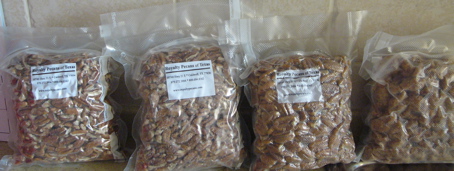
It doesn’t take much to thrill my heart. I feel so blessed.
Small Waist, Big Bum
Some of these studies are just too much. This study claims the results show that the curvier a woman is, the smarter she, and her children, are. From today’s BBC Health News.
Women with curvy figures are likely to be brighter than waif-like counterparts and may well produce more intelligent offspring, a US study suggests.
Researchers studied 16,000 women and girls and found the more voluptuous performed better on cognitive tests – as did their children.
The bigger the difference between a woman’s waist and hips the better.
Researchers writing in Evolution and Human Behaviour speculated this was to do with fatty acids found on the hips.
In this area, the fat is likely to be the much touted Omega-3, which could improve the woman’s own mental abilities as well as those of her child during pregnancy.
You can read the entire article HERE.
NY Cover Giggle
I can’t help it, this just gave me such a giggle.

From The New Yorker
The cartoon refers both to an American senator, Larry Craig, caught playing footsie with the cop in the next stall in the Minneapolis airport and Ahmadinajad playing footsie with nuclear power.
YouTubers had a field day with Craig’s guilty plea, and then reversal. Here is one:
He’s Take-Away
This is for someone very special – hope it gives you a good laugh today.
YOU are dinner by candlelight; he’s take-away. 😉 OK, OK, he can redeem himself, but it has to be substance, not drama.
Motorcycle Moments
A non-food related entry while killing time before Iftaar 🙂 As the weather cools, even slightly, we are seeing more cyclists hitting the roads. Be safe out there.
There are some very very clever people on U-Tube:
Leader of the Pack
From that all time need-for-speed movie, Top Gun:
We Do Not Have Homosexuals in Iran
I found this clip through Global Voices Kuwait who got it from somewhere else, too! Isn’t the net great?
Mahmud Ahmadinejad,Iranian president,said,in Columbia University,”we do not have homosexuals in Iran like you do in your country.” He brought the house down. Most just laughed, a few boo-ed.
The Columbia University president has taken a lot of criticism for his decision to have Ahmadinejad speak. He stuck to his guns.
You can see the film clip for yourself here: We Do Not have Homosexuals in Iran.
Tattoo Regret
The American Academy of Dermatology reports tattoo regret is common in the United States. Among a group of 18- to 50-year-olds surveyed in 2004, 24 percent reported having a tattoo and 17 percent of those considered getting their tattoo removed.
This is just an excerpt from a much longer article that you can read on CNN Health News.
Rape in Kuwait (2)
There seem to be some misconceptions running around about rape in Kuwait. One misconception is that Kuwaitis commit a lot of rape. If you read the newspapers, however, you will discover that a lot of the rapes committed are nationality on nationality, for example, one senior Phillipina lady will befriend an unhappy domestic worker, will “help” her get away, and the domestic finds herself abducted, gang raped and in sexual slavery. That’s one common story.
Domestics of all nationalities are abducted off the streets, taken to apartments or villas, raped repeatedly by two or more men, and then dropped off on the street (or dropped off a balcony). People don’t seem to be very concerned about domestic servants being people here, having the right NOT to be raped, it sort of seems like business as usual, no matter who is raped or doing the raping. I have yet to read of one single case being prosecuted or sentenced in the Kuwait newspapers, but maybe I missed a day or two.
Another common story is Indian/Bangladeshi/Pakistani on Indian/Bangladeshi/Pakistani, and that can be men abducting/raping men, or men abducting/raping women. Some of these women are also recruited into prostitution, and are found when the police raid the dens of iniquity, catching the men and men or men and women in “uncompromising” positions, or, even better – RED HANDED!
There is a whole catagory of abductions – Kuwaiti, Bedoun or other Gulf or Arab nationality where a man or woman, or men or women, is/are abducted and taken to camps in the desert and raped multiple times. Sometimes they are left naked by the side of the road. Sometimes their dead bodies are found, and occasionally enough clues to guess at the identity of the abductors/rapists.
Then there are the men that rape children. It can be within a family. It can be within a building. It can be within a neighborhood. Many times the child knows the rapist, and is told that if they say anything, the rapist will kill or harm the child’s parents. There was an epidemic of child rape in Hawali, and although the man arrested cries “I didn’t do it!” the fact is that the epidemic of rape in Hawali has stopped. That doesn’t mean that children aren’t being raped, it just means that the Hawali Monster seems to be off the streets of Hawali.
Objectively, if there can be said to be a “good” thing about rape in Kuwait, it is that so few of them are fatal.
What can, accurately, be said about Kuwait is that there seems to be a lot of rape. If you think I exaggerate, I challenge you to read the Kuwait papers every day for a month.
When there is a lot of rape, it means there is a social, legal and political climate that tolerates rape. It means that rape cases are not handled with a lot of attention to gathering evidence. It means that men and women are not encouraged to persue rape charges. It means that the police are not very interested in investigating accusations of rape. It means that the legal system is not very interested in prosecuting rape. It means that the rape victims are not valued highly enough to deserve not to be raped.
Rape happens everywhere. Rape happens in wars, rape happens on the streets. In most places, we are taught, rape isn’t about sex as much as it is about power. Here, in Kuwait, I am inclined to think it may be a little bit of both.
I’ve worked with rape victims in several different locations. Working with the victims gives you so much admiration for women, what they endure, what they survive, and their deeply ingrained sense of priorities and self. You’d think the experience would be devastating, but the women who have experienced rape and overcome it have been anything but devastated – many of them become truly awesome individuals, literally, awe-inspiring. They refuse to be victims. They carry on with their lives. They accomplish. They let their anger fuel and energize them to become incredibly accomplished individuals. It isn’t surprising – wealth and accomplishment also give you additional protection against it ever happening again.
There is another tragedy in Kuwait – male rapes. When men rape another men, like in prison, it is very much a power thing. Me big – you little. Me do what I want with you. Most of the victims I have met, or heard about are young teens. Being raped by a bigger, older male really skews their lives. They begin to question what it was about themself that got them raped, they question whether maybe they are gay and don’t know it, they ask, over and over – Why ME? Young men who were good at school start getting bad grades, they can’t concentrate, they often turn to drugs.
Being forced to have sex, whether you are man, woman, or child, is wrong. And doing nothing to stop this epidemic is also wrong. To look the other way is wrong. To say it isn’t happening is wrong. To become so used to it that your heart becomes calloused is just plain wrong.
I know most of the time my blog is a nice place to visit, and these entries make you uncomfortable. I’m sorry if it makes you uncomfortable. I myself am so uncomfortable that, as Martin Luther said (only he said it in German) “I cannot other. God help me.”
Big Girls Don’t Cry?
Listening to SUPERSTATION 99.7 as I am working, I find myself exasperated, from time to time, by the lyrics to some of the songs.
Today, it is Big Girls Don’t Cry. I remember a totally different song with the same name from back a while ago, and actually I like this one better, because she talks about cutting it off and just moving on – and I agree. Sometimes you just have to cut your losses.
But I think big girls – and guys – do cry.

(Picasso’s Weeping Woman)
A researcher actually explored why we cry:
Frey investigated a question his mother had asked him: “Why is it that people cry tears?” He would pursue the answer, alongside his Alzheimer’s work, for many years. He took a scientific approach to her inquiry, and he discovered emotional tears were chemically different from other tears. That research resulted in interviews with People magazine, the Today Show, Good Morning America, and others, as well as a book, Crying: The Mystery of Tears (Harper and Row). “Perhaps the reason people feel better after crying is that they’re removing chemicals that build up during stress,” Frey suggests, adding that the question remains open to further research.
This is from a Washington University Alumni magazine.
I don’t know if there has been any further research on crying, but originally, I remember him stating that emotional tears carried away poisons that stress build in the body. It makes sense to me. I don’t cry all that often, but when I do, when I cry and it’s one of those blow-it-all-out cries, the kind that give you a headache if you carry on for too long – afterwards, you just feel wonderful!
And you wonder why you even let her/him/it assume so much importance in your life?
And you wonder “What was I thinking???”
Sometimes a good cry just puts everything back in proportion and you really CAN move on.
Or that’s how I see it. I don’t mean to go all drama-queen, I am just talking about a good old fashioned lock-yourself-in-the-bedroom-and-cry kind of cry.
But maybe you see it differently. I think big girls DO cry, and for good reasons, and then we move on. But this might be a cultural thing, and I am willing to entertain other ways of looking at it. What do YOU think?
Recent Comments
ExpatAlien on What Country am I Living … intlxpatr on Yellowstone: Old Faithful to C… Michelle on Yellowstone: Old Faithful to C… Cathy on No Grown-Ups in Charge intlxpatr on Waiting for Snow Wikipedia Donate Button

Amazina


Early Voting in Florida


 Here There and Everywhere