Maldives Rape Victim Sentenced to 100 Lashes for PreMarital Sex

Where are the Maldives Islands?
Raped by her stepfather, impregnated against her will, her stepfather killed the baby, and now, sentenced by Sharia law to 100 lashes for pre-marital sex. How can this be justice? (This is from BBC News)
Maldives girl to get 100 lashes for pre-marital sex
By Olivia Lang
BBC News
A 15-year-old rape victim has been sentenced to 100 lashes for engaging in premarital sex, court officials said.
The charges against the girl were brought against her last year after police investigated accusations that her stepfather had raped her and killed their baby. He is still to face trial.
Prosecutors said her conviction did not relate to the rape case.
Amnesty International condemned the punishment as “cruel, degrading and inhumane”.
The government said it did not agree with the punishment and that it would look into changing the law.
Baby death
Zaima Nasheed, a spokesperson for the juvenile court, said the girl was also ordered to remain under house arrest at a children’s home for eight months.
She defended the punishment, saying the girl had willingly committed an act outside of the law.
Officials said she would receive the punishment when she turns 18, unless she requested it earlier.
The case was sent for prosecution after police were called to investigate a dead baby buried on the island of Feydhoo in Shaviyani Atoll, in the north of the country.
Her stepfather was accused of raping her and impregnating her before killing the baby. The girl’s mother also faces charges for failing to report the abuse to the authorities.
The legal system of the Maldives, an Islamic archipelago with a population of some 400,000, has elements of Islamic law (Sharia) as well as English common law.
Ahmed Faiz, a researcher with Amnesty International, said flogging was “cruel, degrading and inhumane” and urged the authorities to abolish it.
“We are very surprised that the government is not doing anything to stop this punishment – to remove it altogether from the statute books.”
“This is not the only case. It is happening frequently – only last month there was another girl who was sexually abused and sentenced to lashes.”
He said he did not know when the punishment was last carried out as people were not willing to discuss it openly.
Relationship Anxiety Hard on Your Immune System
Relationship Anxiety Is Hard On The Immune System, Study Says
Katherine Bindley
katie.bindley@huffingtonpost.com
This is from AOL News/Huffpost:
Relationship anxiety is known to be tough on a person’s mental well-being, but a new study suggests that fear of rejection — and worry that someone doesn’t love you enough — can also serve as chronic stressors that tax the immune system.
In a study of 85 couples who’d been married for an average of 12 years, a team of researchers led by Lisa Jaremka with Ohio State University College of Medicine examined the level of anxiety participants had about close relationships, as well as samples of their blood and saliva.
They found that the levels of cortisol — a hormone associated with stress — were on average 11 percent higher in people with higher levels of attachment anxiety than those who were less anxious. In addition, the more anxious people had between 11 percent and 20 percent fewer T-cells, which help the body to fight off disease.
“The thing that was surprising was the magnitude of the difference, especially in the immune cells that we saw,” Jaremka told The Huffington Post. “Some of the differences in the immune cell numbers, between the higher and the less high anxious attached people, were on the magnitude of what you’d see between obese and non-obese people.”
Attachment styles are believed to be derived from the type of caregiving people experienced in childhood, but the effects extend to, and impact, relationships in adulthood.
Most people are bound to have some level of concern and stress during the ups and downs of a relationship, Jaremka explained to HuffPost. But those with higher levels of attachment anxiety are hypersensitive to signs that a person they’re close to will leave them on a regular basis. They’re also more likely to seek reassurance and interpret their partner’s behaviors in a negative way.
Because the team did not include study participants who fell on the very high end of the anxiously attached spectrum, it’s possible that the effects of relationship anxiety could be even greater than the study suggests. Incidentally, while more women in the study suffered from higher levels of attachment anxiety, the researchers saw the same elevated levels of cortisol and lower T-cells in the men who were anxious.
Previous research had already established that relationship anxiety can have negative effects on a person’s physical health, but less was known about how exactly the anxiety and the health effects related to one another.
According to the Wall Street Journal, it’s believed that about 20 percent of the population falls on the anxious side of the anxiously attached spectrum. Another 25 percent fall into the avoidant category, which means those people may not get close to their partner out of fear that it could lead to a loss of autonomy.
Experts told the Journal that emotional opposites are often initially attracted to one another, but they may eventually face obstacles if they exacerbate one other’s attachment tendencies. For example, an anxious person might push for more affection and attention. This behavior might make an avoidant partner pull further away, in turn, making the anxious person even more insecure.
Despite the negative effects that attachment styles can have on a person’s relationships and physical health, Jaremka explained these traits are not inalterable.
“Anybody that is experiencing something that feels like high levels of attachment anxiety would think, ‘Oh great I’m doomed, but I think it’s important to acknowledge the fact that just because you are highly anxiously attached now doesn’t mean you have to be that way forever,” Jaremka told HuffPost. “We do know based on research that people can change and people can be very anxiously attached in one relationship and not at all in a different relationship.”
So what kind of relationship can serve as an antidote to pre-existing anxiety? One with a secure partner.
“If they are a very caring and loving and responsive partner, who attends to your needs when you need them, who is there for you when you’re stressed…Those relationships seem to be the types of relationships that people are able to feel secure in and are able to overcome anxieties in, if they have them,” Jaremka said.
The study, titled “Attachment Anxiety Is Linked to Alterations in Cortisol Production and Cellular Immunity,” is slated to be published in the journal Psychological Science.
“If Her Eyes are Seditious . . . “
Sheik Abdullah Daoud, Saudi Cleric, Says Even Young Girls Should Be Entirely Covered
02/04/13 04:17 PM ET EST AP
RIYADH, Saudi Arabia — A Saudi cleric says even girls who have not yet reached puberty should be covered from head to toe, citing instances of child molestation in the ultraconservative kingdom and elsewhere.
Sheik Abdullah Daoud made the remarks on the satellite channel al-Majd. He says many viewers watching the program had probably come across instances of sexual harassment as children.
He is not affiliated with the government nor considered a senior sheik.
Judge Mohammed al-Jazlani, a senior sheik, said Monday that such talk denigrates Islam and may push non-Muslims to view Islam negatively. He urged Saudis to ignore unofficial fatwas, or edicts.
Separately, a spokesman for Saudi Arabia’s religious police said online that the force can oblige a woman to cover her face “if her eyes are seditious.” He did not elaborate.
Why is no one protecting Saudi Arabia’s child brides?
The support of the Saudi monarchy and its apologists in the west means the barbaric practice of child marriage is unchallenged
Ali al-Ahmed
guardian.co.uk, Tuesday 8 November 2011 05.00 EST
Atgaa, 10, and her sister Reemya, 8, are about to be married to men in their 60s. Atgaa will be her husband’s fourth wife. Their wedding celebrations are scheduled for this week and will take place in the town of Fayaadah Abban in Qasim, Saudi Arabia.
The girls are getting married because their financially struggling father needs the money that their dowries will provide: young girls of this age can fetch as much as $40,000 each.
Many readers might be shocked at this news. How can it be legal? The answer is that Saudi Arabia has no minimum age for marriage, and it is perfectly legal to marry even an hour-old child.
Three Saudi ministries share the blame for allowing and facilitating child marriages. The health ministry is tasked with conducting genetic tests for couples considering marriage. Saudi law requires potential brides and grooms to provide certificates of genetic testing before marriages can officially proceed.
The justice ministry regulates the marriage process and issues licences. And the interior ministry registers families and documents the relationships between family members. It is also the most powerful government agency; it has authority over all other ministries and can direct their activities at will.
As with many pernicious practices, child marriage would not exist without tacit support and approval from the country’s leadership. Far from condemning child marriage, the Saudi monarchy itself has a long history of marrying very young girls.
Sarah, who is now a brilliant Saudi doctor, told me she was barely 12 when the late prince Sultan proposed to her after seeing her walking at a military base where she had lived with her father. Luckily, her father had the wits to claim that she was chronically ill, at which point the proposal was swiftly rescinded.
Camel festivals, held at his time of the year in Saudi Arabia, witness the practice called akheth (“taking”) in which girls aged 14 to 16 are “gifted” to the usually elderly members of the monarchy for a few days or weeks. This practice, reminiscent of the infamous droit du seigneur in medieval Europe, is maintained to this day with the monarchy’s protection.
Saudi Arabia has probably the highest number of child marriages in the Middle East and yet there has been almost no international outrage or objection directed at the practice. I have personally sent two letters to Ann Veneman, the director of United Nations Children’s Fund (Unicef), regarding the Saudi practice and asking her to make her views on the issue public, as she did with Yemen.
Instead, Unicef lauded Saudi efforts to protect child rights and even honoured Prince Naif, whose interior ministry is one of the departments overseeing child marriages. So no wonder the Saudi monarchy feels confident that such a practice can continue.
The US government has been similarly indifferent to the plight of child brides in the kingdom. In April 2009, I wrote to William Burns, the undersecretary of state, regarding the case of Sharooq, 8 – also from Qasim. I never heard back from him.
At a public conference, I asked a former senator, Chuck Hagel (seated next to Prince Turki al-Faisal, a former head of Saudi intelligence), if he personally or the US would accept the friendship and alliance of a family that allows child marriage. The answer was nothing short of shocking: “We cannot decide for other countries what is appropriate or not,” he said.
So far, no UN body, such as Unicef or the human rights council, has issued a single statement condemning child marriages in Saudi Arabia [see footnote]. In fact, not one country has made a statement in the human rights council on this issue, and not a single western government has asked the Saudi monarchy to stop the practice. The ugly tradition of child marriage thus continues with the help of the monarchy and its apologists in the west.
If any governments, especially in the west, are seriously concerned with this barbaric and medieval practice, they should ban the heads of Saudi justice, interior and health ministries from entering their countries. If this action were taken against government leaders facilitating crimes against children we would soon see a resolution of this issue.
Saudi Arabia must be pressured to set a minimum age for marriage and save children like Atgaa and Reemya.
• This footnote was added on 15 November 2011. Unicef would like to make clear that a statement was issued in 2009 by Ann Veneman, then its executive director, expressing deep concern about child marriage in Saudi Arabia.
The Orphanmaster by Jean Zimmerman

The Orphanmaster is another National Public Radio recommendation for people who like historical fiction, which I really do. I remember being a kid, and yawning my way through history, memorizing dates, it all seemed so irrelevant. Discovering historical fiction was like a light going on in a dark room for me – clever authors have found ways to illuminate events otherwise beyond my comprehension or worse – events I have a hard time making myself care about.
Suddenly, the times are right now and relevant when the right author handles it, and it isn’t always easy to get it right. I have a few very favorite authors – Philippa Gregory, Zoe Oldenberg, Sharon Kay Penman, Jean Plaidy, Edward Rutherford – authors who do a lot of research before they ever sit down to write a novel, and from whom you can learn a lot. They get the nature of the dialogue right, they get the customs, traditions and mind-sets right, and they get it right when a person is born ahead of his or her time in terms of the challenges they face.
I couldn’t put Orphanmaster down. It has to do with an era in American history which barely gets a paragraph in many history books, when the Dutch had a colony on what is now Manhattan Island, and trading posts up what is now the Hudson, into what is now New York. It was New Amsterdam, and many of the street names in modern day New York reflect their Dutch origins.
The Orphanmaster‘s main character is not the Orphanmaster. He is a supporting character to the main character to a girl orphaned at 15, daughter of a Dutch man and wife who were not rich, but who did all right. They had a business, they traded, Blandine learned many things before they died, leaving her an orphan. She was determined to be what would now be an “emancipated minor,” but until she turned 16, she was semi-legally under the responsibility of the Orphanmaster, who sort of kept hands off and sort of watched out for Blandine. She lives on her own and is a successful trader, in her early twenties. She is also a very clean housekeeper, and has plans to grow her trading business, and has a serious suitor she intends to marry.

Orphans start disappearing, and we discover a monster, a witiga, is on the loose. Blandine, and her new friend Drummond, are intrigued and disturbed by the disappearance of orphans, and the bloody, ritualistic mutilations of the orphans by the legendary Witiga.
It’s well written. You want to keep reading and keep reading because you want to know how it ends and how they are able to solve the problem.
It’s not one of the best books I’ve ever read for one reason – the author had the main characters talk as if they were modern people, using modern language, like ‘stuff.’ There was great openness between Blandine and her male friends. Blandine made all her own decisions, made her own arrangements and had full freedom, going where she wanted, doing what she wanted. The author explains it as part of the Dutch system, where some women had a lot of freedom, but I have a really hard time believing in a Dutch colony in the late 1600’s that any woman had the freedom Blandine had. There are parts of the novel where I am reading fast because I want to know what happens next and I get stopped up because Blandine says or does – or even THINKS – in a way that is very modern, and I just can’t buy it.
We are who we are. There are many smart women. Most women through the centuries have had to learn to maneuver in whatever societal constrictions they have been allowed. I suspect there were a lot of societal restrictions in New Amsterdam, and Blandine’s freedom to take off with only her male servant, to run off and live with a man not her husband (even though they are both escaping death sentences), to live an unescorted life . . . I just have a hard time buying it. I know how restricted women are even to day. Four hundred years ago, women were more restricted, and worse, we bought into it. We didn’t have a lot of choices.
So I like this book, and I think there is a lot of information that is true of the settlement of New Amsterdam, I loved the geography and the physical descriptions, I loved the maps included, I loved the descriptions of food and living conditions. I do not buy the heroine, not for one minute. I do not believe, in that historical context, she would have been possible.
Indian Gang Rape Case Goes to Trial
From today’s Huffpost

India Gang Rape Trial Begins In New Delhi
By ASHOK SHARMA
NEW DELHI — The trial of five men charged with the gang rape and murder of a 23-year-old student on a New Delhi bus began in a closed courtroom Thursday with opening arguments by the prosecution lawyers in a special fast-track court set up just weeks ago to handle sexual assault cases.
The brutal attack last month set off protests across India and opened a national debate about the epidemic of violence against women. A government committee established in the wake of the attack has called for a complete overhaul of the way the criminal justice system deals with rape, sexual assaults and crimes against women in general.
The five men on trial – who face a maximum sentence of death by hanging if convicted – covered their faces with woolen caps as they walked into the courtroom Thursday surrounded by a phalanx of armed police. Two hours later, after proceedings were over, they were whisked away by the police.
Details of the day’s proceedings were not available. The courtroom was closed to the public and the media – a routine move in Indian rape cases – even though defense lawyers had argued that since the victim is dead, the proceedings should be opened. There was also a gag order on the lawyers to not reveal what happened inside the court.
Judge Yogesh Khanna turned down requests by journalists Thursday that they be briefed on the day’s proceedings and said the gag order would remain.
Since Friday is a public holiday in India, the next hearing in the case was set for Monday, when the defense will present its opening arguments.
A sixth suspect in the case has claimed he is a juvenile and is expected to be tried in a juvenile court.
On Thursday, a magistrate separately rejected a petition by Subramanian Swamy, a prominent politician, that no leniency be shown toward the accused who claims to be a juvenile because of the brutal nature of the crime, said Jagdish Shetty, an aide to Swamy.
Documents presented by prosecution last week to the Juvenile Justice Board indicated that the defendant was a juvenile at the time of the attack, which would make him ineligible for the death penalty.
Magistrate Geetanjali Goel is expected to rule on the suspect’s age on Jan.28.
The suspect, who is not being identified by The Associated Press because he says he is 17, would face three years in a reform facility if convicted as a juvenile.
After the fast-track court hearing, M.L. Sharma, a defense lawyer for Mukesh Singh, one of the accused, said he had withdrawn from the case. V.K. Anand, who represents Mukesh’s brother Ram Singh, will now defend both brothers. The two lawyers had been arguing over who was Mukesh Singh’s real lawyer.
Sharma said he left the case to save his client from being tortured to fire him. He has long maintained that the other defense lawyers were planted by the police to ensure guilty verdicts.
Dozens of police were outside the sprawling court complex in south New Delhi where the trial is taking place. Inside the court, about 30 policemen blocked access to the room where Khanna heard the prosecution’s case.
Outside the courtroom scores of journalists and curious onlookers crowded the hallway.
Prosecutor Dayan Krishnan warned defense lawyers that if they spoke to journalists he would slap contempt of court notices on them, said V.K. Anand, a defense lawyer.
Police say the victim and a male friend were attacked after boarding a bus Dec. 16 as they tried to return home after an evening showing of the movie “Life of Pi.” The six men, the only occupants of the private bus, allegedly beat the man with a metal bar and raped the woman with it, inflicting massive internal injuries to her, police said. The victims were dumped naked on the roadside, and the woman died two weeks later in a Singapore hospital.
Abhilasha Kumari, a New Delhi-based sociologist, said the attack could end up having a large impact on the country.
`’This case has brought the violence against women center stage and it has, out of sheer public pressure, forced the government to sensitize itself to crimes against women,” she said.
The trial began a day after a government panel recommended India strictly enforce sexual assault laws, commit to holding speedy rape trials and change the antiquated penal code to protect women.
The panel appointed to examine the criminal justice system’s handling of violence against women, received a staggering 80,000 suggestions from women’s groups and thousands of ordinary citizens.
Among the panel’s suggestions were a ban on a traumatic vaginal exam of rape victims and an end to political interference in sex crime cases. It has also suggested the appointment of more judges to help speed up India’s sluggish judicial process and clear millions of pending cases.
Law Minister Ashwani Kumar said the government would take the recommendations to the Cabinet and Parliament.
“Procedural inadequacies that lead to inordinate delays need to be addressed,” he told reporters.
Although I have marked this with “Women’s Issues,” it is only a women’s issue when violence is directed against women and women have a limited access to justice in the system. Rape is a crime of power, inflicting unwanted and uninvited invasion of the very most personal nature. It happens to men, too. Men are far less likely to come forward. They live with the shame; many commit suicide or turn to drugs and alcohol to escape the pain. One day, with women leading the way, men, too, will be able to come forward and claim justice against those who violate them.
Morocco Rape Victims Will No Longer Be Required to Marry Rapist
Morocco To Change Law That Allowed Rapists To Avoid Punishment By Marrying Their Victims
By SMAIL BELLAOUALI 01/23/13 09:46 AM ET EST
RABAT, Morocco — Nearly a year after Morocco was shocked by the suicide of a 16-year-old girl who was forced to marry her alleged rapist, the government has announced plans to change the penal code to outlaw the traditional practice.
Women’s rights activists on Tuesday welcomed Justice Minister Mustapha Ramid’s announcement, but said it was only a first step in reforming a penal code that doesn’t do enough to stop violence against women in this North African kingdom.
A paragraph in Article 475 of the penal code allows those convicted of “corruption” or “kidnapping” of a minor to go free if they marry their victim and the practice was encouraged by judges to spare family shame.
Last March, 16-year-old Amina al-Filali poisoned herself to get out of a seven-month-old abusive marriage to a 23-year-old she said had raped her. Her parents and a judge had pushed the marriage to protect the family honor. The incident sparked calls for the law to be changed.
The traditional practice can be found across the Middle East and in places like India and Afghanistan where the loss of a woman’s virginity out of wedlock is a huge stain on the honor of the family or tribe.
While the marriage age is officially 18, judges routinely approve much younger unions in this deeply traditional country of 32 million with high illiteracy and poverty.
“Changing this article is a good thing but it doesn’t meet all of our demands,” said Khadija Ryadi, president of the Moroccan Association for Human Rights. “The penal code has to be totally reformed because it contains many provisions that discriminate against women and doesn’t protect women against violence.”
She singled out in particular outmoded parts of the law that distinguish between “rape resulting in deflowering and just plain rape.” The new article proposed Monday, for instance, gives a 10-year penalty for consensual sex following the corruption of a minor but doubles the sentence if the sex results in “deflowering.”
Fouzia Assouli, president of the Democratic League for Women’s Rights, echoed Ryadi’s concerns, explaining that the code only penalizes violence against women from a moral standpoint “and not because it is just violence.”
“The law doesn’t recognize certain forms of violence against women, such as conjugal rape, while it still penalizes other normal behavior like sex outside of marriage between adults,” she added. Recent government statistics reported that 50 percent of attacks against women occur within conjugal relations.
The change to the penal code has been a long time in coming and follows nearly a year of the Islamist-dominated government balking at reforming the law.
The Justice Ministry at the time argued that al-Filali hadn’t been raped and the sex, which took place when she was 15, had been consensual. The prime minister later argued in front of parliament that the marriage provision in the article was, in any case, rarely used.
“In 550 cases of the corruption of minors between 2009 and 2010, only seven were married under Article 475 of the penal code, the rest were pursued by justice,” Prime Minister Abdelilah Benkirane said on Dec. 24.
While Morocco updated its family code in 2004, a comprehensive law combating violence against women has been languishing in Parliament for the past eight years.
Social Development Minister Bassima Hakkaoui, the sole female minister in Cabinet, said in September she would try to get the law out of Parliament and passed.
US Sex Trafficking Ring Raided
From BBC News; this is not a “victimless” crime:
Twelve arrested in US raid on Latin sex-trafficking ring
Mr Morton said the case should be a ‘wake-up call’
Another 44 people have been detained. Eleven women from Central America and Mexico, most in their 20s, were freed.
The women were reportedly forced to have sex with up to 30 men a day, charging $30 (£19) for each act.
The gang is thought to have been smuggling women since 2008, moving them to different cities every week in the south-eastern US.
The US authorities have indicted eight men and four women. Most of the other detainees are said to be clients.
The sex-trafficking ring served mostly ethnic Latino immigrants in larger cities and rural communities of Florida, Georgia and the Carolinas, the authorities said.
One of the indicted, a Mexican citizen, is accused of having threatened to send one woman back to Mexico if she did not have sex with at least 25 men a day.
Immigration and Customs Enforcement Director John Morton said 967 arrests in connection with people trafficking and sex tourism were made last year alone.
“To those who would believe that sex trafficking doesn’t happen in America, reflect on this case and think again,” Mr Morton said at a news briefing.
Most of the 44 detainees were reportedly non-Americans and would face court action. Those who were illegal in the country would be deported, said Mr Morton.
The scale of human trafficking in the US is hard to gauge, but the National Human Trafficking Resource Center hotline, operated by Polaris Project since December 2007, has received more than 57,000 calls from every state in the union.
Incidences of sex and labour trafficking have been reported in all 50 states in the US, and the District of Columbia, in the two years leading up to 2012.
Manohar Lal Sharma: “Until today I have not seen a single incident or example of rape with a respected lady”
If you are a follower of my blog, you know I am not a person of violent tendencies. This morning, however, I am so thankful to be half a world away from the scum lawyer who would make these statements about a woman so brutally raped by six men that she died of horrendous internal injuries.
I am fighting instincts which would wish him ill. When he accuses rape victims of being responsible for their attacks, it pushes me over the line.
A person should be free to take a bus without fear of assault. And I suspect that there are also male victims, too ashamed to come forward.

Manohar Lal Sharma, lawyer for one of the accused, speaks to journalists outside the Saket district court complex in New Delhi, India, on Jan. 10. Police badly beat the five suspects arrested in the brutal gang rape and killing of a young woman on a New Delhi bus, Sharma said Thursday, accusing authorities of tampering with evidence in the case that has transfixed India. (AP Photo/Saurabh Das)
As the trial of the men charged with the brutal gang rape and murder of a woman in New Delhi last month gets under way this week, a lawyer for some of the accused suggests the victim was partly to blame for the attack.
Lawyer Manohar Lal Sharma said his clients were innocent and implied that the 23-year-old student must have been in some way responsible for the horrific crime, Bloomberg reports.
“Until today I have not seen a single incident or example of rape with a respected lady,” Sharma said. “Even an underworld don would not like to touch a girl with respect.”
The lawyer’s controversial comments are sure to anger victim’s advocates, especially in light of somewhat similar sentiments proclaimed by Indian guru Asaram Bapu.
Last week Bapu said the victim should have “taken God’s name and could have held the hand of one of the men and said I consider you as my brother and should have said to the other two ‘Brother I am helpless, you are my brother, my religious brother,'” according to the Hindustan Times.
It is worth noting, however, that a representative for Bapu later said the media distorted the guru’s remarks.
“[He] never made such statements. He just asked his women followers to avoid such situation anyhow,” the rep told Asian News International. “He was only suggesting that women should try their level-best to come out from such situation by using diplomatic ways.”
News outlet The Week compiled a list of several other statements that seem to place blame on the rape victim. The compilation includes a comment from Andhra Pradesh Congress Committee president Botsa Satyanarayana, who suggested the victim stayed out too late.
“Do we roam in streets at midnight as we got Independence at midnight?” Satyanarayana said. “She should have assessed the situation before getting into the bus.”
The attack, which occurred on the evening of Dec. 16, has shocked Indian residents and prompted violent protests in cities across the country, CNN notes.
Sharma, who stepped in to help defend the suspects when many other lawyers refused to represent them, also claimed his clients had been tortured by police while in jail, Time reports.
The main suspect in the trial, the bus driver, will plead not guilty according to Reuters, as will the driver and a third suspect he represents.
“We will plead not guilty. We want this to go to trial,” Sharma said. “We are only hearing what the police are saying. This is manipulated evidence. It’s all on the basis of hearsay and presumption.
Six Arrested in Second Indian Gang Rape Case
This was on AOL News / Huffpost this morning. The author makes an interesting point, not only are societal mores at fault, blaming the victim and implying the rape was her fault, but also the problem is exacerbated by the growing imbalance between males and females in the population. Where are potential mates for the excess of men?
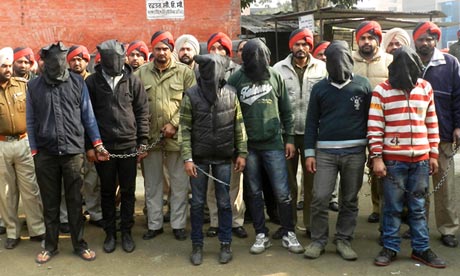
India Gang Rape: Woman Assaulted By Bus Driver, Conducter
By ASHOK SHARMA 01/13/13 07:49 AM ET EST
NEW DELHI — Police said Sunday they have arrested six suspects in another gang rape of a bus passenger in India, four weeks after a brutal attack on a student on a moving bus in the capital outraged Indians and led to calls for tougher rape laws.
Police officer Raj Jeet Singh said a 29-year-old woman was the only passenger on a bus as she was traveling to her village in northern Punjab state on Friday night. The driver refused to stop at her village despite her repeated pleas and drove her to a desolate location, he said.
There, the driver and the conductor took her to a building where they were joined by five friends and took turns raping her throughout the night, Singh said.
The driver dropped the woman off at her village early Saturday, he said.
Singh said police arrested six suspects on Saturday and were searching for another.
Gurmej Singh, deputy superintendent of police, said all six admitted involvement in the rape. He said the victim was recovering at home.
Also on Saturday, police arrested a 32-year-old man for allegedly raping and killing a 9-year-old girl two weeks ago in Ahmednagar district in western India, the Press Trust of India news agency reported. Her decomposed body was found Friday.
Police officer Sunita Thakare said the suspect committed the crime seven months after his release from prison after serving nine years for raping and murdering a girl in 2003, PTI reported Sunday.
The deadly rape of a 23-year-old student on a New Delhi bus in December led to the woman’s death and set off an impassioned debate about what India needs to do to prevent such tragedies. Protesters and politicians have called for tougher rape laws, police reforms and a transformation in the way the country treats women.
“It’s a very deep malaise. This aspect of gender justice hasn’t been dealt with in our nation-building task,” Seema Mustafa, a writer on social issues who heads the Center for Policy Analysis think tank, said Sunday.
“Police haven’t dealt with the issue severely in the past. The message that goes out is that the punishment doesn’t match the crime. Criminals think they can get away it,” she said.
In her first published comments, the mother of the deceased student in the New Delhi attack said Sunday that all six suspects in that case, including one believed to be a juvenile, deserve to die.
She was quoted by The Times of India newspaper as saying that her daughter, who died from massive internal injuries two weeks after the attack, told her that the youngest suspect had participated in the most brutal aspects of the rape.
Five men have been charged with the physiotherapy student’s rape and murder and face a possible death penalty if convicted. The sixth suspect, who says he is 17 years old, is likely to be tried in a juvenile court if medical tests confirm he is a minor. His maximum sentence would be three years in a reform facility.
“Now the only thing that will satisfy us is to see them punished. For what they did to her, they deserve to die,” the newspaper quoted the mother as saying.
Some activists have demanded a change in Indian laws so that juveniles committing heinous crimes can face the death penalty.
The names of the victim of the Dec. 16 attack and her family have not been released.
What is also troubling in these two cases is that the women were on public transportation, and the rapes were arranged and carried out by the bus drivers and bus personnel, people who should have been there to keep her safe. They treated the victims like pieces of meat; it seems excessively hostile and brutal – you have to wonder what is driving them.
You can read more on this in an article from The Guardian, from where I found the photo above of the perpetrators.
Study Suggests Women Wait to Have Children
Found this today in AOL News/Huffington Post:
Those bright eyes and chubby cheeks may be hard to resist, but researchers from the Fred Hutchinson Cancer Research Center in Seattle have good reason to believe you should.
In a study published online in Breast Cancer Research and Treatment, researchers found that the interval between starting menstruation and first giving birth is inversely associated with the risk of triple-negative breast cancer (TNBC), a subtype of the disease that does not depend on hormones such as estrogen to grow and spread, and therefore does not respond to hormone-blocking drugs such as Tamoxifen. To put it plainly, women who wait at least 15 years after their first menstrual period to give birth to their first child may reduce their risk of the aggressive form of breast cancer by up to 60 percent, the report states.
It’s a finding that researchers say African-American women want to consider especially, since they experience disproportionately high rates of triple-negative disease.
In fact, study author Christopher I. Li, M.D. says that his findings may actually explain why black women tend to develop triple-negative breast cancer more often than other groups. African-American women are more likely to start having children at a younger age and are less likely to breast-feed, Li said, pointing to several previous studies that have suggested that breast-feeding provides a protective effect against triple-negative disease.
Previous studies have also countered Li’s latest claim, however, showing that waiting to have children may actually increase your breast cancer risk. But, like Li, researchers note that the type of breast cancer key.
The risk of the most common subtype of breast cancer, ER positive, for example, has proven to be lower among women who’ve had a full-term pregnancy and have breast-fed. The reason, researchers believe, is that the hormones associated with pregnancy induce certain changes in the cellular structure of the breast that make the tissue less susceptible to this type of cancer.
And while prevention trumps having to fight off triple negative disease, researchers honed in on two successful ways to do it this year. In October, scientists pinpointed a new compound created from a rich source in vegetables, including broccoli and brussel sprouts, to combat TNBC, while researchers at Memorial Sloan-Kettering Cancer Center in New York discovered that a certain form of smallpox vaccine was able to kill 90 percent of cancer cells in four days of treatment.
Recent Comments
intlxpatr on Shampoo Ginger tigerbutterya0c5ff1d… on Shampoo Ginger intlxpatr on British Soldier Kidnapped, Esc… John on British Soldier Kidnapped, Esc… intlxpatr on British Soldier Kidnapped, Esc… Wikipedia Donate Button

Amazina


Early Voting in Florida


 Here There and Everywhere