Jesus and the Woman to be Stoned for Adultery
I’ve always loved this passage, along with the woman at the well, and the woman who touched the hem of his garment to be healed from a bleeding disease – Jesus was kind to women, in a time and culture where a pious man would not speak to a woman.
Hilary Mantel captures the stunning experience in Eight Months on Ghazzah Street, where she asks a man at a counter for an item and he looks right past her. She repeats her request and he acts as if she isn’t there. Her husband walks up, asks, and receives an answer. Cultural biases most often do not favor women. In this regard, Jesus – and the prophet Mohammed – changed everything, and treated women as equal people. It’s amazing to me how many of the Jesus anecdotes featuring females survived; it must have been astonishing in his time to treat females – property – with such compassion and humanity.
Footnote to this passage from The Lectionary: The most ancient authorities lack 7.53—8.11; other authorities add the passage here or after 7.36 or after 21.25 or after Luke 21.38, with variations of text; some mark the passage as doubtful.
John 7:53-8:11
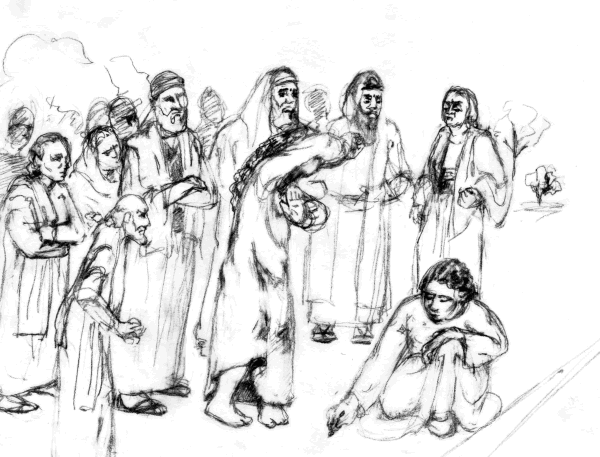
53Then each of them went home, 81while Jesus went to the Mount of Olives. 2Early in the morning he came again to the temple. All the people came to him and he sat down and began to teach them. 3The scribes and the Pharisees brought a woman who had been caught in adultery; and making her stand before all of them, 4they said to him, ‘Teacher, this woman was caught in the very act of committing adultery. 5Now in the law Moses commanded us to stone such women. Now what do you say?’ 6They said this to test him, so that they might have some charge to bring against him. Jesus bent down and wrote with his finger on the ground. 7When they kept on questioning him, he straightened up and said to them, ‘Let anyone among you who is without sin be the first to throw a stone at her.’ 8And once again he bent down and wrote on the ground.* 9When they heard it, they went away, one by one, beginning with the elders; and Jesus was left alone with the woman standing before him. 10Jesus straightened up and said to her, ‘Woman, where are they? Has no one condemned you?’ 11She said, ‘No one, sir.’* And Jesus said, ‘Neither do I condemn you. Go your way, and from now on do not sin again.’]]*
Indian Village Bans Cell Phones – For Women
LOL – what about those cheating, eloping MEN? Ban only women from using cell phones? What about calls from mothers who need you to run an errand? What about calls from the children’s school? Women – and man – who are going to cheat are going to cheat, whether or not you take their cell phone away. Found this on AOL/Huffpost via Reuters:
PATNA, India – (Reuters) – A village council in the eastern Indian state of Bihar has banned the use of mobile phones by women, saying the phones were “debasing the social atmosphere” by leading to elopements – a move that set off outraged protests from activists.
In addition to the ban, the Sunderbari village council in a Muslim-dominated area some 385 kilometers (239 miles) east of Patna, the capital of Bihar, has also imposed a fine of 10,000 rupees ($180) if a girl is caught using a mobile phone on the streets.
Married women would have to pay 2,000 rupees ($36.60).
“It always gives us a lot of embarrassment when someone asks who has eloped this time,” said Manuwar Alam, who heads a newly-formed committee tasked with enforcing the ban, referring to queries from neighboring villages.
He said the number of elopements and extramarital love affairs had risen in the past few months, with at least six girls and women fleeing their homes.
“Even married women were deserting their husbands to elope with lovers. That was shameful for us,” Alam said. “So, we decided to tackle it firmly. Mobile phones are debasing the social atmosphere”.
Local officials have begun investigations, saying that such bans cannot be allowed in a healthy society, while women’s rights activists called it an assault on freedom that could potentially end up harming women by stripping them of one source of protection from trouble, such as unwanted advances by men.
“Girls and women are capable enough to protect themselves,” said activist Suman Lal during a debate on local television. “Technology is meant to be used, not to be banned…The order is nauseating.”
Fellow activist Mohammad Islam said it was “disappointing” that the village council ignored the many advantages of mobile phones before placing a ban on them for one reason.
“I want every girl to be given a mobile phone so that she could call up family members if she has a problem”, he said. ($1 = 54.6400 Indian rupees)
(Reporting by New Delhi newsroom, editing by Elaine Lies)
Woman’s Fertility Predicted by Mom’s Age at Menopause
From today’s BBC News:
Fertility ‘predicted by mother’s age at menopause’

Women whose mothers had an early menopause had far fewer eggs in their ovaries than those whose mothers had a later menopause, a Danish team found.
Women with fewer viable eggs have fewer chances to conceive.
The study, of 527 women aged between 20 and 40, was reported in the journal Human Reproduction.
Ovarian reserveResearchers looked at two accepted methods to assess how many eggs the women had – known as their “ovarian reserve” – levels of anti-Mullerian hormone (AMH) and antral follicle count (AFC).
Currently there is no test that can accurately predict fertility” Dr Valentine , Fertility Society
Women are born with all the eggs they will ever have. These are released from the ovary cyclically, usually one every month after puberty, until menopause.
The AFC and AMH give readings doctors an idea of how many yet-to-be released eggs remain in the ovary.
In the study of female healthcare workers, the researchers found both AMH and AFC declined faster in women whose mothers had an early menopause (before the age of 45) compared to women whose mothers had a late menopause (after the age of 55).
Average AMH levels declined by 8.6%, 6.8% and 4.2% a year in the groups of women with mothers who had early, normal or late menopauses, respectively.
A similar pattern was seen for AFC, with annual declines of 5.8%, 4.7% and 3.2% in the same groups, respectively.
Start youngPast research suggests there is about 20 years between a woman’s fertility starting to decline and the onset of menopause. So a woman who enters the menopause at 45 may have experienced a decline in her fertility at the age of 25.
Lead researcher Dr Janne Bentzen said: “Our findings support the idea that the ovarian reserve is influenced by hereditary factors. However, long-term follow-up studies are required.”
Also, having fewer eggs does not necessarily mean that the woman will go on to have fewer babies.
Dr Valentine Akande, a consultant gynaecologist and spokesman for the British Fertility Society, said the findings were helpful, but that women should not be overly concerned if their mother did have an early menopause.
“There is a huge amount of variation among women. Some will have more eggs and some will have less.
“Whilst it is assumed that lower egg number is associated with more challenges at getting pregnant this study did not look at that.
“Currently there is no test that can accurately predict fertility.
“The advice remains the same – the younger you start trying for a baby the more likely you are to be successful.”
He said, in general, women are most fertile between the ages of 18 and 31.
Your Vote – The Power of We (Blog Action Day 2012)
This year, in the United States we are going through a vicious process, that of choosing one candidate over another for political office. Many people are so put-off by the mechanics of the process that they opt out of the choosing altogether. Others are just too busy to vote, beset by the needs of family, job, car pool, church, social activities, etc. in spite of the ease with which one can ask for and receive an absentee ballot.
You need only live in a country where people have no meaningful vote to quickly learn the value of your vote. Your vote may be just one, but in a democracy, where just one vote can turn an election – your vote counts. Together, with other voters of your persuasion, your vote counts.
There has never been a country where women have the vote and men don’t. Sadly, the opposite is true; there are still countries where women are not considered fully qualified to vote. Less than 100 years ago, our own country was one of them. Yes, it’s true, we didn’t get the vote until 1920. I reprint the following from a post I wrote several years ago, a post I have never forgotten, because it was so shocking to me when I read the price these women paid that I might freely vote today.
“The doctor admonished the men: ‘Courage in women is often
mistaken for insanity.’”
We may have different preferences for who gets elected; that doesn’t matter to me. What matters to me is the power of we – that we care enough about our country and its policies to exercise our right as citizens, to get out there and vote.
This is reblogged from July 17, 2008:
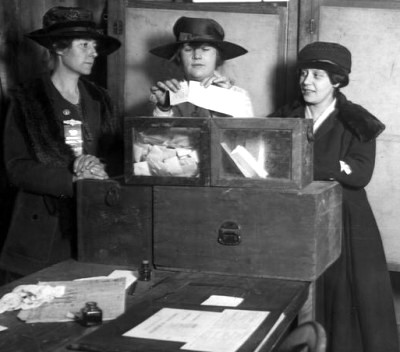
WHY EVERY WOMAN SHOULD VOTE
This is the story of our Grandmothers, and Great-grandmothers, as they
lived only 90 years ago. It was not until 1920 that women were granted
the right to go to the polls and vote.
Thus unfolded the ‘Night of Terror’ on Nov. 15, 1917, when the warden at
the Occoquan Workhouse in Virginia ordered his guards to teach a lesson
to the suffragists imprisoned there because they dared to picket Woodrow
Wilson’s White House for the right to vote. The women were innocent and
defenseless. And by the end of the night they were barely alive. Forty
prison guards wielding clubs and their warden’s blessing went on a
rampage against the 33 women wrongly convicted of ‘obstructing sidewalk
traffic.’
They beat Lucy Burn, chained her hands to the cell bars above her head
and left her hanging for the night, bleeding and gasping for air. They
hurled Dora Lewis into a dark cell, smashed her head against an iron bed
and knocked her out cold. Her cell mate, Alice Cosu, thought Lewis was
dead and suffered a heart attack. Additional affidavits describe the
guards grabbing, dragging, beating, choking, slamming, pinching,
twisting and kicking the women.
For weeks, the women’s only water came from an open pail. Their
food–all of it colorless slop–was infested with worms. When one of the
leaders, Alice Paul, embarked on a hunger strike, they tied her to a
chair, forced a tube down her throat and poured liquid into her until
she vomited. She was tortured like this for weeks until word was
smuggled out to the press.
So, refresh my memory. Some women won’t vote this year because–why,
exactly? We have carpool duties? We have to get to work? Our vote
doesn’t matter? It’s raining?
Last week, I went to a sparsely attended screening of HBO’s new movie
‘Iron Jawed Angels.’ It is a graphic depiction of the battle these women
waged so that I could pull the curtain at the polling booth and have my
say. I am ashamed to say I needed the reminder.
All these years later, voter registration is still my passion. But the
actual act of voting had become less personal for me, more rote.
Frankly, voting often felt more like an obligation than a privilege.
Sometimes it was inconvenient.
My friend Wendy, who is my age and studied women’s history, saw the HBO
movie , too. When she stopped by my desk to talk about it, she looked
angry. She was–with herself. ‘One thought kept coming back to me as I
watched that movie,’ she said. ‘What would those women think of the way
I use–or don’t use–my right to vote? All of us take it for granted
now, not just younger women, but those of us who did seek to learn.’ The
right to vote, she said, had become valuable to her ‘all over again.’
HBO released the movie on video and DVD. I wish all history, social
studies and government teachers would include the movie in their
curriculum. I want it shown on Bunco night, too, and anywhere else women
gather. I realize this isn’t our usual idea of socializing, but we are
not voting in the numbers that we should be, and I think a little shock
therapy is in order.
It is jarring to watch Woodrow Wilson and his cronies try to persuade a
psychiatrist to declare Alice Paul insane so that she could be
permanently institutionalized. And it is inspiring to watch the doctor
refuse. Alice Paul was strong, he said, and brave. That didn’t make her
crazy. The doctor admonished the men: ‘Courage in women is often
mistaken for insanity.’
Please, if you are so inclined, pass this on to all the women you know.
We need to get out and vote and use this right that was fought so hard
for by these very courageous women. Whether you vote democratic,
republican or independent party – remember to vote.
History is being made.
The Ick Factor
Today I got this in my Intlxpatr e-mail:
Nice to meet you,
Am miss Jane,interested in you,and wish to have you as my friend, for a friend is all about Respect,Admiration and love passion also
friendship is consist of sharing of ideas and planing together, i intend to send you my picture for you,if you reply me.
thanks from Jane.
Ummm . . . “Jane” . . . I don’t need your love or passion, and I don’t want do do any ‘planing together’. I don’t want your picture. I will not reply you.
Intlxpatr
Arousal Trumps Ick Factor When Women Have Sex
First, who funds these studies??? LOL, how do they think up the test criteria? Found this morning on AOL News/Huffpost:
How Arousal Overrides Disgust During Sex: Study
Sex may be one of life’s great pleasures, but it also involves a lot that normally might gross people out — sweat, bodily fluids and body odor, for starters.
A small Dutch study, released Wednesday, set out to identify the psychology that leads women to willingly, and even enthusiastically, engage in sexual activities despite the ick factor. The results, published online in the journal PLoS ONE, indicate that arousal overrides feelings of disgust and facilitates a woman’s desire to do something that a woman who is not aroused might find flat-out repulsive.
“Women [who] were sexually aroused were more willing to touch and do initially disgusting tasks,” study co-author Charmaine Borg, a researcher in the department of clinical psychology and experimental psychopathology at the University of Groningen in The Netherlands, told The Huffington Post.
Borg and her colleagues separated 90 female university students into three equal groups: one watched “female friendly erotica;” one watched a video of extreme sports meant to get them excited, but in a non-sexual way; and one watched a video of a train, meant to elicit a neutral response.
The women were then given 16 tasks, most of them unappealing. They were asked to take a sip from a cup of juice that had a large (fake) insect in it, to wipe their hands with a used tissue and to take a bite from a cookie that was sitting next to a living worm. The women were also asked to perform several sex-related tasks, like lubricating a vibrator.
Women in the “aroused group” said they found both the unpleasant tasks and the sex-related tasks less disgusting than women in the other groups. They also completed the highest percentage of the activities, suggesting that sexual arousal not only decreases feelings of disgust, but directly affects what women are willing to do, the study shows.
Daniel R. Kelly, an associate professor of philosophy at Purdue University and author of the book “Yuck! The Nature and Moral Significance of Disgust” who was not involved in the study, explained that disgust is an “extension of our immune system” that helps prevent people from getting infected by making them wary of things, like bodily fluids, that potentially carry disease or make people vulnerable.
“Disgust is an emotion,” he explained. “What it’s there for, primarily, is to protect us against eating things that might poison us, or coming into close physical proximity to things that might carry infections. That’s its mission.”
David Buss, a professor of psychology at the University of Texas Austin and author of “Why Women Have Sex,” called disgust a “huge issue for women.”
“Women show far more disgust and especially sexual disgust, than men,” he said.
Buss concurred with Kelly that the findings are evidence of what “is very likely an evolved psychological defense.”
“It helps to protect women from having sex with the wrong men, such as men who might communicate diseases, men who show signs of a high ‘parasite load,’ men who have poor hygiene and so on,” he said.
What is interesting about the new Dutch paper, the two experts agreed, is that it suggests the mission to avoid the potentially “dangerous” parts of sex takes a backseat when women are aroused. “Sexual arousal can override disgust,” Buss said.
That not only suggests a potential reason why a woman might engage in behaviors that she wouldn’t if she weren’t turned on, it might also provide insights into how low-sexual arousal feeds sexual dysfunctions in women, the study’s authors argue.
“These findings indicate that lack of sexual arousal may interfere with functional sex, as it may prevent the reduction of disgust and disgust-related avoidance tendencies,” Borg explained, saying she hopes the findings prompt further research in this area.
How to Tell If Your Relationship is in Trouble
With all the dire international news in focus, let’s focus on our own relationships. 🙂 Found this on CNN News
By Leigh Newman, Oprah.com
updated 9:13 AM EDT, Thu September 13, 2012
(Oprah.com) — All marriages have problems: He gives you silent treatment instead of talking when he’s upset; you pay more attention to the kids’ school art projects than to the details of his day; neither of you can agree on the fate of Peggy after leaving Sterling Cooper Draper Pryce on Mad Men. This, you tell yourself, is just what happens after so many years together, right? Or…not right? Because, sure, you’re not fighting, and nobody’s having an affair. But at the same time, what if dangerous issues are brewing? How can you are you supposed to know?
William Doherty, PhD, the Director of the University of Minnesota’s Couples On the Brink project helps more than 60 exceptionally troubled couples a year. In his 35 years of doing this kind of work, he’s noticed a handful of almost imperceptible signs when two people are just beginning to splinter apart. He tells us what to look for—when it comes in your own thoughts and actions—that may signal a crisis to come.
1) You’re Doing a Lot of Cost-Benefit Analyses
Perhaps this is you. While walking home from work, you have a little conversation with yourself: “I make dinner every night, plus, I said sorry when he freaked about organic toothpaste—even though I love organic toothpaste and it’s not too expensive. In fact, now that I think about it, I’m usually the first apologize…and the first to stay home with the kids at night. I work so hard. And what am I getting in return? A hug before bed? The occasional bunch of flowers?”
What you’re doing here is a cost-benefit analysis. Corporations do this all the time. A company that makes, say, skinny jeans, compares the energy, money and time all of its departments put into producing them with the energy, money and time it gets out of selling them, to figure out if it should keep manufacturing pants—in a style that horrifies short, round women all over the world—or just stop.
People also use this technique to make decisions. “At the beginning of the relationship,” says Doherty, “this kind of accounting is natural and appropriate [for couples] deciding whether or not to commit.” But if you’ve already joined your life with someone else, you may not realize that by engaging in this kind of emotional inventory, you’re already seeing yourself as separate from your spouse. Your time, energy and resources are not his time, energy and resources. You’re one business, and he’s another, instead of the two of you being united for the profit of all.
2. You’re Conducting an Imaginary Marriage
Just to clarify, an imaginary marriage is not an imaginary affair, complete with dreams of secret rendezvous in obscure motels. It’s a more subtle and, at times, harder-to-recognize fantasy, says Doherty. What to look for? You sitting at your desk, watching Jeremy from production post yet another blissful photo of his wife and himself on Facebook—this time of their trip to Napa for her birthday. A thought crosses your mind: “Jeremy is so much more considerate than my husband.”
Pretty soon, you make the leap to thinking things like: “If I were married to Jeremy, I’d never spend another of holiday at home watching parades on TV.” In your reveries, you tell yourself you’d go to Paris with him. You’d come home at night to him in the kitchen making veal cordon bleu. The two of you would never argue about the cost of non-generic toilet paper or give each other lectures on how many squares you’re allowed to use. Because, in this relationship, you don’t have to deal with all those pesky details that challenge real-life marriage and that probably also caused you to invent Jeremy, the ideal hubby, with whom no man, not even your good, adorable, non-cordon-bleu-making husband can compare.
You’ve lost interest in you husband taking you to Paris or posting photos of you on Facebook. You’re not ready to leave him in reality, but in the vast and unchecked world of your mind, you’re looking for Mr. Anybody Else.
3. You’re building a second home
In a lot of marriages, there comes a time when you realize, “Hey, my husband isn’t meeting all my needs. And I just have accept that and start taking care of myself.” This can be a healthy decision. Let’s say you love all things literary, and he doesn’t. So you join a book group, and maybe make some friends on Good Reads or Shelfari. Metaphorically speaking, you’ve built yourself a little room in your life and filled it with not just with books but friends who love books. You have all kinds of wonderful conversations there.
Where things get dicey, says Doherty, is when you commit to more and more groups. As you get busier and busier, you build a room for each different activity, then fill that room with new intimates — now, you’ve built a gardening room and a PTA room, as well as a room for your weekly office drinks date. In fact, you have a whole house for your emotional life, and that doesn’t include a room for your spouse.
One way to tell the difference between nurturing your own interests and moving out of your marriage, says Doherty, is to examine how you talk about your activities. If you’re saying, “I’ve got to get my opera fix,” on the way to the opera guild, then you’re talking about your love of opera. But if you’re saying, “I’ve got to do what I want,” then you’re looking for something much larger and more perilous for your relationship.
4. You’re keeping coffee dates secret
After you’ve built the second home, there’s a often tendency to hide what happens there. Let’s say you and your friend—not your crush, not your secret love or your secret passion—from book club have coffee one afternoon. Over coffee, you two talk about the memoir Wild. You bring up your own mother’s death. She brings up her own experimentation with drugs. The two of you share some pretty heavy intimacies. When you come home, your spouse asks what you did today. “I worked,” you say. “And then I picked up the dry cleaning and called that guy about the car.”
The problem is not that you shared an intimacy with somebody else, says Doherty, “but that you edited the event out of the conversation.” In other words, you’re hiding a meaningful exchange from the person you supposedly most trust—and you didn’t give that person the opportunity to have that meaningful exchange with you. Another way to think about it? You took an emotional risk with someone, but you didn’t (or couldn’t or wouldn’t) take the lesser risk of telling your spouse about it.
In all these situations, says Doherty, whether you recognize it or not, you’re beginning to start a new life—as yourself, the individual, and not yourself, the part of a couple. At times, you may be convinced you’re just giving yourself some space or giving your spouse some time to himself. But all that space and time can quickly turn into emotional light years. Thankfully, this distance can also lead to some clarity on whether or not you want to return back to where the two of you started—over thousands of revolutions of the planet that mark the rest of your experiences on earth.
Abstinence Only? Mississippi Has Highest Teen Pregnancy Rate Rate In the USA
Sex Education or Abstinence? Do you think there might be some connection between Mississippi’s highest state in the nation teen pregnancy rate and their policy of abstinence only? (For non-US people, ‘abstinence-only’ is code for NO SEX EDUCATION IN THE SCHOOLS. Some people think that teaching young people how sex works, and how to prevent pregnancy gives them ideas they might not try if you didn’t teach them about it or gives them tacit permission to engage in sex.)
* State has nation’s highest teen birth rate
* New law allows abstinence plus sex-ed teaching
* Studies show sex-ed works to prevent teen pregnancy
By Emily Le Coz
TUPELO, Miss., Aug 26 (Reuters) – Artasia Bobo, a 16-year-old Mississippi high school sophomore, was only 12 when she got pregnant and doesn’t recall receiving much in the way of sex education.
Holding her 3-year-old daughter, Annsley, after cheerleading practice recently, the honor-roll student said she’s now an advocate for comprehensive sex education offered as soon as possible.
“What I went through is nothing any girl would want to go through,” she said. “It changed my life. I love my daughter, but if I could go back in time, my life would be a whole lot different.”
Mississippi, the poorest U.S. state, has the nation’s highest teen pregnancy rate. Yet until this year, the state allowed schools to forgo sex education entirely.
That changed with a state law passed last year that mandated school districts adopt either abstinence-only or abstinence-plus sex education policies. Before the new law, any district that did teach sex education had to teach abstinence-only.
Under the new law, a majority of Mississippi’s public school districts this year adopted abstinence-only policies that avoid or downplay the issue of contraceptives.
Twenty other U.S. states and the District of Columbia also require sex education, according to the Guttmacher Institute, a New York-based non-profit organization focusing on sexual and reproductive rights.
After the law took effect at the beginning of July, 81 districts chose abstinence-only and 71 chose abstinence-plus, the state Department of Education reported. Mississippi kept no record of how many districts taught abstinence-only under the old law, department spokesman Jon Kalahar said.
“SERIOUS PROBLEM”
Mississippi reported 55 births per 1,000 teens aged 15 to 19 in 2010 – more than 60 percent above the U.S. average, the Centers for Disease Control and Prevention said in April.
The state also has one of the nation’s highest infant mortality rates and among the highest rates of chlamydia and gonorrhea infections among teens and young adults, according to the Mississippi Department of Health.
“It was obvious we had a serious problem in the state,” said Democratic state Representative Cecil Brown, who chaired the committee that championed the bill. “You can’t stick your head in the sand.”
Abstinence-only allows districts to teach about the benefits of avoiding sex until marriage, the consequences of bearing children out of wedlock and how to reject sexual advances. Such programs also teach that abstinence is the only certain way to avoid pregnancy and sexually transmitted diseases.
Although a discussion of condoms or contraceptives is allowed under this policy, it cannot include demonstrations of use and must present the risks and failure rates of such devices, the law states.
Abstinence-plus must include all those topics and can also teach about the causes and effects of sexually transmitted diseases and how to prevent them, according to the law.
“Before this year, not a single school district had adopted any policy on sex education,” said Jamie Holcomb Bardwell, director of programs for Women’s Fund of Mississippi. “The fact that 71 adopted abstinence-plus is one of the biggest victories for young people in Mississippi this year.”
Bardwell said she’s encouraged that many of the districts with the highest teen pregnancy rates adopted not only abstinence-plus policies, but also implemented sex education programs proven effective for changing teen behavior.
COMPREHENSIVE SEX EDUCATION
“Research shows that when young people have access to a curriculum that’s not abstinence-only … when it includes medically accurate information, they’re more likely to have lower pregnancy rates and lower sexually transmitted infection rates,” she said.
Studies published this year by the Guttmacher Institute show teens who received comprehensive sex education, including instruction on birth control, waited longer to have sex and had lower rates of pregnancy.
That might have been the case for Bobo, but such a course wasn’t offered when she got pregnant. Nor will it be offered this year, since her district chose an abstinence-only policy.
A statewide survey conducted in 2011 by the Social Science Research Center at Mississippi State University found most parents support comprehensive sex education in schools.
Among them is 40-year-old Renee Bobo, Artasia’s mother.
“They’re getting it from TV and from friends, anyway,” said Bobo, who works nights so she can care for her granddaughter while Artasia attends school. “They should get the straight facts from an informed instructor.”
The Lee County School District in northeast Mississippi adopted an abstinence-only program for the first time this year. Superintendent Jimmy Weeks said health classes had previously touched on the subject but this will be the district’s first dedicated sex-education class.
The school board picked abstinence-only because “we don’t want to come across as saying, ‘Hey, premarital sex is OK, let us show us how you do it without getting a disease,'” Weeks said.
Sixteen percent of Lee County births in 2010 were to teens, according to the Mississippi Department of Health. In Itawamba County, where Artasia attends school, the rate was 16.5 percent.
Coahoma County in the Mississippi delta, which at 23 percent had one of the state’s highest rates of births to teens, recently adopted an abstinence-plus program after four years of teaching abstinence-only, said Superintendent Pauline Rhodes.
“I’ve seen first-hand the devastation of children having children, and I have seen students on their way to a promising career have to drop out,” Rhodes said. “I’ve always felt that until we can get a handle on teen pregnancies, we will not be able to get a handle on juvenile delinquencies.” (Editing by David Adams and Jim Loney)
I believe abstinence can work – in a relationship where both people believe in abstinence. How do you apply abstinence to a multi-cultural society where religious, personal and moral values differ? Abstinence DOES prevent pregnancy – but even teenagers in the most virtuous families find the lure of sexual activity irresistible, and can end up pregnant. I like it that Mississippi is taking the pragmatic step of combining abstinence teaching AND sex education. Give them enough information to avoid bringing children into this world who are unwanted and born to parents not capable of parenting.
One Man Woman
Thank you, Hayfa, this is hilarious:
Recent Comments
ExpatAlien on What Country am I Living … intlxpatr on Yellowstone: Old Faithful to C… Michelle on Yellowstone: Old Faithful to C… Cathy on No Grown-Ups in Charge intlxpatr on Waiting for Snow Wikipedia Donate Button

Amazina


Early Voting in Florida


 Here There and Everywhere