Jesus and the Woman to be Stoned for Adultery
I’ve always loved this passage, along with the woman at the well, and the woman who touched the hem of his garment to be healed from a bleeding disease – Jesus was kind to women, in a time and culture where a pious man would not speak to a woman.
Hilary Mantel captures the stunning experience in Eight Months on Ghazzah Street, where she asks a man at a counter for an item and he looks right past her. She repeats her request and he acts as if she isn’t there. Her husband walks up, asks, and receives an answer. Cultural biases most often do not favor women. In this regard, Jesus – and the prophet Mohammed – changed everything, and treated women as equal people. It’s amazing to me how many of the Jesus anecdotes featuring females survived; it must have been astonishing in his time to treat females – property – with such compassion and humanity.
Footnote to this passage from The Lectionary: The most ancient authorities lack 7.53—8.11; other authorities add the passage here or after 7.36 or after 21.25 or after Luke 21.38, with variations of text; some mark the passage as doubtful.
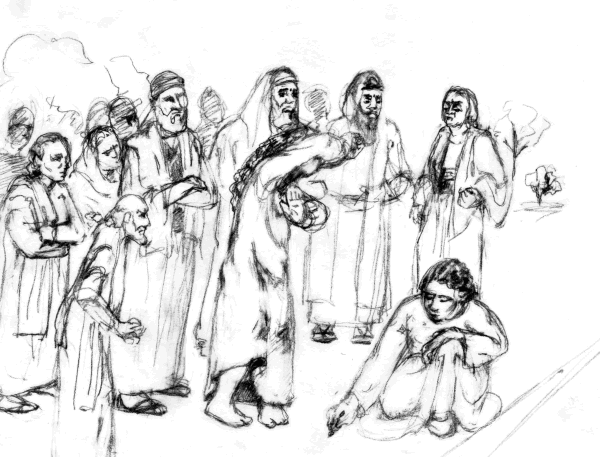
John 7:53-8:11
53Then each of them went home, 81while Jesus went to the Mount of Olives. 2Early in the morning he came again to the temple. All the people came to him and he sat down and began to teach them. 3The scribes and the Pharisees brought a woman who had been caught in adultery; and making her stand before all of them, 4they said to him, ‘Teacher, this woman was caught in the very act of committing adultery. 5Now in the law Moses commanded us to stone such women. Now what do you say?’ 6They said this to test him, so that they might have some charge to bring against him. Jesus bent down and wrote with his finger on the ground. 7When they kept on questioning him, he straightened up and said to them, ‘Let anyone among you who is without sin be the first to throw a stone at her.’ 8And once again he bent down and wrote on the ground.* 9When they heard it, they went away, one by one, beginning with the elders; and Jesus was left alone with the woman standing before him. 10Jesus straightened up and said to her, ‘Woman, where are they? Has no one condemned you?’ 11She said, ‘No one, sir.’* And Jesus said, ‘Neither do I condemn you. Go your way, and from now on do not sin again.’]]*
Discover Relaxing Riyadh
I still get ads from Jazeera airlines, although I no longer live in Kuwait and have asked them for three years to take my name off their mailing list. I have unsuccessfully unsubscribed like fifteen times; now I just have it all sent to spam.
But today, as I was looking over the spam to be sure I wasn’t emptying my box of anything important, I saw this:
Discover Relaxing Riyadh – استمتع بعطلتك في الرياض

LOL – Relaxing Riyadh. A group of the ad guys must have been rolling on the floor when they created that one . . . Or maybe they meant that apart from the spine-tingling traffic, there isn’t a whole lot going on in Riyadh, especially on the social scene . . .
“I Want to See How they Handle the Israel Problem.”
AdventureMan zipped left across three lanes of traffic and into a parking lot.
“What are you doing?” I hollered, hanging on for dear life.
“Jordan Valley restaurant has a new sign up, a big map of the Middle East, and I want to see how they handle the Israel problem,” he answered.
That explains everything. No, really, it does. We’ve been married for a long time, I know what he means.
“Very clever,” we both agreed.

Libyans Say “Sorry” In Counter-Protests
I was living in Qatar, and the Libyan ambassador’s wife had invited me, along with several other women, to morning coffee. It’s what people did. I was sitting between one of my Libyan friends and my good Iranian friend, and I started laughing. I said “Oh, what is this good little American girl doing sitting between a Libyan and an Iranian?” and then we all laughed. We weren’t Libyan, or American, or Iranian, we were just women who liked each other; we got along.
We were all religious women. Not the same religion, but all believers in the Abrahamic tradition. I felt more comfortable with them than I felt around non-religious women. We had a lot of fun together, and we liked each other.

It breaks my heart when bad things happen, and I know how good these people are, and that the people on the attack have their own agenda which has nothing to do with Islam, or Christianity, and everything to do with power. If they prevail, I fear for my good friends.

This article from USA Today made me cry this morning. Ambassador Stevens was loved, and these brave people are risking their futures to tell us so.

Libyans express sorrow over killing of Americans
by Donna Leinwand Leger, USA TODAY
Hours after learning of Ambassador Chris Stevens’ death, the Libyan Youth Movement transformed its Facebook page into a tribute to the slain diplomat. It changed its cover photo from “Free Libya” graffiti sprayed on a Tripoli wall to a somber photo of Stevens with the tag “RIP Christopher Stevens1960-2012.”
“As North America wakes up, dread washes over me. What a rough night. I’m sorry for the horrible day the world is about to face,” the administrator of the Shabab Libya page wrote. “We are sorry.”
As anti-American protests swept across North Africa and the Persian Gulf, a counter-protest of apology emerged. Photos of Libyans carrying hand-lettered signs condemning the violence and expressing contrition for their countrymen appeared on Facebook. “Sorry” became the trending mantra of Libyans on Twitter.
At one counter-protest, an unidentified man carried a crude sign phonetically written in English with blue marker on lined notebook paper, “Sorry People of America this not the Pehavior of our ISLAM and Profit.”
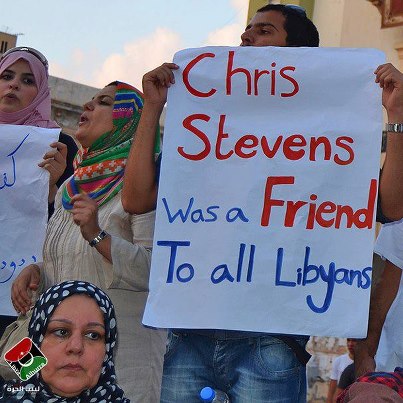
Another sign in red, white and blue read: “Chris Stevens wasa friend to all Libyans.”
On Facebook, one group formed The Sorry Project, designed to collect thousands of personal, written apologies from Libyans. Its profile photo is a man holding a sign, “USA. We are sorry. We are sad.”
“We Are Sorry,” the group wrote on the page created Sept.11. “We would like show that as Libyans we do not support on the actions committed by these criminals. USA, we are sorry and we will say it one thousand times over. Our apologies will never be enough, but the Libyan people will always be grateful for you since you were the first to stand by us in our fight for freedom and hopefully you will continue supporting us.”
One commenter, Hajer Sharief, vowed to avenge Stevens’ death by rebuilding a “new civilized democratic Libya.”
“We promise, we will not tire, we will not falter, and we will not fail,” Sharief wrote. “This is the way real Libyans will pay you back Mr. Ambassador Chris Stevens.”
At the ceremony Friday outside Washington to repatriate the remains of the four American victims, President Obama acknowledged Libya’s internal conflict.
“I know that this awful loss, the terrible images of recent days, the pictures we’re seeing again today, have caused some to question this work. And there is no doubt these are difficult days. In moments such as this — so much anger and violence — even the most hopeful among us must wonder,” Obama said. “But amid all of the images of this week, I also think of the Libyans who took to the streets with homemade signs expressing their gratitude to an American who believed in what we could achieve together. I think of the man in Benghazi with his sign in English, a message he wanted all of us to hear that said, ‘Chris Stevens was a friend to all Libyans.’ “
“I Am The Good Shepherd”
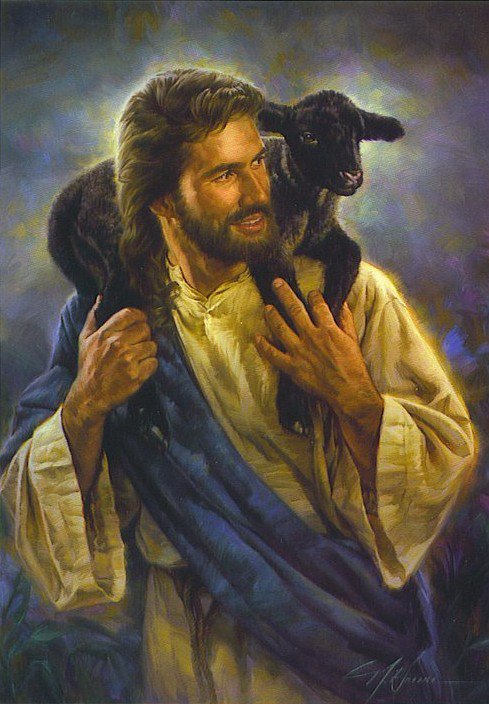
Every time I read those words from the Gospel of John, I am transported back to our first tour in Jordan, sitting outside our little villa near fourth circle, watching the shepherd and the sheep go by. Dusk is falling, you can hear multiple calls to prayer issuing from nearby mosques, and the shepherd is crossing back to their night time pastures.
But there is a ditch, a deep ditch, for new sewer and water lines, and there is only a thin board by which to cross.
One by one, he carries the sheep across. It takes a long time. The sheep are restless, but with a few words, he calms them. They don’t stray, they wait for him to lift and carry them across. Once across, they wait for the rest to follow before they all head on their way. The shepherd is grimy and dusty, covered with mud from ferrying the sheep across the ditch.
The sheep know the shepherd’s voice, and when faced with a new threat, they trust that he will deliver them safely. Sheep are pretty stupid. On their own, they can get into all kinds of trouble. If they have a good shepherd, they are safe.
This is today’s Gospel reading from John:
John 10:1-18
10‘Very truly, I tell you, anyone who does not enter the sheepfold by the gate but climbs in by another way is a thief and a bandit. 2The one who enters by the gate is the shepherd of the sheep. 3The gatekeeper opens the gate for him, and the sheep hear his voice. He calls his own sheep by name and leads them out. 4When he has brought out all his own, he goes ahead of them, and the sheep follow him because they know his voice. 5They will not follow a stranger, but they will run from him because they do not know the voice of strangers.’ 6Jesus used this figure of speech with them, but they did not understand what he was saying to them.
7 So again Jesus said to them, ‘Very truly, I tell you, I am the gate for the sheep. 8All who came before me are thieves and bandits; but the sheep did not listen to them. 9I am the gate. Whoever enters by me will be saved, and will come in and go out and find pasture. 10The thief comes only to steal and kill and destroy. I came that they may have life, and have it abundantly.
11 ‘I am the good shepherd. The good shepherd lays down his life for the sheep. 12The hired hand, who is not the shepherd and does not own the sheep, sees the wolf coming and leaves the sheep and runs away—and the wolf snatches them and scatters them. 13The hired hand runs away because a hired hand does not care for the sheep. 14I am the good shepherd. I know my own and my own know me, 15just as the Father knows me and I know the Father. And I lay down my life for the sheep. 16I have other sheep that do not belong to this fold. I must bring them also, and they will listen to my voice. So there will be one flock, one shepherd. 17For this reason the Father loves me, because I lay down my life in order to take it up again. 18No one takes* it from me, but I lay it down of my own accord. I have power to lay it down, and I have power to take it up again. I have received this command from my Father.’
Tabak Rohoo: A Damascene Dish
Syria is heavy on our hearts, and in our helplessness, we honor our Syrian friends by trying a Damascus dish, Tabak Rohoo.
Although we did not manage to empty the cooking pot by sliding the completed dish out still in layers (a challenge for the future), this dish was so delicious that we plan to have it often. AdventureMan was amazed; he doesn’t even like lamb, but this lamb is delicious.
It is hard to imagine that this dish might be even better if made with ghee. We substituted a very good olive oil. 🙂
The recipe is from allrecipes.com, where I find some of the best recipes ever 🙂
A Vegetable Stew – Tabakh Rohoo
SUBMITTED BY: ALMALOU
“This is an Arabic vegetable stew made in layers and served with steamed rice or bulgur. My Damascene sister in law recently showed me how to make this. It is delicious. The addition of ghee or rendered butter at the end of the cooking is a traditional Damascene style of cooking; however, these days these dishes are made without the extra fat.”
PREP TIME
20 Min
COOK TIME
1 Hr 15 Min
READY IN
1 Hr 35 Min
INGREDIENTS (Nutrition)
• 1 tablespoon ghee (clarified butter)
• 1 pound lamb meat, cut into small pieces
• 1/2 teaspoon ground allspice
• 1/4 teaspoon ground cinnamon
• 1/8 teaspoon ground cloves
• 1/8 teaspoon ground nutmeg
• 1 pinch ground cardamom
• 2 onions, sliced
• 1 potato, peeled and sliced
• 1 pound eggplant, peeled and cubed
• 1 pound zucchini, thickly sliced
• 2 pounds tomatoes, cubed
• 1 chile pepper, chopped
• salt to taste
• 1 tablespoon tomato paste
• 1/4 cup water
• 6 cloves garlic
• salt to taste
• 3 tablespoons dried mint
DIRECTIONS
1. Heat the ghee in a large pot over medium heat. Place the lamb meat in the pot, and cook until evenly brown. Season with allspice, cinnamon, cloves, nutmeg, and cardamom.
2. Place a layer of onion on top of the lamb in the pot, followed by layers of potato, eggplant, zucchini, and tomatoes. Do not stir. Place the chile pepper in the center of the vegetables. Season with salt. Mix the tomato paste and water, and pour over the vegetables. Bring to a boil, reduce heat to low, and simmer 1 hour, until vegetables are tender.
3. With a mortar and pestle, crush together the garlic, salt, and mint. Mix with 2 tablespoons of liquid from the pot, and pour over ingredients in pot. (I used a mini-jar on my blender. I tried the mortor and pestle, but there was a lot of stuff and it was messy and unsuccessful. The blender did just fine, and this mixture is essential to the delicious nature of the dish – Intlxpatr)
When removing the mixture to the serving dish – a fairly open or wide bowl – tip the pot and let it slide out the side so that it stays in the layers.
The Trials of Job
Today’s Lectionary readings feature the first chapter of Job, which is to me a very odd story, worth pondering. It is also interesting to me that this is a story that all three ‘people of the book’ share, and while I have met Moslems named Ayoub (Job) I have never met a Christian named Job.
I went to the Middle East with so many misconceptions. I believed the Moslems to be anti-Christian, and was astonished when I discovered that it was OK with my Moslem friends that I was a Christian. Like all the rest of us, they would prefer I share their beliefs, but they were happy that I was a believer, and that I practiced my religion. No, it didn’t stop them from trying to discuss religious matters with me – all in the goal of bringing me over from the dark side (LOL, i.e. clearing up my errors in thinking and believing), but in these discussions, I had a lot of surprises.
I have more Moslem friends with children named Jesus than I have Christian friends. One friend has a Jesus, a Mary and a Joseph. (She also has two Mohammeds 🙂 ) Noah is in the Quran, and Job, and of course Gabriel, who brought the good news to Mary, is also the angel who recited to Quran to the prophet Mohammed. How did I not know this? The longer I live, the more careful I become about what I take on as beliefs. I give thanks to God who sent me into the wilderness that I might have a better understanding of how things work in the world.
Today’s reading has some puzzles. The Lectionary defines the ‘heavenly beings’ who gathered as ‘sons of God.’ Satan is The Accuser, is in attendance, challenging God on Job’s faith – so is this before or after he has fallen from Grace? Does Satan still appear before God? I thought he was banished . . .
And what awful awful calamities befell Job because of this cosmic wager – imagine, not so much the loss of wealth, although his wealth was vast, but imagine the loss of all your sons and daughters, the loss of everything you cared the most about. And Job, righteous as he is, says the Lord gave it to him and he can take it away. Wow.
Job 1:1-22
1There was once a man in the land of Uz whose name was Job. That man was blameless and upright, one who feared God and turned away from evil. 2There were born to him seven sons and three daughters. 3He had seven thousand sheep, three thousand camels, five hundred yoke of oxen, five hundred donkeys, and very many servants; so that this man was the greatest of all the people of the east. 4His sons used to go and hold feasts in one another’s houses in turn; and they would send and invite their three sisters to eat and drink with them.
5And when the feast days had run their course, Job would send and sanctify them, and he would rise early in the morning and offer burnt-offerings according to the number of them all; for Job said, ‘It may be that my children have sinned, and cursed God in their hearts.’ This is what Job always did.
6 One day the heavenly beings* came to present themselves before the Lord, and Satan* also came among them. 7The Lord said to Satan,* ‘Where have you come from?’ Satan* answered the Lord, ‘From going to and fro on the earth, and from walking up and down on it.’ 8The Lord said to Satan,* ‘Have you considered my servant Job? There is no one like him on the earth, a blameless and upright man who fears God and turns away from evil.’
9Then Satan* answered the Lord, ‘Does Job fear God for nothing? 10Have you not put a fence around him and his house and all that he has, on every side? You have blessed the work of his hands, and his possessions have increased in the land. 11But stretch out your hand now, and touch all that he has, and he will curse you to your face.’ 12The Lord said to Satan,* ‘Very well, all that he has is in your power; only do not stretch out your hand against him!’ So Satan* went out from the presence of the Lord.
13 One day when his sons and daughters were eating and drinking wine in the eldest brother’s house, 14a messenger came to Job and said, ‘The oxen were ploughing and the donkeys were feeding beside them, 15and the Sabeans fell on them and carried them off, and killed the servants with the edge of the sword; I alone have escaped to tell you.’
16While he was still speaking, another came and said, ‘The fire of God fell from heaven and burned up the sheep and the servants, and consumed them; I alone have escaped to tell you.’
17While he was still speaking, another came and said, ‘The Chaldeans formed three columns, made a raid on the camels and carried them off, and killed the servants with the edge of the sword; I alone have escaped to tell you.’
18While he was still speaking, another came and said, ‘Your sons and daughters were eating and drinking wine in their eldest brother’s house, 19and suddenly a great wind came across the desert, struck the four corners of the house, and it fell on the young people, and they are dead; I alone have escaped to tell you.’
20 Then Job arose, tore his robe, shaved his head, and fell on the ground and worshipped. 21He said, ‘Naked I came from my mother’s womb, and naked shall I return there; the Lord gave, and the Lord has taken away; blessed be the name of the Lord.’
22 In all this Job did not sin or charge God with wrongdoing.
The New Revised Standard Version (Anglicized Edition), copyright 1989, 1995 by the Division of Christian Education of the National Council of the Churches of Christ in the United States of America. Used by permission. All rights reserved.
Dust Storms and Diseases
I found this on AOL News/Huffpost this morning, and thought of the awe-inspiring dust storms in Kuwait and Qatar. Living on the tenth floor and watching the enormity of a dust storm rolling into Kuwait City was like being in the middle of a thunder-storm – there is nothing you can do to stop it. It can be terrifying. You realize your true importance in the larger scheme of things (miniscule) and the enormous power of God. You also realize that what you are seeing is just a tiny fraction of his true power.
We also all knew that the dust storms of any size carried contaminants and allergens that could trigger allergic reactions for weeks. This story claims the dust storms in Kuwait and Iraq are the most lethal of all.
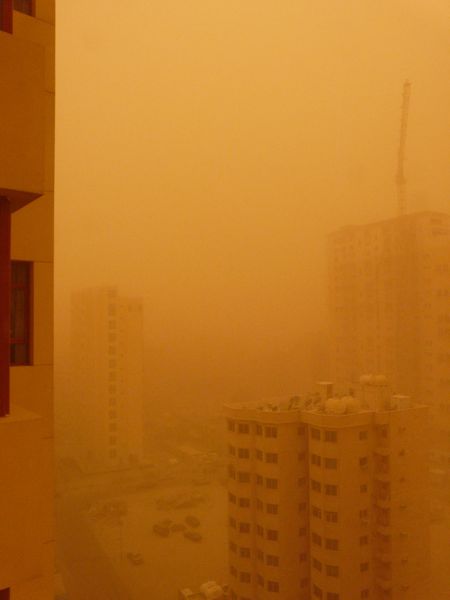
Dust Storms’ Health Risks: Asthma Triggers, Chemicals, Bacteria May Be In The Wind
Posted: 08/11/2012 10:44 am
Lynne PeeplesBecome a fan
lynne.peeples@huffingtonpost.com
Scientists are predicting that the frequency of dust storms, on the rise in the last few years, will continue to increase. Some have also suggested that these storms might well be carrying a more hazardous payload than meets the eye. Among the dangers that experts say are blowing in the wind: asthma triggers, toxic chemicals and infectious disease.
“We are experiencing heat waves and drought across the country. And we anticipate more dust being blown into the air,” said William Sprigg, a dust storm expert at Chapman University in Orange, Calif. “Anything that is loose on the soil is going to be picked up by these storms.”
A look back 80 years to the Dust Bowl could offer a hint of what’s to come. According to a scientific study published in October 1935, Kansas experienced its “most severe measles epidemic,” as well as abnormally high rates of strep throat, respiratory problems, eye infections and infant mortality during the intense dust storms that struck from February to May of that year. The researchers highlighted the potential for both short- and long-term health troubles associated with the dust, but stated that they couldn’t find any pathogens in their dust samples.
The same regions that were affected then — from New Mexico to the Dakotas — may be at greatest risk from dust storms in the future, said Dale Griffin, an environmental health microbiologist with the U.S. Geological Survey. Griffin points to the unsustainable strip farming methods of the 1920s and ’30s, and consecutive years of desiccating heat and high winds that combined to devastate a large swath of the country. And he agrees with Sprigg that conditions today could favor more of the same. This July was the hottest month on record, which has worsened an already devastating drought that experts say has been exacerbated by poor farming practices.
“Because of climate change, it looks like we’re possibly shifting into a phase similar to what occurred in the 1930s, or worse,” said Griffin. “We may be seeing an increase in dust storms that could affect human health.”
Texas and Oregon are among the regions already seeing a rise in such events. Haboobs — severe thunderstorms that kick up massive amounts of dust — have blanketed Phoenix more frequently in recent years, including one headline-grabber last July.
The most well-understood health threat from these storms is the dust particles themselves. If small enough, they can slip past a body’s natural defenses — nose hairs, for example — to infiltrate and damage one’s respiratory system. Now scientists are learning about an array of harmful substances that may also hitch a ride: arsenic and other heavy metals, agricultural fertilizers and pesticides, as well as a laundry list of bacteria, fungi and viruses.
In the southwest, one airborne hazard gaining significant attention is valley fever. A debilitating and sometimes fatal infection, it is contracted from fungal spores naturally present in the region’s soil. Could dust storms send these spores into the air and into the lungs of residents? Sprigg is currently investigating a possible connection between last year’s haboobs and subsequent infections. Such links haven’t been well studied, he said, because people had assumed that the sun’s ultraviolet rays would kill any airborne microbes. But it seems that the dust particles themselves provide a shield for their passengers, explained Sprigg, who is collaborating on a system to predict when dust storms will occur in order to alert area residents, schools and traffic cops.
Other parts of the world are even more familiar with dust storms and their dangers.
The region of Africa between Senegal and Ethiopia has long been subject to severe meningitis epidemics, which research now suggests is at least partially linked to dust storms. In Asia, asthma and other children’s respiratory problems have been found to be more common the week after dust storms.
Perhaps most notorious for pestilent dust is the Middle East.
Navy Capt. Mark Lyles, of the Center for Naval Warfare Studies at the Naval War College in Newport, R.I., found high levels of aluminum, heavy metals, as well as bacteria, fungi and viruses in samples of the ultrafine, and therefore lung-penetrable, Kuwaiti and Iraqi dust. He suggested that parts of this cocktail may be responsible for the mysterious Gulf War Syndrome suffered by veterans of the Iraq War, as well as the high rates of health problems among soldiers returning from the dusty theater of war today.
The Mediterranean Plus on a Hot and Humid Day
“What can you say? It’s summer in Pensacola!” my Pensacola friend laughed. We had been talking about the week of rain-bursts and thunder and lightning we’ve been having – with more the same to come. I don’t mind, the cloud cover keeps the temperatures down, even if it makes the air more humid and heavy.
A perfect day for lunch at the Mediterranean Plus.
There isn’t any time of the year that is not perfect to eat at the Mediterranean Plus. In the winter, you can have their lentil stews and heavier main dishes. In the winter, their lentil soup and seafood soup (it isn’t on the menu; the chef has to make it as the soup of the day) are wonderful. In the summer, we love the salads and often order a plate to share, like the Vegitarian Plate or the Mediterranean Plate.
We split an order of baba ghannoush to start.
This time I had Chicken Kabob (known in the Middle East as Shish Taouk):

While AdventureMan had a felafel sandwich:

There was so much Shish Taouk that I brought the rest home and we split it for dinner, too. Nice light eating on a hot Pensacola summer’s evening.
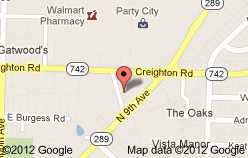
6895 North 9th Avenue Pensacola, FL 32503
(850) 469-9225
(Between the liquor store and Rob’s Cameras; around the corner from Four Winds)
Umm al Quwain: Oldest Pearl in the World
The oldest pearl in the world is found in the United Arab Emirates, according to AOL news/Huffpost this morning:
French researchers are flashing their pearly whites after a historic discovery: what’s believed to be the oldest pearl in the history of the human world.
Discovered in a grave, the Umm al Quwain pearl — named for the location in the United Arab Emirates where it was found — has been carbon-dated back to the 5500 B.C., during the Neolithic Period, which makes it more than 7,500 years old, Press Trust of India reports. Previously, the oldest known pearl was just over 5,000 years old.

According to Discovery News, the pearl is 0.07 inches in diameter and remains fully intact. Pearls buried with the deceased were typically either half-drilled for a man or fully drilled for a woman, though unpierced pearls were often placed on the deceased’s upper lip.
The discovery provides insight into the origins of pearl oyster hunting, suggesting the practice began in Arabia and not in Japan, as researchers originally thought.
The Neolithic period, also known as the New Stone Age, was marked by the change in humans from hunter-gatherers to farmers. The recent discovery has proved that while dangerous, pearl oyster diving became an important part of society in ancient Arab cultures, according to Indian Express.
Discovery News notes that 101 Neolithic pearls have been unearthed from large pearl oysters over the years.
Recent Comments
ExpatAlien on What Country am I Living … intlxpatr on Yellowstone: Old Faithful to C… Michelle on Yellowstone: Old Faithful to C… Cathy on No Grown-Ups in Charge intlxpatr on Waiting for Snow Wikipedia Donate Button

Amazina


Early Voting in Florida


 Here There and Everywhere