King Abdulla Returns to Saudi Arabia, Announces Benefits
Sometimes, there is little to say, the news says it all. Ghadaffi calling his own Libyans “rats” “cockroaches” “cowards” “traitors”, aging, long term leaders announcing increased benefits for citizens . . . These are interesting times. The winds of change are blowing, and no one can tell where those changes will take us . . .
From todays BBC World News:
Saudi King offers benefits as he returns from treatment
The king was greeted by hundreds of well-wishers on his arrival at Riyadh airport
Continue reading the main story
Saudi Arabia’s King Abdullah has announced increased benefits for his citizens, as he returned after months abroad getting medical treatment.
There will be extra funds for housing, studying abroad and social security, according to state television.
King Abdullah has been away from the country for three months, during which time mass protests have changed the political landscape of the Middle East.
There have been few demonstrations in Saudi Arabia.
You can read more at BBC World News/Middle East
Aftermath: Americans at War in the Muslim World
I guess it is no surprise to you that I love National Public Radio / BBC, etc. I learn things I never even knew I didn’t know. As I sat down to write a very different blog entry, I heard the following interview with journalist Nir Rosen, who talks about Americans and our outdated views of the Middle East and Muslim world.
You may be able to listen to the entire interview live by going to NPR Programs and clicking on The US At War in the Muslim World by Nir Rosen.
The US At War In The Muslim World: ‘Aftermath’ With Nir Rosen
Steve Scher
01/04/2011 at 9:00 a.m.
The US invaded Iraq nearly seven years ago. What have been the consequences of going to war in a Muslim country? Have the US invasions of Iraq and Afghanistan created more militancy among the Muslim population there? Have the radical Islamists gained a stronger following as a result of our presence there?
Journalist Nir Rosen has been asking these questions in his reporting from outside the green zones in Iraq and Afghanistan. His new book “Aftermath” tells a side of the story we rarely hear.
Ancient Civilizations Hidden in The Persian Gulf?
I found this first thing this morning on AOL Science News
Theory Points to Civilization Under Persian Gulf
Hugh Collins
Contributor

(Dec. 11) — The waters of the Persian Gulf may be hiding a lost civilization that could change our understanding of human history, according to new research.
This huge fertile stretch of land may have been home to humans from about 74,000 years ago until about 8,000 years ago, according to Discovery News.
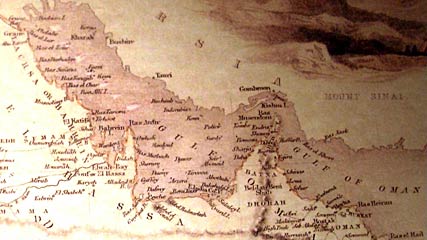
When the waters around them began to rise, these early humans may have migrated to what is now the gulf shoreline, founding new settlements there, according to a paper published in the December issue of Current Anthropology.
Wikipedia
New research suggests the waters of the Persian Gulf, depicted here in an historical map of the region, may be hiding a lost civilization that could change our understanding of human history.
Over the past several years, archaeologists have uncovered new evidence of those shoreline settlements.
“Where before there had been but a handful of scattered hunting camps, suddenly, over 60 new archaeological sites appear virtually overnight,” Jeffrey Rose of the University of Birmingham said, according to LiveScience.
“These settlements boast well-built, permanent stone houses, long-distance trade networks, elaborately decorated pottery, domesticated animals, and even evidence for one of the oldest boats in the world,” Rose said.
Rose says such sophisticated settlements couldn’t have developed so quickly, which is why he believes even older settlements lie beneath gulf waters. If true, Rose’s hypothesis could offer a clue as to how and when human beings first departed Africa and settled in the Middle East.
This has long been a topic for debate, with some scientists saying that humans made the migration 125,000 years ago, while others put it closer to 60,000 years ago, LiveScience said.
The now-submerged slice of land would have been about the size of Great Britain, Rose said.
Since it would have received water from the rivers Tigris, Euphrates, Karun and Wadi Baton, it would have offered a fertile refuge from the nearby harsh deserts.
“I think Jeff’s theory is bold and imaginative, and hopefully will shake things up,” Oxford Brookes University’s Robert Carter told LiveScience.
“It would completely rewrite our understanding of the out-of-Africa migration. It is far from proven, but Jeff and others will be developing research programs to test the theory,” Carter said.
Rose admits that much work remains be done. So far, he has focused on archaeological sites on dry land and studies of geological history.
Finding some physical evidence beneath the waves of the ocean would be a major advance in proving that his theory is correct.
“We would need to find a submerged site, and excavate it underwater,” Rose said, according to LiveScience. “This would likely only happen as the culmination of years of survey in carefully selected areas.”
The waters of the Persian Gulf rose 8,000 years ago, perhaps because of the collapse of a huge glacial dam in Canada, according to Postmedia News.
This event caused water levels to rise across the world. This catastrophic event may have forced humans out of the Gulf basin and given rise to ancient stories such as that of Noah’s Ark.
“Certainly, I think there is compelling evidence to suggest that both the flood and Eden myths may be rooted in these events around the Gulf basin,” Rose said, according to Discovery News.
Insh’allah
When a western-world thinker first goes to live in an Islamic country, the words we love to hate are “bukra” (tomorrow) “badeen” (later) and “insh’allah (God willing), because in the world we are coming from, when you say “tomorrow,” it means that the plumber will be coming tomorrow. In Islamic countries, “tomorrow” or “later” might mean that they don’t want to upset you by telling you that it is unlikely that the plumber will be able to come within the next two weeks.
“Will you have this dress back to me by November 10th?” you ask, because you intend to wear it to the Marine Ball.
“Insh’allah,” they might answer, God willing. They have never seen a dress come back that fast, but God is mighty, and in his power anything is possible.
In today’s Lectionary, James reminds us that “insh’allah” should be our own response to every commitment, and I always find it humbling. We in the West are always so sure, so confident, and as we plan, God just laughs. Or weeps.
James 4:13-5:6
13 Come now, you who say, ‘Today or tomorrow we will go to such and such a town and spend a year there, doing business and making money.’ 14 Yet you do not even know what tomorrow will bring. What is your life? For you are a mist that appears for a little while and then vanishes. 15 Instead you ought to say, ‘If the Lord wishes, we will live and do this or that.’ 16 As it is, you boast in your arrogance; all such boasting is evil. 17 Anyone, then, who knows the right thing to do and fails to do it, commits sin.
5 Come now, you rich people, weep and wail for the miseries that are coming to you. 2 Your riches have rotted, and your clothes are moth-eaten. 3 Your gold and silver have rusted, and their rust will be evidence against you, and it will eat your flesh like fire. You have laid up treasure* for the last days. 4 Listen! The wages of the labourers who mowed your fields, which you kept back by fraud, cry out, and the cries of the harvesters have reached the ears of the Lord of hosts. 5 You have lived on the earth in luxury and in pleasure; you have fattened your hearts on a day of slaughter. 6 You have condemned and murdered the righteous one, who does not resist you.
Just How Emirati Do You Have to Be? (Mixed Marriages)
Thank you, Little Diamond, for sending the article from The National. I totally love this article, and hats off to it’s author, Sultan Al Qassemi.
Mixed marriages bring strength upon strength to the UAE
Sultan Al Qassemi
Not too long ago, I boarded a plane in Dubai bound for the United States. There were a number of Emirati families on board, some of whom I recognised and greeted. After a 14-hour direct flight, we descended from the plane and made our way to passport control.
One Emirati family walked towards the line for US citizens and, in my naivety, I almost told them they were standing in the wrong queue. I hesitated, correctly it turned out. They were American citizens and obliged to stand in the US citizens section.
Many people who hear this story immediately assume that the mother was a foreigner. Not only is that incorrect – the mother is a true-blue Emirati – but she also works in the UAE government.
In the past week, I was reminded of this by an article in The National relating to mixed parentage. The Grand Mufti of Dubai, Dr Ahmed al Haddad, made controversial comments questioning whether there should be restrictions on Emiratis marrying outside their nationality.
In truth,a substantial number of talented Emiratis have been born to mixed marriages, a point that Dr al Haddad’s comments did not seem to take into consideration. According to one person who was present at the panel discussion, Emiratis from mixed marriages may have “mixed loyalties”. So are they Emirati enough?
Well, let us take a look at some of these Emiratis to find out. Ali Mostafa, the director behind City of Life, is the product of a mixed marriage. City of Life, which depicts contemporary life in Dubai in a powerful and realistic fashion, has become an international ambassador for the UAE after opening in Australia and Canada with a screening scheduled in Washington DC. Is its director Emirati enough?
Omar Saif Ghobash and Yousef al Otaiba, the UAE ambassadors to Russia and the United States respectively, both have foreign-born mothers and yet they serve the UAE with as much attention and dedication as any other Emirati ambassador. I have written before about how Mr al Otaiba has worked tirelessly on behalf of the country, in particular on the nuclear 123 agreement with the United States. Mr Ghobash speaks six languages and was heavily involved in bringing New York University to the UAE’s capital. Are they Emirati enough?
Razan al Mubarak is also a product of a mixed marriage. Her late father, like Ambassador Ghobash’s, gave his life for the country. Ms al Mubarak, in her roles as assistant secretary general of the Environment Agency – Abu Dhabi and managing director of the Emirates Wildlife Society, is busy protecting the country’s wildlife on both land and sea. Is she Emirati enough?
At Abu Dhabi’s strategic investment arm Mubadala, the chief operations officer, Waleed al Mokarrab al Muhairi, also happens to be chairman of Yahsat, Advance Technology Investment Company and Cleveland Clinic Abu Dhabi. But perhaps most importantly, he is credited with being “one of the principal architects behind the Abu Dhabi 2030 Economic vision”. And yes, Mr al Mokarrab comes from a mixed family.
Wael Al Sayegh is a writer, poet, translator and founder of the consultancy firm Al Ghaf, which delivers “inter-cultural induction programmes to multinational organisations serving the region”. Mr Al Sayegh has spoken to many multinational corporations about UAE culture and offered a Dubai perspective to foreign news outlets, including the BBC, during recent high-profile criminal cases. Is he Emirati enough?
Sarah Shaw, an Emirati whose biological father is English, currently works at the General Secretariat of the Abu Dhabi Executive Council and is a huge supporter of Emiratisation. Is she Emirati enough?
Other Emiratis from mixed families who have made substantial contributions include the director general of the Dubai World Trade Centre, Helal Saeed al Marri, the film director Nawaf Janahi and the columnist Mishaal al Gergawi, among many others.
There are examples in my immediate circle of Emirati friends who genuinely care about this country, not despite one of their parents being foreign born but perhaps because of it.
Should the UAE, and specifically Dubai, known for being hospitable and welcoming to people of all ethnicities, backgrounds and cultures, make our very own citizens feel unwelcome?
The truth is the UAE is a richer country because of these individuals of mixed backgrounds. What we should concentrate on is strengthening the ties that people have to this great nation. I have previously suggested military service for Emirati high school graduates, cultural immersion and social volunteering as ways to build civic participation.
Frankly, it would be insulting to question the loyalty of Emiratis who are born to a foreign parent. It is also unfair, un-Islamic and ultimately in this case un-Emirati to generalise about people of any background. The Emirates is a vibrant country of many colours – only seeing a single shade excludes too many of its strengths.
(The author, Sultan Sooud Al Qassemi is a non-resident fellow at the Dubai School of Government)
That Cheeky Woman at the Well
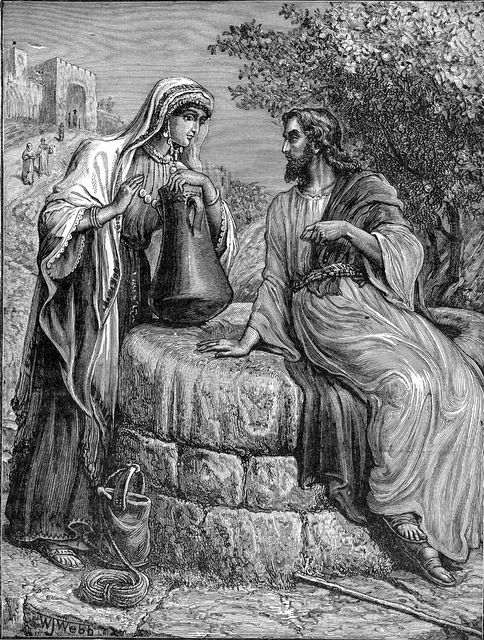
I love this story. I love all the stories about these women, who just won’t stay in their place. What was Jesus thinking? Why would he start a conversation with this woman, a woman not even married to the man with whom she is living? Listen to her tone, can’t you hear her words, barely bordering on mockery?
It doesn’t take long, and the women to whom Jesus speaks sees the light – that this man is something special, and has something special to offer her, even her, the most humble of the humble.
If I had never lived in the Middle East, I would never have understood the nuances of this story, how men just don’t speak to women, how speaking to this woman, not a Jew, a very unclean woman, could make him unclean, how taking anything from her, much less asking for a drink of water was just unthinkable.
Jesus turned it all upside down. He often did the unthinkable – working on the sabbath, speaking to women as if they were real people, talking about how it is what is in our hearts that matters more than looking good in public . . .
John 4:1-26
4Now when Jesus* learned that the Pharisees had heard, ‘Jesus is making and baptizing more disciples than John’— 2 although it was not Jesus himself but his disciples who baptized— 3he left Judea and started back to Galilee. 4But he had to go through Samaria. 5So he came to a Samaritan city called Sychar, near the plot of ground that Jacob had given to his son Joseph. 6Jacob’s well was there, and Jesus, tired out by his journey, was sitting by the well. It was about noon.
7 A Samaritan woman came to draw water, and Jesus said to her, ‘Give me a drink’. 8 (His disciples had gone to the city to buy food.)
9 The Samaritan woman said to him, ‘How is it that you, a Jew, ask a drink of me, a woman of Samaria?’ (Jews do not share things in common with Samaritans.)*
10 Jesus answered her, ‘If you knew the gift of God, and who it is that is saying to you, “Give me a drink”, you would have asked him, and he would have given you living water.’
11 The woman said to him, ‘Sir, you have no bucket, and the well is deep. Where do you get that living water? 12 Are you greater than our ancestor Jacob, who gave us the well, and with his sons and his flocks drank from it?’
13 Jesus said to her, ‘Everyone who drinks of this water will be thirsty again, 14but those who drink of the water that I will give them will never be thirsty. The water that I will give will become in them a spring of water gushing up to eternal life.’
15 The woman said to him, ‘Sir, give me this water, so that I may never be thirsty or have to keep coming here to draw water.’
16 Jesus said to her, ‘Go, call your husband, and come back.’
17 The woman answered him, ‘I have no husband.’ Jesus said to her, ‘You are right in saying, “I have no husband”; 18for you have had five husbands, and the one you have now is not your husband. What you have said is true!’
19 The woman said to him, ‘Sir, I see that you are a prophet. 20 Our ancestors worshipped on this mountain, but you* say that the place where people must worship is in Jerusalem.’
21 Jesus said to her, ‘Woman, believe me, the hour is coming when you will worship the Father neither on this mountain nor in Jerusalem. 22 You worship what you do not know; we worship what we know, for salvation is from the Jews. 23 But the hour is coming, and is now here, when the true worshippers will worship the Father in spirit and truth, for the Father seeks such as these to worship him. 24 God is spirit, and those who worship him must worship in spirit and truth.’
25 The woman said to him, ‘I know that Messiah is coming’ (who is called Christ). ‘When he comes, he will proclaim all things to us.’ 26 Jesus said to her, ‘I am he,* the one who is speaking to you.’
Saudia Arabia, UAE to Block Blackberry
What do you think? I don’t think they are going to be able to do this; I think the blackberries provide too many services and that the users will use their influence to make this not happen:
Saudi Arabia, UAE to Block BlackBerry Services
Updated: 7 hours 11 minutes ago
Adam Schreck
AP
DUBAI, United Arab Emirates (Aug. 1) — The UAE said Sunday it will block key features on BlackBerry smart phones, citing national security concerns because the devices operate beyond the government’s ability to monitor their use. Neighboring Saudi Arabia quickly indicated it planned to follow suit.
The decision could prevent hundreds of thousands of users in the Mideast country from accessing e-mail and the Web on the handsets starting in October, putting the federation’s reputation as a business-friendly commercial and tourism hub at risk.
Blackberry data is encrypted and routed overseas, and the measure could be motivated in part by government fears that the messaging system could be exploited by terrorists or other criminals who cannot be monitored by the local authorities.
However, analysts and activists also see it as an attempt to more tightly control the flow of information in the conservative country, a U.S. ally that is home to the Gulf business capital Dubai and the oil-rich emirate of Abu Dhabi.
Within hours of the announcement, a telecommunications official in neighboring Saudi Arabia said the desert kingdom would begin blocking the BlackBerry messaging service starting later this month. The Saudi official, who spoke on condition of anonymity because he is not authorized to talk to the media, said the country’s telecommunications regulator would issue a statement on the move soon.
People with Blackberries in the Gulf business capital Dubai may have trouble accessing e-mail and the Web starting in October, putting the federation’s reputation as a business-friendly commercial and tourism hub at risk.
Like in Saudi Arabia, government censors in the UAE already routinely block access to websites and other media deemed to carry content that runs contrary to the nation’s conservative Islamic values or could stoke political unrest.
In announcing the ban, the UAE telecommunications watchdog said it will suspend BlackBerry messaging, e-mail and Web browsing services starting October 11. It was unclear if the ban would affect only local users or foreign visitors with roaming services as well.
Regulators say the devices operate outside of laws put in place after their introduction in the country, and that the lack of compliance with local laws raises “judicial, social and national security concerns for the UAE.”
The government said it is singling out the BlackBerry, and not other phones that can access e-mail and the Web, because the devices are the only phones in the country that automatically send users’ data to servers overseas.
Unlike many other smart phones, BlackBerry devices use a system that updates a user’s inbox by sending encrypted messages through company servers abroad, including RIM’s home nation of Canada.
Users like the system because it is seen as more secure, but it also makes BlackBerry messages far harder to monitor than ones sent through domestic servers that authorities could tap into, analysts say.
“This is the irony, that it’s the device with the highest security features,” said Simon Simonian, an analyst at Dubai-based investment bank Shuaa Capital who follows telecommunications. “These same security features corporations like have become an issue of national security for the government.”
Emirati authorities are eager to portray an image of the country as a safe, stable society free from the extremism found elsewhere in the region. They have taken steps to crack down on terror financing and efforts by neighbor Iran to sidestep international sanctions over its nuclear program.
Regulators said they have sought compromises with BlackBerry maker Research in Motion on their concerns, but failed to reach an agreement on the issue.
“With no solution available and in the public interest … Blackberry Messenger, Blackberry E-mail and Blackberry Web-browsing services will be suspended until an acceptable solution can be developed and applied,” Telecommunications Regulatory Authority director-general Mohamed al-Ghanim said in a statement carried on state news agency WAM.
“The TRA notes that Blackberry appears to be compliant in similar regulatory environments of other countries, which makes noncompliance in the UAE both disappointing and of great concern,” he added.
A spokeswoman for Research in Motion said the Canadian company had no immediate comment.
Other countries, including India and the Gulf state of Bahrain, have also raised concerns about BlackBerry messaging features, but have not decided to block them outright.
“The UAE doesn’t want to take any chances and they want to monitor what is going on in the country,” Simonian said.
Research in Motion said in a statement last week it “respects both the regulatory requirements of government and the security and privacy needs of corporations and consumers.”
The company declined to disclose details of talks it has had with regulators in the more than 175 countries where it operates, but defended its phones’ security features as “widely accepted” by customers and governments.
“This is the irony, that it’s the device with the highest security features,” Simonian said. “These same security features corporations like have become an issue of national security for the government.”
Etisalat and Du, the UAE’s two state-run phone companies, said they would comply with the directive and are working on alternative services for their BlackBerry customers.
RIM does not disclose the number of BlackBerry users in the country.
Simonian, the Shuaa analyst, estimated that there are “hundreds of thousands” of BlackBerry users in the country, but likely fewer than the half million users cited by local media.
Associated Press Writer Abdullah al-Shihri in Riyadh, Saudi Arabia, contributed to this report.
The Devil’s Queen by Jeanne Kalogridis
“I need an ESCAPE!” I shouted to AdventureMan, at the end of my rope. So many things going on in my life that are out of my control, I just don’t want to deal with it any more, and I just want to run away and hide. “I’m going out to buy a BOOK!”
I found just the book, The Devil’s Queen by Jeanne Kalogridis.
I don’t know much about the late 1500’s in Europe, do you? At first, reading about this rich, spoiled little girl growing up in Florence, I felt a little impatient with her. All around her people are starving, and she hasn’t a clue. The plague strikes, and people are dying, but she survives. She starves, she suffers cold and fleas and is tossed by fate like a little cork on the water – all before she is 12 years old. Catherine de Medici learns early in life that she has no control over the forces of history and society swirling around her, over who she will love and who she will marry, even over whether she lives or dies. Surviving an attack on her family compound, held prisoner – alone – in nunneries until she is 12 years old – this girl’s life makes mine look peaceable!

I’m feeling better already.
Kalogridis is no Phillipa Gregory, but she has done her research, and draws us in. By the time Pope Clement betrothes Catherine to Henri of France, we are totally hooked. Thirteen years old, and off to live in a strange country as the bride of a man she has never met. She studies French as quickly as possible, but then again – this is a very bright young woman, who has been trained – by life and by education – to survive.
One of the paragraphs made me laugh out loud – as Catherine enters France, she is aware that her very fashionable Italian clothing is very unfashionable in France. She also notes that all the French women are painfully thin, thin to the point of gauntness, and are whispering behind their hands at her more normal size.
Lack of thinness is the least of her problems. She marries Henri, who is also 14, scared, and not in love with her, and they are expected to consummate their marriage under the eye of the King. Oh aargh! Catherine is on a steep learning curve, mastering French culture, diplomacy, the art of war, court politics and fighting the threat of repudiation the only way she can – with utter humility.
What I like the most about this book is that I feel like I was there with her. She is very human, and also very royal. People who are royal have different ideas than the rest of us, and are entitled in ways we can never imagine. They have obligations we can’t imagine. She makes choices I would never make, and yet the author convinced me that given her circumstances, she does the best she can with the resources at hand.
I also like it that Catherine of Medici was a brilliant and educated woman who held her own in a world where the balance was definitely in favor of being a man, and women were greatly at a disadvantage. While she made some horrifying choices, she had her reasons. This is not a book for the faint hearted; it is very earthy and it feels like an accurate portrayal of the times.
As I read these books, I think, too, how little we appreciate how free women are these days, and how recent that freedom is. Being able to choose our own mates – this is very recent. Being able to inherit and to manage our own money – this is very recent. As I talk with my friends who live in the Arabian Gulf, where marriages can still be based on family alliances, maintaining wealth and power, and where divorce can still equal personal disaster, it no longer seems so alien to me – we have this in our own history. We used to marry by contract, and our husbands had full use of our wealth. We used to be judged by whether we could bear children, how many, how many were sons, and how well we managed our households. We used to die in childbirth, and many of our children didn’t survive their infancy.
If you are looking for a good escape, this is a book that will take you there. It will make your own troubles look small in comparison. This book will keep you engrossed, horrified, and entertained, and, in the end, you might learn something, as I did.
You can find The Devil’s Queen at Amazon.com for a mere $10.40 plus shipping, and yes, I own stock in Amazon.com. LOL, we invest in that which we believe to lasting and important, and books play a large role in our lives. 🙂
Saudi Clerics Advocate Adult Breast-Feeding
This really, really needs to go away. It makes no sense, none, for adult women to breastfeed a grown man in order to get around the rules that unrelated men and women should not be in contact with one another.
You can read this article and related articles on AOL News
Dana Kennedy
Contributor
(June 5) — Women in Saudi Arabia should give their breast milk to male colleagues and acquaintances in order to avoid breaking strict Islamic law forbidding mixing between the sexes, two powerful Saudi clerics have said. They are at odds, however, over precisely how the milk should be conveyed.
A fatwa issued recently about adult breast-feeding to establish “maternal relations” and preclude the possibility of sexual contact has resulted in a week’s worth of newspaper headlines in Saudi Arabia. Some have found the debate so bizarre that they’re calling for stricter regulations about how and when fatwas should be issued.
Sheikh Al Obeikan, an adviser to the royal court and consultant to the Ministry of Justice, set off a firestorm of controversy recently when he said on TV that women who come into regular contact with men who aren’t related to them ought to give them their breast milk so they will be considered relatives.
“The man should take the milk, but not directly from the breast of the woman,” Al Obeikan said, according to Gulf News. “He should drink it and then becomes a relative of the family, a fact that allows him to come in contact with the women without breaking Islam’s rules about mixing.”
Obeikan said the fatwa applied to men who live in the same house or come into contact with women on a regular basis, except for drivers.
Al Obeikan, who made the statement after being asked on TV about a 2007 fatwa issued by an Egyptian scholar about adult breast-feeding, said that the breast milk ought to be pumped out and given to men in a glass.
But his remarks were followed by an announcement by another high-profile sheik, Abi Ishaq Al Huwaini, who said that men should suckle the breast milk directly from a woman’s breast.
Shortly after the two sheiks weighed in on the matter, a bus driver in the country’s Eastern Region reportedly told one of the female teachers whom he drives regularly that he wanted to suckle milk from her breast. The teacher has threaten to file a lawsuit against him.
The fatwa stems from the tenets of the strict Wahhabi version of Islam that governs modern Saudi Arabia and forbids women from mixing with men who are not relatives. They are also not allowed to vote, drive or even leave the country without the consent of a male “guardian.”
Under Islamic law, women are encouraged to breast-feed their children until the age of 2. It is not uncommon for sisters, for example, to breast-feed their nephews so they and their daughters will not have to cover their faces in front of them later in life. The custom is called being a “breast milk sibling.”
But under Islamic law, breast milk siblings have to be breastfed before the age of 2 in five “fulfilling” sessions. Islam prohibits sexual relations between a man and any woman who breastfed him in infancy. They are then allowed to be alone together when the man is an adult because he is not considered a potential mate.
“The whole issue just shows how clueless men are,” blogger Eman Al Nafjan wrote on her website. “All this back and forth between sheiks and not one bothers to ask a woman if it’s logical, let alone possible to breastfeed a grown man five fulfilling breast milk meals.
“Moreover, the thought of a huge hairy face at a woman’s breast does not evoke motherly or even brotherly feelings. It could go from the grotesque to the erotic but definitely not maternal.”
Al Nafjan said many in the country were appalled by the fatwa.
“We have many important issues that need discussing,” Al Nafjan told AOL News Friday. “It’s ridiculous to spend time talking about adult breast-feeding.”
Unlawful mixing between the sexes is taken very seriously in Saudi Arabia. In March 2009, a 75-year-old Syrian widow, Khamisa Mohammed Sawadi, living in the city of Al-Chamil, was given 40 lashes and sentenced to six months in prison after the religious police learned that two men who were not related to her were in her house, delivering bread to her.
One of the two men found in her house, Fahd, told the police that Sawadi breast-fed him as a baby so he was considered a son and had a right to be there. But in a later court ruling, a judge said it could not be proved that Fahd was her “breast milk son.” Fahd was sentenced to four months in prison and 40 lashes, and the man who accompanied him got six months and 60 lashes.
The original adult breast-feeding fatwa was issued three years ago by an Egyptian scholar at Egypt’s al-Azhar University, considered Sunni Islam’s top university. Ezzat Attiya was expelled from the university after advocating breast-feeding of men as a way to circumnavigate segregation of the sexes in Egypt.
A year ago, Attiya was reinstated to his post.
How To Be a Southern Lady
You’d think moving back to your own country would be a piece of cake, wouldn’t you? We nomads know better. Young people who travel to other countries to go to school know better. Military people know better. Missionaries know better. Diplomats know better. Anyone who has spent time living abroad know that it works both ways – you have an impact where you are living, and where you are living has an equal impact on you. You may go back, but you are never the same.
With this move, AdventureMan and I have been too busy trying to get settled and to take care of the incredible amount of bureaucratic detail it takes to relocate. Even with AdventureMan ‘retired’, the days are flying by, and we don’t know why we are so busy.
For one thing, I am doing my own housework, and I am finding I am not very good at it. Like I am good at getting laundry done, and even folded, but I haven’t ironed in a long time, and the things that need ironing are stacking up. I have bought a beautiful new ironing board, and a beautiful iron . . . and some starch, the liquid kind I like, not the spray kind. . . but I haven’t set it up, and I haven’t ironed, not a thing. I have discovered that all my packed things looked a lot better after hanging in the closets for a week, most of the wrinkles fell out, lucky me. But . . . the day of reckoning is coming.
The worst part, for me, is cleaning my floors. My floors are supposed to be beautiful; wood and tile floors. They actually ARE beautiful, maybe two days a week, the day I clean them and the next day, but five days a week, they need work. I wish I had asked my cleaning lady in Doha how she got my floors so beautifully clean. I wish I had paid more attention. I keep looking in the store for some miracle, a machine that will clean them in a heartbeat and make them all shiny. . .
The wonderful thing about moving into this culture – and it truly is a different culture from the one in which I was raised – is that we have our wonderful son and his wonderful wife to give us hints on what to do and not to do, and we have his wife’s wonderful family.
Mostly, I try to keep my eyes open. Southern women admire things extravagantly, and after living for so many years in the Middle East and Gulf, learning to admire extravagantly goes against all my instincts.
In the MIddle East, when you admire extravagantly, you can make people nervous. Some people worry about attracting “the evil eye” of jealousy, evil intentions, people who envy you and wish you harm. Some people, if you admire something, will give it to you! It’s true, those stories, it has happened to me. So now I have to un-learn my lessons in retraint and learn to appreciate, if not extravagantly, at least enough to be polite.
One of my wife’s relatives gave us a house-warming gift, an iced-tea maker, with a darling card that states Rule #1 is that every Southern Hostess knows that a pitcher of iced tea is a MUST for all occasions. I like iced tea, but I have never kept it on hand to serve, and I guess I need to start!
Her second rule was one that made me burst out laughing – “A Southern Lady, the most interesting ones anyway, know that rules are made to be broken.”
“Just be prepared for people to leave your home saying “Bless her heart, she must be getting forgetful. There was no iced tea!”
And then rule #3 – “The only correct and acceptable way to criticize anyone is to add ‘bless his/her heart!’ and then, anything goes!”
At a party at her house this weekend, I learned a couple more – the first rule being that when you are invited to a great big family dinner, bring dessert! Thank God, I did take a little guest gift, but now I know – bring dessert! And it had better be sweet!
The next rule is would make any Kuwaiti or Qattari feel right at home – spare nothing in making our guests comfortable. This Southern Hostess had seating areas inside the beautiful air conditioned home, and also seating outside for those who don’t mind a little heat. She had a big basket loaded with all kinds of insect repellents to keep her guests from being bitten. She took time with each guest, and although she was running her little bottom off getting everything organized, she made it all look easy, and as if she was having a good time. I have a sneaking suspicion the truly was enjoying having all the people around and that her great big heart loves taking care of the crowd. She was the essence of gracious hospitality. Did I mention she has also lived in Kuwait?
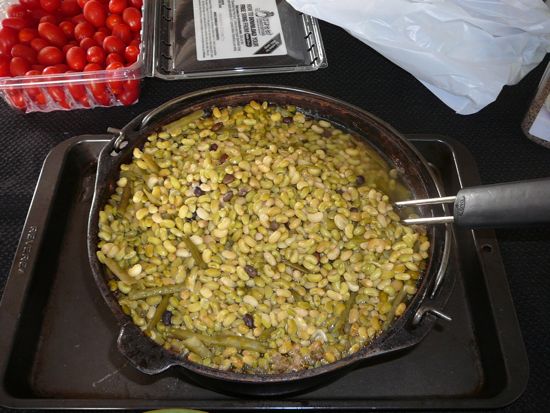
Dinner was “Perlow” an old Southern tradition, made in a huge old kettle from her husband’s mother, and hung from a tripod over a roaring fire to cook. The actual cooking was the men’s work as they sat outside drinking iced tea:

Home grown peas and beans mix – delicious!
Serving up the perlow:
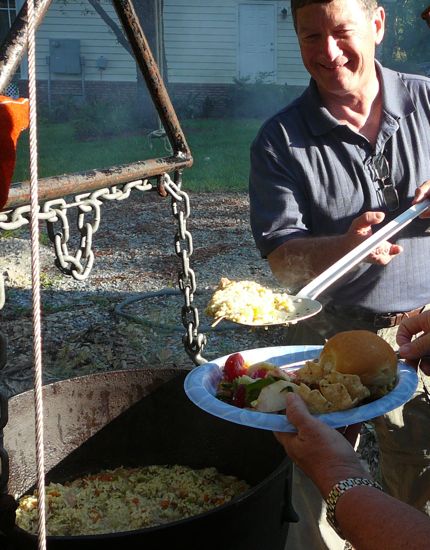
My Middle East / Gulf friends would be comfortable eating this meal – Perlow is a variation of Pilaf, and very similar to Biryani. No alcohol served. No pork. Lots and lots of fabulous sweet desserts.
It’s funny, I used to tell people in Kuwait and Qatar that it was a lot like Alaska; when the weather got too bad, you just stay inside most of the time. When the weather gets good, you go outside as much as you can. When it’s too hot/cold, you run from your air conditioned/heated car to your air conditioned / heated store or movie theater, or restaurant, and then back to your air conditioned / heated car and back to your air conditioned/ heated house.
In the same way, I am beginning to wonder if the South and the Middle East know how much they have in common? In Pensacola, on Saturdays, we have the religious people on the corners shouting at passing cars, not a whole lot different from the volunteer morality police in Saudi Arabia. In the South, as in the Middle East, ‘family’ isn’t just blood, it’s also who you’re married into, and there is a lot of emphasis on family getting together and spending time together. In the South, as in the Middle East, men tend to gather in one area, women in another.
In the South, they drink iced tea; in the Middle East, it’s hot tea. Both have passionate patriots, fundamental believers and a tradition of gracious hospitality. Both have a passion for hunting and fishing. Nobody much likes obeying the rules in either culture. Maybe I’m still in the MIddle East?
Recent Comments
ExpatAlien on What Country am I Living … intlxpatr on Yellowstone: Old Faithful to C… Michelle on Yellowstone: Old Faithful to C… Cathy on No Grown-Ups in Charge intlxpatr on Waiting for Snow Wikipedia Donate Button

Amazina


Early Voting in Florida


 Here There and Everywhere