Dubai, then Doha Most Expensive
Doha second most expensive city in Mideast
Web posted at: 8/27/2009 2:45:52
Source ::: The Peninsula/ By HUDA N V
DOHA: Doha is the second most expensive city in the Arab world, according to a latest study. The USB, one of the world’s leading financial firms, recently released the 14th edition of its ‘Prices and Earnings’ review which has included Doha for the first time in the list of 73 international cities.
Placed in the 39th position in global ratings, Doha is the second most expensive city in the Middle East after Dubai and before Manama. The rating is based on 122 common goods and services. The study looks at the prices of goods and services, and wages and working hours for 14 professionals in 73 cities round the world.
The study reveals that Dubai has surpassed New York and London which were the biggest financial cities in the world. The finical crisis had lead to fluctuation in the rankings of many cities. London which was the second most expensive in the 2006 review plummeted nearly 20 places, landing in the middle of the Western European rankings. Doha is the most expensive city in the world when it comes to a low-class furnished four bedroom flat. With a monthly rent of $4,210, even posh cities like New York ($4,110) and Dubai ($3,950) come after Doha.
However, in high-class four-bedroom apartments, Dubai is one of the most expensive following New York, Hong Kong and Tokyo. In Dubai, such apartments cost $7,090, whereas in Doha they cost $5,580 and $ 3,400 in Manama.
The average rent in most local houses in Qatar is $1,650, $2,160 in Dubai and $890in Manama. With this Doha and Dubai rank among the top 10 most expensive cities in terms of average rents.
Expenditure on some of the 122 goods and services in Doha came to $2,006, while in Dubai it was $2,522 and in Manama $1,773.
One of the common features of ‘Prices and Earnings’ is the ‘Big Mac index’, which has been a trusty indicator of how long an average wage-earner has to work in order to afford that universal meal in each city. This type of comparison is ideal for products that can be purchased around the world in the same quality — products such as an iPod.
People in Doha had to work more as per this index. To earn a Big Mac, people here had to work 34 minutes, whereas in Dubai people could earn the snack with 18 minutes of work and in Manama with 25 minutes of work. To buy an 8 GB iPod nano, Doha residents would have to labour for 35 minutes, compared to 20 minutes and 23 minutes for those in Dubai and Manama, respectively.
While Zurich in Switzerland paid its employees the most (more than $22 an hour), Dubai paid an average of just $10.10, Doha $5.40 and Manama $6.30. The lowest pay was in Mumbai, where workers received an average of just $1.20 an hour.
Food prices are the highest in Japan, at $710, and Geneva ($660) based on 39 standard western food items. In Doha, food cost $379, in Dubai $426 and in Manama $341. Mumbai had the cheapest foods, costing $153.
Taxi prices were the cheapest in Doha at $3.69 for a five-kilometre ride. In Dubai, the same ride cost $4.27 and in Manama $10.61.
Meanwhile, an evening three-course-meal in a good restaurant in Doha cost $59, ranking it the fourth most expensive place, close behind Dubai where such a meal cost $60.
Also, for a short break, which includes an overnight stay in a first-class hotel and various other services, the city could be the second most expensive after Tokyo. A break in Doha and in London cost $1,000 each, following Tokyo, where it can cost $1,130.
The ultra-liberal economic policies of Qatar and Dubai have created an extremely favourable environment for foreign companies and workers here. However, employees in Middle East work more than their counterparts in other countries. Workers in Doha, Dubai and Manama racked up longer hours, averaging 2,210 per year, 308 more than the global average.
Pecking Order
There is so much labor here in Kuwait, and often, they do so little. I cannot imagine what it would be like to have a job, for example, sweeping the parking lot at the Avenues Mall, but I think, being who I am, I would push hard to get all the garbage and trash picked up, and the lot swept. It’s a job. It’s what I am paid to do. I would find hanging around, pretending to push a broom just too boring.
I can only guess that so many do so little because they are paid so little. It’s a kind of passive-aggressive way of getting back at your employer, who may have you bunking with 10 other men in one room, sharing one bathroom, trying to cook food on one hot plate. Men end up killing each other in these situations, as you might imagine.
What astounds me most, in Kuwait, is how some sort of pecking order develops, and you will have one person supervising one person. Or, as in this case, two people supervising one person.
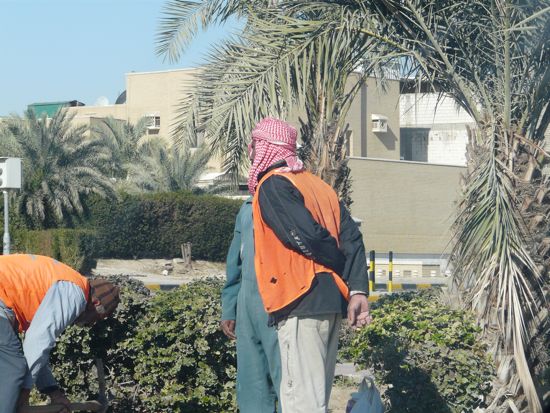
One person fixing the bricks, one person watching him do it. That does not seem like a smart use of human resources to me.
Frequent Traveller
“We’ll be checking in late,” explains AdventureMan, “and we want to be sure you will hold the room for us.”
Pause.
Pause.
Pause. (you can hear frantic clicking in the background)
“Sir, what is your name again?”
“AdventureMan! (He actually gives his real name) A – D – V – E – N – T – U – R – E – M – A – N!” He spells it out.
Pause
Pause
More Pause
“Uh, sir, we can’t find your reservation! When did you make it?”
“The office made it.”
Pause
Pause
Pause
This is not looking good.
“Sir, we do not have a reservation for you. I am so sorry sir!”
“But I am sure the office made a reservation! I have the confirmation number! And, I am one of (your hotel name) SPECIAL CLUB MEMBERS!”
“Uh, yes sir, but this is (a totally different hotel)”
LLLOOOLLL, Adventureman.
“I am SO sorry.” He hangs up. He calls the right hotel, and he is assured they have our room ready for us.
AdventureMan looks at me and we both start giggling.
“I would have hung up,” he begins, but we are both convulsing with laughter.”I would have hung up, but I gave them my NAME!” and we are both dying laughing. He does stay at this other hotel from time to time.
“Next time I call, I will have to identify myself as STUPID-MAN!” he barks, and we are weak and helpless, we are laughing so hard.
Kuwait Tsunami and Earthquake Warning
This is from Al Watan (thanks to Mrm for telling me what a good, reliable source they are!)
Expert warns of powerful earthquakes in Strait of Hormuz
Al Watan staff
KUWAIT: A leading Kuwaiti expert on earthquakes has warned that the Gulf region may face a devastating earthquake that could measure 7.0 on the Richter scale and cause a devastating tsunami.
Dr. Feryal BuRabee said the prospect of such an eventuality is great, particularly since repeated earthquakes have been reported in the Hormuz Straits.
Stressing that such a forecast must be taken seriously; the expert said the shallowness of the area where the earthquakes took place makes the possibility of repeat earthquake very likely.
“Though there were no huge losses from the 6.0 degree earthquake that took place on Wednesday, Sept. 10, 2008, experts should realize that such a sequential order of earthquakes began since early August and still continues to date,” said BuRabee.
She recalled that an earthquake measuring 5.7, which is part of this sequential order of quakes, took place on Sept. 17.
BuRabee pointed out that an 8.3 earthquake that hit the Strait of Hormuz in 1945 caused a tsunami that destroyed a number of areas. The Kuwaiti expert called for the establishment of a regional early warning system that alarms the Gulf of any possible tsunamis. She stated that it would be difficult to accurately specify the date of such a high magnitude earthquake.
You can read the rest of the article by clicking Al Watan.
9/11 Conspiracy Theories Live
When most Americans hear these theories, they just laugh – it never occurs to them that anyone could take them seriously. The New York Times does an article on 9/11 conspiracy theories just as that tragic anniversary approaches:

9/11 Rumors That Become Conventional Wisdom
Justin Lane for The New York Times
CAIRO — Seven years later, it remains conventional wisdom here that Osama bin Laden and Al Qaeda could not have been solely responsible for the attacks of Sept. 11, 2001, and that the United States and Israel had to have been involved in their planning, if not their execution, too.
Many in Cairo see the attacks as part of an anti-Muslim plot.
This is not the conclusion of a scientific survey, but it is what routinely comes up in conversations around the region — in a shopping mall in Dubai, in a park in Algiers, in a cafe in Riyadh and all over Cairo.
“Look, I don’t believe what your governments and press say. It just can’t be true,” said Ahmed Issab, 26, a Syrian engineer who lives and works in the United Arab Emirates. “Why would they tell the truth? I think the U.S. organized this so that they had an excuse to invade Iraq for the oil.”
It is easy for Americans to dismiss such thinking as bizarre. But that would miss a point that people in this part of the world think Western leaders, especially in Washington, need to understand: That such ideas persist represents the first failure in the fight against terrorism — the inability to convince people here that the United States is, indeed, waging a campaign against terrorism, not a crusade against Muslims.
“The United States should be concerned because in order to tell people that there is a real evil, they too have to believe it in order to help you,” said Mushairy al-Thaidy, a columnist in the Saudi-owned regional newspaper Asharq al Awsat. “Otherwise, it will diminish your ability to fight terrorism. It is not the kind of battle you can fight on your own; it is a collective battle.”
There were many reasons people here said they believed that the attacks of 9/11 were part of a conspiracy against Muslims. Some had nothing to do with Western actions, and some had everything to do with Western policies.

Again and again, people said they simply did not believe that a group of Arabs — like themselves — could possibly have waged such a successful operation against a superpower like the United States. But they also said that Washington’s post-9/11 foreign policy proved that the United States and Israel were behind the attacks, especially with the invasion of Iraq.
“Maybe people who executed the operation were Arabs, but the brains? No way,” said Mohammed Ibrahim, 36, a clothing-store owner in the Bulaq neighborhood of Cairo. “It was organized by other people, the United States or the Israelis.”
You can read the entire article at The New York Times.
What a Difference a “D” Makes
AdventureMan called me, laughing, and said “I just have to tell you what just happened to me.”
He was talking with a Kuwaiti woman who said “You speak Arabic amazingly well, except for one little thing – you say the ‘d’ when you should be saying the ‘Dh’.”
It was all he could do not to laugh. Not because of what she had said, but because it reminded him of a conversation we had, repeatedly.
When AdventureMan took Arabic, I took French. We were on our way to Tunis, I had a small baby, and I already spoke a little French. I made arrangements to study half days, and hoped it would be enough. Thanks be to God, together, we did just fine. In Tunis, most Tunisians spoke French and even those who spoke Arabic switched to French for the numbers. (Things are different now; this was many years ago.) The Tunisians called him “That Lebanese guy married to the French woman.” (He is not Lebanese. I am not French. Most Tunisians spoke a Berber dialect, which was not quite the same as Arabic.)
When I finally started formal Arabic classes, years later, I would say things I had learned from my husband and my dear Qatteri teacher would say “No, that is how those Lebanese people say it, not the way we say it.”
When my husband would correct my Arabic, now I could just cooly look at him and say “That is how you Lebanese say it, but we Qatteris say it this way.”
When he would lecture me on Arabic (I can only absorb about one minute of lecture at a time and them my head starts swimming) I would respond with ” ‘Dh’ AdventureMan, ‘Dh’ ” implying that his “Dh” wasn’t hard enough. It would make him laugh every time, totally crack him up. He can’t lecture me when he is laughing.
So here he is on the phone, laughing and laughing, because the Kuwaiti woman told him his Arabic was fine except that his “dh” wasn’t hard enough. God bless you, dear, whoever you are. 🙂
Seattle OKs Bag Fee
From the Seattle Post Intelligencer:
City OKs 20-cent fee on plastic, paper bags
Council also outlaws foam food and drink containers
By KATHY MULADY
P-I REPORTER
Move over, baseball caps and T-shirts.
Logo-emblazoned cloth grocery bags could soon become the most popular company freebie in the Puget Sound region.
Seattle became on Monday one of the first major American cities to discourage the use of paper and plastic shopping bags by requiring grocery, drug and convenience stores to charge 20 cents per bag. In a related action, the City Council also banned plastic foam food and drink containers.
Both laws will go into effect Jan. 1.
People can avoid the fees by bringing their own reusable bags when they shop. The city of Seattle will launch a 90-day education effort to help people figure out the best ways to use cloth bags, and remember to take them when they go shopping. The city also plans to provide residents with a couple of free bags.
One of my favorite stores, Trader Joe’s, has been selling reusable bags forever. They now have a display with many sizes and designs to choose from:
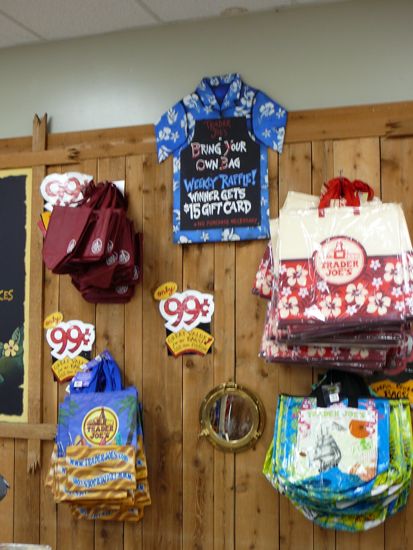
I’m really trying hard. I have a friend who is so conscientious about recycling, she always carries her own bags, and her actions have influenced me greatly. She believes even one person makes a difference, and I believe her – I can see that her behavior has already changed mine! I am trying to carry my own reusable bags now, too.
Especially for my Kuwait/Gulf/Middle East readers, I got a big grin when I saw this in the prepared food section:

A ready-to-go lunch, with felafel, hummous, tabouli and a little bit of flat bread.
Warden Message
If this was a warden message, I didn’t get it. I get most of them. I found this in today’s Arab Times:
Terrorists may target Americans
Following is the full text of the Kuwait 2008 Crime & Safety Report released by the US State Department in March, 2008
Overall Crime and Safety Situation
The Department of State rates Kuwait as low threat for crime. The incidence of crime in Kuwait City remains low. The Government of Kuwait (GOK) maintains a high police profile, with large numbers of uniformed and plainclothes officers on the streets. Each district and governate has police stations operating under the direction of the Ministry of Interior (MOI) Directorate of Public Safety. Street crime does occur and incidents have been reported to the embassy’s Regional Security Office (RSO) recently that required monitoring and security notice dissemination.
Of particular concern are an alarming number of crimes involving individuals impersonating police officers and then assaulting victims, who are primarily third-country nationals (TCNs) and more susceptible to intimidation. The evolving modus operandi (MO) involves a male in plain clothes and an unmarked vehicle stopping a TCN, whether on foot or in a vehicle, asking for his ID, then demanding the person get into the impostor’s vehicle without any explanation of his offense or their destination. The TCN is then driven to a deserted area and assaulted.
The British Embassy released a Warden Notice about an assault that took place in February 2007 that did not involve a British national, but occurred in the Manghaf neighborhood where a large number of British citizens reside. In this case, a TCN was taken in broad daylight from a public area by a police impostor and assaulted, employing the aforementioned MO. A second Warden Notice from the British Embassy in March detailed an incident occurring behind the US Embassy Kuwait, at a shopping center in Mishref, where two young men believed to be local nationals forced a British male teenager into their vehicle late one evening and made sexual advances toward him. The victim escaped by throwing himself from the moving vehicle, where a passing Kuwaiti military vehicle offered assistance and returned him home safely. Based on a long-standing relationship of mutual cooperation and information-sharing, the Regional Security Office (RSO) at US Embassy Kuwait distributed security notices based on the British reports advising staff of these specific instances and included personal security guidance for all employees and their family members.
Violent crime is primarily confined within the TCN community, which comprises the majority of the manual labor force in Kuwait – approximately two-thirds of Kuwait’s residents. It is probable that a high percentage of crimes in the TCN community go unreported. The threat of immediate deportation looms large for many of these guest workers who generally prefer maintaining a low profile so as to avoid unwanted attention from the GOK.
Although several districts within Kuwait City are known to have higher incidences of crime, only one area (Jahra) remains generally off-limits to official embassy personnel. One factor contributing to the high rate of crime in Jahra is the inability of the police to enforce laws in areas where tribal customs take precedence. Known offenders regularly intimidate foreign guest workers, including workers employed by US companies and US military bases, by damaging vehicles, starting fires in trash cans and harassing them while they enter and exit their residences.
Harassment is not due to any affiliation to the United States or US military efforts; instead, it is generally due to criminalsbelieving they can act with impunity. Young Bedouin men who comprise the majority of these gangs are subject to their tribal mores first, but the tribal structure has proven ineffective in controlling these individuals which hinders the efforts of police to crack down on their illicit activities.
Residential crime remains low. There have been no reported break-ins at any official embassy residences within the past year, nor have any vehicles been stolen. A domestic employee of an embassy officer had her purse stolen from an individual on a motorbike outside of the officer’s residence. The perpetrator was later captured by police in the same neighborhood days after the attack. It is not uncommon for embassy staff and dependents to report suspicious persons in their neighborhoods to the RSO, but the majority of these instances have been resolved without any criminal or other hostile intent discovered.
There are no reports of petty thefts against the official American community in any of the popular outdoor markets or shopping malls frequented by tourists and Westerners living in Kuwait. However, the potential for such crime does exist. Individuals should remain aware of their surroundings at all time and assume that no venue is safe from crime. Additionally, vehicle break-ins, although rare, do occur if valuables are left in plain view. Visiting Americans are urged to take the same security precautions in Kuwait that they would practice in the United States. Hotel room doors should be locked and valuables should be stored in hotel safes when available. Visitors should instruct the hotel management not to divulge their room numbers over the telephone to any callers, but only to connect them to their room or to take a message.
Incidents of harassment and road rage, although infrequent, do occur and appear to be on the rise. Females have reported being occasionally accosted or harassed by Arab or South Asian males, particularly while driving alone in the morning or nighttime hours. In an incident involving an Embassy spouse in the fall of 2007, a local male harassed the spouse in a local shopping center, which prompted a security notice by the RSO and a Warden message by the Consular Affairs Section. Women who are the victim of harassment should immediately seek a public area and notify either store management or security personnel. Women should not travel home alone.
Male drivers using their personal vehicles forcefully to stop a female driver or attempting to gain the female’s attention for socializing purposes have been reported. Often this action is meant only to acquire a telephone number or arrange a date. However, reports of males impersonating police or military officers and utilizing his authority to command compliance from unsuspecting females have been increasing. Determining who is a legitimate police officer and who is an impostor is troublesome. In the reports received by the RSO, the individual initiating the contact was not wearing a uniform and was not driving in a clearly marked official GOK police or military vehicle.
Kuwaiti police have the authority to make traffic stops while in civilian clothes and driving in their personal vehicles but must identify themselves with their police ID, which has both Arabic and English writing on it. To ensure that the stopping officer is a legitimate police officer, individuals should remain in their own vehicles with the doors locked, lowering the window only enough to receive the person’s police identification. While checking the bona fides as best as possible, we advise staff to use their mobile phone to alert someone of their situation and if at all possible travel to their location. Tell the person you will agree only to follow him to a police station, and specify which one, keeping your mobile phone open so the person you called can hear the destination.
Lastly, relay the license plate number for the person’s vehicle to your colleague on the phone if at all possible. While Kuwait is in many ways a tolerant country, allowing women to drive, vote, and run for public office, Kuwait is still an Islamic country where conservative customs and dress are the norm. Potential harassment can be reduced if visitors dress conservatively and maintain a respectful demeanor and a low profile. Visitors should avoid confrontational situations, and move away from angry, threatening or aggressive persons, either on foot or in vehicles.
Incidents of vehicle pursuit, extremely aggressive and reckless driving, and vehicle gamesmanship, in which vehicles play a form of high-speed cat and mouse on the freeways, may force vehicles off the road or result in a collision with other vehicles. Speed is the most common cause of vehicle accidents in Kuwait. Apart from periodic storms, road conditions and weather are favorable in Kuwait. Drivers must remain defensive and alert to the hazards posed by others who neglect to yield in merges, cut across lanes to exit, drive aggressively and at excessive rates of speed, pass on shoulders and often operate without headlights at night.
Unexploded bombs, mines, and other ordnance from the 1991 Gulf War remain present in some desert areas in Kuwait. US Embassy Kuwait urges caution if traveling off paved surfaces outside of Kuwait City. A TCN worker was recently killed by unexploded ordinance located near a border checkpoint with Iraq. The unexploded ordinance exploded while the TCN was attempting to remove wiring from the device. Unexploded ordnance has also been discovered in piles of sand used at construction sites, including at Camp Arifjan, the largest US military base in the country.
During the cooler months in Kuwait (October-March) Kuwaitis often travel to the desert to camp. Many of these campgrounds are located very close to the major roadways, but some Kuwaitis travel long distances to camp in isolated areas. Camping in established camp areas decreases the potential for coming into contact with unexploded ordnance. Visitors should avoid camping away from population centers. The US Embassy and the GOK have received threat information indicating official and private Americans may be targeted for terrorist attacks. Soft targets such as western hotels and restaurants can be considered vulnerable to terrorist attack, although many are making improvements to their perimeter and internal security. American citizens are advised to avoid apartment complexes where Americans or other Westerners are generally known to congregate in large numbers. We recommend that Americans maintain a low profile and vary routes and times for required travel to avoid predictable schedules.
Political Violence
For several years after the September 2001 on the US, Kuwait City experienced no major demonstrations or other related violence. During this time, Kuwait has remained a strong ally of the United States, even after the US military invasion into Iraq and the subsequent onset of insurgent violence began to reverberate throughout the region. In early 2006, the controversy over Danish cartoons of the Prophet Mohammed provoked several demonstrations in the country, but these remained peaceful and uneventful. However, when Israel attacked Lebanon in the summer of 2006, several large protests occurred, including two at the US Embassy. Demonstrators expressed an unprecedented amount of anti-US hostility during these protests. While there were no injuries or damage during the protests, the police were not prepaired for how quickly the second demonstration materialized and grew in number. Demonstrators numbering in the hundreds burned American and Israeli flags, while waving the yellow flag of Hezbollah and chanting “Death to Israel and Death to America.” Since the end of the summer 2006 war, there have been no major demonstrations in Kuwait City. While these events were isolated, they clearly illustrate how quickly certain events can evoke an emotional response even in a country not known for political demonstrations or violence.
The primary terrorist threat to US personnel in Kuwait comes from individuals with links to al-Qaeda and regional jihadist networks. In January 2005, Kuwaiti police and Special Forces attempted to arrest members of an indigenous terrorist organization known as the Peninsula Lions. In July 2004, Kuwaiti security forces arrested up to 20 individuals who were engaged in recruitment, training and financing of local youth or terrorist operations in Iraq and Kuwait. These arrests demonstrate the development of extremist elements in Kuwait. In 2002 and 2003, individuals were able to conduct lethal attacks against US military and civilian contractors in Kuwait. While there have been no lethal attacks in the last 12 months, the presence in Kuwait of a growing number of US military and contractor personnel in support of Operation Iraqi Freedom continues to make Kuwait a potential target.
Post-specific Concerns
American citizens traveling to Kuwait should be aware that possession of drugs and alcohol is illegal. Additionally, pornographic materials, weapons, and pork products are confiscated if discovered during customs checks at the airport. Customs authorities will x-ray and search luggage upon entry into the country. While in Kuwait, both women and men should dress conservatively at all times. Shorts and sleeveless shirts are discouraged from being worn in public.
Throughout Kuwait the chances of being involved in a motor vehicle accident are far greater than being a victim of criminal or terrorist act. Driving in Kuwait is hazardous. Embassy employees are briefed upon their arrival in Kuwait that driving is very dangerous in Kuwait. Night driving is particularly dangerous because many drivers do not turn on their headlights. A good general rule to follow while driving in Kuwait is to avoid driving in the number one (far left) lane on Kuwaiti highways, as this lane normally has the drivers traveling at the highest rate of speed. Number one-lane drivers are extremely aggressive and will flash heir headlights rapidly in order to encourage slower-moving drivers to change lanes. Drivers should so be prepared to see camels or other livestock near the side of major highways.
Tips on How to Avoid Becoming a Victim
Americans should maintain a low profile, vary routes and times for all travel to the extent possible, and treat mail and packages from unfamiliar sources with suspicion. All Americans are urged to be suspicious of unexpected visitors and to pay particular attention to suspicious vehicles. Any suspicious activities or vehicles should be reported to the local police as soon as possible. The neighborhoods of Khaitan and Farwaniya, located on the outskirts of Kuwait City International Airport, are recognized and identified as high-crime areas due to criminal elements operating drug, prostitution, gambling, and black market enterprises. These areas are largely populated by TCNs who are poorly paid and may turn to crime for financial gain. Incidences of rape, theft and murder are usually not directed at Americans and Western personnel but largely involves TCNs. Americans are urged to avoid this area altogether, especially at night.
For further information
The main Embassy phone number is +965 259-1001. The Regional Security Officer can be reached by calling +965 259-1001 ext 1704. To contact Consular/American citizen services please call +965 259-1001 ext 1581. The Consular Section Chief can be reached by calling +965 259-1001 ext 1278. The Foreign Commercial Office can be reached by calling +965 259-1001 ext 1392.
The embassy’s working hours are Sunday – Thursday 8:00 am-4:30 pm. During this time, visa applications for travel to the Untied States are accepted. Personal interviews are required and appointment times are requested online. Interviews are conducted at the embassy Monday-Thursday from 8:00 am-12:00 pm. American Citizen Services operates Sunday-Thursday from 9:00 am-11:00 am and 1:00 pm-3:00 pm for routine services, and will generally see any American citizen for emergency services anytime during the workday. The section is closed Monday mornings.
“Arab Education Falling Behind”
In a study recently released, the World Bank reports that education in the Arab World is falling behind. You can read the entire article HERE at BBC Middle East News:
The World Bank has said the quality of education in the Arab World is falling behind other regions and needs urgent reform if it is to tackle unemployment.
In a report, Bank officials said Arab states had to make improving education their top priority, because it went hand-in-hand with economic development.
The region had not seen the increasing literacy and school enrolment witnessed in Asia and Latin America, they said.
Djibouti, Yemen, Iraq and Morocco were ranked the worst educational reformers.
The bright spot? Here is one of the concluding paragraphs:
The report concluded that Jordan and Kuwait were the top educational reformers in the region, while Djibouti, Yemen, Iraq and Morocco ranked lowest in terms of access, efficiency and quality of education.
(An editorial Wooooo Hooooooo to Kuwait!)
Berry and The Alexandrian Link

On his way back from a recent trip, AdventureMan bought a book in an airport, which he read and then asked me to read. Here is what he said:
“It’s not a great book, but I don’t know why I say that. It has an interesting idea and I want to know what you think.”
So just after I finished Inheritance of Loss I started in with this book, and it was the second book I will not recommend to you.
It is wooden. The characters are about a millimeter deep. The plot is unbelievable and doesn’t make sense and doesn’t hang together. It is full of adventure and travel and shoot-outs, which our “hero” miraculously comes through without a scratch while all around him his foes are dropping like flies.
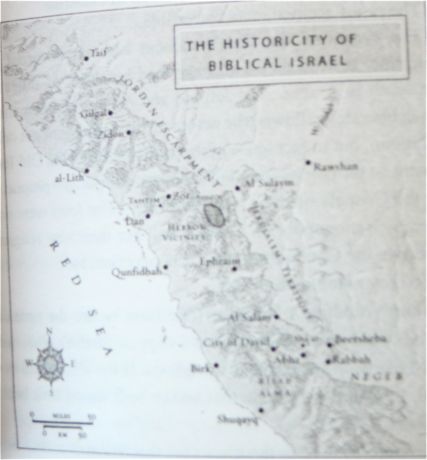
It DOES hinge on an interesting theory, one I had never heard before. There is a Lebanese historian and archaeologist, Kamal Salibi, who published a book called The Bible Came from Arabia. In this book Salibi makes his case for the “holy land” which was given to Abraham not being in Palestine at all, but rather in what is currently Saudi Arabia, along the western coast. He uses the utter lack of archeological findings in current day Israel/Palestine which support biblical accounts, and the plentitude of place names in the Asir region which closely resemble what the place names would have looked like and sounded like in ancient Hebrew, the language of the earliest biblical times.
The book, and the theory was, of course, controversial. If the contentions were true, it would undermine the foundation of the state of Israel in Palestine; it would mean that people have been fighting for the last 60 years over the wrong piece of land.
Here is a (very bad) photo of the map in the book which shows where Salibi believes the biblical cities were actually located. He believes “Jerusalem” was not a city, but an area within which were several cities. He believes “the Jordan” was not a river, but a mountain range, and that here, also, Moses and his refugees from Egypt wandered.
Unless you really love reading badly plotted books with cardboard characters, I would not recommend reading The Alexandrian Link. As a jumping off point for an interesting line of research – AdventureMan was right; this book gives you something new and different to contemplate.
Recent Comments
ExpatAlien on What Country am I Living … intlxpatr on Yellowstone: Old Faithful to C… Michelle on Yellowstone: Old Faithful to C… Cathy on No Grown-Ups in Charge intlxpatr on Waiting for Snow Wikipedia Donate Button

Amazina


Early Voting in Florida


 Here There and Everywhere