Car Seat Base
My new little Sand colored Rav4 is a workhorse! I lug groceries, furniture, boxes, bedding plants and soil, huge pots, and even bookcases, with just a flip of a lever, the middle seats fold down and I have a long flat bed to carry longer items.
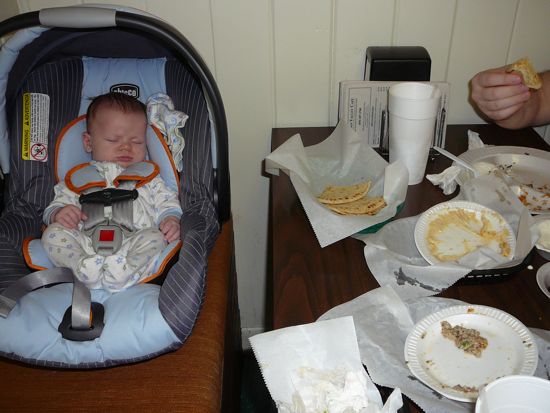
The accessory I like the best doesn’t come with the Rav4. I had to buy it separately. It is a Chicco car seat base, so that I can load and lock my little grandson in my car when we need to pick him up or take him somewhere. 🙂 We had our first trial run taking him to lunch at the Jordan Valley Restaurant in downtown Pensacola, where they had decent baba ghannoush and hummus, bland olives, and felafel – but it isn’t the Beirut. 😦
There are camels on the wall. There are some fabulous cushions. They have some gyros platters and I had a chicken shish taouk . . . it isn’t the Gulf, or – it isn’t the Arabian Gulf – but I am thankful there is one place in town that has felafel and tabbouli. 😉
The good news is, baby Q slept the whole time. 🙂

Clean Carpets
If you are parking in the parking lot on the upside of the long restaurant street, near the Beirut, near Dhow roundabout, and you look at the souks, there is a whole area down on the left that is being developed. There is a large interior souk with abayas and scarves, for example, and a man with the model tents that they will make for you.
There was also, recently, a man cleaning a carpet. I was fascinated. We have carpets. They need cleaning. I have seen carpets cleaned at car washed, and hung on racks to dry. It does not seem to me that people wash these carpets with enormous care, they just wash the carpets.
I would rather like to wash some of our carpets. This man gave me an idea how to do it – gentle detergent in a bucket, a gentle brush, like a dishwashing brush – and the carpet is flat on the ground. I can do this!

Americans Sing for the Liberation of Kuwait
My sweet Kuwait friend sent me this today. It made me cry.
We all have memories of the invasion. I remember it well. We had just moved to Tampa, AdventureMan was working with CENTCOM. He had just brought his very old grandmother to visit with us, and the next day, Iraq invaded, and his grandmother and I didn’t see him again!
We have had a long history with Kuwait, longer than our time living there. Kuwait matters to us. This song makes me cry; the effects of this invasion linger on, resonating and affecting so many lives:
From Kuwait MOI
One reader was asking about where to go online to pay his Kuwait traffic violations. While looking it up (Google “Kuwait Government Traffic Violations Website”) I found this essay on Equality Before the Law in Kuwait:
Lt. Gen. Al-Rejaib: His Highness the Amir stresses on applying the law on everyone
The Interior Undersecretary Lt. Gen. Ahmad Abdullatif Al-Rejaib affirmed on embedding the principle of reward and punish with applying it, where is no place in the Interior Ministry for slackers or neglegants or lacker individuals.
He stressed importance on respecting the authority of the security man after it had been affected for some reasons, affirming on the need of restoring mutual respect between the security man and citizens as well as residents.
Lt. Gen. Al-Rejaib cleared out thoughout his meeting which was featured with honesty and transparency on Wednesday morning 3/2/2010 attended by the Interior Assistant Undersecretary for General Security Affairs, Maj. Gen. KHalil Al-Shamali, leaders and officers of the General Security sector, that the supreme directives of His Highness the Amir, the Supreme Commander of the Armed Forces Sheikh Sabah Al-Ahmad Al-Jaber Al-Sabah, is to apply law on everyone and no one is above it no matter how high this person is.
Lt. Gen. Al-Rejaib urged the leaders and officers of the General Security sector to follow up on all the works that are assigned to them as well as the tasks entrusted on them with honesty and transparency so justice prevails among everyone and for homeland residents to live in comfort, secure and safety. He demanded to honor the hardworker as soon as he accomplished any such achievements so it would be a motivation and an incentive for others to do work accurately.
At the beginning of the meeting in where it was took place at First Lt. Gen. Yousef Al-Khurafi Hall, Lt. Gen. Al-Rejaib welcomed his brothers and sons leaders and officers of the General Security sector, and conveyed to them the greetings of H.E. the Interior Minister Staff Lt. Gen. (ret.) Sheikh Jaber Al-Khaled Al-Sabah and his good wishes for them for success and to exert to give more efforts.
This meeting comes for the sake of discussing many of the issues concerning about security direcotorates and police stations, emphysizing the importance of police station as it is the first point for citizen and resident to turn to and the first security venue known by the Kuwaiti society, he added.
He affirmed that police station was a safeguard for every citizen and resident and a source of fear for any such violators or outlaws; pointed out that the Ministry of Interior has restored the authority of police stations two years ago.
There are bright sides represented by outstanding distinguished efforts done by area leaders, police stations chiefs as well as their officers but in the other hand, there are few who don’t perform their duty in full, and this is not allowed for any case, he added.
Lt. Gen. Al-Rejaib warned on the sluggard individuals who will receive a proper punishment, whereas the sincere and hard work individuals will receive the most appreciable rewards. He stressed importance to reject any such favoritism or mediation or a compliment, and such matters should be dealt with strictness and be terminated.
The Lt. Gen. called on good work organization in police stations, mentioning that the Ministry of Interior is putting all possible support and resources from officers, constables and police patrols, and to such reasons police stations officers should be present in their posting duties.
The leaders of the General Security sector, on top of them Maj. Gen. Khalil Al-Shamali have to be in presence in their places day and night; therefore, it is not exceptable at all that high leaders are in presence at their posts and no police stations officers existed at their assigned locations, he pointed out.
He stressed out that evaluating leaders and officers work stemmed from their performing their duties on combating crime and running after outlaws and out system, and there are not such other way around.
Lt. Gen. Al-Rejaib requested leaders and officers of the General Security sector to work as always do and promised for the sake of Kuwait and its people who deserved to be given all such exerted efforts.
He called on police stations chiefs and their officers to identify the area nature where they work at in terms of its demographic structure, its foremost economical activities and its existent educational and banking facilities, affirming that such information are essential to be awared about by the police station officers.
The security work is an honorable task and an obligatory on us to hold responsibilities, working as a one team and any such achievements accomplished are due to fruitful cooperation and continuous coordination, and self-denial is a trait we should characterized by for the sake of homeland security, he noted out.
The Interior Undersecretary Lt. Gen. Ahmad Abdullatif Al-Rejaib concluded by expressing his hope that the leaders and officers of the General Security sector to be as always as they promised us of being discipline, committed with high duty performance; pointed out that this meeting is a beginning of a series of upcoming meetings with different security sectors.
In Pensacola, people ask me if I wasn’t scared living in Kuwait and Qatar. Safe? I feel safer in Qatar and Kuwait than in Pensacola! And that is what I tell them!
Gulf Women Twice as Likely as Men to Die of Heart Attack
Women face greater risk of heart attack deaths: study
You can read this entire article in today’s Gulf Times by clicking on this blue type
Women throughout the Gulf are almost twice as likely to die in hospital after a heart attack, as male patients, a new regional study published by the American Journal of Cardiology has revealed.
The research involved looking at the death rate of 8,166 males and females hospitalised in 2009 for acute coronary syndrome (ACS) – which includes heart attack and unstable angina.
It was found that female patients who suffered ACS were 1.75 times more likely to die while in hospital than males with the same condition.
Delayed diagnosis of ACS in women, and failure to prescribe the correct cardiovascular medications, and not carrying out the necessary interventions after the event, were behind the increase in the death rate.
The research project was called the Gulf Registry for Acute Coronary Events (Gulf RACE) and the study was titled Comparison of Men and Women with Acute Coronary Syndrome in Six Middle Eastern Countries, 2009.
Arab Gulf? Persian Gulf? Games Cancelled
Islamic Solidarity Games cancelled over Gulf dispute
From BBC News
The first Islamic Solidarity Games were held in Jeddah in 2005
The Islamic Solidarity Games, due to be held in Iran in April, have been called off because of a dispute with Arab countries over what to call the Gulf.
The games federation in Saudi Arabia said the Iranian organisers had failed to address its concerns, particularly about the planned logo and medals.
These bear the words “Persian Gulf”, but Arab countries, who call it the Arabian Gulf, reject the term.
The games had been postponed in October in the hope of striking a deal.
The Islamic Solidarity Sports Federation (ISSF) in Riyadh said, after an emergency board meeting, Iran’s local organising committee “unilaterally took some decisions without asking the federation by writing some slogans on the medals and pamphlets of the games”.
Iran “did not abide by the rules of the Islamic Solidarity Sports Federation” and “did not follow the decisions taken by the general assembly of the federation at a previous meeting in Riyadh”, it said in a statement.
But Iran’s committee for the games disputed the decision.
“In spite of convincing arguments made to the ISSF executive committee, regrettably and without presenting any logical reasons, the ISSF committee decided not to hold the games with Iran as the host,” it said.
The games – which are meant to strengthen ties among Islamic countries – were first held in the Saudi city of Jeddah in 2005.
Iran has campaigned to ensure the body of water between Iran and the Arabian peninsula is known as the Persian, not the Arabian, Gulf.
Doha Trade Fair Opens
I love these fairs – there are vendors from all over. One year, I bought bought fabrics from the Sudan and from Senegal – fabulous things I would never find anywhere else. It’s like a shopping trip around the world. 🙂
Huge turnout at Doha Fair
From today’s Gulf Times
Ahmed al-Nuami inaugurates the Doha Trade Fair 2010 at Doha Exhibition Centre yesterday
The eight-day Doha Trade Fair 2010 got off to a great start yesterday at the Doha Exhibition Centre in the presence of a large number of people.
The fair, organised by the Qatar Tourism and Exhibition Authority in association with Qatar Expo, has attracted more than 600 exhibitors from about 20 countries.
More than 15,000 square metres at the exhibition venue has been occupied by the exhibitors.
Bumper prizes and opportunities for bargains on an array of goods beckon visitors.
Products being sold at the venue include carpets, clothes, cosmetics, textiles, lighting accessories and brassware and handicrafts from many Asian, African, European and Middle East countries.
According to Qatar Expo, QR5mn worth of goods is expected to be sold at the fair in the next seven days.
“With 685 exhibitors this time, the fair is growing at an enormous pace every year. The event is expected to turn Doha into a top business destination of the whole of the Middle East,” an official of the organising company said. He also expressed confidence that there would be more participants at the fair next year.
Qatar Tourism and Exhibition Authority chairman Ahmed al-Nuaimi inaugurated the fair. Diplomats of a number of missions and senior Qatari community members attended the opening ceremony.
The fair timings are between 10am to 1pm and 4pm and 11pm. The event will conclude on January 24.
Etiquette of Eid
I found this in today’s Gulf Times but I see that they found it on islamweb.net (if you are an English speaker, be sure to click on English at the top right part of the page so you can understand what you are reading)
Etiquette of Eid
Eids or Festivals are moments of celebration common to all nations. The festivals of non-believing nations are associated with worldly matters such as the birth of a nation or its decline, the appointment or crowning of a ruler, his marriage, or the beginning of a season like spring, and so on. As for Muslims, their festivals (Eids) are associated with their religious rituals. They have only two festivals or Eids: Eid Al-Fitr (Celebration of the end of Ramadan) and Eid Al-Adha (festival of sacrifice).
When the Prophet, sallallaahu ‘alaihi wa sallam, came to Madinah and found the people celebrating two days he said: “What are these occasions”? They said: “We used to celebrate them in Jaahiliyya (before the coming of Islam)”. He, sallallaahu ‘alaihi wa sallam, then said : “Allah has replaced them for you with the two better days (i.e. Eid Al-Fitr and Eid Al-Adha)”. These two festivals which Allah prescribed to the Muslims are part of the rituals of Islam which should be commemorated and the purposes of which should be understood.
Rules Pertaining to Eid:
1. It is forbidden to fast on the day of both Eids, as it is understood from the hadith narrated by Abee Sa’eed that the Prophet, sallallaahu ‘alaihi wa sallam, forbade the fasting of the two Eids.
2. It is recommended that both men and women observe Eid prayer in an open field as is clear in the hadith narrated by Um Atiya, may Allah be please with her, who said: “We used to be ordered to come out on the day of Eid and even to bring the virgin girls from their houses and menstruating women so that they might stand behind the men and say takbir along with them and hope for the blessings of that day for purification from sins”. Since menstruating women (who stay away from the prayer area) as well as those who are virgin are commanded to observe Eid prayer, there is no doubt that the men, old and young are even strongly commanded to observe it.
3. Eid prayer should be performed before the khutba of Eid as is confirmed in the hadith narrated by Ibn Amr, Abee Sa’eed, and Ibn Abbas, may Allah be pleased with them.
4. It is recommended that the Imaam makes Takbeer (Allahu Akbar) during the prayer, seven times in the first Raka’at and five in the second. This has been confirmed by the companions of the Salaf (our righteous predecessors).
5. It is recommended that the Imaam recites in the first Raka’at Soorah Al-A’alaa (chapter 87) and Soorah Al-’Ghaashiah (chapter 88) in the second. Other reports also show that the Prophet, sallallaahu ‘alaihi wa sallam, used to recite Soorah Qaaf (chapter 50) and Soorah Al-Qamar (chapter 54) as is confirmed in Sahih Muslim.
6. There is no Sunnah prayer either before or after Eid prayer as Ibn Abbas, may Allah, be pleased with him, narrated that whenever the Prophet, sallallaahu ‘alaihi wa sallam, went for Eid prayer, he used to pray two Raka’at (of Eid) but nothing before or after them.
Article courtesy: http://www.islamweb.net
Dubai, then Doha Most Expensive
Doha second most expensive city in Mideast
Web posted at: 8/27/2009 2:45:52
Source ::: The Peninsula/ By HUDA N V
DOHA: Doha is the second most expensive city in the Arab world, according to a latest study. The USB, one of the world’s leading financial firms, recently released the 14th edition of its ‘Prices and Earnings’ review which has included Doha for the first time in the list of 73 international cities.
Placed in the 39th position in global ratings, Doha is the second most expensive city in the Middle East after Dubai and before Manama. The rating is based on 122 common goods and services. The study looks at the prices of goods and services, and wages and working hours for 14 professionals in 73 cities round the world.
The study reveals that Dubai has surpassed New York and London which were the biggest financial cities in the world. The finical crisis had lead to fluctuation in the rankings of many cities. London which was the second most expensive in the 2006 review plummeted nearly 20 places, landing in the middle of the Western European rankings. Doha is the most expensive city in the world when it comes to a low-class furnished four bedroom flat. With a monthly rent of $4,210, even posh cities like New York ($4,110) and Dubai ($3,950) come after Doha.
However, in high-class four-bedroom apartments, Dubai is one of the most expensive following New York, Hong Kong and Tokyo. In Dubai, such apartments cost $7,090, whereas in Doha they cost $5,580 and $ 3,400 in Manama.
The average rent in most local houses in Qatar is $1,650, $2,160 in Dubai and $890in Manama. With this Doha and Dubai rank among the top 10 most expensive cities in terms of average rents.
Expenditure on some of the 122 goods and services in Doha came to $2,006, while in Dubai it was $2,522 and in Manama $1,773.
One of the common features of ‘Prices and Earnings’ is the ‘Big Mac index’, which has been a trusty indicator of how long an average wage-earner has to work in order to afford that universal meal in each city. This type of comparison is ideal for products that can be purchased around the world in the same quality — products such as an iPod.
People in Doha had to work more as per this index. To earn a Big Mac, people here had to work 34 minutes, whereas in Dubai people could earn the snack with 18 minutes of work and in Manama with 25 minutes of work. To buy an 8 GB iPod nano, Doha residents would have to labour for 35 minutes, compared to 20 minutes and 23 minutes for those in Dubai and Manama, respectively.
While Zurich in Switzerland paid its employees the most (more than $22 an hour), Dubai paid an average of just $10.10, Doha $5.40 and Manama $6.30. The lowest pay was in Mumbai, where workers received an average of just $1.20 an hour.
Food prices are the highest in Japan, at $710, and Geneva ($660) based on 39 standard western food items. In Doha, food cost $379, in Dubai $426 and in Manama $341. Mumbai had the cheapest foods, costing $153.
Taxi prices were the cheapest in Doha at $3.69 for a five-kilometre ride. In Dubai, the same ride cost $4.27 and in Manama $10.61.
Meanwhile, an evening three-course-meal in a good restaurant in Doha cost $59, ranking it the fourth most expensive place, close behind Dubai where such a meal cost $60.
Also, for a short break, which includes an overnight stay in a first-class hotel and various other services, the city could be the second most expensive after Tokyo. A break in Doha and in London cost $1,000 each, following Tokyo, where it can cost $1,130.
The ultra-liberal economic policies of Qatar and Dubai have created an extremely favourable environment for foreign companies and workers here. However, employees in Middle East work more than their counterparts in other countries. Workers in Doha, Dubai and Manama racked up longer hours, averaging 2,210 per year, 308 more than the global average.
Recent Comments
Kitchen on Isiais: Winding Down intlxpatr on Shampoo Ginger tigerbutterya0c5ff1d… on Shampoo Ginger intlxpatr on British Soldier Kidnapped, Esc… John on British Soldier Kidnapped, Esc… Wikipedia Donate Button

Amazina


Early Voting in Florida


