Epiphany (2)
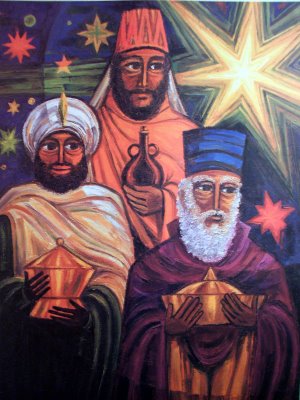
While looking for an image of the Wise Men and the Child that appealed to me, I came across a website, Farsinet.com that has more information about the revelation of the child. Here is a quote from Farsinet.com from the Ronald Latham translation of The Travels of Marco Polo, from an article by H. Behzadi:
In Persia is the city called Saveh, from which the three Magi set out when they came to worship Jesus Christ. Here, too, they lie buried in three sepulchres of great size and beauty. Above each sepulchre is a square building with a domed roof of very fine workmanship. The one is just beside the other. Their bodies are still whole, and they have hair and beards. One was named Beltasar, the second Gaspar, and the third Melchior.
Messer Marco asked several of the inhabitants who these Magi were; but no one could tell him anything except that they were three kings who were buried there in days gone by. But at last he learnt What I will tell you.
Three days farther on, he found a town called Kala Atashparastan, that is to say Town of the Fire-worshippers. And that is no more than the truth; for the men of this town do worship fire. And I will tell you why they worship it. The inhabitants declare that in days gone by three kings of this country went to worship a new-born prophet and took with them three offerings -gold, frankincense, and myrrh – so as to discover whether this prophet was a god, or an earthly king or a healer. For they said : ‘If he takes gold, he is an earthly king; if frankincense, a god; if myrrh, a healer.’
When they had come to the place where the prophet was born, the youngest of the three kings went in all alone to see the child. He found that he was like himself, for he seemed to be of his own age and appearance. And he came out, full of wonder. Then in went the second, who was a man of middle age. And to him also the child seemed, as it had seemed to the other, to be of his own age and appearance. And he came out quite dumbfounded. Then in went the third, who was of riper years; and to him also it happened as it had to the other two. And he came out deep in thought. When the three kings were all together, each told the others what he had seen. And they were much amazed and resolved that they would all go in together.
So, in they went, all three together, and came before the child and saw him in his real likeness and of his real age; for he was only thirteen days old. Then they worshipped him and offered him the gold, the frankincense, and the myrrh. The child took all three offerings and then gave them a closed casket. And the three kings set out to return to their own country.
After they had ridden for some days, they resolved to see what the child had given them. They opened the casket and found inside it a stone. They wondered greatly what this could be. The child had given it to them to signify that they should be firm as stone in the faith that they had adopted. For, when the three kings saw that the child had taken all three offerings, they concluded that he was at once a god, and an earthly king, and a healer. And, since the child knew that the three kings believed this, he gave them the stone to signify that they should be firm and constant in their belief.
The three kings, not knowing why the stone had been given to them, took it and threw it into a well. No sooner had it fallen in than there descended from heaven a burning fire, which came straight to the well into which it had been thrown. When the three kings saw this miracle, they were taken aback and repented of their throwing away the stone; for they saw clearly that its significance was great and good. They immediately took some of this fire and carried it to their country and put it in one of their churches, a very fine and splendid building.
They keep it perpetually burning and worship it as a god. And every sacrifice and burnt offering which they make is roasted with this fire. If it ever happens that the fire goes out, they go round to others who hold the same faith and worship fire also and are given some of the fire that burns in their church. This they bring back to rekindle their own fire. They never rekindle it except with this fire of which I have spoken. To procure this fire, they often make a journey of ten days.
That is how it comes about that the people of this country are fire worshippers. And I assure you that they are very numerous. All this was related to Messer Marco Polo by the inhabitants of this town; and it is all perfectly true. Let me tell you finally that one of the three Magi came from Saveh, one from Hawah, and the third from Kashan.
(LLLLOOOOLLLLLLLL: It took me forever to find an image of the three Wise Men/Magi that didn’t look European or Western instead of Persian and Yemeni, as the legends state!)
Christian vs Christian
This is just purely sad. You can read the whole story at BBC World News.
Unholy dust-up at Nativity church
Members of rival Christian orders have traded blows at the Church of the Nativity in Bethlehem, with four people reported wounded in the fray. Greek Orthodox and Armenian Apostolic priests were sweeping up at the church following the Christmas rites of the Western churches earlier in the week.
Reports say some Orthodox faithful encroached on the Armenian section, prompting pitched battles with brooms.
Intense rivalries at the jointly-run church can set off vicious feuds.
The basilica, built over the grotto in the West Bank town that is the reputed birthplace of Jesus Christ is shared by Roman Catholic, Greek Orthodox and Armenian religious authorities.
Palestinian police formed a human cordon to separate the battling dark-robed and bearded priests and deacons, said to number about 80, so that cleaning could continue.
Read the rest of the story here.
Or is it Kuwait Airport?
. . . or any airport just about anywhere when Christmas and Eid al Kebir all hit at the same time!

moar funny pictures
Dubai Rape Case Update
Here is an update on the case where the 15 year old French boy was kidnapped, taken to the desert and raped, and then the accused said it was consensual. The parents took them to court – and two have now been convicted; the third has yet to be tried. The doctor who examined this boy told the boy he was a homosexual, that there were no signs of rape. The parents were outraged, and pursued the case.
You can read the entire BBC Story HERE.
Emiratis jailed for raping youth
A court in Dubai, in the UAE, has jailed two men for 15 years for the abduction and sexual assault of a 15-year-old French-Swiss boy.
The men, one of whom is HIV positive, took the teenager to the desert and raped him at knifepoint.
The victim’s mother, Veronique Robert, says the authorities lied about the defendant’s medical status to hide the fact that Aids is present in the UAE.
“Fifteen years is nothing for someone who knew he had Aids,” she said.
A lawyer for the family said they would appeal against what they saw as a too-lenient sentence. A juvenile court is trying a third suspect in the same case.
The defence had claimed the victim had consented to sex and had lied to the authorities.
Treatment missed
Ms Robert has been campaigning to change the law in the United Arab Emirates to recognise homosexual rape as a crime and for more openness about HIV and Aids.
Bloggers Changing the Face of News in the Middle East
“So are the “new media” – blogs, websites, chatrooms – now becoming the only truly independent media in the Arab world?”
This article is from today’s BBC News in Depth:
New media dodge Mid-East censors
By Robin Lustig
BBC radio presenter
It’s never easy writing about media freedom.
Even in countries where there is no official censorship, all reporters know there will always be some restraints on what they can say – editors need to be persuaded, owners need to be kept happy, the law has to be obeyed.
Where there is official censorship – where, for example, it is a crime to “bring the government into disrepute” or to publish material which “insults the dignity of the head of state” – the problems are all the greater.
No freedom is absolute, yet some media are a great deal freer than others.
In the Arab world, in general, the media have been heavily politicised.
Governments have tended to control the main media outlets – the main daily newspaper, the main TV and radio networks – and where independent media have been allowed, they have often been owned by opposition parties or by businesspeople with clear links to political organisations. (The establishment of the Qatar-based al-Jazeera TV news station was a rare special case.)
But then, one day, along came the internet. And it was as if someone had blown open a few million doors.
Egyptian successes
Now, everyone can write – weblogs, or blogs, were born, giving everyone with access to the internet exactly the same opportunity to write and publish as the most powerful media tycoon.
You can read the rest of this article by clicking here, on BBC News.
Eid Mubarak!
I was totally caught by surprise! I thought we were going to have a very very quiet Friday, last day of Ramadan, but awoke to hear an unusual and continuous amount of traffic in the middle of the night.
“I think the Eid started,” Adventure Man said groggily. “I got an Eid message.”
“I don’t think so, ” I said, based on absolutely nothing, “it’s not supposed to start until Saturday.”
In all our years living in the Middle East, I have never known an Eid to come early. I have known Eids to wait a day – even two – while the fasting seemed endless, and people dragged themselves to get through one more day, and then one more. But this totally caught me by surprise!

(This photo from a fabulous blog: Astropix.
Blessings of Eid to all my Muslim friends! Blessings! Blessings! May you always have enough! May you be surrounded by friends and family who love you! May your hearts be full of gratitude to God, for all these blessings, known and unknown!
“Middle Eastern” Honey Cake
This recipe was from a paper in Monterey, California, and was called Middle Eastern Honey Cake. I have never seen it in any country I have lived in or been to in the Middle East, and none of my friends in the Middle East have ever had anything like it. . . I almost wonder if it is East European?
But it is a treasure, because it is fast, and easy, and totally DELICIOUS!
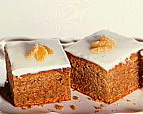
(This recipe, the icing is more honey colored)
“Middle Eastern” Honey Cake
3/4 cups sugar
1/2 cup vegetable oil
1/2 cup honey
2 eggs
1/2 teaspoon vanilla extract
2 cups unsifted flour
2 1/2 teaspoons baking powder
1/2 teaspoon salt
1 cup milk
1. Combine sugar, oil, honey, eggs and vanilla. Mix until well blended. Add combined dry ingredients to oil mixture, alternately with milk, mixing well after each addition.
2. Pour batter into greased floured 9” square pan. Bake at 350 degrees 40 – 45 minutes or until wooden pick comes out clean. Cool. Frost with Honey Cream Cheese Frosting
Honey Cream Cheese Frosting
2 Tablespoons butter or margarine, softened
1 8 oz package cream cheese, softened
1/2 cup powdered sugar
4 Tablespoons honey
sprinkle salt
Blend well.
How can anything so simple be so good? I usually double the recipe and freeze one to pull out when unexpected guests show up. Sometimes I use that black honey that comes from Egypt, and if I can get it, I use Yemeni honey.
Azan Insult
This is from last week’s Arab Times, one of those things I clip because they are interesting and then sometimes I forget. My Kuwait readers will wonder why I am even bothering, maybe this isn’t so interesting, but to me, it is one of those things that illustrate a difference in how we think.
Man Insulted in Azan Row:
Director of an unidentified department of the Ministry of Awqaf and Islamic Affairs has filed a complaint with the Andalus Police Station accusing a Kuwaiti man of humiliating him and threatening to cause him harm, reports Al-Rai daily.
A knowledgeable sourse said the man works as a muezzin at a mosque in Sulaibikhyat and the suspect accused him of calling the faithful for prayers earlier than the time assigned by the ministry.
The source added residents of the area had sent letters of complaints to the ministry stressing the muezzin should abide by prayer timings issued by the ministry.
A source added the man is a political activist and has a file at State Security.
The source also said the man visited the director and humiliated him in a very negative manner. The man reportedly called the official on the phone and called him a donkey and threatened to cause him harm.
Here’s what I love – in Kuwait, the muezzins are LIVE! In every other Islamic country in which I have lived, it has been recordings, but here, they are LIVE! One woman told me that their muezzin was fired because at the end of the call to prayer, music started playing, and everyone knew he had left a recording.
Each muezzin starts the call to prayer at a slightly different time, so you hear a chorus of individual voices raising their voices to say “God is great” and to call the people to prayer, a sound as beautiful as the church bells of western countries, which fulfill a similar function. You can hear the sound of the call to prayer here:
And in how many countries would exact time be an issue when calling people to prayer? Life is sweet, living in a country where time to pray is an important issue.
And here is what I find intriguing – in the west, when we call someone a donkey, it is a very mild insult. I have heard that here, being called a donkey is like one of the very worst things you can call a person. Please, local friends, can you tell me why donkey would be such a bad insult?
Levantine/Gulf/Persian Warrior Women?
I’m still reading Sarum, by Edward Rutherford, although I am nearing the end. I am still thinking back to a fictional character – I think she is fictional because when I Google’d her name, I got the name of an English queen, but not this particular Aelfgifu.
In Sarum, Aelfgifu is a warrior woman. As a young girl, she hangs out with all the guys, rides with them, hunts with them, and is accepted by them. When the Vikings raid, she fights them. The Vikings are astounded, and more than a little angry, to be fought – successfully – by a woman. Later, her father reluctantly allows her to ride with the men to counter another Viking raid – they need all the “men” they can get, and she is one of the best.
I am intrigued. History shows that these exceptional women pop up now and then, and usually just at the right time. Joan of Arc for the French, the Amazons, Apache women warriors in Native American lore, Chinese Tang dynasty warrior women, Masai warrior women in Africa. We have women in the US Army, and I often hear their commanders say “some of my best men are women.”
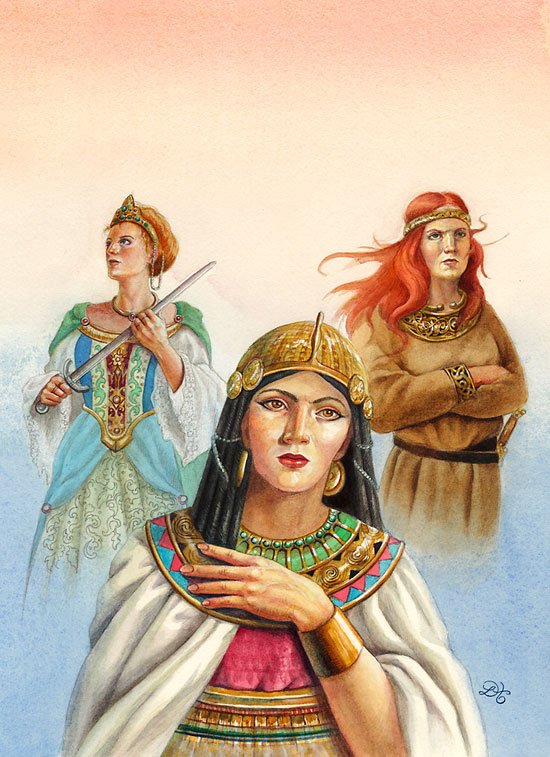
It was hard to find a good warrior women illustration which had women with their clothes on. Most of the illustrator, I guess, being men, they protray women warriors in scanty attire, and most of them have exaggerated breasts and hips, and tiny little wasp waists, and legs about twice as long as a normal woman. Sort of Barbie-doll in warrior women attire. *she snorts in disgust* Leaves a fighter a little vulnerable, don’t you think, fighting in a metal bra and tiny little loincloth? That metal would get uncomfortable in no time, and man, how can you ride a horse for very long without chafing your legs? But then reality wouldn’t sell the drawing, would it?
OK, OK, back to the real question – Warrior women pop up in all cultures. I think that is true, but when I think of the Arabian Gulf, or Persia, or the Levant, no one comes to mind, other than Sheherezad, but she triumphed by her wits, not her brawn, not her fighting skills. I remember hearing that nomadic women could be fierce; are there not legends of Bedouin women?
Is there a woman / are there women who were legendary fighters in Middle East culture? Are there women in Persian culture who fought, or held a castle, or were otherwise brave in the face of danger? Speak now!
Friday Fishin’ and New Weekend
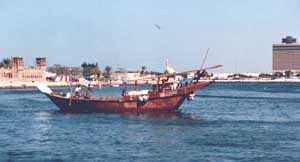
The fish must be running today. When I got up, there were about 25 fishing boats, the old fashioned shuwi. just off the coast. Sorry, they are about a kilometer off the shore, so I can’t get a great photo. I found a photo at agmgifts however, that shows what the boats look like:
Weather Underground says it’s going to be 118° F/ 48°C today – how can they bear it? Some of the boats have no cover? How can they be out under the hot, scorching sun with no cover?
For my non-Kuwait readers, this is a very special weekend, a Thursday-Friday-Saturday weekend, to celebrate the shift to a Friday – Saturday weekend. It has been a long time coming; Kuwait is one of the last countries in the Gulf to make the shift. We were also living in Qatar when the shift to Friday – Saturday happened, but in Qatar, there was no uproar. Here, some people were outraged, saying that Saturday was the Jewish day, and it was a fire-and-brimstone kind of sin to take a day off on the Jewish day.
The government announced the weekend would switch to Friday-Saturday, and then the National Assembly announced that no, it wouldn’t, it would remain Thursday – Friday. Then the government offices started sending out notices to the people working there, and to customers, etc. giving new working hours, and here we go, Friday – Saturday. I am hearing rumors that even Saudi Arabia is considering the change, the last great hold out.
It brings the working week into closer alignment with the rest of the world, having more business days in common. It will make the traffic in Kuwait even worse than it already is.
Recent Comments
ExpatAlien on What Country am I Living … intlxpatr on Yellowstone: Old Faithful to C… Michelle on Yellowstone: Old Faithful to C… Cathy on No Grown-Ups in Charge intlxpatr on Waiting for Snow Wikipedia Donate Button

Amazina


Early Voting in Florida


 Here There and Everywhere