Teacher Orders Students to Strip
From Al Watan. Wonder how much longer this teacher will have a job? What was she thinking???
KUWAIT: Enraged parents of young female students at one of the intermediate schools in Hawally have filed a complaint against an Egyptian teacher, who ordered all the girls in the classroom to strip. A reliable source said: “The Egyptian teacher entered the classroom and asked the students about the source of some foul odor emanating from the classroom. The students however refused to admit or identify the girl who broke a chemical ampoule, so she allegedly ordered all the students to take off their clothes. The students in turn informed their parents about the incident, after which a group of parents filed a complaint against the teacher at the AlـNugra Police Station.”
Hala February Starts in January
From Al Watan
KUWAIT: The festival of Hala February for 2009 will be held from Jan. 29 until Feb. 24, said the festival”s high committee Sunday.
The committee”s general coordinator Waleed AlـJassem told the press that the event would coincide with the third year of reign for His Highnes the Amir Sheikh Sabah AlـAhmad AlـSabah, affirming that the festival would focus on highlighting the nationalistic values among citizens.
An opening carnival, which last for three days, would illuminate this year”s celebrations, he revealed.
Head of the committee”s media team Waleed AlـSagobi said that families could enjoy the festival due to the fact that the event coincide with the spring break for schools, affirming that the festival would be supported by a strong media campaign. ـKUNA
Among a whole lot of other things, as part of my job for a non-profit, I once wrote press releases. As I learned the ropes, I also learned that the newspapers will print almost anything you provide them, as long as you have proven your credibility, and the information is “print ready.” One TV station did a weekly news item on articles I would send – it wasn’t rocket science.
I am so sorry to say this, but if you are having an event, it is worth your while to take advantage of this. If you provide news sources with an event schedule, guess what? They will print it! If they print it, people will come.
If you print it in English, even more people will come! Isn’t Kuwait looking for tourism? Is there now a Hala February website, with an event schedule in English? Wouldn’t that have been a perfect opportunity, if not to publish the schedule of events (hey, having the schedule ready one month in advance is not that hard) AND a website to go to for event additions.
I really try not to be critical. I really try not to be sarcastic. Forgive me.
Kuwait Times on Morality Police
Wooo HOOOO on you, Jamie Etheridge; you bring grammar, tone and content to the Kuwait Times
Kuwait’s illegal morality police
Published Date: January 02, 2009
By Jamie Etheridge
Two female students were attacked by two youths this past week in Hawally, reportedly for not wearing the hijab. The girls were standing outside their school when two bearded young men jumped from an SUV, whacked them with a stick and then jumped back into their truck and took off. The incident sparked outrage and triggered discussions across Kuwait about the self-proclaimed morality police encouraged by a radical Islamist cleric Mubarak Al-Bathali.
In late December, Al-Bathali announced that he had established a voluntary committee for the “Promotion of Virtue and the Prevention of Vice” along the lines of the dreaded Saudi mutaween. The mutaween are a sort of religious police that patrol the streets in the villages and cities of Saudi Arabia, ensuring that women are covered from head to toe, that men go to the mosque to pray and that unmarried men and women do not mix in public. They also enforce other important moral strictures, like no mixed dancing or playing rock and roll music.
Al-Bathali said that his ‘vice’ squad will patrol the Sulaibikhat area first and then slowly spread out to other areas. It’s not clear who was behind the attacks in Hawally. Some have argued that it might have been just a couple of youths having fun and playing a trick on the girls by whacking them like the mutaween in Saudi do.
Let’s hope it was a bad joke by bored teens. God help us if random groups of men suddenly start forming ‘morality’ patrols and beating women on the streets of Kuwait. A Kuwaiti mutaween would create a host of problems.
First, the morality police would be trying to enforce a brand of radical Islam and ideology many in Kuwait – both citizens and expats – do not follow. Many Muslim women in this country do not wear hijab and there are no laws that require them to do so – despite the best efforts of the fundamentalists in parliament.
Second, Kuwaitis are highly protective of their female family members and few are likely to accept strange men whacking their mothers, sisters, daughters, wives and aunts in public areas. Following the 1990-1991 Iraqi invasion and occupation, some radical Islamists tried to establish a religious police and had begun even stationing ‘officers’ outside the Co-ops in Jabriya, Surra and elsewhere.
These mullahs carried short sticks and would strike women coming out of the Co-ops who they deemed to be dressed inappropriately. The women, of course, immediately called their male relatives who then rushed to the Co-ops and attacked the mullahs for attacking the women. The resulting chaos led to the banning of the self proclaimed morality cops.
Third, an ad hoc security force running loose around the country poses a real and present danger to the forces of the Interior Minister and by extension, the stability and security of Kuwait as a whole.
Nearly 20 years later, the radicals have reemerged and wider popularity – as evidenced by the fundamentalists victory in parliamentary polls – has encouraged them to reassert their plans for greater social control.
Success for the mullahs will mean failure for Kuwait’s experiment with democracy. Unlike the rest of the Gulf Arab states, Kuwait isn’t just beginning this experiment. For nearly half a century, this diminutive Muslim country has balanced tribal mores and religious identity with the Islamic and democratic ideals of freedom, dignity and self respect. Allowing roving bands of self appointed religious police to patrol the streets of Kuwait will undermine all of the country’s efforts toward balancing tradition
and modernity.
Some Forecasters See a Fast Economic Recovery
From today’s New York Times: Business:
Economics as the dismal science? Not in some quarters.
In the midst of the deepest recession in the experience of most Americans, many professional forecasters are optimistically heading into the new year declaring that the worst may soon be over.
For this rosy picture to play out, they are counting on the Obama administration and Congress to come through with a substantial stimulus package, at least $675 billion over two years.
They say that will get the economy moving again in the face of persistently weak spending by consumers and businesses, not to mention banks that are reluctant to extend credit.
If the dominoes fall the right way, the economy should bottom out and start growing again in small steps by July, according to the December survey of 50 professional forecasters by Blue Chip Economic Indicators. Investors seemed to be in a similarly optimistic mood on Friday, bidding up stocks by about 3 percent.
But in the absence of that government stimulus, the grim economic headlines of 2008 will probably continue for some time, these forecasters acknowledge.
Read the entire article HERE
Uncle Jay Explains the News (US) from 2008
Tongue-in-cheek funny . . . This came out mid-December, or I am sure there would also be a shot at more recent events . . .
An Eye for an Eye in Iran – Penalty for Acid Disfigurement?
I found this today in the Washington Post
Woman Blinded by Spurned Man Invokes Islamic Retribution
By Thomas Erdbrink
Washington Post Foreign Service
Sunday, December 14, 2008; Page A01
TEHRAN — Ameneh Bahrami once enjoyed photography and mountain vistas. Her work for a medical equipment company gave her financial independence. Several men had asked for her hand in marriage, but the hazel-eyed electrical technician had refused them all. “I wanted to get married, but only to the man I really loved,” she said.
Four years ago, a spurned suitor poured a bucket of sulfuric acid over her head, leaving her blind and disfigured.
Late last month, an Iranian court ordered that five drops of the same chemical be placed in each of her attacker’s eyes, acceding to Bahrami’s demand that he be punished according to a principle in Islamic jurisprudence that allows a victim to seek retribution for a crime. The sentence has not yet been carried out.
You can read the rest of the article Here.

You may think you know how I feel about this. The man stole from this woman. He violated her very life. He stole her ability to see, her ability to support herself, he disfigured her for life and stole the likelihood of the love match she was holding out for. He treated her like property – if he can’t have her, then he will have revenge.
She fought – and won – for him to be blinded with the same acid she has been blinded with. She doesn’t ask that he be disfigured, only blinded. The court in Iran agreed. The sentence has not yet been carried out.
I’m interested in what YOU think. I feel sympathy for the woman, Ahmena Bahrami. I love the way she went after her attacker in the courts. I love it that she didn’t just collapse and be a victim.
On the other hand, I wish she had gone after something different. The thought of purposely blinding someone is SO repugnant to me, I can’t support it. I wish she had gone after his money, forcing him to support her at the level she was earning, for the rest of her life – and his. I find myself thinking – what good does it do to blind him?
He committed a heinous act. Hideous, unthinkable. And yet I find the punishment equally hideous, and unthinkable. I worry that in the future, she will regret having enforced this upon her assailant. I think that revenge, getting revenge, can extract it’s own price from our character. Do you think she will feel better? Do you think she will be happier knowing he was blinded in retrubution? I kinda sorta doubt it.
What do you think?
New Doha Museum – International Herald Tribune
It’s the most wonderful feeling in the world, hearing from old friends, even old friends you have never met. Blogger Kinan is one of those dear friends – I always enjoyed his blog entries, and I miss him, as he enjoys his new life in Sweden, working towards his advanced degrees.
But oh what joy, getting a note this morning with encouragement to read an article he found on the New Doha Museum of Islamic Art in the International Herald Tribune. You can read it too, by clicking on the blue type. 🙂
Doha Museum of Islamic Arts Opens
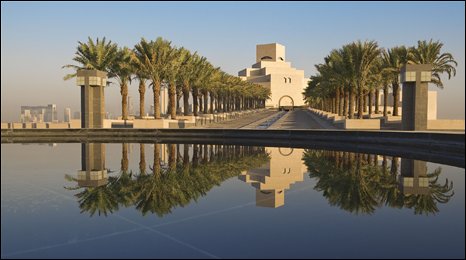
My friends in Doha tell me that the long-awaited Museum of Islamic Arts, designed by I.M. Pei (who showed up for the opening, along with Robert de Niro) opened this weekend. I can hardly wait to see it for myself.
By Lawrence Pollard
BBC News, Doha
A few years ago, prices in London auction houses went through the roof – not for the classic modern or contemporary art, but for works from the Islamic world.
Fabulous jewels, manuscripts and ceramics were fetching 10 times their estimate and more, and it soon emerged this was thanks to the al-Thani family, rulers of Qatar, the tiny gas-rich Gulf state.
They had tempted the veteran architect I M Pei – the man behind the glass pyramid at the Louvre – to design one last statement building, a spectacular museum on a purpose-built island in Doha, which would house only the best Islamic art.
Then they went shopping for their collection.
And this weekend the museum opens, a dramatic pile of white limestone shapes inspired by Islamic architecture and full of 800 of the finest examples of Islamic art.
Not long ago, the idea of culture being a reason to visit the Gulf would have made other Arabs laugh. No longer.
The Syrian cultural historian Rana Kabbani sees a political element to the museum, putting Doha on the cultural map.
“I think all the rulers in the Gulf see what they really lack is culture on a grand scale, as a kind of imperial identity. It’s a political-cultural lack. They have the means, and they’re going for it.”
The hope is that – like hosting a Grand Prix or buying a football club – a fabulous collection of art will bring prestige, attract tourists and create a brand.
That’s why along the coast, two museums are planned for Abu Dhabi – branches of the Louvre and Guggenheim.
New conversation
But what exactly is the Islamic art in the collection? What can ceramics from southern Spain have in common with metalwork from the Silk Route city of Samarkand?
One thing which links them is the misconceptions about Islamic art held by both east and west.
Designer and writer Navid Akhtar explains: “The conversation tends to go: ‘How come you don’t paint people? Because its forbidden.’
“There’s little understanding of the scriptures or commentaries, or the concept of art, so we’re left with a limited conversation.
“There’s a lot of figurative Islamic art. And the geometric patterns aren’t just pattern.”
The Koran has no comment on the visual arts.
The prophet was firmly against idols, but then so were Jews, orthodox Christians and puritan Anglicans at various times.
Many religions mistrust images but their cultures still end up using them – Islam however has had less use for them.
“The Koran is not a narrative like the old or new testament, it doesn’t tell a story, a narration you can illustrate,” says professor Doris Abouseif, author of Beauty in Arabic Culture.
“The Koran is precepts, it guides but doesn’t narrate.”
Any museum will show Persian and Indian miniatures, or Arab pottery with figures of animals or people.
They won’t be from a mosque, but the figure isn’t banned from wider Islamic culture.
‘Whole language’
One element Islamic objects have in common is intricate geometric patterns.
Some scholars think this is a craft habit, pure and simple, but to many younger Muslim artists the geometry holds something else.
“Pattern is a whole language of colour, form and shape,” says Reem al-Faisal, a Saudi artist-photographer.
“Each colour symbolises a state of the soul or being. It’s poetry translated into material elements.”
Mr Akhtar agrees: “Many of these things, as well as being objects of beauty, have functional usage, but then hidden beyond that is the sense of transcendence that they create.”
The chief curator of the new museum, Oliver Watson, is British, as are many of the staff.
The museum houses 800 artistic and historical works from three continents
The study of Islamic art is a western creation, which Ms al-Faisal says is not a problem so long as more Muslims now take up the study.
“I don’t care if it’s Muslims or Westerners – the problem is that there’s not enough research and that’s a mistake of the Muslims.
“They should have studied their own civilisation far more, they’ve been in hibernation for 500 years. There has to be a reawakening – they have to start studying their own history.”
Qatar’s museum will be just a glittering collection of greatest hits unless it manages to become, as promised, a centre of education and research into the history of this beautiful art.
Somalia: Pirates – and Dumping
This is a report from BBC News. I published a piece previously on Somalia on March 11, and blogger Shafi said the following:
“When wealthier nations align their fleet of vessels at Somali coast to fish illegally (estimated at around $6 million as the article says) and dump toxic waste in some parts of the water, aren’t they doing a greater evil and a major harm to the shell-shattared country and her people than the pirates for whom piracy is itself a survival method?”
The statement caught me totally by surprise. I went looking to see if it was true, and it was.
Shafi has a fascinating blog, and if you have some time, go take a look. Meanwhile, I am happy to see glimpses of a fuller picture coming forth in the news:

Ex-Somali Army Colonel Mohamed Nureh Abdulle lives in Harardhere – the town closest to where the hijacked Saudi oil tanker, Sirius Star is moored. He tells the BBC, via phone from his home, that the town’s residents are more concerned about the apparent dumping of toxic waste than piracy.
The Harardhere-born military man advises the town’s elders on security matters and is in his fifties.
Somalia has been wracked by conflict since 1991 – when its last national government was forced from power.
The super-tanker is close to our coast. It is a very, very long ship. Some time ago we had our own problems of piracy in our town but that has not happened lately.
The people who have been hijacking these ships in our seas are not from our region. We do not know any of the guys on the super-tanker and they haven’t made any contact with us.
You know, our problem is not piracy. It is illegal dumping.
These problems have been going for sometime and the world knows about it. The Americans have been here in the region for a long time now – they know about the pollution.
Instead, no, the world is only talking about the pirates and the money involved.
Mysterious illnesses
Meanwhile, there has been something else going on and it has been going on for years. There are many dumpings made in our sea, so much rubbish.
It is dumped in our seas and it washes up on our coastline and spreads into our area.
A few nights ago, some tanks came out from the high sea and they cracked it seems and now they are leaking into the water and into the air.
The first people fell ill yesterday afternoon. People are reporting mysterious illnesses; they are talking about it as though it were chicken pox – but it is not exactly like that either. Their skin is bad. They are sneezing, coughing and vomiting.
This is the first time it has been like this; that people have such very, very bad sickness.
The people who have these symptoms are the ones who wake early, before it is light, and herd their livestock to the shore to graze. The animals are sick from drinking the water and the people who washed in the water are now suffering.
TimesOnline ran an article on Somalia after the tsunami, and the contaminants that had been washed ashore:
“The current situation along the Somali coastline poses a very serious environmental hazard not only in Somalia but also in the eastern Africa sub-region,” the report says. Toxic waste was first dumped in Somalia in the late 1980s, but accelerated sharply during the civil war which followed the 1991 overthrow of the late dictator Mohamed Siad Barre.
Local warlords, many of them former ministers in Siad Barre’s last government, received large payments from Swiss and Italian firms for access to their respective fiefdoms.
Most of the waste was simply dumped on remote beaches in containers and leaking disposable barrels.
Somali sources close to the trade say that the dumped materials included radioactive uranium, lead, cadmium, mercury and industrial, hospital, chemical and various other toxic wastes. In 1992, Unep said that European firms were involved in the trade, but because of the high level of insecurity in the country there were never any accurate assessments of the extent of the problem.
In 1997 and 1998, the Italian newspaper Famiglia Cristiana, which jointly investigated the allegations with the Italian branch of Greenpeace, published a series of articles detailing the extent of illegal dumping by a Swiss firm, Achair Partners, and an Italian waste broker, Progresso.
The news is so much more complicated than it appears. How do we stop all these wrongful, hurtful things? Do not we have a responsibility toward the poorest nations? If we – meaning the richest nations – don’t stop this dumping now, is there not every chance in the world that it will come back to haunt us?
Election: Will Life Follow Fiction?
This is an article from the New York Times
Will life follow fiction? The article talks of some very eerie similarities between the TV race for the White House, and this year’s real race:
By BRIAN STELTER
Published: October 29, 2008
When Eli Attie, a writer for “The West Wing,” prepared to plot some episodes about a young Democratic congressman’s unlikely presidential bid, he picked up the phone and called David Axelrod.
Mr. Attie, a former speechwriter for Vice President Al Gore, and Mr. Axelrod, a political consultant, had crossed campaign trails before. “I just called him and said, ‘Tell me about Barack Obama,’ ” Mr. Attie said.
Days after Mr. Obama, then an Illinois state senator, delivered an address to the 2004 Democratic National Convention, the two men held several long conversations about his refusal to be defined by his race and his aspirations to bridge the partisan divide. Mr. Axelrod was then working on Mr. Obama’s campaign for the United States Senate; he is now Mr. Obama’a chief strategist.
Four years later, the writers of “The West Wing” are watching in amazement as the election plays out. The parallels between the final two seasons of the series (it ended its run on NBC in May 2006) and the current political season are unmistakable. Fiction has, once again, foreshadowed reality.
Watching “The West Wing” in retrospect — all seven seasons are available on DVD, and episodes can be seen in syndication — viewers can see allusions to Mr. Obama in almost every facet of Matthew Santos, the Hispanic Democratic candidate played by Jimmy Smits. Santos is a coalition-building Congressional newcomer who feels frustrated by the polarization of Washington. A telegenic and popular fortysomething with two young children, Santos enters the presidential race and eventually beats established candidates in a long primary campaign.
Wearing a flag pin, Santos announces his candidacy by telling supporters, “I am here to tell you that hope is real.” And he adds, “In a life of trial, in a world of challenges, hope is real.” Viewers can almost hear the crowd cheering, “Yes, we can.”
Comparisons between Senator John McCain and the “West Wing” Republican candidate, Arnold Vinick, a white-haired Senate stalwart with an antitax message and a reputation for delivering “straight talk” to the press, also abound. Vinick, played by Alan Alda, is deemed a threat to Democrats because of his ability to woo moderate voters. And he takes great pride in his refusal to pander to voters, telling an aide: “People know where I stand. They may not like it, but they know I’ll stick with it.”
Even the vice-presidential picks are similar: the Democrat picks a Washington veteran as his vice presidential candidate to add foreign policy expertise to the ticket, while the Republican selects a staunchly conservative governor to shore up the base.
Certainly some of the parallels are coincidental. It is unlikely, for example, that the writers knew Mr. Obama had an affection for Bob Dylan when they made Santos a Dylan fan. But it is the unintentional similarities that make the DVDs of the sixth and seventh seasons, which at the time received mixed reviews, so rewarding to watch now. In both “The West Wing” and in real life, for example, the Phillies played in the World Series during the election campaign.
As the primaries unfolded this year, “I saw the similarities right away,” said Lawrence O’Donnell, a producer and writer for the series who has appeared on MSNBC as a political analyst. Mr. O’Donnell had used Mr. McCain as one of the templates for the Vinick character in the episodes he wrote, though he said that “McCain’s resemblance to the Vinick character was much stronger in 2000 than in 2008.”
Echoing the criticism Mr. McCain faced during the primaries, a White House aide in “The West Wing” contends that Vinick is “not conservative enough” for the Republican base. Sometimes the two candidates’ situations are almost identical: when the press starts asking where Vinick attends church, he tells his staff that “I haven’t gone to church for a while.” Asked in July by The New York Times about the frequency of his church attendance, Mr. McCain said, “Not as often as I should.”
Mr. Alda and Mr. McCain are the same age. When a hard-edged strategist played by Janeane Garofalo joins the Santos campaign, she immediately alludes to Vinick’s age. “He’s been in the Senate for like 90 years. He was practically born in a committee room,” she says.
In the same way that Obama surrogates have subtly knocked Mr. McCain’s lack of computer skills, the Garofalo character remarks to the Santos campaign manager, Josh Lyman: “Why are you always talking about high-tech jobs? Because Vinick uses a manual typewriter.”
Conversely, Santos staffers talk about getting video of the candidate with his “adorable young children hugging their hale and vital dad.” The casting of Mr. Smits introduced story lines about the prospect of a minority president. But when an aide suggests a fund-raising drive in a Latino community, Santos snaps: “I don’t want to just be the brown candidate. I want to be the American candidate.” The Obama campaign has made similar assertions.
Still, “The West Wing” — like Mr. Obama — does not ignore racial issues entirely. In the seventh season Santos delivers a speech on race at a critical moment for his campaign, and staffers privately worry that voters will lie about their willingness to vote for a minority candidate.
If the show sometimes seems like a political fantasy — a real debate where politicians are required to answer questions? a candidate rejecting an attack ad? — it also reflects the tenor of the real-life campaign season.
Santos wins the nomination only after a lengthy fight on the convention floor, an inexact parallel to Obama’s extended primary fight with Senator Hillary Rodham Clinton. Just as the Obama campaign pivoted to the economy this fall, Lyman tells Santos staffers that “this new economic message may be our ticket,” and he winds up being right. An economic crisis does not ensue, but back-to-back emergencies on “The West Wing” — a nuclear power plant malfunction and a dispute in Kazakhstan — bring to mind the election-defining qualities of the actual economic crisis.
“Dramatically, they are exactly the same thing: the unforseeable,” Mr. O’Donnell said.
As President Bush did during the bailout talks, Jed Bartlet, the Democratic “West Wing” president played by Martin Sheen, brings both candidates to the White House for a briefing. Facing the prospect of deploying 150,000 American soldiers to Kazakhstan three weeks before the election, Vinick grumbles, “I can say goodbye to my tax cut.” He tells Santos, “Your education plan’s certainly off the table.”
Santos emerges victorious weeks later, but only after a grueling election night. Online, some “West Wing” fans are wondering whether the show will wind up forecasting the real-life result as well. In Britain, where the series remains popular in syndication, a recent headline on a blog carried by the newspaper The Telegraph declared: “Barack Obama will win: It’s all in ‘The West Wing.’ ”
Recent Comments
ExpatAlien on What Country am I Living … intlxpatr on Yellowstone: Old Faithful to C… Michelle on Yellowstone: Old Faithful to C… Cathy on No Grown-Ups in Charge intlxpatr on Waiting for Snow Wikipedia Donate Button

Amazina


Early Voting in Florida


 Here There and Everywhere