Catastrophic Vanishing Water in Middle East
I found this article in the Weather Underground News this morning:
DOHA, Qatar — An amount of freshwater almost the size of the Dead Sea has been lost in parts of the Middle East due to poor management, increased demands for groundwater and the effects of a 2007 drought, according to a NASA study.
The study, to be published Friday in Water Resources Research, a journal of the American Geophysical Union, examined data over seven years from 2003 from a pair of gravity-measuring satellites which is part of NASA’s Gravity Recovery and Climate Experiment or GRACE. Researchers found freshwater reserves in parts of Turkey, Syria, Iraq and Iran along the Tigris and Euphrates river basins had lost 117 million acre feet (144 cubic kilometers) of its total stored freshwater, the second fastest loss of groundwater storage loss after India.
About 60 percent of the loss resulted from pumping underground reservoirs for ground water, including 1,000 wells in Iraq, and another fifth was due to impacts of the drought including declining snow packs and soil drying up. Loss of surface water from lakes and reservoirs accounted for about another fifth of the decline, the study found.
“This rate of water loss is among the largest liquid freshwater losses on the continents,” the authors wrote in the study, noting the declines were most obvious after a drought.
The study is the latest evidence of a worsening water crisis in the Middle East, where demands from growing populations, war and the worsening effects of climate change are raising the prospect that some countries could face sever water shortages in the decades to come. Some like impoverished Yemen blame their water woes on the semi-arid conditions and the grinding poverty while the oil-rich Gulf faces water shortages mostly due to the economic boom that has created glistening cities out of the desert.
In a report released during the U.N. climate talks in Qatar, the World Bank concluded among the most critical problems in the Middle East and North Africa will be worsening water shortages. The region already has the lowest amount of freshwater in the world. With climate change, droughts in the region are expected to turn more extreme, water runoff is expected to decline 10 percent by 2050 while demand for water is expected to increase 60 percent by 2045.
One of the biggest challenges to improving water conservation is often competing demands which has worsened the problem in the Tigris and Euphrates river basins.
Turkey controls the Tigris and Euphrates headwaters, as well as the reservoirs and infrastructure of Turkey’s Greater Anatolia Project, which dictates how much water flows downstream into Syria and Iraq, the researchers said. With no coordinated water management between the three countries, tensions have intensified since the 2007 drought because Turkey continues to divert water to irrigate farmland.
“That decline in stream flow put a lot of pressure on northern Iraq,” Kate Voss, lead author of the study and a water policy fellow with the University of California’s Center for Hydrological Modeling in Irvine, said. “Both the UN and anecdotal reports from area residents note that once stream flow declined, this northern region of Iraq had to switch to groundwater. In an already fragile social, economic and political environment, this did not help the situation.”
Jay Famiglietti, principle investigator of the new study and a hydrologist and UC Irvine professor of Earth System Science, plans to visit the region later this month, along with Voss and two other UC Irvine colleagues, to discuss their findings and raise awareness of the problem and the need for a regional approach to solve the problem.
“They just do not have that much water to begin with, and they’re in a part of the world that will be experiencing less rainfall with climate change,” Famiglietti said. “Those dry areas are getting dryer. They and everyone else in the world’s arid regions need to manage their available water resources as best they can.”
Two New Restaurants to Open on Palafox Place, Pensacola
Woooo HOOOOO, Carleton Proctor at the PNJ just tweeted there will be two new restaurants, one Italian, opening this year on Palafox Place in downtown Pensacola:
The menu of downtown Pensacola’s restaurants is about to add another entree.
David Hambrick, owner and manager of Jaco’s Bayfront Bar & Grille, has reached an agreement with Durnford Enterprises Inc. to lease the former Distinctive Kitchens property on Palafox Place.
Hambrick said Thursday he plans to open an Italian-themed restaurant in one half of the 11,000-square-foot building, and eventually will open a second adjacent restaurant within that space at a later date.
“We’ve been talking to them (Durnford) since October when he heard the property had become available,” Hambrick said. “We’ve verbally agreed to a lease and now we’re just waiting for incorporation papers and a name for the restaurant.”
“The core menu will be modern Italian,” he said.
The deal and lease is expected to close March 1, Hambrick said.
Durnford Manager Frank Webb confirmed the agreement with Hambrick. Durnford owns the building, which has addresses of 29 and 31 Palafox Place.
First opened in 2004, Distinctive Kitchens and Culinary Arts Center closed late last summer, and the building has been unused since then.
Hambrick said he is working with Pensacola architect Brian Spencer on the interior design of the proposed restaurant.
Hambrick and business partner Paul Bruno will design the entirely rebuilt kitchen area, which eventually will serve both proposed restaurants.
Follow Carlton Proctor at twiter.com/CarltonProctorPNJ.
New Mexico Bill Would Criminalize Abortions After Rape As ‘Tampering With Evidence’
And Republicans wonder why they have problems getting elected, why they are accused of war on women. This proposed law is not a whole lot different than Morocco’s law that the rapist can escape prosecution by marrying the rape victim. Like let’s just go back a couple centuries where women have no rights, and a rape victim is considered damaged property. So a rape victim who has an abortion is prosecuted for destroying evidence???’
New Mexico is an interesting state, historically Republican but trending Democrat. No wonder . . .
New Mexico Bill Would Criminalize Abortions After Rape As ‘Tampering With Evidence’
Laura Bassett
lbassett@huffingtonpost.com
A Republican lawmaker in New Mexico introduced a bill on Wednesday that would legally require victims of rape to carry their pregnancies to term in order to use the fetus as evidence for a sexual assault trial.
House Bill 206, introduced by state Rep. Cathrynn Brown (R), would charge a rape victim who ended her pregnancy with a third-degree felony for “tampering with evidence.”
“Tampering with evidence shall include procuring or facilitating an abortion, or compelling or coercing another to obtain an abortion, of a fetus that is the result of criminal sexual penetration or incest with the intent to destroy evidence of the crime,” the bill says.
Third-degree felonies in New Mexico carry a sentence of up to three years in prison.
Pat Davis of ProgressNow New Mexico, a progressive nonprofit opposing the bill, called it “blatantly unconstitutional” on Thursday.
“The bill turns victims of rape and incest into felons and forces them to become incubators of evidence for the state,” he said. “According to Republican philosophy, victims who are ‘legitimately raped’ will now have to carry the fetus to term in order to prove their case.“
The bill is unlikely to pass, as Democrats have a majority in both chambers of New Mexico’s state legislature.
UPDATE: 12:25 p.m. — Brown said in a statement Thursday that she introduced the bill with the goal of punishing the person who commits incest or rape and then procures or facilitates an abortion to destroy the evidence of the crime.
“New Mexico needs to strengthen its laws to deter sex offenders,” said Brown. “By adding this law in New Mexico, we can help to protect women across our state.”
Deepwater Horizon Spill and Hazards
On the front page of today’s Pensacola News Journal is a report by the Associated Press saying:
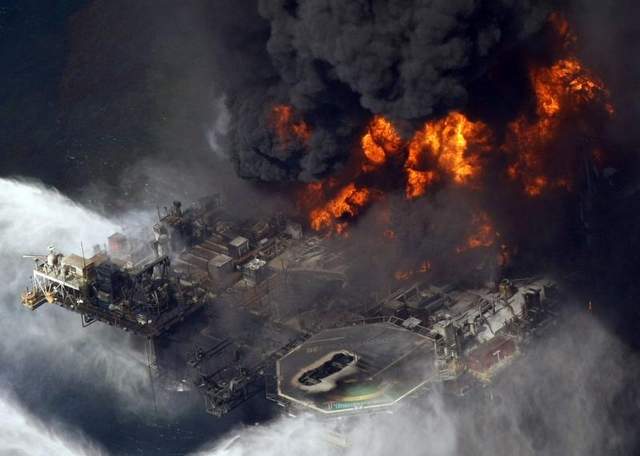
BP Missed Big Hazards, report says: Focus on worker safety obscured other problems.
HOUSTON – BP and the drilling contractor that operated the ill-fated Deepwater Horizon were so focused on worker safety they didn’t do enough to prevent major hazards, such as the 2010 rig explosion in the Gulf of Mexico that killed 11 people, federal investigators said yesterday.
Excuse me? Does that make sense to anyone?? So concerned with safety that 11 people got killed because they overlooked SAFETY problems?? I thought I must be crazy, but the report goes on to say the following:
The panel listed a litany of problems large and small they had already uncovered even though it has not received all of the records from Transocean, the drilling contractor that has challenged the board’s right to investigate the offshore incident.
Among the panel’s findings:
• BP and Transocean’s “bridging document,” designed to align safety procedures between the companies, was generic and addressed only six safety issues, but none of them dealt with major issues.
• The companies didn’t have key process limits or controls for safe drilling.
• There were no written instructions for how to conduct a crucial test at the end of the cementing process, one that ultimately was misinterpreted by the crew after it was conducted several times, each time differently.
• Similar concerns about too narrow a focus on personal safety were raised after an explosion in 2005 at BP’s Texas City refinery that killed 15 people, but few of the panel’s recommendations were implemented on the offshore rig.
“It’s always puzzled me why a company like BP … that has major resources available … is involved with two of the biggest accidents,” said John Bresland, a member of the board who is wrapping up his second five-year term and was involved in both investigations.
The drilling company doesn’t want to cooperate, and doesn’t think the federal government has the right to investigate? The company so focused on worker safety had an agreement with the drilling company that only focused on minor issues? NO key processes or controls?
What is wrong with this story? From this story, it is clear that worker safety was never a focus of BP. BP had another blowup with 15 deaths at a Texas refinery resulting from safety processes that were too narrowly focused, and now they are saying they are too focused on worker safety, and that is why they have so many worker deaths?
I guess, following the same reasoning, that the Deepwater Horizon blowup, which killed sealife, is still blackening beaches, which has created a tar carpet along the ocean floor, created birth defects among birds and mammals, and will create havok for a lifetime to come, all that resulted from BP’s excessive concern for the Environment?
Is this craziness? That kind of communication just makes me crazy.
I don’t care how much they end up paying to universities, groups promoting tourism, people who lost work, wildlife organizations, etc. as a result of the Deepwater Horizon explosion. You have to see that whatever they are paying is to buy silence, to buy complicity, to keep us from complaining too much when problems associated with the explosion continue to – literally – surface. Their money is to co-opt us. No matter what they are paying, it is too little.
Sunlight May Help Prevent Heart Attacks
This report is from Bottom Line. It seems to me that we are more primitive biological organisms that we think ourselves, but it also occurs to me that if sunlight helps prevent heart attacks, and helps limit damages, do people in the sunny places have a lower incidence of death due to heart attacks?
Sunlight Helps Prevent Heart Attacks

Ah, sunlight.
There’s nothing like being outdoors on a summer morning.
What you may not know is that sunshine doesn’t just boost your mood and your vitamin D level—it also may help you ward off a heart attack or minimize the damage that one can cause, according to a new first-of-its-kind study.
I talked to the researchers to find out more about how we can all harness the power of light to brighten our heart health.
I called the study’s lead author, Tobias Eckle, MD, PhD, an associate professor of anesthesiology, cardiology and cell and developmental biology at the University of Colorado School of Medicine in Denver.
Dr. Eckle told me that our circadian rhythm—the physical, mental and behavioral changes prompted by light and darkness that occur over each 24-hour period—helps determine the level of a certain protein that can minimize the cell damage and cell death caused by a heart attack. This protein might even stop a heart attack in its tracks. So Dr. Eckle and his colleagues were eager to see whether exposure to certain kinds of light at a certain time might be effective at boosting levels of this protein.
In the study, researchers divided mice into two groups. One group was exposed to light boxes emitting light that was the same level of brightness as daylight (“bright light”), and others were exposed to regular room lighting (“regular light”). Both groups were exposed to the light first thing in the morning at 6:00 am.
Then the mice were given anesthesia and heart attacks were triggered in them. Researchers found that mice that had been exposed to three hours of “bright light” had three times the amount of the protective protein as the mice that had been exposed to “regular light”—and, incredibly, the “bright light” mice’s hearts had experienced only one-fifth as much damage!
HOW SUNNY ARE THE FINDINGS?
There are, of course, unanswered questions—for example, how the findings might apply to humans and how lasting the benefit of the protein might be.
That said, the results are promising. What’s especially interesting is that it’s the light exposure on the eyes—not the skin—that affects the protein levels, said Dr. Eckle. So humans wearing sunscreen or long sleeves wouldn’t blunt the effect.
SAFE WAYS TO LET IN THE LIGHT
Several forces have conspired over recent decades to keep people out of the sun during the day, such as indoor work and fear of skin cancer. But many people would be likely to benefit from getting more sunlight exposure as early in the morning as possible.
Here are some safe ways from Dr. Eckle to shed more light on your daily routine…
1. Take a daily walk outdoors, and keep wearing sunscreen. Even 10 to 20 minutes a day is better than nothing. Since, as I mentioned earlier, it’s the way that light affects your eyes (not your skin) that matters, apply sunscreen—that won’t dampen the benefits. The added exercise will boost your heart health, too.
2. Get sunlight while indoors. Sit near large, bright windows.
3. Use a light therapy box. If you can’t follow either of the first two tips, or if you’re at high risk for skin cancer and want to avoid UV rays at all costs, this may be the best option for you. Available online for about $50 and up, light therapy boxes mimic the brightness of sunlight while filtering out most damaging UV rays.
Source: Tobias Eckle, MD, PhD, associate professor of anesthesiology, cardiology, and cell and developmental biology, University of Colorado School of Medicine, Denver. His study was published in Nature Medicine.
Umm al Quwain: Oldest Pearl in the World
The oldest pearl in the world is found in the United Arab Emirates, according to AOL news/Huffpost this morning:
French researchers are flashing their pearly whites after a historic discovery: what’s believed to be the oldest pearl in the history of the human world.
Discovered in a grave, the Umm al Quwain pearl — named for the location in the United Arab Emirates where it was found — has been carbon-dated back to the 5500 B.C., during the Neolithic Period, which makes it more than 7,500 years old, Press Trust of India reports. Previously, the oldest known pearl was just over 5,000 years old.

According to Discovery News, the pearl is 0.07 inches in diameter and remains fully intact. Pearls buried with the deceased were typically either half-drilled for a man or fully drilled for a woman, though unpierced pearls were often placed on the deceased’s upper lip.
The discovery provides insight into the origins of pearl oyster hunting, suggesting the practice began in Arabia and not in Japan, as researchers originally thought.
The Neolithic period, also known as the New Stone Age, was marked by the change in humans from hunter-gatherers to farmers. The recent discovery has proved that while dangerous, pearl oyster diving became an important part of society in ancient Arab cultures, according to Indian Express.
Discovery News notes that 101 Neolithic pearls have been unearthed from large pearl oysters over the years.
“Nobody wins. We’ve all lost.”
Guilty. A fitting end to a sorry story. A man who used his position to prey on the most vulnerable, poor children. He brought down one of America’s heroes, Joe Paterno, and cast a stain on a stellar football school. Although he is convicted, as one victim’s mother states, there are no winners here – the kids will have to live with his betrayal for the rest of their lives. My guess is he still believes he did nothing wrong. These guys tell themselves that their victims are willing. Put the man away.
BELLEFONTE, Pa.—Jerry Sandusky was convicted Friday of sexually assaulting 10 boys over 15 years, a swift and emphatic end to a case that shattered Penn State University’s Happy Valley image and brought down Hall of Fame football coach Joe Paterno.
Sandusky, a 68-year-old retired defensive coach who was once Paterno’s heir apparent, was found guilty of 45 of 48 counts and is almost certain to spend the rest of his life in prison.
The jury of seven women and five men, including nine with ties to Penn State, deliberated more than 20 hours over two days.
Sandusky showed little emotion as the verdict was read. Judge John Cleland revoked his bail and ordered him taken to the county jail to await sentencing in about three months. Many of the charges carry mandatory minimum sentences.
Sandusky half-waved toward his family in the courtroom as the sheriff led him away. Outside, he calmly walked to a sheriff’s car with his hands cuffed in front of him.
The accuser known in court papers as Victim 6 broke down in tears upon hearing the verdicts, and a prosecutor embraced him and said, “Did I ever lie to you?”
The man, now 25, testified that Sandusky called himself the “tickle monster” in a shower assault. He declined to comment to a reporter afterward, but his mother said: “Nobody wins. We’ve all lost.”
Almost immediately after the judge adjourned the case, loud cheers could be heard from a couple hundred people gathered outside the courthouse as word quickly spread that Sandusky had been convicted. The crowd included victim’s advocates and local residents with their children.
As Sandusky was placed in the cruiser to be taken to jail, someone yelled at him to “rot in hell.” Others hurled insults and he shook his head no in response.
Lead defense attorney Joe Amendola was interrupted by cheers from the crowd on courthouse steps when he said, “The sentence that Jerry will receive will be a life sentence.”
Eight young men testified in a central Pennsylvania courtroom about a range of abuse, from kissing and massages to groping, oral sex and anal rape. For two other alleged victims, prosecutors relied on testimony from a university janitor and then-graduate assistant Mike McQueary, whose account of a sexual encounter between Sandusky and a boy of about 10 ultimately led to Paterno’s firing and the university president’s ouster.
Sandusky did not take the stand in his own defense, which Amendola said was a last-minute strategy change.
Defense attorney Karl Rominger said it was “a tough case” with a lot of charges and that an appeal was certain. He said the defense team “didn’t exactly have a lot of time to prepare.”
Amendola praised the prosecution, the judge and the jury and added: “Jerry indicated he was disappointed with the verdict, but obviously he has to live with it.” He said he would appeal.
Pennsylvania Attorney General Linda Kelly thanked the accusers who testified, calling them “brave men.”
She said she hoped the verdict “helps these victims heal … and helps other victims of abuse to come forward.”
Jerry Sandusky faces up to 442 years in prison. (AP Photo)
“One of the recurring themes in this case was: Who would believe a kid?” she said. “The answer is: We here in Bellefonte, Pa., would believe a kid.”
Sandusky repeatedly denied the allegations, and his defense suggested that his accusers had a financial motive to make up stories, years after the fact. His attorney also painted Sandusky as the victim of overzealous police investigators who coached the alleged victims into giving accusatory statements.
But jurors believed the testimony that, in the words of lead prosecutor Joseph McGettigan III, Sandusky was a “predatory pedophile.”
One accuser testified that Sandusky molested him in the locker-room showers and in hotels while trying to ensure his silence with gifts and trips to bowl games. He also said Sandusky had sent him “creepy love letters.”
Another spoke of forced oral sex and instances of rape in the basement of Sandusky’s home, including abuse that left him bleeding. He said he once tried to scream for help, knowing that Sandusky’s wife was upstairs, but figured the basement must be soundproof.
Another, a foster child, said Sandusky warned that he would never see his family again if he ever told anyone what happened.
And just hours after the case went to jurors, lawyers for one of Sandusky’s six adopted children, Matt, said he had told authorities that his father abused him.
Matt Sandusky had been prepared to testify on behalf of prosecutors, the statement said. The lawyers said they arranged for Matt Sandusky to meet with law enforcement officials but did not explain why he didn’t testify.
Amendola said Sandusky reluctantly agreed not to testify in his own behalf because the son would have been called by the prosecution as a rebuttal witness and the defense feared that would destroy any chance of acquittal.
Defense witnesses, including Jerry Sandusky’s wife, Dottie, described his philanthropic work with children over the years, and many spoke in positive terms about his reputation in the community. Prosecutors had portrayed those efforts as an effective means by which Sandusky could camouflage his molestation as he targeted boys who were the same age as participants in The Second Mile, a charity he founded in the 1970s for at-risk youth.
Sandusky’s arrest in November led the Penn State trustees to fire Paterno as head coach, saying he exhibited a lack of leadership after fielding a report from McQueary. The scandal also led to the ouster of university president Graham Spanier, and criminal charges against two university administrators for failing to properly report suspected child abuse and perjury.
The two administrators, athletic director Tim Curley and now-retired vice president Gary Schultz, are fighting the allegations and await trial.
The family of Paterno, who died exactly five months before Sandusky’s conviction, released a statement saying: “Although we understand the task of healing is just beginning, today’s verdict is an important milestone. The community owes a measure of gratitude to the jurors for their diligent service. Our thoughts and prayers continue to be with the victims and their families.”
In a statement, Penn State praised the accusers who testified and said that it planned to invite the victims of Sandusky’s abuse to participate in a private program to address their concerns and compensate them for claims related to the school.
Sandusky had initially faced 52 counts of sex abuse. The judge dropped four counts during the trial, saying two were unproven, one was brought under a statute that didn’t apply and another was duplicative.
Angry Father Beheads Daughter with Sword
I am embarrassed to tell you that my source for this story is Fox News:
JAIPUR, India – Police say a man upset over his daughter’s lifestyle chopped her head off with a sword and then paraded it through his village before surrendering to authorities in western India.
Marble miner Ogad Singh’s 20-year-old daughter had been living with her parents in the Rajasthani village of Dungarji after leaving her husband two years ago.
Police Superintendent Umesh Ojha says Singh was upset by his daughter having affairs with men, and became enraged when she eloped with one of them two weeks ago.
Ojha says Singh forced her to return home Sunday, and beheaded her Monday with a sword.
Rapidly modernizing India faces increasing social clashes as youths resist traditions like arranged marriage or limits on women venturing outside their parents’ or husbands’ homes.
Saudi Disinformation on Qatar Coup
Thank you, John Mueller, for contributing this fascinating piece on the reported – and then unreported – ‘coup attempt in Qatar’. We were there when this happened the last time. It was bizarre – there was nothing. No increased military or police presence, just the same quiet and relaxed day-by-day. It was all a lie, created to stir the pot, and to create a perception – based on nothing.
BREAKING; Qatar Military Coup “Rumours” Stir Bad Blood With House of Saud
by Finian Cunningham, April 17, 2012
The rumour mill is churning in the Persian Gulf with unconfirmed reports of a failed military coup against the Qatari ruler.
There were even media reports that American military helicopters had whisked the Emir and his wife to a safe unknown destination in the aftermath of the failed putsch, said to be have been attempted by high-ranking officers.
Saudi news channel Al Arabiya reported earlier today a coup bid against Qatari Emir Hamad Bin Khalifa Al Thani. However, by midday, the story appeared to have been removed from Al Arabiya’s English-language website.
Iranian news channel Press TV toned down its early headlines of a coup and later speculated that Saudi-owned Al Arabiya may have been engaging in disinformation to undermine the Qatari regime, indicating a power struggle between the Houses of Saud and Thani.
The FARS semi-official Iranian news channel, however, insisted that sources within the Qatari royal entourage had confirmed earlier this week that there was a foiled coup in Doha.
Not surprisingly, Qatari-owned Al Jazeera news site ran no information on the alleged plot.
Whether the reports of this week’s failed coup turn out to be rumour or something more sinister, there is nevertheless no disguising the fact of underlying bad blood in the Gulf Arab enclave, both between and within the Gulf monarchies.
That may at first seem at odds with the “thick as thieves” appearance of the six states that form the Gulf Co-operation Council: Saudi Arabia, Kuwait, Bahrain, Qatar, United Arab Emirates and Oman. All are Sunni monarchies that have aligned with the US-led NATO powers’ aggressive policy of isolating Shia Iran.
Saudi Arabia and Qatar have emerged in particular as militant allies of US/NATO geopolitics across the Middle East. They played instrumental roles in paving the way for NATO’s aerial bombardment and regime change in Libya; and they have been most strident in denouncing the Syrian government of Bashar Al Assad, calling for his overthrow and arming mercenary forces that are accused of committing atrocities and sabotage.
But herein lies the potential for rivalry and enmity. Saudi Arabia, the world’s largest oil exporter, and Qatar, the number one exporter of liquefied natural gas, are bankrolling mercenaries and jihadis from Iraq, Libya, Lebanon and elsewhere in a bid to be top dog in a fissile region. The region is being inflamed with sectarian tensions precisely because of self-serving Saudi and Qatari power politicking.
The Gulf monarchs have also been funding election campaigns of Islamist parties in Egypt and Tunisia, aligned to the conservative Muslim Brotherhood, in line with Western powers using these same parties to shunt and blunt popular calls for greater democracy.
The rapid growth of Saudi-backed satellite TV channels broadcasting across the region – several of them spouting Saudi theocratic rhetoric – is indicative of a rivalry for influence with Qatar, which originally pioneered the Arab medium with the Al Jazeera station.
While on the surface, Riyadh and Doha may appear joined at the hip in terms of advancing the US-led Western imperialist agenda for hegemony, that service generates tensions between and within the royal houses.
In Qatar, there are reported tensions within the Al Thani ruling family and other powerful clans over what critics of the Emir call “his excessive alignment with US foreign policy and breaking of Arab ranks”. There are also domestic problems of corruption owing to the Al Thanis monopolising Qatar’s lucrative property market.
And despite the apparent alliance with Saudi Arabia, the present Qatari Emir will be mindful that the Saudi rulers have been implicated in previous suspected coup attempts against him in February 2011, 2009, 2002 and 1996.
The present Qatari ruler came to power after he led a coup against his own father in 1995 while the latter was holidaying in Europe. The following year, the Saudi and Bahraini rulers backed a failed counter-coup to reinstall the older Emir.
In 2010, the coup plotters were released from jail by Emir Hamad after a request was made by Saudi King Abdullah.
So in the Arab enclave of the NATO camp, all is not as cosy as it may seem. Washington and the other Western powers no doubt think they have a clever Arab cover from the Gulf autocrats to redraw the Middle East political map according to their imperialist designs. But in all such intrigues of deception and power lust, the band of thieves have to watch their backs.
Finian Cunningham is Global Research’s Middle East and East Africa Correspondent
cunninghamfinian@gmail.com
Upcoming Execution in Iran?
Thank you, John Mueller 🙂
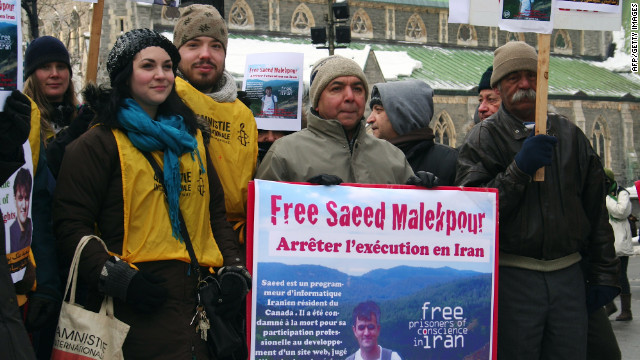
Supporters demonstrate in January for the release of Saeed Malekpour in Montreal, Quebec.
(CNN) — A computer programmer from Canada faces imminent execution in Iran for the actions of another person, which he had no control over, a human rights group says.
Saeed Malekpour wrote a program to upload photos to the Internet, an accomplishment that could cost him his life, Amnesty International reported Friday. Authorities in the Islamic Republic claimed his program was used by someone else to upload pornography and charged him with “insulting and desecrating Islam.”
Malekpour, who is a Toronto resident, was arrested in October 2008 while visiting relatives in Iran. He was convicted in a short trial and was sentenced to death in October 2011, according to Amnesty International.
Iran’s Supreme Court confirmed the sentence on January 17. Malekpour’s lawyers have been unable to ascertain the whereabouts of his court files since Tuesday and fear this could be an indicator that an executioner could carry out the sentence soon, Amnesty said. A court official suggested to the lawyers that the file had been sent to the Office for the Implementation of Sentences, according to Amnesty.
Malekpour sent a letter from prison detailing beatings and other mistreatment at the hands of Iranian prison officials to obtain a confession, said Hadi Ghaemi, executive director of the International Campaign for Human Rights in Iran.
“A large portion of my confession was extracted under pressure, physical and psychological torture, threats to myself and my family, and false promises of immediate release upon giving a false confession to whatever the interrogators dictated,” the letter says.
Malekpour’s supporters have created Facebook pages and websites in his support dating to at least 2009.
Amnesty International has requested on its website that concerned individuals write Iranian authorities inside and outside the country to demand that Malekpour not be executed.
Recent Comments
ExpatAlien on What Country am I Living … intlxpatr on Yellowstone: Old Faithful to C… Michelle on Yellowstone: Old Faithful to C… Cathy on No Grown-Ups in Charge intlxpatr on Waiting for Snow Wikipedia Donate Button

Amazina


Early Voting in Florida


 Here There and Everywhere