Pakistan’s Swat Valley Women Fight Back with Jirga
I love this. Women are using technology – and the traditional system – to persist in seeking justice for women who are often little more than slaves to their husband.

Tahira
Women in Pakistan’s Swat valley are making history, and perhaps some powerful enemies, by convening an all-female jirga, a forum for resolving disputes usually reserved for men. Some readers may find details of this report by the BBC’s Orla Guerin disturbing.
Tahira was denied justice in life, but she continues to plead for it in death – thanks to a grainy recording on a mobile phone.
As she lay dying last year the young Pakistan wife and mother made a statement for use in court.
In the shaky amateur video, she named her tormentors, and said they should burn like she did.
Tahira was married off at the age of 12 and died last year following a suspected acid attack
Tahira’s flesh was singed on 35% of her body, following a suspected acid attack. Her speech was laboured and her voice was hoarse, but she was determined to give her account of the attack, even as her flesh was falling off her bones.
“I told her you must speak up and tell us what happened,” her mother Jan Bano said, dabbed her tears with her white headscarf. “And she was talking until her last breath.”
Tahira’s husband, mother-in-law, and father-in-law were acquitted this month of attacking her with acid. Her mother plans to appeal against that verdict, with help from a new ally – Pakistan’s first female jirga.
Under the traditional – and controversial – jirga system, elders gather to settle disputes. Until now this parallel justice system has been men-only, and rulings have often discriminated against women. The new all-women jirga, which has about 25 members, aims to deliver its own brand of justice.
It has been established in an unlikely setting – the scenic but conservative Swat valley, formerly under the control of the Pakistan Taliban. We sat in on one of its sessions in a sparsely furnished front room. Women crowded in, sitting in a circle on the floor, many with children at their feet. Most wore headscarves, and a few were concealed in burqas.
Probing injustice
For more than an hour they discussed a land dispute, problems with the water supply, unpaid salaries, and murder. The only man in the room was a local lawyer, Suhail Sultan. He was giving legal advice to jirga members including Jan Bano who he represents.
“In your case the police is the bad guy,” he told her. “They are the biggest enemy. ” He claims the police were bribed by the accused, and were reluctant to investigate the case properly.

The jirga tackled land disputes, water supplies, and murder
The jirga is making history, and perhaps making enemies. In Swat, as in many parts of Pakistan, men make the key decisions – like whether or not their daughters go to school, when they marry, and who they marry. And oppression starts early. Tahira was married off at just 12 years old, to a middle-aged man.
“Our society is a male-dominated society, and our men treat our women like slaves,” said the jirga founder, Tabassum Adnan. “They don’t give them their rights and they consider them their property. Our society doesn’t think we have the right to live our own lives.”
This chatty social activist, and mother of four, knows that challenging culture and tradition comes with risks. “Maybe I could be killed,” she said, “anything could happen. But I have to fight. I am not going to stop.”
They glued [my daughter’s] mouth and eyes closed. Just her face was left, the rest was flesh and broken bones”
Taj Mehal
As we spoke in a sun-baked courtyard Tabassum got a disturbing phone call. “I have just been told that the body of another girl has been found, ” she said. ” Her husband shot her.” She plans to investigate the case, and push the authorities to act.
“Before my jirga women have always been ignored by the police and by justice, but not now. My jirga has done a lot for women,” she said.
There was agreement from Taj Mehal, a bereaved mother with a careworn face, sitting across the courtyard on a woven bed.
Her beloved daughter Nurina was tortured to death in May.
“They broke her arm in three places, and they strangled her,” she told me, putting her hands to her own throat to mimic the action. “They broke her collarbone. They glued her mouth and eyes closed. Just her face was left, the rest was flesh and broken bones.”
She speaks of her daughter’s suffering with a steady voice, but grief is wrapped around her, like a heavy shawl.
“When I looked at her, it was like a piece was pulled out of my heart,” she said. “I was turned to stone. I see her face in front of my eyes. I miss her laughter.”
Women are a rare sight on the streets of Mingora
Nurina’s husband, and his parents, have now been charged with her murder, but her mother says that initially the courts took no interest.
“Whenever we brought applications to the judge he would tear them up and throw them away,” she said. “Now our voice is being heard, because of the jirga. Now we will get justice. Before the jirga husbands could do whatever they wanted to their wives.”
Women are little seen or heard on the bustling streets of Mingora, the biggest city in Swat. Rickshaw taxis dart past small shops selling medicines, and hardware supplies.
There are stalls weighed down with mangoes, and vendors dropping dough into boiling oil to make sugar-laden treats. Most of the shoppers are men.
‘No justice’ at jirgas
When we asked some of the local men their views on the women’s jirga, the results were surprising. Most backed the women.
“It’s a very good thing,” said one fruit seller, “women should know about their rights like men do, and they should be given their rights.”
Another said: “The jirga is good because now finally women have someone to champion their cause.”
The response from the local male jirga was less surprising. They were dismissive, saying the women have no power to enforce their decisions.
Most local men who spoke to the BBC expressed support for the women’s initiative
That view was echoed by the prominent Pakistani human rights activist Tahira Abdullah. “I don’t see it as more than a gimmick,” she said. “Who is going to listen to these women? The men with the Kalashnikovs? The Taliban who are anti-women? The patriarchal culture that we have?”
Ms Abdullah wants jirgas stopped whether male or female. “The jirga system is totally illegal, and has been declared illegal by the Supreme Court of Pakistan. It can never be just. There are several extremely notorious cases where we have noticed that women do not get justice from jirgas, neither do non-Muslims.”
One of those cases took place last year in a remote region of northern Pakistan where a jirga allegedly ordered the killing of five women – and two men – for defying local customs by singing and dancing together at a wedding.
And there are regular reports of jirgas decreeing that women and young girls be handed over from one family to another to settle disputes.
But for some, like Jan Bano, the women’s jirga is bringing hope. Every day she climbs a steep hill to visit Tahira’s grave, and pray for the daughter whose voice has still not her heard. Her video recording was not played in court.
Justin Cronin: The Twelve
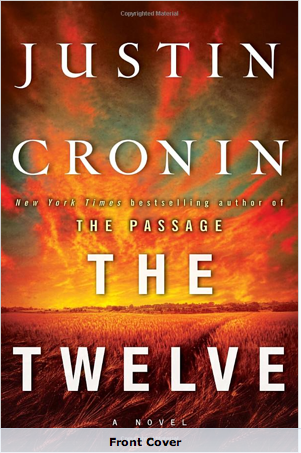
I had downloaded The Twelve to my iPad for a trip, but didn’t get to it, and sort of forgot it was there until my son mentioned he was listening to it on audio-books, and it was good, maybe even better than the first book in the trilogy, The Passage. He had loaned me The Passage several years ago when it came out, and as soon as I finished, I got on the list to download as soon as the next book came out – it was that good.
Cronin’s gift is an ability to create a future world entirely different from our own, with a devastating enemy – the virals – who, literally, are us, transformed. Cronin can make the enemy terrifying, destructive, truly horrifying – and can make them also captive to their repugnant nature and even pitiable. I think that is an amazing dance for an author to accomplish.
The setting is post-apocalyptic USA; the government had a sector working on a secret weapon which – of course – was not able to be contained, creating 12 super vampire-like creatures called Virals, who in turn create hordes of minions. This volume, The Twelve, is set more than 100 years later, but shifts back to earlier times to help us understand how this disaster occurred, and how characters relate back to the earliest times of the disaster. The populations live in fear of sudden attacks; one family, out on a picnic, are almost totally wiped out by an eclipse for which the Virals were prepared – and the families were not.
As I read his books, I find them very cinematic, but, as my son and I discussed, too complex for a movie; it would need a gritty HBO series like The Wire, or OZ, or Deadwood to capture the subtleties, the nuances that make this a best-selling series. The heroes and heroines are all make for the screen, their relationships – and inter-relationships – make them interesting, and then, as we learn more, interesting again. We never know enough to make a final judgement on any character; the characters are complex and the relationships obscure until the author chooses to reveal. It makes it fun to try to spot them before he tells us. I missed a couple!
Although it can be read as a great-adventure stand-alone, you’ll be happier if you read The Passage before you read The Twelve. If you have a problem with postponing gratification, you might want to wait until the third and conclusive volume of the trilogy is published – and that may be a year or so.
“Heavyweight Saudi Arabia” Influence Counters “Over-Stepping” Qatar?
From the Kuwait Times, a fascinating comparative analysis of the influence of Saudi Arabia and Qatar on Islamic countries in transitions:
Qatar losing ground to Saudi diplomacy

DUBAI: Qatar, a key supporter of Islamists who rose to power in Arab Spring countries, is losing ground in regional politics to Saudi Arabia which appears to have seized the reins on key issues, notably Egypt and Syria. The decline in Qatar’s regional diplomacy comes as its powerful emir Sheikh Hamad bin Khalifa Al-Thani unexpectedly abdicated in favor of his son Tamim last month.
The wealthy Gulf state had transformed itself into a key regional player but began to retreat as heavyweight Saudi Arabia re-entered the political arena after lagging behind in the immediate period following the eruption of the Arab Spring uprisings in December 2010. The ouster of Egypt’s Islamist president Mohamed Morsi last week by the army and the election by the Syrian opposition of Saudi-linked Ahmad Assi Jarba as new leader stripped Qatar of strong influence in both countries.
“Qatar had tried to take a leading role in the region but overstepped its limits by openly backing the Muslim Brotherhood in Egypt, Syria, and other Arab Spring states,” said Kuwaiti political analyst Ayed Al-Manna. Jonathan Eyal, head of international relations at Britain’s Royal United Services Institute, argued that Qatar’s regional politics have failed.
“Qatar’s Middle Eastern diplomacy now lies in ruins: it failed to produce dividends in Libya, backfired in Syria and has now collapsed in Egypt,” local Emirati daily The National quoted him on Tuesday as saying. Realizing the damaging effects of their policies, Manna noted, “the Qataris sought to cut down on their commitments” which were already affected by the emir’s abdication and the sidelining of the influential prime minister Sheikh Hamad Bin Jabr Al-Thani.
As a result, “Saudi Arabia, a historical regional US ally, regained its role” in coordination with other oil-rich Gulf monarchies, said Manna. Saudi Arabia’s King Abdullah was the first foreign head of state to congratulate Egypt’s interim president Adly Mansour, hours after he was named to replace Morsi. And on Tuesday, the kingdom pledged $5 billion in assistance to Egypt. The United Arab Emirates, which has cracked down on the Muslim Brotherhood in the past few months, offered Egypt an aid package of $3 billion.
“Saudi Arabia wants to ensure stability in Arab Spring countries, regardless of its ideological interests,” said analyst Abdel Aziz Al-Sagr, head of the Gulf Research Centre. “It had supported the Muslim Brotherhood in Egypt but reconsidered this support after the Brotherhood failed to run the country wisely,” he argued. But the Saudi researcher downplayed the rivalry between Saudi Arabia and Qatar, both of which have been looking to expand their influence during the Arab Spring uprisings and prevent any potential revolt against their own autocratic regimes.
“The Saudi-Qatari harmony still exists and there is no battle for influence between the two countries,” said Sager. And as proof, “Riyadh was the first to be informed of the political change in Qatar, six months before it took place. And it welcomed it.” But the two countries, whose relations have been historically tense or at least marked by mistrust, support two different approaches of political Islam that emerged strongly in the wake of the Arab Spring.
Qatar sides with political parties linked to the Muslim Brotherhood, whose experience was cut short despite the strong media support they enjoyed from the influential Doha-based Al-Jazeera news channel. Meanwhile, Saudi Arabia promotes Salafist groups that focus less on politics and more on implementing Shariah Islamic law on daily life matters such as forcing women to wear a veil and prohibiting the mixing between sexes. Saudi King Abdullah has reiterated his country’s stance against using Islam for political purposes.
“Islam rejects divisions in the name of one party or another,” he said in a statement marking the start Wednesday of the Muslim holy month of Ramadan. The kingdom will never accept” the presence of political parties, that “only lead to conflict and failure.” But regardless of the political agendas of Saudi Arabia or Qatar, the people who rose up during the Arab Spring revolts will have the final word on their own political futures, argued former Bahraini cabinet minister Ali Fakhro. “It is the Arab people, not Qatar nor Saudi Arabia, who will determine the political future of the region.” – AFP
“So There We Were, Two Naked Guys in the Shower and . . . . “
LOL, no, no, this is not going where you think it might go, but it got my attention, too!
AdventureMan was in the locker room with one of his exercise/aerobics buddies, cooling down from his water aerobics class when this story started, and was sharing the story with me later, at lunch, as we exchangin details of our mornings.
“. . . And he asked ‘do you know what today is?’ and I said ‘Yes! It’s the 63th anniversary of the beginning of the Korean War,” AdventureMan responded.
Guy talk. Guys discuss their combat experience in different wars. Combat is so intense, it imprints memories the way childbirth does in women, or a huge traumatic event, like the Iraqi invasion of Kuwait, or 9-11, or the Kennedy assassination, or the Tsunamis that hit Japan and washed entirely over the Maldives – experiences when the earth beneath your feet shifts, and things you once took for granted are shaken forever.
Who said guys don’t connect? AdventureMan has another old friend he needs to get in touch with today, to tell him he is thinking of him; Korean War veterans are largely forgotten in the tallying of combat in our country.
Pensacola is a wonderful place to be a military veteran. There is a Veteran’s hospital, and veteran-friendly policies at the clinics, commissaries and BX/PXx. Today we had lunch at Mellow Mushroom, where every Tuesday they give 20% off to all active duty and retired servicemen and women. Home Depot and Lowe’s give 10% off on every purchase, even plumbers, electricians, contractors, banks, theaters and many stores often give military discounts. And they thank us for our service. :0
To those of you who served in the Korean conflict: Thank you for your service.
And The Mountains Echoed by Khaled Hosseini
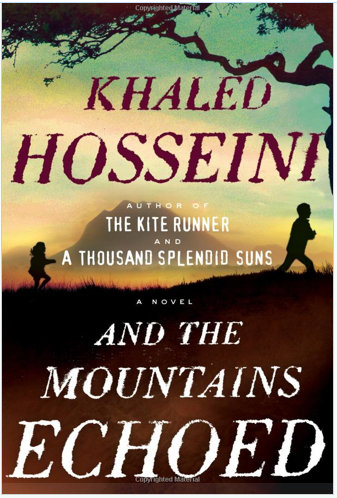
I danced when I saw the Amazon box; rarely do I buy hardcover (hurts too much when they fall over if I fall asleep reading, too bulky to carry on planes) but this one I was on the waiting list for, mail it as soon as it is published! Khaled Housseini, author of Kite Runner and A Thousand Splendid Suns has a new runaway best-seller; thanks to him I’ve just spent three days in Afghanistan, Paris and Los Angeles.
As the book opens, I am big brother to a baby sister whose Mom died in childbirth, living in a remote village in Afghanistan. Life is tough, but through the eyes of these children, life is idyllic, even though food is scarce and winters are cold. We have a huge oak tree with a swing, we play with the other children, and we have each other. Our father’s new wife is kind enough, but is busy with her own children, and the drudgery of cooking, cleaning and making do in a very small, poor Afghan village.
Later, I am Pari, living in Paris with an alcoholic, self-absorbed mother, making a life for myself, but always with a nagging feeling of something just outside my peripheral vision, another life . . .
The tale is told through the eyes of many, and on the way to the end of the tale we meet a wide spectrum of humanity, suffer the ills of war, callousness and unintended cruelties. We find that the man with superficial charm also saves and changes the lives of many, we find a doctor who finds fulfillment serving in the poorly resourced hospitals of Afghanistan, and we feel the agonies of a dutiful daughter watching her father fade into the world of Alzheimer’s.
It’s a wonderful, wild ride, richly textured, and when it finishes, you are not ready for it to end.
More Deaths than Birth for White Americans, a Minority in Three Decades
Don’t you love demographics? Demographics are a great forecasting tool, if you have the courage to use them. Demographics forced change on the United States military, forcing them to include women in more roles, recently increasing their job opportunities as the demographic pool dwindles. The same demographics are hurting the military budget now, as the huge bulge of baby-boomers retires, takes pensions and guaranteed free medical care, living a LONG time with more serious age-related illnesses, while the military struggles to allocate scarce resources.
Here is a fascinating factoid from The New York Times, a journal which notices small – but significant – changes, and gives us a little idea what the impact may be.

Census Benchmark for White Americans: More Deaths Than Births
By SAM ROBERTS
Published: June 13, 2013 232 Comments
Deaths exceeded births among non-Hispanic white Americans for the first time in at least a century, according to new census data, a benchmark that heralds profound demographic change.
The disparity was tiny — only about 12,000 — and was more than made up by a gain of 188,000 as a result of immigration from abroad. But the decrease for the year ending July 1, 2012, coupled with the fact that a majority of births in the United States are now to Hispanic, black and Asian mothers, is further evidence that white Americans will become a minority nationwide within about three decades.
Over all, the number of non-Hispanic white Americans is expected to begin declining by the end of this decade.
“These new census estimates are an early signal alerting us to the impending decline in the white population that will characterize most of the 21st century,” said William H. Frey, a demographer with the Brookings Institution.
The transition will mean that “today’s racial and ethnic minorities will no longer be dependent on older whites for their economic well-being,” Dr. Frey said. In fact, the situation may be reversed. “It makes more vivid than ever the fact that we will be reliant on younger minorities and immigrants for our future demographic and economic growth,” he said.
The viability of programs like Social Security and Medicare, Dr. Frey said, “will be reliant on the success of waves of young Hispanics, Asians and blacks who will become the bulwark of our labor force.” The issues of minorities, he added, “will hold greater sway than ever before.”
In 2010, according to the National Center for Health Statistics, more non-Hispanic whites died than were born in 11 states, including California, Florida and Pennsylvania. White deaths exceeded births in a majority of counties, including Los Angeles, the most populous.
The disparity between deaths and births in the year that ended last July surprised experts. They expected that the aging white population would eventually shrink, as it has done in many European countries, but not for another decade or so.
Nationally, said Kenneth M. Johnson, the senior demographer at the Carsey Institute, a research center based at the University of New Hampshire, “the onset of natural decrease between 2011 and 2012 was not anticipated.” He attributed the precipitous shift in part to the recession, adding that “the growing number of older non-Hispanic whites, which will accelerate rapidly as the baby boom ages, guarantees that non-Hispanic white natural decrease will be a significant part of the nation’s demographic future.”
Professor Johnson said there were 320,000 more births than deaths among non-Hispanic whites in the year beginning July 2006, just before the recession. From 2010 to 2011, the natural increase among non-Hispanic whites had shrunk to 29,000.
Census Bureau estimates indicate that there were 1.9 million non-Hispanic white births in the year ending July 1, 2012, compared with 2.3 million from July 2006 to 2007 during the economic boom, a 13.3 percent decline. Non-Hispanic white deaths increased only modestly during the same period, by 1.6 percent.
The census population estimates released Thursday also affirmed that Asians were the fastest-growing major ethnic or racial group. Their ranks grew by 2.9 percent, or 530,000, with immigration from overseas accounting for 60 percent of that growth.
The Hispanic population grew by 2.2 percent, or more than 1.1 million, the most of any group, with 76 percent resulting from natural increase.
The non-Hispanic white population expanded by only 175,000, or 0.09 percent, and blacks by 559,000, or 1.3 percent.
The median age rose to 37.5 from 37.3, but the median declined in Alaska, Hawaii, Kansas, North Dakota and Oklahoma. It ranged from 64.8 in Sumter, Fla., to 23 in Madison, Idaho.
The number of centenarians nationally neared 62,000.
Qatar Prepares For Leadership Transition as Emir Steps Down
Thank you Grammy, for forwarding this article from The Telegraph. Who knew? I thought the current Emir was looking slimmer and healthier than before, but maybe he just wants a quieter, more private life, and the prince is willing to take the reins?
We watched Doha go from a sleepy little seaside capitol to a skyscraper-laced booming natural gas economy. It was an amazing time to be living in Doha. Sounds like more changes may be in store.

By Damien McElroy, Foreign Affairs Correspondent7:00PM BST 09 Jun 2013
Senior figures in Qatar have briefed foreign counterparts that the time has come for Sheikh Tamim bin Hamad, the 33-year-old crown prince to take over the leadership of the gas-rich Gulf state, the Daily Telegraph has learned.
The succession plan, which is due to be launched by the end of the month, will see Hamad bin Jassim, the prime minister and one of the biggest investors in Britain, give up his post.
Within weeks of that decision the royal court will announce that the emir, Sheikh Hamad bin Khalifa, who has struggled with health problems, will cede powers to the Sandhurst-educated crown prince.
A prominent British visitor to the gas-rich Gulf state was told of the plans earlier this year and sources said other key states, including the US and Iran, have also been briefed about the succession.
“The plan is to manage a staged handover of power that allows the crown prince to come to the fore,” said one source with knowledge of the discussions. “The stakes are very high because Qatar is at forefront of events in a very sensitive region.”
Representatives of the Qatar government were not able to comment on the discussions about the emirate’s future leadership but analysts said any changes in Qatar’s leadership would have huge implications for the Middle East and Western foreign policy.
“The legacy of the emir and the prime minister has been to make Qatar a player in the world,” said Michael Stephens, a Gulf researcher at the Royal United Services Institute. “It was an outpost when they took over and now it has grown into a modern city, it is one of the biggest investors in Europe and Britain, has set up a very powerful Arab television station [Al Jazeera] and has a very prominent foreign policy. That is almost all down to the driving force of those two men.”
Sheikh Hamad, the emir, took power in a bloodless coup in 1995, taking advantage of his father’s absence on a trip to Europe. The charismatic monarch has overseen the transformation of the emirate, which lies just 21 miles from the coast of Iran. His glamorous wife Sheikha Mozah, who was last week seen at a charity function with the Prince of Wales at Windsor Castle, has been a symbol of women’s rights in the Arab world.
The resignation of Hamad bin Jassim has huge consequences for Britain even though he is staying as chief executive of the Qatar Investment Authority, an immensely well resourced sovereign wealth fund that recycles the emirate’s gas revenues.
He will continue to be the driving force behind the entity that owns Harrods and invested in prime property projects in London, including The Shard, Europe’s tallest building.
With a relatively tiny population of less than two million, Qatar is an outsized force in Middle East politics.
Although Sheikh Tamim is well known to diplomats and foreign officials, there are questions over the future direction of policies under the new leadership.
As a result of his education in Britain and Qatar’s role as the host of an American airbase, he has close links to Western militaries.
But observers point to his close alliance with the Islamist Muslim Brotherhood as a potential sign that he will not be as liberal as his father and the prime minister.
The country has spent liberally on supporting Islamist movements in the Arab Spring, playing a key role in providing arms and logistics for rebels in Libya, Egypt and Syria.
Recent Comments
Kitchen on Isiais: Winding Down intlxpatr on Shampoo Ginger tigerbutterya0c5ff1d… on Shampoo Ginger intlxpatr on British Soldier Kidnapped, Esc… John on British Soldier Kidnapped, Esc… Wikipedia Donate Button

Amazina


Early Voting in Florida


