French Intercede to Save Mali
Heard yesterday on NPR that France was stepping up to the plate on Mali, found the story on BBC this morning . . . it isn’t easy. It’s like people in the US don’t get news of countries like Mali unless they really seek it out. You can find more stories on Mali and the Tuareg / Al Qaeda alliance tormenting Northern Mali at the BBC link.


The Ansar al Din is imposing in Mali the kind of Islam that the Taliban imposed in Afghanistan – an Islam which forbids music, forbids women to participate in public life, enforced by a group of ignorant, uneducated thugs with weapons. Everything Ansar al Din stands for is contrary to the true nature of Islam.
Go France!
French troops continue operation against Mali Islamists
Mali: Divided nation
French Defence Minister Jean-Yves Le Drian said army units had attacked a column of rebels heading towards the central town of Mopti.
He also revealed that a French pilot had been killed in fighting on Friday.
The French troops deployed on Friday after Mali’s army lost control of a strategically important town.
Mali’s government said its forces had recaptured the town, Konna, after the air strikes, but it was not clear if all Islamist fighters had left the area.
‘Terrorist state’
Armed groups, some linked to al-Qaeda, took control of the whole of northern Mali in April.
They have sought to enforce an extreme interpretation of Islamic law in the area.
Regional and Western governments have expressed growing concern about the security threat from extremists and organised crime.
Mr Le Drian said on Saturday that hundreds of French troops were involved in the military operation in Mali.
The minister said Paris had decided to act urgently to stop the Islamist offensive, which threatened to create “a terrorist state at the doorstep of France and Europe”.
He also revealed that a French pilot was killed in Friday’s fighting – during an air raid to support Mali’s ground troops in the battle for Konna.
“During this intense combat, one of our pilots… was fatally wounded,” the minister said.
Speaking on Friday, French President Francois Hollande said the intervention complied with international law and had been agreed with Malian interim President Dioncounda Traore.
It would last “as long as necessary”, Mr Hollande said.
French officials gave few operational details.
Residents in Mopti, just south of Konna, told the BBC they had seen French troops helping Malian forces prepare for a counter-offensive against the Islamists.
Mr Traore declared a state of emergency across Mali, which he said would remain in place for an initial period of 10 days.
He used a televised address to call on Malians to unite and “free every inch” of the country.
‘Crusader intervention’
The west African bloc Ecowas said it was authorising the immediate deployment of troops to Mali “to help the Malian army defend its territorial integrity”.
UN Secretary-General Ban Ki-moon says the situation in Mali is becoming increasingly volatile
The UN had previously approved plans to send some 3,000 African troops to Mali to recapture the north if no political solution could be found, but that intervention was not expected to happen until September.
French Foreign Minister Laurent Fabius said the aim of the operation was to stop Islamist militants advancing any further.
It was not clear how far the French would go in helping Mali’s government retake territory in the north.
At least seven French hostages are currently being held in the region, and Mr Fabius said France would “do everything” to save them.
A spokesman for al-Qaeda in the Islamic Maghreb (AQIM) said he considered the French operation a “Crusader intervention”, and told France it would be “would be digging the tombs of [its] sons” if the operation continued, according to the Mauritania-based Sahara Media website.
France ruled Mali as a colony until 1960.
This chart is from a Blog called The Moor Next Door:

Saudi Government Informing ‘Responsible Male’ When Women Leave Saudi Arabia
Thank you, John Mueller, for this fascinating article from FRANCE 24:
Electronic tracking: new constraint for Saudi women – FRANCE 24
AFP – Denied the right to travel without consent from their male guardians and banned from driving, women in Saudi Arabia are now monitored by an electronic system that tracks any cross-border movements.
Since last week, Saudi women’s male guardians began receiving text messages on their phones informing them when women under their custody leave the country, even if they are travelling together.
Manal al-Sherif, who became the symbol of a campaign launched last year urging Saudi women to defy a driving ban, began spreading the information on Twitter, after she was alerted by a couple.
The husband, who was travelling with his wife, received a text message from the immigration authorities informing him that his wife had left the international airport in Riyadh.
“The authorities are using technology to monitor women,” said columnist Badriya al-Bishr, who criticised the “state of slavery under which women are held” in the ultra-conservative kingdom.
Women are not allowed to leave the kingdom without permission from their male guardian, who must give his consent by signing what is known as the “yellow sheet” at the airport or border.
The move by the Saudi authorities was swiftly condemned on social network Twitter — a rare bubble of freedom for millions in the kingdom — with critics mocking the decision.
“Hello Taliban, herewith some tips from the Saudi e-government!” read one post.
“Why don’t you cuff your women with tracking ankle bracelets too?” wrote Israa.
“Why don’t we just install a microchip into our women to track them around?” joked another.
“If I need an SMS to let me know my wife is leaving Saudi Arabia, then I’m either married to the wrong woman or need a psychiatrist,” tweeted Hisham.
“This is technology used to serve backwardness in order to keep women imprisoned,” said Bishr, the columnist.
“It would have been better for the government to busy itself with finding a solution for women subjected to domestic violence” than track their movements into and out of the country.
Saudi Arabia applies a strict interpretation of sharia, or Islamic law, and is the only country in the world where women are not allowed to drive.
In June 2011, female activists launched a campaign to defy the ban, with many arrested for doing so and forced to sign a pledge they will never drive again.
No law specifically forbids women in Saudi Arabia from driving, but the interior minister formally banned them after 47 women were arrested and punished after demonstrating in cars in November 1990.
Last year, King Abdullah — a cautious reformer — granted women the right to vote and run in the 2015 municipal elections, a historic first for the country.
In January, the 89-year-old monarch appointed Sheikh Abdullatif Abdel Aziz al-Sheikh, a moderate, to head the notorious religious police commission, which enforces the kingdom’s severe version of sharia law.
Following his appointment, Sheikh banned members of the commission from harassing Saudi women over their behaviour and attire, raising hopes a more lenient force will ease draconian social constraints in the country.
But the kingdom’s “religious establishment” is still to blame for the discrimination of women in Saudi Arabia, says liberal activist Suad Shemmari.
“Saudi women are treated as minors throughout their lives even if they hold high positions,” said Shemmari, who believes “there can never be reform in the kingdom without changing the status of women and treating them” as equals to men.
But that seems a very long way off.
The kingdom enforces strict rules governing mixing between the sexes, while women are forced to wear a veil and a black cloak, or abaya, that covers them from head to toe except for their hands and faces.
The many restrictions on women have led to high rates of female unemployment, officially estimated at around 30 percent.
In October, local media published a justice ministry directive allowing all women lawyers who have a law degree and who have spent at least three years working in a lawyer’s office to plead cases in court.
But the ruling, which was to take effect this month, has not been implemented.
Kuwait Celebrated Constitutional Jubilee with World Record Breaking Fireworks
Wooo Hooooo! And thank you, John Mueller, for forwarding this fabulous article. Holy smokes, it looks like double the number of viewers on the coast were in gridlock on the roads. For the original article, and to see a video of the fireworks live, go to Daily Mail:
Celebrating a golden jubilee Kuwait style: Gulf state spends £10million to put on the biggest firework display of all time
By PHIL VINTER
PUBLISHED: 21:12 EST, 10 November 2012 | UPDATED: 03:09 EST, 12 November 2012
For the paltry sum of just £10million Kuwait earned a place in the Guinness Book of Records last night as it celebrated the golden jubilee anniversary of its constitution in style by laying on the biggest fireworks display of all time.
A dazzling array of colours illuminated the skies above the country’s capital of Kuwait City as a staggering 77,282 fireworks were launched over the period of an hour.
A representative of Guinness World Records announced the achievement on Kuwait television at the end of the display which had been watched by tens of thousands of Kuwaitis and expatriates on the Arabian Gulf Road by the sea.
The visual presentation marked 50 years to the day since the late emir Sheikh Abdullah al-Salem al-Sabah announced that Kuwait had become the first Arab state in the Gulf to issue a constitution and have a parliament.
Before the festivities Emir Sheikh Sabah al-Ahmad al-Sabah pledged the government’s continuing commitment to democracy and made a plea for national unity as the wealthy Gulf state struggles with a political crisis.
Scroll down for video
 Exploding fireworks illuminate the sky over Kuwait City, Kuwait, last night, during celebrations on the occasion of the 50th Constitution Day jubilee
 The firework show which lasted for an hour was the largest of its kinds in the world and cost a reported £10million
 A dazzling array of colours illuminated the skies above the country’s capital of Kuwait City as a staggering 77,282 fireworks were launched over the period of an hour


A representative of Guinness World Records announced that the display was the biggest of all time on Kuwait television at the end of the display which had been watched by tens of thousands of Kuwaitis and expatriates on the Arabian Gulf Road by the sea
In the past 50 years parliament has been dissolved on nine occasions, while some articles of the constitution itself were frozen twice to suspend parliament for a total of 11 years in the 1970s and 1980s.
Last night’s celebration came as the government and opposition are locked in one of the worst standoffs in the country’s history, with the opposition accusing the government of staging a coup against the constitution.
More than 150 people and 24 policemen suffered minor injuries during three massive demonstrations held by the opposition to protest against the amendment of the electoral law ordered by the emir last month.
The opposition claims the amendment is in breach of the constitution and allows the government to influence the outcome of parliamentary polls due on December 1. It insists that the emir must repeal the amendment.
The opposition is marking the constitution anniversary with a huge rally in Kuwait City on Sunday.
Read more: http://www.dailymail.co.uk/news/article-2231223/Celebrating-golden-jubilee-Kuwait-style-Gulf-state-spends-10million-biggest-firework-display-time.html#ixzz2C1ZtoiKL
Follow us: @MailOnline on Twitter | DailyMail on Facebook
Election Day Fun
No more same old, same old. Today, Pensacola had a group of up-and-coming leaders from twelve African countries in town studying Grassroots Democracy and the US Elections. There is nothing like questions from non-US citizens to keep you on your toes and even give you a good laugh as you try to explain the eccentricities of our electoral system. This group, brought to Pensacola by the Gulf Coast Citizens Diplomacy Council, asked some great, probing questions.

Their questions were thoughtful and open-ended. At the end of the session, one delegate from Uganda summarized his observation that although we are deeply polarized in this election, we have confidence in our civil servants and the bureaucracy. While the leaders at the top may change, and while policies MIGHT change, they have to go through processes to change. It’s not like one leader or the other comes in and overnight, everything is changed, everything is done a different way.
AdventureMan says he loves that we live in a country where power is transferred peacefully – no coup. No revolution. We might have ugly elections, but they are peaceful, and when one triumphs, thousands of people supporting the losing side are not killed.
Had not thought about it that way. 🙂
These visitors are in Pensacola at just the right time for them to observe our biggest election. They have questions about everything, from the signs in our front yards to voter fraud and deceptive wording on proposed amendments. They talked today with the Supervisor of Elections, with elected officials, and with normal, everyday citizens. Tonight they will attend some of the parties around town, as the votes are counted. It is a very special experience for us, to see ourselves as others might see us, as we hold our elections.
Chris Rock: A Special Message for White People
You gotta love this guy – he is hilarious, irreverent and can find humor in a situation where some people are ready to come to blows:
watch?feature=player_embedded&v=EDxOSjgl5Z4
(I cannot make the image show; click on blue type to watch this video on YouTube)
By Secret Ballot
I hear people talking back and forth; feeling one another out. Most assume their friends will vote Republican; it’s Republican country up here in the westernmost part of Florida. Yards are littered with Romney – Ryan signs, with a few timid Obama signs here and here in a yard or on a car fender.

My Dad taught us, when we were very young, that the only appropriate answer when asked how one would vote is “I am voting by secret ballot.” He taught us how precious the right is to cast your vote and to know that no one can intimidate you into voting for someone else, because we vote by secret ballot. No husband can command his wife, no father can command his family, no minister can command his church. We each vote our individual conscience.
So we have the luxury of worrying whether we will vote the right candidates into office. We can only do the best we can with the information we have. I don’t want opinions, I want to see where a candidate stands on the issues that are important to me. And, in the end, I trust in the Lord:
Psalm 20
Now this I know:
The Lord gives victory to his anointed.
He answers him from his heavenly sanctuary
with the victorious power of his right hand.
7 Some trust in chariots and some in horses,
but we trust in the name of the Lord our God.
8 They are brought to their knees and fall,
but we rise up and stand firm.
9 Lord, give victory to the king!
Answer us when we call!
When I hear people moaning in the locker room, or jeering in the parking lot, I walk right by. It’s not my problem. I vote my conscience, and I leave the outcome in the Lord’s hands.
Romney Tax Plan
This is not meant to be a political endorsement; it is just that some people are so funny – this made me laugh out loud. Thanks Little Diamond 🙂
Your Vote – The Power of We (Blog Action Day 2012)
This year, in the United States we are going through a vicious process, that of choosing one candidate over another for political office. Many people are so put-off by the mechanics of the process that they opt out of the choosing altogether. Others are just too busy to vote, beset by the needs of family, job, car pool, church, social activities, etc. in spite of the ease with which one can ask for and receive an absentee ballot.
You need only live in a country where people have no meaningful vote to quickly learn the value of your vote. Your vote may be just one, but in a democracy, where just one vote can turn an election – your vote counts. Together, with other voters of your persuasion, your vote counts.
There has never been a country where women have the vote and men don’t. Sadly, the opposite is true; there are still countries where women are not considered fully qualified to vote. Less than 100 years ago, our own country was one of them. Yes, it’s true, we didn’t get the vote until 1920. I reprint the following from a post I wrote several years ago, a post I have never forgotten, because it was so shocking to me when I read the price these women paid that I might freely vote today.
“The doctor admonished the men: ‘Courage in women is often
mistaken for insanity.’”
We may have different preferences for who gets elected; that doesn’t matter to me. What matters to me is the power of we – that we care enough about our country and its policies to exercise our right as citizens, to get out there and vote.
This is reblogged from July 17, 2008:
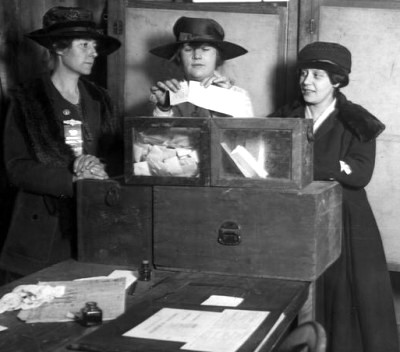
WHY EVERY WOMAN SHOULD VOTE
This is the story of our Grandmothers, and Great-grandmothers, as they
lived only 90 years ago. It was not until 1920 that women were granted
the right to go to the polls and vote.
Thus unfolded the ‘Night of Terror’ on Nov. 15, 1917, when the warden at
the Occoquan Workhouse in Virginia ordered his guards to teach a lesson
to the suffragists imprisoned there because they dared to picket Woodrow
Wilson’s White House for the right to vote. The women were innocent and
defenseless. And by the end of the night they were barely alive. Forty
prison guards wielding clubs and their warden’s blessing went on a
rampage against the 33 women wrongly convicted of ‘obstructing sidewalk
traffic.’
They beat Lucy Burn, chained her hands to the cell bars above her head
and left her hanging for the night, bleeding and gasping for air. They
hurled Dora Lewis into a dark cell, smashed her head against an iron bed
and knocked her out cold. Her cell mate, Alice Cosu, thought Lewis was
dead and suffered a heart attack. Additional affidavits describe the
guards grabbing, dragging, beating, choking, slamming, pinching,
twisting and kicking the women.
For weeks, the women’s only water came from an open pail. Their
food–all of it colorless slop–was infested with worms. When one of the
leaders, Alice Paul, embarked on a hunger strike, they tied her to a
chair, forced a tube down her throat and poured liquid into her until
she vomited. She was tortured like this for weeks until word was
smuggled out to the press.
So, refresh my memory. Some women won’t vote this year because–why,
exactly? We have carpool duties? We have to get to work? Our vote
doesn’t matter? It’s raining?
Last week, I went to a sparsely attended screening of HBO’s new movie
‘Iron Jawed Angels.’ It is a graphic depiction of the battle these women
waged so that I could pull the curtain at the polling booth and have my
say. I am ashamed to say I needed the reminder.
All these years later, voter registration is still my passion. But the
actual act of voting had become less personal for me, more rote.
Frankly, voting often felt more like an obligation than a privilege.
Sometimes it was inconvenient.
My friend Wendy, who is my age and studied women’s history, saw the HBO
movie , too. When she stopped by my desk to talk about it, she looked
angry. She was–with herself. ‘One thought kept coming back to me as I
watched that movie,’ she said. ‘What would those women think of the way
I use–or don’t use–my right to vote? All of us take it for granted
now, not just younger women, but those of us who did seek to learn.’ The
right to vote, she said, had become valuable to her ‘all over again.’
HBO released the movie on video and DVD. I wish all history, social
studies and government teachers would include the movie in their
curriculum. I want it shown on Bunco night, too, and anywhere else women
gather. I realize this isn’t our usual idea of socializing, but we are
not voting in the numbers that we should be, and I think a little shock
therapy is in order.
It is jarring to watch Woodrow Wilson and his cronies try to persuade a
psychiatrist to declare Alice Paul insane so that she could be
permanently institutionalized. And it is inspiring to watch the doctor
refuse. Alice Paul was strong, he said, and brave. That didn’t make her
crazy. The doctor admonished the men: ‘Courage in women is often
mistaken for insanity.’
Please, if you are so inclined, pass this on to all the women you know.
We need to get out and vote and use this right that was fought so hard
for by these very courageous women. Whether you vote democratic,
republican or independent party – remember to vote.
History is being made.
The War We are Losing: Assault of American Servicewomen
Shocking, and sad. What can be worse than serving your country and to be assaulted by a member of your own team? To double that shock and betrayal, to have the team captains bury your injury for the sake of the team?? I thank God for the gals that are taking their cases to civil court and making a stink. Sometimes, that is what it takes to make people pay attention.
I have a friend, a friend in her sixties. She has served in Iraq and Afghanistan as a civilian, and she has had senior officers stalk and attack her. She is disgusted that senior leaders could feel so entitled, and so free from constraints.
I can’t print this whole article here, but it is fascinating. You can read the entire article from Huffpost: HERE.
Active-duty female personnel make up roughly 14.5 percent — or 207,308 members — of the more than 1.4 million Armed Forces, according to the Department of Defense.
One in three military women has been sexually assaulted, compared to one in six civilian women, according to Defense. According to calculations by The Huffington Post, a servicewoman was nearly 180 times more likely to have become a victim of military sexual assault (MSA) in the past year than to have died while deployed during the last 11 years of combat in Iraq and Afghanistan.
According to the most recent report by the Pentagon’s Sexual Assault Prevention and Response Office, 3,192 sexual assaults were reported out of an estimated 19,000 — roughly 52 a day — between Oct. 1, 2010, to Sept. 31, 2011. The department estimates that only roughly 14 percent of the assaults were reported. The majority of sexual assaults each year are committed against service members by service members, SAPRO reports. While MSA does not affect only women, the office characterizes the “vast majority” of victims as female junior enlists under the age of 25, and the “vast majority” of perpetrators as male, older (under the age of 35) and generally higher-ranking.
Last Tuesday, Defense Secretary Leon Panetta ordered a sweeping review of all initial military training across the services: Army, Navy, Air Force, Marine Corps and Coast Guard. The move resulted in part from mounting pressure at Lackland Air Force Base in Texas, where at least 43 women have recently come forward as victims of sexual assault. Every aspect of training, from the selection of instructors who directly supervise trainees to the number of female instructors, is under consideration. And a day after Panetta issued the directives, Defense officials revealed that Jeffrey A. Sinclair — a brigadier general with five combat tours behind him — is facing possible courts martial on charges ranging from inappropriate relationships with female subordinates to forcible sodomy.
On Friday, Panetta called the military’s record on prosecuting MSA an “outrage.”
Panetta’s refrain for years has been heartening: “One sexual assault is too many.”
To which Havrilla responds, “This whole concept of ‘zero tolerance,’ it’s just words and no action.”
“You can’t leave. You can’t quit. You can’t walk away.”
We were in the military when the first women were sent to serve with formerly all-male battalions. There was a lot of controversy, and a lot of chagrin among the men. I think those first women were some of the bravest women ever. Almost forty years later, the battle is still being fought. Militaries attract the guys with high testosterone, the guys who don’t think the rules, laws and boundaries apply to them – and slowly, slowly, they have to be brought to understand that yes, the rules apply to them, and that forcible sex with another woman – or man – is OFF LIMITS. Bravo to those brave women who go public and create awareness and disgust for this problem. Evil whens men get away with this despicable crime.
Recent Comments
Kitchen on Isiais: Winding Down intlxpatr on Shampoo Ginger tigerbutterya0c5ff1d… on Shampoo Ginger intlxpatr on British Soldier Kidnapped, Esc… John on British Soldier Kidnapped, Esc… Wikipedia Donate Button

Amazina


Early Voting in Florida


