
Two Who Attacked US Consulate in Benghazi Arrested in Turkey?
“Turkish media are reporting the apprehension of two suspects in the Sept. 11 attack that killed the U.S. ambassador to Libya,” NPR’s Peter Kenyon reports from Istanbul.
He tells our Newscast Desk that:
“A Turkish television channel reports that the Tunisian men were apprehended at Ataturk Airport while trying to enter the country on fake passports. A Turkish newspaper added that the suspects were taken to an Istanbul police station for questioning. There was no immediate confirmation from the police, nor any details as to why the men are considered suspects in the attack.
“Ambassador Chris Stevens and three other diplomatic staff were killed in Benghazi. Although the violence began amid a protest against a video that mocks Islam, U.S. authorities later concluded that the Americans died as the result of a planned terrorist attack.”
As we reported Thursday, an FBI team spent about 12 hours at the attack site this week. In the three weeks since the Americans were killed, however, the consulate had been only lightly secured and it’s likely that much of the evidence was either taken away or disturbed.
Let’s hear it for facial-recognition software . . . .

Big Brother Exploring Crowd Control

I find this terrifying, on the lines of those loud, destructive aliens in that Tom Cruise movie about an invasion from outer space. Have you ever heard a noise so loud you couldn’t think? Couldn’t hear? Now imagine that noise in your mind! The potential applications for this technology whether for crowd control or warfare are appalling.
Microwave Ray Gun
Under a research contract from the U.S. Navy, microwave ray guns are being developed by Sierra Nevada Corp. that are designed to beam sounds directly into people’s heads at a distance of up to several hundred yards away. The device—dubbed MEDUSA (Mob Excess Deterrent Using Silent Audio)—exploits the microwave audio effect, in which short microwave pulses rapidly heat tissue causing a sound effect “loud” enough to cause discomfort or even incapacitation. While
supposedly intended for non-lethal use in crowd control, future military uses for this type of technology are sure to arouse the imagination.
Iran to Isolate Iranians from the Internet?
Engaget publishes the information that Iran intends to isolate Iranians in Iran from the global ‘net. Makes sense to me . . . if I am running a country where I don’t want my people exposed to what is happening in the rest of the world, when I want to create my own perceptions of reality, if I don’t want people adopting ways contrary to my own beliefs AND I have the power to enforce it . . . But does anyone in the world truly have the power to isolate a population?
It seems to me that the quickest way to encourage people to find a new way to do something is to try to make it impossible for them to do it. Forbidding access incites clever minds to find work-arounds . . .
So what kind of “Spring” happens in a country where strict fundamentalists have already taken over . . . ?
Iran announces plans to create isolated local internet system, fate of global access unknown
By Sean Buckley posted Sep 23rd 2012 6:07PM
Iranians have been having trouble accessing YouTube, Gmail and other Google services for some time now, but their digital world may be growing even smaller — Iran announced today that it plans to shuffle citizens onto its own domestic version of the web. Reuters reports that officials plan to connect citizens to the national information network that’s currently in use at government agencies. Iran hopes to complete the transition by March of next year, and is already taking steps to isolate its population from certain international services. “Google and Gmail will be filtered throughout the country until further notice,” an Iranian official added, noting that the ban would commence in “a few hours.”
Some locals, such as the Iranian Students’ News Agency, are attributing the ban to recent protests sparked by a trailer for an anti-Islamic film on YouTube called Innocence of Muslims, but the government has made no official comment on the reason behind the ban. The state isn’t clear on the fate of the global internet in Iran, either — although it has talked about creating an isolated national network before. Here’s hoping the new network will be a compliment to the Persian web, and not a substitute.
“I Want to See How they Handle the Israel Problem.”
AdventureMan zipped left across three lanes of traffic and into a parking lot.
“What are you doing?” I hollered, hanging on for dear life.
“Jordan Valley restaurant has a new sign up, a big map of the Middle East, and I want to see how they handle the Israel problem,” he answered.
That explains everything. No, really, it does. We’ve been married for a long time, I know what he means.
“Very clever,” we both agreed.

Libyans Say “Sorry” In Counter-Protests
I was living in Qatar, and the Libyan ambassador’s wife had invited me, along with several other women, to morning coffee. It’s what people did. I was sitting between one of my Libyan friends and my good Iranian friend, and I started laughing. I said “Oh, what is this good little American girl doing sitting between a Libyan and an Iranian?” and then we all laughed. We weren’t Libyan, or American, or Iranian, we were just women who liked each other; we got along.
We were all religious women. Not the same religion, but all believers in the Abrahamic tradition. I felt more comfortable with them than I felt around non-religious women. We had a lot of fun together, and we liked each other.

It breaks my heart when bad things happen, and I know how good these people are, and that the people on the attack have their own agenda which has nothing to do with Islam, or Christianity, and everything to do with power. If they prevail, I fear for my good friends.
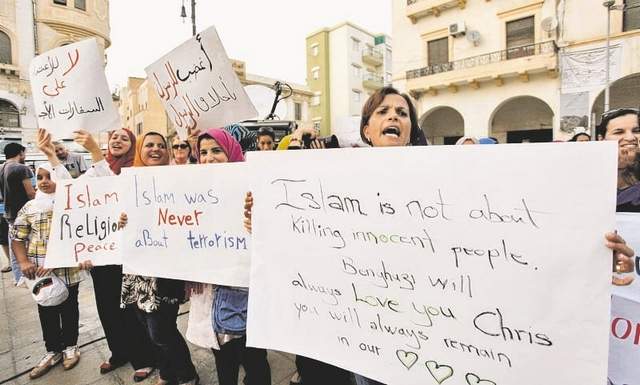
This article from USA Today made me cry this morning. Ambassador Stevens was loved, and these brave people are risking their futures to tell us so.
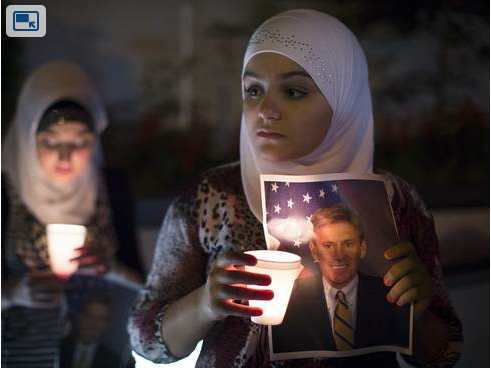
Libyans express sorrow over killing of Americans
by Donna Leinwand Leger, USA TODAY
Hours after learning of Ambassador Chris Stevens’ death, the Libyan Youth Movement transformed its Facebook page into a tribute to the slain diplomat. It changed its cover photo from “Free Libya” graffiti sprayed on a Tripoli wall to a somber photo of Stevens with the tag “RIP Christopher Stevens1960-2012.”
“As North America wakes up, dread washes over me. What a rough night. I’m sorry for the horrible day the world is about to face,” the administrator of the Shabab Libya page wrote. “We are sorry.”
As anti-American protests swept across North Africa and the Persian Gulf, a counter-protest of apology emerged. Photos of Libyans carrying hand-lettered signs condemning the violence and expressing contrition for their countrymen appeared on Facebook. “Sorry” became the trending mantra of Libyans on Twitter.
At one counter-protest, an unidentified man carried a crude sign phonetically written in English with blue marker on lined notebook paper, “Sorry People of America this not the Pehavior of our ISLAM and Profit.”
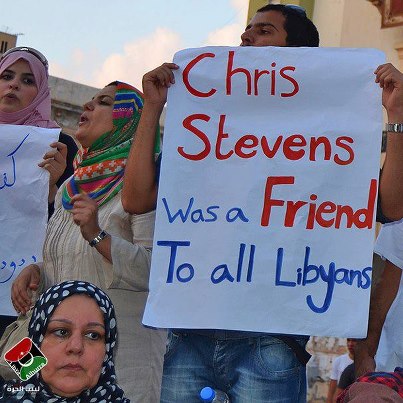
Another sign in red, white and blue read: “Chris Stevens wasa friend to all Libyans.”
On Facebook, one group formed The Sorry Project, designed to collect thousands of personal, written apologies from Libyans. Its profile photo is a man holding a sign, “USA. We are sorry. We are sad.”
“We Are Sorry,” the group wrote on the page created Sept.11. “We would like show that as Libyans we do not support on the actions committed by these criminals. USA, we are sorry and we will say it one thousand times over. Our apologies will never be enough, but the Libyan people will always be grateful for you since you were the first to stand by us in our fight for freedom and hopefully you will continue supporting us.”
One commenter, Hajer Sharief, vowed to avenge Stevens’ death by rebuilding a “new civilized democratic Libya.”
“We promise, we will not tire, we will not falter, and we will not fail,” Sharief wrote. “This is the way real Libyans will pay you back Mr. Ambassador Chris Stevens.”
At the ceremony Friday outside Washington to repatriate the remains of the four American victims, President Obama acknowledged Libya’s internal conflict.
“I know that this awful loss, the terrible images of recent days, the pictures we’re seeing again today, have caused some to question this work. And there is no doubt these are difficult days. In moments such as this — so much anger and violence — even the most hopeful among us must wonder,” Obama said. “But amid all of the images of this week, I also think of the Libyans who took to the streets with homemade signs expressing their gratitude to an American who believed in what we could achieve together. I think of the man in Benghazi with his sign in English, a message he wanted all of us to hear that said, ‘Chris Stevens was a friend to all Libyans.’ “
Salafi Led Crowd Attacks American Embassy in Tunis
Have you been watching the attack on the Embassy in Tunis?” my Mom asked as we were chatting. She and Dad had visited us in Tunis when we were stationed there. Dad rented a car, and then turned it back in when the driving was too scary for him. Mom let out the waists in all her dresses so they would be loose and flow-y in the hot September of Tunisia.
No, no I hadn’t been watching, I’d had a busy morning.
My memories of the Embaassy in Tunis are so sweet. Just off Place Pasteur, and pretty much everyone knew everyone. In the autumn months, the tiny embassy commissary sold avocados from one of the embassy employee’s trees, great huge avocados – not available any where else in Tunisia.
We lived near The Butcher with the Blue Awning, in Mutuelville, We lived in a villa surrounded by a family with 12 children, around our ages, who adopted us and especially me and our son. The women took me everywhere; it was one of the most memorable postings of my life. They took me to a local hairdresser to get ready for a wedding party; the style he gave me for the evening is a style I wear to this day, I loved it so much, sort of 1930’s French retro. There was one supermarket, and mostly it had canned tuna, canned tomatoes and sometimes fresh milk. We took our own containers to the olive oil man, and stood in line when a fresh shipment arrived. He would weigh our container, fill it, weigh it again and charge by the weight. Some of the best, freshest olive oil I have ever tasted and cooked with, and so inexpensive.
My heart breaks that this sweet embassy would be attacked. Salafist led, of course. When they cannot win the votes of the hearts and men, they resort to violence. AYB! AYB! (Shame! Shame!)
Tunisia Embassy Protest: Black Smoke Seen Rising Above Building
By BOUAZZA BEN BOUAZZA 09/14/12 05:43 PM ET
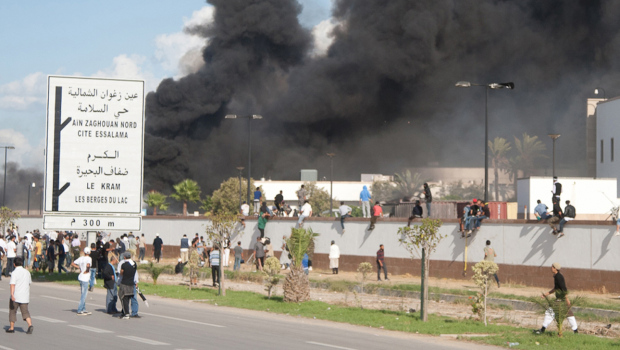
TUNIS, Tunisia — Violent protests outside the U.S. Embassy in Tunis against an anti-Muslim film were met with tear gas and gunshots Friday, leaving two people dead, around 40 others injured and plumes of black smoke wafting over the city.
Several dozen protesters briefly stormed the U.S. Embassy compound in Tunisia’s capital, tearing down the American flag and raising a flag with the Muslim profession of faith on it as part of the protests. Protesters also set fire to and looted an American school adjacent to the embassy compound and prevented firefighters from approaching it. The school appeared to be empty and no injuries were reported.
Earlier, several thousand demonstrators had gathered outside the U.S. Embassy, including stone-throwing protesters who clashed with police, according to an Associated Press reporter on the scene. Police responded with gunshots and tear gas. Police and protesters held running battles in the streets of Tunis. Amid the unrest, youths set fire to cars in the embassy parking lot and pillaged businesses nearby.
The state news agency TAP, citing the health ministry, said both of those killed were demonstrators, while the injured included protesters and police. Two of the injured were in critical condition, the health ministry said.
A Tunisian employee of the U.S. Embassy who had an injured leg was taken out on a stretcher to an ambulance. It wasn’t immediately clear if there were any other injuries. Embassy officials did not respond to calls and emails.
The group that breached the U.S. Embassy’s outer wall was eventually pushed back outside by a huge deployment of police and special forces. As night fell, the crowd of protesters outside the embassy dwindled to a handful.
The al-Wataniya 1 television station said the presidential guard also intervened and escorted the U.S. ambassador and about 80 embassy personnel away from the site to safety.
Crowds angry over an anti-Muslim film ridiculing the Prophet Muhammad have assaulted U.S. embassies across the Middle East.
The degree of violence in Tunisia surprised many and raised new questions about the direction of the country, where an uprising last year forced out its longtime president and set off pro-democracy revolts across the Arab world. A once-banned Islamist party came to power in elections last year, but the moderate government has struggled to quell protests by increasingly vocal ultraconservative Muslims known as Salafis.
By Tarek Amara
TUNIS, Sept 14 (Reuters) – At least two people were killed and 29 others were wounded on Friday when police fought hundreds of protesters who ransacked the U.S. embassy in Tunisia in their fury over a film denigrating the Prophet Mohammad, state television said.
Tunisian President Moncef Marzouki condemned what he called “an attack against the embassy of a friendly nation”.
Tunisia expects Washington to guarantee around a fifth of the $2.2-2.5 billion its needs to borrow next year to help its economy recover after its revolution last year overthew its veteran leader and triggered the Arab Spring uprisings.
A Reuters reporter saw police open fire to try to quell the assault, in which protesters forced their way past riot police into the embassy.
The protesters smashed windows, hurled petrol bombs and stones at police from inside, and started fires in the embassy and the compound. A black plume of smoke rose from the building.
One protester was seen throwing a computer out of a window, while others walked away with telephones and computers.
A Tunisian security officer near the compound said the embassy had not been staffed on Friday, and calls to the embassy went unanswered. A Reuters reporter saw two armed U.S. soldiers on the roof.
Health Minister Khalil Zaouia told state media at least two people died and 29 were injured, revising down an earlier toll from state television which said three died and 28 had been wounded.
The protesters, many of whom were Islamic Salafists, also set fire to the nearby American School, which was closed at the time, and took away laptops and tablet computers.
The protests began after Friday prayers and followed a rallying call on Facebook by Islamist activists that was quickly endorsed by the local faction of the Islamic militant group Ansar al-Sharia.
FLAG BURNED
An Interior Ministry spokesman said police were hunting Saif-Allah Benahssine, the leader of the Tunisian branch of Ansar al-Sharia to interrogate him about the incidents. Better known under the alias Abu Iyadh, Benahssine is also a prominent figure in Tunisia’s Salafist movement.
Libyan officials suspect the Libyan branch of Ansar al-Sharia of being behind an attack in Benghazi in which four Americans, including the U.S. ambassador to Libya, were killed on Tuesday.
The moderate Islamist Ennahda movement, which heads the Tunis government, had advised Tunisians against participating in the protest against the crude, low-budget film, made in California and trailed online, which portrayed the Prophet engaged in vulgar and offensive behaviour.
“The (Tunisian) government does not accept these acts of aggression against foreign diplomatic missions,” said a statement read on state television. It said Tunisian authorities were “committed to ensuring the safety of foreign diplomatic missions”.
Hundreds of protesters wielding petrol bombs, stones and sticks had charged at the security forces protecting the embassy before jumping a wall to invade the compound.
“Obama, Obama, we are all Osamas,” they chanted, in reference to the slain al Qaeda leader, Osama bin Laden.
The protesters pulled down the U.S. flag flying over the embassy, burned it, and replaced it with a black flag emblazoned with the Shahada, the Islamic declaration of faith.
Riot police finally drove the protesters from the embassy and the compound, and a Reuters reporter saw them arresting around 60.
The compound was cordoned off by police, soldiers and members of the elite presidential guard, but clashes continued in the el-Aouina district across a highway from the smart Auberge du Lac neighbourhood where the embassy is located.
Marzouki, in an address broadcast on state media, said he had spoke to U.S. Secretary of State Hillary Clinton and condemned the attack as “unacceptable considering its implications on our relations with” Washington.
“This attack is part of a wider plan aimed at stoking hatred between the people,” he said.
Blog Action Day 2012: Register Now!
I just registered for Blog Action Day October 15, 2012. Take part in a huge global discussion http://bit.ly/OtyYtE #BAD12
I love the theme they have chosen for this year: The Power of We 🙂
Hello Bloggers
Welcome back to Blog Action Day for 2012.
As previous participants of Blog Action Day, I am pleased to share with you three important announcements.
1. Blog Action Day will be held on October 15, 2012,
2. Our theme is “The Power of We” – you can use the #powerofwe hashtag, and
3. Registrations for Blog Action Day are now OPEN.
Why did we choose The Power of We?
We choose this theme for a few reasons.
Firstly, the popularity of the subjects Community, Equality, Transparency/Anti-Corruption and Freedom, in the theme poll we ran via Facebook and Twitter, over te last few weeks.
Secondly, we felt that Blog Action Day needed to reflect the ever growing movements of people working together for positive social change.
Whether using digital tools like blogs, social networks and mobiles, or meeting face to face in local community halls, neighbours house, andpublic streets. Greater numbers of people have been coming together to make change, either for their own communities or the world at large.
For the team at Blog Action Day, we see The Power of We as a celebration of people working together to make a positive difference in the world, and we hope you take part and register your blog for Blog Action Day.
Ideas for how you can discuss “The Power of We”
For Blog Action Day, you might profile a person or a group who inspire you, talk about your own efforts to make change, or highlight a cause that has been successful for using people power to make a difference.
There are hundreds of examples you could choose from such as; fighting for healthier meals for kids in schools, protecting people’s rights in countries far away, stopping practices in industries that hurt the environment and communities, challenging authorities to listen and act for the people.
Or, you may want to focus on historical social change movements such as the Suffragettes movement, campaigns against slavery or civil rights.
If you are active in a movement, you might even want to discuss the strategies and tips of how to organise to encourage other people to make change happen.
Getting ready for Blog Action Day
As Blog Action Day gets closer (just under seven weeks away) we will be sharing thoughts from our NGO partners, previous Blog Action Day participants and interesting individuals about our theme, and ask them to provide suggestions and materials that you can use for your blogs on October 15, 2102.
Also, over the next few weeks we will be increasing our communications with a weekly email, as well as regularly updates, content and opportunities via our website and social media channels.
The team at Blog Action Day can’t wait to see what you all blog about and we really hope that you enjoy taking part in Blog Action Day on October 12, 2012.
All the best
Karina and Jason and the rest of the Blog Action Day team
PS. Don’t forget to register for this year’s event via our website
James Lee Burke and the Creole Belle
James Lee Burke is number one on my guilty-pleasures list.

I first met his main character Dave Robicheaux in A Morning For Flamingos, a book I picked up in a military library at Lindsay Air Station, a post that doesn’t even exist any more. In the cold dark endless winter in Wiesbaden, Germany, James Lee Burke lit up my life. I had thought I was picking up just another escapist mystery novel, but when James Lee Burke puts words together to describe the way a storm moves in over the bayou, prose becomes poetry.
There is a downside. Whether it is his character Dave Robicheaux, the former New Orleans cop, now head homicide investigator in New Iberia, Louisiana, or his Hackberry Holland series set in West Texas, James Lee Burke’s books are filled with extreme violence and disturbing images that live in your head for a long time.
I’ve recommended James Lee Burke to friends, some of whom have said “Why do you read this trash??? It is HORRIBLE! It is full of over-the-top violence!”
And then again . . . he is writing about some really really bad people. They are out there. There are people who exist who inflict cruelty. I don’t understand it, I can’t begin to fathom where the urge would come from, but I’ve seen it. It’s out there. James Lee Burke pulls up that rock and exposes the dark happenings underneath.
On one level, as I started reading Creole Belle, I thought “Oh James Lee Burke, stop! Stop! It’s the same old formula! A downtrodden victim (often a beautiful woman) cries for help. You and Clete start looking for information and end up beating people up and then they retaliate by threatening your family! There is a rich, beautiful woman who seems vulnerable and who you kind of like, but she is complicated. There are rich amoral people who keep their hands clean, but who are calling the shots and never go to jail! Stop! Stop!”
Well, I should say that, and maybe I should stop. Then he starts talking about the smoke from the sugar cane fields and the bridge over the Bayou Teche, and the big Evangeline oak in St. Martinsville, and I am a goner. I’m sucked in, I’m hooked.
I detest the violence and the images. I keep coming back because James Lee Burke has some important things to say.
I’d love to have him to dinner. I’d love for him and our son to have a chance to talk about Law Enforcement. Here is what James Lee Burke has to say in Creole Bell:
There are three essential truths about law enforcement: Most crimes are not punished; most crimes are not solved through the use of forensic evidence; and informants product the lion’s share of information that puts the bad guys in a cage.
My son hates shows like CSI, and Law and Order, where the evidence convicts the criminals. He says it raises unreal expectations in juries, and makes it harder to get a conviction.
We watched a Violation of Parole hearing, or actually a series of hearings, where the judge asked each individual whose parole was about to be revoked what had happened when he or she was re-arrested. In each case, the parolee had done something stupid; drove a car with an expired license, drove to another state, was arrested driving drunk, etc. EVERY time. The judge made his point, I believe.
From Creole Belle:
But if Caruso was the pro Clete thought she was, she would avoid the mistakes and geographical settings common to the army of miscreants and dysfunctional individuals who constitute the criminal subculture of the United States. Few perpetrators are arrested during the commission of their crimes. They get pulled over for DWI, an expired license tag, or throwing litter on the street. They get busted in barroom beefs, prostitution stings, or fighting with a minimum-wage employee at a roach motel. Their addictions and compulsions govern their lives and place them in predictable circumstances and situations over and over, because they are incapable of changing who and what they are. Their level of stupidity is a source of humor at every stationhouse in the country. Unfortunately, the pros – high end safecrackers and jewel thieves and mobbed-up button men and second story creeps – are usually intelligent, pathological, skilled in what they do, middle class in their tastes and little different in dress and speech and behavior from the rest of us.
And then there are paragraphs like this that discuss the human experience, and have a far wider application than the book:
No one likes to be afraid. Fear is the enemy of love and faith and robs us of all serenity. It steals both our sleep and our sunrise and makes us treacherous and venal and dishonorble. It fills our glands with toxins and effaces our identity and gives flight to any vestige of self-respect. If you have ever been afraid, truly afraid, in a way that makes your hair soggy with sweat and turns your skin gray and fouls your blood and spiritually eviscerates you to the point where you cannot pray lest your prayers be a concesion to your conviction that you’re about to die, you know what I am talking about. This kind of fear has no remedy except motion, no matter what kind. Every person who has experienced war or natural ctastrophe or man-made calamity knows this. The adrenaline surge is so great that you can pick up an automobile with your bare hands, plunge through glass windows in flaming buildings, or attack an enemy whose numbers and weaponry are far superior to yours. No fear of self-injury is as great as the fear that turns your insides to gelatin and shrivels your soul to the size of an amoeba.
Last, but not least, this is what keeps me coming back to James Lee Burke, so much so that I buy the book almost as soon as it is released. James Lee Burke isn’t afraid to take on the big guys. He “gives voice to those who have no voices.” (Proverbs 31:8) His focus is always on the dignity of the common man, the dignity of hard work, done well, and on the dignity of doing unexpected kindnesses to those who have no expectation of kindness.
. . . All was not right with the world. Giant tentacles of oil that had the color and sheen of feces had spread all the way to Florida, and the argument that biodegradation would take care of the problem would be a hard sell with the locals. The photographs of pelicans and egrets and seagulls encased in sludge, their eyes barely visible, wounded the heart and caused parents to shield their children’s eyes. The testimony before congressional committees by Louisiana fisher-people whose way of life was being destroyed did not help matters, either. The oil company responsible for the blowout had spent an estimated $50 million trying to wipe their fingerprints off Louisiana’s wetlands. They hired black people and whites with hush-puppy accents to be their spokesmen on television. The company’s CEO’s tried their best to look ernest and humanitarian, even though the company’s safety record was the worst of any extractive industry doing business in the United States. They also had a way of chartering their offshore enterprises under the flag of countries like Panama. Their record of geopolitical intrigue went all the way back to the installation of the shah of Iran in the 1950’s. Their even bigger problem was an inability to shut their mouths.
They gave misleading information to the media and the government about the volume of oil escaping from the blown well, and made statements on worldwide television about wanting their lives back and the modest impact that millions of gallons of crude would have on the Gulf Coast. For the media, their tone-deafnessness was a gift from a divine hand. Central casting couild not have provided a more inept bunch of villains.
James Lee Burke has a voice, and he uses it. He could just cash in on his reputation as an Edgar Award winning author, but he uses his voice to speak out against injustice and corruption. He is a champion of the people. I’ve written several book reviews, and taken some trips just because I wanted to see James Lee Burke country; if you are interested in those, you can read them here.
I have a concern about this series, in that this book ended differently than all the others. So differently it made me seriously question whether Burke intends to continue writing about Dave Robicheaux or if Dave is about to hang up his shield and call it a day. He’s a guilty pleasure I am not yet ready to give up.
Recent Comments
Kitchen on Isiais: Winding Down intlxpatr on Shampoo Ginger tigerbutterya0c5ff1d… on Shampoo Ginger intlxpatr on British Soldier Kidnapped, Esc… John on British Soldier Kidnapped, Esc… Wikipedia Donate Button

Amazina


Early Voting in Florida


