Kuwait or Qatar or Pensacola?
Showering after my water-aerobics class, I could hear voices discussing a local political-social situation. A benefits agency has groups of families working in it, and they know all the tricks. They know how to insure more of their own family members hired, and they know how to help all their family members (and friends) take advantage of all the entitlements.
Expats abroad call it nepotism, and scorn it as a third-world corruption. In truth, it happens everywhere.
There is an ongoing schism taking place in Qatar and Kuwait, countries that have been gracious and welcoming to me. The nationals of Kuwait and Qatar control citizenship carefully. The citizen base is about 20% of the population, on a good day. The rest of the population are people who are in Kuwait and Qatar to work. Most there to work can never hope for citizenship. For many, the poverty in their home country is so brutal that no matter how hard the working conditions, at least it is a salary, and they can send something home so that, literally, their families can eat. They dream – like we do – of educating their children so that they will have a better, more secure life.
Here is the problem. When 80% of the population is NON-Kuwaiti, or NON-Qatari, your country starts to change. One way in which things have changes is that in a very short time, the highways have gone from very quiet to gridlock, due to a dramatic increase in drivers and cars. In Qatar, the situation is made worse by nationalization of the taxi service, resulting in so few taxis that hotels now use private limo services, because finding a taxi at peak times is near to impossible.
That’s one issue. The second issue is language. Imagine your elderly parents going into shops to buy something – in their own country – and the clerks don’t speak their language. As they are stumbling and bewildered, some noisy “workers” walk in, state their needs, are understood, conduct their business and exit before you even get served. This is happening in Kuwait and in Qatar; everyone is speaking English. In a country where the workers are Indian, Nepalese, Philipino, Saudi, Yemani, Omani, Lebanese, Syrian, French, Dutch, English, Australian, South African, American (and about thirty or forty others) the common language has evolved to be English, not Arabic.
How do you think you would feel if it were happening here? If the great majority of cars on the road were not “us” but “guests” in our country? If the clerks in stores couldn’t understand what you want, because although they are in your country, they don’t speak your language?
Another problem is what to do with the huge, disproportionate number of geographically single males brought in to work as builders, cleaners, heavy equipment operators, dishwashers, drivers, security guards and other fairly low-paid positions? In Kuwait and in Qatar, non-married sex is strictly forbidden, even holding hands in public is considered an affront to morality. These men are banned from malls where families might gather, and from other public places. Their existence is grim, and they often find themselves unpaid, or paid far less than they were promised for their labor.
Last, but not least, this very modest Gulf culture has people – foreign guest workers – parading themselves on their streets in various states of undress. Think about it – that’s how we look to them. We have no shame. We bare our faces. We flaunt the glory of our uncovered hair. Sometimes a shawl might drop and a glimpse of bare arm or even a hint of cleavage might shock the modest eyes of a believer.
In Pensacola, there are also fundamentalists who wear long skirts, long sleeves, and determinedly modest clothing. I wonder what these believers think about the skimpy clothing on the beaches, or in the malls?
Coming home has been a real eye opener. It was easy for me to be critical of things I saw in Qatar and in Kuwait. Coming home, we joke all the time about “Kuwaiti drivers” here in the US, but the real joke is – they sure look a lot like us.
Last week, we saw a man here make a U-turn right in the middle of the road, and rock as he tried to regain control of his truck, and almost blast right through a red light he didn’t see. The back of his truck was down, and items loose in the truck bed were heading toward the highway – fortunately he figured that out, and last we saw, he had stopped to fix his rear door. Maybe he wasn’t sober. Maybe he had had an argument with his wife or boss or someone and was not paying close attention to his driving. All I know is that we have seen a goodly number of inattentive drivers here, too.
When a bureaucracy gets corrupted, when the rules are not applied equally to all, when select groups get favored treatment – here in Pensacola, at the immigration department in Kuwait or in the traffic department in Qatar – everyone suffers. It’s a political problem, a social problem, and a systemic problem. God willing, if we are truly evolving as a species, we will find a way to create truly fair and transparent systems which will work as they are ideally intended to work.
It’s on us. We have to make it happen. We have to want it badly enough to make it happen, even making sacrifices for the greater good.
I don’t have any answers. I don’t know how to make us better people that we are, how to make ourselves make the right choices. I do know this – whether it is a tiny village in Germany, or an eagle’s aerie in Kuwait, or the lush life of Doha – we are all more alike, and share more similarities and problems, than we are different. If we could only learn to see through one another’s eyes, maybe we could find ways to resolve our differences and learn to cooperate.
Kuwait Bans Blackberry?
I have always loved politics. I don’t love politick-ing, I love watching what politicians do. One of the first rules, in my book, is “Don’t pass laws you can’t enforce.”
It’s pretty basic. Have you ever watched parents who tell their children over and over “Don’t do (whatever)” but they are too lazy to get off their big bottoms to go over and distract the child or to enforce penalties for misbehavior? What happens? The child does – or continues to do – what he or she wants, while the parent either gives up or escalates to a punishment out of proportion to the infraction.
Governments are the same. Don’t make a big noise if you don’t intend – or can’t – follow through. Don’t create penalties you can’t or won’t enforce.
Trying to ban Blackberries in Kuwait – LLLLLOOOOOOLLLLLLLLL! Trying to ban message services? These tech-savvy young people can run circles around the politicians and bureaucrats who try. This is a total hoot.
BlackBerry Ban Eyed
KUWAIT CITY, May 23: The Ministry of Interior is planning to stop BlackBerry Messenger (BBM) service and a decision to this effect might be issued within the next few days, reports Al-Shahid daily. A security source said the service cannot be controlled by the Ministry of Communications or security authorities and hence, users of BlackBerry sets were taking advantage to spread rumors and call for strikes.
He added that the ministry came to the decision after conducting studies and holding several meetings in the last fortnight. The three telecommunication companies in Kuwait, however, said they had not received any official request from the Interior Ministry so far.
Arab Times Online
Victory at the Shrimp Basket
This is a moral victory. AdventureMan and I ate at the Shrimp Basket last week and we DID NOT eat fried food! We tried their non-fried platters, AdventureMan had the grilled fish and shrimp, and I had the blackened fish and shrimps. I took the photo before eating! (another victory, woooo HOOOO!)
Yes, I did dip my shrimp in the melted butter. I could not resist. This is one of the best seafood meals I have had in a long time, it was totally delicious.

On the table was this sign:
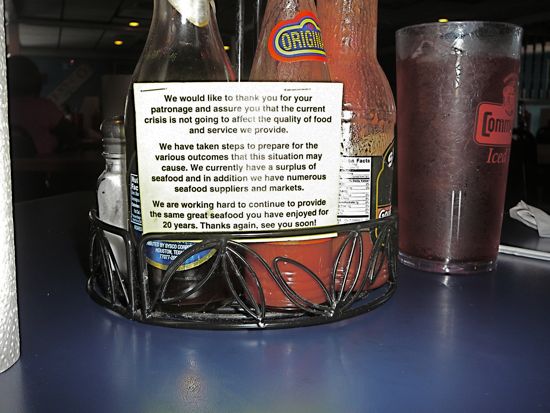
The oil has started coming ashore in Louisiana. It is thick and gooey, and it is sticking to the marshlands, clinging to delicate feathers on birds and suffocating wildlife. This is the beginning of a long, long, ugly process of trying to reclaim what nature never intended the oil to touch. It is devastating.
Music Banned in Somalia
We are in our own world these days, boxes needing unpacking, deliveries interrupting tasks, and no connection – no TV, no internet, no land line phone. We do have a cell phone, and Friday night our son called to ask us if we have heard about the weather.
Nope.
Heavy rains, strong winds, possibility of tornados. It was lively!
I hadn’t heard about Somalia, either.
This is really scary to me. This is the kind of thing I worry about in my own country – who makes the rules? Who gets to say what music I listen to, what movies I watch? Who gets to restrict my access to information?
Who gets to tell me that as a woman, I can’t have a checking account in my name? Or that I have to wear a burqa? Or that I am not allowed to wear a niqab (if that’s what I want?)
Somalia Radicals Declare Music ‘Un-Islamic,’ and Radio Goes Tuneless
POSTED: 04/25/10
If, as my colleague Sarah Wildman reports, the Francophonic world is intent on curbing expressions of fundamentalist Islam belief, then the radical Muslim world is taking no prisoners with the West, either. Last week, the Somalian fundamentalist Islamic group Hizbul Islam announced that music of any kind is “un-Islamic,” warning of “serious consequences” for those who dare to violate their decree. In response, radio stations all over the country, including those run by the moderate Muslim transitional government, cut all music from their broadcasts. Even intro music for news reports was scrapped. In its place? “We are using sounds such as gunfire, the noise of vehicles and the sound of birds to link up our programmes and news,” said one Somalian head of radio programming.
Get the new
PD toolbar!
Somalia has been wracked with inter-tribal violence for nearly two decades. In the last few years, increasingly radical Muslim militants, including the dominant Shabab group, have taken over large parts of the country and become closely affiliated with al-Qaeda. A moderate Muslim transitional government, helmed by a former teacher named Sheik Sharif Sheik Ahmed, controls a small part of the country. His government is largely propped up by African Union peacekeepers, with United Nations’ and U.S. support.
In the meantime, Islamic radicals like Shabab have gone on a campaign the New York Times described as “a quest to turn Somalia into a seventh century style Islamic state.”
The music decree follows a string of fundamentalist decrees, including prohibitions on wearing bras (also “un-Islamic”), the banning of modern movies and news channels, including the BBC and Voice of America.
As evidence of a power struggle between the moderate Muslim government and the hard-line radicals who control many parts of the country, Sheik Ahmed’s government responded last Sunday by saying any radio stations that stopped playing music would face closure. In the government’s eyes, those radio stations that complied with the ban were colluding with the radicals.
In the meantime, the radio stations have been caught between a rock and a hard place. “The order and counter-order are very destructive,” radio director Abukar Hassan Kadaf said in the Times article. “Each group are issuing orders against us and we are the victims.”
In the escalating tug-of-war between Western and Islamic powers over freedom of expression, what remains to be seen is how much of a causal relationship exists between the two. Is a proposed burqa ban in Quebec a result of the shuttering of a radio station in Somalia? Does a call for prohibition of headscarves in Paris force a bra-burning in Mogadishu?
If Islamic decrees do, in fact, fuel the fire for legal actions in the West (and vice versa), then continued and increased prohibition seems inevitable. But if radical Islam and a skeptical West are destined to one-up each other in a battle of bans, the powers that be might remember the men and women caught in the crossfire. That is, the women in the West who wear niqabs by choice, or the men and women in Somalia who just want to listen to music. What is perhaps most strikingly absent in all the brouhaha surrounding sharia vs. Western law are the voices of the moderate Muslims themselves. In the end, perhaps the gulf between the two sides will prove too great to be bridged, but for the immediate future, we would do well to remember the ground we share in common. Before there’s nothing left to ban.
Tax Day Tea Party in Pensacola
We don’t really understand the Tea Party. It is clearly against Obama, but then again, it is clearly the party of “against” and it is hard to find anything it is for. This is a problem; it is easy to tear down, and it is a lot more difficult to create – to formulate solutions which will provide benefits for the majority of participants.
As we were approaching our hotel, we saw this huge crowd of ‘protesters’ who appeared to be partying. But every sign was different! As 15 April is Tax Day, the day our income taxes are due, maybe about 10% were carrying signs that had to do with taxes, preferably NO taxes. The rest of the signs protested other things – constitutional amendments (what – women voting? black people being counted as full people? the repeal of prohibition?), no abortion, putting God first – it was a total potluck of causes.
The weather was mild, the sun was shining, there was a breeze – great day for an incoherent protest, LOL. I took pictures from the safety of our car, although everyone seemed very friendly:






Here is what cracks us up. Pensacola is a highly military reliant community. There is a huge military presence here, from Eglin Air Force Base to the Pensacola Naval Air Station. Pensacola is glad to have the military business. So where do they think the money comes from that pays the military salaries, and thus, gets spent in their economy, at their businesses? Few Americans have saved enough to comfortably retire, who do they think is contributing to their Social Security support, and Medicare, and Medigap? Tax dollars! Who do they think supports public education, and guarantees law and order? Who do they think runs the justice system? Who do they think provides emergency fire and medical services? Tax dollars! Who builds and maintains the roads and bridges, insures safety in our food supplies, construction and medicines? Our government, supported by our tax dollars!
Do I like paying taxes? No! Not one bit! But in the interest of the greater good, we pay our taxes honestly, and thank God to live in a society with order, thanks to our tax dollars.
Qatar Quits Instant Tourist Visa for US Citizens?
Rumor has it that The Government of Qatar recently informed the U.S. Embassy that as of May 1, 2010 U.S. citizens will no longer be able to apply for tourist visas on arrival in Qatar.
U.S. citizens who plan on travelling to Qatar after May 1, 2010 should contact their nearest Qatari Embassy (www.english.mofa.gov.qa) or the Ministry of Interior (www.moi.gov.qa/site/english) for details on how to apply for their visa.
That’s a fairly spectacular change, and sort of short notice . . .
Qatar Initiates Solar Energy Plan
Woooo HOOOO, Qatar, for not depending on a non-renewable energy source, but continuing to develop strategies for survival into the future. And Qatar definitely has an abundance of solar power. But then again – so does Kuwait.
Qatar to tap solar power in a big way
Web posted at: 3/2/2010 6:29:33
Source ::: THE PENINSULA/ BY SATISH KANADY
DOHA: Qatar is all set to tap its abundance of solar power. Two leading international agencies yesterday announced their decision to partner with two Qatari entities to produce the green energy in the country.
SolarWorld AG, one of the world’s largest solar companies, will partner with Qatar Solar Technology (QST), in which Qatar Foundation (QF) has a major stake. Separately, the Institute of Technical Thermodynamics, German Aerospace Centre (DLR), will partner with the country’s ambitious Qatar National Food Security Programme (QNFSP).
Qatar Solar Technology marks the entry of QF into the solar energy sector. QF will have a 70 percent stake in QST, with SolarWorld holding 29 percent and Qatar Development Bank the remaining one percent.
The initial investment in QST is valued at over $500m, QF said.
Through the joint venture, solar grade polysilicon, the essential ingredient of solar panels, would be produced in the first phase.
QST will develop a new plant in Ras Laffan Industrial City, in the northeast of Qatar, which will be one of the first operational polysilicon plants in the region. The plant will produce well over 3,500 tonnes per annum of the material and will be designed with future expansion in mind, which will enable it to significantly increase production capacity.
You can read the rest of the article, including contributions by Texas A&M, by clicking HERE
Americans Sing for the Liberation of Kuwait
My sweet Kuwait friend sent me this today. It made me cry.
We all have memories of the invasion. I remember it well. We had just moved to Tampa, AdventureMan was working with CENTCOM. He had just brought his very old grandmother to visit with us, and the next day, Iraq invaded, and his grandmother and I didn’t see him again!
We have had a long history with Kuwait, longer than our time living there. Kuwait matters to us. This song makes me cry; the effects of this invasion linger on, resonating and affecting so many lives:
Hey Ayatollah! Leave Those Kids Alone!
Every now and then I make a new friend. I can see in their eyes – life! love! willingness to engage and take risks! people who don’t necessarily see things the way the majority does.
One of these friends, my Kuwaiti friend, is a treasure. She has the most amazing mind, and sends me the most amazing things.
You might look at me and think I am too old for Pink Floyd, but you would be wrong. Pink Floyd makes my blood run faster. They did when I was younger, they did when my own son discovered Pink Floyd, and then, watching this video my friend sent – WOW. There goes the adrenelin!
OK, YouTube won’t let me insert it in this post. Go to the original post, play the video. . . very creative, very moving:
http://www.blurredvisionmusic.com/
Don’t you love young people? They love justice, and they hate injustice. They hate unnecessary constrictions. They hate people telling them how to think. All that energy, all that passion, all that vision!
Most of my friends – like AdventureMan, like my Kuwaiti friend – are still 25 on the inside. 🙂
Most of my friends will get this video – and love it! 🙂
It’s Good To Be The Amir :-)
One of the first things visitors say when I take them around Doha is “It’s so clean!” said in a voice of total wonder. Doha IS clean, noticeably clean. Along the Corniche, everything is clean – and manicured. Doha is beautiful. The roads are beautiful, and getting beautifuller – er . . . more beautiful.
Qatar is not a democracy. It has a monarch, the Amir. The Amir has huge resources, and he channels much of his resources into infrastructure – highways, water treatment, electricity, parks (along the Corniche, wireless internet is provided to the community, totally FREE, miles of free internet), education – and serious work is being done to raise the level of education and educational possibilities continually – planning for future food and water, trying to insure that if and when the gas runs out, Qatar will have a sustainable economy.
It’s not a job I would want. It’s a lot of hard work, and who do you trust to share your vision and help you get the job done? Every day must have its frustrations, and the triumphs take a lot of work and perseverance. Building a country’s infrastructure is not for the faint-hearted.
But the job has its perks, and one of them is that you can create your own viewing stand for the 0800 Friday morning military review parade. This reviewing stand makes me grin. This Amir has some Events people with a flair for the dramatic and a tip of the hat to the traditional at the same time. While some complain that the new souks are like Disney Does Doha, anyone who used to go there and goes there now will tell you that there is new life in the souks. They are clean and safe and light and well cared for.
Anyway, I digress.
Here is where the Amir gets to sit to review his military at the parade tomorrow morning at 0800:
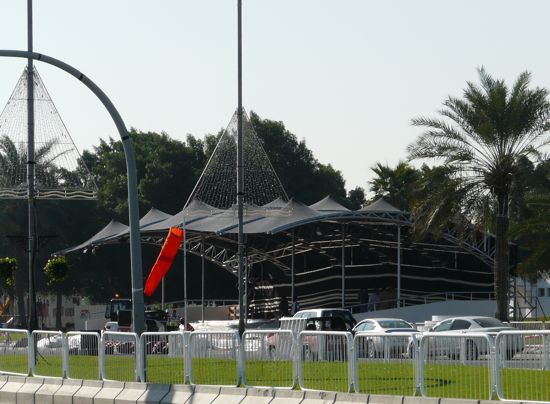
I was afraid to go any closer, as people were practicing for the parade, security might not like me taking photos, but how cool is this? They used original beit as-shar (house of hair, i.e. wool) fabric for the inner lining of the review tent. I totally love it. This fabric was originally made mostly from goat hair, but also stripes of sheep and camel hair. I have some. It’s tough and strong, and in panels, woven by the women. I don’t think they make tent bodies like this any more.
Recent Comments
ExpatAlien on What Country am I Living … intlxpatr on Yellowstone: Old Faithful to C… Michelle on Yellowstone: Old Faithful to C… Cathy on No Grown-Ups in Charge intlxpatr on Waiting for Snow Wikipedia Donate Button

Amazina


Early Voting in Florida


 Here There and Everywhere