Truthful Visitor on Doha Press
Do you ever visit QatarLiving.com? It’s one of those places where you can end up passing a lot of time, and it is also a place where there is both a lot of information and a lot of misinformation. There are some very good posts, and then there are some poseurs.
A recent Forum discussed the statement by Qatar Attorney General Dr Ali bin Futais Al Marri that “no one is above the law.” As forums often do, the threads segued into a discussion of freedom of the press in Qatar.
I almost split my sides, I was laughing so hard. I asked Truthful Visitor if I could print his post on this blog, and he gave me permission. I hope you enjoy it as I did. 🙂
Don’t you folks know that all the newspapers in Qatar are screened by the Ministry of Interior every evening before publication for the following day? Anything that doesn’t fit the required image is cut out.
Hence you always get the presence of evil (there’s always an Asian gang being deported for doing something dreadful like burglary or selling liquor) page 1, bottom of the page, that covers the Evil In Our Midst; then the sycophantic article about HH who has just made some pithy pronouncement on The Necessity For Mutual Understanding And Education Across The World, page 2; some phony figures about how much more the Pearl property or other investments have increased pages 3 – 5; some baloney about how safe the country is for investment, page 6; then the gushing op-ed about how the best societies in the world are so great because they have been enforcing Islamic values, pages 6 – 8; Qatar Airways wins award for best in-flight hot towels, page 9, and a new order for 500 Airbus aircraft (thanks to the strategic profitability of the airline! ha!) . And not to forget, Gulf Escapes Economic Downturn for the fourth week in a row, page 10 ad infinitum.
The Filipina maids found dead and decayed in the desert? The photos of the police when they turn the water cannons on the labour camps outside the Industrial Area? Oh no. Those photos were seized under duress. These things are just not family -friendly, now are they?
If it doesn’t fit the great narrative of Qatar, it’s not really news!
Thank you, Truthful Visitor. (truthfulvisitor/-a-t-/me.com)
“It Was a Mistake!” The Fall of the Wall
BBC News reports today that while the ease in travel restrictions was planned, the way it happened – was a mistake!
When the Berlin Wall opened on 9 November 1989 Brian Hanrahan was the BBC News reporter on the ground. This year he’s been back to talk to some of those whose decisions made this key moment in 20th Century history possible.
From the safe distance of 20 years, the opening of the Berlin Wall can be seen as inevitable – the natural consequence of changes that were reshaping Europe. But for most of 1989 it was unthinkable.
And the decision itself was an accident – intended neither to happen the way it did nor to spark off the tumultuous changes that followed.
I heard the inside story of what started this extraordinary rush of events from one of those who made the decision in the East German Politburo – the communist party’s ruling body.
With hindsight, it’s the border guards we must thank
Politburo reformer Hans Modrow
Hans Modrow was a communist reformer in the Gorbachev mould. He had only just been given a place on the Politburo as East Germany’s leaders tried to head off the demands for change that were sweeping the country. But as a new boy his opinions counted for little.
He remembers an agitated discussion about the travel restrictions – the laws which banned most East Germans from leaving the country and which had sparked off the popular discontent.
At the end of it the party leader, Egon Krenz, suddenly produced a new set of regulations. From now on it would be much easier for East Germans to travel.
What annoyed Mr Modrow was the autocratic way in which the Communist Party still did business. “We couldn’t change anything, he says, We sat there like stupid little boys. We just had to do what we were told.”
‘Blurted out’
But now came a blunder that would bring down the Berlin Wall and the East German state with it.
The intention was to announce the changes overnight and phase in the new rules the next morning. Instead one of the Politburo members, Guenter Schabowski, blurted out the plans during a televised press conference – and compounded his error by adding the new rules would come into force “immediately”.
Live press conferences were a novelty in communist days, and Mr Schabowski was becoming something of a celebrity through his appearances. Mr Modrow is still scathing about Mr Schabowski’s preening in front of the media.
The Politburo announce the decision to allow people to cross the border
“The order wasn’t to be published until 0400 in the morning. But Mr Schabowski didn’t notice. He went into an international press conference. And he was so arrogant and full of himself. We had no idea this was happening.”
Mr Schabowski’s announcement was complicated and bureaucratic, and like many others that evening I puzzled over it before concluding that it signalled free travel. If this was true it would mean the end of the Berlin Wall because the whole fearsome structure with its watchtowers, barbed wire and guard dogs had become redundant.
East Berliners were rather quicker off the mark. Tens of thousands of them started turning up at the border demanding to be let across.
But the guards hadn’t been told anything – their standing orders were to stop anyone crossing. Until recently they’d been instructed to shoot to kill anyone who tried.
This night they tried to turn people back – but after a generation being pushed about Berliners turned belligerent and refused to go.
Stunned guards
The standoff between the armed guards and the angry crowds soon grew tense and dangerous.
The guards asked their headquarters for orders but the government ministries in charge of security told them nothing. Mr Modrow and the other Politburo members had gone home unaware of what was going on.
With radio and TV reports bringing more people on to the streets, Mr Modrow says it was the border guards themselves who decided what to do.
“With hindsight it’s the border guards we must thank, not any of us in the Politburo. The guards on the ground – at the time – made the critical decision. They ignored their standing orders. They said, ‘Open the border.'”
I arrived at the main border post just in time to see the barriers swing open as the guards gave up any attempt to regulate the crossing. They looked stunned at the mass of people streaming past them. Their whole world was collapsing about them.
But if East Germany’s leaders were ignorant of what was happening, the rest of the world was already watching on television.
In Washington, James Baker was at lunch with the President of the Philippines, Cory Aquino, when he was told the news. A short while later, hearing that people were taking sledgehammers to the wall, he abandoned the table and hastened over to the White House.
Changed world
There he and President Bush were taken aback at what they saw. They’d had no warning. “It was happening before our eyes. Maybe the Soviet leadership saw it coming but I don’t think anyone in allied capitals anticipated it happening with that speed.”
And Mr Baker admitted candidly that he was daunted by the scale of the task ahead in reshaping world alliances. As the West’s chief diplomat he would have to do most of it. “The world as I had known it all my adult life changed that day, and it changed fundamentally. I had grown up with the Cold War. Everyone in my generation had.”
In the Kremlin the man most responsible for the change slept through it. The Soviet leader had been tipped off a few days earlier about the way the East Germans were thinking.
Mr Gorbachev chuckled as he remembered the rush to tell him what had happened. “They reported to me quite early in the morning. They were in a hurry to let me know. We had been expecting it to happen. It could have happened at any time.”
And he was matter-of-fact about the consequences. “I took note of the report. It moved us on to a new phase. Not that I was enthusiastic about it, but I accepted it as something that had to happen. We understood that the time was coming for the German problem to be addressed.”
In London Douglas Hurd had been foreign secretary for just 15 days. He noted the news from Berlin in his diary. “The regime and now the wall are crumbling fast,” he wrote. But he was already wondering how he could persuade the Prime Minister, Margaret Thatcher, to consider the idea of a united Germany.
Berliners were only just opening the bottles of sparkling Sekt at the beginning of a street party that would last for days. Many were still uncertain what exactly was happening.
But in a few short hours they had changed the contours of world politics and there could be no going back. The inevitable, unthinkable accident had happened.
Debate on Media Freedom in Doha, Qatar
From today’s Gulf Times:
Debate on Qatari press law
The Doha Centre for Media Freedom (DCMF) will hold a roundtable discussion on the Qatari press law that dates back to 1979, on Wednesday, at The Ritz-Carlton Doha, an official said yesterday.
According to the official, under the discussion will be the need for a Qatari media, and the view concerning modification and changes to the accrual Press Law, in order for it to match the requirements of the current era.
Discussions will be moderated by DCMF deputy director general Maryam al-Khater, while senior media officials of the country, editor-in-chiefs, senior journalists, heads of media organisations and others are expected to be in attendance.
After an introductory presentation of the most-recent study prepared by DCMF on the Press Law, comprising recommendations, suggestions, and analyses, the floor will be opened to what is expected to be a “vigorous debate”, the official said.
“The DCMF calls on all media specialists to exercise their right of expression by participating in this gathering and sharing their thoughts about the possibility of amending the negative provisions of the law for journalists’ rights as well as adding provisions which respond to their ambitions,” the official added.
The event coincides with the National Day for Human Rights, which falls on November 11 every year.
There was an earlier report, on June 24th, that most of the original members of the DCMF had resigned:
Media Freedom Centre team leaves office
DOHA: Robert Ménard, director- general of the Doha Centre for Media Freedom and his team have left the Centre.
“We no longer have either the freedom or the resources to do our work,” said Menard, in a statement issued yesterday.
The heads of the assistance, research and communications departments have also left the Centre, said the statement.
The Center was set up on the initiative of H H Sheikha Mozah bint Nasser Al Missned and Reporters Without Borders in December 2007.
Ménard, who became director-general on April 1, 2008, was the founder of Reporters Without Borders, which he headed for 23 years.
I imagine this is going to be a very interesting “vigorous” debate, of interest to all those who write – or blog – on Qatar. One of the things I notice in both Kuwait and Qatar is that in the interest of self-preservation, the newspapers self-censor. For example, when a crime is committed, if it is an Asian, or even, rarely, a westerner, the name of the criminal can be printed. If it is a local citizen, they do not print the names, not ever, unless it is a rare case where the defendant is convicted and appeals – on rare occasions, the name will appear then. In order to spare the family the embarrassment, I have been told, but I would think that the fear of embarrassing the family would have a strong deterrent effect on young men, for example, who think it is OK to abduct, rape and humiliate young men and women, without fear of having their crime made public.
In Kuwait, they publish the crimes committed, at least. In Qatar, you would think from reading the papers, that these crimes don’t exist. They do. They aren’t reported.
I think it is very cool that in Qatar, many of these issues are opened for public debate, as in this media debate, and in the ongoing Doha Debate series.
November 9, 1989 The Fall of the Wall
Twenty years ago tomorrow, and I still hold my breath in wonder.
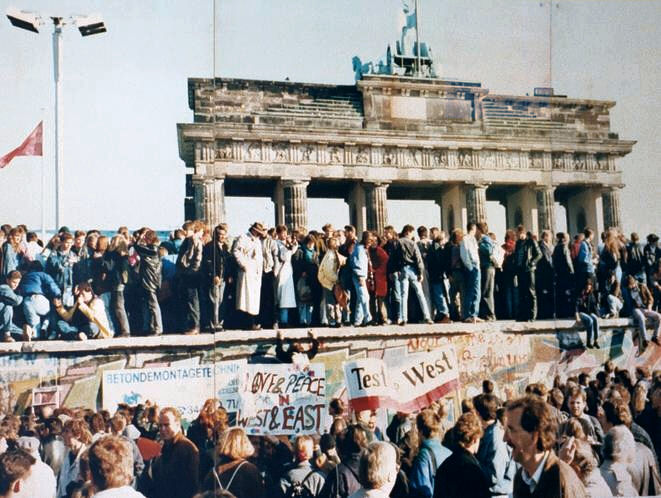
I was doing a very untypical thing for me – I was headed for the Czech border with three military-wife friends, to buy crystal. There was an unusual amount of traffic, all coming from the border, and the cars – not the normal beautiful cars you find on the German autobahns, but the fiberglass cars coming out of the Soviet Union and Eastern Bloc – miles and miles and miles on end, all headed West.
When it happened, we didn’t have a clue. There had been rising signs of unrest in the East, but that happens, and has always been ruthlessly put down.
The US had been in Germany forty years. In the most recent years, all the posts and all the military housing had undergone significant updatings – significant and expensive. If you asked anyone about the possibility of the wall coming down (Berlin Wall, for those of you who were not alive) they would just laugh.
“We’ll be here forever,” they would say.
So too, would Germans say.
“We’ve been divided for too long. We think differently,” they would say “We could never be re-united.”
In one joyful night, that all changed. As we reached our stop and went for dinner in our Gasthaus, the television showed the cars flowing over the borders, and the young dancing on the wall in Berlin. It was one of those rare occasions when the world held it’s breath in wonder and amazement; we did not know this was a possibility. Such joy!
Germany has struggled to make the reunification work. Even now, in the west, Germans will gripe about how all their tax monies are going to the east, and those from the east are taking their jobs, but in essence, the reunification has been a success, and the greater Germany is an amazing fact-of-life I never thought I would see in my life.
I still celebrate November 9th in my heart. Twenty years! It seems like yesterday.
The Social Contract
Without accountability, does the social contract exist?
Wikipedia on the Social Contract:
Social contract describes a broad class of theories that try to explain the ways in which people form states and/or maintain social order. The notion of the social contract implies that the people give up some rights to a government or other authority in order to receive or maintain social order through the rule of law. It can also be thought of as an agreement by the governed on a set of rules by which they are governed.
Social contract theory formed a central pillar in the historically important notion that legitimate state authority must be derived from the consent of the governed. The starting point for most of these theories is a heuristic examination of the human condition absent from any structured social order, usually termed the “state of nature”. In this condition, an individual’s actions are bound only by his or her personal power, constrained by conscience. From this common starting point, the various proponents of social contract theory attempt to explain, in different ways, why it is in an individual’s rational self-interest to voluntarily give up the freedom one has in the state of nature in order to obtain the benefits of political order.
Exporting Trash to Poorer Countries
From The New York Times, where you can read the entire article on exporting trash by clicking here
By ELISABETH ROSENTHAL
Published: September 26, 2009
ROTTERDAM, the Netherlands — When two inspectors swung open the doors of a battered red shipping container here, they confronted a graveyard of Europe’s electronic waste — old wires, electricity meters, circuit boards — mixed with remnants of cardboard and plastic.
“This is supposed to be going to China, but it isn’t going anywhere,” said Arno Vink, an inspector from the Dutch environment ministry who impounded the container because of Europe’s strict new laws that place restrictions on all types of waste exports, from dirty pipes to broken computers to household trash.
Exporting waste illegally to poor countries has become a vast and growing international business, as companies try to minimize the costs of new environmental laws, like those here, that tax waste or require that it be recycled or otherwise disposed of in an environmentally responsible way.
Rotterdam, the busiest port in Europe, has unwittingly become Europe’s main external garbage chute, a gateway for trash bound for places like China, Indonesia, India and Africa. There, electronic waste and construction debris containing toxic chemicals are often dismantled by children at great cost to their health. Other garbage that is supposed to be recycled according to European law may be simply burned or left to rot, polluting air and water and releasing the heat-trapping gases linked to global warming.
While much of the international waste trade is legal, sent to qualified overseas recyclers, a big chunk is not. For a price, underground traders make Europe’s waste disappear overseas.
After Europe first mandated recycling electronics like televisions and computers, two to three tons of electronic waste was turned in last year, far less than the seven tons anticipated. Much of the rest was probably exported illegally, according to the European Environment Agency.
Paper, plastic and metal trash exported from Europe rose tenfold from 1995 to 2007, the agency says, with 20 million containers of waste now shipped each year either legally or illegally. Half of that passes through this huge port, where trucks and ships exchange goods around the clock.
When we were blogging about pirates in Somalia, a Somali wrote in that part of the problem was that rich western countries were dumping toxic trash off the coast of Somalia and damaging the traditional fishing wealth of the country. Once trash is exported, there is no telling where it will be dumped, or what problems we are causing for our descendants down the road. I can’t help but think that we reap what we sow – and that we need to be paying attention to what we are dumping and where we are dumping it.
Obama and Dreams From My Father
It took me 20 days, but I finished Barack Obama’s Dreams From My Father. I didn’t read it because he is President of the United States, although that would be a good reason, but I read it because our book club is reading it, and I know how busy the next few months are going to be, so I read ahead during the slower times of summer.
And the trick to finishing it was not allowing myself to read anything else until I had finished – I had a stack of really intriguing books to urge me on. “As soon as I finish, I can read . . . ” Even with all that incentive, Obama’s book is a slog.
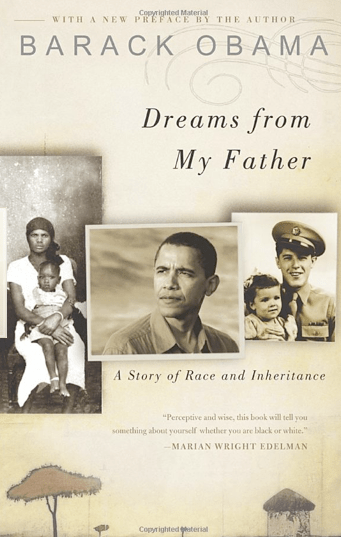
He is a gifted orator. He is a plodding writer. There is also a problem I find with autobiographies by anyone – we all fool ourselves, we all position ourselves in a better light, and we have no idea how transparent we are when we do so. Fellow bloggers, do you ever read anything you have written a couple years ago and squirm with embarrassment, or even delete? To be an author is a very very brave thing, when you have a book published, there is no going back, your transgressions are all right out there, and the public can be cruelly critical.
What I liked about the book is Obama-as-Third-Culture-Kid, a man of mixed identity. Most kids who have grown up moving or grown up in different countries from their own, or who have immigrated, can tell you, being an alien is no fun. Obama learns how to adapt, how to look for clues to fitting in, how to pass. It’s a common theme in Third-Culture-Kids.
My favorite part of the book was his return to Kenya, his openness to his African roots, the open-armed love with which his Kenyan half-brothers and sisters welcome him and his response. He had some truly extraordinary adventures, working out just who his father had been as a person. He was blessed to recognize the richness of his inheritance.
The book plods along, but it was worth the time. For all it’s flaws, I find I like that man, and I understand more about where he is coming from. (for grammarians, I understand more about from where the man is coming.) 🙂
Today’s News from Doha
It’s a very brave thing to take an honest and open look at the serious problems confronting any society.
Report on domestic workers by year-end
Web posted at: 6/24/2009 2:49:44
Source ::: The Peninsula.
DOHA: The first national survey on domestic workers in Qatar will be completed soon and the findings will be announced by the end of this year, a senior official of the Qatar Foundation for Combating Human Trafficking, the organisers of the study, has said.
On Monday, the Foundation signed a memorandum of understanding (MoU) with the Doha International Institute for Family Studies and Development for collaboration between the two bodies in carrying out the survey. The MoU was signed by Mariam Al Malki, director of the Foundation and Richard Wilkins, managing director of the Institute.
Speaking on the occasion, Al Malki said the survey which is the first of its kind in the region, aimed at identifying the problems of domestic workers in the country and seek solutions. Another major objective of the study was to assess the impact of housemaids and other domestic workers on the Qatari family and the society.
The survey conducted through direct interviews with a randomly selected group of domestics workers and families has received a positive response from the society, added Al Malki.
She attributed the success to an awareness campaign waged with the support of the media prior to the launch of the survey. The survey covered 657 families and a total of 900 domestic workers from five regions across the country, said Al Malki.
The interviews were conducted through questionnaires prepared separately for the two targeted categories. The questionnaires for domestic workers were available in 10 languages including Arabic to cater to the different nationalities.
Wilkins said the study was extremely important since it can help in identifying the problems of domestic workers as well as their impact on the society.
“ Almost every Qatari household has employed domestic workers, especially because most women are now working outside. This is also a sensitive issue, given the impact of these workers on the families,” he said.
Protecting women and children to focus on providing social and psychological support to victims of family violence:
Counselling service launched for victims of behavioural disorders
Web posted at: 6/24/2009 2:47:0
Source ::: The Peninsula
DOHA: The Qatar Foundation for Protection of Women and Children has launched a new service to provide social and psychological support to victims of violence as well as those who suffer from behavioural disorders.
The service named “change your life” is part of the Foundation’s three-year plan to prepare a comprehensive rehabilitation programme for such members of the society. Besides moral and psychological support, the Foundation will provide medical and legal assistance to victims to facilitate their rehabilitation.
Farida Al Obaidli, Director of the Foundation said, recently they had come across a case where a family wanted to abandon their four children.
“This was very surprising. The fact that such incidents still occur underlines the need for social and psychological support and rehabilitation,” said Al Obaidli.
She said the Foundation had been providing legal assistance to victims of violence and abuse. It has 19 lawyers who help people who don’t have the capability to hire the service of a lawyer to present their case in the court.
And one tiny very strange article:
Media Freedom Centre team leaves office
DOHA: Robert Ménard, director- general of the Doha Centre for Media Freedom and his team have left the Centre.
“We no longer have either the freedom or the resources to do our work,” said Menard, in a statement issued yesterday.
The heads of the assistance, research and communications departments have also left the Centre, said the statement.
The Center was set up on the initiative of H H Sheikha Mozah bint Nasser Al Missned and Reporters Without Borders in December 2007.
Ménard, who became director-general on April 1, 2008, was the founder of Reporters Without Borders, which he headed for 23 years.
It’s a little cooler out today in Doha. High temperature this afternoon only reached 109°F / 43°C. 🙂
The Appeal by John Grisham
One of the things I like about John Grisham is that he really likes the underdog. In his books, the person often the least likely to prevail does so, usually because he has a smart attorney, one who is paying attention and taking good care of the client. Warning – this book review contains a spoiler, so don’t go any further if you don’t want to know too much about the plot and resolution.
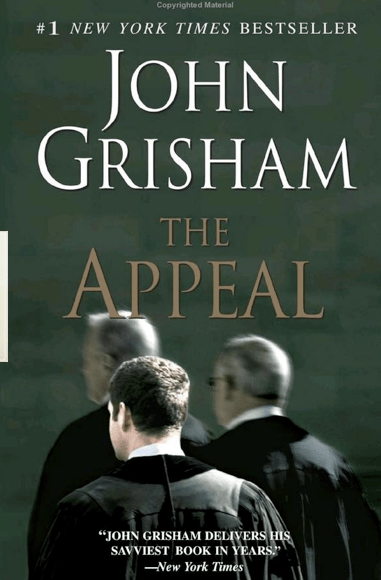
The Appeal is the exception. No one wins, not even the apparent winner, who sails off in the end with his empty, unsatisfying life. He schemes, he exploits, he lies, he buys elections, and he makes a fortune – and he isn’t satisfied. He is married to a woman who sounds more like a greyhound, all skin and bones and self-absorption.
The subject matter is a case where a chemical company has dumped toxic wastes into the ground in Mississippi, it has penetrated into the groundwater, and polluted the entire water system of a small fictional town. Two lawyers, married to one another, sacrifice everything and face bankruptcy to win a case for their client who has lost both husband and son to cancer caused by the toxic chemicals dumped. They win.
There is an appeal.
What this book is about isn’t just about groundwater contamination, or even about buying elections in Mississippi – it is an indictment of every state that elects judges. The core of the novel is about how big money, big corporations, pick candidates and fund them, legally and illegally, and insure that they win. They pack the courts with judges who are opposed to large settlements.
God bless John Grisham. With all his great legal thrillers, he has made a bundle and can take risks like writing a book like The Appeal, which should be an eye opener, and should be read by every caring citizen.
Judges should not be elected. When the judiciary are elected, they have to think about their next election, with every legal decision. It taints objectivity. It corrupts objectivity. It eliminates objectivity. Without an objective judiciary – why bother? They will always rule on the side whose interests are the most powerful and profitable.
Here are a couple quotes that tell you where the novel is going. My Kuwaiti friends are going to love this – I have taken so many shots at Kuwait corruption – so here it is, my friends, exposure of the institutionalized corruption in my country:
Barry laughed and crossed his legs. “We do campaigns. Have a look.” He picked up a remote and pushed the button, and a large white screen dropped from the ceiling and covered most of the wall, then the entire nation appeared. Most of the states were in green, the rest were in a soft yellow. “Thirty-one states are in the green. The yellow ones have the good sense to appoint their courts. We make our living in the green ones.”
“Judicial elections.”
“Yes. That’s all we do, and we do it very quietly. When our clients need help, we target a supreme court justice who is not particularly friendly, and we take him, or her, out of the picture.”
“Just like that.”
“Just like that.”
“Who are your clients?”
“I can’t give you the names, but they’re all on your side of the street. Big companies in energy, insurance, pharmaceuticals, chemicals, timber, all types of manufacturers, plus doctors, hospitals, nursing homes, banks. We raise tons of money and hire the people on the ground to run aggressive campaigns.”
* * * * * * * *
The Senator did not know who owned the jet, not had he ever met Mr. Trudeau, which in most cultures would seem odd since Rudd had taken so much money from the man. But in Washington, money arrives through a myriad of strange and nebulous conduits. Often those taking it have only a vague idea of where it’s coming from; often they have no clue. In most democracies, the transference of so much cash would be considered outright corruption, but in Washington the corruption has been legalized. Senator Rudd didn’t know and didn’t care that he was owned by other people. He had over $11 million in the bank, money he could eventually keep if not forced to waste it on some frivolous campaign. In return for such an investment, Rudd had a perfect voting record on all matters dealing with pharmaceuticals, chemicals, oil, energy, insurance, banks and on and on.
I like almost every book I read by John Grisham. He is a man with a conscience, and he is trying to raise our awareness of corruptive factors before our system goes entirely under. I couldn’t put this book down, and I can hardly wait to read the next one.
Recent Comments
ExpatAlien on What Country am I Living … intlxpatr on Yellowstone: Old Faithful to C… Michelle on Yellowstone: Old Faithful to C… Cathy on No Grown-Ups in Charge intlxpatr on Waiting for Snow Wikipedia Donate Button

Amazina


Early Voting in Florida


 Here There and Everywhere