Jailed for Headscarf?
It’s a good think I read this article all the way through before I published it. I thought it was about a woman getting arrested for wearing hijab. She was not arrested for wearing hijab. Read the last sentence in the article. She was turned away from the courtroom for wearing hijab – that’s bad enough. She was arrested when she swore at the bailiff (an officer of the court who preserves a dignified atmosphere in the courtroom, or tries to.)
I suspect this policy is more a gang thing – prohibiting headgear that would cause an outbreak of violence in the court – but that it was enforced in ignorance and protest against this Muslim-American woman. They released her quickly once threatened with investigation.
Sikhs won the right to wear their headgear while serving in the US military, as a religious right. I am betting Muslim women can win the right to wear hijab – it just needs to be tested in the courts. I do not think they can win the right to wear niqab, or other face coverings into the court – it isn’t a religious requirement, and the safety of the court can’t be protected if you don’t know who you are letting into the courtroom.
ATLANTA (Dec. 17) – A Muslim woman arrested for refusing to take off her head scarf at a courthouse security checkpoint said Wednesday that she felt her human and civil rights were violated.
‘Stripped of My … Human Rights’
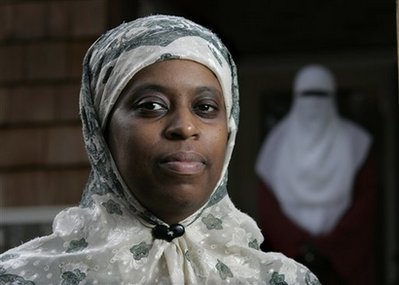
A Georgia judge ordered Lisa Valentine, above at her home in Douglasville, to serve 10 days in jail for refusing to take her head scarf off in court Tuesday. The Muslim, who had violated a policy that prohibits any headgear, was released Wednesday after an advocacy group called for a federal probe into the matter.
A judge ordered Lisa Valentine, 40, to serve 10 days in jail for contempt of court, said police in Douglasville, a city of about 20,000 people on Atlanta’s west suburban outskirts.
Valentine violated a court policy that prohibits people from wearing any headgear in court, police said after they arrested her Tuesday.
Kelley Jackson, a spokeswoman for Georgia Attorney General Thurbert Baker, said state law doesn’t permit or prohibit head scarfs.
“It’s at the discretion of the judge and the sheriffs and is up to the security officers in the court house to enforce their decision,” she said.
Valentine, who recently moved to Georgia from New Haven, Conn., said the incident reminded her of stories she’d heard of the civil rights-era South.
“I just felt stripped of my civil, my human rights,” she said Wednesday from her home. She said she was unexpectedly released after the Washington-based Council on American-Islamic Relations urged federal authorities to investigate the incident as well as others in Georgia.
The group cited a report that the same judge removed a woman and her 14-year-old daughter from the courtroom last week because they were wearing Muslim head scarves.
Jail officials declined to say why she was freed and municipal Court Judge Keith Rollins said that “it would not be appropriate” for him to comment on the case.
Last year, a judge in Valdosta in southern Georgia barred a Muslim woman from entering a courtroom because she would not remove her head scarf. There have been similar cases in other states, including Michigan, where a Muslim woman in Detroit filed a federal lawsuit in February 2007 after a judge dismissed her small-claims court case when she refused to remove a head and face veil.
Valentine’s husband, Omar Hall, said his wife was accompanying her nephew to a traffic citation hearing when officials stopped her at the metal detector and told her she would not be allowed in the courtroom with the head scarf, known as a hijab.
Hall said Valentine, an insurance underwriter, told the bailiff that she had been in courtrooms before with the scarf on and that removing it would be a religious violation. When she turned to leave and uttered an expletive, Hall said a bailiff handcuffed her and took her before the judge.
Associated Press writer Kate Brumback in Atlanta contributed to this report.
State Blocks Diwaniyas on State Land
I can understand the state not wanting to allow the people to build on public land, land reserved to preserve right of way, land reserved for parks, land to protect the ability to see around a corner. We watched all the illegal diwaniyas come down in our area, carted away on trucks, to be replaced with outdoor diwaniyas, which are lovely – but what to do when the temperatures start going up again?
Many of our friends have diwaniyyas – one – or more (!) built into their homes. An outdoor diwaniya is a luxury if you have the space for it. It looks to me like more homes are being built with a permanent diwayiya designed to match the house.
My real question is – How does this differ from the chalets? Are the chalets not also built on state property? Is there a bureau from which you get a permit? Is there any contractual understanding, like the land is deeded to you for 99 years before you put up an expensive chalet? Or do you build, knowing the government can reclaim that land at any time?
State succeeds in blocking diwaniyas bill
Al Watan staff
KUWAIT: The Parliament rejected a controversial draft law on Wednesday that called for regulating the construction of private diwaniyas on State property.
After a discussion, the proposal was overruled by a vote of 34 against and 26 in favor.
A number of MPs had presented the proposal, which was aimed at allowing the construction of private diwaniyas on State property adjacent to owners” homes provided that a license is obtained from the Ministry of Finance in exchange of an annual fee of no more than 0.250 Kuwaiti dinars per square meter.
Moreover, the Parliament also rejected a proposal to form a committee to investigate violations committed by the team tasked with removing all structures that have been illegally built on State property.
This proposal was voted down by 35 of the 61 legislators who were present at the session.
Earlier, the Parliament”s Finance and Economic Affairs Committee had rejected the draft law regulating the construction of private diwaniyas on State land, saying that it will have a negative impact regardless of the traditions related to these forms of gathering places.
It said the construction of these structures on State property will increase security, administrative and financial burdens on the State.
This issue was first discussed during Tuesday”s Parliament session, but a lack of order in the Abdullah AlـSalem Hall led to an adjournment of the session.
The Kuwaiti government had opposed the bill since the beginning, saying it bears many implementation difficulties and encourages encroachments on State property in a disorganized fashion.
Last updated on Thursday 13/11/2008
Obama Elected President
I awoke this morning to a new world. This isn’t a political blog; I will not often discuss political events other than how they impact on lives. My family was die-hard Republican until my father retired. During Ronald Reagan’s presidency, it all changed – his domestic policies hit retirees hard. My father was a man who, when we tried to give him ideas how he could pay less in taxes, looked at us and said “Why would I want to pay less in taxes? I served our great country, they paid my salary and now they give me retirement and health care. Why would I want to pay less in taxes.” God rest his soul. But he started voting Democrat – and said Republican policies only helped the very rich, and hurt the middle-class.
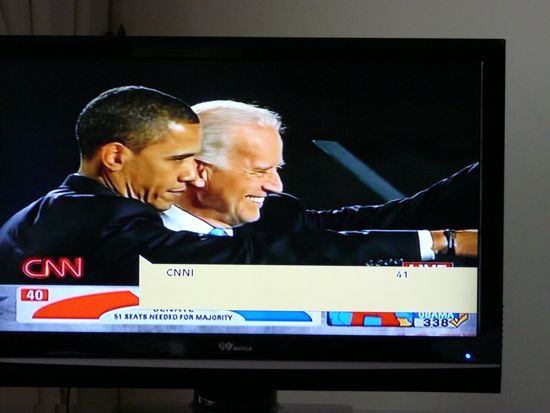
I never thought I would see the day a black man would be elected President in the United States. John McCain is a decent man, he would have made a fine president, and he gave one of the most graceful speeches acknowledging his election loss I have ever heard. May God richly bless him. Obama’s win is very exciting – a new day in our country.

I called our son and talked with him – barely believing Obama could have carried Florida. I told him how moving it is to me to see a black man elected (no, I am not black, but you know me, I hate prejudice) and he said “Mom, he is SMART, too.” I couldn’t have been prouder of him than at that moment.

And this is today’s Psalm. I have to share it with you – it seems such a brilliant omen:
Psalm 72
Of Solomon.
1Give the king your justice, O God,
and your righteousness to a king’s son.
2May he judge your people with righteousness,
and your poor with justice.
3May the mountains yield prosperity for the people,
and the hills, in righteousness.
4May he defend the cause of the poor of the people,
give deliverance to the needy,
and crush the oppressor.
5May he live* while the sun endures,
and as long as the moon, throughout all generations.
6May he be like rain that falls on the mown grass,
like showers that water the earth.
7In his days may righteousness flourish
and peace abound, until the moon is no more.
8May he have dominion from sea to sea,
and from the River to the ends of the earth.
9May his foes* bow down before him,
and his enemies lick the dust.
10May the kings of Tarshish and of the isles
render him tribute,
may the kings of Sheba and Seba
bring gifts.
11May all kings fall down before him,
all nations give him service.
12For he delivers the needy when they call,
the poor and those who have no helper.
13He has pity on the weak and the needy,
and saves the lives of the needy.
14From oppression and violence he redeems their life;
and precious is their blood in his sight.
15Long may he live!
May gold of Sheba be given to him.
May prayer be made for him continually,
and blessings invoked for him all day long.
16May there be abundance of grain in the land;
may it wave on the tops of the mountains;
may its fruit be like Lebanon;
and may people blossom in the cities
like the grass of the field.
17May his name endure for ever,
his fame continue as long as the sun.
May all nations be blessed in him;*
may they pronounce him happy.
18Blessed be the Lord, the God of Israel,
who alone does wondrous things.
19Blessed be his glorious name for ever;
may his glory fill the whole earth.Amen and Amen.
20The prayers of David son of Jesse are ended.
Election Joke: Today, You Voted
A good friend sent this non-partisan joke just in time for election day:
While walking down the street one day a US senator is tragically hit by
A truck and dies.
His soul arrives in heaven and is met by St. Peter at the entrance.
‘Welcome to heaven,’ says St. Peter. ‘Before you settle in, it seems
There is a problem. We seldom see a high official around these parts,
You see, so we’re not sure what to do with you.’
‘No problem, just let me in,’ says the man.
‘Well, I’d like to, but I have orders from higher up. What we’ll do Is
have you spend one day in hell and one in heaven. Then you Can choose
where to spend eternity.’
‘Really, I’ve made up my mind. I want to be in heaven,’ says the
Senator.
‘I’m sorry, but we have our rules.’
And with that, St. Peter escorts him to the elevator and he goes Down,
down, down to hell. The doors open and he finds himself In the middle
of a green golf course. In the distance is a clubhouse And standing in
front of it are all his friends and other politicians Who had worked
with him.
Everyone is very happy and in evening dress. They run to greet him,
Shake his hand, and reminisce about the good times they had while
Getting rich at the expense of the people.
They play a friendly game of golf and then dine on lobster, caviar And
champagne.
Also present is the devil, who really is a very friendly guy who Has a
good time dancing and telling jokes. They are having such a Good time
that before he realizes it, it is time to go.
Everyone gives him a hearty farewell and waves while the elevator
Rises…
The elevator goes up, up, up and the door reopens on heaven where St.
Peter
Is waiting for him.
‘Now it’s time to visit heaven.’
So, 24 hours pass with the senator joining a group of contented souls
Moving from cloud to cloud, playing the harp and singing. They have a
Good time and, before he realizes it, the 24 hours have gone by and St.
Peter returns.
‘Well, then, you’ve spent a day in hell and another in heaven. Now
Choose your eternity.’
The senator reflects for a minute, then he answers: ‘Well, I would Never
have said it before, I mean heaven has been delightful, but I think I
would be better off in hell.’
So St. Peter escorts him to the elevator and he goes down, down, Down
to hell.
Now the doors of the elevator open and he’s in the middle of a Barren
land covered with waste and garbage.
He sees all his friends, dressed in rags, picking up the trash and
Putting it in black bags as more trash falls from above.
The devil comes over to him and puts his arm around his shoulder.
‘I don’t understand,’ stammers the senator. ‘Yesterday I was here And
there was a golf course and clubhouse, and we ate lobster and Caviar,
drank champagne, and danced and had a great time. Now there’s just a
wasteland full of garbage and my friends look miserable.
What happened?’
The devil looks at him, smiles and says, ‘Yesterday we were
campaigning.. .
Today you voted.’
Election: Will Life Follow Fiction?
This is an article from the New York Times
Will life follow fiction? The article talks of some very eerie similarities between the TV race for the White House, and this year’s real race:
By BRIAN STELTER
Published: October 29, 2008
When Eli Attie, a writer for “The West Wing,” prepared to plot some episodes about a young Democratic congressman’s unlikely presidential bid, he picked up the phone and called David Axelrod.
Mr. Attie, a former speechwriter for Vice President Al Gore, and Mr. Axelrod, a political consultant, had crossed campaign trails before. “I just called him and said, ‘Tell me about Barack Obama,’ ” Mr. Attie said.
Days after Mr. Obama, then an Illinois state senator, delivered an address to the 2004 Democratic National Convention, the two men held several long conversations about his refusal to be defined by his race and his aspirations to bridge the partisan divide. Mr. Axelrod was then working on Mr. Obama’s campaign for the United States Senate; he is now Mr. Obama’a chief strategist.
Four years later, the writers of “The West Wing” are watching in amazement as the election plays out. The parallels between the final two seasons of the series (it ended its run on NBC in May 2006) and the current political season are unmistakable. Fiction has, once again, foreshadowed reality.
Watching “The West Wing” in retrospect — all seven seasons are available on DVD, and episodes can be seen in syndication — viewers can see allusions to Mr. Obama in almost every facet of Matthew Santos, the Hispanic Democratic candidate played by Jimmy Smits. Santos is a coalition-building Congressional newcomer who feels frustrated by the polarization of Washington. A telegenic and popular fortysomething with two young children, Santos enters the presidential race and eventually beats established candidates in a long primary campaign.
Wearing a flag pin, Santos announces his candidacy by telling supporters, “I am here to tell you that hope is real.” And he adds, “In a life of trial, in a world of challenges, hope is real.” Viewers can almost hear the crowd cheering, “Yes, we can.”
Comparisons between Senator John McCain and the “West Wing” Republican candidate, Arnold Vinick, a white-haired Senate stalwart with an antitax message and a reputation for delivering “straight talk” to the press, also abound. Vinick, played by Alan Alda, is deemed a threat to Democrats because of his ability to woo moderate voters. And he takes great pride in his refusal to pander to voters, telling an aide: “People know where I stand. They may not like it, but they know I’ll stick with it.”
Even the vice-presidential picks are similar: the Democrat picks a Washington veteran as his vice presidential candidate to add foreign policy expertise to the ticket, while the Republican selects a staunchly conservative governor to shore up the base.
Certainly some of the parallels are coincidental. It is unlikely, for example, that the writers knew Mr. Obama had an affection for Bob Dylan when they made Santos a Dylan fan. But it is the unintentional similarities that make the DVDs of the sixth and seventh seasons, which at the time received mixed reviews, so rewarding to watch now. In both “The West Wing” and in real life, for example, the Phillies played in the World Series during the election campaign.
As the primaries unfolded this year, “I saw the similarities right away,” said Lawrence O’Donnell, a producer and writer for the series who has appeared on MSNBC as a political analyst. Mr. O’Donnell had used Mr. McCain as one of the templates for the Vinick character in the episodes he wrote, though he said that “McCain’s resemblance to the Vinick character was much stronger in 2000 than in 2008.”
Echoing the criticism Mr. McCain faced during the primaries, a White House aide in “The West Wing” contends that Vinick is “not conservative enough” for the Republican base. Sometimes the two candidates’ situations are almost identical: when the press starts asking where Vinick attends church, he tells his staff that “I haven’t gone to church for a while.” Asked in July by The New York Times about the frequency of his church attendance, Mr. McCain said, “Not as often as I should.”
Mr. Alda and Mr. McCain are the same age. When a hard-edged strategist played by Janeane Garofalo joins the Santos campaign, she immediately alludes to Vinick’s age. “He’s been in the Senate for like 90 years. He was practically born in a committee room,” she says.
In the same way that Obama surrogates have subtly knocked Mr. McCain’s lack of computer skills, the Garofalo character remarks to the Santos campaign manager, Josh Lyman: “Why are you always talking about high-tech jobs? Because Vinick uses a manual typewriter.”
Conversely, Santos staffers talk about getting video of the candidate with his “adorable young children hugging their hale and vital dad.” The casting of Mr. Smits introduced story lines about the prospect of a minority president. But when an aide suggests a fund-raising drive in a Latino community, Santos snaps: “I don’t want to just be the brown candidate. I want to be the American candidate.” The Obama campaign has made similar assertions.
Still, “The West Wing” — like Mr. Obama — does not ignore racial issues entirely. In the seventh season Santos delivers a speech on race at a critical moment for his campaign, and staffers privately worry that voters will lie about their willingness to vote for a minority candidate.
If the show sometimes seems like a political fantasy — a real debate where politicians are required to answer questions? a candidate rejecting an attack ad? — it also reflects the tenor of the real-life campaign season.
Santos wins the nomination only after a lengthy fight on the convention floor, an inexact parallel to Obama’s extended primary fight with Senator Hillary Rodham Clinton. Just as the Obama campaign pivoted to the economy this fall, Lyman tells Santos staffers that “this new economic message may be our ticket,” and he winds up being right. An economic crisis does not ensue, but back-to-back emergencies on “The West Wing” — a nuclear power plant malfunction and a dispute in Kazakhstan — bring to mind the election-defining qualities of the actual economic crisis.
“Dramatically, they are exactly the same thing: the unforseeable,” Mr. O’Donnell said.
As President Bush did during the bailout talks, Jed Bartlet, the Democratic “West Wing” president played by Martin Sheen, brings both candidates to the White House for a briefing. Facing the prospect of deploying 150,000 American soldiers to Kazakhstan three weeks before the election, Vinick grumbles, “I can say goodbye to my tax cut.” He tells Santos, “Your education plan’s certainly off the table.”
Santos emerges victorious weeks later, but only after a grueling election night. Online, some “West Wing” fans are wondering whether the show will wind up forecasting the real-life result as well. In Britain, where the series remains popular in syndication, a recent headline on a blog carried by the newspaper The Telegraph declared: “Barack Obama will win: It’s all in ‘The West Wing.’ ”
Kuwait Activists Reject MPs” Hijab Ruling
Activists reject MPs” hijab ruling
”Wearing of veil is not prerequisite for ministerial post”
KUWIAT: Political activists have expressed their great disappointment at the Parliament”s Legislative Committee”s decision which stated that the positions held by Minister of Education and Minister of Higher Education Nouriya AlـSubaih and Minister of State for Housing Affairs and Minister of State for Development Affairs Moudi AlـHomoud as female ministers were unconstitutional.
In a symposium entitled “Who protects personal freedom,” eminent activist Najla AlـNaqi said that the committee should have paid attention to more serious issues rather than focusing on marginal issues such as wearing the veil. She urged the committee to reconsider its decision.
Sheikha Dr. Maymouna AlـSabah made the Constitution a point of departure for her argument, stating that it did not distinguish between genders when it came to the qualification of a voter and never mentioned any preference of one over the other. She demanded for the appointment of more female ministers since it is the only way for them to reach the Parliament.
Historian Ghanima AlـFahaid outlined the role of Kuwaiti women and their contribution to society in different fields including defending the State from invaders. She reminded the audience of the brilliant work of both ministers and that they tirelessly endeavor to serve the community in every possible way.
Kuwait University lecturer Dr. Layla AlـSabaan regarded the decisions as regrettable at a time when women should be encouraged and commended for their work. She stressed that the Kuwaiti society believes in equal opportunities for all regardless of gender and that personal freedom should be respected as long as it doesn”t jeopardize the culture and traditions of the society.
Journalists Society consultant Dr. Ayed AlـManna discussed the legality of female ministers, highlighting that gender equality in a country like Kuwait is extremely important. He added that Kuwait is a liberal society in many ways, pointing out that the Constitution does not specifically say that women must wear veils as a perquisite to taking up their ministerial posts.
Meanwhile, political activist Najat AlـHashshash questioned the nature and background of the decision asking if this ruling applied to all female staff working in the Parliament or ministers only.
Last updated on Friday 24/10/2008
All Female Ministers Must Cover Hair, or Female Ministers are Unconstitutional? Or?
I am pretty good at reading the news, but all this is a little too Byzantine, even for me. This is from today’s Al Watan. I think it says that females who do not cover their hair can still be ministers, in spite of some members of parliament saying that females who do not cover their hair are not allowed to be ministers. You read it and tell me what YOU think it says.
Maybe some of the Ministers of Parliament lack so much self contol that they fear the sight of the hair of Nouriya AlـSubaih and/or Moudhi AlـHumoud will impede their performance?
There is an Islamic dress code? Like if you do not wear an abaya and niqab, or hijab, you cannot be Moslem?
Panel brands female ministers” appointment ”unconstitutional”
Court freezes MPs” suspension from Parliament
Al Watan staff
KUWAIT: Parliament”s Committee for Legislative and Legal Affairs, during its meeting on Sunday, signed off on a report stating that the appointment of female Cabinet ministers Nouriya AlـSubaih and Moudhi AlـHumoud is unconstitutional. The decision is said to stem from the fact that both women do not conform to the Islamic dress code because they refuse to cover their hair.
The committee”s convener, Ali AlـHajeri, announced that the report has been unanimously endorsed by the committee”s members, which include, among others, MPs Nasser AlـDuwailah, Mohammed AlـHatlani and Mohammed Hayef, and that it is backed up by Article 82 of the Constitution and Article 1 of the Elections Law that stipulates that women should adhere to the Islamic dress code.
On the eve of the inauguration of the new parliamentary term on Tuesday, the National Assembly is expected to grapple with a wide range of burning issues, including a decision by the Constitutional Court to strip two former MPs of their parliamentary seats.
Sources have reported that there has been a bizarre twist concerning this particular issue with Speaker of Parliament Jassem AlـKharafi announcing that he has received a letter from the Administrative Court informing him about a decision to suspend the Constitutional Court”s verdict that revoked the membership of Mubarak AlـWalaan and Abdullah AlـAjmi. He also revealed that the Administrative Court is due to look into the case today.
AlـKharafi affirmed that he will take measures in accordance with the ruling issued by the Administrative Court.
A constitutional expert affirmed that the newly reinstated MPs should be allowed to take their seats in Parliament unless the Administrative Court issues another verdict ruling in favor of the lawmakers whose membership was revoked.
Reacting to this new development, MP Askar AlـEnezi affirmed that verdicts issued by the Constitutional Court are final and unchallengeable.
He argued that the Administrative Court has no jurisdiction to look into constitutional matters.
Last updated on Monday 20/10/2008
Update 21 October
Female minister reacts to panel decision
Comply with Islamic attire or resign, urges MP
Al Watan staff
KUWAIT: The Chairman of Parliament”s Legislative and Legal Committee Nasser AlـDuwailah has described comments made on Monday by the Minister of Housing and Minister of State for Housing Affairs Moudhi AlـHumoud as “unacceptable”, after she attacked a decision by the committee that considers the appointment of the two female Cabinet ministers as unconstitutional because they do not follow the Islamic dress code.
“The minister”s remarks are irresponsible and unacceptable,” he firmly said, while calling on the minister to tender her resignation immediately.
Noting that the committee has thoroughly looked at the legal aspects of the female ministers” appointment, he pointed out that the members have concluded that the duo have failed to comply with regulations regarding the Islamic dress code that is deemed acceptable inside the Abdullah Salem Chamber (Parliament).
He explained that the ministers are free to wear to whatever they want outside the Parliament, noting that the law which gave women their full political rights stipulates that female candidates or appointees comply with certain set regulations.
Insisting that the law was passed by Parliament rather than the committee, he explained that the committee”s response is consistent with the spirit of the Constitution.
He concluded by expressing hope that the government will express regret over the minister”s remarks.
Last updated on Tuesday 21/10/2008
For Expats: Understanding Kuwait Issues
I am reprinting this entire article from today’s Arab Times because it covers so much ground and gives those of us with little understanding of Kuwait issues a lot of background. It is an interview done with Osama Al-Sayegh, head of the Ja’ffery Department at Kuwait Awqaf Public Foundation.
Sectarian animosity between Shias and Sunnis in the region had mellowed down since the beginning of the last century, but has been revived following the Iran-Iraq war in the 80’s. Though the sectarian feelings are not allowed to override national sentiments in Kuwait, the fires burning in our close neighborhood could spread into our country. Osama Al-Sayegh, head of the Ja’ffery Department at Kuwait Awqaf Public Foundation, was sharing some of the deep concerns of his community in Kuwait with the Arab Times, alongside putting the community’s spiritual and political relations with Iran in the right perspective.
Q: Elections took place, and some months have gone by since the new government and Parliament took office. How do you assess the situation in Kuwait?
A: From my point of view, Kuwait has been affected by the meltdown in the US economy, and the worldwide repercussions because of it. Most of the countries are affected by this turn of events, and Kuwait cannot be isolated.
Probably, as of now it is not that bad, but in future Kuwait will also be hit hard, I fear. The price of oil is coming down, as consumers around the world are beginning to rationalize their consumption, while inflation is still high. These factors will affect the people of Kuwait, creating a financial squeeze, which in turn will have political fallouts.
Q: What do you think about the composition of the new Parliament and the cabinet? Are they efficient enough to tackle these crises?
A: That’s a real problem in Kuwait. While all these crises are looming large over Kuwait, our Parliament members seem too apathetic, and are only worried about grinding their personal axes. Each member has a set of personal agendas divorced from national interests, which he tries to fulfill using his office. This attitude is inimical to the country.
Q: Do you think this situation is peculiar to the current Parliament only, or has it been the trend of the Parliament for long?
A: The situation has become so worse only in the last 15 years. Before that we had good government and parliamentarians who worked for national interest. The results were palpable in the health and educational sectors. However, now it seems there is a disjuncture between the Parliament and the cabinet, and so even if the latter come up with a good vision, the MPs don’t give due support. Sometimes, it seems to me that both the government and the Parliament are in cahoots with each other in scuttling good projects for the nation. Finally, it’s the people who are suffering from all these petty politics.
Q: One common reason ascribed to this lack of cooperation between the executive and legislative bodies in Kuwait is sectarian division. How strong is the Shia-Sunni division in politics?
A: The division between Shias and Sunnis dates back to 1400 years. And the rivalry had been acerbic through out the centuries. However, towards the beginning of the last century, the lines had blurred and the intensity of the differences had waned between the two sects. But with the coming of the Iranian revolution in the late 70’s and the ensuing Iran-Iraq war, the clock has been turned back, and the sectarian spirit among people in the Middle East has been revived.
Now, in that context, Kuwait is a tiny country wedged between a Shiite Iran, a Sunni Saudi Arabia and a mixed Iraq, where an intense battle is raging still, with a marked sectarian perspective. We shall be very careful, as the fire in our neighborhood can spread to us also. And going by the size of our country, even a minor spark can burn down the nation.
We have to focus on factors that unite the two sects and stay away from getting deep into our differences. The basics are all the same between us. Our God is Allah, our Prophet is Mohammed (PBUH), our book is the Holy Quran and our Qibla (the direction of prayer) is the Kabah. Other peripheral things have to be kept on the sidelines.
We have to understand that we are a very small country, and we shouldn’t let petty sectarianism destroy our social fabric. We have only our country, and we shall preserve it in our best interest.
Q: How alive are these sectarian tendencies in Kuwait?
A: As I said things were quite normal until the late 70’s. When the revolution swept through Iran, the government of Kuwait feared that the revolution might get imported into Kuwait through sectarian influences. And therefore to counterbalance Shias in the society, the government allowed Sunni foreign nationals to immigrate into Kuwait. However, some of these new immigrants came from very fundamentalist schools of thought. In reaction to these events some Shias in Kuwait took to extreme ideologies, giving rise to sectarian tensions in the society. Fanatical groups in both these sects are only a small minority and not mainstream. Yet, in a small country like Kuwait, it is enough to start a communal conflagration.
We have to understand that Islam is a religion of peace. Its fundamental aim is peace, and there is no force in religion. Yes, there are principles and practices, which we believe have to be followed and adhered to. For example issues like segregation in educational institutions and so on … we believe these have to be followed, but we should not force them on anyone. These have to be abided out of one’s own will.
Q: The government of Kuwait once feared that Iran might influence Shias in Kuwait, and we see such ideas still current in the society at least when some MPs make veiled statements of Shiite politicians taking orders from their “foreign masters.” What’s the truth of the matter?
A: This is not true, because Shias here are Arabs and not Persians. Our Arab identities are very strong. Similarly, it is also wrong to accuse Sunni MPs of loyalty to Saudi Arabia.
Q: The question of loyalty is an important issue in all societies which have minority communities in them on the basis of nationality, ethnicity or religion. During World War II, Japanese in America were targeted; similarly Muslims in India often face charges of being loyal to Pakistan. So, it is only natural that such questions of belongingness are also faced by Shias in Kuwait. Your comments.
A: Yes, there may be one or two misguided currents, like in all communities, who may have wrong ideas of allegiance and patriotism. However, this is only a very insignificant fringe that wields no influence over the mainstream community in any terms. But for such minor aberrations, the rest of the community is very clear and proud about its Kuwaiti identity. This is our soil and our roots are here, and we belong here and our allegiance is only to this country.
Q: Generally speaking, what is the Kuwaiti identity? Is there such a strong national identity in Kuwait that is free from any religious or sectarian taint?
A: Yes. There is a strong national identity. But this is not something we wear on our sleeves and strut around. We live our normal lives, but whenever there is a crisis we unite as one. For example, look what happened during the invasion. All Kuwaitis, from wherever they were, fought in their own ways for our freedom. It was this collective will and ambition that got us our freedom.
Q: Spiritually do you look up to Iran in any way? Are the Fatwas passed by Ayatollahs applicable to you also?
A: No. May be such things happen in Lebanon, where the Shiite community looks to Iran or Syria for support. But here in Kuwait, we have a very strong sense of national identity and we act as Kuwaitis at times of crisis.
Q: I was referring to spiritual matters, not political. For example, when Ayatollah Khomeini passed a Fatwa demanding the death of Salman Rushdie for authoring the controversial book “Satanic Verses” demeaning Islam’s Prophet (PBUH), did Shias here feel that it was a universal call and accept it as binding on them as well?
A: There were many Fatwas regarding Salman Rushdie that came from Iran and Saudi Arabia. But Kuwait’s mainstream community, be it Sunnis or Shias, were not affected by those Fatwas. Yes, there might have been a small group in both communities who might have been very emotionally moved by those Fatwas and even wanted to act on it. But by and large, Kuwaitis did not react to these Fatwas.
Q: What do you think of tribal primaries, especially those that have a strongly sectarian character?
A: The law should be strictly implemented to stop such tribal primaries. This is a very unhealthy practice and can hurt the very fundamental objectives of democracy. It violates the fundamental rights of the people to elect their representative, as primaries preempt elections and decide winners beforehand. So I am strongly against primaries.
Q: Will political parties help the situation in any way, because then you will have people grouping under parties based on larger manifestoes?
A: May be yes. But we have to make sure the country is ready for such a transformation. Otherwise, we may not be able to realize the benefits of change.
Q: Is the presence of such a large number of Islamists in the Parliament positive for the nation or is it negative?
A: Going by the current trend, it is negative. However, I attach this negativism not to their ideologies, but their greed and manipulation of ideologies for personal ends. From history we know that all major conflicts happen when religion is exploited by opportunists. Religion, be it Islam, Christianity or any other religion for that matter, is never the actual cause behind conflicts.
Q: Islamists are clamoring to make Sharia the only source of law in Kuwait. Do you agree with them?
A: Sharia is indeed the best source of legislation. But before enforcing it, we should have pure intentions and we should raise ourselves to those high standards instigated by Sharia. But with our tainted lawmakers it is impossible to apply true Sharia, and so I don’t go for it currently.
Q: But Islamically speaking is that the correct approach, because as against God’s law you are asking for man-made laws?
A: Of course God’s law is most superior. But how to apply this law in our lives is the question, and there are differences of opinion.
Q: Does the Awqaf have any strategy for the right application of Sharia?
A: The Awqaf deals not with matters of legislation. We are focused on charitable works and on social issues, such as raising the standard of education and healthcare in Kuwait and tackling unemployment and so on.
Q: You seem to be adopting a very soft stance even in matters of religion, for example, while you were talking about segregation you said it should not be enforced but only offered as a choice. Are you taking religion too lightly?
A: See, the religion is very clear; there are ‘do’s’ and ‘don’ts’ that have been spelt out very clearly. Basic principles of religion such as the ban on drinking, where there is consensus, have to be enforced. But in matters where there are differences of opinion, and where we engage with other people as humans, we have to be soft. We should not think ourselves morally superior to judge others; it is only Allah who has the right to judge humans, because only he knows what is in their hearts.
Q: Is this your personal stance, or is this the general stance of all Shias in such matters?
A: This is the general stance of Shias. That’s why here in Awqaf, it is customary for us to pay visits to centers of other people’s faiths. We went to Vatican and visited Pope Benedict XVI.
I believe there is much to learn from each other. The Vatican church is known for its charities all over the world across religious or ethnic divides. For example, Christian charities worth millions of dollars poured into disaster areas like Indonesia during Tsunami, Iran during the Bam earthquake or Lebanon during the recent war, and so on. Though the motive behind these charities is often alleged to be religious conversion, we cannot deny the fact that those acts of kindness draw sympathy towards the Christian faith.
Though we don’t believe in such conversions, acts of charities like these will definitely help in breaking the ice with other communities and making them open to the message of Islam.
Q: How do you, given your sectarian orientations, look at broader international issues related to Iran such as the country’s nuclear ambitions and its standoff with the US?
A: This is a political issue. Iran claims that it requires nuclear energy for civilian purposes, while America alleges that Iran has ulterior motives of building nuclear weaponry. And sitting here we can’t be sure who is lying. May be both parties are lying.
Q: Both parties are lying. Can you explain more?
A: What I mean is that when politics is involved, religious principles are sidelined. Do you know that Iran gives financial aid to al-Qaeda though they are ideologically opposed to Iran?
Iran has also supplied money to Taleban, who are antagonistic to Shias and have even conducted targeted killings of Shias in Afghanistan. So all this is politics. The current government of Iraq comprises more of Shias, and logically speaking Iran should be supporting this government. But they are against Iraq’s government because of political reasons. So, in most cases, politics takes precedent over religion, and the political equations are often too complicated to be made sense out of.
Q: How do you look at Hezbollah?
A: The only group that is sincere to the cause that they set out to accomplish in the Arab world is the Hezbollah, at least as of now. Every other organization has veered off from its main objectives.
While all the mighty Arab nations are keeping mum over Israel’s illegal occupation of Palestine, only Hezbollah has been offering a stiff resistance, despite the smallness of their means as against a mighty power like Israel — we shall bear in mind that Hezbollah is not even a nation, they are only a small group, and in the recent war broke the myth of Israel’s invincibility.
Q: Moughniya was a controversial figure in Kuwait for his alleged connections with Hezbollah and a hijack drama many years ago. When he died there were new controversies raised when some MPs hailed him as a martyr and extolled his virtues during his funeral. Is Moughniya the victim of a slur campaign because he belonged to the minority community?
A: The greatest tragedy regarding Moughniya is that his story is shrouded in mystery and people have never been given a clear picture of what he actually was. The government is to be blamed for this, and this led to mixed opinions with some lionizing him and some demonizing him.
Until now there has not been any clear verdict on him. Nobody knows whether he is guilty or not. If he is guilty, he should have been punished, or if he is innocent, he should be cleared of all charges and acquitted. Neither of this has happened in clear terms.
Q: So do you think it is a crime to praise a person whose credentials are in doubt? The MPs were only expressing their opinion on an issue that lies in the grey area. Do you think it’s proper to incriminate them for that?
A: It is not about expressing opinions. As members of the Parliament, these two MPs should have shown greater discretion in indulging in controversies that rake up sectarian turmoil. Sentiments of the people should also be taken into consideration, especially while involving in deeply controversial issues such as these, where much of the truth lies in the realm of the unknown.
Q: Are you scared this could spill into Kuwait also?
A: Yes, the fire is very close by. It can easily spread. It would only take a small band of misguided youth to spark off a conflagration. There are extremists on both sides, who are of course small in number, but Kuwait is a small country and even such ragtag groups are enough to upset the harmony of our nation.
Q: Is Kuwait sitting on a time bomb? Can there be an outbreak of a sectarian violence any time?
A: No, no. The situation is very much under control. The government is doing an extremely good job on that front. They are acting prudently, and making sure no community is made to feel deprived of justice. Whenever there are any communal embers flaring, they put it off with iron hands, and do not allow such things to spread.
Q: What in your opinion are the priorities of the government?
A: I think Kuwait should focus on education and health. We shall think of improving our infrastructure and manpower in the health sector, so that we wouldn’t have to spend millions of dinars in sending our patients to Europe or America for better treatment. Let’s bring experts from outside, I think even that will work out much cheaper.
By Valiya S. Sajjad
Arab Times Staff
Travel Advisory
Just in time for Eid travel . . .
The truth is – I feel safe here. The truth is also that it only takes one crazy person, or one small group of crazies, and bizarre and terrible things can happen.
To: All American Wardens
From: Consular Section
Subject: Warden Notice 2008 – 18
Please circulate the following message without additions or omissions
immediately to all American citizens within your area of responsibility.
Begin Text.
TRAVEL ALERT – ARABIAN PENINSULA AND PERSIAN GULF
1. This Travel Alert is being issued to warn Americans about heightened security
concerns in and around the Arabian Peninsula and Persian Gulf. U.S. citizens
traveling to or already in the region are reminded to maintain a high level of
vigilance and to take appropriate steps to increase their security awareness.
This Travel Alert expires on February 22, 2009.
2. The security threat level in the Arabian Peninsula and Persian Gulf region
remains high after the September 17 terrorist attack on the U.S. Embassy in
Sana’a, Yemen, in which several security personnel and innocent bystanders,
including one U.S. citizen, were killed. Credible information indicates that
al-Qaida and affiliated organizations continue to plan attacks against U.S.
interests in the region. These attacks may employ a wide variety of tactics
including suicide operations, assassinations, kidnappings, hijackings and
bombings. While conventional weapons such as explosive devices are a more
immediate threat in many areas, the use of non-conventional weapons, including
chemical or biological agents, must be considered a possible threat. Terrorists
do not distinguish between official and civilian targets. Increased security at
official U.S. facilities may lead terrorists and their sympathizers to seek
softer targets such as public transportation, residential areas
, and public areas where people congregate, including restaurants, hotels,
clubs, and shopping areas.
3. Potential targets are not limited to those companies or establishments with
overt U.S. ties. For instance, terrorists may target movie theaters, liquor
stores, bars, casinos, or any similar type of establishment, regardless of
whether they are owned and operated by host country nationals. Due to varying
degrees of security at all such locations, U.S. citizens should be particularly
vigilant when visiting these establishments. From time to time, the Embassy
may restrict official Americans from restaurants, hotels, or shopping areas.
U.S. citizens should exercise caution and take prudent security measures,
including maintaining a high level of vigilance, avoiding crowds and
demonstrations, keeping a low profile, varying times and routes for all travel,
and ensuring travel documents are current.
4. U.S. citizens living or traveling abroad are encouraged to register with the
nearest U.S. Embassy or Consulate through the State Department’s travel
registration web site at https://travelregistration.state.gov/ibrs/ui/ so that
they can obtain updated information on travel and security. Americans without
Internet access may register directly with the nearest U.S. Embassy or
Consulate. By registering, American citizens make it easier for the Embassy or
Consulate to contact them in case of emergency.
5. U.S. Government facilities worldwide remain at a heightened state of alert.
These facilities may temporarily close or periodically suspend public services
to assess their security posture. In those instances, U.S. embassies and
consulates will make every effort to provide emergency services to U.S.
citizens. Americans abroad are urged to monitor the local news and maintain
contact with the nearest U.S. Embassy or Consulate.
6. As the Department continues to develop information on any potential security
threats to U.S. citizens overseas, it shares credible threat information through
its Consular Information Program documents, including the Worldwide Caution,
available on the Internet at http://travel.state.gov.
In addition to information on the Internet, travelers may obtain up-to-date
information on security conditions by calling 1-888-407-4747 toll-free in the
U.S. and Canada or,outside the U.S. and Canada on a regular toll line at
1-202-501-4444. These numbers are available from 8:00 am to 8:00 pm Monday
through Friday, Eastern Time (except U.S. federal holidays.)
End Text.
American citizens with any questions or concerns may telephone the Embassy at
259-1581, 259-1583 or 259-1240. In case of an emergency outside business hours,
American citizens may reach the Embassy duty officer by calling 259-1001.
For the latest security information, Americans should regularly monitor the
Department’s web site at http://travel.state.gov, where the current Worldwide
Caution, Travel Warnings, and Travel Alerts can be found. Up-to-date information
on security can also be obtained by calling 1-888-407-4747 toll free in the
U.S., or, for callers outside the U.S. and Canada, a regular toll line at
1-202-501-4444. These numbers are available from 8:00 a.m. to 8:00 p.m. Eastern
Time, Monday through Friday (except U.S. federal holidays.)
This message may be accessed on the Embassy website, http://kuwait.usembassy.gov
American citizens in Kuwait who would like to receive future Warden Messages
from the Embassy directly by e-mail may sign up for this service by sending an
e-mail to the following address: join-wardenmessagekuwait@mh.databack.com
American citizens resident and visiting in Kuwait who are not registered with
the Embassy, or whose registration information has changed, are urged to
register as soon as possible.
Obsession: Radical Islam and the US Election
Most of you know that I have a niece I admire as well as adore. She speaks Arabic fluently, and even better, she is interculturally fluent, from Morocco to the Gulf to Beirut, she flows with the Arabic culture, and works with an organization promoting intercultural understanding. I couldn’t be more proud of the work she does.
Please, before you read any further, take a deep breath. This is going to get bad.
Today, Little Diamond wrote about a DVD sent out by a facade-organization through newspapers in US swing states. The DVD is called Obsession: Radical Islam’s War Against the West.

Although it never claims to be a Republican support organization, or a McCain support ad, what the DVD does is to try to scare people into voting for McCain. The message is this – all Muslims are radical, and we need a strong leader like McCain to counter their insidious influence.
As my niece says, she doesn’t believe McCain would ever approve such a tawdry piece of nasty propaganda; the Clarion Group who sent this DVD out probably did it on their own.
I urge to to go to Little Diamond’s blog and read her experience, and the comments. She quotes one individual, saying:
“Whoever they are, they sure must have a lot of money. H pointed out last night that each DVD probably cost $1 to produce and $1 to distribute. That’s $56 million, not to mention the cost of placing the DVDs with each newspaper. Even if H’s estimate was too high, assuming $.50 to produce and $.50 to distribute means $28 million + advertising contract costs. That’s quite a lot of money for a no-name non-profit to have gathered since its creation in 2006.”
Elections can bring out the best in people and/or the worst. Both McCain and Obama have so far treated each other respectfully, as is appropriate for educated, senatorial leaders of a country. This kind of hate-tactic is NOT the American way. It makes me see red.
Recent Comments
ExpatAlien on What Country am I Living … intlxpatr on Yellowstone: Old Faithful to C… Michelle on Yellowstone: Old Faithful to C… Cathy on No Grown-Ups in Charge intlxpatr on Waiting for Snow Wikipedia Donate Button

Amazina


Early Voting in Florida


 Here There and Everywhere