For Expats: Understanding Kuwait Issues
I am reprinting this entire article from today’s Arab Times because it covers so much ground and gives those of us with little understanding of Kuwait issues a lot of background. It is an interview done with Osama Al-Sayegh, head of the Ja’ffery Department at Kuwait Awqaf Public Foundation.
Sectarian animosity between Shias and Sunnis in the region had mellowed down since the beginning of the last century, but has been revived following the Iran-Iraq war in the 80’s. Though the sectarian feelings are not allowed to override national sentiments in Kuwait, the fires burning in our close neighborhood could spread into our country. Osama Al-Sayegh, head of the Ja’ffery Department at Kuwait Awqaf Public Foundation, was sharing some of the deep concerns of his community in Kuwait with the Arab Times, alongside putting the community’s spiritual and political relations with Iran in the right perspective.
Q: Elections took place, and some months have gone by since the new government and Parliament took office. How do you assess the situation in Kuwait?
A: From my point of view, Kuwait has been affected by the meltdown in the US economy, and the worldwide repercussions because of it. Most of the countries are affected by this turn of events, and Kuwait cannot be isolated.
Probably, as of now it is not that bad, but in future Kuwait will also be hit hard, I fear. The price of oil is coming down, as consumers around the world are beginning to rationalize their consumption, while inflation is still high. These factors will affect the people of Kuwait, creating a financial squeeze, which in turn will have political fallouts.
Q: What do you think about the composition of the new Parliament and the cabinet? Are they efficient enough to tackle these crises?
A: That’s a real problem in Kuwait. While all these crises are looming large over Kuwait, our Parliament members seem too apathetic, and are only worried about grinding their personal axes. Each member has a set of personal agendas divorced from national interests, which he tries to fulfill using his office. This attitude is inimical to the country.
Q: Do you think this situation is peculiar to the current Parliament only, or has it been the trend of the Parliament for long?
A: The situation has become so worse only in the last 15 years. Before that we had good government and parliamentarians who worked for national interest. The results were palpable in the health and educational sectors. However, now it seems there is a disjuncture between the Parliament and the cabinet, and so even if the latter come up with a good vision, the MPs don’t give due support. Sometimes, it seems to me that both the government and the Parliament are in cahoots with each other in scuttling good projects for the nation. Finally, it’s the people who are suffering from all these petty politics.
Q: One common reason ascribed to this lack of cooperation between the executive and legislative bodies in Kuwait is sectarian division. How strong is the Shia-Sunni division in politics?
A: The division between Shias and Sunnis dates back to 1400 years. And the rivalry had been acerbic through out the centuries. However, towards the beginning of the last century, the lines had blurred and the intensity of the differences had waned between the two sects. But with the coming of the Iranian revolution in the late 70’s and the ensuing Iran-Iraq war, the clock has been turned back, and the sectarian spirit among people in the Middle East has been revived.
Now, in that context, Kuwait is a tiny country wedged between a Shiite Iran, a Sunni Saudi Arabia and a mixed Iraq, where an intense battle is raging still, with a marked sectarian perspective. We shall be very careful, as the fire in our neighborhood can spread to us also. And going by the size of our country, even a minor spark can burn down the nation.
We have to focus on factors that unite the two sects and stay away from getting deep into our differences. The basics are all the same between us. Our God is Allah, our Prophet is Mohammed (PBUH), our book is the Holy Quran and our Qibla (the direction of prayer) is the Kabah. Other peripheral things have to be kept on the sidelines.
We have to understand that we are a very small country, and we shouldn’t let petty sectarianism destroy our social fabric. We have only our country, and we shall preserve it in our best interest.
Q: How alive are these sectarian tendencies in Kuwait?
A: As I said things were quite normal until the late 70’s. When the revolution swept through Iran, the government of Kuwait feared that the revolution might get imported into Kuwait through sectarian influences. And therefore to counterbalance Shias in the society, the government allowed Sunni foreign nationals to immigrate into Kuwait. However, some of these new immigrants came from very fundamentalist schools of thought. In reaction to these events some Shias in Kuwait took to extreme ideologies, giving rise to sectarian tensions in the society. Fanatical groups in both these sects are only a small minority and not mainstream. Yet, in a small country like Kuwait, it is enough to start a communal conflagration.
We have to understand that Islam is a religion of peace. Its fundamental aim is peace, and there is no force in religion. Yes, there are principles and practices, which we believe have to be followed and adhered to. For example issues like segregation in educational institutions and so on … we believe these have to be followed, but we should not force them on anyone. These have to be abided out of one’s own will.
Q: The government of Kuwait once feared that Iran might influence Shias in Kuwait, and we see such ideas still current in the society at least when some MPs make veiled statements of Shiite politicians taking orders from their “foreign masters.” What’s the truth of the matter?
A: This is not true, because Shias here are Arabs and not Persians. Our Arab identities are very strong. Similarly, it is also wrong to accuse Sunni MPs of loyalty to Saudi Arabia.
Q: The question of loyalty is an important issue in all societies which have minority communities in them on the basis of nationality, ethnicity or religion. During World War II, Japanese in America were targeted; similarly Muslims in India often face charges of being loyal to Pakistan. So, it is only natural that such questions of belongingness are also faced by Shias in Kuwait. Your comments.
A: Yes, there may be one or two misguided currents, like in all communities, who may have wrong ideas of allegiance and patriotism. However, this is only a very insignificant fringe that wields no influence over the mainstream community in any terms. But for such minor aberrations, the rest of the community is very clear and proud about its Kuwaiti identity. This is our soil and our roots are here, and we belong here and our allegiance is only to this country.
Q: Generally speaking, what is the Kuwaiti identity? Is there such a strong national identity in Kuwait that is free from any religious or sectarian taint?
A: Yes. There is a strong national identity. But this is not something we wear on our sleeves and strut around. We live our normal lives, but whenever there is a crisis we unite as one. For example, look what happened during the invasion. All Kuwaitis, from wherever they were, fought in their own ways for our freedom. It was this collective will and ambition that got us our freedom.
Q: Spiritually do you look up to Iran in any way? Are the Fatwas passed by Ayatollahs applicable to you also?
A: No. May be such things happen in Lebanon, where the Shiite community looks to Iran or Syria for support. But here in Kuwait, we have a very strong sense of national identity and we act as Kuwaitis at times of crisis.
Q: I was referring to spiritual matters, not political. For example, when Ayatollah Khomeini passed a Fatwa demanding the death of Salman Rushdie for authoring the controversial book “Satanic Verses” demeaning Islam’s Prophet (PBUH), did Shias here feel that it was a universal call and accept it as binding on them as well?
A: There were many Fatwas regarding Salman Rushdie that came from Iran and Saudi Arabia. But Kuwait’s mainstream community, be it Sunnis or Shias, were not affected by those Fatwas. Yes, there might have been a small group in both communities who might have been very emotionally moved by those Fatwas and even wanted to act on it. But by and large, Kuwaitis did not react to these Fatwas.
Q: What do you think of tribal primaries, especially those that have a strongly sectarian character?
A: The law should be strictly implemented to stop such tribal primaries. This is a very unhealthy practice and can hurt the very fundamental objectives of democracy. It violates the fundamental rights of the people to elect their representative, as primaries preempt elections and decide winners beforehand. So I am strongly against primaries.
Q: Will political parties help the situation in any way, because then you will have people grouping under parties based on larger manifestoes?
A: May be yes. But we have to make sure the country is ready for such a transformation. Otherwise, we may not be able to realize the benefits of change.
Q: Is the presence of such a large number of Islamists in the Parliament positive for the nation or is it negative?
A: Going by the current trend, it is negative. However, I attach this negativism not to their ideologies, but their greed and manipulation of ideologies for personal ends. From history we know that all major conflicts happen when religion is exploited by opportunists. Religion, be it Islam, Christianity or any other religion for that matter, is never the actual cause behind conflicts.
Q: Islamists are clamoring to make Sharia the only source of law in Kuwait. Do you agree with them?
A: Sharia is indeed the best source of legislation. But before enforcing it, we should have pure intentions and we should raise ourselves to those high standards instigated by Sharia. But with our tainted lawmakers it is impossible to apply true Sharia, and so I don’t go for it currently.
Q: But Islamically speaking is that the correct approach, because as against God’s law you are asking for man-made laws?
A: Of course God’s law is most superior. But how to apply this law in our lives is the question, and there are differences of opinion.
Q: Does the Awqaf have any strategy for the right application of Sharia?
A: The Awqaf deals not with matters of legislation. We are focused on charitable works and on social issues, such as raising the standard of education and healthcare in Kuwait and tackling unemployment and so on.
Q: You seem to be adopting a very soft stance even in matters of religion, for example, while you were talking about segregation you said it should not be enforced but only offered as a choice. Are you taking religion too lightly?
A: See, the religion is very clear; there are ‘do’s’ and ‘don’ts’ that have been spelt out very clearly. Basic principles of religion such as the ban on drinking, where there is consensus, have to be enforced. But in matters where there are differences of opinion, and where we engage with other people as humans, we have to be soft. We should not think ourselves morally superior to judge others; it is only Allah who has the right to judge humans, because only he knows what is in their hearts.
Q: Is this your personal stance, or is this the general stance of all Shias in such matters?
A: This is the general stance of Shias. That’s why here in Awqaf, it is customary for us to pay visits to centers of other people’s faiths. We went to Vatican and visited Pope Benedict XVI.
I believe there is much to learn from each other. The Vatican church is known for its charities all over the world across religious or ethnic divides. For example, Christian charities worth millions of dollars poured into disaster areas like Indonesia during Tsunami, Iran during the Bam earthquake or Lebanon during the recent war, and so on. Though the motive behind these charities is often alleged to be religious conversion, we cannot deny the fact that those acts of kindness draw sympathy towards the Christian faith.
Though we don’t believe in such conversions, acts of charities like these will definitely help in breaking the ice with other communities and making them open to the message of Islam.
Q: How do you, given your sectarian orientations, look at broader international issues related to Iran such as the country’s nuclear ambitions and its standoff with the US?
A: This is a political issue. Iran claims that it requires nuclear energy for civilian purposes, while America alleges that Iran has ulterior motives of building nuclear weaponry. And sitting here we can’t be sure who is lying. May be both parties are lying.
Q: Both parties are lying. Can you explain more?
A: What I mean is that when politics is involved, religious principles are sidelined. Do you know that Iran gives financial aid to al-Qaeda though they are ideologically opposed to Iran?
Iran has also supplied money to Taleban, who are antagonistic to Shias and have even conducted targeted killings of Shias in Afghanistan. So all this is politics. The current government of Iraq comprises more of Shias, and logically speaking Iran should be supporting this government. But they are against Iraq’s government because of political reasons. So, in most cases, politics takes precedent over religion, and the political equations are often too complicated to be made sense out of.
Q: How do you look at Hezbollah?
A: The only group that is sincere to the cause that they set out to accomplish in the Arab world is the Hezbollah, at least as of now. Every other organization has veered off from its main objectives.
While all the mighty Arab nations are keeping mum over Israel’s illegal occupation of Palestine, only Hezbollah has been offering a stiff resistance, despite the smallness of their means as against a mighty power like Israel — we shall bear in mind that Hezbollah is not even a nation, they are only a small group, and in the recent war broke the myth of Israel’s invincibility.
Q: Moughniya was a controversial figure in Kuwait for his alleged connections with Hezbollah and a hijack drama many years ago. When he died there were new controversies raised when some MPs hailed him as a martyr and extolled his virtues during his funeral. Is Moughniya the victim of a slur campaign because he belonged to the minority community?
A: The greatest tragedy regarding Moughniya is that his story is shrouded in mystery and people have never been given a clear picture of what he actually was. The government is to be blamed for this, and this led to mixed opinions with some lionizing him and some demonizing him.
Until now there has not been any clear verdict on him. Nobody knows whether he is guilty or not. If he is guilty, he should have been punished, or if he is innocent, he should be cleared of all charges and acquitted. Neither of this has happened in clear terms.
Q: So do you think it is a crime to praise a person whose credentials are in doubt? The MPs were only expressing their opinion on an issue that lies in the grey area. Do you think it’s proper to incriminate them for that?
A: It is not about expressing opinions. As members of the Parliament, these two MPs should have shown greater discretion in indulging in controversies that rake up sectarian turmoil. Sentiments of the people should also be taken into consideration, especially while involving in deeply controversial issues such as these, where much of the truth lies in the realm of the unknown.
Q: Are you scared this could spill into Kuwait also?
A: Yes, the fire is very close by. It can easily spread. It would only take a small band of misguided youth to spark off a conflagration. There are extremists on both sides, who are of course small in number, but Kuwait is a small country and even such ragtag groups are enough to upset the harmony of our nation.
Q: Is Kuwait sitting on a time bomb? Can there be an outbreak of a sectarian violence any time?
A: No, no. The situation is very much under control. The government is doing an extremely good job on that front. They are acting prudently, and making sure no community is made to feel deprived of justice. Whenever there are any communal embers flaring, they put it off with iron hands, and do not allow such things to spread.
Q: What in your opinion are the priorities of the government?
A: I think Kuwait should focus on education and health. We shall think of improving our infrastructure and manpower in the health sector, so that we wouldn’t have to spend millions of dinars in sending our patients to Europe or America for better treatment. Let’s bring experts from outside, I think even that will work out much cheaper.
By Valiya S. Sajjad
Arab Times Staff
Travel Advisory
Just in time for Eid travel . . .
The truth is – I feel safe here. The truth is also that it only takes one crazy person, or one small group of crazies, and bizarre and terrible things can happen.
To: All American Wardens
From: Consular Section
Subject: Warden Notice 2008 – 18
Please circulate the following message without additions or omissions
immediately to all American citizens within your area of responsibility.
Begin Text.
TRAVEL ALERT – ARABIAN PENINSULA AND PERSIAN GULF
1. This Travel Alert is being issued to warn Americans about heightened security
concerns in and around the Arabian Peninsula and Persian Gulf. U.S. citizens
traveling to or already in the region are reminded to maintain a high level of
vigilance and to take appropriate steps to increase their security awareness.
This Travel Alert expires on February 22, 2009.
2. The security threat level in the Arabian Peninsula and Persian Gulf region
remains high after the September 17 terrorist attack on the U.S. Embassy in
Sana’a, Yemen, in which several security personnel and innocent bystanders,
including one U.S. citizen, were killed. Credible information indicates that
al-Qaida and affiliated organizations continue to plan attacks against U.S.
interests in the region. These attacks may employ a wide variety of tactics
including suicide operations, assassinations, kidnappings, hijackings and
bombings. While conventional weapons such as explosive devices are a more
immediate threat in many areas, the use of non-conventional weapons, including
chemical or biological agents, must be considered a possible threat. Terrorists
do not distinguish between official and civilian targets. Increased security at
official U.S. facilities may lead terrorists and their sympathizers to seek
softer targets such as public transportation, residential areas
, and public areas where people congregate, including restaurants, hotels,
clubs, and shopping areas.
3. Potential targets are not limited to those companies or establishments with
overt U.S. ties. For instance, terrorists may target movie theaters, liquor
stores, bars, casinos, or any similar type of establishment, regardless of
whether they are owned and operated by host country nationals. Due to varying
degrees of security at all such locations, U.S. citizens should be particularly
vigilant when visiting these establishments. From time to time, the Embassy
may restrict official Americans from restaurants, hotels, or shopping areas.
U.S. citizens should exercise caution and take prudent security measures,
including maintaining a high level of vigilance, avoiding crowds and
demonstrations, keeping a low profile, varying times and routes for all travel,
and ensuring travel documents are current.
4. U.S. citizens living or traveling abroad are encouraged to register with the
nearest U.S. Embassy or Consulate through the State Department’s travel
registration web site at https://travelregistration.state.gov/ibrs/ui/ so that
they can obtain updated information on travel and security. Americans without
Internet access may register directly with the nearest U.S. Embassy or
Consulate. By registering, American citizens make it easier for the Embassy or
Consulate to contact them in case of emergency.
5. U.S. Government facilities worldwide remain at a heightened state of alert.
These facilities may temporarily close or periodically suspend public services
to assess their security posture. In those instances, U.S. embassies and
consulates will make every effort to provide emergency services to U.S.
citizens. Americans abroad are urged to monitor the local news and maintain
contact with the nearest U.S. Embassy or Consulate.
6. As the Department continues to develop information on any potential security
threats to U.S. citizens overseas, it shares credible threat information through
its Consular Information Program documents, including the Worldwide Caution,
available on the Internet at http://travel.state.gov.
In addition to information on the Internet, travelers may obtain up-to-date
information on security conditions by calling 1-888-407-4747 toll-free in the
U.S. and Canada or,outside the U.S. and Canada on a regular toll line at
1-202-501-4444. These numbers are available from 8:00 am to 8:00 pm Monday
through Friday, Eastern Time (except U.S. federal holidays.)
End Text.
American citizens with any questions or concerns may telephone the Embassy at
259-1581, 259-1583 or 259-1240. In case of an emergency outside business hours,
American citizens may reach the Embassy duty officer by calling 259-1001.
For the latest security information, Americans should regularly monitor the
Department’s web site at http://travel.state.gov, where the current Worldwide
Caution, Travel Warnings, and Travel Alerts can be found. Up-to-date information
on security can also be obtained by calling 1-888-407-4747 toll free in the
U.S., or, for callers outside the U.S. and Canada, a regular toll line at
1-202-501-4444. These numbers are available from 8:00 a.m. to 8:00 p.m. Eastern
Time, Monday through Friday (except U.S. federal holidays.)
This message may be accessed on the Embassy website, http://kuwait.usembassy.gov
American citizens in Kuwait who would like to receive future Warden Messages
from the Embassy directly by e-mail may sign up for this service by sending an
e-mail to the following address: join-wardenmessagekuwait@mh.databack.com
American citizens resident and visiting in Kuwait who are not registered with
the Embassy, or whose registration information has changed, are urged to
register as soon as possible.
Obsession: Radical Islam and the US Election
Most of you know that I have a niece I admire as well as adore. She speaks Arabic fluently, and even better, she is interculturally fluent, from Morocco to the Gulf to Beirut, she flows with the Arabic culture, and works with an organization promoting intercultural understanding. I couldn’t be more proud of the work she does.
Please, before you read any further, take a deep breath. This is going to get bad.
Today, Little Diamond wrote about a DVD sent out by a facade-organization through newspapers in US swing states. The DVD is called Obsession: Radical Islam’s War Against the West.

Although it never claims to be a Republican support organization, or a McCain support ad, what the DVD does is to try to scare people into voting for McCain. The message is this – all Muslims are radical, and we need a strong leader like McCain to counter their insidious influence.
As my niece says, she doesn’t believe McCain would ever approve such a tawdry piece of nasty propaganda; the Clarion Group who sent this DVD out probably did it on their own.
I urge to to go to Little Diamond’s blog and read her experience, and the comments. She quotes one individual, saying:
“Whoever they are, they sure must have a lot of money. H pointed out last night that each DVD probably cost $1 to produce and $1 to distribute. That’s $56 million, not to mention the cost of placing the DVDs with each newspaper. Even if H’s estimate was too high, assuming $.50 to produce and $.50 to distribute means $28 million + advertising contract costs. That’s quite a lot of money for a no-name non-profit to have gathered since its creation in 2006.”
Elections can bring out the best in people and/or the worst. Both McCain and Obama have so far treated each other respectfully, as is appropriate for educated, senatorial leaders of a country. This kind of hate-tactic is NOT the American way. It makes me see red.
Sarah Palin and Hillary Clinton
If you missed Saturday Night Live’s spoof of Sarah Palin and Hillary Clinton (Tina Fey & Amy Poehler), see it now:
Watch it now, before they take it off!
9/11 Conspiracy Theories Live
When most Americans hear these theories, they just laugh – it never occurs to them that anyone could take them seriously. The New York Times does an article on 9/11 conspiracy theories just as that tragic anniversary approaches:

9/11 Rumors That Become Conventional Wisdom
Justin Lane for The New York Times
CAIRO — Seven years later, it remains conventional wisdom here that Osama bin Laden and Al Qaeda could not have been solely responsible for the attacks of Sept. 11, 2001, and that the United States and Israel had to have been involved in their planning, if not their execution, too.
Many in Cairo see the attacks as part of an anti-Muslim plot.
This is not the conclusion of a scientific survey, but it is what routinely comes up in conversations around the region — in a shopping mall in Dubai, in a park in Algiers, in a cafe in Riyadh and all over Cairo.
“Look, I don’t believe what your governments and press say. It just can’t be true,” said Ahmed Issab, 26, a Syrian engineer who lives and works in the United Arab Emirates. “Why would they tell the truth? I think the U.S. organized this so that they had an excuse to invade Iraq for the oil.”
It is easy for Americans to dismiss such thinking as bizarre. But that would miss a point that people in this part of the world think Western leaders, especially in Washington, need to understand: That such ideas persist represents the first failure in the fight against terrorism — the inability to convince people here that the United States is, indeed, waging a campaign against terrorism, not a crusade against Muslims.
“The United States should be concerned because in order to tell people that there is a real evil, they too have to believe it in order to help you,” said Mushairy al-Thaidy, a columnist in the Saudi-owned regional newspaper Asharq al Awsat. “Otherwise, it will diminish your ability to fight terrorism. It is not the kind of battle you can fight on your own; it is a collective battle.”
There were many reasons people here said they believed that the attacks of 9/11 were part of a conspiracy against Muslims. Some had nothing to do with Western actions, and some had everything to do with Western policies.

Again and again, people said they simply did not believe that a group of Arabs — like themselves — could possibly have waged such a successful operation against a superpower like the United States. But they also said that Washington’s post-9/11 foreign policy proved that the United States and Israel were behind the attacks, especially with the invasion of Iraq.
“Maybe people who executed the operation were Arabs, but the brains? No way,” said Mohammed Ibrahim, 36, a clothing-store owner in the Bulaq neighborhood of Cairo. “It was organized by other people, the United States or the Israelis.”
You can read the entire article at The New York Times.
Moroccan Blogger Jailed
You can read the entire story, which appeared today, on BBC News Africa:

A Moroccan blogger has been jailed for two years for showing disrespect to the monarchy, say the man’s family.
Mohammed Erraji, 29, was convicted after writing an article claiming King Mohammed VI’s charitable habits were encouraging a culture of dependency.
There has been no official comment on the case, but rights groups claim Erraji did not have a fair trial.
A BBC reporter says criticising the king is an offence in Morocco and the royal family remains a taboo subject.
Morocco has previously caused international outrage with its treatment of internet users.
Earlier this year, Fouad Mortada was sentenced to three years in prison for creating a false profile on the internet site Facebook using the identity of the king’s brother.
He received a royal pardon following protests from internet users around the world.
‘Disastrous’
Erraji claimed in an internet article that the king’s charity towards Moroccans was stifling development by encouraging people to be lazy.
“This has made the Moroccans a people without dignity, who live by donations and gifts,” he wrote.
The BBC’s James Copnall in the capital, Rabat, says he was particularly critical of the practice known as grima – giving lucrative licences to run taxis and other transport in exchange for begging letters.
Erraji said this did not happen in developed countries, where hard work rather than begging is rewarded.
He was arrested by the authorities last Friday and accused of “lacking the respect due to the king”.
In court on Monday, he was given a two-year prison sentence and fined 5,000 Dirham ($630:£356).
Building 7 Collapse Solved, No Mystery
Feds Say They’ve Solved 9/11 Mystery
By DEVLIN BARRETT, AP
GAITHERSBURG, Md. (Aug. 21) – Federal investigators said Thursday they have solved a mystery of the Sept. 11, 2001, attacks: the collapse of World Trade Center building 7, a source of long-running conspiracy theories.
The 47-story trapezoid-shaped building sat north of the World Trade Center towers, across Vesey Street in lower Manhattan. On Sept. 11, it was set on fire by falling debris from the burning towers, but skeptics have long argued that fire and debris alone should not have brought down such a big steel-and-concrete structure.
Federal investigators said Thursday they have resolved a lingering question from the Sept. 11, 2001, terror attacks: What caused World Trade Center 7 to collapse? They determined the building, which sat north of the World Trade Center towers, was brought down by fire started by debris from the twin towers.
Scientists with the National Institute of Standards and Technology say their three-year investigation of the collapse determined the demise of WTC 7 was actually the first time in the world a fire caused the total failure of a skyscraper.
“The reason for the collapse of World Trade Center 7 is no longer a mystery,” said Dr. Shyam Sunder, the lead investigator on the NIST team.
Investigators also concluded that the collapse of the nearby towers broke the city water main, leaving the sprinkler system in the bottom half of the building without water.
The building has been the subject of a wide range of conspiracy theories for the last seven years, partly because the collapse occurred about seven hours after the twin towers came down. That fueled suspicion that someone intentionally blew up the building in a controlled demolition.
Critics like Mike Berger of the group 9/11 Truth said he wasn’t buying the government’s explanation.
“Their explanation simply isn’t sufficient. We’re being lied to,” he said, arguing that there is other evidence suggesting explosives were used on the building.
Sunder said his team investigated the possibility that an explosion inside the building brought it down, but found there was no large boom or other noise that would have occurred with such a detonation. Investigators also created a giant computer model of the collapse, based partly on news footage from CBS News, that they say shows internal column failure brought down the building.
Investigators also ruled out the possibility that the collapse was caused by fires from a substantial amount of diesel fuel that was stored in the building, most of it for generators for the city’s emergency operations command center.
The 77-page report concluded that the fatal blow to the building came when the 13th floor collapsed, weakening a critical steel support column that led to catastrophic failure.
“When this critical column buckled due to lack of floor supports, it was the first domino in the chain,” said Sunder.
The NIST investigators issued more than a dozen building recommendations as a result of their inquiry, most of which repeat earlier recommendations from their investigation into the collapse of the two large towers.
In both instances, investigators concluded that extreme heat caused some steel beams to lose strength, causing further failures throughout the buildings until the entire structure succumbed.
The recommendations include building skyscrapers with stronger connections and framing systems to resist the effects of thermal expansion, and structural systems designed to prevent damage to one part of a building from spreading to other parts.
A spokeswoman for the leaseholder of the World Trade Center, developer Larry Silverstein, praised the government’s work.
“Hopefully this thorough report puts to rest the various 9/11 conspiracy theories, which dishonor the men and women who lost their lives on that terrible day,” said Silverstein spokeswoman Dara McQuillen.
In discussing the findings, the investigator Sunder acknowledged that some may still not be convinced, but insisted the science behind their findings is “incredibly conclusive.”
“The public should really recognize the science is really behind what we have said,” he said, adding: “The obvious stares you in the face.”
Copyright 2008 The Associated Press. The information contained in the AP news report may not be published, broadcast, rewritten or otherwise distributed without the prior written authority of The Associated Press. Active hyperlinks have been inserted by AOL.
Geraldine Brooks: March
Geraldine Brooks knocks my socks off. If she writes a book, fiction or non-fiction, I will buy it and read it. The first one I read by her was Nine Parts Desire: The Hidden World of Islamic Women, and the second most memorable book was her Year of Wonders, a book about how the plague comes to a 17th century English village and how the villagers cope with it – how some survive. She has a knack for keen observations, and for writing so as to place you squarely in the scene she is describing.
So when she came out with a new book extrapolating from the experiences protrayed in Louisa May Alcott’s classic favorite Little Women, why didn’t I rush to buy it? March is described by Publisher’s Weekly as “the Civil War experiences of Mr. March, the absent father in Louisa May Alcott’s Little Women.”

Didn’t you love Little Women when you read it? What’s not to love? Those wonderful sisters, their saintly mother, working together, suffering together, prevailing through sheer grit and determination – we can read that book over and over again, loving it every time.
Geraldine Brooks takes us with Mr. March into the grim realities of the American Civil War, the “war to free the slaves,” the war to keep the United States united, or the war between the states. This is not the idealized world of Little Women, this is not the memory we have of the nice letters he writes home from the field, this is the reality of war and all it’s ugliness. As the book opens, Mr. March is fleeing a massacre, struggling to survive, he is surrounded by the dead and seriously wounded, bullets are flying past him and he has to cross a deep, rushing river. A man grabs him who can’t swim, and he has to push him away to gasp for air. The man drowns, March survives, feeling deep guilt. When he finally finds a group of his men, drying out by the side of the river, he sits down and writes to his girls about the sweet breeze in the air. Not a word about the horrors he has witnessed, not his personal despair about having failed a wounded comrade.
As we experience the horrors of this war with Mr. March, we experience with him the brutality, cruelty, and crudity of all conflict. There are no good guys. There is no “just cause,” just winners and losers, and it’s very hard to tell what they are fighting for. Seeing this war from the point of view of the combatants, we realize that no-one will remain untouched; that this experience will resonate through the rest of their lives.
Geraldine Brooks knows how to grab us and keep us gripped. Every chapter reveals a new facet – how March and Marnee met and married, how they built a life together, how, in their idealism, they lost everything. Most discouraging of all is how, below the surface, they understand themselves and one another and their relationship so little.
I dare you to read this book. It isn’t an easy book, and at the same time, it is a book with timeless qualities, and a book that will get you thinking and keep you thinking for a long time. Isn’t that the definition of a good book?
Vanity Fair Spoofs Obama Cover
Vanity Fair Spoofs New Yorker Cover
From AOL News
(July 23) – Call it the battle, albeit friendly, of political cartoon satire. A little more than a week after The New Yorker magazine caused a commotion with its controversial magazine cover of Barack Obama and his wife, Vanity Fair decided it wouldn’t be outdone.

This week, the magazine published a spoof cover — published only on the Vanity Fair Web site — of John McCain and his wife in a similar pose and in the same Oval Office setting.
But this image may create some of its own controversy. It shows the 71-year-old McCain, often the butt of age jokes, using a walker, and his wife Cindy — who once had a drug problem — cradling an armful of prescription pill bottles. A portrait of President Bush hangs above a fireplace where the Constitution is burning.
Why Women Should Vote
“Courage in women is often mistaken for insanity.”
When I got this in the mail this morning, I had to smile. The woman who sent it to me is now in her 90’s. She was a mentor to me as a young woman, and she was a pistol. She taught me, over and over again, that women can do anything they put their mind to doing – that nothing can hold us back except ourselves. She’s a pistol. I want to be like her when I grow up. 🙂
It is always a shock to me to know that women in the United States have only had the right to vote for less than a hundred years. We take it for granted. We shouldn’t. We should make our vote a mighty force.
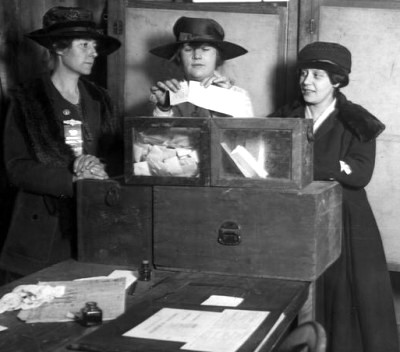
WHY EVERY WOMAN SHOULD VOTE
This is the story of our Grandmothers, and Great-grandmothers, as they
lived only 90 years ago. It was not until 1920 that women were granted
the right to go to the polls and vote.
Thus unfolded the ‘Night of Terror’ on Nov. 15, 1917, when the warden at
the Occoquan Workhouse in Virginia ordered his guards to teach a lesson
to the suffragists imprisoned there because they dared to picket Woodrow
Wilson’s White House for the right to vote. The women were innocent and
defenseless. And by the end of the night they were barely alive. Forty
prison guards wielding clubs and their warden’s blessing went on a
rampage against the 33 women wrongly convicted of ‘obstructing sidewalk
traffic.’
They beat Lucy Burn, chained her hands to the cell bars above her head
and left her hanging for the night, bleeding and gasping for air. They
hurled Dora Lewis into a dark cell, smashed her head against an iron bed
and knocked her out cold. Her cell mate, Alice Cosu, thought Lewis was
dead and suffered a heart attack. Additional affidavits describe the
guards grabbing, dragging, beating, choking, slamming, pinching,
twisting and kicking the women.
For weeks, the women’s only water came from an open pail. Their
food–all of it colorless slop–was infested with worms. When one of the
leaders, Alice Paul, embarked on a hunger strike, they tied her to a
chair, forced a tube down her throat and poured liquid into her until
she vomited. She was tortured like this for weeks until word was
smuggled out to the press.
So, refresh my memory. Some women won’t vote this year because–why,
exactly? We have carpool duties? We have to get to work? Our vote
doesn’t matter? It’s raining?
Last week, I went to a sparsely attended screening of HBO’s new movie
‘Iron Jawed Angels.’ It is a graphic depiction of the battle these women
waged so that I could pull the curtain at the polling booth and have my
say. I am ashamed to say I needed the reminder.
All these years later, voter registration is still my passion. But the
actual act of voting had become less personal for me, more rote.
Frankly, voting often felt more like an obligation than a privilege.
Sometimes it was inconvenient.
My friend Wendy, who is my age and studied women’s history, saw the HBO
movie , too. When she stopped by my desk to talk about it, she looked
angry. She was–with herself. ‘One thought kept coming back to me as I
watched that movie,’ she said. ‘What would those women think of the way
I use–or don’t use–my right to vote? All of us take it for granted
now, not just younger women, but those of us who did seek to learn.’ The
right to vote, she said, had become valuable to her ‘all over again.’
HBO released the movie on video and DVD. I wish all history, social
studies and government teachers would include the movie in their
curriculum. I want it shown on Bunco night, too, and anywhere else women
gather. I realize this isn’t our usual idea of socializing, but we are
not voting in the numbers that we should be, and I think a little shock
therapy is in order.
It is jarring to watch Woodrow Wilson and his cronies try to persuade a
psychiatrist to declare Alice Paul insane so that she could be
permanently institutionalized. And it is inspiring to watch the doctor
refuse. Alice Paul was strong, he said, and brave. That didn’t make her
crazy. The doctor admonished the men: ‘Courage in women is often
mistaken for insanity.’
Please, if you are so inclined, pass this on to all the women you know.
We need to get out and vote and use this right that was fought so hard
for by these very courageous women. Whether you vote democratic,
republican or independent party – remember to vote.
History is being made.
Recent Comments
Kitchen on Isiais: Winding Down intlxpatr on Shampoo Ginger tigerbutterya0c5ff1d… on Shampoo Ginger intlxpatr on British Soldier Kidnapped, Esc… John on British Soldier Kidnapped, Esc… Wikipedia Donate Button

Amazina


Early Voting in Florida


