Visitors, Not Residents?
From yesterday’s Arab Times:
The General Immigration Department of the Ministry of Interior is studying a proposal to replace the term ‘resident’ — the status given to expatriates working in Kuwait, reports Al-Watan daily. The daily added this has been done to ‘fight’ attempts by international organizations asking Kuwait to grant citizenship to expatriates who have been working in the country for a long time. Meanwhile, a reliable source said ‘visitor’ will replace the term ‘resident’. The source also said the General Immigration Department has stopped receiving applications for self sponsorship after noticing an increasing number in applications over the past few months. According to knowledgeable sources the Assistant Undersecretary for Citizenship Affairs Major-General Sheikh Ahmad Al-Nawaf has issued instructions to take into account the demographic structure of the country while issuing work permits because Kuwaitis account for only 33 percent of the population compared to 67 percent expatriates.
Calling all us guest-workers “visitors” is just a dumb idea. Call us guest-workers, call us workers, but if you call us “visitors” then you run into problems with folks who are just coming in for a VISIT, i.e. visitors.
I have always preferred being a resident. When I come into Qatar or Kuwait and all the lines are long except the GCC lines, I can always take a chance that the guards will think I am married to one of you when I step into the GCC line. If the person at the desk says I am in the wrong line, I can always look confused and say “I am a resident!” It has worked – well, most of the time. 😉
This issue is hand-in-hand with the school issue. Times are changing, old traditions are not being observed, and the blame is falling on foreign influences. It’s kind of like that train has left the station – if you want to go back to old ways, you’ll have to get rid of automobiles, computers, mobiles, supermarkets, and most of all, that demon of all forces of modernization – television.
The Taliban managed to reinstate old traditions, and in doing so, to take Afghanistan right back to the stone age. It was not just the women who suffered – men who didn’t want to wear beards, men whose hair was too long, men who wanted to listen to music, men who wanted to discuss politics – all were punished, some were killed.
The real challenge here is how Kuwait, as a modern nations state with a lot of money, is going to move with the modern world, not against it.
Travel Dilemma
We love Syria. I used to take trips around Syria with a group of archaeologists; we stayed weird places and saw the most remote and obscure places just to see them, just to see what we could see. It was so much fun; Syria is so beautiful. We most often went there in winter, and I remember how COLD it could be, even into April.

We requested visas weeks ago. No visas. This week we got a state department advisory saying travel in Syria was not advisable because of the embassy incident that happened in September 2006 – like over a year ago. Yeh, right. It couldn’t be that travel there is riskier because of the recent Israeli incursion?

Adventure Man suggested maybe we go to Paris, thinking Paris would make it all better. Then Morocco, knowing I also love Morocco. I am thinking maybe Larnaca, maybe Salalah, maybe Beirut. There is a part of me that is still hoping the visas will come through and I don’t want to commit to anything else. Aaaarrrrrgggghhhhhhhh!
Fireman Threatened
This morning, Adventure Man said “is this for me?” as he came across one of the scraps of newspaper left lying around in the living room. Sometimes they are – an exhibit at the Dar al Funoon, the opening of the new Tarek Rajeb Calligraphy Museum – but this time, it isn’t for him, not directly, it is for you.
From yesterday’s (October 8, 2007) Kuwait Times:
Fireman Threatened
A car caught on fire in Ardiya and firemen rushed tothe scene to put the fire out. When they finished their job and began writing their report, they saw liquor bottles inside the car. Shortly thereafter, detectives came by and told the firemen to forget about what they saw.
When the firemen said they wouldn’t and that they would report the matter, the detectives threatened the firemen at gunpoint.
Comment: Even Adventure Man had to laugh at that one, and said “it’s the Wild West out there, cowboys running around everywhere.”
Firemen and policemen are heroes in my book. And Kuwait has some good ones, true heroes. The bad ones, using their power for selfish gain – seem to be multiplying. Will the new face of the police force – bringing in non-Kuwaitis – make the force better, i.e. impartial enforcers of the law – or worse?
Saudis to Overhaul Legal System
Found this today on BBC Middle East News.
Saudi Arabia has announced an overhaul of its judicial system, including the allocation of $2bn (£981m) for training judges and building new courts.
The reforms, by royal decree, will lead to the creation of a supreme court, an appeals court and new general courts to replace the Supreme Judicial Council.
Reformers have welcomed the measures, which they say will improve human rights and help modernise the country.
They complain that the current judicial system is often opaque and arbitrary.
Until now, Saudi judges have had wide discretion to issue rulings according to their own interpretation of Islamic Sharia law.
The judiciary has also long resisted the codification of laws or the reliance on precedent when making a ruling.
Defendants also do not have recourse to appeal and often have no right to proper legal representation.
Unchecked powers
The new reforms announced by King Abdullah are aimed at addressing some of these perceived failings and at introducing safeguards such as appeal courts that can overturn decisions by lower courts, the BBC’s Heba Saleh says.
You can read the rest HERE.
Laughter is the Best Weapon
I just heard this quote on Good Morning America as they are discussing how Hilary Clinton laughs to disarm her critics and opponents:
The human race has only one really effective weapon and that is laughter. Mark Twain.
Good old Mark Twain! That cagey old cynic said some great things. I found this wonderful web page: Brainy Quotes: Mark Twain
Here are some that I just love. Take a look and see what YOU like.
Why is it that we rejoice at a birth and grieve at a funeral? It is because we are not the person involved.
What a wee little part of a person’s life are his acts and his words! His real life is led in his head, and is known to none but himself.
We have the best government that money can buy.
To refuse awards is another way of accepting them with more noise than is normal.
There is no distinctly American criminal class – except Congress.
There are several good protections against temptation, but the surest is cowardice.
The most interesting information comes from children, for they tell all they know and then stop.
Man was made at the end of the week’s work when God was tired.
It’s not the size of the dog in the fight, it’s the size of the fight in the dog.
It is curious that physical courage should be so common in the world and moral courage so rare.
In the first place, God made idiots. That was for practice. Then he made school boards.
Good breeding consists in concealing how much we think of ourselves and how little we think of the other person.
Giving up smoking is the easiest thing in the world. I know because I’ve done it thousands of times.
Anger is an acid that can do more harm to the vessel in which it is stored than to anything on which it is poured.
A lie can travel half way around the world while the truth is putting on its shoes.
We Do Not Have Homosexuals in Iran
I found this clip through Global Voices Kuwait who got it from somewhere else, too! Isn’t the net great?
Mahmud Ahmadinejad,Iranian president,said,in Columbia University,”we do not have homosexuals in Iran like you do in your country.” He brought the house down. Most just laughed, a few boo-ed.
The Columbia University president has taken a lot of criticism for his decision to have Ahmadinejad speak. He stuck to his guns.
You can see the film clip for yourself here: We Do Not have Homosexuals in Iran.
We Share the Road
Look closely. Look at the third set of wheels back, second set from the right. I know, I know, it is very difficult to see the tread. That’s because there is NO tread left on this tire.

Other tires on this truck were already shredding. Look, the one just in front of the bare-tread tire had some kind of exterior coating kind of thing on it, like a whole tire patch of some kind, also shredding. He is carrying a heavy load load. This is a disaster waiting to happen.
To my left is a police car.
I can’t remember? Is Kuwait the #1 most dangerous country for driving in the world, or the #2?
Donna Leon: Wilful Behavior
You think Donna Leon is writing about one thing, and then you discover it is about something else entirely. It seems to happen often in that line of work – you see the same thing on Law and Order, and Cold Case, and The Wire – what initially seems like a straightforward crime had depths and switch-backs unfathomable from the initial crime scene.
In Wilful Behavior, Paula, Brunetti’s wife, has just about had it with her university level students. They have no yearning for knowledge and insight, they are rife with materialism, she is feeling burned out and cynical. One student, who bucks the trend, comes to talk with her, and then Brunetti about the possibility of a post-mortem clearing of a person’s name, but she won’t give the name of the person or the crime that person committed. Before Commissario Brunetti has begun to plumb these depths – the student is murdered.
It’s always depressing when a young person dies. You can’t help but think of how treasured they were, how full of potential, and all that is gone now, wasted. A light in the world has gone out, and you grieve for how brightly that light might have shown. Brunetti and his wife only knew the murdered girl briefly, but her murder strikes them deeply.
Here is an excerpt from Brunetti’s discussion with the student before she was killed:
“I didn’t know young people even knew who Il Duce was.” Brunetti said, exaggerating, but not by much, and mindful of the almost total amnesia he had discovered in the minds of anyone, of whatever age, with whom he had attempted to discuss the war or its causes. Or worse, the sort of cock-eyed, retouched history that protrayed the friendly, generously disposed Italians led astray by their wicked Teutonic neighbors to the north.
The girl’s voice drew him back from these reflections. “Most of them don’t. This is old people I’m talking about. You’d think they’d know or remember what things were like then, what he was like.” She shook her head in another sign of exasperation. “But no, all I hear is that nonsense about the trains being on time and no trouble from the Mafia and how happy the Ethiopians were to see our brave soldiers.” She paused as if assessing just how far to go with this conservatively dressed man with the kind eyes; whatever she saw seemed to reassure her, for she continued. “Our brave soldiers come with their poison gas and machine guns to show them the wonders of Fascism.”
So young and yet so cynical, he thought, and how tired she must be already of having people point this out to her. “I’m surprised you aren’t enrolled in the history faculty,” he said.
“Oh, I was, for a year. But I couldn’t stand it, all the lies and dishonest books and the refusal to take a stand about anything that’s happened in the last hundred years.”
“And so?”
“I changed to English Literature. The worst they can do is make us listen to all their idiotic theories about the meaning of literature or whether the text exists or not.” Hearing her, Brunetti had the strange sensation of listening to Paula in one of her wilder moments. “But they can’t change the texts themselves. It’s not like what the people in power do when they remove embarassing documents from the State Archives. They can’t do that to Dante or Manzoni, can they?” she asked speculatively, a question that really asked for an answer.
“No,” Brunetti agreed. “But is suspect that’s only because there are standard editions of the basic texts. Otherwise, I’m sure they’d try, if they thought they could get away with it.” He saw that he had her interest, so he added, “I’ve always been afraid of people in possession of what they believe is the truth. They’ll do anything to see that the facts are changed and whipped into shape to agree with it.”
And, as it turns out, in the persistent corruption of Venetian bureaucracy, that is exactly what this murder is all about – the theft and possession of art during WWII, and how the ramifications are still trickling down today. How people are willing to kill to keep the past safely in the past, and to hang on to their treasured and priceless possessions.
Donna Leon continues to be one of my favorites because she is never formulaic – she has ISSUES, and she uses her Brunetti novels to educate her readers. As we become educated, we continue to experience Venice through all the senses, the smell of the veal cooking for dinner, the taste of the tiny espressos in the corner cafe meeting places, the gruesome murder sites, the sound of the waves in the canals, whipped up by the prevailing winds . . .you read Donna Leon, you become Venetian.
A Thousand Splendid Suns
Once I picked up Khaled Hosseini’s A Thousand Splendid Suns, I barely put it down again until I was finished. I found myself thoroughly involved in the lives of Mariam and Leila, unwilling even to stop to fix dinner! The author of Kiterunner has hit another home run.
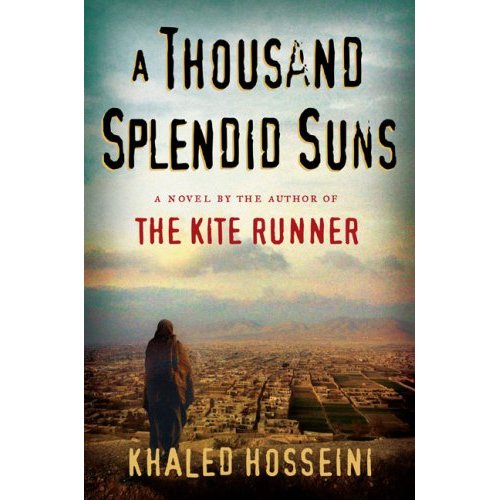
There was a time when we would listen to older state department types talk – with enormous longing – about their tours of duty in Afghanistan, pre-Soviet invasion, pre-Taliban, pre-American occupation. Have you ever read James Michener’s Caravan? There are two countries I long to vist, but the countries they are now are not the countries I heard people talk about – Afghanistan and Ethiopia. Our friends loved their times in these two countries.
A Thousand Splendid Suns opens in a small village outside Herat, and then takes us to Kabul. Mariam is born harami, a bastard, of a village cleaning woman in the house of a very wealthy man. Her father builds a small hut for her mother and herself in a remote part of the small village, and visits Mariam every week. Life is simple, and difficult, but also full of kind people who visit and who are concerned with Mariam’s welfare.
After marrying, Mariam goes to Kabul and learns a new way of life with her husband, Rasheed. What fascinates me with Hosseini is that while Rashid is one of the villians of this novel, he is just a man, doing the best he can given his own upbringing and limitations. In a sense, he is “everyman”, the strutting, domineering, sometimes brutal and abusive husband we find in every culture. But Hosseini also gives him transient bouts of kindness which blow through a little less often than the transient bouts of cruelty.
He also gives us good men, in this book, in the person of Jalil, the father of Mariam, who steps up to the plate in acknowledging Mariam and supporting her and her mother, but fails to nurture in the very real way women need nurturing from their fathers in order to reach their full potential in life. Hosseini also gives us a very strong man in the book, Tariq, who, although he has only one leg, is more wholly a man than any other man in the book. I imagine that this is not unintentional. (How Kissingerian is that for a double negative?!)
Written almost entirely in the Afghan world of women, we see through the eyes of Mariam, and later Leila, the transitions in Afghanistan and their impacts on daily life. We experience happiness with them, and peaceful scenes in quiet moments, raising the children, stepping outside into the garden at night to share a cup of tea and a shared bowl of halwa.
Between the moments of peacefulness, we also experience incoming morter rounds, explosions, marauding bands of warlords, and starvation. We go into a women’s hospital under Taliban control, where there are no medications, no running water, no instruments, and an Afghani female doctor does a C-section with no anaesthesia and is required to keep her burqa on. We watch a mother abandon her role and take to her bed when her two sons are killed fighting the Soviets, we experience betrayal and we experience helplessness, and we experience a Kabul women’s prison. A Thousand Splendid Suns is a rich feast of experiences, juxtaposing the everyday chores of women around the world – cooking, raising children, laundry – with events on the world stage.
(Available from Amazon for $14.27 plus shipping.)
When Evil Strikes

(the cover of the Sydney, Australia, Herald Sun)

(Photograph from the archive of TIME photographer James Nachtwey, You can see his entire collection, and more at Time Magazine)
The killing of innocents is never right, not when it is committed by the US, not when it is committed by our allies, not when it is committed against innocents, never.
I’ve always loved September, the time of new beginnings, new school years, the fresh breath of Autumn, but I awake the morning of September 11 full of sadness. I have sad, intense dreams, and I am conscious, throughout the day, of the horrors we inflict upon one another. It is a day of great sadness.
It is so sad for me that this one time, I am closing the comment sections. We all have to deal with our sadness in our own way.
Recent Comments
intlxpatr on Shampoo Ginger tigerbutterya0c5ff1d… on Shampoo Ginger intlxpatr on British Soldier Kidnapped, Esc… John on British Soldier Kidnapped, Esc… intlxpatr on British Soldier Kidnapped, Esc… Wikipedia Donate Button

Amazina


Early Voting in Florida


 Here There and Everywhere