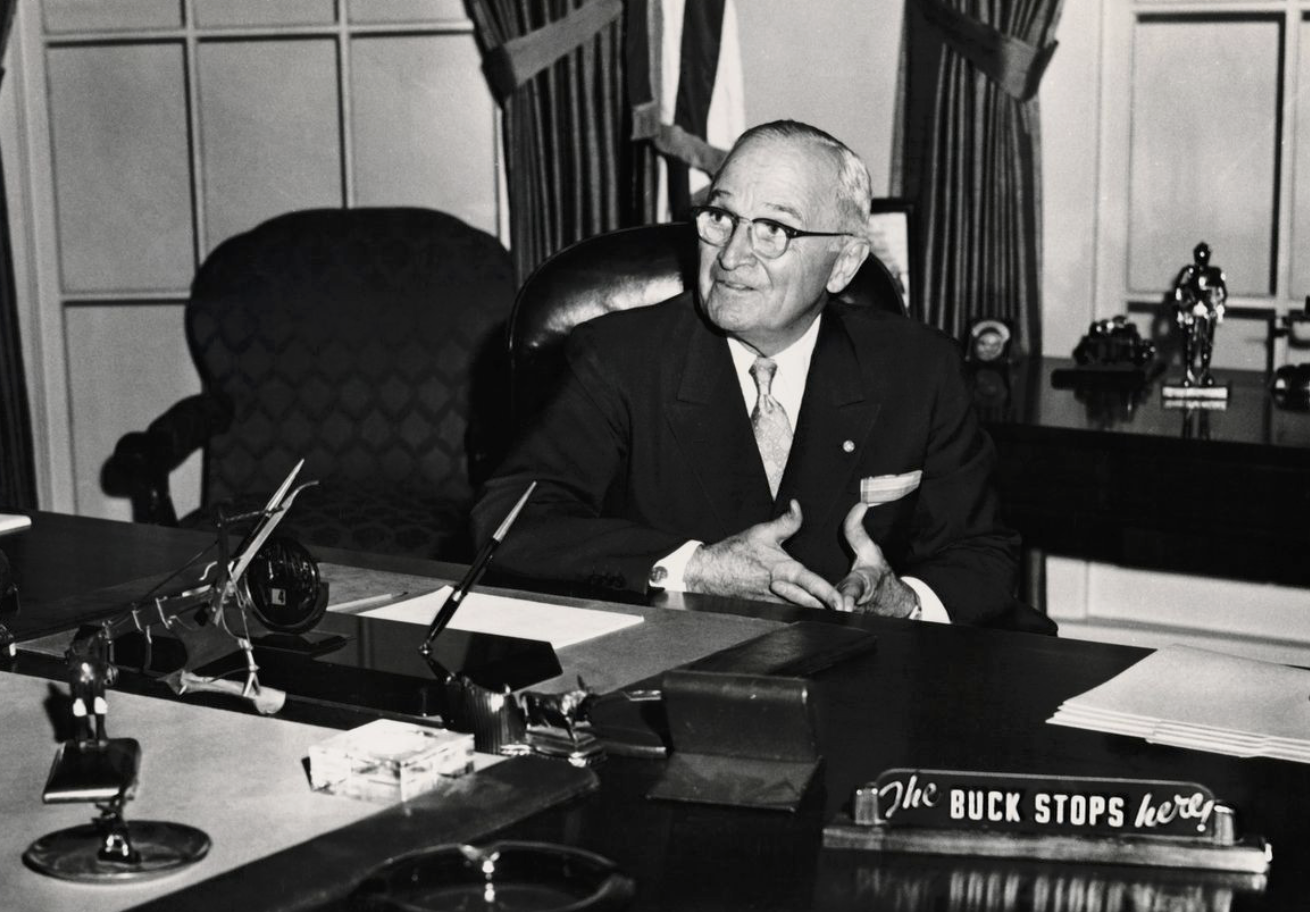
What Happened to “The Buck Stops Here?”
Today, Heather Cox Richardson reports the following:
When a reporter asked Trump today why he didn’t “stick around for the signing ceremony with this Iran peace deal,” the famously camera-courting president answered: “I might, but I’d rather, this is a memorandum of understanding. It’s very important, but it might not be the kind of a document that I should be signing.” The reporter responded: “There is some element to this where you send the vice president. If it works out, great. You look like a genius for sending him. If it doesn’t work out, it’s the vice president’s fault.”
Trump responded: “I like that idea…. This way, if it works out, I’m gonna take the credit; if it doesn’t work out, I’m blaming J.D. You better be careful, J.D. He’s gonna turn his plane around and get the hell outta here. Yeah, I like that idea. I think that’s a good idea.”
If anyone else said that, and then said “just kidding!” we might believe them. When Trump says it, he means it. He doesn’t really know what the memo implies, doesn’t understand how it puts the United States in a worse position than before he started the war (the memo specifically calls it a war), and while he is already taking credit for it, he leaves himself an escape hatch in case the wires and mirrors stop working.
Citizens, more than ever, it is time to protect your vote and to make sure your vote counts.
Make sure you are registered to vote.
Call your Supervisor of Elections and make sure you are still on the rolls, and that your information is accurate.
If you intend to vote by mail, make sure you are listed for a mail-in vote, and when you vote, mail you vote at a post office, or deliver your vote to the office of the Supervisor of Elections in advance of election day.
Vote the scoundrels out.
Trump is in the process of doing everything in his power, legal or illegal (just look at the judges who stop his illegal mandates daily), to eliminate votes against his party. We, the people, must be vigilant!
The Buck Stops Here.
Robert Reich: Freedom Summer 2026
Robert Reich shares an idea for hope in a shocking season of gerrymandering. Win anyway, by registering voters. Michelle Obama would say “we go high”:
Friends,
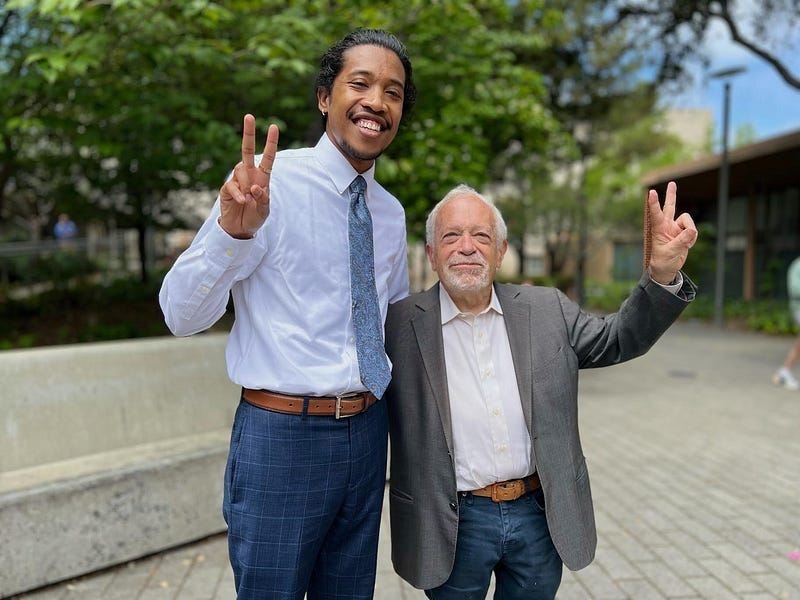
Yesterday I spoke with Tennessee state representative Justin Jones, one of the nation’s young Black leaders who’s been a rising star in Tennessee politics, about the Supreme Court’s shameful April 29 decision in Louisiana v. Callais, gutting Section 2 of the Voting Rights Act.
Jones told me that, at Trump’s urging, Tennessee Republicans had prepared a redistricting map even before the Court announced its decision. Then, despite pleas from Black voters and voting rights advocates, the white Republican legislators moved their meeting to another room without allowing the public in to watch, passed the new map out of committee, and enacted it within 24 hours.
The new map has eliminated Tennessee’s one remaining Democratic district around Memphis, a city of about 610,000 people, about two-thirds of whom are Black — by cracking it into three majority-white district, one stretching hundreds of miles. The map has also divided Nashville, another city with a Black majority, into five white-majority districts.
Jones described Tennessee house speaker Cameron Sexton as the “grand wizard in chief,” explaining that “that’s what they want to do. They want to create a process that is unfair and unequal.”
Other Southern states have joined Tennessee’s rush to redistrict.
Louisiana’s governor has ordered that the state’s ongoing congressional election be set aside while state lawmakers redraw maps to eliminate a Democratic-majority – that is, a Black-majority – seat covering Baton Rouge.
At Trump’s request, Alabama Republicans have approved legislation directing the governor to schedule new primary elections this year under a GOP-friendly map that would end districts represented by Black lawmakers, if courts lift an injunction on its redistricting.
The Mississippi legislature will soon convene in a Confederate-era capitol building that it hasn’t used in 100 years, presumably to eliminate the Democratic majority in the one Mississippi district held by a Black representative.
South Carolina’s Republican majority in the statehouse voted Wednesday to extend its legislative calendar, allowing time to consider whether they should eliminate the state’s sole Democratic-majority, Black-majority district, held by long-serving representative James Clyburn.
Florida was already in a special redistricting session when the Supreme Court announced its decision, enacting a congressional map for its 28 districts that packs Black and brown voters into four districts on the south Florida coast and Orlando, eliminating every other Democratic majority.
“We’re going backwards at warp speed,” Jones told me. “In just over a week, we’ve gone from the 1965 Voting Rights Act back to the era of Jim Crow.”
I asked him what he and other Black political leaders in the South were planning to do.
“There’ll be a lot of litigation,” he said, “but we can’t be optimistic with this Supreme Court.”
“So, what’s the strategy?”
“We need the biggest voter turnout in history this fall. Every Black person, every Brown person, every Democrat, everyone who cares about the moral soul of this nation has to vote for equal voting rights. Take over Congress. Increase our power in state legislatures. This is the only way to respond.”
“I’m with you,” I said, “but I really wonder whether that’s possible.”
“How about a new Freedom Summer?” Jones responded, with a smile. “A multi-racial force of young people fanning out across the South, registering voters, getting them to the polls, just like they did in 1964.”
“I remember. I lost a dear friend in Mississippi Freedom Summer.”
“I have no direct memory, of course,” Jones said. “I was born in 1995, thirty-one years after Freedom Summer. But the South is almost back to where it was then. So, yes, it’s possible. It’s got to be possible.”
I told him I’d share his idea with you, and ask you for your responses.
“Cunning, Ambitious, Unprincipled Men”
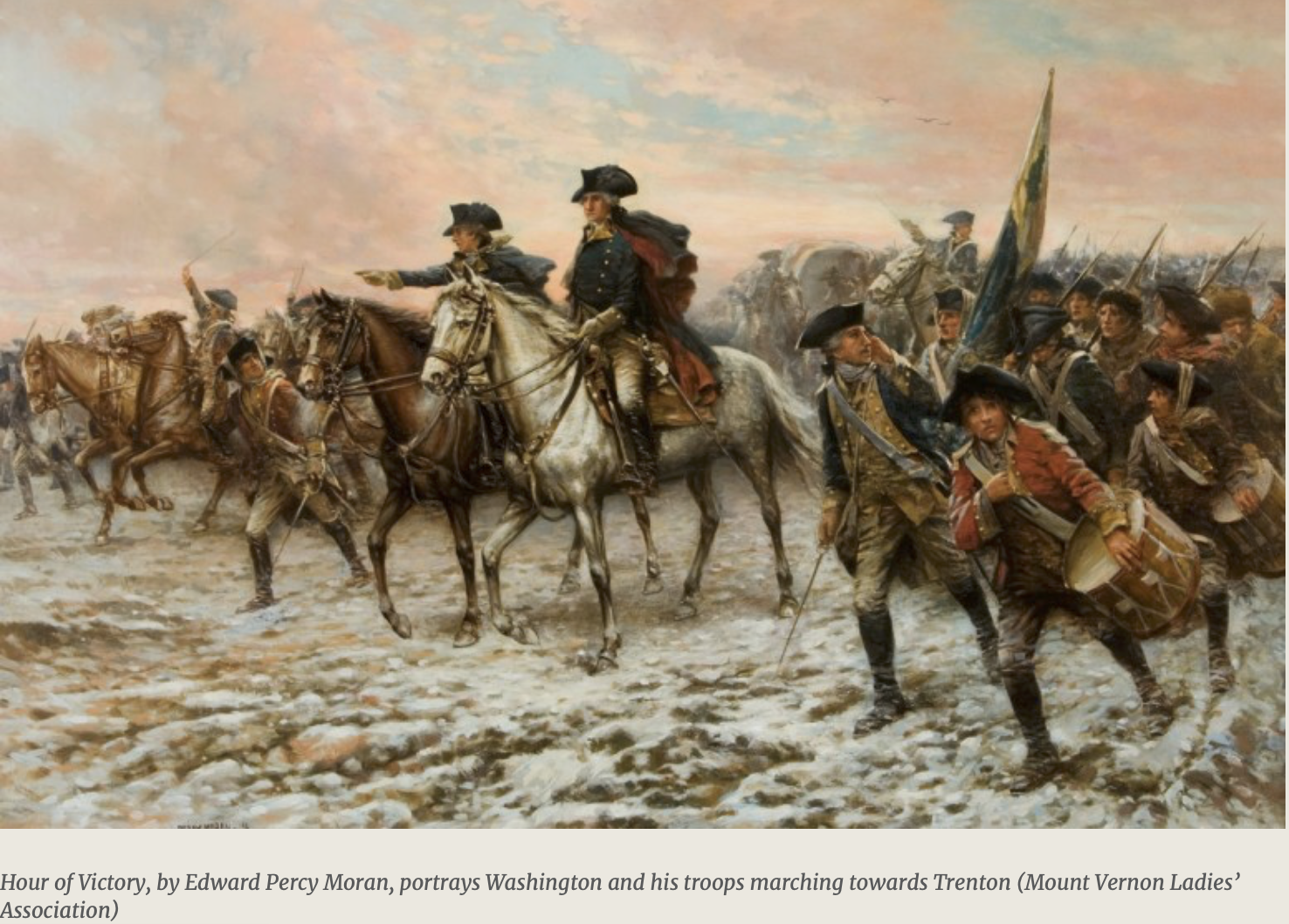
” However [political parties] may now and then answer popular ends, they are likely in the course of time and things, to become potent engines, by which cunning, ambitious, and unprincipled men will be enabled to subvert the power of the people and to usurp for themselves the reins of government, destroying afterwards the very engines which have lifted them to unjust dominion. “
George Washington, FAREWELL ADDRESS | SATURDAY, SEPTEMBER 17, 1796
The proposed SAVE act addresses a problem that does not exist. There IS occasional voter fraud, it is very rare and it is as often committed by one party as the other. Our elections are safe.
The SAVE act creates barriers for legal voters, especially for women who have changed their name as American citizens culturally do. So if you are a married woman, your ID does not match your birth certificate.
As a woman who has had to scramble in my life time to gather original documents, I know how frustrating, time-consuming and expensive it can be. I had to provide my birth certificate and marriage certificate to live in some foreign countries as we served our country. I was strongly motivated, and I had the luxury of clear instructions, TIME, and enough money to buy the documents I needed.
It is primarily American citizens; Women and the poor, who will be inconvenienced by this act, or unable to vote due to lack of money and time to access their documents.
In my state, Florida, restrictions have already gone into place that diminish voting: a requirement to renew your voting registration every other year, limits on early voting, and limits on absentee voting (especially hard for the elderly with limited abilities). Voters are increasingly forced to wait in long lines in the Florida heat and humidity. Oh – and there is an effort by one party to forbid groups who want to provide water for those standing in line to vote, a concern that a bottle of water might influence a vote.
LOL, this is an AI summary of Florida voting restrictions:
Overview of Voting Restrictions in Florida
Florida has implemented several voting restrictions that affect voter eligibility and the voting process. These changes have been a topic of significant debate.
Key Restrictions
Citizenship Verification
- Voters must provide proof of citizenship to register and vote.
- This requirement aims to ensure that only eligible citizens participate in elections.
Identification Requirements
- Certain forms of identification that were previously accepted may no longer be valid.
- Voters must present specific forms of ID when voting in person.
Voter Eligibility Challenges
- Individuals can challenge another person’s eligibility to vote, but this process is regulated.
- Challenges must be submitted in writing and can only occur within a specific timeframe before an election.
Provisional Ballots
- Voters whose eligibility is challenged can cast provisional ballots.
- These ballots are counted only after verifying the voter’s eligibility.
Impact on Voters
Affected Groups
- The new laws may disproportionately impact students, seniors, and women, who may lack the required identification or documentation.
- Critics argue that these restrictions could suppress voter turnout among eligible citizens.
Registration Deadlines
- Voters must register at least 29 days before an election.
- Changes to voter registration, such as party affiliation or address, must also be submitted by specific deadlines.
These restrictions are part of ongoing discussions about election integrity and access to voting in Florida.
These are moves designed to usurp the reins of government.
Congress Overturns Bush Veto
From BBC News.
The United States Congress has for the first time overturned President George W Bush’s veto, on a bill authorising spending on water projects.

The Senate voted 79-14 to overturn the veto, after the House of Representatives voted 361-54, well over the two-thirds majority required.
The last time a veto was overridden was in 1998, under President Bill Clinton.
The bill authorises billions of dollars-worth of local projects, many of which Mr Bush says are unnecessary.
It includes funding for coastal restoration in Louisiana after Hurricane Katrina, improving the Florida Everglades and fisheries in the Great Lakes.
Many local projects, such as dams, sewage plants and beach restoration, are considered important to local communities and therefore to politicians’ electors.
My comment: It’s about time. I only wish it had happened before, when Congress approved a child healthcare plan, Bush vetoed it, and Congress didn’t have the votes to override the veto.
In the US system, there are two houses in the legislature; the Senate, with two representatives from each state, and the House of Representatives, with representations allocated according to population. When a bill is passed, it has to be passed by both houses, by a simple majority, more voting for than against. Then the bill goes to the President for his signature. If he vetos the bill (says no) then the bill can still become a law if 2/3 of the members of the Senate and 2/3 members of the House vote for it.
Several members of Bush’s party, the Republicans, had to vote with the Democrats in order to overcome the veto.
You can read the rest of the story HERE.
In addition to national laws, there are state laws. In my state, Washington state, there is a really cool way a bill may be introduced by the people, called an initiative. If you can gather enough genuine signatures – and they will be sampled and verified, so you really have to have more than enough real signatures – you can put an issue on the ballot. It usually takes a lot of signatures, and most of the time the initiatives can be a little bit crack-pot, but it puts a lot of power in the hands of the people to have this instrument for making laws.
On the other hand, there are also referendums, in which the elected legislators will send a bill to the people to vote on.
These are both forms of direct democracy, where the people vote for themselves, instead of trusting elected representatives make the decisions for them.
You would think it would be an ideal form of democracy, but to work, it requires that people educate themselves on the issues, and people often aren’t willing to do that.
Recent Comments
Kitchen on Isiais: Winding Down intlxpatr on Shampoo Ginger tigerbutterya0c5ff1d… on Shampoo Ginger intlxpatr on British Soldier Kidnapped, Esc… John on British Soldier Kidnapped, Esc… Wikipedia Donate Button

Amazina


Early Voting in Florida


