Blogging: The Opinion Explosion
Today there was a lively discussion on National Public Radio about news, and the great enormity of it, and how news reporting is changing. It used to be, so they said, that news reporters reported the facts, as best they could find the information, and they kept their opinions to themselves. The goal was objectivity.
Hmmmmm. In the US, it seems to me we had an entire period when the press was seen as “muckracking” or seeking scandal. The tabloids have always been with us. Even in the HBO TV series Rome, there were cartoons on the wall, a sort of primitive newspaper, entertaining, whether true or not-true.
So my speculation would be that as objective and fair (or as Fox puts it “fair and balanced” reporting which totally makes me want to throw up because FOX is SO SO slanted) as we would like to think our news is, bias has always crept in, and it is always a case of caveat emptor when it comes to news.
Here were some priceless quotes and ideas from the today’s NPR discussion:
“Not everyone’s experience is that interesting.”
Two rules for basic research:
1) Not every authority is right. Don’t believe someone just because they claim “authority”. Authorities can be wrong.
2) Just because you agree with an authoritie’s opinion does not make it true.
When you blog, podcast, SMS, etc. information, be sure to give your source of information and some evaluation of how reliable that source is likely to be.
Wikipedia is not necessarily a reliable source to be quoting. You have to double check the sources of information there, too.
My favorite piece of verbiage: We are experiencing a cacaphony of unfiltered information.
My comment: It’s exciting to hear people discuss the new ways in which we are getting – and sharing – news/information. I was in traffic, trying desperately to write phrases and ideas down at every red light. (How often do you say “alhamdallah” for the red lights??) We have access to so much more information, but how much of it is “hard” and how much is opinion? I love hearing people discussing information and dissemination of information, and how it is changing our lives.
And how much harder it is for any nation to keep a big secret – the containment walls have become more porous, information seeps through. Cell phones transmit real time dramas, bloggers share information (and misinformation), news can be SMS’d before it hits the airwaves by official sources. Governments which like to control information are fighting a losing battle, and it will increasingly change the faces of government (oops, my opinion!).
As our actions become increasingly public (cameras tracking vehicles, bank withdrawals, parking lots, cell phones broadcasting private moments, etc) we will all become, privately and publicly, increasingly accountable. (I am extrapolating here!) What an interesting new world . . .
Virginia Hall: A Modest Heroine
The Good Shepherd, a new movie with Angelina Jolie, and Matt Damon, directed by Robert DeNiro (!), will open Friday, a story of the beginnings of the American intelligence services, the OSS and the CIA. I can hardly wait.
Earlier this week, there were some small news articles about Virginia Hall, who served her country risking her life time and time again, fighting the Nazis in the allied clandestine services, facing the possibility of torture and death if she were caught. Hall didn’t let anything hold her back. She believed that what she was doing was worth doing, and when WWII ended, she continued working quietly for the greater good. I would have loved to meet this woman. What a pistol!
Here is what Wikipedia has to say about her:
Virginia Hall MBE DSC (April 6, 1906 – July 14, 1982) was an American spy during World War II. She was also known by many aliases: “Marie Monin,” “Germaine,” “Diane,” and “Camille.”[1]
She was born in Baltimore, Maryland and attended the best schools and colleges, but wanted to finish her studies in Europe. With help from her parents, she traveled the Continent and studied in France, Germany, and Austria, finally landing an appointment as a Consular Service clerk at the American Embassy in Warsaw, Poland in 1931. Hall hoped to join the Foreign Service, but the loss of her lower leg was a terrible setback. Around 1932 she accidentally shot herself in the left leg when hunting in Turkey, it was later amputed from the knee down, which caused her a limp.[2]
The injury foreclosed whatever chance she might have had for a diplomatic career, and she resigned from the Department of State in 1939.
The coming of war that year found Hall in Paris. She joined the Ambulance Service before the fall of France and ended up in Vichy-controlled territory when the fighting stopped in the summer of 1940. Hall made her way to London and volunteered for Britain’s newly formed Special Operations Executive, which sent her back to Vichy in August 1941. She spent the next 15 months there, helping to coordinate the activities of the French Underground in Vichy and the occupied zone of France. When the Germans suddenly seized all of France in November 1942, Hall barely escaped to Spain.[3]
Journeying back to London (after working for SOE for a time in Madrid), in July 1943 she was quietly made a Member of the Order of the British Empire. The British had wanted to recognize her contribution with a higher honor but were afraid it might compromise her identity as she was then still active as an operative.
Virginia Hall joined the U.S. Office of Strategic Services (OSS) Special Operations Branch in March 1944 and asked to return to occupied France. She hardly needed training in clandestine work behind enemy lines, and OSS promptly granted her request and landed her from a British MTB in Brittany (her artificial leg kept her from parachuting in).
Code named “Diane,” she eluded the Gestapo and contacted the French Resistance in central France. She mapped drop zones for supplies and commandos from England, found safe houses, and linked up with a Jedburgh team after the Allied Forces landed at Normandy. Hall helped train three battalions of Resistance forces to wage guerrilla warfare against the Germans and kept up a stream of valuable reporting until Allied troops overtook her small band in September.
For her efforts in France, General William Joseph Donovan in September 1945 personally awarded Virginia Hall a Distinguished Service Cross — the only one awarded to a civilian woman in World War II. (emphasis mine)
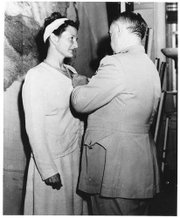
In 1950, she married OSS agent Paul Goillot. In 1951, she joined the Central Intelligence Agency working as an intelligence analyst on French parliamentary affairs. She retired in 1966 to a farm in Barnesville, Maryland.
Virginia Hall Goillot died at the Shady Grove Adventist Hospital in Rockville, MD in 1982.
Her story was told in “The Wolves at the Door : The True Story of America’s Greatest Female Spy” by Judith L. Pearson (2005) The Lyons Press, ISBN 1-59228-762-X
She was honoured in 2006 again, at the French and British embassies for her courageous work.[4]
Today’s Grin: We are Forbidden to Report the Following Story
Todays Kuwait Times bottom left corner:
Information Gags Press
Kuwait: The Ministry of Information issued a gag order to all local media over reporting the tussle between two leading Kuwait companies over the September takeover of a KSE-listed firm. A copy of the court order ordering the ban was attatched to the ministry’s letter to all local dailies and media. The following is a translation of the accompanying Arabic letter (shown on the front page):
From the Ministry of Information, To the Editor-in-Chief, Kuwait Times. With reference to case number 900/2006 filed by Mohammed Abdul Mohsen Al-Kharafi Holding Co and Mohammed Abdul Mohsen Al-Khorafi & Sons for General Trading and Contracting against the Minister of Commerce and Industry as the supreme chairman of the Kuwait Stock Exchange (KSE), a court order has been issued pertaining to the banning of the publication of any news concerning the subject of the contestation (number 2/2006) till a verdict is issued concerning the nondisclosure violations. Therefore, please be advised to stop any publication till the case is over.
So the Kuwait Times reports that it cannot report the story. Brilliant.
Bahrain Censors Google Earth
This morning my nephew from GE sent me an e-mail with an article from the Financial Times on Mahmoud’s Den and Google Earth in Bahrain. When Google Earth upgraded the resolution on Bahrain, Bahrainis started recording the discrepancy in properties, and circulating copies of residencies, luxury cars, boats, etc. in contrast to the poor, crowded villages. The Bahraini government banned the use of Google Earth in Bahrain. You can guess what happened next – downloads shot through the roof. It’s just human nature.
The article in Financial Times gives more information.
When are governments going to figure out that when you ban a technology, you only make it more attractive? Google Earth downloads for free, it is available to everyone with a computer and adequate bandwidth. No matter what safeguards you put in, there are ways around it. That’s just the nature of technology.
Mahmoud’s Den sports a button that says “No Sunni, No Shiia, Just Bahraini”.
Philippa Gregory and Catherine of Aragon
Being sick has one advantage. . . you can catch up on some of your reading. Philippa Gregory is one of my favorite writers of historical fiction.
To my great shame, I have a very difficult time reading history. Unless it is vigorously written, it puts me to sleep. It is particularly embarassing when my husband has a degree in History, and his eyes light up discussing battles and strategems and who said what to whom and why it matters. It has to do with my hard-wiring, it’s not even a gender thing.
So I gravitate toward historical fiction; give me people and motivations and interactions any day, and I can remember it. Sometimes, I even learn something. Philippa Gregory never lets me down. She researches, she documents, and she might speculate, but you always have a clear idea what is real (historically documented) and what is a good story, putting meat on the bones of the history.
Out of sequence, I read The Queen’s Fool and The Other Boleyn Girl. Each of these books is peripheral to the story of Catherine of Aragon. The first features a woman chosen to be a Fool at the court of Queen Mary, Catherine’s daughter. She is of Jewish descent, hiding as a Christian, escaped from the fires of the Spanish Inquisition. She lives in fear of being caught out in her deception. With her father, a printer, she tries to secrete and maintain many of the books of Moorish Spain, the knowledge of the ancients, which the church begins to declare heretical in England. The second book, The Other Boleyn Girl, is about Anne Boleyn, but told from the perspective of her sister, Lady Mary, who was also mistress to Henry, King of England, while he was married to Catherine of Aragon. The Boleyn girls are portrayed as mere pawns in the great game of power in the English court.
So this newest book, The Constant Princess, opens in Spain, as Queen Isabella of Castile, Catherine’s mother, and King Ferdinand of Aragon fight to eliminate the Moors and to unite their lands into one Kingdom. The little girl, whose mother is the chief strategist and who fights in armor alongside her husband, learns battlefield tactics at her parent’s feet and in their camps and learns diplomatic skills in their throne rooms.
We follow Catherine to England, married first to Arthur, then after Arthur’s death, to Henry. She assures them her marriage to Arthur was never consummated, that Arthur was too young, and impotent. Gregory assumes this was a lie. We don’t know. I would guess that it was one of those lies that nobody believes but was convenient to all to pretend to believe, for money, for power, for alliances.
We stand with Catherine as she sends Henry off to fight the French, then leads her own troops up to vanquish the Scots. We agonize with her as she strives to become pregnant, to carry an heir to the throne full term to birth, and as she loses a seemingly perfect baby boy to infant death. We sit with her in stragegic councils, watch her balance the budgets for court and state, and scheme to protect the English borders against all threats. Whew! Being a Queen of England is hard work!
The book ends with Catherine facing the eccliastical trial as her own husband disputes the validity of her marriage to him and seeks to set her aside for his freedom to marry Anne Boleyn.
I don’t review every book I read, but I was captivated by the cross cultural threads in this book, and by the fact that while we all know the basic facts of the story – Henry divorces Catherine of Aragon to marry Anne Boeyn – Catherine’s history, her talents, her strengths and victories were news to me. The influence of her upbringing in Moorish Spain and the influence it played on her growing understanding of the world is a golden thread woven throughout the story.
Early in her first marriage, the young princess tells her beloved husband of her childhood in Grenada:
” . . . We walk in their gardens, we bathe in their hammams, we step into their scented leather slippers and we live a life that is more refined and more luxurious than they could dream of in Paris or London or Rome. We live graciously. We live, as we have always aspired to do, like Moors. Our fellow Christians herd goats in the mountains, pray at roadside cairns to the Madonna, are terrified by superstition and lousy with disease, live dirty and die young. We learn from Moslem scholars, we are attended by their doctors, study the stars in the sky which they have named, count with their numbers which start at the magical zero, eat of their sweetest fruits and delight in the waters which run through their aquaeducts. Their architecture pleases us: at every turn of every corner we know that we are living inside beauty. . . . We learn their poetry, we laugh at their games, we delight in their gardens in their fruits, we bathe in the waters that have made flow. We are the victors, but they have taught us how to rule. . . .”
I can hardly wait for a trip to Spain!
We Never Saw it Coming
Tomorrow, November 9th, is a very special anniversary for me. The night of November 9, 1989, I was in a car with three other women, escaping from our cold-warrior duties. We were on our way to the border towns of West Germany for some shopping in the crystal factories. We really needed the get-away.
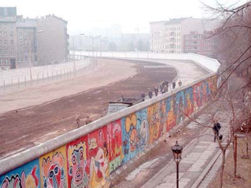
We had a drive of several hours, and on the way, we noticed the strangest thing – an unusually heavy numbers of cars coming FROM the border, and most of these cars were POS – old, slow, rusty, spewing black smoke, made of fiberglass – but full of people. The West Germans only drive new, shiny cars – where were these cars coming from?
We turned on the radio, and learned that the Czechoslovakian border had opened. When we got to our little gasthaus, we sat in the common room and watched, spellbound, as young people danced on the Berlin Wall. It was the most amazing, stunning sight you could imagine.
There were signs this was coming. No one seriously believed it really would happen, and happen so fast and so dramatically. The American government was pouring millions of dollars into Germany to renovate housing and offices and services, assuming the status quo would endure for the forseeable future, and American forces would be there a long long time. A mere fifteen years later, American presence had decreased dramatically, entire bases have closed, those renovated offices and houses turned back over to the Germans. Whoda thunk?
The reunification of Germany has been painful, continues painful. The integration of the former Soviet states into the European community moves at a snail’s pace, but it moves. It’s a new Europe, one currency, goods traded freely, young people from all countries free to move and work in other European countries. It’s an amazing new world.
The frustrations of getting the political system to work are mitigated by the occasional tipping point when the world changes in a heartbeat, and the people dance on the Wall.
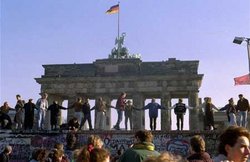
Thanks to Wikipedia for sharing appropriate photos!
Weekend Rumors: Kuwait
Just before Ramadan started, there were all kinds of rumors flying around about an upcoming change in the weekend. Normally, this is just fluff stuff, but I remember reading it in the newspaper, too, giving it a little more substance than just buzz.
Has anyone heard anything recently? Is a change of weekend to Friday – Saturday still in the works or is it blown out of the water by the newer and graver rumors?
Judicial Staff Immunity (??) (!)
Page 6, Kuwaiti Times News In Brief
“Major General Thabit Al Muhanna has instructed officials of the traffic department not to issue any tickets against members of judicial staff such as judges, prosecutors and investigators, reported Al-Qabas. He said that they were also not authorized to report any of these members to police or any other officials for investigations. He said the traffic department officials in these cases should only record the civil ID details of said members.”
The judiciary is held to a LESSER standard than the average citizen? In most countries, the judiciary (my son is a prosecutor) is held to a HIGHER standard, because they are the ones who must dispense justice with wisdom . . . How can they prosecute, investigate, judge with clear conscience when they are exempt from the laws they implement?
What Am I Missing Here?
“Yes to the waiver of loans” read the banners of 50 citizens rallying in silent protest in front of Parliament to request a bailout of private debt. What am I missing here? As I understand it, these are grown-up people who have taken out loans, many loans greatly out of proportion to their income, and who now don’t want to pay the loans back. Am I understanding this correctly?
So who pays? If the loans are waived, who pays the banks? If a loan is waived, does that person forfeit the right to ever borrow again? And what discourages a person whose repayment is waived from making the same mistake again, borrowing more than they can re-pay?
And who is making these huge loans to citizens with limited salaries? Why would they give a loan that the borrower could only repay with hardship? Are there laws governing banking practices in Kuwait?
The “A” Word: Accountability
My internet was out when I got up – waaaaaay too early this morning, totally jet lagging, so I read this morning’s Kuwait Times, which I usually save as my reward for getting work done. (Yep, total news geek.)
You can usually scan a politician’s speech quickly to tell if it is platitudes or substance – so Speaker of the National Assemply Jassem Mohammed al-Koraifi’s speech at the opening of the National Assembly yesterday caught my eye. For one thing, he used the “A” word – accountability – three times. That’s a very brave word for a government official to use, and he used it in impressive ways.
He may have used the “A” word more than three times – I am betting he was speaking in Arabic, and the full text of the speech is not printed, only excerpts. Still – three times!
First, I’m impressed that he encourage women who are interested in participating as elected officials to start running NOW. He’s right. It takes more than an electoral season to build a winning platform. You know there are good women out there qualified and capable of public office – encourage them, support them, and introduce them to your friends.
The KT quotes the Speaker as saying that “reform is a responsibility that lies with all, and that that both parliament and government are first to bear that responsibility. ‘I stress to the head and members of the government; you are responsible for laying policies and responsible for implementing legislation and are accountable for your institutions and bodies’ performance, and bear the responsibility before your superiors.'” (emphasis mine)
His next reported use of the word is in his section on reform: “Parliament is a constitutional partner in the planning of reform precedures and legislation, and an overseer over implementing reform programs and realization of its objectives, and a body those who abuse its means and tools shall stand accountable to.” (emphasis mine)
The last reported use was in the part of his address on building consensus. “This should all come within a positive relationship based on transparency, credibility, mutual respect, and guarantees for optimal use of supervisory and accountability tools and where the independence of the judicial authority is maintained with none interfering in its affairs and where its objectives are the interests of Kuwait and its future, its security and its stability.”
My favorite part of the speech, beyond the “A” word, is this: “When coming upon difference inopinion or disagreement over an issue, the matter should be dealt with in parliament and in its committees and with a keeness to preserve this partnership.
“Handling such issues should be as partners who disagree rather than as enemies with a dispute; none shall question the patriotism of another, it is not right for any to doubt another’s loyalty, and there cannot be hurling of accusations and abuse and settling of scores as that would strain the social fabric and dispel amicability and respect.”
I started reading blogs when I was coming to Kuwait, and trying to find out what the issues were. The papers are . . . ambiguous. Vague. I could catch glimpses, but it was following the blogs that I have learned the most. One blog helped me understand the issues in May The Ultimate with words and photos and a discussion of what the difference was between one voting district, five voting districts or ten voting districts – something I had never found in reading the English press.
I find committment, passion, insight and intelligence in your blogs. I find potential leadership, and an honesty when you are talking with one another that I don’t find when I ask questions myself. We are all so careful in our cross-cultural conversations, not to offend, not to give too much information which makes us look bad.
My country is also young – only 200 years. We have had our corrupt Presidents, scandals, lax standards and poorly enforced laws. Rule of Law is not something that happens overnight – it only happens when a good majority of the people have the conviction that the rule of the majority serves the greater good of all, while still protecting the interests of the minority. It takes time. It takes committment. And it takes accountability.
Recent Comments
ExpatAlien on What Country am I Living … intlxpatr on Yellowstone: Old Faithful to C… Michelle on Yellowstone: Old Faithful to C… Cathy on No Grown-Ups in Charge intlxpatr on Waiting for Snow Wikipedia Donate Button

Amazina


Early Voting in Florida


 Here There and Everywhere