Cell Phone Terrorist
I have my own personal terrorist. Somehow, somewhere, he got my phone number. If I forget to turn my cell phone off, he calls at around 2 in the morning. If I just hang up, he calls again.

He called me last night, again. After two calls (I wasn’t awake enough the first time to think about turning my phone off) I did turn the phone off and first thing this morning, cup of coffee in hand, I called him back.
He answered, sounding very confused and sleepy, and maybe Bangladeshi.
“I think you have the wrong number,” I said, and hung up.
Fifteen minutes later, he called again.
“Wrong number,” I said, and hung up.
AdventureMan asks me why I don’t put the phone on silent. I guess I could, but I would probably forget to put it back on ring the next day. I could leave the phone in another room at night, and I probably will.
History of Architecture in Old Kuwait City (5)
One last quote from this wonderful book by Saleh Abdulghani Al-Muttawa, because it summarizes his ideas on what makes house practical for the weather and customs of this region:
Cultural Response
. . .the major critical cultural and customs problems which concern housing are;
1. Privacy for female inhabitants
2. Separation between female and male guests, and separation between guests, in general, and house members.
3. Future family expansion
. . . The approach to solving those critical problems are as follows:
1. To assure privacy for family members, and especially female members. The family part of the house has been pushed all the way to the back; in other words, it is on the north side far away from the street. It is difficult, or impossible, for anyone passing by the house to be able to look through and see the inside, especially with all those trees and plants placed in front of the house. Another conservative step has been taken by separating the family entrance from the guest’s entrance, and placing the family entrance close to the driveway and the garage for easy and private access. All that gave the female members of the family more free and secured mobility inside the house.
2. The prototype design provides a separate quarter for the guests, “Dewania.” The “Dewania” is placed on the southern side of the house away from the family entrance, to provide privacy for both family members and guests. The “dewania” is actually divided into two “dewanias,” female “dewania” and male “dewania.” For more seclusion and privacy of both sexes, the entrance of the female “dewania” is placed on the west side and the entrance of the male “dewania” is placed on the east side. Both entrances are close to the main road to make it more convenient and easy for the guests to come in and out. Each “dewania” has its own bath. There is only one dining room, because most of the time only men stay for dining. (Women have to go home to cook for their families.) If it happens that both sexes stay for dining, women can be accomodated in their “dewania.” A collapsible partition is placed in between the two “dewanias.” In big events like wedding parties or feasts, the partition can be collapsed, so the space would be large enough for a sizable number of people.
In a post last week, How decisions are made in Kuwait we had a long discussion about diwaniyas in the comments section. What I like about al-Muttawa’s concept is that collapsible wall in between the female and male diwaniyya. It could allow the females to listen in on major political discussions – what? You think we aren’t interested? You are wrong! – and participate.
“How can they participate while separated?” my western friends will be asking.
There are emmisaries. When sitting with the women, in Saudi Arabia, I wondered at first how my husband and I would both know when it is time to go. In western society, we have a meeting of the eyes and my husband will give an almost imperceptible nod and I know it is time to begin to make our farewells. As the hour got later and later, and still later, I finally asked one of the women how I would know when my husband wanted to leave.
“You want to leave?” she gasped in horror!
“No, No!” I assured her, “I just don’t know how I will know when my husband wants to leave!”
“Your husband will send for you! The children will tell you!” she laughed, and I stopped worrying. The children were running back and forth from room to room, reporting on the happenings in the men’s diwayya, where a holy man was discussing morality and requirements of morality.
This was one of my favorite places in Saudi Arabia, the house of friends. In the women’s majlis, there was only a TV, and seating around all the walls. There was nothing on the walls, nothing, not a picture, not a calligraphy, nothing, but the furniture was strong and comfortable, and the hospitality never-ending. When dinner time came, we went to an adjacent entirely bare room, bare except for the lavish dinner laid on the floor, where we all sat and ate, and one huge cupboard, full of mattresses. The dining room became one of the sleeping rooms when all the guests departed.
I didn’t get a tour of the house; I only know what I saw from my entrance through the family entrance into the female part of the house, my brief glimpse of the kitchen area – large and utilitarian. What I remember most clearly was the love and joy in the family, and that all the walls were totally devoid of anything decorative.
+ + + + + +
When I came to live in Kuwait, the real estate people showed me 20 villas and one apartment. The villas, each and every one, were HUGE! Most of them were three or four floors, more than one had an elevator, and several had their own swimming pools.
Most of the houses had a large kitchen – separate from the house, outside! Alongside it were the quarters for the maids, the drivers, the guard, etc. Most of the houses had at least five bedrooms, at least two diwaniyyas.
In the newer areas, there was barely two feet between houses, so windows on the sides of the houses were non-existent, or heavily curtained over, making those rooms very dark. In the older houses, the bathrooms were small and the spaces were divided strangely, by western ways of thinking.
Mostly, though, the villas were lovely, full of luxurious materials and beautiful touches. As I would walk though, sounds bounced off the thick cinderblock walls and the marble floors.
AdventureMan works long hours. I would think of me and the Qatteri Cat bouncing around in the huge house like two little peas in a big bowl, and where would I find him if he hid out for a while? The villas were just too much space for our little family, and we opted for the apartment, although the apartment is bigger than many homes in the United States. AdventureMan and the Qatteri Cat still look at me accusingly from time to time; they always enjoyed an hour or two together in the garden on Friday mornings, and now we have no garden. . . all we have (I can’t even keep a straight face as I write this) is that glorious 24-hour-a-day 180° view of the Arabian Gulf. 😉
+ + + + + + +
If I ever see this book for sale, I will come back here and update. If YOU see it for sale, please come back here and let us know!
History of Architecture in Old Kuwait City (4)
This is my favorite section from The History of Architecture in Old Kuwait City by Saleh Abdulghani Al-Mutawa, Architect. It is quoted from the section called Social Customs, starting on page 206:
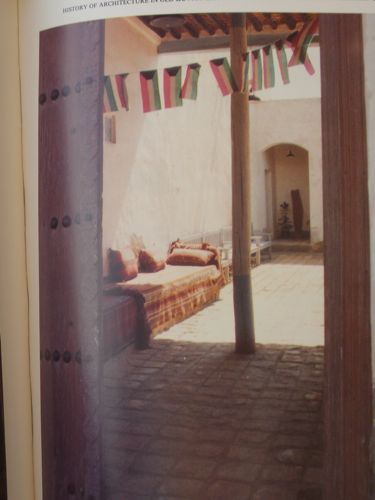
Kuwait is a small nation, with population of one million, that actually has a large influence on people’s behavior; it makes the whole country like one unified family. In the neighborhoods, it is customary to see houses left open and without any security measures, always ready for visitors, which reflects the strength of the relations between neighbors, and the confidence they enjoy. The most distinctive customs are:
1. Large families; average size is eight members. The young generation is trying to minimize the family size. They live in rather large houses, seven to ten bedrooms, which is considered to be an average size house. The house provides privacy for the boys, when they grow up and have their own families.
2. Large family groups, either under one roof or in clustered dwellings, is noticable throughout Kuwait neighborhoods. That reflect the willingness of families and relatives to cooperate and help each other.
3. Newly married sons tend to stay in their parent’s house and share the cooking and dining, so houses have rather large kitchens and dining rooms.
4. Families and relatives visit each other on Fridays and stay for lunch, which is the main meal of the day. The number of visitors varies from 20 – 50 persons, depending on the size of the families. Men and women visit in separate rooms, since separation of males and females is part of the custom. (The author notes that he is talking about old habits and traditions that were prevailing in the old city.)
5.All houses have what is called “Dewania” which is a guest room. In well designed houses, two “Dewanias” were furnished, one for males and one for females, since separation between males and females is mandatory as far as the customs are concerned. The “Dewania” has its separate entrance from the rest of the house, which is to provide privacy for the inhabitants and prevent sudden interactions with guests. It is considered bad for a female to be seen by a male guest, and vice versa. In poorly designed houses, the “Dewanias” don’t have proper privacy and seclusion. The men have the habit of visiting the neighborhood “Dewanias” at night for socialization and discussion of daily matters. In the past the “Dewanias” were the only news sources for the people. Different “Dewanias” are known by the last name of the owners. Hot tea and Arabian coffee are served on a regular basis and in big events like celebrations, “Eads”, wedding parties, and so forth, big feasts held for families, friends and neighbors.
6. “Chay Aldaha”, or afternoon tea at which it is customary for women to visit each other and gossip. Hot tea and cookies are served for refreshment. “Chay Aldaha” is held in the female “Dewania” to ensure privacy for female guests and to prevent sudden embarrassing interactions with male inhabitants.
7. Women are dressed in conservative clothes when they go out; the face and the two hands are the only parts of the body which are exposed. (The author makes a note that he is talking about old habits and traditions which were prevailing in the city) Privacy for women inside the house is an important factor. They should not be seen from the outside while they are doing their daily housework, and should not be in the way when male guests are visiting in the house.
As you can see, the winds of change have blown through Kuwait creating many, many changes. This book captures a slice of time in Kuwait history, and a wealth of information you don’t even know you know. The ways Kuwaitis lived for generations have changed, just in the last 20 years. I was particularly taken with the author’s mention – several times – that women should not be seen tending to their daily housework – how many Kuwaiti women do you know who are doing housework?
There is a current controversy regarding removal of diwaniyyas constructed on public grounds – if this is an old and accepted tradition, perhaps some adjustment can be made, particularly where the diwaniyyas are not impeding public transport or walking paths? Perhaps some can be “grandfathered”, i.e. exceptions made because of historical location?
Meanwhile, my Kuwaiti friends, sorry for boring you with these descriptions of your family dwellings; you already know all this, but the rest of the world does not, and I wanted to share this with those who follow this blog because they find you exotic and fascinating. 🙂 You really need to add this book to your libraries, as a record of a way of life that seems to be slipping all to quickly into the past.
Saudi Men Arrested for Flirting
This is in today’s BBC News.
Saudi men arrested for ‘flirting’
Relations between the sexes outside marriage is against the law
Prosecutors in Saudi Arabia have begun investigating 57 young men who were arrested on Thursday for flirting with girls at shopping centres in Mecca.
The men are accused of wearing indecent clothes, playing loud music and dancing in order to attract the attention of girls, the Saudi Gazette reported.
They were arrested following a request of the Commission for the Promotion of Virtue and Prevention of Vice.
The mutaween enforce Saudi Arabia’s conservative brand of Islam, Wahhabism.
Earlier in the month, the authorities enforced a ban on the sale of red roses and other symbols used in many countries to mark Valentine’s Day.
The ban is partly because of the connection with a “pagan Christian holiday”, and also because the festival itself is seen as encouraging relations between the sexes outside marriage, punishable by law in the kingdom.
You can read the whole article HERE.
I wonder . . . is this what is going to happen in Kuwait? So like they segregate the university. . . then they segregate all the schools, EVEN THE PRIVATE SCHOOLS, so there is no choice. . . then they start patrolling the malls?
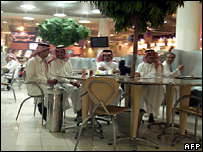
I lived in Saudi Arabia, and I remember the mutawaaeen were NOT police, but sometimes they took on the prerogatives of the police. So I have to wonder, like who made the arrest in the malls? Was it the police? Was it the mutawa hitting the boys with their little sticks? Did they call the boys parents? I have SO many questions!
Is This News?
Today in the Arab Times I see this announcement:
Ministry monitoring Internet networks to block porn sites
KUWAIT : The Ministry of Communications is monitoring Internet networks to block porn websites and clamp down illegal Internet telephony, Al Seyassah daily quoted the Director of Telephones Monitoring Department at the Ministry of Communications Eng Nasser Al Khandari as saying. The department is also monitoring various areas for such illegal telephone service providers.
Is this news? One time, I was looking for tablecloths, and the site was blocked for inappropriate content. It seems to me that the Ministry of Communication has an ongoing battle, trying to block content providers. As for illegal telephony . . . it appears they are cracking down mostly on large scale telephone service providers, not on the individual VOIP phones. VOIP users complain from time to time about “listeners” and about echos, but I think this is more a result of poor connections than any local actions. Am I wrong?
Which ministry is it that will be/is monitoring bloggers?
Wheezing
I could feel the weather change as I woke in bed last night with a slight wheeze – and sure enough, this morning when I looked out, there was this thick haze. I don’t know if this is a sandstorm . . . the particles are so fine. Maybe it is a dust storm.
The weather is significantly warmer this week, even though the weather forecast for all of February is unseasonably cold. Yesterday it got up to about 70°F/50°C, and it was delightful. Just warm enough for a lot of people to go picnicking.
I had a yen for Chinese food, and while we normally go to Tang Chow, which I love, this time we headed for Gulf Royal, at the City Center. I knew just how to get there; we took 30 to 5th ring and then headed toward City Center, but I made a mistake and told AdventureMan to exit at Amman Street, and then we got all messed up. Ah well, it was Friday and the streets were still quiet.
AdventureMan said “I know how to get there” so we got out on Gulf Road intending to turn right off the old Bida’a circle – only to find it was totally blocked. We wound our way through Rumaithia until we could find a way to get across 5th ring – quite an adventure.
At the Gulf Royal, we discovered they have a whole section of “cabinets,” the private little dining rooms. We had been there several times before and I never knew they were there! I just didn’t want to be around people who were smoking, and so they showed us to the back, with all the families. I love quiet, private little dining rooms! This is something we only see in the Gulf, something we will miss back in Seattle.
The food was good, City Centre was packed.
How Security Police Say “Sorry”
This is from today’s Kuwait Times. I know you are all dancing for joy that journalist and blogger Bashar Al-Sayegh is free, and we as a blogging community can all celebrate his release.
His arrest was a mistake.
It says so in the article. Pay attention! You have to read carefully, because security police speak a language all their own.
This is how they say “I’m sorry. It was a mistake.”
Responding to calls to dismantle the state security department, Rujaib stressed that the department was very vital for any state. “It forms the eye that never sleeps in protecting the nation’s security, in political, social and economic fields,” he explained, pointing out that it existed all over the world.
Asked whether Sayegh’s arrest was meant to convey a message against the freedom of the press, Rujaib stressed that press freedom was fully observed, yet reminded that journalists could be arrested for other reasons. “Meanwhile, police officers could be arrested for any reason as well,” he added, underlining that no violations took place during Sayegh’s arrest. On whether he believed that the issue had been politically motivated by some MPs, Rujaib said, “I am a security official and a politician should answer this question.
Do you think he is implying that there might have been another reason? Does it sound like deflecting blame? I think he is saying “We screwed up. We’re sorry.”
Credit Card MixUp
They must have thought we were stark raving out of our minds. In the middle of a crowded dinner-time restaurant, the three of us are out of control. Normally bordering on dignified, we are whooping with laughter, tears are streaming down our faces and we are laughing out loud, totally out of control.
The waitress brought the bill for my Mom, who was treating, but when she brought it back for my Mom’s signature, my Mom said “this isn’t my credit card!” She looked at it closely . . . it was my sister’s credit card.
“How did I give her your credit card?” she asked my sister, who looked baffled.
“I can’t imagine!” she responded. Mom had made it clear that this evening was HER treat, and we hadn’t even reached for our wallets this time.
This was our third dinner together in ten days. We have switched off paying, and we figure that the switch must have happened either a week ago, or five days ago. But . . . and this is the truly horrifying part – both have been charging on the switched cards! As the total implications dawned on us, we were horrified – and our reaction was this hysterical laughter as they tried to figure out what they had charged on each other’s card.
The horror is this – neither of them had noticed they were not using their own card. And no one, at any store, noticed that the signature on the charge slip DID NOT MATCH the name on the charge card. My mother charged several times, my sister charged a few things, but no one ever questioned the fact they were using someone else’s card.
This is horrifying. it is only hysterically funny because it was my mother and sister, and they had to work out who owes what to whom – and the total lack of privacy as two grown women have to tell each other what they have charged. That is laughable. But we are still totally appalled that it could happen, and that it was never caught nor challenged. Amazing.
Comment Section Closed, Wooo Hoooo
I have had some problems with one particular spammer targeting one particular entry on my blog. Really nasty stuff, it offends me. I clear it out almost as quickly as they send it, but it is ANNOYING.
WordPress is so cool. I went into edit, and turned off “allow comments.” It allowed all the original comments, but has a cheery message now:
“Sorry, the comment form is closed at this time”
*Dancing at a stinging blow against spammers*
Holy Cow! It’s Hard to Explain.
As I was leaving the Apple Market, I saw this display:

which totally cracked me up.
EnviroGirl told me there are all kinds of displays for all kinds of life events – birthdays, new babies, anniversaries, promotions, graduations – if you can think it up, this company will put it out there. Tombstones for a 40th birthday, storks for babies, and this one – Holy Cow! for a birthday.
I don’t know how I would like to get to work and find one of these displays outside on my birthday – I prefer to celebrate quietly, without a lot of fanfare. But every time I see these, I have to grin, so I guess it isn’t all that bad.
What also gives me a grin, however, is how very American this tradition is. I cannot imagine it at all in Kuwait. I can’t imagine it in Germany. Somehow, I just don’t think it would be so funny in any other country, except maybe South Africa, or Australia . . . countries where people don’t take themselves too seriously, and the loss of dignity would not be too severe. It’s just a joke, something a good friend might do.
What do you think? Do you think it is too undignified? Does it invade privacy? Do you think it is funny?
Recent Comments
ExpatAlien on What Country am I Living … intlxpatr on Yellowstone: Old Faithful to C… Michelle on Yellowstone: Old Faithful to C… Cathy on No Grown-Ups in Charge intlxpatr on Waiting for Snow Wikipedia Donate Button

Amazina


Early Voting in Florida


 Here There and Everywhere