We just finished our year in EfM, Education for Ministry, and the overall theme was a multi-cultural world, where we confront our own assumptions and prejudices. It has been a grand journey.
We have friends, friends whose son is our son’s best friend for lo, these many years, and they know how to be good neighbors. They are the soul of hospitality. They take in immigrants, fresh-off-the-boat, and teach them how to survive, help them find furniture, apartments, and a living. They welcome visitors, and care for them and their children. They are helpful. They do all this because it is the right thing to do, and they do it tirelessly. I am in awe of these friends; they are the essence of the Good Samaritan.
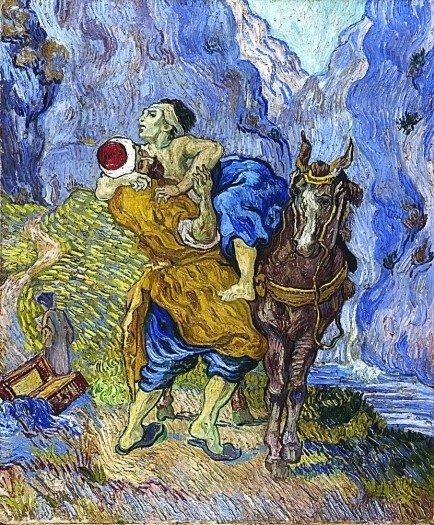
This is Vincent Van Gogh’s painting of The Good Samaritan
This beloved parable is about more than being kind to our neighbor. It’s about the grace that is shared and the miracle that is manifested each time we help each other, and each time we allow ourselves to be helped. Both of the main characters in this story, the man who is beaten and left for dead and the man who rescues him and has him cared for, had to humble themselves in order to be in relationship.
Mutual distrust and mutual prejudice could have cost the injured man his life, either by the Samaritan refusing to stop, or in the injured man refusing help from such a suspicious source. Jesus asks us to look past the natural lines of religious creed, racial and ethnic identities, socioeconomic status, and all the other words we use to separate “us” from “them,” and to see his face in the man in the ditch. Jesus is asking us to look up and see his face in the man who is saving someone who cannot save himself.
We are invited to see the face of Jesus on each of these men—to realize that when we reach out in love or when we are being helped, Jesus is always present. Are you willing to be humbled in that way? Who or what can you help, today? Who or what can help you?
PRAY for the Diocese of North West Australia (Western Australia, Australia)
When I think of the Good Samaritan, I think too of a very pregnant friend, pregnant with triplets, a Jewish woman working in Qatar, whose car broke down. In this day of cell phones, she called her husband for help, but in the time she waited for him to arrive with help, many many Qatari men and families stopped to offer assistance, insisted on giving her bottles of cold water, stopped and waited with her until her husband came and she was safe. They saw a stranger in distress, and they didn’t hesitate, they stopped. Good neighbors 🙂
I’ve been looking for this line forever, but it is no wonder that I couldn’t find it, I remembered it wrong, or I was using a different translation. When Father Ian at Church of the Epiphany in Doha would begin the prayers, he began with that invocation, reminding us that we, too, are tribal in our passions and affiliations. He used that word, tribal, instead of family. It is probably more true to the original intent.
Once people start drawing and adhering to lines between them and us, things get ugly in a hurry. I liked what Pope Francis said about Freedom of Speech being fine but it had to include respect for the religions of others, and self restraint. We all need to remember that it is the one true God who is the father of us all, and he will be the only one to judge us in the end.
We all get a lot of things wrong. Let’s hope He is truly the all-merciful and all-compassionate.
Ephesians 3:14-21
14 For this reason I bow my knees before the Father,* 15 from whom every family* in heaven and on earth takes its name. 16 I pray that, according to the riches of his glory, he may grant that you may be strengthened in your inner being with power through his Spirit, 17 and that Christ may dwell in your hearts through faith, as you are being rooted and grounded in love. 18 I pray that you may have the power to comprehend, with all the saints, what is the breadth and length and height and depth, 19 and to know the love of Christ that surpasses knowledge, so that you may be filled with all the fullness of God.
20 Now to him who by the power at work within us is able to accomplish abundantly far more than all we can ask or imagine, 21 to him be glory in the church and in Christ Jesus to all generations, for ever and ever. Amen.
This morning I found two comments on an old post about high temperatures in Qatar (now deleted). I was offended, but now I offer up this commenter to my Qatari friends. He has included his phone number. I suggest you call him and correct his mistaken ideas about Qatari women.
Kuwaiti police have busted a “wild party” and arrested 23 “cross-dressers and homosexuals” at a chalet in the south of the country on Sunday.
“The vice police received a tip about the party and a warrant was issued by the public prosecution to take action against the cross dressers and homosexuals,” a security source told local daily Al Rai.
“The police encircled the chalet to make sure no one escaped and proceeded to arrest the people participating in the party. Some of them tried to escape by using the backdoor of the chalet and heading to the sea, but they were caught,” the source added.
The daily said that investigations revealed the party was exclusively for “cross-dressers and homosexuals” who would face the charges of “engaging in immoral activities.”
Lesbian, Gay, Bisexual and Trans (LGBT) rights receive no protection in Kuwait and homosexual acts between two male adults can result in a six-year prison sentence, though there are no laws against sexual acts between two women. Cross-dressing is also illegal.
In 2013, Public health official Yousuf Mindkar announced the introduction of a screening process at Kuwait’s International Airport to prevent LGBT expatriates from entering Kuwait or other Gulf Cooperation Council (GCC) countries.
“Health centres conduct the routine medical check to assess the health of the expatriates when they come into the GCC countries,” he said.
“However, we will take stricter measures that will help us detect gays who will be then barred from entering Kuwait or any of the GCC member states.”
The same paper later showed the minister appearing to backtrack on the move saying it was a “mere proposal.”
“It may or may not be accepted,” he said.
“The debate will reflect the keen interest of the GCC countries in human rights, taking into consideration the teachings of our religion and international agreements.”
Some suggested that concerns over the hosting of the FIFA 2022 World Cup in Qatar, and the potential controversy that would ensue were fans to be screened, may have led to the backtrack.
AdventureMan and I are not even typical of our generation. Living overseas, living in so many countries, we just got used to paying in cash. In our early years, even countries like France had more places that didn’t take credit cards than places that did. When it comes to buying gas in France, you’d better have a bucketful of cash 😉
But even those in our generation tend to pull out their credit cards for meals out, so this week AdventureMan asked wait staff percentages of who paid cash and who paid with cards. The most common answer was around 85% paid with a card.
I can understand. The restaurants/stores don’t have to keep as much money on hand for change, so it is easier on them, and those who pay with a card can track their expenses. Part of me laughs and says I think we don’t want to track our eating-out expenses, and another part thinks that because we pay cash, we probably don’t indulge in extras so often, which, for us, is a good thing. If we have dessert, we normally split it.
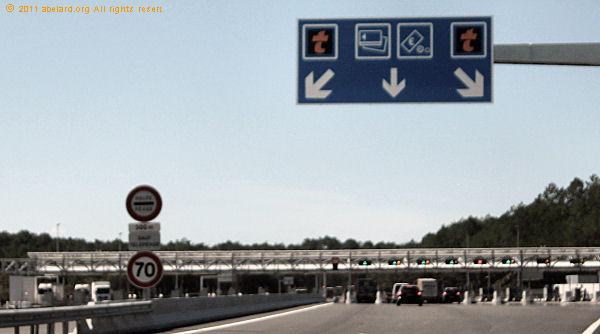
I do remember how wonderful it was to be able to pay all the tolls on the toll roads in France with a credit card, how wonderfully easy it was to use my credit card and the ATM’s in Kuwait and Qatar and Saudi Arabia – for some reason, it was like they were years ahead of the USA in banking technology, and banking by phone. But even there, in the smaller shops, you needed cash.
Hey, millennial! Yes, you there, standing in line at the Starbucks (SBUX) counter, tapping away on your smartphone, with the button-like doodads growing into your earlobes — put away that debit card.
No, don’t worry. No one’s going to nag you about buying a cup of overpriced coffee. We all have our vices. And you’re still basking in the fresh glow of youth. At least your vices won’t hurt you as much as they’d hurt us old codgers.
But the way you’re buying your coffee — you’re doing it wrong. And you’re not alone.
Paper or Plastic?
According to a recent survey by CreditCards.com, only about 1 in 3 American consumers currently uses a plastic card — credit or debit — when buying something that costs $5 or less. Most folks still pay with cash for such small purchases, with folks ages 65 and up having the greatest fondness for paying with greenbacks (82 percent).
But when it comes to the Millennials, 51 percent use plastic to pay for such purchases.
There’s only so much cash that will fit in your wallet, and if you limit yourself to paying in cash — you eventually run out. Old folks like me, whose memories aren’t what they used to be (and maybe never were), like this “automatic” check on spending. And as a result, CreditCards.com reports that the older a consumer is, the more likely he or she is to pay for small purchases in cash than to pull out a plastic card.
Not All Plastic Is Created Equal
Among plastic cards, nationally, consumers are about twice as likely (22 percent) to use a debit card to pay for a small purchase as to put the purchase on credit (11 percent). When the data is broken down by age group, it turns out that millennials are even more fond of debit cards than the average shopper. Consumers ages 18 to 29 use debit cards more often than any other age group when making small purchases.
But here’s the thing: Debit and credit cards may be nearly equal in their convenience of use when shopping for small items (eliminating the need to carry weighty pockets, jingling with unwanted coins). But they’re not at all equal in the financial benefits they convey to a consumer.
To cite the most obvious example, credit cards often offer you “rewards” for using them. With card companies charging retailers fat interchange fees for every transaction they process, they can afford to pay you generously when you “choose plastic.” Airline miles; “points” redeemable for cash back, account credits, merchandise, and gift cards; and just plain cash-back offers, as high as 5 percent, all make the choice between credit and debit a bit of a no-brainer. (Granted, some debit cards offer rewards of their own — but they’re rare, hard to find and usually much less generous.)
But rewards are only the most obvious monetary benefit of choosing credit over debit. Consider: When you pay for a purchase — large or small — with a debit card, that money is almost immediately deducted from your account.
What Warren Buffett Thinks
In contrast, a charge placed on a credit card is a debt that doesn’t come due — and needn’t be paid — until your credit card bill is sent to you. Depending on the date of purchase and the due date on your credit card bill, you may not have to pay that bill for as long as a month — which means you may be able to hang on to your money, and collect interest on it at your bank, for that time. (Super-investor Warren Buffett calls this concept of using someone else’s money, and collecting interest on it for your own benefit, “free float,” and deadpans that his business partner “Charlie and I find this enjoyable.”)
Granted, with the ultra-low interest rates that banks are paying on checking accounts these days, free float isn’t as profitable as it used to be — probably only pennies per credit card billing cycle. But still, free money is free money. Are you going to turn it down because you’re not being offered enough free money?
Of course, you do need to remember to pay your credit card bill on time, so as not to get hit by late fees. But as long as you can manage that, a credit card isn’t really a card you use for taking out long-term credit at all. It’s a pay-once-a-month debit card — that pays you free money every month.
The High Cost of Not Buying on Credit
Another advantage: CreditCards.com quotes Martin Lynch, director of education of the Cambridge Credit Counseling Corp. of Massachusetts, noting that “debit cards … can’t be reported to the credit bureaus and, thus, they don’t build [up] credit [ratings].” Building up a strong credit rating is crucial to a young person looking to buy his or her first car or to secure a mortgage on a starter home.
Getting charges and on-time payments, onto your credit report — to establish a track record as a reliable borrower — is therefore a good thing. It’s something you want to do as often as possible, and using a credit card to pay for small purchases is a great way to build up your credit report quickly.
Melinda Opperman, senior vice president of community outreach at Springboard Nonprofit Consumer Credit Management Inc., another expert interviewed by CreditCards.com, echoes the sentiment: “We like the idea of using credit cards frequently for small, manageable expenses. This gives users the benefit of an active credit history, but leaves them with monthly bills that are small enough to pay off in full, so they don’t have to pay any interest.”
Suffice it to say, any idea that’s supported by professional credit counselors, and by the world’s third richest man, is one that millennials would be well advised to take to heart.
Motley Fool contributor Rich Smith has no position in any stocks mentioned, and hasn’t used a debit card in years. The Motley Fool recommends and owns shares of Starbucks. To read about our favorite high-yielding dividend stocks for any investor, check out our free report.
The Islamic State of Iraq and Syria (ISIS), now threatening Baghdad, was funded for years by wealthy donors in Kuwait, Qatar, and Saudi Arabia, three U.S. allies that have dual agendas in the war on terror.
The extremist group that is threatening the existence of the Iraqi state was built and grown for years with the help of elite donors from American supposed allies in the Persian Gulf region. There, the threat of Iran, Assad, and the Sunni-Shiite sectarian war trumps the U.S. goal of stability and moderation in the region.It’s an ironic twist, especially for donors in Kuwait (who, to be fair, back a wide variety of militias). ISIS has aligned itself with remnants of the Baathist regime once led by Saddam Hussein. Back in 1990, the U.S. attacked Iraq in order to liberate Kuwait from Hussein’s clutches. Now Kuwait is helping the rise of his successors.As ISIS takes over town after town in Iraq, they are acquiring money and supplies including American made vehicles, arms, and ammunition. The group reportedly scored $430 million this week when they looted the main bank in Mosul. They reportedly now have a stream of steady income sources, including from selling oil in the Northern Syrian regions they control, sometimes directly to the Assad regime.
But in the years they were getting started, a key component of ISIS’s support came from wealthy individuals in the Arab Gulf States of Kuwait, Qatar and Saudi Arabia. Sometimes the support came with the tacit nod of approval from those regimes; often, it took advantage of poor money laundering protections in those states, according to officials, experts, and leaders of the Syrian opposition, which is fighting ISIS as well as the regime.
“Everybody knows the money is going through Kuwait and that it’s coming from the Arab Gulf,” said Andrew Tabler, senior fellow at the Washington Institute for Near East Policy. “Kuwait’s banking system and its money changers have long been a huge problem because they are a major conduit for money to extremist groups in Syria and now Iraq.”
Iraqi Prime Minister Nouri al-Maliki has been publicly accusing Saudi Arabia and Qatar of funding ISIS for months. Several reports have detailed how private Gulf funding to various Syrian rebel groups has splintered the Syrian opposition and paved the way for the rise of groups like ISIS and others.
“The U.S. has made the case as strongly as they can to regional countries, including Kuwait. But ultimately when you take a hands off, leading from behind approach to things, people don’t take you seriously and they take matters into their own hands.”
Gulf donors support ISIS, the Syrian branch of al Qaeda called the al Nusrah Front, and other Islamic groups fighting on the ground in Syria because they feel an obligation to protect Sunnis suffering under the atrocities of the Assad regime. Many of these backers don’t trust or like the American backed moderate opposition, which the West has refused to provide significant arms to.
Under significant U.S. pressure, the Arab Gulf governments have belatedly been cracking down on funding to Sunni extremist groups, but Gulf regimes are also under domestic pressure to fight in what many Sunnis see as an unavoidable Shiite-Sunni regional war that is only getting worse by the day.
“ISIS is part of the Sunni forces that are fighting Shia forces in this regional sectarian conflict. They are in an existential battle with both the (Iranian aligned) Maliki government and the Assad regime,” said Tabler. “The U.S. has made the case as strongly as they can to regional countries, including Kuwait. But ultimately when you take a hands off, leading from behind approach to things, people don’t take you seriously and they take matters into their own hands.”
Donors in Kuwait, the Sunni majority Kingdom on Iraq’s border, have taken advantage of Kuwait’s weak financial rules to channel hundreds of millions of dollars to a host of Syrian rebel brigades, according to a December 2013 report by The Brookings Institution, a Washington think tank that receives some funding from the Qatari government.
“Over the last two and a half years, Kuwait has emerged as a financing and organizational hub for charities and individuals supporting Syria’s myriad rebel groups,” the report said. “Today, there is evidence that Kuwaiti donors have backed rebels who have committed atrocities and who are either directly linked to al-Qa’ida or cooperate with its affiliated brigades on the ground.”
Kuwaiti donors collect funds from donors in other Arab Gulf countries and the money often travels through Turkey or Jordan before reaching its Syrian destination, the report said. The governments of Kuwait, Qatar, and Saudi Arabia have passed laws to curb the flow of illicit funds, but many donors still operate out in the open. The Brookings paper argues the U.S. government needs to do more.
“The U.S. Treasury is aware of this activity and has expressed concern about this flow of private financing. But Western diplomats’ and officials’ general response has been a collective shrug,” the report states.
When confronted with the problem, Gulf leaders often justify allowing their Salafi constituents to fund Syrian extremist groups by pointing back to what they see as a failed U.S. policy in Syria and a loss of credibility after President Obama reneged on his pledge to strike Assad after the regime used chemical weapons.
That’s what Prince Bandar bin Sultan, head of Saudi intelligence since 2012 and former Saudi ambassador in Washington, reportedly told Secretary of State John Kerry when Kerry pressed him on Saudi financing of extremist groups earlier this year. Saudi Arabia has retaken a leadership role in past months guiding help to the Syrian armed rebels, displacing Qatar, which was seen as supporting some of the worst of the worst organizations on the ground.
The rise of ISIS, a group that officially broke with al Qaeda core last year, is devastating for the moderate Syrian opposition, which is now fighting a war on two fronts, severely outmanned and outgunned by both extremist groups and the regime. There is increasing evidence that Assad is working with ISIS to squash the Free Syrian Army.
But the Syrian moderate opposition is also wary of confronting the Arab Gulf states about their support for extremist groups. The rebels are still competing for those governments’ favor and they are dependent on other types of support from Arab Gulf countries. So instead, they blame others—the regimes in Tehran and Damascus, for examples—for ISIS’ rise.
“The Iraqi State of Iraq and the [Sham] received support from Iran and the Syrian intelligence,” said Hassan Hachimi, Head of Political Affairs for the United States and Canada for Syrian National Coalition, at the Brookings U.S.-Islamic World Forum in Doha this week.
“There are private individuals in the Gulf that do support extremist groups there,” along with other funding sources, countered Mouaz Moustafa, executive director of the Syrian Emergency Task Force, a Syrian-American organization that supports the opposition “[The extremist groups] are the most well-resourced on the ground… If the United States and the international community better resourced [moderate] battalions… then many of the people will take that option instead of the other one.”
FIFA Executive Says He Doesn’t Think 2022 World Cup Will Be In Qatar
* Zwanziger is member of FIFA Executive Committee
* Plans under way to shift World Cup to European winter (Updates with FIFA reaction)
BERLIN, Sept 22 (Reuters) – The 2022 World Cup will not be held in Qatar because of the scorching temperatures in the Middle East country, FIFA Executive Committee member Theo Zwanziger said on Monday.
“I personally think that in the end the 2022 World Cup will not take place in Qatar,” the German told Sport Bild on Monday.
“Medics say that they cannot accept responsibility with a World Cup taking place under these conditions,” the former German football (DFB) chief, who is now a member of the world soccer’s governing body FIFA that awarded the tournament to Qatar in 2010.
Although wealthy Qatar has insisted that a summer World Cup is viable thanks to cooling technologies it is developing for stadiums, training areas and fan zones, there is still widespread concern over the health of the players and visiting supporters.
“They may be able to cool the stadiums but a World Cup does not take place only there,” Zwanziger said.
“Fans from around the world will be coming and traveling in this heat and the first life-threatening case will trigger an investigation by a state prosecutor.
“That is not something that FIFA Exco members want to answer for.”
FIFA officials, contacted by Reuters, said Zwanziger was not giving the view of the all powerful Executive Committee.
“He is expressing a personal opinion and he explicitly says so,” FIFA spokewoman Delia Fischer said. “We will not comment on a personal opinion.”
FIFA President Sepp Blatter said in May that awarding the World Cup to Qatar was a ‘mistake’ and the tournament would probably have to be held in the European winter.
“Of course, it was a mistake. You know, one comes across a lot of mistakes in life,” he told Swiss television station RTS in an interview at the time.
“The Qatar technical report indicated clearly that it is too hot in summer, but the executive committee with quite a big majority decided all the same that the tournament would be in Qatar,” he added.
FIFA is now looking to shift the tournament to a European winter date to avoid the scorching summer where temperatures routinely rise over 40 Celsius.
Asian Football Confederation (AFC) president Sheik Salman Bin Ebrahim Al Khalifa chaired a meeting to discuss the matter earlier this month with the options of January/February 2022 and November/December 2022 offered as alternatives to June/July.
However, talk of a potential change away from the usual dates has resulted in plenty of opposition from domestic leagues around the world, worried the schedule switch would severely disrupt them.
Both FIFA and Qatar World Cup organizers have also been fending off questions of corruption ever since they were awarded the tournament back in 2010, while Qatar has also been criticized for the conditions provided for migrant workers’ in the tiny Gulf state. (Reporting by Karolos Grohmann. Editing by Patrick Johnston)
My annual “who knew I’d be blogging for X years?” post has turned into my any-excuse-will-do fun forage for elaborate and gorgeous cakes that I can invite you into my virtual world to sample, stop and chat, have a cup of virtual coffee, mint tea or even sweet fresh water and Iced tea (it’s a Southern thing).
The first cake pays homage to Kuwait and my blogger beginnings. Kuwait was an amazingly lively blogging scene, with some very daring bloggers, a couple of whom have since spent some time in prison for their daring.
Something elegant and exquisite for my fancier friends:
For those who love the beach as I do, love the waves and the seashells:
And for all my friends who are kids in their hearts, like us. ❤
I know my limits, and elaborate Eiffel tower cookies are outside my area of capability, but if you are painstaking and detail oriented, I have added a website where you can see, step by step, how to make these for yourself. I myself will just stand here and gobble as you head for the cakes 🙂
I’m surprised every year that I’ve kept at this. In truth, it was so much easier in Kuwait and in Qatar and all the traveling back and forth, there was so much more material! Now, my life is more private, and while blogging is a blessing, there may come a time when I say “enough.” Let’s raise our cups to another good year 🙂
The people in my group last week suffered greatly in the high temperatures and high humidity we are experiencing. I must be adapting a little; I remember being thankful for the breeze.
“What do you wear when it gets this hot?” they asked me, “like around the home?”
I laughed. I learned a thing or two in Tunis, in Amman, in Tabuk and Riyadh, in Kuwait and in Doha. At home, I dress like local women, in long loose dresses.
Or worse. I dress like their maids. In the souks you could find wonderful, 100% cotton dresss that were loose and flowing, and that is good in hot weather so the air can circulate. Some of the dresses were nicer, but the dresses I liked a lot for just being around the house doing what people do, like making sure the dishes are done and a meal prepped, doing a little quilting or reading . . . you could buy these great little dresses for about $3.00 in the souks. Not only were they practical – especially when you live in a house with a cat, and always put on “real” clothes just as you are about to run out the door so you don’t have any cat hair on you – but they came in great colors and prints, designs that made me happy to put them on.
Now, one of my all time favorite dresses, in purple and black, has bit the dust. I liked it because it had some geometrics, and the geometrics changed, and – it was purple. I have worn it for about six years now, and I have worn it out. I mended it several times when the underarm seams ripped:
But now, it has gotten all soft, so soft the material just rips easily with holes that cannot be mended.
I like this dress so much I am saving it and cutting it up so it will have another new life as a quilt 🙂
And I am thinking it is time to plan a trip back to Doha and Kuwait to replenish my hot weather dresses 🙂















 Here There and Everywhere