I was told – by Saudi women, Qatari women and Palestinian women of faith, that Allah wants women to be educated. The first wife of Muhammed was a businesswoman and a prominent leader in her time. Perhaps the ISIS extremists need to spend a little more time reading the Qu’ran and hadith.
From today’s AOL News/ Huffpost
BAGHDAD (AP) — Militants with the Islamic State group tortured and then publicly killed a human rights lawyer in the Iraqi city of Mosul after their self-proclaimed religious court ruled that she had abandoned Islam, the U.N. mission in Iraq said Thursday.
Gunmen with the group’s newly declared police force seized Samira Salih al-Nuaimi last week in a northeastern district of the Mosul while she was home with her husband and three children, two people with direct knowledge of the incident told The Associated Press on Thursday. Al-Nuaimi was taken to a secret location. After about five days, the family was called by the morgue to retrieve her corpse, which bore signs of torture, the two people said, speaking on condition of anonymity because of fears for their safety.
According to the United Nations Assistance Mission in Iraq, her arrest was allegedly connected to Facebook messages she posted that were critical of the militants’ destruction of religious sites in Mosul. A statement by the U.N. on Thursday added that al-Nuaimi was tried in a so-called “Sharia court” for apostasy, after which she was tortured for five days before the militants sentenced her to “public execution.” Her Facebook page appears to have been removed since her death.
“By torturing and executing a female human rights’ lawyer and activist, defending in particular the civil and human rights of her fellow citizens in Mosul, ISIL continues to attest to its infamous nature, combining hatred, nihilism and savagery, as well as its total disregard of human decency,” Nickolay Mladenov, the U.N. envoy to Iraq, said in a statement, referring to the group by an acronym. The statement did not say how she was killed.
Among Muslim hard-liners, apostasy is thought to be not just conversion from Islam to another faith, but also committing actions that they believe are so against the faith that one is considered to have abandoned Islam.
Mosul is the largest city held by the Islamic State group in the self-declared “caliphate” it has carved out, bridging northern and eastern Syria with northern Iraq. Since overrunning the once-diverse city in June, the group has forced religious minorities to convert to Islam, pay special taxes or die, causing tens of thousands to flee. The militants have enforced a strict dress code on women, going so far as to veil the faces of female mannequins in store fronts.
In August, the group destroyed a number of historic landmarks in the town, including several mosques and shrines, claiming they promote idolatry and depart from principles of Islam.
Al-Nuaimi’s death is the latest in a string of attacks by the militant group to silence female activists and politicians. In July in the nearby town of Sderat, militants broke into the house of a female candidate in the last provincial council elections, killed her and abducted her husband, the U.N. said. On the same day, another female politician was abducted from her home in eastern Mosul; she remains missing.
Hanaa Edwer, a prominent Iraqi human rights activist, said at least five female political activists have been killed in recent weeks by the Islamic State group in Mosul, including al-Nuaimi, who Edwer said was also running for a seat on the provincial council.
“But it is not just women being targeted,” Edwer said. “They will kill anyone with a voice. It is terrifying.”
The Gulf Center for Human Rights said Wednesday that al-Nuaimi had worked on detainee rights and poverty. The Bahrain-based rights organization said her death “is solely motivated by her peaceful and legitimate human rights work, in particular defending the civil and human rights of her fellow citizens in Mosul.”
The Islamic State extremists’ blitz eventually prompted the United State to launch airstrikes last month, to aid Kurdish forces and protect religious minorities in Iraq.
This week, the U.S. and five allied Arab states expanded the aerial campaign into Syria, where the militant group is battling President Bashar Assad’s forces as well as Western-backed rebels. Despite making gains in some of the country’s more isolated areas, where airstrikes have paved the way for successful ground operations by Kurdish and Iraqi forces, the cities of Mosul and Fallujah remain major strongholds of the group, which has buried itself among large civilian populations.
The militant group recently killed 40 Iraq soldiers and captured 68 near Fallujah and then paraded their captives through the city in a show of brawn.
Nearly a dozen countries have also provided weapons and training to Kurdish peshmerga fighters, who were strained after months of battling the jihadi group.
In other developments Thursday, German Defense Minister Ursula von der Leyen visited northern Iraq for talks with Kurdish leaders about the fight against Islamic State extremists and Berlin’s efforts to help with arms deliveries.
Thursday also marked the start of German arms deliveries to the semi-autonomous Kurdish region, with the ultimate goal of supplying 10,000 Kurdish fighters with some 70 million euros ($90 million) worth of equipment.
“We are involved with relief shipments and the airlift, but we know that this is not sufficient,” said von der Leyen. “Much more is needed to get these (millions of people) through the winter.”
___
Associated Press writer David Rising in Berlin and Bram Janssen in Irbil and an Associated Press reporter in Mosul contributed to this report.
September 26, 2014
Posted by intlxpatr |
Crime, Cultural, Faith, Family Issues, Living Conditions, News, Quality of Life Issues, Social Issues, Women's Issues | apostasy, Hanaa Edwer, Human Rights, Iraq, Mosul, Samira Salih al-Nuaimi, Sharia Court |
Leave a comment
The Islamic State of Iraq and Syria (ISIS), now threatening Baghdad, was funded for years by wealthy donors in Kuwait, Qatar, and Saudi Arabia, three U.S. allies that have dual agendas in the war on terror.
The extremist group that is threatening the existence of the Iraqi state was built and grown for years with the help of elite donors from American supposed allies in the Persian Gulf region. There, the threat of Iran, Assad, and the Sunni-Shiite sectarian war trumps the U.S. goal of stability and moderation in the region.It’s an ironic twist, especially for donors in Kuwait (who, to be fair, back a wide variety of militias). ISIS has aligned itself with remnants of the Baathist regime once led by Saddam Hussein. Back in 1990, the U.S. attacked Iraq in order to liberate Kuwait from Hussein’s clutches. Now Kuwait is helping the rise of his successors.As ISIS takes over town after town in Iraq, they are acquiring money and supplies including American made vehicles, arms, and ammunition. The group reportedly scored $430 million this week when they looted the main bank in Mosul. They reportedly now have a stream of steady income sources, including from selling oil in the Northern Syrian regions they control, sometimes directly to the Assad regime.
But in the years they were getting started, a key component of ISIS’s support came from wealthy individuals in the Arab Gulf States of Kuwait, Qatar and Saudi Arabia. Sometimes the support came with the tacit nod of approval from those regimes; often, it took advantage of poor money laundering protections in those states, according to officials, experts, and leaders of the Syrian opposition, which is fighting ISIS as well as the regime.
“Everybody knows the money is going through Kuwait and that it’s coming from the Arab Gulf,” said Andrew Tabler, senior fellow at the Washington Institute for Near East Policy. “Kuwait’s banking system and its money changers have long been a huge problem because they are a major conduit for money to extremist groups in Syria and now Iraq.”
Iraqi Prime Minister Nouri al-Maliki has been publicly accusing Saudi Arabia and Qatar of funding ISIS for months. Several reports have detailed how private Gulf funding to various Syrian rebel groups has splintered the Syrian opposition and paved the way for the rise of groups like ISIS and others.
“The U.S. has made the case as strongly as they can to regional countries, including Kuwait. But ultimately when you take a hands off, leading from behind approach to things, people don’t take you seriously and they take matters into their own hands.”
Gulf donors support ISIS, the Syrian branch of al Qaeda called the al Nusrah Front, and other Islamic groups fighting on the ground in Syria because they feel an obligation to protect Sunnis suffering under the atrocities of the Assad regime. Many of these backers don’t trust or like the American backed moderate opposition, which the West has refused to provide significant arms to.
Under significant U.S. pressure, the Arab Gulf governments have belatedly been cracking down on funding to Sunni extremist groups, but Gulf regimes are also under domestic pressure to fight in what many Sunnis see as an unavoidable Shiite-Sunni regional war that is only getting worse by the day.
“ISIS is part of the Sunni forces that are fighting Shia forces in this regional sectarian conflict. They are in an existential battle with both the (Iranian aligned) Maliki government and the Assad regime,” said Tabler. “The U.S. has made the case as strongly as they can to regional countries, including Kuwait. But ultimately when you take a hands off, leading from behind approach to things, people don’t take you seriously and they take matters into their own hands.”
Donors in Kuwait, the Sunni majority Kingdom on Iraq’s border, have taken advantage of Kuwait’s weak financial rules to channel hundreds of millions of dollars to a host of Syrian rebel brigades, according to a December 2013 report by The Brookings Institution, a Washington think tank that receives some funding from the Qatari government.
“Over the last two and a half years, Kuwait has emerged as a financing and organizational hub for charities and individuals supporting Syria’s myriad rebel groups,” the report said. “Today, there is evidence that Kuwaiti donors have backed rebels who have committed atrocities and who are either directly linked to al-Qa’ida or cooperate with its affiliated brigades on the ground.”
Kuwaiti donors collect funds from donors in other Arab Gulf countries and the money often travels through Turkey or Jordan before reaching its Syrian destination, the report said. The governments of Kuwait, Qatar, and Saudi Arabia have passed laws to curb the flow of illicit funds, but many donors still operate out in the open. The Brookings paper argues the U.S. government needs to do more.
“The U.S. Treasury is aware of this activity and has expressed concern about this flow of private financing. But Western diplomats’ and officials’ general response has been a collective shrug,” the report states.
When confronted with the problem, Gulf leaders often justify allowing their Salafi constituents to fund Syrian extremist groups by pointing back to what they see as a failed U.S. policy in Syria and a loss of credibility after President Obama reneged on his pledge to strike Assad after the regime used chemical weapons.
That’s what Prince Bandar bin Sultan, head of Saudi intelligence since 2012 and former Saudi ambassador in Washington, reportedly told Secretary of State John Kerry when Kerry pressed him on Saudi financing of extremist groups earlier this year. Saudi Arabia has retaken a leadership role in past months guiding help to the Syrian armed rebels, displacing Qatar, which was seen as supporting some of the worst of the worst organizations on the ground.
The rise of ISIS, a group that officially broke with al Qaeda core last year, is devastating for the moderate Syrian opposition, which is now fighting a war on two fronts, severely outmanned and outgunned by both extremist groups and the regime. There is increasing evidence that Assad is working with ISIS to squash the Free Syrian Army.
But the Syrian moderate opposition is also wary of confronting the Arab Gulf states about their support for extremist groups. The rebels are still competing for those governments’ favor and they are dependent on other types of support from Arab Gulf countries. So instead, they blame others—the regimes in Tehran and Damascus, for examples—for ISIS’ rise.
“The Iraqi State of Iraq and the [Sham] received support from Iran and the Syrian intelligence,” said Hassan Hachimi, Head of Political Affairs for the United States and Canada for Syrian National Coalition, at the Brookings U.S.-Islamic World Forum in Doha this week.
“There are private individuals in the Gulf that do support extremist groups there,” along with other funding sources, countered Mouaz Moustafa, executive director of the Syrian Emergency Task Force, a Syrian-American organization that supports the opposition “[The extremist groups] are the most well-resourced on the ground… If the United States and the international community better resourced [moderate] battalions… then many of the people will take that option instead of the other one.”
(Thank you for the lead, Muller 🙂 )
September 25, 2014
Posted by intlxpatr |
Bureaucracy, Counter-terrorism, Cross Cultural, ExPat Life, Financial Issues, Fund Raising, Interconnected, Kuwait, Leadership, Middle East, Political Issues, Qatar, Quality of Life Issues, Saudi Arabia, Social Issues, Women's Issues | Kuwait banks, Kuwait moneychangers, Religious Freedom, Shuria Law |
5 Comments
From yesterday’s USA Today, a very brief article in the USA Round Up:
Alaska: Fairbanks
The number of security cameras in Alaska schools is going up. The Fairbanks Daily News-Mirror reported video cameras are being installed in Fairbanks middle and elementary schools and it’s part of a statewide trend aimed at making schools safer.
As I raised our son, I was – well, most of the time – an attentive parent. I would listen, and when necessary, I would correct. It’s a mother’s job to help her children navigate the pitfalls of life, and to have a tool-box full of resources with which to cope.
Perhaps I did my job too well. Our son became a lawyer, and he is very particular about the things I say, especially when I use a term incorrectly, such as irony.
Here is what Wikipedia says irony is:
event characterized by an incongruity, or contrast, between what the expectations of a situation are and what is really the case, with a third element, that defines that what is really the case is ironic because of the situation that led to it.
I am about to use the term “irony” correctly. 🙂

When I read the above article, I remembered the horror of Orwell’s 1984, the book, and then the movie. The movie was terrifying, the presence of cameras everywhere, hidden, not hidden, just knowing they were everywhere and everything you did could be monitored.
The irony comes in that here we are, with cameras everywhere, and we are glad for it. The irony is that our society has slipped so far from its ideal that we cannot trust our neighbor to behave him or herself, and we protect ourself by placing cameras so as to encourage people to behave.
I am not so sure that our moral codes have ever worked well; I think it seems to be the nature of humanity to claim a moral code, but not to adhere strictly to it. I think of people who talk about the safety of the ’50’s, but I don’t believe that safety was truly that safe. I think children disappeared. I think wives were beaten, women raped. I think robberies and assaults happened, and I think the law was more lax than it is today.
But it is an irony, IMHO, that we welcome cameras today as a low-cost policing of ourselves, our neighbors, and those we fear will hurt us or take our property. We trust ourselves and one another so little that we are increasingly installing cameras. We’ve been considering installing them through our home security company; we have motion detectors, cameras are just the next upgrade. Have we exchanged a high value on privacy for a heightened perceived need for protection of life and property?
September 25, 2014
Posted by intlxpatr |
Books, Character, Civility, Community, Crime, Cultural, Family Issues, GoogleEarth, Interconnected, Law and Order, Living Conditions, Privacy, Quality of Life Issues, Social Issues, Technical Issue |
4 Comments
FIFA Executive Says He Doesn’t Think 2022 World Cup Will Be In Qatar

* Zwanziger is member of FIFA Executive Committee
* Plans under way to shift World Cup to European winter (Updates with FIFA reaction)
BERLIN, Sept 22 (Reuters) – The 2022 World Cup will not be held in Qatar because of the scorching temperatures in the Middle East country, FIFA Executive Committee member Theo Zwanziger said on Monday.
“I personally think that in the end the 2022 World Cup will not take place in Qatar,” the German told Sport Bild on Monday.
“Medics say that they cannot accept responsibility with a World Cup taking place under these conditions,” the former German football (DFB) chief, who is now a member of the world soccer’s governing body FIFA that awarded the tournament to Qatar in 2010.
Although wealthy Qatar has insisted that a summer World Cup is viable thanks to cooling technologies it is developing for stadiums, training areas and fan zones, there is still widespread concern over the health of the players and visiting supporters.
“They may be able to cool the stadiums but a World Cup does not take place only there,” Zwanziger said.
“Fans from around the world will be coming and traveling in this heat and the first life-threatening case will trigger an investigation by a state prosecutor.
“That is not something that FIFA Exco members want to answer for.”
FIFA officials, contacted by Reuters, said Zwanziger was not giving the view of the all powerful Executive Committee.
“He is expressing a personal opinion and he explicitly says so,” FIFA spokewoman Delia Fischer said. “We will not comment on a personal opinion.”
FIFA President Sepp Blatter said in May that awarding the World Cup to Qatar was a ‘mistake’ and the tournament would probably have to be held in the European winter.
“Of course, it was a mistake. You know, one comes across a lot of mistakes in life,” he told Swiss television station RTS in an interview at the time.
“The Qatar technical report indicated clearly that it is too hot in summer, but the executive committee with quite a big majority decided all the same that the tournament would be in Qatar,” he added.
FIFA is now looking to shift the tournament to a European winter date to avoid the scorching summer where temperatures routinely rise over 40 Celsius.
Asian Football Confederation (AFC) president Sheik Salman Bin Ebrahim Al Khalifa chaired a meeting to discuss the matter earlier this month with the options of January/February 2022 and November/December 2022 offered as alternatives to June/July.
However, talk of a potential change away from the usual dates has resulted in plenty of opposition from domestic leagues around the world, worried the schedule switch would severely disrupt them.
Both FIFA and Qatar World Cup organizers have also been fending off questions of corruption ever since they were awarded the tournament back in 2010, while Qatar has also been criticized for the conditions provided for migrant workers’ in the tiny Gulf state. (Reporting by Karolos Grohmann. Editing by Patrick Johnston)
September 22, 2014
Posted by intlxpatr |
Middle East, Qatar, Quality of Life Issues, Weather, Work Related Issues | FIFA 2022 Qatar |
Leave a comment
It’s still hot, hitting the nineties, but something is changing. You can see it in the angle of the sunlight, especially at sun rise and sun set, the directions have changed, the angles have changed, and the colors are richer.
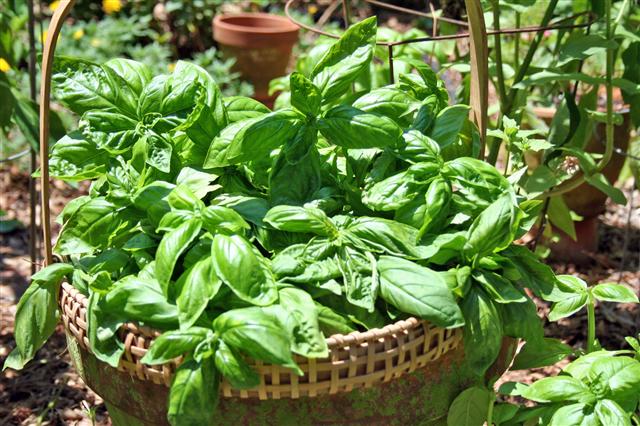
Time to harvest the basil. This is not my garden, nor my basket, nor my garden, but the resemblance is uncanny, and this is a great photo for illustrative purposes.


We grow a lot of basil, pots and pots of basil. After early church, I hit the pots with my garden shears. I trim off all the little flowers on top (I’ve been doing this all summer, but I never seem to keep on top of it) and then I trim back the branches, laden with basil. I have an entire basket full of Genovese, which, after picking off the leaves, washing them and spinning them dry, come to 12 cups of basil.
Doesn’t everything go better with a little pesto? I love to smear a little on my BLT’s, I love to pop a spoonful into a soup, and oh my holy tomato, basil pesto on pasta, to die for. I know what I want to do, but I want to be sure I get proportions right, so I go to The Silver Palate Cookbook, it came out years and years ago and has a lot of basic but really really good recipes. So, how old is this cookbook? When I was looking at the Pesto page, there was a box that said “Pesto – the quiche of the ’80’s” or something like that which implied pesto was the newest, most wonderful thing – in the ’80’s.
“????” I thought.
Isn’t pesto one of those classics? Maybe it’s because we frequented Italian restaurants when I was going to high school in Germany, but I remember pesto. It’s not like quiche (which, by the way, is my grandson’s favorite thing), it’s no passing trend, pesto is classico!
I made all the batches with garlic, lots of garlic, about triple what the recipe calls for, and I roasted it before I tossed it in. One batch I made with almonds, one batch with sunflower seeds and the last batch with my all time favorite, walnuts. I labeled little snack bags, put globs of pesto in them, sealed them up, put them all in one big gallon sized plastic bag and sealed that up and put the whole lot in the freezer, to pull on on those days when I need a pop of flavor and a taste of the long hot summer.
Here is my variation on the Silver Palate recipe:
Basil Genovese Pesto
4 cups basil, packed, washed, dried in salad spinner (or whatever) still fresh and green
8 – 12 cloves garlic, peeled, roasted
2/3 cup really good olive oil
some salt and some pepper. The best thing is coarsely ground salt and coarsely ground pepper that you’ve ground yourself.
about 1/2 cup nuts. Pine nuts are classic, as are walnuts, but pesto is one of those dishes with a lot of variation based on what God’s great earth hath provided. I don’t even measure the nuts, just eyeball it. I used walnuts, almonds, and sunflower seeds in separate batches.
In a nice large food processor, put in nuts, garlic, salt, pepper, oil and then pack in 4 cups of basil. Process until you have a gritty ball. You won’t be able to see any leaves, but you will be able to see specks of white. Spoon into freezer containers in usable amounts and freeze.
September 14, 2014
Posted by intlxpatr |
Arts & Handicrafts, Cooking, Cultural, ExPat Life, Food, Gardens, Living Conditions, Pensacola, Quality of Life Issues, Recipes, Weather |
2 Comments
Not a lot going on at Bonefish Grill on 12th Avenue in Pensacola, near the airport, at least at lunch time. We’ve been here on week-end nights when the wait is an hour or more for a table, but today, the place is almost empty.
We are seated, and service is, as always at Bonefish, superb. Some establishments really know how to train and how to maintain their high levels, and no one can ever fault Bonefish on service.
We went for appetizers and salads. Our son introduced us to Bang Bang Shrimp when Bonefish first opened, and it has been a big favorite ever since:

I had the Caesar Salad with grilled salmon – yummy, but not the best in town.
Adventure Man had the house salad, which he said was delicious, but a little boring.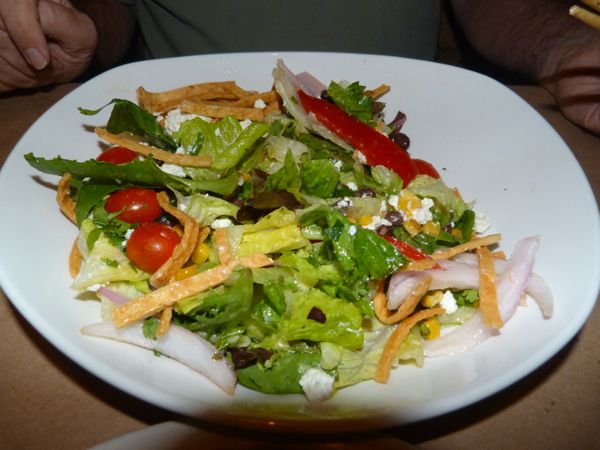
Since we had filled up on Bang Bang Shrimp, we both had salad to take home with us. What is not to love about Bonefish packaging 🙂 just a nice little extra touch.
 We were frankly disappointed. We had been happy to discover Bonefish open at lunch, but disappointed at the limited menu selections, and the lackluster appearance of the restaurant. There was another issue. Sometimes in Florida, in some stores you will smell a smell that I can only describe as “these floors were washed with dirty water.” AdventureMan does not smell it, but it is so loathsome to me that it spoils my shopping, and, in this case, my meal. There was a very faint smell of that not-quite-clean smell, and it distracted me.
As mentioned, the service was, as ever, superb but we won’t be hurrying back any time soon.
September 13, 2014
Posted by intlxpatr |
Customer Service, Eating Out, ExPat Life, Food, Living Conditions, Pensacola, Quality of Life Issues, Restaurant | Bonefish Grill |
Leave a comment
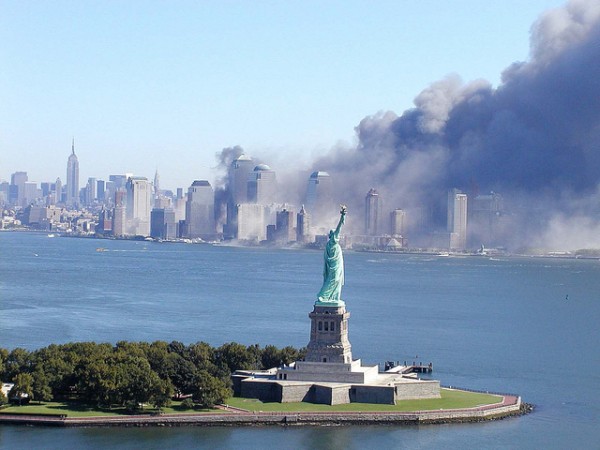
A reading from today’s Forward Day by Day helps us to cope with the resonating horrors of that monstrous day. We are living in a world where we are more and more inextricably interconnected. Where I am living, I often hear people talk about how “Moslems are killing Christians all over the world!” and my heart breaks, thinking of the wonderful friends I have lived among is so many Moslem countries, their kindness, their hospitality, our long pleasant conversations. I learned so much.
I am glad we believe in a God who knows our hearts. I am thankful for grace, and forgiveness. When we talk about killing, we also need to take account for all the civilians we have killed, trying to bring about peace, trying to eradicate Al Qaeda, Al Shebaab, those who would harm us.
God asks us to love one another. He doesn’t say “Christians, you love just the Christians.” He shows us how to love the Samaritans, the lame, the blind, the mentally ill, the “other”. He tells us, clearly, to love our enemies. The Gospel that speaks the loudest is the gospel of our lives lived to honor him.
THURSDAY, September 11
Acts 15:8-9 [Peter said], “And God, who knows the human heart, testified to them…and in cleansing their hearts by faith he has made no distinction between them and us.”
Thirteen years ago, this day became one of those days that divide time into what life was like before, and after; one of those days when you will remember, always, where you were, what you were doing—this time when you heard the news that airplanes had crashed into the World Trade Center and thousands of people had died.
Job asks, “Does not calamity befall the unrighteous?” (31:3), but we learned, vividly, on September 11, 2001, that the righteous and the innocent suffer too.
Psalm 59:6 exhorts God to “show no mercy to those who are faithless and evil.” The terrorists who flew the planes on 9/11 forced us to confront the power of evil and challenged us to find a way to respond with forgiveness. Perhaps we can learn something about that in Peter’s response to the heated discussions about Jews and Gentiles, about who could be saved, and how: “God, who knows the human heart…has made no distinction between them and us” (Acts 15:8-9).
Then, as now, there were good people and evildoers on all sides, religions, and races. Now, as then, judgment and salvation comes only through the mercy and grace of God.
September 11, 2014
Posted by intlxpatr |
Charity, Circle of Life and Death, Civility, Community, Counter-terrorism, Crime, Cross Cultural, Events, ExPat Life, Faith, Friends & Friendship, Interconnected, Lectionary Readings, Pensacola, Political Issues, Quality of Life Issues, Spiritual | 9/11 |
Leave a comment
Big article in AOL news about Dan Gilbert going to Silicon Valley to pitch moving their offices to Detroit because it’s way cool.

Excuse me?
While I appreciate his loyalty to Detroit, the things he is pitching all apply to Pensacola – AND. And in Pensacola you don’t have harsh winters. And in Pensacola you are minutes from one of the most beautiful sugar-white sand beaches, uncrowded, in the world. And Pensacola is family oriented. And Pensacola has affordable housing. And Pensacola has a way-cool culture, with parades, symphony, ballet, opera, theatre and restaurants, and world class National Naval Aviation Museum. And people spend thousands of dollars to come visit Pensacola when they could be living the dream – in Pensacola.
Dan Gilbert is a powerful man – in Detroit. Now he wants to convince Silicon Valley to move to America’s Motor City where they’ll have wide open offices, inexpensive living, and access to amazing talent.
Gilbert, the chairman of Rock Ventures and the owner of Quicken Loans, owns 60 buildings in downtown Detroit that house 12,000 employees. He is also an active backer in startups and has been inviting small companies to come bloom in Detroit over the past half-decade.
Why should you move to Detroit?
“The perception doesn’t do it justice. You have a huge talent pool,” said Gilbert. “And the people are way cooler.”
Gilbert believes that the Midwest work ethic isn’t a myth. He said that, despite the rumors to the contrary, the city has an innovative city government and, thanks to his extensive purchases in Detroit, there is space to spare for new startups. He is also working hard to reduce blight around the city, ensuring that city doesn’t look like it does in the popular “desolation porn” that characterizes the city.
The result is a smaller, more compact city that allows smaller companies to gain a foothold in the tech economy.
The city is, arguably, entering a period of renaissance. Thanks to Quicken Loans and Gilbert’s work in the city, most of the blight has been converted to cheap office space. While it does still seem like a wasteland to the average graduate, we saw a city reborn when we visited in 2012 and things are improving immensely.
In short, he said, Detroit is all about opportunity.
“We have great bones,” said Gilbert.
Detroit has good bones? Pensacola has office space, room to grow, a population of workers that can be trained to fill high tech jobs, several colleges, a university, and low stress living. It’s such an easy sell.
September 10, 2014
Posted by intlxpatr |
Arts & Handicrafts, Beauty, Bureaucracy, Community, Cultural, ExPat Life, Family Issues, Financial Issues, Interconnected, Living Conditions, Local Lore, Pensacola, Quality of Life Issues, Values |
Leave a comment
Wooo HOOOO Pensacola, getting those dealers off the streets. It’s not like its permanent, but it’s a start. There is one funny thing you will spot in this write-up in the Pensacola News Journal, that the next to last man named had charges that include selling cocaine within 1000 feet of a place of worship.
If you’ve ever been to Pensacola, you will understand how hilarious that is. You can’t go 1,000 feet away from one house of worship and not be within 1,000 feet of the next. It’s just like the mosques in Qatar and Kuwait, if you are lost, you can’t call someone and when they ask where you are, you can’t say “I’m by the big mosque/church on the corner!” because there are mosques/churches on EVERY corner! Pensacola has churches everywhere! I just think that’s interesting, that it seems to be an additional charge on the sheets in Pensacola.
An approximate 4-month-long investigation targeting street-level drug dealers resulted in the arrests of 13 people for selling crack cocaine to undercover Pensacola Police officers Friday.
Warrants for selling cocaine also have been issued for an additional 20 people, said Sgt. Marvin Miller, who supervises the department’s Vice & Narcotics Unit. Miller said the investigation targeted areas notorious for narcotics sales.
All of the charges are third-degree felonies punishable by up to five years in prison. Additional prison time can be added for selling within 1,000 feet of a specified area such as convenience stores, schools, and places of worship, or if the person is a repeat offender.
Officers from various units within the Pensacola Police Department spent approximately 12 hours today making the arrests.
Arrested today and charged with sale of cocaine and conspiracy to sell cocaine were:
Alfred Peasant, 34, of 1300 block of North Sixth Avenue, Pensacola
Sharon Pickett, 49, of 100 block of North J Street, Pensacola.
David Jones, 24, of 3600 block of Swan Lane, Pensacola.
Demarko Weathers, 21, of 2000 block of West Chase Street, Pensacola.
Minnie Mae Sapp, 54, of 100 block of South N Street, Pensacola.
Terry Crenshaw, 28, of 1000 block of West Hillary Street, Pensacola.
Larry Dornall Knight, 52, of 3600 block of North Ninth Avenue, Pensacola.
Antoine Booker, 34, of 1100 block of West Hope Drive, Pensacola.
Also arrested today were:
Donte A. Brazile, 36, of 3000 block of Torres Avenue, Pensacola. Charged with sale of cocaine.
Dominique Blackwell, 19, of 600 block of North B Street, Pensacola. Charged with possession of cocaine with intent to sell within 1,000 feet of a place of worship.
Kernist Ferrell, 57, address unavailable; Robert Lee Watts, 23, address unavailable; and Michael Coleman, 33, of 600 block of North A Street, Pensacola.
All three, who are currently in jail, were charged with sale of cocaine.
September 6, 2014
Posted by intlxpatr |
Bureaucracy, Community, Crime, Cultural, Doha, ExPat Life, Faith, Humor, Kuwait, Law and Order, Living Conditions, Pensacola, Quality of Life Issues, Social Issues, Values |
Leave a comment
Every year around this time, we get a whopper of a cable bill, far above our normal bill.
And we gird for war.
I used to handle it and AdventureMan would sometimes laugh from his office. (Once an insurance agent said to me “You READ the policy??” when I told her I was discontinuing it because the things it covered were things that didn’t apply, and the things that I needed weren’t covered.) When AdventureMan volunteered to handle the annual cable bill call, I danced for joy.

If you want to win, you have to have a strategy. But not any old strategy is going to win the cable bill battle, you have to have the strength and fortitude for THE LONG PHONE CALL.
As we do this, I can hear my Dad’s voice as he would do battle over the phone, with the post office over an extra charge on a package, or a financial institution about just when that interest should be paid and how it should be calculated.
You can’t do this unless you have the time and energy.
AdventureMan ultimately prevails, and saved us over $600 over the course of the cable year, but it is a tedious battle, at one point, the equivalent of a siege, a battle of attrition, as he goes through what we are buying line by line.
The cable representative, however, has his own weapons – wire and smoke and mirrors, disguised as bundles and discounts and specials. They can “stack” some, but not others, and the packages may not be as described. It’s dirty warfare, down in the trenches, but the ultimate weapon is that AdventureMan has the time, and they have their time limits.
One day we are hoping to walk away from cable altogether, but until we can figure out how to get Downton Abbey, Game of Thrones, and other programs we like on a reliable basis, we stick with the devil we know.
September 3, 2014
Posted by intlxpatr |
Adventure, Bureaucracy, Civility, Communication, Cultural, Customer Service, Entertainment, Family Issues, Financial Issues, Living Conditions, Pensacola, Pet Peeves, Quality of Life Issues |
2 Comments





 Here There and Everywhere