Colors and Localities
One of the things we joke about, AdventureMan and I, when we come back to the Seattle area, is that all the houses are grey. Some might look brown, but it is a very grey brown. Some might look green, but it is a very grey kind of green. Some houses are purely grey – maybe they have white trim, but they are very very grey. An occasional truly brown house sticks out, anything not toned down by grey sticks out. And oh! now and then someone with a Mediterranean soul will build a pink or terra cotta house with a red tile roof and people will say “Oh! Look at that! They must not be from around here!”
Yesterday, I was in one of my most favorite places, Home Depot, wandering around looking at what the contracters are putting in the newest houses.
“High rise toilets!” I exclaimed to AdventureMan, who was on the phone with me. “For people who are older, and don’t have the strength in their legs to lower themselves too far!”
I was looking to see what was available in small bathtubs, because I love a hot bath on a cold day, and I want a deeper, smaller tub in which I can lean back with a good book, not one of these huge tubs that take all day to fill. I was looking at shower apparatus; I am thinking one day I want to go the European way with those wall flash-heaters that give you hot water when you need it and don’t keep heating it all day when you don’t.
And then I saw the carpet samples. I just had to laugh. When we lived in Florida, I loved walking into the model homes, with their seafoam green carpets, or even a mellow shade of tropical pink. Everything looked so welcoming and laid back.
In the Pacific Northwest, people choose from shades of sand. I never knew there could be so much variation on beige, which is somewhere between white and brown:
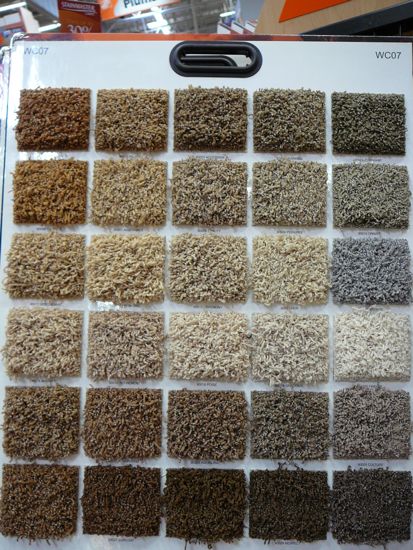
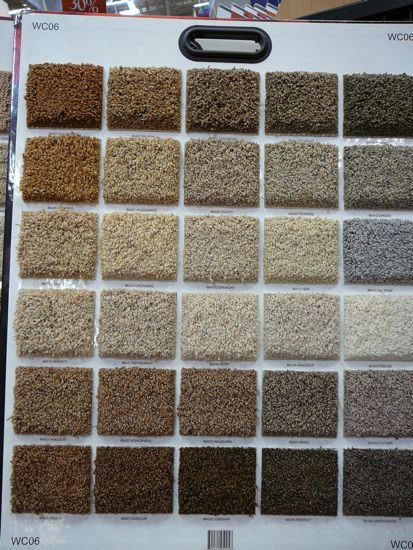
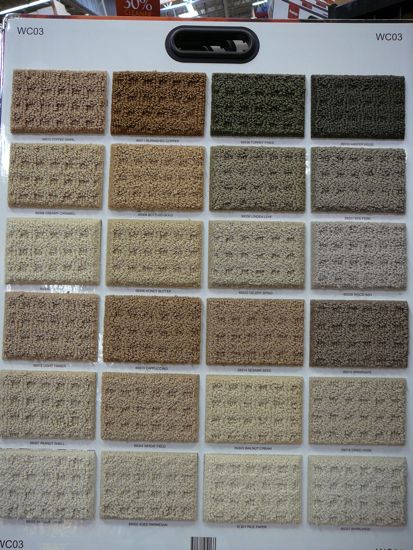
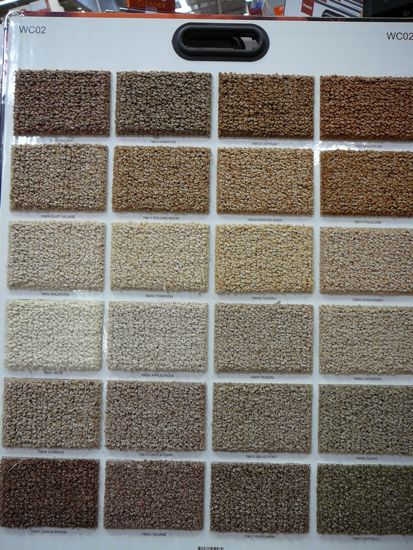
To those of you who say that sand isn’t as dark as the darkest brown swatches of carpet, I can only say you have never walked along a Pacific Northwest Beach on a dark and stormy day. Believe me, sand can be very very dark.
“We Didn’t Have a Refrigerator”
We were eating breakfast together, my Mom and I, when she dropped a bomb. I had no idea she could catch me by surprise that way. We’d been talking about fresh peaches, and preserves.
“When your Dad and I got married, we didn’t even have a refrigerator,” she said.
Not have a refrigerator? You can get married and not have a refrigerator?
“How did you get one?” I asked, still reeling from astonishment.
“Your Dad inherited $100 from some very distant relative,” she related, “he got like 1/32nd, which came to $100. We used it to buy a refrigerator.”

“What did you do before you had it?” I asked, still a little disoriented.
“Well, it was Alaska,” she said. “We had these sort of pantries that had shelves with little holes opening to the outside, covered with screen to keep out insects and mosquitos, but it would let in the cool air. It didn’t get that hot, even in the summer. In the winter, we had shelves on the outside porches, too.”
Holy smokes, I thought to myself. How would I function without a refrigerator? We would have to go back to shopping every day. If there weren’t refrigerators, maybe stores wouldn’t have frozen sections, too? Maybe we would have to be buying meat just as it was slaughtered, only vegetables that could travel from not too far without refrigeration, we would be using a lot more grains and things that didn’t need refrigeration to preserve them.
Maybe we would be drying more foods? We would probably, in Kuwait, be eating more dates and rice, eating more locally raised foods – what, sheep? camel meat? We would probably be eating a lot more fish. We would probably go back to canning foods while they were abundant – tomatoes, fruit jams, maybe we would even pickle some fish and/or shrimp for out-of-season eating. Our food might be saltier, as salt is also a preservative. Maybe we would eat more rice, more pomegranate . . . maybe occasionally a boat would come in from Ethiopia or Kenya bringing rare coffee beans, and only very special, very lucky people would have access to the little luxury we all take for granted.
Ooops. Well, I am getting carried away. I was so amazed to hear my mother had initially kept house without a refrigerator that I sort of spaced out.
She went on to tell me that as she was growing up, her family had an ice box, and they would put out a special piece of paper when they needed ice from the ice man, who would drive by every day to provide ice for the cool-boxes. The ice came in different sizes, depending on the size of the ice box.
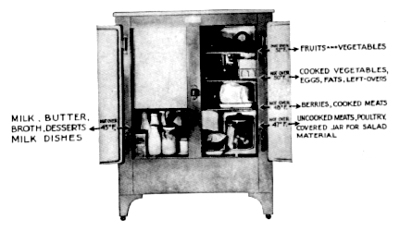
(I found this picture and a fairly clear explanation of ice boxes on on Wikipedia.)
It gets better. As I was reading the Wikipedia information, I came across the Pot in Pot refrigerator , known in Arabic as a “zeer” for which Mohammed Bah Abba was awarded a Rolex Laureate (Rolex Awards for Enterprise) in 2000. You can read about Mohammed Bah Abba, the Nigerian teacher who developed this simple, but effective refrigeration technique, by clicking on the blue type above. You can read more about the Zeer pot, and see a photo of how they work, by clicking here: Science in Africa.
River Jordan Parts
Today’s reading, from Joshua, concerns a second river crossing when the river stops flowing to allow the Israelites to cross, carrying the Arc of the Covenant. According to this reading, there should be a stone memorial somewhere in that area – I wonder if any remnants have ever been found? I wonder if the river has changed course (rivers do) and whether the memorial (assuming it exists, recognized or unrecognized) is now in Israel, or in Jordan?
Joshua 3:14-4:7
14 When the people set out from their tents to cross over the Jordan, the priests bearing the ark of the covenant were in front of the people. 15Now the Jordan overflows all its banks throughout the time of harvest. So when those who bore the ark had come to the Jordan, and the feet of the priests bearing the ark were dipped in the edge of the water, 16the waters flowing from above stood still, rising up in a single heap far off at Adam, the city that is beside Zarethan, while those flowing towards the sea of the Arabah, the Dead Sea,* were wholly cut off. Then the people crossed over opposite Jericho. 17While all Israel were crossing over on dry ground, the priests who bore the ark of the covenant of the Lord stood on dry ground in the middle of the Jordan, until the entire nation finished crossing over the Jordan.
4When the entire nation had finished crossing over the Jordan, the Lord said to Joshua: 2‘Select twelve men from the people, one from each tribe, 3and command them, “Take twelve stones from here out of the middle of the Jordan, from the place where the priests’ feet stood, carry them over with you, and lay them down in the place where you camp tonight.” ’ 4Then Joshua summoned the twelve men from the Israelites, whom he had appointed, one from each tribe. 5Joshua said to them, ‘Pass on before the ark of the Lord your God into the middle of the Jordan, and each of you take up a stone on his shoulder, one for each of the tribes of the Israelites, 6so that this may be a sign among you. When your children ask in time to come, “What do those stones mean to you?” 7then you shall tell them that the waters of the Jordan were cut off in front of the ark of the covenant of the Lord. When it crossed over the Jordan, the waters of the Jordan were cut off. So these stones shall be to the Israelites a memorial for ever.’
Ministry Conducts Demographics Study
This is from today’s Kuwait Times. I LOVE demographics. I love tagging factors, loading them all into a data base and seeing where the stats fall. You learn so much.
The Ministry of Social Affairs and Labor is studying effective means to rectify the country’s demographic imbalance. The ministry has reportedly reached the conclusion that the blend of different nationalities in Kuwait has proved detrimental to its societal fabric. One Arab nation’s expatriate population in the country has exceeded 300,000, sources say, which puts the states economic and political stability at great risk. Sources said that the matter is complicated and needs all the ministries’ undivided support.
Expatriates, it is felt, bring with them their own modern culture and customs which are alien to the local citizens, most of whom follow archaic customs deeply rooted in tribal practices. Expatriates are also accused of taking the law into their own hands without approaching the concerned authorities whenever they are confronted with a problem. It has also been observed that expatriates belonging to a certain nationality inhabit certain areas in droves, leaving security officials at a loss to change the situation.
As a move towards controlling the situation, the ministry is to form a permanent committee comprising officials from different ministries to scrutinize all the expatriates who arrive at Kuwait.
It will issue a fitness certificate to eligible expatriates on the lines of medical fitness test. Employers will then be able to decide whether to appoint those workers or repatriate them. The ministry also plans to come down heavily on expats who obtain jobs using illegal residence permits.
Hmmm. Rectifying the population imbalance might require giving up expatriate labor. What laborers do you want to give up? The largest number are probably doing low-skill level work – cleaning houses, cleaning the streets . . .Or do you want to give up those who are managing your stores, taking your orders in all the restaurants, cooking, taking care of the office chores?
I can guess which expatriates are bringing in alien modern customs and practices, but unless you are going to give up television, cable, the internet and travel . . . that train has probably left the station.
So which nationality has over 300,000 expats in Kuwait? And which nationalities “inhabit certain areas in droves?”
Who takes the law into their own hands?
It Gives Me Hope
You know who I am, I’m pretty consistent in what I have to say. I believe we all have a lot more in common than we have differences, and I want us to find ways to get along. We, as a species, spend so much time and energy and resources fighting over the pettiest differences. How will we ever call ourselves civilized until we can treat every fellow creature with respect?
I bet Cupertino has problems, too. I know for one thing it is incredibly expensive. Most of what I saw there, I really liked. Whole Foods. High Tech Engineering. A wide variety of people, all working together in peace.
At our hotel, there were five weddings taking place the same day as “our” wedding. I came down in the elevator with one couple and their parents, and I got a photo of them in the hotel garden area before their wedding:

The groom is from India, and the bride is Chinese. The parents, and all the relatives are gathered, and dressed in gorgeous, flowing silks, and the bride and groom are just amazingly in love with each other and it is so beautiful, they are all so happy.
Cupertino takes a lot of pride in being beautiful, and the buildings they build are beautiful and they have “campuses” where lots of related buildings are connected with winding garden paths and ponds full of ducks.
I particularly love this sculpture:

Which looks totally different from the side:

There were flowers and plants everywhere. Many I couldn’t even recognize. I would have to learn a whole new world of gardening in California:

Law of the Garbage Truck
A good friend sent this to me. I hadn’t seen it before, and thought you might like to see it, too.
I hopped in a taxi and we took off for the airport. We were driving in the right lane when suddenly a black car jumped out of a parking space right in front of us. My taxi driver slammed on his breaks, skidded, and missed the other car by just inches! The driver of the other car whipped his head around and started yelling at us. My taxi driver just smiled and waved at the guy. And I mean, he was really friendly.
So I asked, ‘Why did you just do that? This guy almost ruined your car and sent us to the hospital!’
This is when my taxi driver taught me what I now call, ‘The Law of the Garbage Truck.’
He explained that many people are like garbage trucks.
They run around full of garbage, full of frustration, full of anger and full of disappointment.
As their garbage piles up, they need a place to dump it and sometimes they’ll dump it on you.
Don’t take it personally, just smile, wave, wish them well and move on.
Don’t take their garbage and spread it to other people at work, at home, or on the streets.
The bottom line is that successful people do not let garbage trucks take over their day.
Life’s too short to wake up in the morning with regrets, so…..
‘Love the people who treat you right.
Pray for the ones who don’t.’
Sky Walk – I Couldn’t Do it
Today on Good Morning America, they hit the 3rd of America’s Seven Natural Wonders. It is the Grand Canyon, and they broadcast from the new skywalk that they built cantilevered out over the Canyon. It has a glass floor, and you walk out 4,000 feet above the bottom of the canyon.
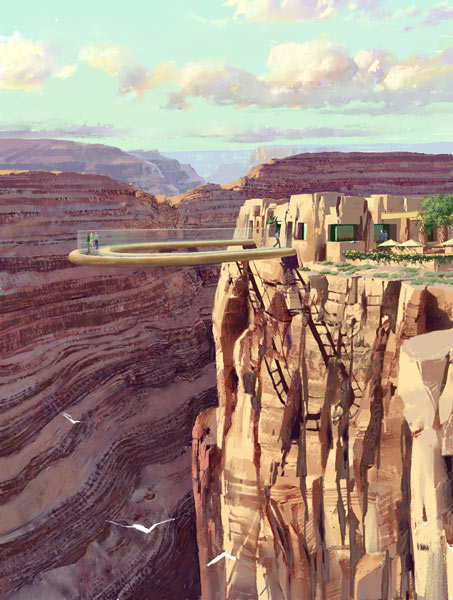
I almost threw up.
Just looking at it makes my blood pressure jump; my heart is beating fast and my palms start to sweat.
I have a mild case of fear-of-heights. (Acrophobia) I feel unbalanced looking down, I feel like I could fall right over.
AdventureMan, thank God, has the same sensitivity, so he doesn’t tease me. I know we will visit this skywalk one day, and I wonder if he will be able to force himself to walk out on it. I already know I won’t be doing it. It’s just too stressful for me. . . . Even watching it on Good Morning America, I feel all stressed out!
Kuwait Green
There is a miracle in Kuwait. Suddenly, there are trees a bright, Easter-basket-grass green.
“What kind of miracle is that?” you might ask, you who live in other climates.
That bright spring-green is a miracle in a land where the true blue of the blue sky is often screened with haze, where the dominant color is a white beige sand, and, most important of all, where there has not been a truly significant rain the entire rainy season here.
The color is painfully beautiful, the eye seeks it out and feasts on its vibrancy in an otherwise dull landscape. The tree that is showing the vibrant green is a little willowy, graceful. The green is probably only for a day or two before it fades into a duller green – still welcome because it IS green.

The second tree is my favorite tree in Kuwait, but I don’t have a single Kuwaiti friend who can tell me what it is. They tell me it is a very old tree, a tree that can live a long time on very little water, a tree often used to screen houses and provide both shade and privacy. I love the laciness on its leaves, the delicacy of its foliage. In contrast to the spring-green tree, the foliage is a more grey-blue-green, and it is a much taller tree. There is a delicacy about this tree, an elegant restraint and a timelessness that fascinates me. If I were Kuwaiti, if I had my own compound, I would grow this tree, I would grow many of them and watch their lacy branches sway in the slightest breeze.

Can someone tell me the names for these trees?
(PS I had to look up it – it’s + Possessive to be sure I got it right, above. I didn’t get it right at first, but it is right now. If you have any confusion, don’t be alarmed – it confuses all of us. If you click on the blue type, there is a very simple way to remember when to use it and when to use it’s.)
MacDonalds MacKrisby
This is for my stateside readers. Wherever you go, except for Syria, there seems to be a MacDonalds. The funny thing is, in different countries, they have different specialties, things you never see in the USA. For example, while we lived in Qatar, they had a special called the MacArabia, which was kind of like a local fast food, but on a more Western bun. It was no where near as tasty as the local equivalent, but I think they add things to the menu to appeal to people forced to eat there when the kids insist. I am only guessing; I can’t even remember the last time I had anything from MacDonalds.
In Kuwait, they have added a new sandwich, the MacKrispy, a breaded fried chicken thing, sort of like a great big dry chicken nugget. Because Arabic does not have a “p”, the literal translation of the word (you can see it down by the little golden arches) is MacKrisby.

College Level Classes for Older Adults
AdventureMan and I fantasize about what retirement will look like, even though it is a few years ahead of us. It helps to think about what is coming and how we are going to handle it.
We have a house near my Mom, and Mom sent AdventureMan a clipping from the local paper about classes being taught for “older adults” (WHEN did THAT happen, we wonder, when did we become “older” adults???) with the sweet note that AdventureMan could teach a few classes.
Here are some of the classes offered at the college near us:
Africa: A Closer Look
The Canterbury Tales, Part I and Part II
Civil Liberties and Security
Current Issues Forum
End of Life Decisions
Geology of National Parks
The History of the Supreme Court
Jazz: Can You Dig it?
The Many Faces of Hinduism
Native Basketry of the columbia Plateau, Northwest Coast and Arctic Alaska
The Poetry of Billy Collins
The War of 1812
He’s excited about the idea. So as we were planning to pray together before he left for the day, we were chatting excitedly.
“You could teach some classes on buying hand woven carpets! or on Arabic culture! or you could teach about some aspect of Africa!” I suggest. (I have my own projects that keep me very busy.)
“I was thinking more about organizational classes – managing organizations, financial management, that kind of thing . . ” he responded, “You know, like organizing your life . . .”
(I can see that manic gleam come into his eye and I know what is coming next might well be something I don’t want to hear. . .)
“I’ve got it!” he exclaims, and he starts laughing, because he is already cracking himself up. “I can teach a class called . . . HOW TO ORGANIZE YOUR WIFE! Ha ha hahahahahahahahahhahahahahhahahahahhahahhahahah.”
I can’t help it. I am laughing too. But it’s not THAT funny, AdventureMan.
Recent Comments
intlxpatr on Shampoo Ginger tigerbutterya0c5ff1d… on Shampoo Ginger intlxpatr on British Soldier Kidnapped, Esc… John on British Soldier Kidnapped, Esc… intlxpatr on British Soldier Kidnapped, Esc… Wikipedia Donate Button

Amazina


Early Voting in Florida


