Three Market Trends for 2010
From The Peninsula Business Section
Three market trends to watch for in ’10
Web posted at: 12/27/2009 11:51:49
Source ::: LAT-WP
Washington: In case you missed it, Treasury Secretary Timothy F Geithner this week promised America that there won’t be another financial crisis in 2010.
“We’re not going to have a second wave of financial crisis,” Geithner said in an interview with National Public Radio. “We’ll do what is necessary to prevent that. We cannot afford to let the country live again with a risk that we’re going to have another series of events like we had last year.”
Well, there it is. And you wonder why the stock market is at 14-month highs? Anyone who has deep-seated doubts about the financial system’s health may view Geithner’s explicit guarantee as a sign of dangerous government hubris, or simple naivete.
But his promise does address what is for some investors the pre-eminent question about 2010: Can the world avoid another calamity on the scale of what fueled the markets’ meltdown from September 2008 to March 2009?
To put it another way: Your financial planning for the new year would be a lot easier if you knew that the chance of another collapse was remote even if markets were likely to be volatile.
The strongest evidence against a second collapse is that the credit crisis has eased dramatically. That may not be evident in banks’ lending. But by many key barometers, including new issuance of corporate bonds and the rates banks charge each other for short-term loans, credit has begun to flow again worldwide.
If we assume that Geithner is right about the absence of another mega-crisis in 2010, I think there are three important financial trends that either got under way or accelerated in 2009 that also will be critical for investors and savers in the new year:
The Great Deleveraging rolls on. Many Americans piled on excessive debts in the 1980s, 1990s and first half of this decade. On that much, everyone agrees. Now, that total household debt load of $14 trillion is being worked down — voluntarily, as people pay off credit cards, for example, or involuntarily, as banks force foreclosures. Consumer credit excluding mortgages fell for a ninth straight month in October, a record stretch of declines, according to Federal Reserve data.
But debt reduction has a “long, long way to go,” says Ian Shepherdson, chief US economist at High Frequency Economics in Valhalla, New York. The question is whether it can proceed without tipping the economy back into recession.
One ticking time bomb: a jump in 2010 in the number of homeowners with so-called option ARM loans who will see their loan rates reset at higher levels.
An obvious implication of consumers’ need to reduce debt is that people will save more and consume less than before. That will be a continuing drag on the economic recovery. I know we’ve all heard that a million times, but that doesn’t make it less true.
The upshot: no imminent rate relief for savers who now are lucky to earn 1 percent or 2 percent on their cash.
Corporate earnings keep improving. Expectations of a profit recovery helped stoke the stock market’s turnaround in March. Wall Street has been pleasantly surprised since then.
Starting with the current quarter, earnings are forecast to begin rising, albeit from extremely depressed year-earlier levels.
Sales have edged up for many companies this year as the global economy has begun to rebound. But a big part of the profit-recovery story has stemmed from companies’ slashing of their payrolls, driving the US unemployment rate above 10 percent for the first time since 1982.
Many investors keep looking for a middle ground on risk-taking. That means cash probably will keep pouring into bonds — at least until some people discover, to their surprise, that it’s possible to lose money in fixed-income securities, too.
Small investors usually are prone to chasing hot stock markets. Not this year. Even as the US stock market has continued to rally Americans have shunned domestic stock mutual funds. Each week since late August more cash has been pulled from them than has flowed in via new purchases, according to the Investment Company Institute’s data.
He turns a desert into pools of water
One of today’s readings in The Lectionary are these verses from a much longer reading, Psalm 107. When I read these lines, I can’t help thinking how this very dull and flat land, Qatar, this little thumb sticking up into the Gulf, has greened, how the oil and gas have served to green this land, to change its face, and how much money is flowing out from this country to many other countries of the world.
All those of us from far away countries who labor here are benefitting from these springs of wealth, sending money home.
33He turns rivers into a desert,
springs of water into thirsty ground,
34a fruitful land into a salty waste,
because of the wickedness of its inhabitants.
35He turns a desert into pools of water,
a parched land into springs of water.
36And there he lets the hungry live,
and they establish a town to live in;
37they sow fields, and plant vineyards,
and get a fruitful yield.
38By his blessing they multiply greatly,
and he does not let their cattle decrease.
39When they are diminished and brought low
through oppression, trouble, and sorrow,
40he pours contempt on princes
and makes them wander in trackless wastes;
41but he raises up the needy out of distress,
and makes their families like flocks.
42The upright see it and are glad;
and all wickedness stops its mouth.
43Let those who are wise give heed to these things,
and consider the steadfast love of the Lord.
For my Christian readers, Muslims also use the Psalms as holy readings –
“The Qur’an (Surah An-Nisa 4:163) states “and to David We gave the Psalms”. Therefore, Islam confirms the Psalms as being inspired of God.”
Did you know that?
The Social Contract
Without accountability, does the social contract exist?
Wikipedia on the Social Contract:
Social contract describes a broad class of theories that try to explain the ways in which people form states and/or maintain social order. The notion of the social contract implies that the people give up some rights to a government or other authority in order to receive or maintain social order through the rule of law. It can also be thought of as an agreement by the governed on a set of rules by which they are governed.
Social contract theory formed a central pillar in the historically important notion that legitimate state authority must be derived from the consent of the governed. The starting point for most of these theories is a heuristic examination of the human condition absent from any structured social order, usually termed the “state of nature”. In this condition, an individual’s actions are bound only by his or her personal power, constrained by conscience. From this common starting point, the various proponents of social contract theory attempt to explain, in different ways, why it is in an individual’s rational self-interest to voluntarily give up the freedom one has in the state of nature in order to obtain the benefits of political order.
Greeting Your Enemies With a Feast (Elisha)
I love it when I come across a good story I haven’t heard before in my daily readings in The Lectionary and this one is a doozy. I didn’t hear a lot of bible stories about Elisha as I was growing up (Elisha followed Elijah) but this reading includes some amazing stories, including one of the first instances of turning away an enemy with a feast.
2 Kings 6:1-23
6Now the company of prophets* said to Elisha, ‘As you see, the place where we live under your charge is too small for us. 2Let us go to the Jordan, and let us collect logs there, one for each of us, and build a place there for us to live.’ He answered, ‘Do so.’ 3Then one of them said, ‘Please come with your servants.’ And he answered, ‘I will.’ 4So he went with them. When they came to the Jordan, they cut down trees. 5But as one was felling a log, his axehead fell into the water; he cried out, ‘Alas, master! It was borrowed.’ 6Then the man of God said, ‘Where did it fall?’ When he showed him the place, he cut off a stick, and threw it in there, and made the iron float. 7He said, ‘Pick it up.’ So he reached out his hand and took it.
8 Once when the king of Aram was at war with Israel, he took counsel with his officers. He said, ‘At such and such a place shall be my camp.’ 9But the man of God sent word to the king of Israel, ‘Take care not to pass this place, because the Arameans are going down there.’ 10The king of Israel sent word to the place of which the man of God spoke. More than once or twice he warned such a place* so that it was on the alert.
11 The mind of the king of Aram was greatly perturbed because of this; he called his officers and said to them, ‘Now tell me who among us sides with the king of Israel?’ 12Then one of his officers said, ‘No one, my lord king. It is Elisha, the prophet in Israel, who tells the king of Israel the words that you speak in your bedchamber.’ 13He said, ‘Go and find where he is; I will send and seize him.’ He was told, ‘He is in Dothan.’ 14So he sent horses and chariots there and a great army; they came by night, and surrounded the city.
15 When an attendant of the man of God rose early in the morning and went out, an army with horses and chariots was all around the city. His servant said, ‘Alas, master! What shall we do?’ 16He replied, ‘Do not be afraid, for there are more with us than there are with them.’ 17Then Elisha prayed: ‘O Lord, please open his eyes that he may see.’ So the Lord opened the eyes of the servant, and he saw; the mountain was full of horses and chariots of fire all around Elisha. 18When the Arameans* came down against him, Elisha prayed to the Lord, and said, ‘Strike this people, please, with blindness.’ So he struck them with blindness as Elisha had asked. 19Elisha said to them, ‘This is not the way, and this is not the city; follow me, and I will bring you to the man whom you seek.’ And he led them to Samaria.
20 As soon as they entered Samaria, Elisha said, ‘O Lord, open the eyes of these men so that they may see.’ The Lord opened their eyes, and they saw that they were inside Samaria. 21When the king of Israel saw them he said to Elisha, ‘Father, shall I kill them? Shall I kill them?’ 22He answered, ‘No! Did you capture with your sword and your bow those whom you want to kill? Set food and water before them so that they may eat and drink; and let them go to their master.’ 23So he prepared for them a great feast; after they ate and drank, he sent them on their way, and they went to their master. And the Arameans no longer came raiding into the land of Israel.
Eid Confusion
After writing that I don’t get a lot of phone calls, my VOIP started ringing. Four times, it was AdventureMan – we always have a lot to talk about. Once, my Mom, who calls just because she can and because the number we got is her area code, so it is like calling next door, and we all like that. Last, one of my friends in Kuwait – we have discovered we can call VOIP to VOIP. It’s like double the trouble – VOIP phones don’t always have the best connection, sometimes they are echo-y, sometimes one person can hear and the other can’t, sometimes you get other people on the conversation with you – so when you talk VOIP to VOIP, you have double the risk of technical difficulties, but still, an cost-per-phonecall that encourages long conversations (if you can hear and understand one another.)
“Has Eid started in Kuwait?” I asked at one point.
“I don’t thing so,” she replied. “I think it starts like Monday or so.”
It’s confusing to me. I know that Ramadan started four weeks ago tomorrow, so it is likely Eid will be 28 days later, like tonight or tomorrow or Sunday. But Kuwait started the Eid holidays on Friday, the official holidays, so that people will have nine full days of Eid celebration. (two weekends and a five day week). I don’t know if it is the same in Qatar.
It is also confusing as to just who gets the Eid holiday. When I lived in Tunis, lo, these many years ago, the entire country got every celebration. Those of us at the Embassy were doubly blessed; we got all the American holidays AND we got all the Tunisian holidays. So did just about everybody; the country shut down. For at least three days, no restaurants were open, no stores were open – you had to know about this in advance and bring in provisions to last until the Eid celebrations were over.
I wonder, did it used to be that way in Qatar? In Kuwait? That everything shut down, at least for the first day of Eid, and often longer?
In Kuwait and in Qatar, occasionally – like the first day of Eid – the stores will be closed a day – some just half a day. So many workers here are non-Muslim that it makes it possible to keep places open without intruding on someone’s celebration of Eid, in fact, I would think being able to go to restaurants and pick up a few items in the stores enhances the Eid experiences. I know most of my friends in Qatar are leaving town, just as I am getting back, beating feet for Europe, for Africa, for the Maldives, celebrating by traveling.
All the same, I am not sure when exactly Eid is expected to start officially, like according to the lunar calendar. Anyone?
Irrelevant Clothing, Shoes and Scissors
It doesn’t matter how long I have been living in the Middle East, it doesn’t matter how many times I have made the trip back and forth, I never seem to get it quite right.
I knew it was going to be less hot in Seattle. I knew it. And still, I didn’t pack a single pair of closed toe shoes, a single pair of nylon stockings, and only a couple long sleeved things. It doesn’t matter that I have lived in Seattle, that I know Seattle, when I am in the middle of the heat and humidity of August in Doha, I lack the imagination to think clearly about the coolness of August in Seattle. I have a lot of lightweight cotton dresses . . . hmmm, so irrelevant in Seattle.
I keep a storage locker here. It started when we moved our parents from their big house to a 2 BR condo (with a water view 🙂 ) and Mom had separated out some of her treasures to divide among us movers. The problem was, I didn’t really want to take them with me (bulky and I would have to bring them back) and I have already imposed on the sister who lives here with a bunch of my stuff, so I finally decided to rent a storage locker. I discovered as a landlord, it actually comes off my taxes. I still have to pay for it, but it isn’t a total loss. I keep Seattle supplies in the locker, too.
When I went to the locker yesterday to pick up some more long sleeved stuff, and my Seattle hairdryer, and my Seattle make-up and living supplies (dishwashing soap, coffee filters, paper towels, laundry soap, etc.) yesterday, with my Mom in the car, nothing went right. My code didn’t work. I had to go inside, leaving my Mom sitting in the car, and it took them a while to work out what was wrong.
(“We don’t have seven number codes! . . . .Hmmm, , mmm, , , yeh, it says you have a seven number code all right, . . .. so here is your new code . . . )
And the new code didn’t work either.
They opened the gate for me, I went to my locker, and with my Mom sitting in the car, discovered my laundry soap had leaked during the time between visits, and with my Mom sitting in the car, I had to clean it all up AND dig out some relevant clothing, and some wrapping paper for gifts I need to send, and scotch tape and scissors (yes, I keep all the things that I frequently use in the locker so I don’t have to buy them again and again and again.) I also grabbed the bag of cosmetic items – like shampoo, toothpaste, my Seattle toothbrush, etc.)
My poor Mom! Remember her? She is still out there sitting in the car!
(The code didn’t work on the way out, either.)
So after all that sitting in the car, I treated Mom to a trip to Trader Joe’s, a place we both love. I picked up sugar snap peas; I just eat them like candy, instead of candy, they are SO good, and some sushi for later on, and Mom picked up things that were really bad, like triple gingersnaps and a wonderfully fragrant new Rosemary Tree.
On the way home, she said “you know you have some stuff in the guest bathroom” and I assured her that I did not, that it was all my middle sister’s stuff, and she said “No, Little Diamond looked at it while she was staying here and said it was yours, that it was stuff you use.” Hmmm. Little Diamond said that?
So when we got back to Mom’s house, I checked the cupboard, and there was one of those zipper bags like (ahem) I always use, and inside was . . . yep. Another hairbrush. Another Seattle toothbrush. Scotch tape. Scissors. My particular make-up back-ups. Shampoo. I brought it with me, and I had two almost identical zipper bags full of Seattle supplies. I can only imagine that sometimes when I get here after all those hours of traveling that my mind is just so addled I am not thinking.

It also makes me feel a little weird that Little Diamond knows me so well that she can identify MY things with just a glance at the contents of the plastic bag, LLOOLLLL! I am that predictable?
On my way over to my Mom’s, I had stopped at the local Fred Meyer’s, a Target-like local store I just love. Now that I am in Seattle, I see things differently. I see things I can hardly resist, like something in me feels like getting ready for the winter, but then, Thank God, my sterner self jerks me back just as I am reaching for:

Look at those socks! Look at those colors! I can barely resist, they are such a hoot! but then . . . where would I wear them? Even if I were abaya’d, people could see my bright polka-dot chartreused ankles and it would draw unwanted attention . . . . maybe just around the house . . .
But no . . . around the house – look at these!
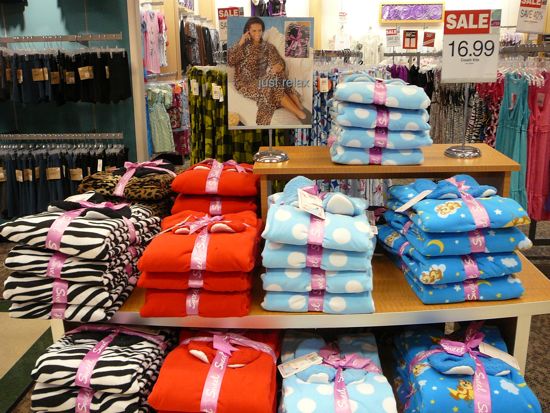
Thick, fuzzy sleepers, only $16.99, like we wore when we were kids, only these are for grownups, and oh! look at that zebra print! The cheetah! They are almost irresistable!
And so irrelevant in Doha!
Doha Hazard
I’m driving along, getting ready to get in the right turn lane, when all of a sudden ahead of me, I can see a change in grade: Roadworks. Only in my lane. Here is the hazard – I can get in the lane now, and bump along, or I can stay in my curent lane and switch later, but I don’t know how many other drivers are adopting that strategy, and if I don’t make the right turn, I have to go many blocks out of my way. I signal and get in the raw, bumpy lane.

There just isn’t any good time to do roadworks. Some of the roads have serious potholes, many of the side roads have other serious defects. They have to be fixed, but oh the mess, the inconvenience. It’s the same in Kuwait, it’s the same in Seattle. I think of the bureaucrats who have to raise the funds (at least in Kuwait and Doha, it’s not taxes!), hire the companies, make the decisions and bear the howling complaints of the inconvenienced while the necessary work takes place.
At least on this day traffic is flowing smoothly and drivers are making allowances for one another. Things could be a lot worse.
Written Communication, Plusses and Minuses
I was e-mailing back and forth this morning with a dear friend who is traveling. She was about to visit an old school friend, and before visiting, dug out all the letters she had received from the friend – an enormous collection – and read through them all. She said it was a very moving experience, and I could tell that even before visiting her friend, she was feeling close from having read all those letters.
When was the last time you got a letter?
I have some letters my husband has written, saved away. 🙂 Most of my written communications these days are done by e-mail, instant-message, or texting. I used to have files of e-mails, but as they grew bigger and bigger, I sort of stopped saving them, except for important ones, or business-related ones.
These blogs are also written communication, but more like books, less personal and you never really know who is reading on any given day, and who isn’t, so like it is not the most reliable way to communicate something important, especially to one person or a small group of people; e-mail just makes more sense. Or picking up the telephone, which I don’t do all that often as I am not so much of a telephone person and many people I would call are in different time zones.
But it makes me wonder what record we will have of these times? I told my friend when I was in college, I worked part time in the university xerox department, and most things in the Northwest Collection came to me. I could read them as I copied them – diaries, letters, to-do lists, shopping lists – ephemeral things, but written on paper, and they give us a tiny peephole into the daily lives of people who lived a couple hundred years ago.
Think of your life, and how things have changed, even if you are in your twenties. Two hundred years from now, people will have so many questions about our lives, how we lived, why we did the things we did. With fewer lasting pieces of paper, will the record be so complete?
Think of our electronic storage devices – remember floppy disks? My computer wouldn’t even be able to read a floppy disk! Think of the tiny little USB devices we are saving onto now – how long will that technology last? In another generation, it will be as opaque and accessible as the ancient inscribes stones buried in the deserts.
As we go more and more paperless, how are we saving the ephemera?
As I upload a couple years worth of photos to be printed, I think of the scrap booking craze, how you take a few photos and decorate all around them, but do the resulting albums give you truth, or do they give you a fantasy of the truth?
I think of the photographs from a hundred years ago – people with somber faces. Serious faces. No one ever smiled for the photos. There are photos of my earliest relatives in Seattle, they are truly a grim looking bunch, I think it was the style then, and I have a feeling that they didn’t look like that most of the time; our family culture is pretty jokey. So I am also wondering about family lore, family history and realities. Like most of us expunge the photos of us that are unflattering – and destroy letters we would never want anyone to read. In so doing, we don’t change the real history, but we do change the transmission of history! Much of what gets transmitted ends up being censored, by us!
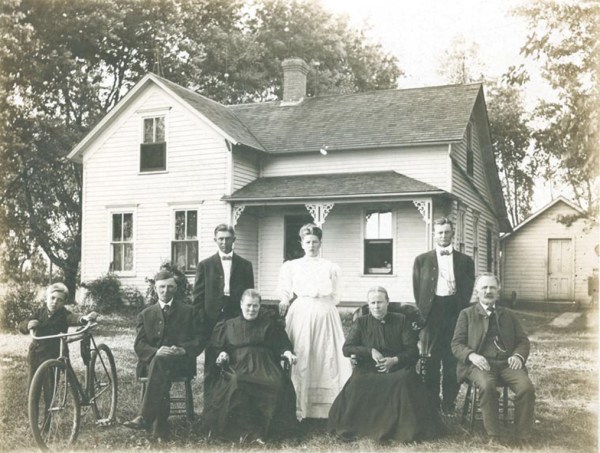
(This is not my family, just a photo from the early 1900’s from rootsweb.ancestry.com)
For years, I have taken my photos and put them in books – and they are heavy. But we actually take them out and look at the photos from time to time, whereas now, most of my photos are stored on the computer, and rarely do I take the time to upload them to be printed. I wonder what the photographic record will be, if there will be a downturn in photos showing what was going on because so few are printed in a relatively lasting format.
I have so much on the internet – photos, writing, etc. What is something happens to the internet. I haven’t even been saving back ups of the blogs. I used to, like the first six months, but, frankly, so much of it is trivial that I stopped backing it up. And if I lost everything, would it be a tragedy – or a huge relief? I think of friends who have lived through terrible events and who live their lives more lightly now – fewer purchases, fewer emotional turmoils – going through something horrible can truly streamline your life.
I guess I am just babbling.
Mixed Message: Doha Dressing
With all the advisories going out, to both men and women but seemingly especially pointed at women, telling us to cover up, and be respectful of local culture and traditions, and especially not to dress disturbingly during Ramadan, I had to smile today in the mall (no not The Mall, another mall) when I saw these darling dresses in the window. OK, so we buy the dresses – who could resist? WHERE can we wear these dresses?

(They really are adorable dresses, and the Ramadan sales are already cranking up, Wooo HOOOO!)
“Lord, Please Don’t Let Me Grow Up to Be a Dirty Old Man”
“So,” said AdventureMan, sitting down with me to eat a pizza after an unusually disrupted Friday, our day off, “tell me more about King David. Like wasn’t he the one who killed Goliath?”
He is asking, because the sermon at our church this morning was like eight sermons in one sermon. While the priest stuck close to the gospel and readings, he made so many good points that we had already discussed with our friend over breakfast, but there were still so many to discuss.
“Yeh, King David is problematic, once you get to be a grown-up,” I started. We have to start with the Israelis arrival in the promised land.”
“Israelites.” He corrected me.
“Yes. Them. They wanted a king. God said ‘no’ that they didn’t need a king, but they kept whining that all the other peoples had a king and they wanted one, too.”
(Please keep in mind, I am not a theologian, and this is my summary, as best as I can figure it out, so you can argue with me, I am no expert, but I DO read scripture.)
“They kept begging for a king, and I am guessing it annoyed God so much that he gave them one. (Who knows what God is thinking?) The prophet Samuel annointed Saul, and Saul became king over all the tribes of Israelites, but he got in major trouble because he didn’t do what God told him to do.”
“What did he do?” AdventureMan is fascinated.
“He was supposed to kill ALL the males of the tribe he had conquered, but he didn’t. When Samuel confronted him, he argued, then he said he would go back and kill the ones he had promised God he would kill and he had promised these guys he would not kill them, but he went back and killed them anyway. He thought going back and doing what he was supposed to do would make it all right with God, but it didn’t.”
“Where does David come in?” AdventureMan asks.
“Samuel anoints David king, at God’s instruction, so for a while there are two kings of Israel.” I explain.
“Isn’t that the one where Samuel looks at all the sons and doesn’t see the one who is supposed to be king?” AdventureMan asks. (Good! He was listening in Sunday school!)
“Yep. God told him none of the sons he saw was the one, so he asked the father if he didn’t have any other sons and he sent for David, who was out taking care of the sheep in the fields, and God said ‘that’s the one.
So David kills Goliath, and Saul invites him to come live with him in the castle, and Saul’s son Jonathan loves David and David loves him, and Saul’s daughter Michal also loves David, and David marries her. Saul knows God’s spirit isn’t with him anymore, and he has these fits when he tries to kill David because David is very successful in battle and the people love him and Saul has a sneaking suspicion that God’s spirit is with David, so he is really jealous, even though a part of him loves David. There are a lot of times he throws his spear at David, trying to kill him, and finally Michal and Jonathan help David escape totally.
Eventually Saul dies, David becomes king, but David has some odd behaviors.”
“I remember last week, or the week before, when the arc of the covenant was being moved and David told one man to stop and it ended up killing that man,” AdventureMan said, “it was supposed to be about moving God’s home on earth, but it turned into being all about David.”
“Yeh, during that same procession, he took off all his clothes and danced wildly. It may have been exultation, but there is this strange verse about Michal watching from her window and despising him in her heart. Really an odd event.”

“OK, so what happened with Bathsheba?” he asks.
“Pretty much what we heard today in the gospel reading.” I respond. “After Uriah is killed in battle, she marries the king and bears him a son who becomes Solomon, who turns out to be really wise.”
“So what is your problem with David?” AdventureMan asks.
“We all grow up thinking he is a great guy, but the bible tells us he was also greatly flawed,” I respond. “After Michal helped David get away, Saul married her to another guy, and they really loved each other, but once David became king, he sent his men to take her away from the other guy, even though he already had two other wives. He did that naked dancing thing. God made him really sick for disobeying, and being more focused on his kingliness than this responsibilities, but David repents heartily, and tells God if God will heal him, he will serve God with all his heart. I guess it is a mystery to me why God loves David so much. But it might have more to do with Solomon than with David.”
It’s not often that AdventureMan and I are so engrossed in a bible reading that we discuss it over dinner, and the discussion went on and on, because it was such a human story, and also sort of a mystery.
During the sermon, the priest made us vote as to who was wrong, Bathsheba, for bathing on her roof, or David. We all voted, every single person, for David being in the wrong.
At the end of the service, when the priest sends us forth to love and serve God, he added this prayer, which I am certain referred to King David, but it caused a collective gasp nonetheless:
“Lord, please keep us far away from pornography. Please don’t let me grow up to be a dirty old man.”
We love this priest. He is direct. Very straightforward. At the same time, he is very practical about people and their fallibilities. I suspect we will be thinking about this sermon the whole week. That’s a really good sermon!
(I found a fascinating discussion of the passage about King David dancing naked in a writing on Passionate Spirituality and Worship written by a Mennonite theologian which presents another interpretation / explanation of what is going on)
Recent Comments
intlxpatr on Waiting for Snow intlxpatr on Waiting for Snow Abou Tabblouleh on t… on Waiting for Snow Abou Tabbouleh on in… on Waiting for Snow intlxpatr on Waiting for Snow Wikipedia Donate Button

Amazina


Early Voting in Florida


 Here There and Everywhere