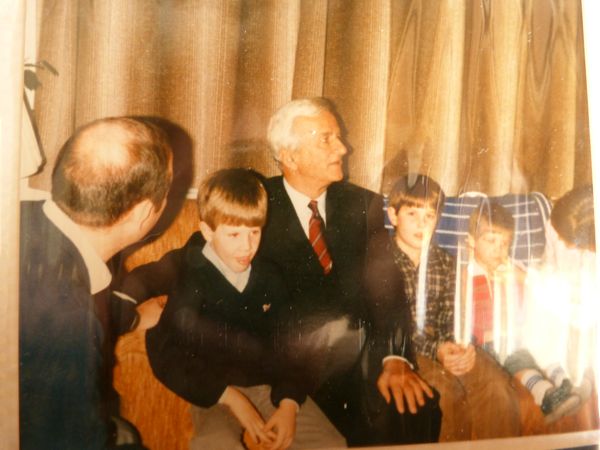
We met President von Weizsaecker under unusual circumstances. He has asked to greet members of the US Forces living in Germany on Thanksgiving. A friend called us urgently two days before Thanksgiving, asking if we would join them; they had been selected for the President’s visit. Others had been invited, but their children had come down with chicken-pox. We had just moved, had no plans and were delighted for the offer.
President Richard von Weizsaecker arrived in a large motorcade, the streets lined with people. When he entered the military quarters, suddenly we all felt a bit shy, but he sat himself among all the children, who all happened to be boys and un-shy. He knew just how to get them talking, and us. He was a most gracious and elegant man, sure of who he was, and excelling in putting others at ease.
The next day our photo appeared on the front page of the Stars and Stripes with the President, and our friends from all over Germany were calling to ask if we’d gone undercover – we were identified with the names of the people who had originally been invited, whose children had chicken pox. Of course, the more we explained, the more nobody believed us. It was hilarious.
BERLIN (AP) – Former German President Richard von Weizsaecker, who urged his country to confront the Nazi past, promoted reconciliation and denounced far-right violence during a 10-year tenure that spanned the reunification of west and east, has died. He was 94.
President Joachim Gauck’s office announced Weizsaecker’s death on Saturday. Weizsaecker, a patrician and eloquent figure who was president from 1984 to 1994, raised the profile of the largely ceremonial presidency and established himself as a moral conscience for the nation.
Weizsaecker’s May 1985 speech marking the 40th anniversary of Nazi Germany’s defeat in World War II cemented his reputation. It won widespread praise as an effort to bring fellow Germans to terms with the Holocaust.
“All of us, whether guilty or not, whether young or old, must accept the past. We are all affected by its consequences and liable for it,” said Weizsaecker, who served as a regular soldier in Adolf Hitler’s army. “Anyone who closes his eyes to the past is blind to the present.”
“The 8th of May was a day of liberation,” he told the West German parliament. “It freed us all from the system of National Socialist tyranny.”
Later that month, the Netherlands’ German-born Prince Claus presented the president with a Dutch translation of the speech, telling him that it enabled him finally to acknowledge his roots in a country where resentment of the Nazi occupation remained widespread.
In October 1985, Weizsaecker made the first visit to Israel by a West German head of state. His Israeli counterpart, Chaim Herzog, said the comments had won Weizsaecker “a special place in the history of your people.”
“Richard von Weizsaecker stood worldwide for a Germany that had found its way to center of the democratic family of peoples,” current President Joachim Gauck said in a message of condolences to Weizsaecker’s widow. “He stood for a federal republic that faces up to its past.”
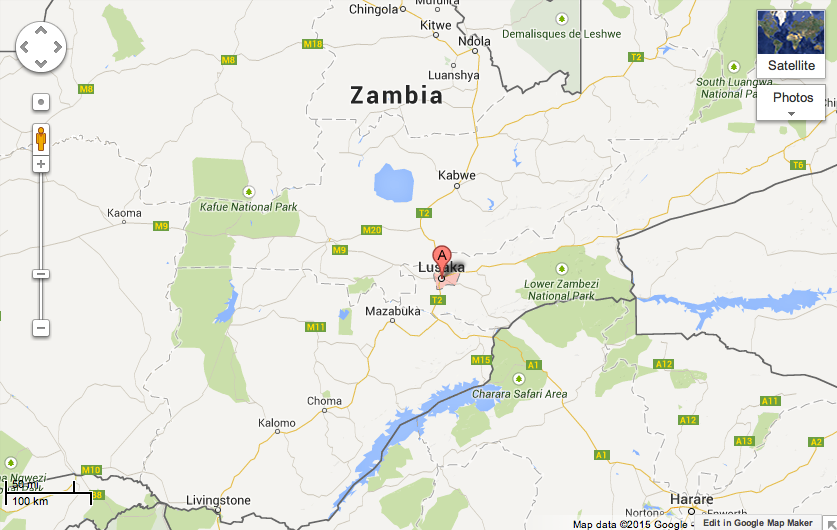
Today the church prays for the diocese of Lusaka, and I smile as I pray for my Zambian friends. We have stayed in Lusaka several times, and visited schools and clinics in remote parts of Zambia. Zambia is an amazing country – something like 70 different peoples and languages, and training in all the schools to help them learn how to live together.
One young Zambian told us that when they come into contact, it is normal to feel strange; the “other” doesn’t speak the same dialect, may be a traditional enemy, is just different, uncomfortable. They are trained to ask “What is it like where you live?” and to listen to the response.
I have used that phrase so many times; it is so useful. When you listen to an “other” talk about his or her life, you connect. You find similarities, and differences, and you learn the joys and challenges of this different life. It is a wonderful question. I used it the first time in Zambia, at a dinner with a lot of people we didn’t know. The woman next to me seemed stuffy, but sometimes that can be shy, so I asked “What is it like where you are from?” and she looked at me with concern and said, very sharply, “What do you mean?” I said “what is your life like, tell me about what you do in a day?” and she said “That is a very odd question!” but she went on to tell me about her life, her country house and her passion for riding. By the end, we were having a great conversation.
May God bless you richly, Zambia. May your peoples live together in God’s peace!
It’s my favorite time of the year, and there is just so much to do. Cooler temperatures give me energy! As I am making my morning coffee (as opposed to my mid-morning coffee, or my after-lunch coffee or that regrettable late afternoon coffee) I noticed a ray of sunshine coming in obliquely from a new direction, illuminating how dusty my lower cupboards had gotten. While the coffee brews, I grab the spray and paper towels and quickly wipe down the streaked, dusty doors, hoping no one else has noticed their grime. There are even a couple stray Pete-hairs, which make me sad. I still miss that sweet cat. I wonder where his spirit roams?
It’s the time of year for cleaning-out and re-organizing, and when you are a quilter, you have a lot to re-organize. I have shelves and bins of fabrics, shelves of books and patterns, shelves of cut pieces and threads, shelves of quilts ready to be assembled. January is such a great month for getting rid of things that just bog me down and collect dust. There are a few things I am sentimental about, but for the most part, I love the free-ness of clearing out the expendable.
And, with all the juices of renewal flowing, AdventureMan and I are planning one of our wonderful road trips. I used to do all the planning; AdventureMan might give some input but for the most part, he was focused on his job and I took care of travel plans, reservations, funding, etc. Now he has more time, we call back and forth from office to office about hotel websites, Google Maps, travel time. I create the data base and print out the segments, he helps with things to do and see and hotels and side trips. At first, it was a real adjustment for me, having input, but now it’s made things a lot more fun.
I didn’t used to print out segments, not once I got my smart phone, but to our horror, we discovered there are still places in this great United States where (gasp!) there is no coverage! When you have to make tricky road connections, it helps to have directions, and a hand held map. I put together folders, and we can just throw pieces away as they are accomplished. Our trips are more like missions, but a lot more fun.
We don’t do bucket lists, or not so much, but we do try to scratch an itch. There are places I haven’t seen, experiences I haven’t had. We’re alike in that way, AdventureMan and I. We love our road trips, as much for the unexpected blessings as for the planned ones. At dinner last night, I told him that about the worst experience I could remember was finding myself in a camp on the Busanga Plains in Zambia; it was about a week too early, it was still soaked with the receding flooding, game was scarce and it was very very hot. Mosquitos were everywhere, and I was covered with bites. At the same time, I have had better, less memorable experiences. You have to have the odd bad experience to help you understand just how good some of the good ones have been.
I had to do this photo because these below $2/gallon gas prices are such an unexpected delight:
And I had a moment when I thought my heart would stop as our nearly 5 year old “baby” stood up on the high bar at gymnastics!
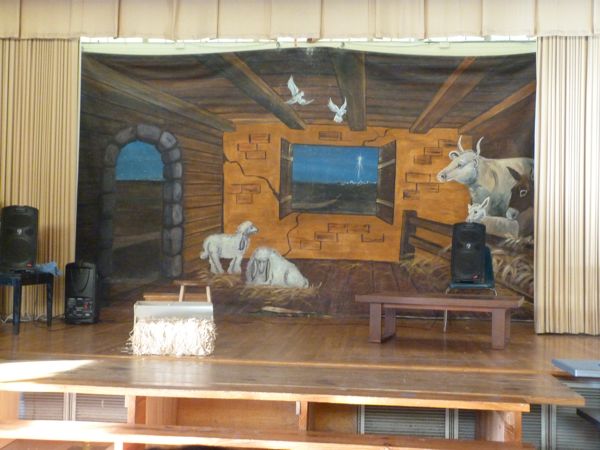
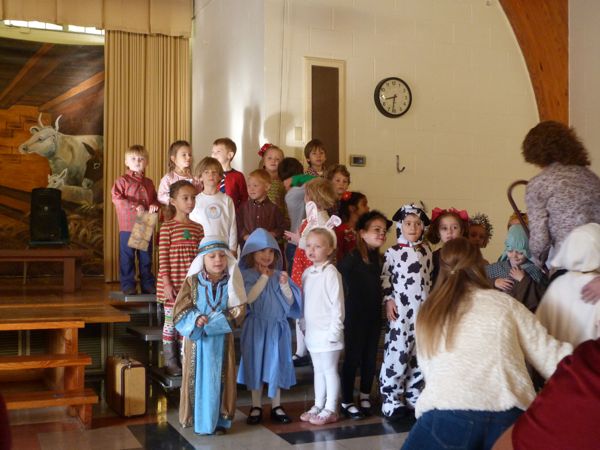
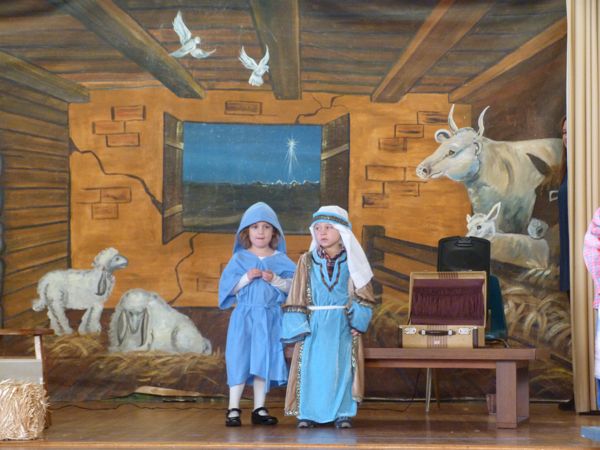
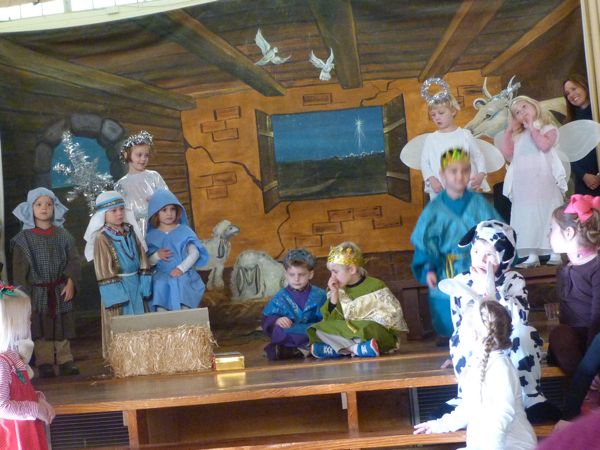
There is nothing on earth as heart warming as three and four year olds at the Episcopal Day School doing a Christmas pageant. The teachers and aides are truly heroes, teaching Christmas Carols and a script to children so young. Getting the children in, getting them in their places, keeping them on track – it was adorable, heart warming – and totally hilarious. The songs were so sweet, the kids so delighted to see their loved ones in the audience (“Hey, Dad! Dad! DAD!”) and their joy in being a part of it so palpable. The little Star of the East who missed her cue and followed the Wise Men, the little girl belting out the Christmas songs, the adorable sheep – I grin just thinking about it.
Herding cats, LOL!
Joseph and Mary start their trip:
Joseph and Mary are presented with a pillow for their trip:
Jesus, Mary and Joseph!
The Star of the East:
The manger, Jesus, Mary, Joseph, the shepherds, the angels, the wise men, all the barnyard animals, and the Star of the East:
It didn’t last thirty minutes. It is a highlight of our Christmas season 🙂
Earlier this fall, a Michigan prosecuting attorney began making the rounds of metro Detroit high schools letting kids know that increasingly normal behavior – sexting – could land them in jail for a long time.
Oakland County Prosecutor Jessica Cooper stepped up her education efforts after nearly three dozen Rochester area teens faced felony charges after circulating nude photos on their cell phones.
Cooper backs reform of laws that require Michigan prosecutors to charge sexting teens under the same statutes intended to prosecute pedophiles.
But in the meantime, she wants kids to be aware of the serious legal consequences of activity that a study by the American Academy of Pediatrics found is a “normal” part of adolescent sexual development.
And because they don’t want their parents to know what they’re up to as they click away on cell phone screens, they’ve developed their own shorthand to keep them in the dark.
A Denver television station tested – and stumped – several parents to determine if they could crack the codes their children use when they’re texting or sending online messages on their phones.
A detective with the Jefferson County District Attorney’s Office told Denver television station KMGH that parents may be missing some red flags “because they don’t know the lingo or the language.”
Here’s a list of commonly used terms:
8 – it means ate, can also refer to oral sex
9 – Parent watching
99 – Parent gone
1337 – Elite, leet or L337
143 – I love you
1174 – the meeting place, meet at
420 – Marijuana
459 – I love you
53X – Sex
ADR – Address
AEAP – As Early As Possible
ALAP – As Late As Possible
ASL – Age/Sex/Location
BROKEN – hung over from alcohol
CD9 – Code 9 (parents are around)
C-P – Sleepy
F2F – Face-to-Face
GNOC – Get Naked On Cam
GYPO – Get Your Pants Off
HAK – Hugs And Kisses
ILU – I Love You
IWSN – I Want Sex Now
KOTL – Kiss On The Lips
KFY or K4Y – Kiss For You
KPC – Keeping Parents Clueless
LMIRL – Let’s Meet In Real Life
MOOS – Member Of The Opposite Sex
MOSS – Member Of The Same Sex
MorF – Male or Female
MOS – Mom Over Shoulder
MPFB – My Personal F*** Buddy
NALOPKT – Not A Lot Of People Know That
NIFOC – Nude In Front Of The Computer
NMU – Not Much, You?
P911 – Parent Alert
PAL – Parents Are Listening -or- Peace And Love
PAW – Parents Are Watching
PIR – Parent In Room
POS – Parent Over Shoulder or Piece Of Sh**
pron – Porn
Q2C – Quick To Cum
RU/18 – Are You Over 18?
RUMORF – Are You Male OR Female?
RUH – Are You Horny?
S2R – Send To Receive
SorG – Straight or Gay
TDTM – Talk Dirty To Me
WUF – Where You From
WYCM – Will You Call Me?
WYRN – What’s Your Real Name?
I’ve always loved this story. Imagine, being a hated tax collector, and probably taking your cut. Imagine, a famous person coming to town, and being short, you climb a tree so you can see him pass by. And imagine that as he is passing, he notices you, he really sees you, he calls you by name and asks to stay at your place (how did he even know my name, I might wonder)?
The Lord Jesus turns everything upside down. He says we do wrong, and if we follow him (which I understand means that we do as he says and does) that the price for our sins is paid by him. He says the rules on earth are not the rules in the heavenly kingdom, and he calls Zacchaeus, as he calls you and me.
Luke 19:1-10
19He entered Jericho and was passing through it. 2A man was there named Zacchaeus; he was a chief tax-collector and was rich. 3He was trying to see who Jesus was, but on account of the crowd he could not, because he was short in stature. 4So he ran ahead and climbed a sycomore tree to see him, because he was going to pass that way. 5When Jesus came to the place, he looked up and said to him, ‘Zacchaeus, hurry and come down; for I must stay at your house today.’ 6So he hurried down and was happy to welcome him. 7All who saw it began to grumble and said, ‘He has gone to be the guest of one who is a sinner.’ 8Zacchaeus stood there and said to the Lord, ‘Look, half of my possessions, Lord, I will give to the poor; and if I have defrauded anyone of anything, I will pay back four times as much.’ 9Then Jesus said to him, ‘Today salvation has come to this house, because he too is a son of Abraham. 10For the Son of Man came to seek out and to save the lost.’
When I was a kid, I did not like reading the Old Testament, all those old-timey people, and it all seemed very confusing to me. As I grew older, I find I like the Old Testament part of our readings very much, the people come alive in all their faults and bad decisions, and God’s mercy shines through as we continue to rebel against him and follow too much our own devices and desires of our hearts.
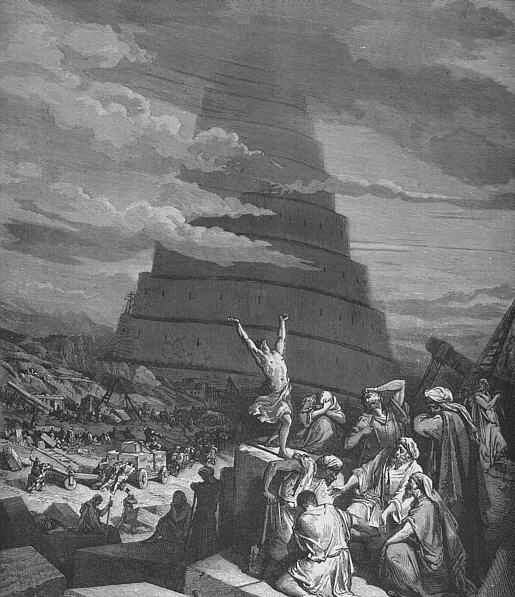
I love Genesis 11, where mankind, in all our pride, decides to build a tower, and it must have been pretty good because it got God’s attention and he didn’t like it. He didn’t like it so much that he created confusion among all the languages spoken, but I bet it was also confusion and dissension among the decision makers, too, to scatter the mighty population.
As the wandering descendants of Abraham began to settle, they often went up against armies and peoples much larger than they were, and God always told them not to worry, he would confuse the armies. He put fear in their hearts, in the confusion, mighty armies collapsed and scattered.
And why am I bringing this up, you might wonder?
This ISIS Army, it seems to me, is already cobbled together. I hear people people talking, people who know, they say ISIS is smart, fights smart. I believe they have some smart leaders, but I am willing to bet that they have some fatal flaws, also. They have overstretched. They are trying to enforce their will by violence and killing off the opposition, which might encourage the appearance of cooperation, but in reality breeds legions of those who will turn on them in a heartbeat.
Yes, we mistakenly dropped weapons which they were able to access. Mistakes happen in war zones all the time, with modern communication we just hear about it a lot sooner, not like 40 years from now when it is declassified and someone writes a book about it. Frankly, it’s not that big a deal.
What I believe is a big deal is their lack of cohesion. Lacking any strategic direct line to important decision makers, I am praying, and what I am praying is this, words from Psalms:
Confuse, O Lord, confound their speech
Disintegrate ISIS from the inside.
Create, Great and Merciful Father, miscommunications, misunderstandings, competing agendas and internal strife among the ISIS force.
All Mighty, All Powerful God, create a massive collapse, let their foot-soldiers drift away, drift home to their mothers and fathers and their families, and leave the Iraqi villages and the Syrian villages in peace.
Dry up the wealth of the Gulf, funneled through corrupt money changers in Kuwait, let it be mishandled, go missing, be stolen, be diverted and find its way to true charitable organizations providing a means of survival to those thousands of refugees who have been displaced.
Oh God! Collapse this abomination, the Islamic State of the Levant and Syria, collapse it utterly from within, strip it of all its power, devastate it like a virulent plague from within!
Oh God, bring good out of this downfall. Teach the remnants who return to their homes to live together in peace, to form peaceful and stable communities and then nations whose lives honor you!
All this is possible for the God who can do all things. Confound their speech, Lord, confuse them utterly, devastate and collapse them utterly from within. You are the one true God, there is no other God.
We are not without resources. We have the mighty fist of prayer.
Today’s reading in the Lectionary is from Sirach, one of the books of the Apocrypha, and features wisdom on faithful friends. I especially love “let your advisors be one in a thousand.” I have been greatly blessed to have found a few of those, and they stick with you for a lifetime.
Bless you, bless you, faithful friends!
Sirach 6:5-17
5 Pleasant speech multiplies friends,
and a gracious tongue multiplies courtesies.
6 Let those who are friendly with you be many,
but let your advisers be one in a thousand.
7 When you gain friends, gain them through testing,
and do not trust them hastily.
8 For there are friends who are such when it suits them,
but they will not stand by you in time of trouble.
9 And there are friends who change into enemies,
and tell of the quarrel to your disgrace.
10 And there are friends who sit at your table,
but they will not stand by you in time of trouble.
11 When you are prosperous, they become your second self,
and lord it over your servants;
12 but if you are brought low, they turn against you,
and hide themselves from you.
13 Keep away from your enemies,
and be on guard with your friends.
14 Faithful friends are a sturdy shelter:
whoever finds one has found a treasure.
15 Faithful friends are beyond price;
no amount can balance their worth.
16 Faithful friends are life-saving medicine;
and those who fear the Lord will find them.
17 Those who fear the Lord direct their friendship aright,
for as they are, so are their neighbours also.
The New Yorker is an expensive subscription and worth every penny. This article takes an enormously complex situation, breaks it down into components and summarizes the options and their drawbacks. No wonder President Obama is having a problem finding a strategy – there aren’t a lot of winning options out there, and we don’t need to get stuck with another tar baby.
Wars cost money. There is an election coming up. The economy is just now moving past the downswing, and we still have wounded from Iraq and Afghanistan to take care of. Can anything we do make a difference? Will that difference be appreciated or will it add to our reputation as a world bully? All these are factors when formulating a strategy.
At the end of the eighth century, Harun al-Rashid, a caliph of the Abbasid dynasty, built a palace in Raqqa, on the Euphrates River, in what is now Syria. His empire stretched from modern Tunisia to Pakistan. It was an age of Islamic discovery in science, music, and art; Rashid’s court of viziers inspired stories in “One Thousand and One Nights.”
In June, the Islamic State in Iraq and al-Sham (ISIS) declared Raqqa the seat of a new caliphate, presided over by Abu Bakr al-Baghdadi, a fierce preacher who was once an American prisoner in Iraq, and is now in hiding. The city has lost its splendor. Public executions are “a common spectacle” on Fridays in El Naim Square or at the Al Sa’a roundabout, a United Nations human-rights commission reported last month. ISIS fighters mount the dead on crucifixes, “as a warning to local residents.”
ISIS emerged a decade ago as a small Iraqi affiliate of Al Qaeda, one that specialized in suicide bombings and inciting Iraq’s Sunni Muslim minority against the country’s Shiite majority. The network regenerated after 2011 amidst Iraq’s growing violence and the depravities of Syria’s civil war. This year,ISIS has conquered cities, oil fields, and swaths of territory in both Syria and Iraq. The movement draws its strength from Sunni Arab communities bitterly opposed to the Shiite-led government in Baghdad and the Alawite-dominated regime in Damascus, led by Bashar al-Assad.
Defense Secretary Chuck Hagel has called ISIS “as sophisticated and well funded as any group that we have seen . . . beyond anything we have seen.” The group has former military officers who can fly helicopters, spot artillery, and maneuver in battle. ISIS is increasingly a hybrid organization, on the model of Hezbollah—part terrorist network, part guerrilla army, part proto-state.
President Obama has decided that the United States must now attack ISIS, if only from the air. The President vacationed on Martha’s Vineyard, and golfed conspicuously, as his initial aerial campaign in Iraq unfolded. He has been less than forthright about why, after pledging to end America’s costly war in Iraq, he believed a return to battle there was necessary. But in interviews and other forums Obama has offered a casus belli, in three parts.
ISIS has massacred religious minorities, including Christians and Yazidis, and American air strikes can prevent more wanton killing, the President has said. A second imperative is the defense of the Kurdistan Regional Government, a semi-autonomous, oil-endowed American ally in northern Iraq, which a few weeks ago was teetering under pressure from ISIS but has since recovered, with the aid of American air power. The third, and most resonant, reason that the President has given is self-defense: to disrupt ISIS before it tries to attack Americans in the region or inside the United States.
ISIS has beheaded one American journalist, James Foley, and threatened to execute a second. Yet some terrorism specialists point out that ISIS is consumed by the sectarian wars in Syria and Iraq, and has shown no intent to launch attacks in the West, or any ability to do so. Still, ISIS has attracted five hundred British volunteers, many scores of other European passport holders, and even some Americans to its fight; they might eventually turn toward London, Berlin, or New York. Last week, British authorities announced that the threat of a terrorist attack on its home soil was “severe,” given the rising number of British jihadis now among the militants in Iraq and Syria.
The question about President Obama’s resumption of war in Iraq is not whether it can be justified but where it will lead. Air strikes against a well-resourced guerrilla army will do little if they are not accompanied by action on the ground. It would be a catastrophic error for the United States to take on that role. But what other professional force will dislodge the self-proclaimedISIS caliphate and then control the population? American policy assumes that Iraq’s squabbling politicians will rally a Shiite-led army to fight ISIS in the country’s Sunni heartland. On recent evidence, this assessment looks unrealistic.
In Syria, the options are worse. Obama has said repeatedly that he does not believe that Syria’s moderate rebels have the capacity to overthrow Assad or defeat jihadists. Yet the alternatives would allow Syria’s violence to fester at the cost of tens of thousands more civilian lives or would tacitly condone an alliance with the brutal Assad, who has been implicated in war crimes.
Obama and his advisers have at times taken refuge in a self-absolving logic: We can’t force people in other countries to unite around our agenda, so, if they don’t, whatever calamity unfolds is their responsibility. As a retreat from American hubris, this form of realism has appeal. As a contribution to a stable Middle East, it has failed utterly.
It is not yet clear that ISIS will endure as a menace. Fast-moving extremist conquerors sometimes have trouble holding their ground. ISIS has promised to govern as effectively as it intimidates, but its talent lies in extortion and ethnic cleansing, not in sanitation and job creation. It is vulnerable to revolt from within.
The group’s lightning rise is a symptom, however, of deeper instability; a cause of that instability is failed international policy in Iraq and Syria. If the United States is returning to war in the region, one might wish for a more considered vision than Whack-a-Mole against jihadists.
The restoration of human rights in the region first requires a renewed search for a tolerable—and, where possible, tolerant—path to stability. ISIS feasts above all on the suffering of Syria, and that appears to be unending. The war is in its fourth year, with almost two hundred thousand dead and nine million displaced, inside the country and out. The caliphate now seated in Raqqa is the sort of dark fantasy that can spring to life when people feel they are bereft of other plausible sources of security and justice.
“We don’t have a strategy yet,” the President remarked last week, infelicitously, about Syria. He does have a coalition of allies in the region that are willing to challenge ISIS’s ambition, including Jordan, Turkey, Saudi Arabia, and the United Arab Emirates. These countries patronize disenfranchised Sunnis in Iraq and Syria, and some of their support certainly reaches jihadists, includingISIS. Yet they share an interest in reducing Syria’s violence and in promoting regional and local Sunni self-governance that is less threatening and more sustainable than what ISIS has created. Ultimately, Sunnis will need the kind of autonomy that Kurds presently enjoy.
Leading a coalition of this character is hard, uncertain work. George H. W. Bush, the President whose foreign policy Obama seems to admire most, did it successfully in the runup to the Gulf War of 1991, by intensive personal engagement. Obama has more than two years left in the White House. To defeat ISIS, but also to reduce its source of strength, will require the President to risk his credibility on more than just air strikes.
Steve Coll, a staff writer, is the dean of the Graduate School of Journalism at Columbia University, and reports on issues of intelligence and national security in the United States and abroad.
Its been a sad couple of months, starting with our cat’s death, and a friend’s death. We grieve Pete, we miss him, and we ask ourselves if we made a big mistake thinking a knee operation would be the right thing, if he would have lived happily without it? Pete was in pain. There were days he couldn’t go up the stairs. There were days he spent almost the entire day in his heated bed. We didn’t see a lot of options. Other sad news has hit; it feels like a season of losses.
In the Lectionary readings, we are reading Job, Ayyoub, and I think if my friend who said “Al-hamdallah!” when I told her my father is dying. I learned so much from her. She made me understand I am to thank God even for the bad things, it is God’s will, and a part of a bigger picture I will never see. And then this morning, I saw a reference to an old post, a post from 2006, a post I don’t even remember writing.
Thorns Sandra felt as low as the heels of her shoes as she pushed against a November gust and the florist shop door.
Her life had been easy, like a spring breeze. Then in the fourth month of her second pregnancy, a minor automobile accident stole that from her.
During this Thanksgiving week she would have delivered a son. She grieved over her loss. As if that weren’t enough, her husband’s company threatened a transfer. Then her sister, whose holiday visit she coveted, called saying she could not come for the holiday.
Then Sandra’s friend infuriated her by suggesting her grief was a God-given path to maturity that would allow her to empathize with others who suffer. She has no idea what I’m feeling, thought Sandra with a shudder.
Thanksgiving? Thankful for what? She wondered. For a careless driver whose truck was hardly scratched when he rear-ended her? For an airbag that saved her life but took that of her child?
“Good afternoon, can I help you?” The shop clerk’s approach startled her.
“I….I need an arrangement,” stammered Sandra.
“For Thanksgiving? Do you want beautiful but ordinary, or would you like to challenge the day with a customer favorite I call the Thanksgiving “Special?” asked the shop clerk. “I’m convinced that flowers tell stories,” she continued. “Are you looking for something that conveys ‘gratitude’ this thanksgiving?”
“Not exactly!” Sandra blurted out. “In the last five months, everything that could go wrong has gone wrong.”
Sandra regretted her outburst, and was surprised when the shop clerk said, “I have the perfect arrangement for you.”
Just then the shop door’s small bell rang, and the shop clerk said, “Hi, Barbara…let me get your order.” She politely excused herself and walked toward a small workroom, then quickly reappeared, carrying an arrangement of greenery, bows, and long-stemmed thorny roses. Except the ends of the rose stems were neatly snipped: there were no flowers.
“Want this in a box?” asked the clerk.
Sandra watched for the customer’s response. Was this a joke? Who would want rose stems with no flowers! She waited for laughter, but neither woman laughed.
“Yes, please,” Barbara, replied with an appreciative smile. “You’d think after three years of getting the special, I wouldn’t be so moved by its significance, but I can feel it right here, all over again,” she said as she gently tapped her chest. And she left with her order.
“Uh,” stammered Sandra, “that lady just left with, uh….she just left with no flowers!
“Right, said the clerk, “I cut off the flowers. That’s the Special. I call it the Thanksgiving Thorns Bouquet.”
“Oh, come on, you can’t tell me someone is willing to pay for that!” exclaimed Sandra.
“Barbara came into the shop three years ago feeling much like you feel today,” explained the clerk. “She thought she had very little to be thankful for. She had lost her father to cancer, the family business was failing, her son was into drugs, and she was facing major surgery.”
“That same year I had lost my husband,” continued the clerk, “and for the first time in my life, had just spent the holidays alone. I had no children, no husband, no family nearby, and too great a debt to allow any travel.”
“So what did you do?” asked Sandra.
“I learned to be thankful for thorns,” answered the clerk quietly. “I’ve always thanked God for the good things in my life and never questioned the good things that happened to me, but when bad stuff hit, did I ever ask questions! It took time for me to learn that dark times are important. I have always enjoyed the ‘flowers’ of life, but it took thorns to show me the beauty of God’s comfort. You know, the Bible says that God comforts us when we’re afflicted, and from His consolation we learn to comfort others.”
Sandra sucked in her breath as she thought about the very thing her friend had tried to tell her. “I guess the truth is I don’t want comfort. I’ve lost a baby and I’m angry with God.”
Just then someone else walked in the shop. “Hey, Phil!” shouted the clerk to the balding, rotund man.
“My wife sent me in to get our usual Thanksgiving Special….12 thorny, long-stemmed stems!” laughed Phil as the clerk handed him a tissue-wrapped arrangement from the refrigerator.
“Those are for your wife?” asked Sandra incredulously. “Do you mind me asking why she wants something that looks like that?”
“No…I’m glad you asked,” Phil replied. “Four years ago my wife and I nearly divorced. After forty years, we were in a real mess, but with the Lord’s grace and guidance, we slogged through problem after problem. He rescued our marriage. Jenny here (the clerk) told me she kept a vase of rose stems to remind her of what she learned from “thorny” times, and that was good enough for me. I took home some of those stems. My wife and I decided to label each one for a specific “problem” and give thanks for what that problem taught us.”
As Phil paid the clerk, he said to Sandra, “I highly recommend the Special!”
“I don’t know if I can be thankful for the thorns in my life.” Sandra said. “It’s all too…fresh.”
“Well,” the clerk replied carefully, “my experience has shown me that thorns make roses more precious. We treasure God’s providential care more during trouble than at any other time. Remember, it was a crown of thorns that Jesus wore so we might know His love. Don’t resent the thorns.”
Tears rolled down Sandra’s cheeks. For the first time since the accident, she loosened her grip on resentment. “I’ll take those twelve long-stemmed thorns, please,” she managed to choke out.
“I hoped you would,” said the clerk gently. “I’ll have them ready in a minute.”
“Thank you. What do I owe you?”
“Nothing. Nothing but a promise to allow God to heal your heart. The first year’s arrangement is always on me.” The clerk smiled and handed a card to Sandra. “I’ll attach this card to your arrangement, but maybe you would like to read it first.”
It read: “My God, I have never thanked You for my thorns. I have thanked You a thousand times for my roses, but never once for my thorns. Teach me the glory of the cross I bear; teach me the value of my thorns. Show me that I have climbed closer to You along the path of pain. Show me that, through my tears, the colors of Your rainbow look much more brilliant.”
Praise Him for your roses; thank him for your thorns!
I know God can bring great good out of all things. I have seen this in my own life, out of the worst circumstances can come good I could never have foreseen. I am praying this fervently; that he will bring great good out of all circumstances.









 Here There and Everywhere