Sun Setting Over the Bayou
I love winter. I love the cool temperatures; I feel so much more energetic. I get things done.
I’m in my office, and I can smell tomatoes roasting downstairs; AdventureMan has found a new recipe for a Shrimp and Avocado Soup. He is using freshly picked tomatoes given us by our daughter-in-law’s Dad, so fresh, so tasty, and the roasting is intensifying the flavors. He is happy; he has found passion in cooking up new tastes; one night a week he does dinner and from time to time when he is inspired he also cooks up dinners to share with our son and his family.
I’ve gone off duty. I’ve been working all day, following my passion, listening to NPR and a guest talking about happiness. Happiness, she says, is enjoying the process, living in the right now. High points like Christmas and weddings are but a moment; the true secret of happiness is learning to appreciate the daily life.
For me, the right now is gathering colors. I love colors, and I can see minute differences in shades and colorings, so this is precise and demanding work, gathering the colors, sorting them so once I start using them I can find them quickly. This is just a fraction of the colors I will be using; the colors of the sea:

I have a good collection, but never enough. This time I especially need a good selection of the lighter shallow-water colors:

At this time of the year, I can see the bayou through gaps in the trees that have lost their leaves. The sun is setting; sparkling in through our windows, and it’s the most light we’ve had all day. Even so, the light is fading fast, and I can no longer reliably sort one shade too close to another. Time to go “off duty.” I’ve saved the newspaper as my reward for working hard all day. Time to enjoy the setting sun, sparkling off the glimpse of bayou.

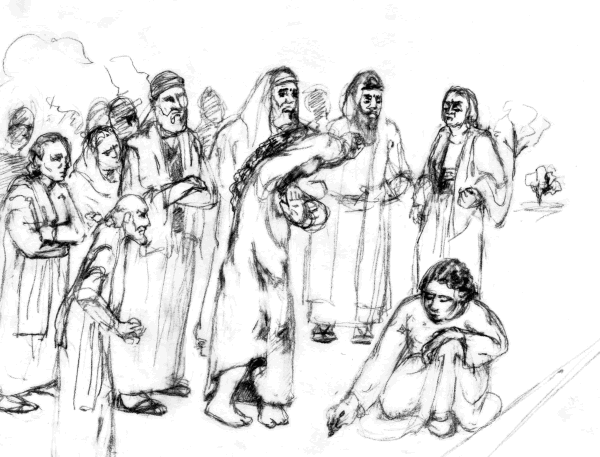
Jesus and the Woman to be Stoned for Adultery
I’ve always loved this passage, along with the woman at the well, and the woman who touched the hem of his garment to be healed from a bleeding disease – Jesus was kind to women, in a time and culture where a pious man would not speak to a woman.
Hilary Mantel captures the stunning experience in Eight Months on Ghazzah Street, where she asks a man at a counter for an item and he looks right past her. She repeats her request and he acts as if she isn’t there. Her husband walks up, asks, and receives an answer. Cultural biases most often do not favor women. In this regard, Jesus – and the prophet Mohammed – changed everything, and treated women as equal people. It’s amazing to me how many of the Jesus anecdotes featuring females survived; it must have been astonishing in his time to treat females – property – with such compassion and humanity.
Footnote to this passage from The Lectionary: The most ancient authorities lack 7.53—8.11; other authorities add the passage here or after 7.36 or after 21.25 or after Luke 21.38, with variations of text; some mark the passage as doubtful.
John 7:53-8:11
53Then each of them went home, 81while Jesus went to the Mount of Olives. 2Early in the morning he came again to the temple. All the people came to him and he sat down and began to teach them. 3The scribes and the Pharisees brought a woman who had been caught in adultery; and making her stand before all of them, 4they said to him, ‘Teacher, this woman was caught in the very act of committing adultery. 5Now in the law Moses commanded us to stone such women. Now what do you say?’ 6They said this to test him, so that they might have some charge to bring against him. Jesus bent down and wrote with his finger on the ground. 7When they kept on questioning him, he straightened up and said to them, ‘Let anyone among you who is without sin be the first to throw a stone at her.’ 8And once again he bent down and wrote on the ground.* 9When they heard it, they went away, one by one, beginning with the elders; and Jesus was left alone with the woman standing before him. 10Jesus straightened up and said to her, ‘Woman, where are they? Has no one condemned you?’ 11She said, ‘No one, sir.’* And Jesus said, ‘Neither do I condemn you. Go your way, and from now on do not sin again.’]]*
Indian Village Bans Cell Phones – For Women
LOL – what about those cheating, eloping MEN? Ban only women from using cell phones? What about calls from mothers who need you to run an errand? What about calls from the children’s school? Women – and man – who are going to cheat are going to cheat, whether or not you take their cell phone away. Found this on AOL/Huffpost via Reuters:
PATNA, India – (Reuters) – A village council in the eastern Indian state of Bihar has banned the use of mobile phones by women, saying the phones were “debasing the social atmosphere” by leading to elopements – a move that set off outraged protests from activists.
In addition to the ban, the Sunderbari village council in a Muslim-dominated area some 385 kilometers (239 miles) east of Patna, the capital of Bihar, has also imposed a fine of 10,000 rupees ($180) if a girl is caught using a mobile phone on the streets.
Married women would have to pay 2,000 rupees ($36.60).
“It always gives us a lot of embarrassment when someone asks who has eloped this time,” said Manuwar Alam, who heads a newly-formed committee tasked with enforcing the ban, referring to queries from neighboring villages.
He said the number of elopements and extramarital love affairs had risen in the past few months, with at least six girls and women fleeing their homes.
“Even married women were deserting their husbands to elope with lovers. That was shameful for us,” Alam said. “So, we decided to tackle it firmly. Mobile phones are debasing the social atmosphere”.
Local officials have begun investigations, saying that such bans cannot be allowed in a healthy society, while women’s rights activists called it an assault on freedom that could potentially end up harming women by stripping them of one source of protection from trouble, such as unwanted advances by men.
“Girls and women are capable enough to protect themselves,” said activist Suman Lal during a debate on local television. “Technology is meant to be used, not to be banned…The order is nauseating.”
Fellow activist Mohammad Islam said it was “disappointing” that the village council ignored the many advantages of mobile phones before placing a ban on them for one reason.
“I want every girl to be given a mobile phone so that she could call up family members if she has a problem”, he said. ($1 = 54.6400 Indian rupees)
(Reporting by New Delhi newsroom, editing by Elaine Lies)
The Reciprocity Experiment
This is fascinating. I get these mailing labels every year from charities I’ve never heard of. I feel so GUILTY not sending them anything – they’ve spent their hard earned money sending me a gift! What to do? This man studied the phenomenon and discovered that we all find ourselves in this dilemma from time to time.
This is from National Public Radio, where I get the best news of things I might never hear about otherwise:
Give And Take: How The Rule Of Reciprocation Binds Us
by ALIX SPIEGEL
In 1974, Phillip Kunz and his family got a record number of Christmas cards. In the weeks before Christmas they came daily, sometimes by the dozen. Kunz still has them in his home, collected in an old photo album.
“Dear Phil, Joyce and family,” a typical card reads, “we received your holiday greeting with much joy and enthusiasm … Merry Christmas and Happy New Year’s. Love Lou, Bev and the children.”
The cards from that year came in all shapes and sizes, but the basic message was the same. The writers wanted Kunz to know that he and his family were cared for, and also they wanted to share their own news. They included pictures of family members and new homes and smiling graduates with freshly minted diplomas.
It all seems pretty normal, except for one thing: Kunz didn’t know any of them.
Kunz was a sociologist at Brigham Young University. Earlier that year he’d decided to do an experiment to see what would happen if he sent Christmas cards to total strangers.
And so he went out and collected directories for some nearby towns and picked out around 600 names. “I started out at a random number and then skipped so many and got to the next one,” he says.
To these 600 strangers, Kunz sent his Christmas greetings: handwritten notes or a card with a photo of him and his family. And then Kunz waited to see what would happen.

In 1974, Phillip Kunz, a sociologist at Brigham Young University, wanted to see what would happen if he sent Christmas cards to people he didn’t know.
Courtesy of the L. Tom Perry Special Collections at Brigham Young University
“It was just, you know, a shot in the dark,” he says. “I didn’t know what would happen.”
But about five days later, responses started filtering back — slowly at first and then more, until eventually they were coming 12, 15 at a time. Eventually Kunz got more than 200 replies. “I was really surprised by how many responses there were,” he says. “And I was surprised by the number of letters that were written, some of them three, four pages long.”
Why would someone send a three-page letter to a complete and total stranger?
Why did so many people write him back at all?
Following Rules
Robert Cialdini is an emeritus psychologist at Arizona State University who studies how our behavior is affected by social rules that we’re only vaguely aware of but which have incredible power over what we do. What happened to Kunz, he explains, is the direct result of one of the rules that most interest him: the rule of reciprocation. The rule, he says, is drilled into us as children.
“We are obligated to give back to others, the form of behavior that they have first given to us,” he says. “Essentially thou shall not take without giving in return.”
And so if someone passes you in the hall and says hello, you feel compelled to return their greeting. When you don’t, you notice it, it makes you uncomfortable, out of balance. That’s the rule of reciprocation.
“There’s not a single human culture that fails to train its members in this rule,” Cialdini says.
This is probably because there are some obvious benefits to the rule of reciprocation; it’s one of those rules that likely made it easier for us to survive as a species.
But what’s interesting about all this is how psychologists like Cialdini can actually measure the way the rule affects how we behave in all sorts of situations.
Exhibit A: those little pre-printed address labels that come to us in the mail this time of year along with letters asking for donations.
Those labels seem innocent enough, but they often trigger a small but very real dilemma. “I can’t send it back to them because it’s got my name on it,” Cialdini says. “But as soon as I’ve decided to keep that packet of labels, I’m in the jaws of the rule.”
The packet of labels costs roughly 9 cents, Cialdini says, but it dramatically increases the number of people who give to the charities that send them. “The hit rate goes from 18 to 35 percent,” he says. In other words, the number of people who donate almost doubles.
You can see the same thing when it comes to tipping.
If a server brings you a check and does not include a candy on the check tray, you will tip the server whatever it is that you feel the server deserves. “But if there’s a mint on the tray, tips go up 3.3 percent,” Cialdini says.
According to Cialdini, the researchers who did that study also discovered that if while delivering the tray with the mint the server paused, looked the customers in the eye, and then gave them a second mint while telling them the candy was specifically for them, “tips went through the roof.”
Servers who gave a second mint got a 20 percent increase over their normal tip.
Many decades ago Cialdini noticed a similar phenomenon when he studied Hare Krishnas in the U.S. He says that in the late 1960s the religion was really struggling financially; it seemed strange to many Americans, so it was hard for them to raise money.
But then they hit on a solution. In airports (and other public places), they would simply give the people passing by what they described as a gift: a flower, a book, a magazine. Then, after the person had the gift in his or her hand, they would ask for a small donation. Cialdini says he spent days in different airports observing these transactions, watching as recipients struggled to come up with the right solution.
“You would see many of them with frowns on their faces reach into a pocket or a purse, come up with a dollar or two, and then walk away angry at what had just occurred,” recalls Cialdini. But they would give, he believes, because of the rule of reciprocation. For years, he says, the Hare Krishna religion raised millions of dollars this way.
Reciprocating Influence
There are really dozens of ways that the rule of reciprocation affects us, some of them good, some of them bad. For example, politicians, like the rest of us, are subject to the rule of reciprocation. And so when organizations or interest groups give them money, though they might believe that money won’t influence their decisions, it’s sometimes hard for them, as it is for us, to be immune.
Cialdini believes you can also see the rule operate in the medical profession.
“You find doctors more willing to prescribe medication based on what gifts, favors and tips they have been given by one pharmaceutical company or another,” he says.
This doesn’t mean that the rule of reciprocation affects all of us all of the time. Cialdini says different situations trigger different people differently.
But it is powerful. One of those invisible powerful things that can subtly shape how we behave even years after someone has given us something.
Consider the case of Phillip Kunz, the sociologist who decided to send Christmas cards to random strangers.
For years his family got cards from the people he contacted in 1974.
“We got cards for maybe 15 years,” he says.
Thanksgiving on the Bayou
The Thanksgiving venue changed this year. We all have families, families have struggles, and one of those struggles meant that the Thanksgiving celebration would shift to another home. Same cast of characters, same fabulous food, just a different location.
The organization is superb. Everyone has a part to play. Nieces and nephews arrive to assist in preparations, clearing the grounds, putting out tables and chairs, helping wherever they can. Cousins get to spend time together, catching up, as they work together. The aunts are all busy in the kitchens, cutting, chopping, baking, cooking, stewing, putting their best efforts into making the dishes everyone loves.



The guys do the turkeys. They may have help, but the turkeys seem to be the guys prerogatives. They also carry in the hams.
There are so many desserts that they won’t fit on one table. They won’t fit on two tables! When all the desserts are put on the tables, there are still back-up pies and cakes in the pie-safe behind the table!
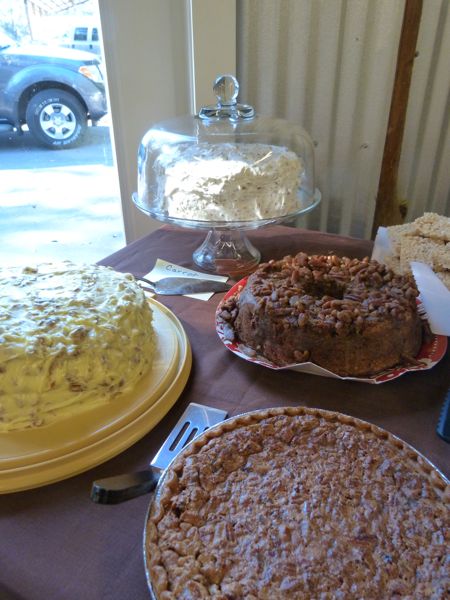
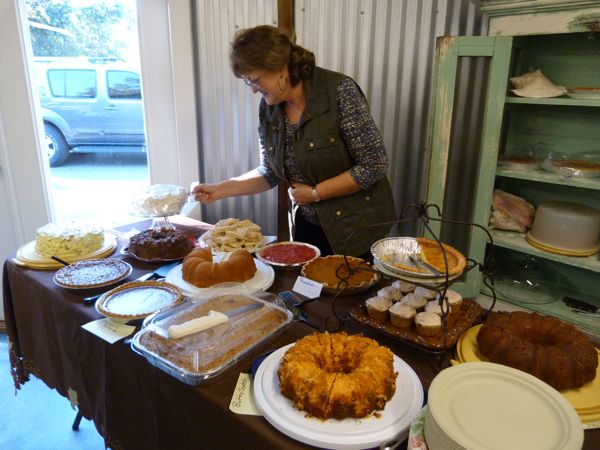
Cousins fill glasses with ice; guest can choose lemonade, sweet tea or “un”

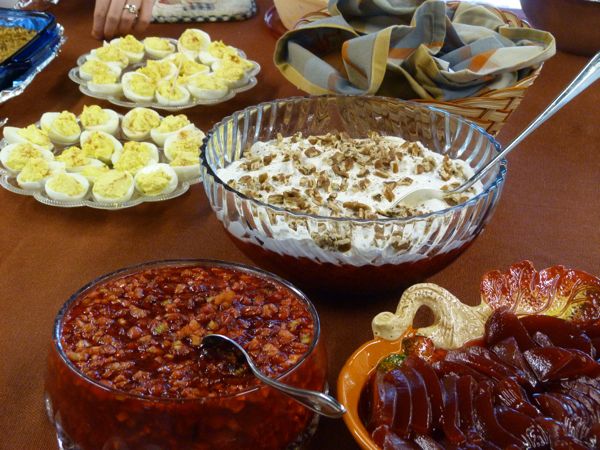
The tables groan with turkeys, hams and side dishes – beans and peas from the garden, corn bread, sweet potato casseroles, and more, much, much more:


There is fun for everyone – kayak rides, tractor rides, and ring toss:



There’s always a special room where babies can nap – this is a very child friendly celebration. This family loves babies and little ones, and encourages all the cousins to stay close. It’s always a full day, Thanksgiving, with much for which to give thanks. 🙂 When the great meal is over, people play, visit, walk, chat . . . and then sneak back for another taste of their favorite dish!
The Power of Kindness to Change Lives
This week AdventureMan and I have been blessed, greatly blessed. We have met some wonderful people and heard some amazing things. Two stories in particular have shaken the earth for me.
“How It Happened for Me”
The first story is about a friend we met from the newest country on earth, South Sudan. A group of us were sitting together when one woman turned to this man from the South Sudan and asked “How did you find Jesus?”
This was not a religious gathering, so it is an unusual question on a social evening. But this quiet, modest man responded “I will tell you. It is a long story. It starts when I was only five months, not a baby, five months in my mother’s womb.”
He told us of a life with no security. His parents and family fled to the forest, and were on the run continually most of his life – until recently. He told of a life trying to find safe places, sometimes being separated from his parents.

He told of a priest who, when he and his brothers and sisters were very young, taught them to say “God bless Mother and God bless Father and God bless my brothers and sisters and watch over us always.” He was kind to the children, and taught them that God loves them, that God is kind. He said they did not know who this God was, but he and his brothers and sisters said this prayer every night, to keep his family safe. He said they learned other simple prayers. There would be rare times when someone would teach them a letter, or some numbers, drawing in the sand, or the floor of the forest, simple, quick lessons.
“So I don’t know all the stories you do,” he said. “I don’t even know the bible very well, we never had educated priests, just simple men who taught us simple prayers. Only later did we become more educated.”
As we listened, we had huge lumps in our throats. I could hear Jesus’ voice saying that we must believe as little children, and this man had the pure simple faith of a child, a memory from his earliest years, as he prayed for his family to be safe in a world where life was continual chaos and a struggle to survive.
“When I understood about God,” he went on, “there wasn’t even a church or a pastor-man who could baptize me; I had to believe for many years before I could become a Christian.”
As a footnote, he told us that somehow, most of his village managed to survive, helping one another. His entire family made it through, his parents are still alive. The village children little by little gained education, becoming doctors, lawyers, professionals of all kinds. His village now has a church, a simple church, not always staffed, but a church. The war is ended. For him, the simplicity of peace is all he ever wanted.
We will never forget his, and his story. We have met an extraordinary human being.
Today, we went to a lunch, invited by a friend, to raise funds for public education. LOL, this is what I used to do; I worked for an education foundation and raised money for public education. I love this kind of thing. I knew just what to expect – lots of success stories, stellar achievements, and a gentle pitch.
Whoa! Wrong! Darling kids – check. Recognition of important guests – check. Gentle pitch – no way! They got right to business; you will see this form, please take your pens RIGHT NOW and fill it out and give what you can, education funds seem to get cut more every year and we are trying to do more with less and less. Give NOW. CHECK!
The final speaker was a local businessman and patron-of-just-about-everything, a man who also brought baseball to Pensacola. He talked about his own public education. He talked about his speech impediment, and his deafness, he talked about his short stature and his inability to sit still and concentrate. He talked about teachers who identified him and instead of treating him as an obstacle, made him believe they were glad to have him in their class. He talked about teachers who gave him special assignments, who taught him math by having him calculate baseball averages. He knew their names, these saints who kept him in school, no matter how discouraged he might be.
He graduated with a 1.9 grade point, and had no intention of going to college, but ended up astonishing everyone by doing well on the ACT test and having a guidance counselor who found him just exactly the right environment where he could flourish on the college level.
Important people usually enjoy telling you the great things they have done. This man focused on his disabilities, his humiliations and his weaknesses, and how the kindness of educators had pulled him out of a very dark place and set him on the road for the success he is today.
I am willing to bet that the education foundation gained a lot of donors today. We were caught by surprise. We can defend against the powerful and successful, but when the heart speaks from vulnerability and failure, our hearts respond. This man is a success, but he gives credit to those who looked at him with caring eyes, with caring hearts, who lifted him and helped him on his way to the incredible (wealthy) success he is today, with a flourishing business and innumerable local charities who are grateful for his support.
What a week! And it’s only Tuesday! I wonder what the rest of the week will bring?
Daily Readings on Gossip
I grew up in a culture that thrives on gossip and speculation. Today’s reading from The Lectionary reminds me to gurd my tongue; never to repeat a conversation, unless not to repeat it would be a sin, as in murder or abuse.
Sirach 19:4-17
4 One who trusts others too quickly has a shallow mind,
and one who sins does wrong to himself.
5 One who rejoices in wickedness* will be condemned,*
6 but one who hates gossip has less evil.
7 Never repeat a conversation,
and you will lose nothing at all.
8 With friend or foe do not report it,
and unless it would be a sin for you, do not reveal it;
9 for someone may have heard you and watched you,
and in time will hate you.
10 Have you heard something? Let it die with you.
Be brave, it will not make you burst!
11 Having heard something, the fool suffers birth-pangs
like a woman in labour with a child.
12 Like an arrow stuck in a person’s thigh,
so is gossip inside a fool.
13 Question a friend; perhaps he did not do it;
or if he did, so that he may not do it again.
14 Question a neighbour; perhaps he did not say it;
or if he said it, so that he may not repeat it.
15 Question a friend, for often it is slander;
so do not believe everything you hear.
16 A person may make a slip without intending it.
Who has not sinned with his tongue?
17 Question your neighbour before you threaten him;
and let the law of the Most High take its course.*
Words for Life
From The Lectionary readings for Friday, October 26:
Sirach 11:2-20
2 Do not praise individuals for their good looks,
or loathe anyone because of appearance alone.
3 The bee is small among flying creatures,
but what it produces is the best of sweet things.
4 Do not boast about wearing fine clothes,
and do not exalt yourself when you are honoured;
for the works of the Lord are wonderful,
and his works are concealed from humankind.
5 Many kings have had to sit on the ground,
but one who was never thought of has worn a crown.
6 Many rulers have been utterly disgraced,
and the honoured have been handed over to others.
7 Do not find fault before you investigate;
examine first, and then criticize.
8 Do not answer before you listen,
and do not interrupt when another is speaking.
9 Do not argue about a matter that does not concern you,
and do not sit with sinners when they judge a case.
10 My child, do not busy yourself with many matters;
if you multiply activities, you will not be held blameless.
If you pursue, you will not overtake,
and by fleeing you will not escape.
11 There are those who work and struggle and hurry,
but are so much the more in want.
12 There are others who are slow and need help,
who lack strength and abound in poverty;
but the eyes of the Lord look kindly upon them;
he lifts them out of their lowly condition
13 and raises up their heads
to the amazement of many.
14 Good things and bad, life and death,
poverty and wealth, come from the Lord.*
17 The Lord’s gift remains with the devout,
and his favour brings lasting success.
18 One becomes rich through diligence and self-denial,
and the reward allotted to him is this:
19 when he says, ‘I have found rest,
and now I shall feast on my goods!’
he does not know how long it will be
until he leaves them to others and dies.
20 Stand by your agreement and attend to it,
and grow old in your work
My Wealth and My Treasure . . .
Blessings abound when you have faithful friends! Blessings on my friends, and know I am thinking of you as I write this, each and every one-in-a-thousand 🙂 From today’s readings in The Lectionary:
Sirach 6:5-17
5 Pleasant speech multiplies friends,
and a gracious tongue multiplies courtesies.
6 Let those who are friendly with you be many,
but let your advisers be one in a thousand.
7 When you gain friends, gain them through testing,
and do not trust them hastily.
8 For there are friends who are such when it suits them,
but they will not stand by you in time of trouble.
9 And there are friends who change into enemies,
and tell of the quarrel to your disgrace.
10 And there are friends who sit at your table,
but they will not stand by you in time of trouble.
11 When you are prosperous, they become your second self,
and lord it over your servants;
12 but if you are brought low, they turn against you,
and hide themselves from you.
13 Keep away from your enemies,
and be on guard with your friends.
14 Faithful friends are a sturdy shelter:
whoever finds one has found a treasure.
15 Faithful friends are beyond price;
no amount can balance their worth.
16 Faithful friends are life-saving medicine;
and those who fear the Lord will find them.
17 Those who fear the Lord direct their friendship aright,
for as they are, so are their neighbours also.
Arousal Trumps Ick Factor When Women Have Sex
First, who funds these studies??? LOL, how do they think up the test criteria? Found this morning on AOL News/Huffpost:
How Arousal Overrides Disgust During Sex: Study
Sex may be one of life’s great pleasures, but it also involves a lot that normally might gross people out — sweat, bodily fluids and body odor, for starters.
A small Dutch study, released Wednesday, set out to identify the psychology that leads women to willingly, and even enthusiastically, engage in sexual activities despite the ick factor. The results, published online in the journal PLoS ONE, indicate that arousal overrides feelings of disgust and facilitates a woman’s desire to do something that a woman who is not aroused might find flat-out repulsive.
“Women [who] were sexually aroused were more willing to touch and do initially disgusting tasks,” study co-author Charmaine Borg, a researcher in the department of clinical psychology and experimental psychopathology at the University of Groningen in The Netherlands, told The Huffington Post.
Borg and her colleagues separated 90 female university students into three equal groups: one watched “female friendly erotica;” one watched a video of extreme sports meant to get them excited, but in a non-sexual way; and one watched a video of a train, meant to elicit a neutral response.
The women were then given 16 tasks, most of them unappealing. They were asked to take a sip from a cup of juice that had a large (fake) insect in it, to wipe their hands with a used tissue and to take a bite from a cookie that was sitting next to a living worm. The women were also asked to perform several sex-related tasks, like lubricating a vibrator.
Women in the “aroused group” said they found both the unpleasant tasks and the sex-related tasks less disgusting than women in the other groups. They also completed the highest percentage of the activities, suggesting that sexual arousal not only decreases feelings of disgust, but directly affects what women are willing to do, the study shows.
Daniel R. Kelly, an associate professor of philosophy at Purdue University and author of the book “Yuck! The Nature and Moral Significance of Disgust” who was not involved in the study, explained that disgust is an “extension of our immune system” that helps prevent people from getting infected by making them wary of things, like bodily fluids, that potentially carry disease or make people vulnerable.
“Disgust is an emotion,” he explained. “What it’s there for, primarily, is to protect us against eating things that might poison us, or coming into close physical proximity to things that might carry infections. That’s its mission.”
David Buss, a professor of psychology at the University of Texas Austin and author of “Why Women Have Sex,” called disgust a “huge issue for women.”
“Women show far more disgust and especially sexual disgust, than men,” he said.
Buss concurred with Kelly that the findings are evidence of what “is very likely an evolved psychological defense.”
“It helps to protect women from having sex with the wrong men, such as men who might communicate diseases, men who show signs of a high ‘parasite load,’ men who have poor hygiene and so on,” he said.
What is interesting about the new Dutch paper, the two experts agreed, is that it suggests the mission to avoid the potentially “dangerous” parts of sex takes a backseat when women are aroused. “Sexual arousal can override disgust,” Buss said.
That not only suggests a potential reason why a woman might engage in behaviors that she wouldn’t if she weren’t turned on, it might also provide insights into how low-sexual arousal feeds sexual dysfunctions in women, the study’s authors argue.
“These findings indicate that lack of sexual arousal may interfere with functional sex, as it may prevent the reduction of disgust and disgust-related avoidance tendencies,” Borg explained, saying she hopes the findings prompt further research in this area.
Recent Comments
ExpatAlien on What Country am I Living … intlxpatr on Yellowstone: Old Faithful to C… Michelle on Yellowstone: Old Faithful to C… Cathy on No Grown-Ups in Charge intlxpatr on Waiting for Snow Wikipedia Donate Button

Amazina


Early Voting in Florida


 Here There and Everywhere