‘Some Just Like to Hate’
I am receiving hateful e-mails; e-mails claiming Barack Obama is really Muslim, and that Muslims are trying to take over America. Sometimes I wonder how well my friends really know me? Sometimes I wonder how well I know my friends, that they would be so nice and kind as I know them to be, and so rabid in their hate-filled beliefs?
When I found this article today in AOL News it comforted me . . . that this round of Anti-Islam is no where near so mindless and destructive as the hatred of the Catholics, of the Mormons, of the Jews. I can only hope that this too, shall pass.
I work at changing perceptions one person at a time. The most common question I get about living in Jordan, Tunisia, Saudi Arabia, Qatar and Kuwait is “Weren’t you scared?” and I laugh, and point out that the crime rate in Pensacola is much higher, and that the risks of my walking alone in any of those countries was much less than here.
I tell them about my time with women in those countries, the many kindnesses I received, the fun we had working and playing together. They know I am religious. It puzzles them that I can find being around people so different from me comfortable. I tell them how we share values, how being around religious women from Qatar is easier than being around non-believing American women. It’s the stories that make the difference. I can understand why Jesus spoke so often in metaphors. You have to find some way to explain that people can understand, some way they can visualize and connect to what may seem alien and strange.
Andrea Stone
Senior Washington Correspondent
WASHINGTON (Aug. 19) — Are Muslims the new Jews? Or Irish Catholics? Perhaps Mormons? Or are they really the war on terror’s Japanese?
Religious experts and historians say: all of the above.
The still-unfolding controversy over plans to build an Islamic center near ground zero is just the latest chapter in a long saga of religious and ethnic misunderstanding that experts say goes back to the nation’s earliest days.
Fear of foreigners dates to the Alien and Sedition Acts of 1798, which were aimed at French immigrants suspected of disloyalty, said American University historian Allan Lichtman. “Then it was the Irish, the Germans, and the Catholics, and the Jews,” he said. “These waves of xenophobia are as American as apple pie unfortunately.”
Despite the appeal of blaming the overheated rhetoric over the dispute in lower Manhattan on the still raw emotions left over from the Sept. 11 attacks, antipathy toward Muslims predates the furor around the proposed Park51 Islamic center.
A Gallup Poll conducted late last year found 43 percent of Americans admit to feeling some prejudice toward followers of Islam. That’s more than twice the number who feel that way about Christians, Jews or Buddhists.
Acts of vandalism against mosques are rising. Plans to build new ones sprout not-in-my-backyard protests and even calls to outlaw them. Muslim women complain that bans on head scarfs trample their religious rights. In Florida, congressional candidate Allen West, who has been endorsed by Sarah Palin, has said Islam is not a religion but “a totalitarian theocratic political ideology.”
Blogs such as Stop Islamization of America and Creeping Sharia have helped lay the foundation for the controversy. And the culture war promises to grow even hotter. A fundamentalist Christian pastor who describes Islam as “of the devil” has called for an “International Burn a Quran Day” to mark the ninth anniversary of 9/11 next month. A more mainstream minister, Franklin Graham, was booted from a prayer service at the Pentagon, where Muslim prayer is welcome, after he called Islam “evil.”
Yet is any of this new? While nearly one in five believe, incorrectly, that Barack Obama is a Muslim, this is not the first time a president has been suspected of lying about his religion. Anti-Semites and Nazi sympathizers spread false rumors in the 1930s that Franklin Delano Roosevelt, a mainline Episcopalian, was Jewish.
The latest debate reveals “the dark underbelly of the American psyche,” said Boston University religion professor Stephen Prothero, author of “God Is Not One: The Eight Rival Religions That Run the World–and Why Their Differences Matter.” “We keep imagining that we’ve outgrown our religious bigotry and we haven’t. It keeps getting tested for each new religious group.”
Everything old is new again
Scholars liken today’s Muslim bashing to similar episodes in American history. In the 19th century, the nativist Know-Nothing Party wanted to prevent immigrants, especially Irish Catholics, from coming to America. Prejudice against Mormons forced them to flee west to Utah. Anti-Semitism spawned lynchings as, of course, did racism.
In 1924, Congress clamped down on immigration from eastern and southern Europe — home to such “undesirables” as Italians and Jews — as well as all of Asia. And after the attack on Pearl Harbor, more than 110,000 Japanese-Americans living on the West Coast were forced into internment camps for the duration of World War II.
Today’s debate over the mosque “is very mild compared to some of these previous episodes,” said John Green, a University of Akron political scientist who studies religion and politics. He notes that religion, ethnicity and race are often conflated to produce a conflict between new groups and old groups.
“Each of these episodes has its unique circumstances,” he said, “but they appear to be most severe when the unpopular group is linked to national security and the definition of the nation. 9/11 is a good example and many of these episodes were associated with wars. Other were linked to other crises like state rights, civil rights, immigration and communism.”
Louise Cainkar, a Marquette University sociologist, sees similarities to anti-German sentiment during World War I and against the Japanese in World War II but says neither were as “strong or pervasive” as the feelings about Muslims. The only thing that comes close, she said, was the anti-Catholic movement of the 19th century that lingered in a less-virulent form until 1960, when presidential candidate John F. Kennedy had to affirm publicly that he would take no orders from the pope.
Religion and politics have often mixed in America, with uneven results. After 9/11, President George W. Bush rejected the formula that Islam equaled terrorism and spoke out loudly in favor of religious tolerance. In the current debate, political rhetoric has ranged from far right to moderate middle to wishy-washy to impassioned.
But Prothero was struck by two reactions “by politicians who should know better” — Senate Majority Leader Harry Reid and Republican presidential hopeful Mitt Romney. Both men oppose the proposed Islamic center in lower Manhattan and both are Mormons.
“It’s unconscionable and frankly shocking that any Mormon would speak on this issue the way Romney and Reid have spoken. Don’t they remember that the founder of their religion was assassinated by an anti-Mormon mob?” said Prothero, who also wrote “Religious Literacy: What Every American Needs to Know — And Doesn’t.”
Yet he said the men are typical of Americans who live in one of the most religious countries on earth but are “astonishingly ignorant” about religion. He noted that Imam Faisal Abdul Rauf, who heads the Cordoba Initiative behind the proposed Islamic center, is a Sufi. Sufism is a tolerant strain of Islam that Osama bin Laden and al-Qaida consider an infidel religion and whose shrine in Pakistan was recently the target of a double suicide bombing.
“I find the lack of memory frightening,” Prothero said. “This is a classic moment when it helps to remember something about American history – that our freedoms have been hard won.”
Muslims in America
Akbar Ahmed, chairman of the Islamic studies department at American University and a former Pakistani diplomat, visited 100 mosques in 75 cities over the last year for his new book, “Journey Into America: The Challenge of Islam.” What he found in interviews with Muslims and non-Muslims, native-born and immigrant, was a common feeling of being under siege from a faltering economy, natural disasters and two wars at a time when the first non-white president in history “has become a lightening rod for everything that is going on in America.”
But he said the controversy “is not just about one mosque, although that is a very special and sensitive one because of 9/11. It is much more.”
Ahmed said Muslims haven’t had the chance to go through “the process of Americanization that successive waves of immigrants” did before them.
When the Immigration Act of 1965 opened the door for the first time to people from Third World countries — many of them Muslims — the doctors, lawyers and engineers who came “flew straight into the American dream,” Ahmed said. “Nobody challenged them. They didn’t go through the century-long process that Italians and Jews did” to be accepted. But when 9/11 happened, “People said, ‘Who are these Muslims? We don’t know anything about them’ ” and some quickly equated the 19 hijackers with all Muslims in America.
“Some Muslims have been here five generations,” Ahmed said, “but today they are all under a cloud.”
Cainkar, author of “Homeland Insecurity: The Arab American and Muslim American Experience after 9/11,” noted that Arabs have lived in America for more than a century but anti-Arab feelings intensified only after the Six-Day War in 1967 and have since combined to inflame ill will toward Muslims. Today, she said, those speaking out against the proposed mosque are motivated by more than just religious beliefs.
“Some have foreign policy interests. Some think a strong America means controlling Muslim movements and countries. Some support Israel and so understand that to mean opposing Muslims. Some have a conservative view of American society and think it should be Euro-American. Some don’t like people of color. Some believe Jesus is our savior and other religions are false. Some just like to hate,” she said.
“It is not really about Muslims at all — they actually know very little about them.”
Cats in Cages
For four months now, since we moved here, AdventureMan and I have been looking for a good cat hotel for the Qatari Cat. When we are away for short times, our son and his wife look in on QC, making sure he is well fed, well loved, etc. but if we are going anywhere for a longer time . . . we don’t want to burden a family with two working adults, a baby and three cats of their own.
Seeking a good cat boarding facility in Pensacola has been daunting. The very best one we found prior to today had a separate, quiet floor where the cats were boarded, but the cages were sterile. There was one cat, who looked just like QC, and the veterinary technician said he was a BAD CAT, and poked her finger in at him and told him he was a bad cat. They had great dog facilities, play times, etc. Cats were . . . chopped liver

And that has been our experience, desperately looking around Pensacola for a GOOD place to leave QC. We have visited so many places, veterinarians, grooming places – cats in steel cages. One place had larger steel cages, but cats in dark, damp, smelly rooms, cats warehoused in the same dank, dirty place with DOGS, cats in steel cages, looking miserable. Honestly, how can we travel? We can’t leave QC alone too long; he gets really depressed and stops eating and stops taking care of himself. And visiting all these boarding facilities was just depressing. We would walk out with a pit in our stomach.
Today, we passed one place – it looked cute. AdventureMan said “you run in and see if they board cats” (it looked like a dog place). I walked in, and there were three women grooming dogs, and it was quiet. The dogs all looked really happy. No, they don’t board cats yet, not yet, because they want to do it right, had I ever heard of cat condos?
Yes! Yes! Like the Kitty Ritz in Kuwait, a place that understands cats, understands their need for security, for privacy in their litter, for some variety and some stimulation under controlled circumstances. We loved the Kitty Ritz, and we loved the cat hotel we used to take our cat to in Germany, where they had kitty condos and a cage full of mice that kept the cats fascinated for hours. Our cat loved to go there! They even knew how to give her insulin shots twice a day.
So we went looking, one last time, and we found what we were looking for, at Village Groomers and We Tuck ‘Em Inn in Pace, less than half an hour from our house.
The place is CLEAN. Orderly. The cat dorms are roomy, one room for sleeping and observing, another room with litter and food. Each cat has his or her own drawer with his or her name on it with special foods and cat toys and blankets – anything from home to help the cat be content and secure.

We reserved an upper dorm for Qatari Cat. It gives us so much peace of mind knowing he will be well taken care of.
February Barnacles

I rarely miss a water aerobics class. The Y makes it easy, even if I oversleep, there is also a 0930 class, or if I’m feeling bad, there are also classes on Tuesday and Thursday. Since I’m going to have to make it up anyway, I just go. I rarely feel bad enough to stay home, and most things I can schedule for after my class.
Any kind of aerobics class is funny. I try to be friendly to everyone, because these classes can be a real pain in the patootie if there are cliques or snobs, it starts to feel like junior high all over again, and God knows, that was bad enough the first time. Life is too short.
But there is one spot I really like. I like to be in the back of the class, so I can exercise harder or differently and not confuse anyone else. I’ve been doing water aerobics for a while and sometimes while the rest of the class is doing cross-country, for example, I will do it off the floor of the pool, or do an extra kick on the jacks, things like that, so it just works better for me to be at the back of the class. I also like to be at a certain depth, not too deep and not too shallow. So . . . regrettably . . . I am one of those people who have a spot.
Sometimes if I am a little late someone else stands in “my” spot and I have to stand somewhere else. I don’t worry about it, people in these classes come and go, and I usually get to stand there. If I don’t, I am still OK.
There are two other women on the back wall with me, who are pretty much always in their same places, and we really do have a good time. I joke that we are the barnacles, stuck to the back wall. This morning, I complimented one of them on her earrings, and she said they were amethysts for February, and as it turns out, we all have birthdays within one week of one another in February – all three of us, within one week. What an amazing coincidence.
She worked us hard this morning, and it is a good thing, as I fly this afternoon for Seattle. Keep me in your prayers for safe travels, and travel mercies, please!
It’s Easy To Tell a Spy
This story interests me because I grew up in Cold War America, and when I was going to high school in Germany, we were surrounded by propaganda urging us always to be careful about anything we said, in public or even in private.
“It’s easy to tell a spy” the public service announcements would go, and show someone in a cafe, or in line waiting for a bus, or in the library giving out information on where her husband or father was deployed or when such and such a unit was going to the border, and a nefarious person writing it down to send back to their leaders, always the dreaded Russians.
They’re back. Did they ever go away?

NEW YORK -Nine people charged with operating as Russian spies entrenched in American suburbia were making long-shot bids to be released from jail pending trial Thursday, even as authorities scoured a Mediterranean island for an alleged co-conspirator who disappeared after he was granted bail.
Hearings were set for federal courts in Boston, New York and Alexandria, Va., for all but one of the 10 people arrested over the weekend by federal authorities in the United States.
Police searched airports, ports and yacht marinas Thursday to find an 11th person who was arrested in Cyprus but disappeared after a judge there freed him on $32,500 bail. The man, who had gone by the name Christopher Metsos, failed to show up Wednesday for a required meeting with police.
Authorities also examined surveillance video from crossing points on the war-divided island, fearing the suspect might have slipped into the breakaway north, a diplomatic no-man’s-land that’s recognized only by Turkey and has no extradition treaties.
In the U.S., Donald Heathfield and Tracey Foley, of Cambridge, Mass., were scheduled to appear Thursday at a federal court in Boston. Mikhail Semenko, Michael Zottoli and Patricia Mills, all of Arlington, Va., were set for a hearing before Magistrate Judge Theresa Buchanan in U.S. District Court in Alexandria. Defendants Richard Murphy, Cynthia Murphy, Juan Lazaro and Vicky Pelaez were to go before a judge in New York.
All have been charged with being foreign agents. Officials said the suspects will all eventually be transferred to New York, where the charges were filed.
Not due in court Thursday was Russian beauty Anna Chapman, the alleged spy whose heavy presence on the Internet and New York party scene has made her a tabloid sensation. She was previously ordered held without bail.
Eight of the suspects were accused by prosectuors of being foreign-born, husband-and-wife teams who were supposed to be Americanizing themselves and gradually developing ties to policymaking circles in the U.S.
Most were living under assumed identities, according to the FBI. Their true names and citizenship remain unknown, but several are suspected of being Russians by birth.
Heathfield claimed to be a Canadian but was using a birth certificate of a deceased Canadian boy, agents said in a court filing. His wife, Tracey Foley, purported to be from Canada, too, but investigators said they searched a family safe deposit box found photographs taken of her when she was in her 20s that had been developed by a Soviet film company.
Juan Lazaro had said he was born in Uraguay and was a citizen of Peru; he was secretly recorded by the FBI talking about a childhood in Siberia, according to court documents.
Two, Chapman and Mikhail Semenko, were Russians who didn’t attempt to hide their national origin, FBI agents said, but they had a similar mission: blend in, network and learn what they could.
Britain’s Foreign Secretary William Hague said the U.K. was investigating whether Foley might have used a forged British passport. The British spy agency MI5 is also investigating the extent to which Foley and Chapman had links to London, and will likely seek to find out whether either attempted to recruit British officials as informants.
There is evidence that at least some of the alleged agents had success cultivating contacts in the business, academic and political worlds.
The criminal complaint alleges that either Heathfield or Foley sent messages to Moscow talking about turnover at the CIA that was supposedly “received in private conversation” with a former congressional aide. Other messages described Heathfield establishing contact with a former high ranking U.S. national security official, and with a U.S. researcher who worked on bunker-busting nuclear warheads.
Moscow thanked Cynthia Murphy for having passed along “very useful” information about the global gold market and instructed her to strengthen ties with students and professors at Columbia University’s business school, where she was getting a degree, according to the FBI.
Among other things, the Russians wanted “detailed personal data and character traits w. preliminary conclusions about their potential to be recruited by Service,” according to one intercepted message.
Clare Lopez, senior fellow at the Center for Security Policy and a professor at the Centre for Counterintelligence and Security and a former operations officer for the CIA, said the alleged plotters might have someday been able to produce valuable information, if left in place long enough.
“Their value is not just in acquiring classified information,” she said. “There’s a lot that goes on that’s not simply stealing secrets and sending them back to Moscow.”
Metsos was charged with supplying funds to the other members of the ring.
Cypriot Justice Minister Loucas Louca on Thursday admitted that a judge’s decision to release him on bail “may have been mistaken” and said authorities were examining leads on his possible whereabouts.
“We have some information and we hope that we will arrest him soon,” Louca told reporters, without elaborating.
Cyprus has for decades been a hotbed of espionage intrigue as spies converge on the eastern Mediterranean island at the crossroads of Europe, Africa and Asia.
More recently, former CIA agent Harold Nicholson, in prison for espionage, recruited his 24-year-old son Nathaniel to meet with Russian agents in cities around the world from 2006 to 2008 to collect money owed by his former handlers. One of those cities was the Cypriot capital, Nicosia.
Good Enough
This is from Rick Warren’s Daily Hope send out for today, and for me, it really hits home. So many times I hesitate to step up to the plate, waiting until I am sure my skills are what is needed, when what is really needed is just for someone to have the courage to step up, to speak out.
The best ‘Christian’ person I know, who follows this Christian principle, was born Muslim. She is always the first to serve, and the last to take anything. She is the first to give and the first to start cleaning up after an event. She is never afraid to get her hands dirty, or to defend the dignity of ‘the least of these.’
Real servants do their best with what they have. Servants don’t make excuses, procrastinate, or wait for better circumstances. Servants never say, “One of these days” or “When the time is right.” They just do what needs to be done.
The Bible says, “If you wait for perfect conditions, you will never get anything done” (Ecclesiastes 11:4 NLT).
God expects you to do what you can, with what you have, wherever you are. Less-than-perfect service is always better than the best intention.
One reason many people never serve is that they fear they are not good enough to serve. They have believed the lie that serving God is only for superstars. Some churches have fostered this myth by making “excellence” an idol, which makes people of average talent hesitant to get involved.
You may have heard it said, “If it can’t be done with excellence, don’t do it.” Well, Jesus never said that! The truth is, almost everything we do is done poorly when we first start doing it — that’s how we learn.
At Saddleback Church, we practice the “good enough” principle: It doesn’t have to be perfect for God to use and bless it. We would rather involve thousands of regular folks in ministry than have a perfect church run by a few elites.
Sorting Through Our Lives
At lunch, on our anniversary, AdventureMan and I played a game, a game we call “the top three”. He started it. “What are your top three thrills in our life together?” he asked . . .
We came up with contenders, debated relative merits, but agreed on #1 – the birth of our son. Then there were the top three vacations, the top three surprises, etc. It’s always fun; and together remember things you wouldn’t remember on your own.
Every now and then you get a glimpse of what makes life worthwhile, and you are additionally blessed by knowing how happy you are at the time you are happy.
One of those days was today.
Yesterday, we went by to see our son and his wife and our little adorable grandson had a cough.
“Do you need for us to take care of him tomorrow?” we asked.
Oh! If we could take care of him in the morning, that would be wonderful! And so, promptly at 0730, we were at their doorstep, and our morning passed – oh, happily! – taking care of our adorable grandson. He has a bad cough, but he is on the mend, and we had some fun.
He loves his jumpy-thing, which we call a Johnny Jump-Up, but it isn’t, it’s like calling all tissues “Kleenex” or all copies a “Xerox”:
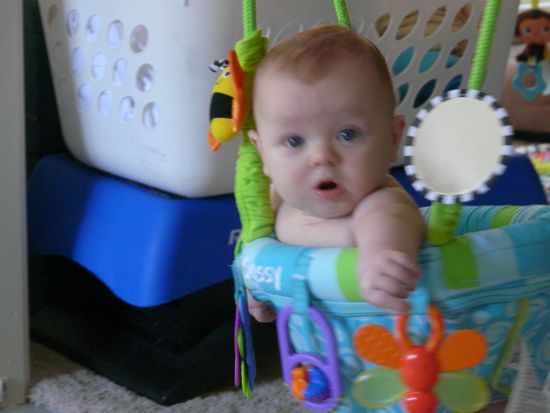
He has discovered his hands and feet; I love watching him, it’s pure motion, every leg and every arm going at once:

Well, he can’t talk yet, not clearly, so he blows bubbles to tell us how much he loves us:

“Oh!” exclaims AdventureMan, “You have to take a picture of him while he is sleeping, he is so beautiful.”
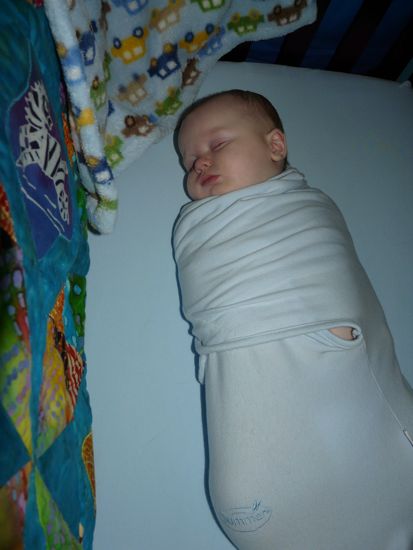
LOL! I had swaddled him, and he tried to tell me I had done it wrong, but I didn’t listen. When I went back 10 minutes later, he was still squalling AND he was no longer swaddled. I re-swaddled, this time, doing it right and tight, and before I even put him in his crib, he was sound asleep.
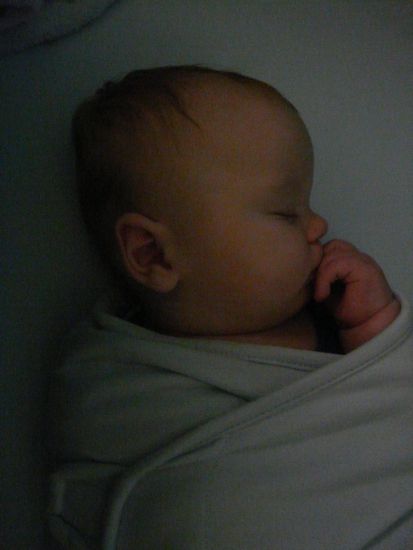
He did manage somehow to get one arm out:
On the way home, we picked up some roasting chickens for dinner, to roast with fresh rosemary and basil from our own garden. Yummm. AdventureMan will deliver one to our son and his wife around dinner time.
We are happy AND we know it. It’s a great day in Pensacola.
OOops! Ops!
The silence tipped him off.
He had just finished referring to his study as “The Command Center.”
The silence continued, then I broke it, quietly asking “and just whom would you be commanding?”
“Ummm. . . err . . . Ops Center! Operations Center!” he corrected himself.
We both laughed.
We’ve been married 37 years. 🙂
AdventureMan Wishes He Were There
I love our road trips. We always catch up on thoughts and pursuits that may seem to trivial in the activities of our normal busy days. It’s a time to talk over dreams, and hopes, and to sketch out some broad outlines of goals and calendars.
“Sometimes I read your blog,” AdventureMan starts off (and I never know where it will go!) “and I think ‘oh what a fun woman! I wish I were there with her having that adventure!’ and then I realize I was there!”
LLLOOOLLL!
People have told me I can make something out of nothing. I think the gift is knowing you are having a good time at the time you are having the good time. 🙂
Saudi Woman Attacks Muttawa
I found this on AOL News
“People are fed up with these religious police, and now they have to pay the price for the humiliation they put people through for years and years,” she was quoted as saying. “This is just the beginning and there will be more resistance.”
(May 18) — An angry young Saudi Arabian woman has left her mark on a religious policeman who approached her for illegally socializing with an unmarried young man.
According to the Saudi daily Okaz, the woman strongly objected to the policeman’s interference and repeatedly punched him so hard that he ended up in the hospital with bruises to his face and body.
The couple, believed to be in their 20s, were strolling through an amusement park in the city of Al-Mubarraz when the policeman asked them to confirm their relationship to one another.
Hasan Jamali, AP
In Saudi Arabia, women aren’t allowed to drive or to appear in public without a male guardian.
For unknown reasons, the man collapsed while being questioned, and the woman jumped in with fists flying, Okaz reported, according to arabianbusiness.com.
No statement on the incident has so far been made by the religious police – formally titled the Commission for the Promotion of Virtue and Prevention of Vice – or by the regular police, the Arab site and The Jerusalem Post reported.
If the unidentified woman is charged she could face a long prison term, as well as body lashes.
“To see resistance from a woman means a lot,” Wajiha Al-Huwaidar, a Saudi women’s rights activist, told The Media Line News Agency, The Post reported.
“People are fed up with these religious police, and now they have to pay the price for the humiliation they put people through for years and years,” she was quoted as saying. “This is just the beginning and there will be more resistance.”
“The media and the Internet have given people a lot of power and the freedom to express their anger,” she added. Whatever the religious police do ends up all over the Internet, she said, which gives them “a horrible reputation and gives people power to react.”
Under Saudi law, women are not allowed to drive, be seen in public without a male guardian and socialize with unrelated men.
A decision to open the country’s first co-educational university last year was strongly criticized by a senior Saudi cleric, who was then fired by King Abdullah, The Post reported.
Recent Comments
ExpatAlien on What Country am I Living … intlxpatr on Yellowstone: Old Faithful to C… Michelle on Yellowstone: Old Faithful to C… Cathy on No Grown-Ups in Charge intlxpatr on Waiting for Snow Wikipedia Donate Button

Amazina


Early Voting in Florida


 Here There and Everywhere