Who Knew? Pumpkin Shortage, Pumpkin Pie
“Have you heard about the great pumpkin shortage?” asked my friend Grammy. I think I snorted. I thought she was kidding.
No. No, she was not kidding. Today I found this on AOL News where you can read the whole story by clicking on the blue type.
Pumpkin Shortage Means No Pie for Thanksgiving
Posted Nov 18th 2009 2:30PM by Susan Wagner
Planning on serving pumpkin pie next week for Thanksgiving? You might want to find a back up — maybe pecan pie, or some spicy gingerbread. What’s wrong with pumpkin pie? Nothing — except that there aren’t any pumpkins available this year.
Rainy conditions in the midwest this fall have washed out the pumpkin crop, leaving retailers at a loss for canned pie filling. This week, the LA Times reported that Nestlé, which controls 85% of the pumpkin crop for canning, was all out of pumpkins. The company issued a surprise apology, saying that the rain had destroyed the remains of an already-small crop. Nestlé plans to stop shipping canned pumpkin after Thanksgiving, and the company says that once this season’s supply is gone, there won’t be any more pumpkins available for canning until August 2010.
Don’t lose hope!
For one thing, here in Qatar, there doesn’t appear to be any shortage of pumpkin – or, well, squash. It tastes like pumpkin, but looks more like old fashioned pumpkins, not like the generic vanilla USA sugar pumpkin.
My beautiful French friend’s nose got that pinched French look when she heard about pumpkin pies made with canned pumpkin.
“Why would you do that?” she asked in genuine bewilderment. “All you have to do is to cook the pumpkin pieces until they are soft, then use them as you would canned pumpkin, except that it’s fresh, and has no added chemicals.”
HER pumpkin pie was out of this world, made with fresh pumpkins and her special spice mix:
2 tablespoon ground cinnamon
1 1/2 tablespoon ground ginger ( or1 tablespoon of grated fresh ginger)
1 teaspoon cloves
1 teaspoon mace (or ground nutmeg)
1 pinch anis seeds ground
1 cup dark brown sugar
Ground all the pieces together than add the sugar, keep it in a closed lid jar.
Her filling : 2 pounds fresh pumpkin flesh, steamed, mashed and cooled down, 1 cup of packed brown sugar, 3 eggs, 1 teaspoon of baking soda, half a cup of the spice mix.
Her pie was amazing. I would bake at 350F/180C for about an hour; it makes a big pie.
FYI: How Long is a Generation?
So I get on a track and I can’t get off, like a little hamster running on the wheel. I got to thinking about generations, and how long ago is 10 generations and so I had to ask Google the question: How long is a generation? Don’t you love Google? They always have an answer.
Now I know something new. Now I will share it with you. This comes from Ancestry.com
Research Cornerstones: How Long Is a Generation? Science Provides an Answer
How Long Is a Generation?
By Donn Devine, CG, CGI
We often reckon the passage of time by generations, but just how long is a generation?
As a matter of common knowledge, we know that a generation averages about 25 years—from the birth of a parent to the birth of a child—although it varies case by case. We also generally accept that the length of a generation was closer to 20 years in earlier times when humans mated younger and life expectancies were shorter.
In genealogy, the length of a generation is used principally as a check on the credibility of evidence—too long a span between parent and child, especially in a maternal line, has been reason to go back and take a more careful look at whether the evidence found reflects reality or whether a generation has been omitted or data for two different individuals has been attributed to the same person. For that purpose, the 20- and 25-year averages have worked quite acceptably; birth dates too far out of line with the average are properly suspect.
But now, researchers are finding that facts differ from what we’ve always assumed—generations may actually be longer than estimates previously indicated.
Several recent studies show that male-line generations, from father to son, are longer on average than female-line generations, from mother to daughter. They show, too, that both are longer than the 25-year interval that conventional wisdom has assigned a generation. The male generation is at least a third longer; the female generation is about one-sixth longer.
As early as 1973, archaeologist Kenneth Weiss questioned the accepted 20- and 25-year generational intervals, finding from an analysis of prehistoric burial sites that 27 years was a more appropriate interval but recognizing that his conclusion could have been affected if community members who died away from the village were buried elsewhere.
Why Age Matters
In a more-recent study regarding generation length, sociologist Nancy Howell calculated average generational intervals among present-day members of the !Kung, contemporary hunter-gatherer people of Botswana and Namibia whose lifestyle is relatively similar to that of our pre-agricultural ancestors. The average age of mothers at the birth of their first child was 20 years and at the last birth 31, giving a mean of 25.5 years per female generation—considerably above the 20 years often attributed to primitive cultures. Fathers were six to 13 years older than mothers, giving a male generational interval of 31 to 38 years.
A separate study, conducted by population geneticists Marc Tremblay and Hélène Vézina, was based on 100 ascending Quebec genealogies. Researchers found a generational interval, based on the years between parents’ and children’s marriages, to average 31.7 years, and they determined that male generations averaged 35.0 years while female generations averaged 28.7 years.
Biological anthropologist Agnar Helgason and colleagues used the Icelandic deCODE genetics database to arrive at a female line interval of 28.12 years for the most recent generations and 28.72 years for the whole lineage length. Male line lineages showed a similar difference—31.13 years for the recent generations and 31.93 years overall. For a more mathematically appealing average, Helagason and fellow researchers recommended estimating female generational line intervals at 30 years and male generational intervals at 35 years, based on the Quebec and Iceland studies.
Calculating Ideas
What does this mean to the genealogist? When assigning dates to anthropologically common ancestors 50 or more generations in the past, using the “accepted” 20 or 25 years as a conversion factor can produce substantial underestimates of the time interval.
For my own purposes, however, given the imprecision of the various results and my own need for an estimate that lends itself to easy calculation, I decided that three generations per century (33 years each) for male lines and 3.5 generations per century (29 years each) for female lines, might work better when I needed to convert generations into years.
To check the accuracy of my values, I decided to compare the generational intervals from all-male or all-female ranges in my own family lines for the years 1700 to 2000. I was pleasantly surprised to see how closely the intervals agreed with the estimates I was using. For a total of 21 male-line generations among five lines, the average interval was close to 34 years per generation. For 19 female-line generations from four lines, the average was an exact 29 years per generation.
In genealogy, conclusions about relationships are subject to change whenever better evidence is discovered. Similarly, it’s the nature of the physical and biological sciences that current understandings are subject to change as more data becomes available and that data’s interpretation becomes more certain. So, for now, when genealogists want to convert generations to years and create probable date ranges, using an evidence-based generational interval—like Helagason’s 30 and 35 years or one that you’ve developed based on your own family history research—may be the best solution.
Donn Devine, CGSM, CGISM, a genealogical consultant from Wilmington, Delaware, is an attorney for the city and archivist of the Catholic Diocese of Wilmington. He is a former National Genealogical Society board member, currently chairs its Standards Committee, is a trustee of the Board for Certification of Genealogists, and is the administrator for Devine and Baldwin DNA surname projects.
Only Ten Generations
We were talking about marriage prospects, and I mentioned one young man.
She hesitated, then told me “we don’t marry with this family.”
“Why not?” I asked her. “He’s handsome, and kind, and I am told that they are the richest family in Qatar.”
“They are Iranian,” she said shortly.
“Iranian?” I asked. “They are Qatteri! They have been here more than ten generations!”
She grinned at me.
“It’s not enough,” she said. “They are still Iranian.”
Halloween Baby
You won’t hear all mother-in-laws say things like this, but you’ll hear me say it, and often – we are so lucky. Our son chose a wife who is a true companion, and whose style suits our own, sometimes so much it is scary.
They are expecting a baby – and she is beginning to be “great with child”. She wrote us this morning that she won a Halloween costume contest. We knew they were toying with the concept, but the reality is hilarious. Alien!

Saturday mornings can be depressing for us, as AdventureMan heads back to his job. Not so this morning – we were dying laughing!
Where to Start a Difficult Conversation?
“Mom,” my son started out, “I have some bad news.”
My heart sank. They are expecting a baby in late January. Please Lord, let this baby be OK.
He starts into a long story, which has to do with an old friend who lost a job, who is staying with them temporarily, who has been very helpful, and on and on and on; I live in a family where nuances are important, and details help understand the conclusions, but it is hard to hold your breath that long!
Then he gets to the point. While he and his wife were at work, the friend was in the house recovering from jet-lag and it started raining hard. His friend thought he heard drips in the attic, and upon exploration, they discovered a small leak in the roof. He will call the contractor we work with, but he wanted me to know.
Bad news?
“Son!” I said, laughing, “when you start a sentence with ‘I have bad news,’ it needs to be followed immediately with ‘I am OK, my wife is OK and the baby is OK’ so I don’t have a heart attack!”
We both laughed. He said “yeh, I thought about that about halfway through the explanation, but I didn’t want to break the train of thought.”
When you have bad news, get it out on the table. Start with “I have bad news, (fill in the blank.)” Then go into the background, and the proposed solutions. My son did everything right, except for the part about I was scared for him and his wife and the baby.
On the other hand, after all that build-up, I was so happy that it seemed like such a small problem, compared to the possibilities.
My husband tells a joke, the point of which is to build up gently to bad news. Not to start with “the cat is dead” but to start with “the cat was on the roof . . . ” The day came when I had to call him with some very bad news, and because I am wired to laugh in the face of the worst things that can happen (it is a sort of hysterical reaction, I have to work hard to control myself at funerals and weddings, I cry at weddings and want to laugh at funerals. The big things are just too overwhelming for me so I react inappropriately. Our family joke is that “inappropriate” is the grown-up word for “stupid”) I had a very hard time not starting off with “the cat was on the roof,” which would have been totally inappropriate but I was overwhelmed, knew I needed to let him know immediately, and you think when you get to be a grown-up you will have all the answers, but we don’t. We really don’t. Like you, we do the best we can.
What I really like was that when our son gave us the bad news, he also had a proposal for how to handle it. Wooo HOOO.
Then he told us they are planning their Halloween costumes. First, because his wife is now very visibly pregnant, they were looking for a cheap doll to take apart and glue some appendages coming out of her little basketball-tummy, but now they are looking for tentacles, a la “Alien”. LLLLOOOOLLLLL! I thought it would be the perfect occasion to wear her wedding dress, our son could wear a tuxedo and the friend could go as the angry-Papa, carrying a shotgun. Yes, we are a little weird in our family, but we have a great time.
Shifting Weather Patterns

Last week, we had our first days under 100°F/38°C.
Last night, AdventureMan shivered and moved close to me.
“I’m cold” he said pitifully, putting his cold feet up against me.
It’s OK. I’m used to it. He is often cold, and I radiate heat. We pile the covers up on him and I sleep with just a sheet. I can’t sleep if I am too hot.
“There’s another quilt out on the loveseat” I tell him, referring to a piece of furniture about twenty steps away.
“Will you go get it for me?” he asked, his voice quavering.
We’ve been married a long time. I’m on to his tricks.
“No,” I laughed, “If you want another blanket, you have to go get it.”
“I don’t want to leave the bed,” he complained, and snuggled closely to me to absorb my heat.
This morning, at 0700, it is not even 80°F. Wooo HOOOOOO! There is still some humidity, but the afternoons are balmy, and there are evenings you can sit outside and drink coffee. Wooo HOOOO, my favorite season – Outside Season!
The Help by Kathryn Stockett

In my book club last year, one of the themes that continued to arise as we read books from many cultures was how we are perceived by the people we hire to help us in our homes. In The White Tiger, a Man Booker Award Winner, the main character lucks into a job working for a family as a driver. We see the people for whom he works from the inside, their sweet acts and all their flaws. We see how callous they can be, and, ultimately, how the driver takes his revenge and becomes his own boss. (Not one of my favorite books, but then again, I’m still thinking about it a year later, so there is something to be said for it.)
In Half of a Yellow Sun we saw an entirely different relationship (in a book I totally loved, BTW) between employer and employee, but it shared with White Tiger the aspect of employer as seen from the eyes of an employee inside the house who sees the family and all its interactions intimately.
The Help, a surprise best seller, does the same to 1960’s era Mississippi. A recent graduate from Ole Miss (University of Mississippi) starts interviewing the maids from local households, any maid that will talk to her. At first, no one will talk with her, but after traumatizing racial clashes, one by one, they share their stories. Just interviewing the maids, just the maids sharing their stories, is enough to bring on serious consequences.
First, the book is riveting. I have a million things I really REALLY need to be doing, and I can’t stop reading. There is something about peeking into your neighbors house, seeing how they behave when they think no one is looking, that appeals to the voyeur in each of us.
Second, these women are taking serious risks. I am on the edge of my chair with each reading, hoping nothing bad happens to them.
Third, there is something that makes you squirm, it is the old “wee giftie” that shows us the worst in ourselves as others might see us; our own hypocrisies, our condescensions, our patronizing acts, how cruel our charitable acts can appear through the eyes of others, and how callous we are in the end towards those who take care of us every day.
It has rocketed onto the best seller list, now the #6 best selling book on Amazon.
If your book club is looking for a book to read that will get you talking and keep you talking for a long time, this is one of the best.
If you have hired help in the house, I double-dog-dare-you to read this book. (OOps, sometimes the little Alaska girl in me pops back out!) Fair warning, though, once you start, you won’t want to put it down.
Girls of Riyadh by Rajaa AlSanea
“Have you read Girls of Riyadh?” my friend asked me on the phone, and when I said I had not, she said she would bring it to me.
“It’s an easy read” she said, “it will take you an afternoon.”
Sometimes life intruded. It took me a little longer. I had expected this to be lightweight, along the lines of the shopaholic books, read ’em and forget ’em. Airport reading, stuff you save to read when you know you will have time to kill.
I was surprised. I guess I had gotten the impression it was lightweight because I had seen it discussed on some of the blogs, and there are some light-hearted moments in the book. The four young women are well drawn, and their experiences are handled with sensitivity. She never reveals which character from the book she is, but I have my suspicions. 🙂
Each girl has her own unique experiences as she reaches young womanhood, and mating. Although the experiences are treated deftly, there is a serious undercurrent that belies the light tone. The underlying circumstances surrounding the mating rituals in a country so tradition-bound as Saudi Arabia turn mating into a dark ritual, full of unseen pits and minefields.
The very worst fear during these years is the wagging tongues of others. I have heard this theme over and over in my own dealings with young women in this part of the world.
“You know, khalto, a woman’s reputation is like glass, it is easily shattered,” explained my young-woman Qatteri friend, solemnly.
(for my Western readers, Khalto means ‘aunt’ literally, and is a term used respectfully for family friends, meaning ‘sister of my mother’)
“I don’t want to get married,” she continued, “They come for you as a bride and they are so nice and they make you feel so in love with them, but then, when you are married, they change. Men are . . . men are . . ”
“Dogs?” I asked.
“Yes! Yes!,” she exclaimed, “Dogs!” (pause)
“How did you know, Khalto?”
LLLLOOOOLLLLLLLLLL! It’s one of those moments when you know we are all more alike than we are different.
Girls of Riyadh is a worthy read. It is thought-provoking, and compassion-provoking. You grow to love these girls, and you hope a happy ending for them.
Greeting Your Enemies With a Feast (Elisha)
I love it when I come across a good story I haven’t heard before in my daily readings in The Lectionary and this one is a doozy. I didn’t hear a lot of bible stories about Elisha as I was growing up (Elisha followed Elijah) but this reading includes some amazing stories, including one of the first instances of turning away an enemy with a feast.
2 Kings 6:1-23
6Now the company of prophets* said to Elisha, ‘As you see, the place where we live under your charge is too small for us. 2Let us go to the Jordan, and let us collect logs there, one for each of us, and build a place there for us to live.’ He answered, ‘Do so.’ 3Then one of them said, ‘Please come with your servants.’ And he answered, ‘I will.’ 4So he went with them. When they came to the Jordan, they cut down trees. 5But as one was felling a log, his axehead fell into the water; he cried out, ‘Alas, master! It was borrowed.’ 6Then the man of God said, ‘Where did it fall?’ When he showed him the place, he cut off a stick, and threw it in there, and made the iron float. 7He said, ‘Pick it up.’ So he reached out his hand and took it.
8 Once when the king of Aram was at war with Israel, he took counsel with his officers. He said, ‘At such and such a place shall be my camp.’ 9But the man of God sent word to the king of Israel, ‘Take care not to pass this place, because the Arameans are going down there.’ 10The king of Israel sent word to the place of which the man of God spoke. More than once or twice he warned such a place* so that it was on the alert.
11 The mind of the king of Aram was greatly perturbed because of this; he called his officers and said to them, ‘Now tell me who among us sides with the king of Israel?’ 12Then one of his officers said, ‘No one, my lord king. It is Elisha, the prophet in Israel, who tells the king of Israel the words that you speak in your bedchamber.’ 13He said, ‘Go and find where he is; I will send and seize him.’ He was told, ‘He is in Dothan.’ 14So he sent horses and chariots there and a great army; they came by night, and surrounded the city.
15 When an attendant of the man of God rose early in the morning and went out, an army with horses and chariots was all around the city. His servant said, ‘Alas, master! What shall we do?’ 16He replied, ‘Do not be afraid, for there are more with us than there are with them.’ 17Then Elisha prayed: ‘O Lord, please open his eyes that he may see.’ So the Lord opened the eyes of the servant, and he saw; the mountain was full of horses and chariots of fire all around Elisha. 18When the Arameans* came down against him, Elisha prayed to the Lord, and said, ‘Strike this people, please, with blindness.’ So he struck them with blindness as Elisha had asked. 19Elisha said to them, ‘This is not the way, and this is not the city; follow me, and I will bring you to the man whom you seek.’ And he led them to Samaria.
20 As soon as they entered Samaria, Elisha said, ‘O Lord, open the eyes of these men so that they may see.’ The Lord opened their eyes, and they saw that they were inside Samaria. 21When the king of Israel saw them he said to Elisha, ‘Father, shall I kill them? Shall I kill them?’ 22He answered, ‘No! Did you capture with your sword and your bow those whom you want to kill? Set food and water before them so that they may eat and drink; and let them go to their master.’ 23So he prepared for them a great feast; after they ate and drank, he sent them on their way, and they went to their master. And the Arameans no longer came raiding into the land of Israel.
Lunch at Ivar’s in Mukilteo
Mom and I are heading out to the coast tomorrow for some time at the beach. On the Washington/Oregon beaches, you never know what the weather is going to be. It doesn’t matter how old you get, you know how Mamma’s are? Like she keeps asking me if I have a sweatshirt? Do I have a raincoat? Have I packed my toothbrush? (no, I made that last one up! 😉 )
So today we were running errands, like go to the bank so we have enough cash, like pick up a few groceries, because the places we stay have a kitchen (more important, they have a view of the OCEAN!), pick up a junky beach-book or two, and some Sudoku, and then, let’s go have lunch!
Mom LOVES Alaska fried clams, and Ivar’s does them the BEST, so we drive north to Mukilteo, but it takes forever because they are doing some road repairs on the back roads we usually take, and our “short-cuts” take a lot of time.
“Promise to remind me to take photos this time.” I ask her, but she won’t promise.
A few bites in, I remember. I’m getting better. 🙂
Here are Mom’s Alaska Fried Clams:
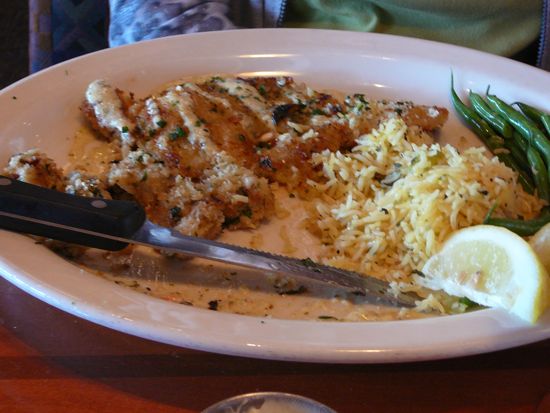
Even thought lunch portions are smaller, it was still a lot of clam, and very very rich, breaded and then sauteed in butter. Mom says her green beans were also really good.
Here is my grilled Alaska salmon, on a bed of spinach and orzo salad vinaigrette:

I’m like Popeye, I love SPINACH! This whole meal was delicious, and, once again, we were happy to see the restaurant had a good clientele eating lunch. Even Seattle is begining to feel the economic crunch.
Recent Comments
intlxpatr on Shampoo Ginger tigerbutterya0c5ff1d… on Shampoo Ginger intlxpatr on British Soldier Kidnapped, Esc… John on British Soldier Kidnapped, Esc… intlxpatr on British Soldier Kidnapped, Esc… Wikipedia Donate Button

Amazina


Early Voting in Florida


 Here There and Everywhere