“Who Am I?”
As DNA testing becomes more and more common, surprises are popping up everywhere. This article from BBC is about two Englishwomen who discover they have Native American blood when they send their DNA in for testing.
It’s fascinating to think that migration and trade has left it’s traces generations later. I love the work that is being done with bloodlines these days.
Native American DNA found in UK
DNA testing has uncovered British descendents of Native Americans brought to the UK centuries ago as slaves, translators or tribal representatives.
Genetic analysis turned up two white British women with a DNA signature characteristic of American Indians.
An Oxford scientist said it was extremely unusual to find these DNA lineages in Britons with no previous knowledge of Native American ancestry.
Indigenous Americans were brought over to the UK as early as the 1500s.
It rocked me completely. It made think: who am I?
Doreen Isherwood
Many were brought over as curiosities; but others travelled here in delegations during the 18th Century to petition the British imperial government over trade or protection from other tribes.
Experts say it is probable that some stayed in Britain and married into local communities.
Doreen Isherwood, 64, from Putney, and Anne Hall, 53, of Huddersfield, only found out about their New World heritage after paying for commercial DNA ancestry tests.
Mrs Isherwood told BBC News: “I was expecting the results to say I belonged to one of the common European tribes, but when I got them back, my first thought was that they were a mistake.
“It rocked me completely. It made think: who am I?”
You can read the rest of the article at BBC Science/Nature News, here.
Dark, Disturbing Road
Do you remember the happy books you read? Those that are light and breezy? Those with happy-ever-after endings? Most of the time, my bet would be you don’t. You read them, and they’re gone.
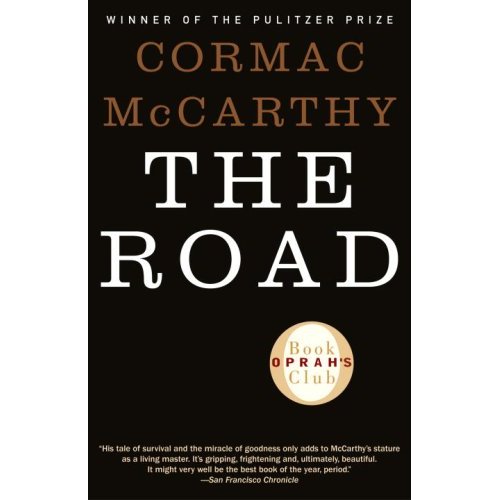
Not this book, The Road, by Cormac McCarthy. I found myself hesitating to even review this book, it is so disturbing to me. The prose is simple, even stark. The atmosphere is relentlessly bleak. The main character, whose name we never know, spends most of the book foraging and scavenging to feed himself and his starving son. The cover says it takes place in America, but it could be anywhere.
It is post-apocalyptic literature at it’s bleakest. All we know is that there were huge balls of light and then everything burned, and kept burning. It is still burning, in some places, during the time span of this novel. It rains or snows most of the time, and the rain is grey and the snow is grey. It is bone-chilling cold, and gathering wood for a fire to keep warm is a constant task.There is never a clear sunny day, only lighter or darker shades of grey. The nights are dark, no moon, no stars, just blackness.
It’s another one of those books I grabbed on the way to the airport without looking too carefully. I saw this was an Oprah Book Club choice and didn’t even read the cover. These books I just grabbed have grabbed me in return – I have read five in a row, books I have to talk over with my husband while I am reading them, they are so full of ideas I need to explore, unsettling settings, shaking to insecurity all that we take for granted.
This one, though, is seriously dark. I read until past midnight last night, adrenaline pumping through my system, as the man and his son evade marauders, thieves, and cannibals. I needed the human warmth of my husband’s body next to mine to drive away the alienation of this book. Even safe in my own bed, though, my sleep is troubled and I wake feeling scared and depressed. As you read The Road, you realize how very thin the veneer of civilization is that holds us together in community, and how that veneer rips when there is no longer law holding back the more powerful, those with weapons, those with more resources. When food becomes scarce, when people become very hungry . . . the rules break down, in serious and unthinkable ways.
If one book can have such an impact on my emotions and feelings of security, I can’t help but think how the trauma of the Iraqi invasion must still be resonating, invisible, below the surface, but an uninvited guest in the daily lives of those who experienced those horrors and trauma in Kuwait. You wonder if you will ever trust in “normal” again?
When your world suddenly shifts in a heartbeat, when your wealth disappears, when you suddenly have only your wits to survive on, how will YOU do?
As the Father and Son travel The Road seeking a warmer climate, and “the good guys”, goodness is remarked by its absence. Our protagonist refuses to help a lost child, a cellar full of people being kept as a food supply, and a couple of men along the road whose situation is even worse than their own. His son, born just after the event which forever changes the world, begs his Dad to share, but the Dad, knowing how spare the food supply is, refuses.
Beyond a crossroads in that wilderness they began to come upon the possessions of travelers abandoned in the road years ago. Boxes and Bags. Everything melted and black. Old suitcases curled shapeless in the heat. Here and there the imprint of things wrested out of the tar by scavengers. A mile on and they began to come upon the dead. Figures half mired in the blacktop, clutching themselves, mouths howling. He put his hand across the boy’s shoulder. Take my hand, he said. I don’t think you should see this.
Yes.
It’s OK Papa.
It’s OK?
They’re already there.
I don’t want you to look.
They’ll still be there.
He stopped and leaned on the cart. He looked down at the road and he looked at the boy. So strangely untroubled.
Why don’t we just go on, the boy said.
Yes. Okay.
They were trying to get away, weren’t they Papa?
Yes. They were.
Why didn’t they leave the road?
They couldn’t. Everything was on fire.
I dropped other things I really needed to do so that I could finish The Road. I can’t spend another night wondering how I would survive in this dog-eat-dog world. I need to move on with my life. I need to shift my focus.
And yet . . . I recommend McCarthy’s The Road to you. It is dark, it is brutal, it is relentlessly bleak, but still there is a thin golden thread of the father and son relationship weaving through the tapestry of despair, which redeems the book. You can’t help but admire the determination to persist, when the signs are all around you that nothing is going to get better. Somehow, in spite of all the despair, there is redemption, and even hope.
MOC Bans Porno Film Sites
Today’s Kuwait Times:
Internet Porno Film Sites
The Ministry of Communication has closed down all new sites that advertise pornographic films. The ministry of Communication represented by Undersecretary Eng. Abdulaziz Al-Osaimi and his counterpart at the Ministry of Information achieved this new step. This move was done in order to have control over the sites, which are being followed by the Ministry of Information. Al-Osaimi has assigned administration director Nassar Al-Kandari to work on closing those sites from the Internet and ensuring that companies do not use other systems to re-open it. The ministry succeeded in coordinating with local internet companies to close all porno sites, but lately the ministry realized that there are new sites marketing through drama films to porno films.
My comments:
I truly hate porn. I hate it because it creates a fantasy world that real women can barely compete with. I bet if men spent half the time and attention on their wives and families that they spend on porn, there wouldn’t be so much divorce. And guys – those women are PAID. They’re ACTING. Most of them would rather be doing anything but what they are doing, but they do it for the MONEY. It’s about as real as the World Wide Wrestling Federation Matches, it’s all staging and airbrushing and making money off YOUR fantasies.
Rant over – reality strikes. How do you ban pornography?
First, how do you define pornography? When I was a student in political science, we spent a week of class time trying to come up with a definition that everyone could buy into. We never succeeded.
There is some pretty powerful erotic literature, erotic art out there, stuff I don’t find pornographic in the least. So what are the guidelines?
Second, WHO defines pornography?
Third, how on earth will the Ministry of Communication and the Ministry of Information keep up with all the new porn sites that keep popping up? These sites make people a LOT of money, they have the money to pay ingenious high tech guys to keep devising new ways to get their product to market.
And last, who is the poor porno-guy who has to watch all this garbage and enforce the ban?
And – is your internet phone still working? 😉
Sparkle Plenty Jumps In
Sparkle Plenty has always loved good jewelry. She is on first name terms with the major jeweler in our home town, and they always grin when she walks in. Her blogging name is well chosen!

She is my sister, although almost of another generation. She is the youngest aunt, the “fun” aunt. Everyone likes hanging around Sparkle Plenty’s house – and all the cousins gather there around the pool – or the pool table. Sparkle Plenty and her husband have all the fun toys, the fun gatherings and her house is full of laughter.
Her house is also full of pets. She and her husband, Mariner Man, have a soft spot for anything lost or injured or abandoned. One by one, they have gathered a menagerie of cats, dogs and birds who are all grateful not to be out on the streets. They take the ones who limp, the ones no-one else wants. Sparkle Plenty and Mariner Man are all about heart.
After a couple months of commenting, now she had jumped in to the blogging party, and her theme, Flashes of Light that catch the eye, the mind and the heart is perfectly expressive of her goodness and her compassion and her yearning to be a force for good in the universe. Welcome Sparkle Plenty, and may the force of good be with you!
Please visit Sparkle Plenty and welcome her to our virtual community.
Readings for Today
You will notice to the right, in my Blogroll, is an entry for The Lectionary. The Lectionary readings are scheduled so that every three years you read completely through the Bible. Actually, my sect, which is Episcopalian (the American version of Anglican, although the two have been closer at some times than others) shares the same readings with many other Christians, we also have some books/chapters in our Bible that most of the main-line Protestant bibles don’t have.
Today’s gospel reading is one of the hardest ones. You look at it and you read it and it SOUNDS so simple:
Luke 6:27-38
27 ‘But I say to you that listen, Love your enemies, do good to those who hate you,
28bless those who curse you, pray for those who abuse you.
29If anyone strikes you on the cheek, offer the other also; and from anyone who takes away your coat do not withhold even your shirt.
30Give to everyone who begs from you; and if anyone takes away your goods, do not ask for them again.
31Do to others as you would have them do to you.
32 ‘If you love those who love you, what credit is that to you? For even sinners love those who love them.
33If you do good to those who do good to you, what credit is that to you? For even sinners do the same.
34If you lend to those from whom you hope to receive, what credit is that to you? Even sinners lend to sinners, to receive as much again.
35But love your enemies, do good, and lend, expecting nothing in return.* Your reward will be great, and you will be children of the Most High; for he is kind to the ungrateful and the wicked. 36Be merciful, just as your Father is merciful.
37 ‘Do not judge, and you will not be judged; do not condemn, and you will not be condemned. Forgive, and you will be forgiven;
38give, and it will be given to you. A good measure, pressed down, shaken together, running over, will be put into your lap; for the measure you give will be the measure you get back.’
There is nothing easy about loving your enemy. One priest, as I was anguishing through this passage, told me “You don’t have to LIKE them, but you MUST love them.” That helped, but still, loving your enemy is probably the hardest thing on earth to do. And “Do not judge”????? Holy smokes, we judge one another on a daily basis, and usually not to their credit.
Give, even if you think the begger may be lying?
And then, the hardest one of all – “Forgive, and you will be forgiven.” So like, if I don’t forgive . . . I don’t get forgiveness? Like I have to give up my grudges, the chip on my shoulder? I have to forgive the unforgivable, the personal insults, the slights, the jerk who cuts me off on the road? I have to forgive my neighbor? I have to forgive my friend? My husband? George Bush? Osama bin Laden? I have to forgive to receive forgiveness??
But, at the last, the reward – that no matter how hard it is, if you follow these rules, abundant life will be poured in your lap.
You can follow the daily readings by clicking on the Lectionary, in the blogroll, and scrolling down to the current week. Click on the week and it will take you to the daily readings, which include the Psalms, the Old Testament, the New Testament and the Gospel. The reading above, from Luke, is today’s Gospel reading.
A Beautiful Apology
Gere apologises over Shetty kiss
The kiss:
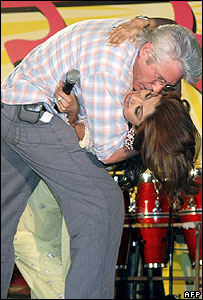
Actor Richard Gere has apologised for causing offence when he kissed Bollywood actress Shilpa Shetty.
The incident, at an Aids awareness event in Delhi, prompted public protests and then an arrest warrant for both stars over the “obscene act”.
Gere, 57, said he had misread Indian customs and that he regretted any problems he had caused Shetty.
You can read the whole story here, at BBC News.
I am guessing both Gere and Shetty got a lot of mileage out of the storm of publicity from his onstage behavior, and now he has graciously and sincerely apologized. Pardon my cynicism, but he has been in India before, I would think he would have been more sensitive.
Nonetheless, he made a beautiful apology. And I wonder why politicians don’t do the same? Why, when you realize you have stepped on someone’s toes, don’t you just make a full and gracious apology? No, it doesn’t change what has happened, but it can sometimes calm the troubled waters.
What if the Danish papers had made a full and gracious apology for publishing the cartoons of the Prophet Mohammed? It would not have changed the fact that they had been published, but it would not have hurt to acknowledge that they had hurt the sensitivities of a large portion of the world, and to apologize for the offence.
“Make This Case Go Away”
This is from today’s Kuwait Times.
MP Intervenes to save rapists
by Hanan Al-Saadoun
Kuwait: Two men accused of kidnap, rape and assault were let off the hook after pressure from a lawmaker and a senior police officer. A captain from the Traffic Department was on duty in Khaitan when he saw a parked car with an Asian maid in it and a man standing next to the car. The maid suddenly pointed to the officer and cried for help, so the captain rushed to the car and found another man inside with the maid.
The captain asked the man outside what the problem was. The main replied that this was a runaway maid and he was a detective. The captain asked for his ID but the man refused. The captain then realized that the man smelled of alcohol.
The men suddenly assaulted the captain and bit his hand, injuring him severely (emphasis added by blogger.) After the captain subdued both men, they confessed that they were drunk and that they had tried to rape the maid. The captain then tried to file a case at the Khaitan police station against the two men, but the MP intervened and tried to stop the captain from registering the case. The captain persisted and kept pushing to file a case for a week, until his superior intervened too and told him to “forget the incident.”
My comment: If I ever stop getting outraged when I read reports like this, God forbid, I will be dead.
First, the maid’s life is seriously damaged. Any victim can tell you that the terror of abduction, with or without rape, resonates through your life. When you are in a situation where you have no power, and are at the mercy of someone stronger or more powerful than you are, it is a life-changing event. And would her sponsor accept her back, even though it were no fault of her own? Would they not be afraid she might be diseased? They might even accuse her of inviting the assault – and this was an assault.
Second, these young men lied to the police, impersonated a police officer, resisted arrest and caused bodily harm to a senior police official. Did you notice – THEY CONFESSED.
Third, the police captain had the guts and integrity to persue filing this case against these wicked young men, inspite of pressures from above. WOOOOOO HOOOOOOOOOO on you, brave one, for your integrity.
Last, kudos for Hanan al-Sadoun who does such a great job presenting so many of these outrageous stories in an objective manner, letting us fill in the details and express our outrage in our blogs. Brava, habeebti.
Evidently this air tight case will never get to court.
And what have these young men learned about accountability? That their name and wasta will make their despicable actions go away? What is the fitting punishment for what they have done? C’mon readers, check in on this one.
OK, OK, I’ll take a deep breath and stop now.
Senior Citizens in Kuwait Taking Hospital Beds?
Tacked on to another article in yesterday’s Kuwait Times was this tiny bit of news, with much larger social implications:
“In other news, sources revealed that senior citizens have changed the rooms of public hospitals into old aged homes due to the low fees that are imposed on reserving a room at the hospital.
The rooms at public hospitals are worth KD 1 per day, and if the patient stays for two months, then he will pay only 500 fils per day.
Effective measures must be adopted by the Ministry of Health such as giving a determined time for each patient in order to enable hospitals to receive other patients.”
In a related article several months ago, a article in the same newspaper said that the hospitals were overrun with old people because people couldn’t take care of them at home, and it was much less shameful to say “my Mother is in the hospital” than to say “my mother is in a home for old people.”
It sounds to me like the solution is for the Kuwait government to open a state of the art “hospital” specializing in Gerontology, which in reality would be a retirement center for people unable to take care of their own physical needs, and whose families cannot meet their needs (believe me, after my father’s lengthy and debilitating illness, I know there is only so much a family can do), and they can still say that their parent(s) are in a hospital.
It would meet the need of “hospitalization,” would provide the older people with the intensive and personal services that they need, and would free the beds in traditional hospitals for the seriously ill and damaged citizens.
It’s only words.
Kuwait conference calls for document on women rights
In yesterday’s Kuwait Times, there was a tiny paragraph in the reporting about Personal Law in Kuwait pertaining to women that stated
“Among the loopholes of that must be corrected is the provision empowering a woman’s father to marry her to whoever he likes or divorce her without consulting or even informing her . . . “
Is this possible? Does this still happen? I thought in Islam, a woman had to agree to accept a man as husband, and had a right to have clauses put into her marriage contract? And a father can have his daughter divorced from her husband without her even knowing about it, much less agreeing to it?
Here is today’s reporting from the Kuwait Times on the recommendations for legal changes:
KUWAIT: Participants in the Conference on the “Kuwaiti Women in National Legislations” have recommended the preparation of a comprehensive national document to facilitate women participation in the country’s development aspects under the sponsorship of the legislative and executive authorities as well as the civic society institutions.
At the conclusion of the one-day conference, organised by the National Assembly’s women affairs committee, the participants demanded improvement of legislative performance, promotion of the existing legislations and completion of the legal system in an introduction for the rise of women’s rights in the society.
To read the rest of the article, with the recommendations made by the committee, click on Kuwait Times, here.
India’s dangerous secret sex lives
In a BBC article by Linda Pressly, we learn that India has the largest HIV case-load in the world with an estimated 5.7 million people living with the virus. And that women are at highest risk of getting the HIV virus – from their husbands.
More people are living with HIV in India than anywhere else but activists in Gujarat say that until sexual diversity is accepted, prevention may be impossible.
In India’s conservative society sex lives are kept very secret
“Just as other people live their lives, my husband and I maintain our normal family life, even though he has boyfriends.”
Gita was relating some of the most intimate details of her marriage.
“We look after each other, so that’s why I don’t have a problem with his homosexuality,” she said.
“At first I was shocked because I didn’t know anything about it. But I discovered that homosexuality is completely natural in some people, so I’m OK with it.
“I never thought it would create any problems for me.”
Gita’s husband Vijay, has been having sexual relationships with men ever since they got married.
You can read the rest of this fascinating article here.
Recent Comments
ExpatAlien on What Country am I Living … intlxpatr on Yellowstone: Old Faithful to C… Michelle on Yellowstone: Old Faithful to C… Cathy on No Grown-Ups in Charge intlxpatr on Waiting for Snow Wikipedia Donate Button

Amazina


Early Voting in Florida


 Here There and Everywhere