John from Cincinnati
One of the things we love the most about time with our son and his wife is that they open our horizons. I am waking up these mornings around 3:30, can’t get back to sleep. But my son helps me towards the end of the day, to stay up one more hour, by hooking me on John from Cincinnati, a new series on HBO.

The series is bizarre. I have only seen four episodes; and now I am going to have to wait until Sunday nights for the next one to view.
It centers around a California surfing family, the Yosts. The eldest was a surf champion until his knee gave out, his son wowed the surfing world until he got lost in a haze of dope and booze, and the youngest Yost, Shawn, is just beginning to show his supurb stuff.
But that isn’t all. There is the main character, John, who seems to be a transpositon of John the Baptist into modern times and lacking all kinds of clues as to how we humans behave. He doesn’t excrete, he doesn’t sleep, and he doesn’t understand sex. One of the funniest scenes is a surf-savvy supporting character named Kai explaining how sex is accomplished. It sounds pretty absurd as she explains it.
It’s about the surfing culture. It’s about family interactions. It’s about a small town and how they deal with conflict. And about how they support one another in tough times. It’s HBO, so it can be crude, it can be violent, and it can be very adult. It’s also thought provoking and intriguing.
Very strange things have begun to happen in this small town. Grandpa Yost ended up levitating as he washed off after surfing. Shawn had a fatal surfing accident, from which he recovers. John from Cincinnati can pull whatever money he needs out of his pocket. Butchie has been without drugs the two days John has been staying with him, and is amazed that he isn’t going through withdrawal.
Five segments in, we still don’t really know what we are seeing. We are beginning to understand how the community works, the interfamily struggles. I can’t wait to see what’s coming next.
Qatteri Cat Loves His Dad
We start our day together as a family – Adventure Man, me, Qatteri Cat – and all of Qatteri Cat’s babies, who end up on the bed by morning . . .He brought two babies in last night while I was still reading, and the other two appeared sometime as we were sleeping.

As we gathered in the living room to watch the sun over the Gulf, to see if we could spot any dolphins, Adventure Man sat with Qatteri Cat and began to play with him. Adventure Man almost lost a finger!

We got the Qatteri Cat when he was still a very young cat. He was found, sick and with an eye infection, on the Corniche in Doha, too young to be away from his mother, but with no mother in sight. A family adopted him, but the females in the family didn’t like him, and he spent much of his time alone, on a too hot or too cold balcony.
When we adopted him, he LOVED Adventure Man at first sight, but he was very wary of me. His back would arch if my hand raised. He watched my feet like a hawk. If my voice raised, his ears went back. And he was terrified of plastic bags, totally freaked out.
After a month or so, he would sit next to me, but not for long. He usually ended up biting me or scratching me in a panic to get away. It took months to calm him down, to calm his terrors, to gain his trust.

He is a very odd cat. He doesn’t eat meat, won’t touch it. He loves shrimp and sardines, and we special order salmon flavored cat food for him. He never begs for food. If I forget to feed him, he will nip at my feet – that’s his only signal, and he has to be very hungry to even do that. He never begs for food. He drinks very little water, so little that we have to encourage him to drink often.
Most of all, he wants to go out. He wants to roam free, he wants to be the CAT that God created him to be. But now, we have trained him too well – he is too trusting, and has no understanding about cars at all. He wouldn’t last long on the mean streets of Kuwait.

We also have to be careful, because underneath this contented cat, not too far from the surface, is that street-born cat. Most mornings I have a tough time typing, because he is snuggled up between my left arm and the computer. Occasionally, all of a sudden, in his imagination, my left hand becomes something else as it types along, and he attacks. His attacks, with teeth and claws, come as a surprise. It is a great trick NOT to try to remove my hand immediately, which only makes him bite and claw harder, but to stay totally still and say his name in reproving tones. It reminds him who he is and who I am, and he will let go. It happens less and less often, but we never forget there is still a wild cat not far below the thin veneer of civilization.
Most of all, he loves Adventure Man. He cries when he leaves, and he starts getting restless when it is time for him to come home. He waits by the door. When Adventure Man travels, he gets depressed, and Adventure Man talks to him on the phone when he calls. Sometimes I will ask “can you say hello to Qatteri Cat?” and he’ll say “not now, there are people around!” and he will leave the office and call back to talk with Qatteri Cat where no-one can hear him. Adventure Man gets most of his exercise these days chasing Qatteri Cat from room to room, throwing his ball, playing hide and seek.
OK, Skunk, this one was for you. 🙂
Backbiting
Our New Testament reading for today included this passage:
Galatians 5: 13-15
13 You, my brothers, were called to be free. But do not use your freedom to indulge the sinful nature; rather, serve one another in love. 14The entire law is summed up in a single command: “Love your neighbor as yourself.” 15 If you keep on biting and devouring each other, watch out or you will be destroyed by each other.
I love the way this passage describes the truly awful way the things we can say about one another can destroy. “Devour” is a very strong word, and fits perfectly with backbiting, doesn’t it?
I remember one of my first Ramadans, and my friends who were explaining Ramadan to me explained how one of the most important things during Ramadan was absolutely NO BACKBITING.
Answers.com says this:
Back·bit·ing
n.
Secret slander; detraction.
Backbiting, and bearing of false witness.
so I wonder if this is exactly the same in Arabic as in English. The impression I got is that backbiting in Arabic is more like gossip. Backbiting seems to imply that it is not true, but gossip can hurt even if it has a thread of truth. My impression from what my friends were telling me was that saying anything negative or unkind about another during Ramadan was severely discouraged, true or not.
Can you clarify this for me?
Jimmie Rodgers on your Prayer List
This is an e-mail from the son of Jimmie Rodgers, who a thousand years ago sang a song called Honeycomb:
Jimmie Rodgers was a TCK – Third Culture Kid – a military brat who went to high school in Germany. He is facing a medical crisis, and major surgery tomorrow, June 28, and his family asks for your prayers:
Hello Everyone!
Perhaps we have not spoken for a while. Perhaps we have never even met but somehow we have been connected through this wonderful world of email. That being said if you are considering this to be SPAM consider it the best kind because there is an opportunity here to be kind if for just a moment and truly bless someone. My name is Michael Rodgers. My fathers name is Jimmie Rodgers. Some of you might remember him from his musical career that has now spanned fifty years.
In 1957 he recorded a song called “Honeycomb” and followed it up with a string of hit records totaling 25 top ten singles,eighty million records sold worldwide and concert appearances throughout the world. Through all of that he carried himself with grace, charm and an incredible sense of humor and style.
In 1967 when he was 33 years old my father was injured in what is now known as a road rage incident with an off duty Los Angeles Police Officer. He suffered severe head injuries and underwent three brain surgeries.
During one of those surgeries he lost 28 square inches of his skull on the right side of his head.
Since 1968 he has carried what is considered to be the largest steel plate ever implanted in someone’s head. For 39 years the entire right side of his head has been entirely made of steel.
It took Dad nearly 15 years to recover from the last surgery in 1968 as he had to learn to walk,speak and regain his motor skills. He was not suppose to live more than 10 years with this steel plate in his body as the body continually tries to reject these kind of implants. Over the years as he has gotten older the skin on his scalp has gotten thinner (as it does with everyone) and the steel has began to try to regain it’s original shape and the edges of the plate that overlap the remaining bone have become sharp and they continually cut his scalp open making the plate stick through the top of his head. When this happens his brain is exposed to air and possible infection, he has terrible mood swings and if left this way this situation will eventually lead to his death.
Over the last 15 years he has had the plate filed, snipped, cut, and reshaped, he has had over 60 different skin graphs and other surgeries to try and keep his head from opening up. The last such surgery was 18 months ago and it nearly killed him. He now has a hole in his head the size of a half dollar and it has been this way since February. There is not enough healthy skin left on his scalp to cover it over.
My dad is tough. He is the definition of the word. He has avoided what is about to take place and tried everything imaginable to live with the constant pain and discomfort and he has now made a decision that will define what will be the rest of his life.
On Thursday June 28, 2007 a team of Brain Surgeons in Hot Springs Arkansas will remove the steel plate that he has carried with him for 39 years. They plan to remove the outer layer of skin and lift the plate away from the position it has held covering the outer layer of his brain. If successful they will replace the plate with a new material that has been developed that will recreate the skull bone and will not be rejected by the body. They also plan to recreate new skin on his head using his own stem cells in a paste form so that no more skin graphs will be needed.
If this surgery works he will no longer have the worry that his head will open up and his brain will become exposed anymore. If this surgery works he will have the chance to live what is left of his life without pain and the ever present knowledge that at anytime his head will open up again.
If this surgery works there is also a very real chance that he might never recover from the intense trauma that he is about to go through. At 33 years of age it took him 15 years to recover. At 73 years of age who knows what the outcome might be. What we do know is that he cannot live with this in his body anymore and it needs to come out if he is going to have any chance to live whatsoever.
Dad has made the decision. The Doctors feel confident that all will be fine and we are stepping out on faith that this is the right course of action.
As someone who some of you know to be a fairly private person I am opening up to you about a very serious family issue. This is not an easy time and I need your help. I kindly ask of you to give of yourselves and help me and my family and most importantly my father through the next few days.
From now until the end of next week and beyond if possible I kindly ask you all to please do the following.
* Please pray for my father that his surgery and recovery will be successful and that his health will be completely restored.
* Please pray for the team of Doctors and Nurses that will be performing the surgery so that they might have guidance and wisdom during this time.
* Please pray for our family that we might have strength and courage to face the days ahead in helping Dad with his recovery.
* Please Pray whatever your heart tells you to pray to whatever higher power you feel guides your life.
* Please put my father Jimmie Rodgers on your prayer lists at church or through an email request such as this one. (Feel free to copy and send).
All of us are connected in this life in some way. I believe there is power in prayer and power in positive thought.
I believe and claim that my father will completely recover from this surgery and that his body will be restored.
I believe that together all of us through prayer and positive energy and thinking can help that to happen.
Thank you all for being a part of and playing a part (large or small) in my life.
Thank you for giving my request consideration.
Name: Jimmie Rodgers
Date of Surgery: June 28, 2007 Steel Plate Removal / Skull Replacement.
My family and I thank you.
And my father thanks you and will be most appreciative to you for your thoughts and prayers. Please click on this link to see my father so that you can see him vital and healthy in your prayers.
God Bless,
Michael Rodgers
The Nativity of John the Baptist
This will be a long, technical post that you can skip if religious matters don’t interest you. It is aimed at my colleagues who enjoy comparing points of religion.

This week, we celebrated the feast of the birth of St. John, known as The Baptist. There were several scriptural readings (see below which is from the online Lectionary on my blogroll)
We had a reading I hadn’t heard before:
An account of the mercy of thy Lord bestowed upon his servant Zachariah, when he called upon his lord in low tones, praying: My Lord, my very bones have become feeble and my head has turned hoary with age, but never have my supplications to Thee, Oh Lord, remained unfruitful. I am apprehensive of the behavior of my relations after my death, and my wife is barren. I beg Thee, therefore, do Thou bestow upon me from Thyself a successor to be my heir and to be the heir of the blessings of the House of Jacob; and to make him one who should be pleasing in Thy sight, O Lord . . . .
(it tells of Johns conception and birth)
We commanded Yahya (John): Hold fast the Book; and we bestowed upon him wisdom while he was still young, as a token of tenderness from Ourself and to purify him. He grew up righteous, and was dutiful towards his parents and was not haughty or rebellious. Peace was on him on the day of his birth, and on the day of his death, and peace will be on him on the day he will be raised up to life again.
As I am hearing this reading, I am thinking “I am pretty familiar with our scriptures, and while it sounds familiar, I don’t think I have ever heard this reading before,” and I thought maybe it was from one of the less often read books that not all churches agree is part of the scripture.
And then – the reader said “This reading on John is from the Qu’ran.”
I was amazed. First – I had no idea John was mentioned in the Qu’ran. I know Jesus is in the Qu’ran, and my Saudi women friends told me Jesus’ name is in there more than the name of the Prophet Mohammed. (Peace be upon all the prophets!) But I had no idea John was in the Qu’ran, Chapter 19, which is called the book of Maryam, and also tells of the life and ministry of Jesus.
Second – I’ve never heard the Qu’ran read in a Christian church service before, but why not? It added, not subtracted, from our understanding of John. I thought it was pretty cool.
Here is what our Lectionary has to say about John the Baptist:
THE BIRTH OF JOHN THE BAPTIST
(24 JUNE NT)
Our principal sources of information about John the Baptist are
(1) references to his birth in the first chapter of Luke,
(2) references to his preaching and his martyrdom in the Gospels, with a few references in Acts, and
(3) references in Josephus to his preaching and martyrdom, references which are consistent with the New Testament ones, but sufficiently different in the details to make direct borrowing unlikely.
According to the Jewish historian Josephus (who wrote after 70 AD), John the Baptist was a Jewish preacher in the time of Pontius Pilate (AD 26-36). He called the people to repentance and to a renewal of their covenant relation with God. He was imprisoned and eventually put to death by Herod Antipas (son of Herod the Great, who was king when Jesus was born) for denouncing Herod’s marriage to Herodias, the wife of his still-living brother Philip. In order to marry Herodias, Herod divorced his first wife, the daughter of King Aretas of Damascus, who subsequently made war on Herod, a war which, Josephus tells us, was regarded by devout Jews as a punishment for Herod’s murder of the prophet John.
In the Book of Acts, we find sermons about Jesus which mention His Baptism by John as the beginning of His public ministry (see Acts 10:37; 11:16; 13:24). We also find accounts (see Acts 18:24; 19:3) of devout men in Greece who had received the baptism of John, and who gladly received the full message of the Gospel of Christ when it was told them.
Luke begins his Gospel by describing an aged, devout, childless couple, the priest Zechariah and his wife Elizabeth. As Zechariah is serving in the Temple, he sees the angel Gabriel, who tells him that he and his wife will have a son who will be a great prophet, and will go before the Lord “like Elijah.” (The Jewish tradition had been that Elijah would herald the coming of the Messiah = Christ = Annointed = Chosen of God.) Zechariah went home, and his wife conceived. About six months later, Gabriel appeared to the Virgin Mary, a kinswoman of Elizabeth, and told her that she was about to bear a son who would be called Son of the Most High, a king whose kingdom would never end. Thus Elizabeth gave birth to John, and Mary gave birth six months later to Jesus.
After describing the birth of John, Luke says that he grew, and “was in the wilderness until the day of his showing to Israel.” The people of the Qumran settlement, which produced the Dead Sea Scrolls, sometime use the term “living in the wilderness” to refer to residing in their community at Qumran near the Dead Sea. Accordingly, it has been suggested that John spent some of his early years being educated at Qumran.
All of the gospels tell us that John preached and baptized beside the Jordan river, in the wilderness of Judea. He called on his hearers to repent of their sins, be baptized, amend their lives, and prepare for the coming of the Kingship of God. He spoke of one greater than himself who was to come after. Jesus came to be baptized, and John told some of his disciples, “This is the man I spoke of.” After His baptism by John, Jesus began to preach, and attracted many followers. In fact, many who had been followers of John left him to follow Jesus. Some of John’s followers resented this, but he told them: “This is as it should be. My mission is to proclaim the Christ. The groomsman, the bridegroom’s friend, who makes the wedding arrangements for the bridegroom, is not jealous of the bridegroom. No more am I of Jesus. He must increase, and I must decrease.” (John 3:22-30)
John continued to preach, reproving sin and calling on everyone to repent. King Herod Antipas had divorced his wife and taken Herodias, the wife of his (still living) brother Philip. John rebuked him for this, and Herod, under pressure from Herodias, had John arrested, and eventually beheaded. He is remembered on some calendars on the supposed anniversary of his beheading, 29 August.
When John had been in prison for a while, he sent some of his followers to Jesus to ask, “Are you he that is to come, or is there another?” (Matthew 11:2-14) One way of understanding the question is as follows: “It was revealed to me that you are Israel’s promised deliverer, and when I heard this, I rejoiced. I expected you to drive out Herod and the Romans, and rebuild the kindom of David. But here I sit in prison, and there is no deliverance in sight? Perhaps I am ahead of schedule, and you are going to throw out the Romans next year. Perhaps I have misunderstood, and you have a different mission, and the Romans bit will be done by someone else. Please let me know what is happening.”
Jesus replied by telling the messengers, “Go back to John, and tell him what you have seen, the miracles of healing and other miracles, and say, ‘Blessed is he who does not lose faith in me.'” He then told the crowds: “John is a prophet and more than a prophet. He is the one spoken of in Malachi 3:1, the messenger who comes to prepare the way of the LORD. No man born of woman is greater than John, but the least in the Kingdom of God is greater than John.”
This has commonly been understood to mean that John represents the climax of the long tradition of Jewish prophets looking forward to the promised deliverance, but that the deliverance itself is a greater thing. John is the climax of the Law. He lives in the wilderness, a life with no frills where food and clothing are concerned. He has renounced the joys of family life, and dedicated himself completely to him mission of preaching, of calling people to an observance of the law, to ordinary standards of virtue. In terms of natural goodness, no one is better than John. But he represents Law, not Grace. Among men born of woman, among the once-born, he has no superior. But anyone who has been born anew in the kingdom of God has something better than what John symbolizes. (Note that to say that John symbolizes something short of the Kingdom is not to say that John is himself excluded from the Kingdom.)
Traditionally, the Birth of Jesus is celebrated on 25 December. That means that the Birth of John is celebrated six months earlier on 24 June. The appearance of Gabriel to Mary, being assumed to be nine months before the birth of Jesus, is celebrated on 25 March and called the Annunciation, and the appearance of Gabriel to Zechariah in the Temple is celebrated by the East Orthodox on 23 September. At least for Christians in the Northern Hamisphere, these dates embody a rich symbolism. (NOTE: Listmembers living in Australia, New Zealand, South Africa, southern South America, or elsewhere in the Southern Hemisphere, press your delete keys NOW!) John is the last voice of the Old Covenant, the close of the Age of Law. Jesus is the first voice of the New Covenant, the beginning of the Age of Grace. Accordingly, John is born to an elderly, barren woman, born when it is really too late for her to be having a child, while Jesus is born to a young virgin, born when it is really too early for her to be having a child. John is announced (and conceived) at the autumnal equinox, when the leaves are dying and falling from the trees. Jesus is announced (and conceived) at the vernal equinox, when the green buds are bursting forth on the trees and there are signs of new life everywhere. John is born when the days are longest, and from his birth on they grow steadily shorter. Jesus is born when the days are shortest, and from his birth on they grow steadily longer. John speaks truly when he says of Jesus, “He must increase, but I must decrease.”
(Of course, it is to be noted that none of this symbolism proves anything, since the Scriptures do not tell us that Jesus was born on 25 December. The symbolism of the dates is used by Christians, not as evidence, but as material for the devout imagination.)
FIRST LESSON: Isaiah 40:1-11
(Isaiah speaks of someone who will cry out, “Prepare the way of the LORD.”)
PSALM 85
(The long exile is over, God has retored his people, mercy and truth are reconciled.)
SECOND LESSON: Acts 13:14b-26
(Paul preaches about Christ, and how the prophets, including John the Baptist, all pointed forward to him.)
THE HOLY GOSPEL: Luke 1:57-80
(The birth of John the Baptist; his father Zechariah’s song of praise.)
by James Kiefer
Stress Management
A friend sent this to me today – she knows I am going through a hard time. And she’s the kind of friend who would bail me out of jail and say “didn’t we have fun?!”
A lecturer when explaining stress management to an audience, raised a glass of water and asked “How heavy is this glass of water?”
Answers called out ranged from 20g to 500g.
The lecturer replied, “The absolute weight doesn’t matter.
It depends on how long you try to hold it.
If I hold it for a minute, that’s not a problem.
If I hold it for an hour, I’ll have an ache in my right arm.
If I hold it for a day, you’ll have to call an ambulance.
In each case, it’s the same weight, but the longer I hold it, the h eavier it becomes.”
He continued,
“And that’s the way it is with stress management.
If we carry our burdens all the time, sooner or later,
As the burden becomes increasingly heavy,
We won’t be able to carry on. ”
“As with the glass of water,
You have to put it down for a while and rest before holding it again.
When we’re refreshed, we can carry on with the burden.”
“So, before you return home tonight, put the burden of work down.
Don’t carry it home.
You can pick it up tomorrow.
Whatever burdens you’re carrying now,
Let them down for a moment if you can.”
So, my friend p ut down anything that may be a burden to you right now.
Don’t pick it up again until after you’ve rested a while.
Here are some great ways of dealing with the burdens of life:
*Accept that some days you’re the pigeon, and some days you’re the statue.
*Always keep your words soft and sweet, Just in case you have to eat them.
* Always read stuff that will make you look good if you die in the middle of it.
* Drive carefully. It’s not only cars that can be recalled by their maker.
* If you can’t be kind, at least have the decency to be vague.
* If you lend someone $20 and never see that person again, it was probably worth it.
* It may be that your sole purpose in life is simply be kind to others.
* Never put both feet in your mouth at the same time, because then you won’t have a leg to stand on.
* Nobody cares if you can’t dance well. Just get up and dance.
* Since it’s the early worm that gets eaten by the bird, sleep late.
* The second mouse gets the cheese.
* When everything’s coming your way, you’re in the wrong lane.
* Birthdays are good for you. The more you have, the longer you live.
* You may be only one person in the world, but you may also be the world to one person.
* Some mistakes are too much fun to only make once.
* We could learn a lot from crayons… Some are sharp, some are p retty and some are dull. Some have weird names, and all are different colors, b ut they all have to live in the same box.
*A truly happy person is one who can enjoy the scenery on a detour.
Donna Leon Crossing Cultures
I’m in the middle of a Donna Leon read-fest. When I wrote the reviews the last time, I saw three books by her I had never seen – and I comb the aisles of Barnes and Noble when I am in the US, and Half Price Books, looking for titles by her. I am guessing some of her books haven’t been printed in the US, but I was able to find them from the UK Amazon.com.
The two latest books I have read by Donna Leon are timely. The first, Fatal Remedies, starts out being about Commissario Guido Brunetti’s wife, Paola’s crusade against the sex tours to undeveloped countries, her outrage against trips that allow grown men to exploit the poverty and need that the poorest of families will sell their own daughters and even young children to satisfy these men’s uncontrolled lusts. Her outrage leads her to a jail cell in her own husband’s precinct.
But just when you think you know where this story is going, it turns, as many of Leon’s books do, and tackles another subject, one very much in the eye of the news – falsified medications. There is a huge profit to be made, and huge wrongdoings in the medical supplies field, as expired medications are shipped to the most needy countries, and prescription and over-the-counter medications contain ingredients that are at best, harmless, and at worst – poisonous!
Guido Brunetti follows the money, and exposes the cheats.
In the second book, The Death of Faith, the issue – corruption in the church – comes close to home, as Brunetti’s daughter gets a low grade from her religious education instructor for asking questions, logical questions, about the dogma of the Catholic faith. Leon also tackles the issue of the order of Opus Dei, the same mysterious order featured in The DaVinci Code, an order that does exist, but about which solid knowledge is murky. What is known is that the order, in jihadist fashion, seeks to establish the Catholic church as the supreme guide to behavior on earth, it’s own version of sharia law to be the ruling principle in every country.
This is an anethema to Commissario Brunetti, and to all thinking Italians who savor the separation of church and state. He asks the eternal question – who decides? Who decides what behavior is acceptable, what questions are allowable? Religious belief, or the lack of it, is so very personal – this is a very timely issue that all nations are struggling with. Religious rule? Secular rule?
Underlying all the Donna Leon books is the sweetness of daily life with Brunetti’s family, his beautiful and principled wife, his teenaged children, the food they eat, the family discussions they have, the flowers he brings home and the strength of the connection they have with one another. The Venetian setting weaves its own magical thread through every novel, as we ride with Brunetti in the vaporetto on the canals, as we sit with him in a local bar for a quick coffee – or something stronger – and as he walks the streets from home to office, or to talk with a witness.
And last, but not least, the utter corruption in the Venetian system reminds us that veniality is not restricted to the United States, or to Kuwait, or to Nigeria, or Italy, or to any one country, but wherever man seeks to impose order, the chaos of corruption must be slowly and surely overcome by the building of an honest bureaucracy, people like you and me, serving in seemingly hopeless situations, but doing our best, day by day, like Guido Brunetti, to build a better world for our children.
The Good Husband of Zebra Drive
In Alexander McCall Smith’s newest book about Mma Ramotswe, it is a time of transition and unease. Unthinkable things happen. Mma Makutsi quits her job as Mma Ramotswe’s assistant detective, and Charlie, the apprentice, quits to start his own taxi service. Mr. J.L.B. Matekoni feels a restless urge to try out his detecting skills and everything is in turmoil.

And underneath, amazing things happen. When you think differently, there is room for change, and forgiveness.
With Mma Makutsi back in her usual place, the heavy atmosphere that had prevailed that morning lifted. The emotional reunion, as demonstrative and effusive as if Mma Makutsi had been away for months, or even years, had embarrassed the men, who had exchanged glances and then looked away, as if in guilt at an intrusion into essentially female mysteries. But when the ululating from Mma Ramotswe had died down and the tea had been made, everything returned to normal.
“Why did she bother to leave if she was going to be back in five minutes?” asked the younger apprentice.
“It’s because she doesn’t think like anybody else,” said Charlie. “She thinks backwards.”
Mr. J.L.B. Matekoni, who overheard this, shook his head. “It’s a sign of maturity to be able to change your mind when you realize that you’re wrong,” he explained. “It’s the same with fixing a car. If you find out that you’re going along the wrong lines then don’t hesitate to stop and correct yourself. If, for example, you’re changing the oil seal at the back of a gearbox, you might try to save time by doing this without taking the gearbox out. But it’s always quicker to take the gearbox out. If you don’t, you end up taking the floor out and anyway, you have to take the top of the gearbox off, and the prop shaft too. So it’s best to stop and admit your mistake before you go any further and damage things.”
Charlie listened to this – it was a long speech for Mr. J.L.B. Matekoni – and then looked away. He wondered if this was a random example siezed upon by Mr. J.L.B. Matekoni, or if he knew about the seal he had tried to install in the old rear-wheel-drive Ford. Could he have found out somehow?
In another place, Charlie has just told Mma Ramotswe of his plans to start the No. 1 Ladies Taxi Service:
For a minute or two, nobody spoke. Mma Ramotswe was aware of the sound of Charlie’s breathing, which was shallow, from excitement. We must remember, she thought, what it is like to be young and enthusiastic, to have a plan, a dream. There is always a danger that as we went on in life we forget about that; caution – even fear – replaced optimism and courage. When you were young, like Charlie, you believed that you could do anything, and, in some circumstances at least, you could. . . . .
“I will tell all my friends to use your taxi,” she said. “I am sure you will be very busy.”
And oh yes, in the midst of all this, three mysteries get solved – a case of inventory gone missing, a case of a string of inexplicable hospital deaths, and a case of a husband potentialy gone astray.
GREAT summer reading, deceptively simple. You find yourself mulling over the situations, the responses and the outcomes, and trying out new ways of thinking. Give it a try – you don’t have to read the whole series to enjoy each volume.
This eighth book in the series is available from Amazon.com for a mere $12.70. It makes great summer reading.
Happy Birthday, Big Diamond
You were the one with all the courage, you were the one who never understood the word “no.” With your big, sunny smile, you went ahead and did just exactly what you pleased.
“Watch me! Wheeeeeeeee!” you shouted as you jumped out of the swing, breaking your arm.
“This is how you do it!” you yelled, sliding on the ice down the long wooden walk, falling and breaking the other arm.
Nothing stopped you. You look the impossible in the eye, and you spit.
And all these years later, you still do! You are the most amazing woman, indominable, unstoppable. You set a high standard for all the rest of us, with your energy, your clarity of values, and your generousity of spirit.
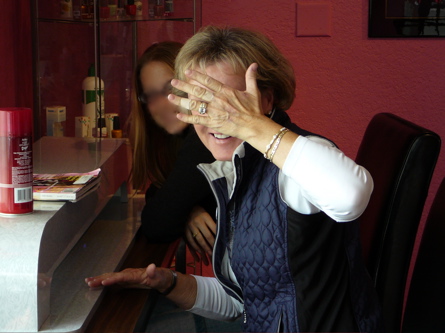
And today, your birthday, will also be the christening of your first grandchild.
How amazing, how wonderful. You are in my thoughts, dear sister, and I wish I could be there to celebrate with you.
Rules of Engagement
As you know, I am from a very close, very funny family. Earthling, my nephew, just got engaged.
We’ve all been waiting. Almost from the beginning, we knew this girl was THE ONE. We almost always know. They announced their engagement by sending a series of photos of a hike they took near Google Valley in California, including the photo of the bride-elect and her new ring. We are dancing for joy, that these two dear people have found one another and are committing their futures to one another.
And – the bride-to-be has started a blog called Rules of Engagement. She is a very funny, very clever writer, and will take you step by step through the travails of an American style wedding.
Enjoy!
Recent Comments
intlxpatr on Shampoo Ginger tigerbutterya0c5ff1d… on Shampoo Ginger intlxpatr on British Soldier Kidnapped, Esc… John on British Soldier Kidnapped, Esc… intlxpatr on British Soldier Kidnapped, Esc… Wikipedia Donate Button

Amazina


Early Voting in Florida


