The Kuwait Church Souk
In Kuwait, as in most of the Middle East, in the shopping areas, shops that sell the same kind of goods are grouped together. “Souks” in the traditional shopping areas are small stalls, or open displays, thus all the vegetable vendors are grouped in one area, the perfume dealers in another, the cloth dealers in another. It is handy – when you go looking for something, if one shop doesn’t have it, another surely will.
I remember once looking for masonry screws in Doha; when the first stall didn’t have it, he left his stall – and all his merchandise, unprotected – and took me to his friend, who did have them. Sometimes a stall owner will send a helper to another store, and return with the item you are seeking.
Even some of the large malls seem to group similar vendors in the same spots. In Saudi Arabia, I remember entire floors devoted to shoes, or to abayas, or to accessories, or cloth and tailors.
So it gives me a big grin to go to churchin Kuwait on Fridays.
Friday mornings are sleepy in Kuwait. It’s a day off for the majority of the population, and Moslems go to the mosque for Friday prayers around noon. In the middle of downtown Kuwait, however, even early on a Friday morning, there is a hive of activity – at what we call the “church souk”.
It’s really a very clever concept, and also one that tickes my heart. In one area are many many churches. They are all Christian, and range from congregations of mainly Indian men, to Phillipino families, Nigerians, Chinese, Western, Baptist, Evangelical, Catholic, Orthodox, at least one congregation which has live musicians playing loud, joyful hymns and then more staid and traditional congregations.
I’ve often wondered how all these different congregations manage to work out a schedule – there must be at least 10 – 12 different meeting locations – for sharing the chapels, for managing the time needed to get people seated, and then to clear up and get people out again. It’s exactly these kinds of little bureaucratic quibblings that can stir up a hornet’s next of problems between “like minded” believers. If there are problems, the church leaders seem to work them out without acrimony. I wonder how they do that?
In my heart, I believe this is how we were meant to worship – and although our worship has different styles, it delights me that we all – hundreds of us, if not thousands – meet in the one area, every Friday, and have the freedom, here in Kuwait, to worship each in our own style. That’s a very powerful freedom.
Adventure Man’s Diet
My husband, the great Adventure Man, said that his idea of a diet was being married to a woman who was sometimes so busy with her hobbies that she doesn’t have time to fix dinner and he has to eat peanut butter and crackers. It’s true. Sometimes I lose track of time. Fortunately, he LOVES peanut butter and crackers.
The bottle of peanut butter we were working on – more than half finished – was one of those bottles recalled for contamination. Ugh. Great weight-loss peanut butter. 😦
Peeking Inside
You are a blessing in my life.
You think you are just blogging, but for me, you allow me to get a little bit beneath the surface of what your lives are like here in Kuwait.
I have to assume that most of you, like me, protect a lot of realities in your life, and that I am just getting the surface, just getting what you feel comfortable sharing with me.
And yet . . .no matter how superficial the “peek,” it is better than nothing.
Over time, we build a body of work. No matter how discreet we are ( Little Diamond I almost wrote “discrete,” and thinking of your pet peeve, checked it, thank God!) we reveal how we think, and what is important to us.
I love having some Kuwaiti friends. You teach me things I could never learn in a million years, just looking from the outside.
True story: I am having breakfast with my Kuwait friend at the Al-Kout Mall and she shivers. This friend is very special to me; it’s as if a flame burns inside her, keeping her pure and true from the inside out.
“I feel so out of place here!” she says.
I am truly bewildered.
“You are Kuwaiti! This is a Kuwaiti Mall!” I cry. “What is it that makes you so uncomfortable?”
“It’s like another world,” she says. “I’m not dressed conservatively enough.”
She is dressed in jeans – not tight. A t-shirt – not tight. And has a long sleeved shirt to go over it tied around her shoulders. She is entirely modest.
“I don’t see it,” I say. “Please, let me see through your eyes. What are you seeing, how is it different, why are you uncomfortable?”
“You’ve been to Marina Mall,” she responded. “You can see the difference?”
Of course. But Marina Mall . . . it is kind of a la la land to me, sort of bizarre. It almost looks Western, but there are things that are just not quite right . . .
“Yes,” she said. “You’ve got it.”
I still don’t know what I’ve got. So she starts explaining . . .”Look, you can see how the thobes are cut differently down here, tighter around the chest.”
(Uh . . . no, I can’t see!)
“. . . and the cuffs, the way they button. And the shoes are different, less . . . . ”
all of a sudden, I am thinking of my friend who taught Arabic, and the hours she labored, trying to get me to hear the difference between the light “t” and the hard “t”, I am trying and trying, but I don’t get it and then one day – I do!
I thank God for you, my friends, letting me see through your eyes, helping me understand, giving me new ways of seeing the world.
You All Look the Same to Us
“Which one is Noriko?” my instructor asked me.
“She’s Japanese, ” I responded, “She sits between Katrina and Joyce.”
She looked up at me and grinned.
“We can’t tell you apart, you know,” she laughed. “You all look the same to us. It takes us weeks, even months, to be able to tell you apart.”
Maybe I should have been offended, but I wasn’t. My class was made up of Europeans, Americans, Asians – people from all over the world who wanted to learn Arabic. It was funny to me that she couldn’t tell us apart, but I often have the same problem – I’m bad with faces. When you’re the teacher, looking out at a sea of faces – it takes a while.
But it has become a family tag-line, a joke – “You all look the same to us”.
Even After All this Time – Latifi
A good book can make your blood race faster. A good book may even require underlines, turned page corners to mark the places you liked the best. A good book may compell you to tell others about it. Above all, a good book is a book you think about long after you have turned the last page.
Some of my best “good books” come to me through Little Diamond, my neice who lives in Beirut. We share a family culture, but even better, we share a wacky sense of humor. There are times we can’t even let our eyes meet in family gatherings, because we are thinking the same thing and can’t afford to laugh out loud.
She recommended this book to me more than three years ago, and I bought it immediately. And then it sat in my “read me soon” pile(s), languishing, unread, until early this year.
Oh, what a treat this book is! Once I picked it up, I could hardly put it down!

The book is autobiographical, and begins in pre-revolutionary Iran, where Afchineh Latifi’s father is a soldier. You see the early years of her life with her sweet, struggling parents, and you feel like you lived in their home with them, the images are so vivid.
As a military officer, though, her father is suspect once the revolutionaries come into power, and her family’s fortunes fail. Her father is arrested. As Latifi’s mother bravely goes from jail to jail, trying to find her husband, her daughters are often with her. Once she finds him, she brings him comfort items – shaving kit, washcloth, etc. so he can maintain a small amount of dignity while he is being beaten and imprisoned. Latifi’s mother was young when this book opens, maybe in her thirties, with two daughters and two sons, and I am totally blown away by the courage it took to persist as her husband was transferred from prison to prison, increasingly brutalized, and then, immediately after the last visit – shot. So immediately that the family heard the shots.
And then the real nightmare begine. The young mother and her family have no income, and her (now dead) husband’s mother claims her house, even though they bought her a house of her own while her husband was alive. Latifi’s Mom never gives up. She gets her daughters visitor’s visas to Austria and puts them in a convent school, and then gets them to America – again on visitor’s visas – where they are forced to camp – for years – with a relative. Literally, years. Their brave mother eventually manages to get herself and her sons out of Iran, and join them in the US.
Their mother is a pistol. She is brave in the face of obstacles that would deter most of us. She never gives up. I am in total awe of her commitment to the survival – and thriving – of her family.
I love this book for two reasons – the first being the strength and courage of this family, and the second being that they immigrated to America. You will hear a lot of Americans who say terrible things about immigrants, and how they take up scarce resources better meant for “real” Americans. Who are they kidding? We are ALL immigrants, in America, except for the Native Americans! This family, their will to succeed, is the story of us all, and what makes the country great. It is still a country where you can work hard, and succeed, and thrive. It’s an every day story in our country, but a story I never get tired of hearing.
Here are some excerpts from the book:
She looked at me as if I were an alien, which in fact I was. “Yes,” she said, “You get a library card and you can borrow as many books as you want.”
“And it doesn’t cost a thing?” I asked.
“Not a penny,” the woman said. “Unless you bring the books back late. Then we charge you a late fee.”
This was news to me. There were libraries in Tehran to be sure, but we had never frequented them. Mom would come home every two or three weeks with armsful of new books, and we would devour them hungrily. We were much too spoiled to share books with anyone.
The librarian processed my card on the spot. I couldn’t believe it. It felt like the biggest gift of my life. . . . . By the end of the summer I discovered a whole new world. Books. Words. Stories. I got in touch with my inner geek. Reading was not only exciting, it offered escape. When I was reading, my other life didn’t exist. There were days when I didn’t even think of Mom.
Her Mother was still in Iran at this time, and she and her sister are living with relatives who have loud arguments wondering how much longer they will be burdened with these girls. Finally, the two sisters find jobs, as well as going to school, and save every penny, and get an apartment where they live while putting themselves through university. And, one day, their mother and brothers arrive. Life changes. They all live together again.
“It’s almost Norouz,” she said. “Or have you forgotten?”
I had indeed forgotten. She was referring to the Persian New Year, which on the Gregorian calendar falls in late March. About two weeks before the start of Norouz, many Persians take part in something called ‘khane tekani,’ which literally means ‘shaking your house.’ You will see people painting their homes, washing their carpets, sweeping out their attics, cleaning their yards. One could say that it is a form of spring cleaning, but that is only a very small part of it. In Persian ‘no’ means new, and ‘rouz’ means day. The last Wednesday of the year is known as ‘chahar shanbeh suri.’ At dusk, with the cleaning over, people light small bonfires and sing traditional songs, and those who can manage it are urged to jump over flames. Fire, too, is seen as a cleansing, purifying agent: it burns away all the negative things in one’s life – the bad habits, the misfortune, the sorrows. It’s all about cleanliness: clean house, clean soul, new beginnings.
On the “new day” itself, people focus on family and friends, and for the next two weeks there will be much visiting back and forth. In each house, one finds a ‘sofreh eid,’ . . . Laid out on this garment, one will find the ‘Haft Seen’ (Seven S’s) comprised of seven items that begin with the letter S. These are ‘sabzeh’ or sprouts (representing rebirth); samanu, a pudding (for sweetness in life); ‘senjed,’ the sweet, dry fruit of the lotus tree (representing love); ‘serkeh’ or vinegar (for patience); ‘seer’ or garlic (for its medicinal qualities); ‘somaq’ or sumak berries (for the color of sunrise); and ‘seeb’ or red apples (symbols of health and beauty. In addition there are candles laid out on the ‘sofreh eid” one for each member of the household. The lit candles represent the goodness and warmth that enter life with the coming of spring.
(For the first time, this year we are invited to a new year’s celebration, and I thank God that I read this book just at the right time, so I will know even just a little of what this is all about. I am excited to see the ‘haft seen.’ )
Something else happened that November that I will never forget: Our family celebrated Thanksgiving for the first time. We loved the whole idea behind the celebration. It wasn’t about religion, and it wasn’t about gifts; it was about people sitting down to enjoy a meal together and acknowledging everything that they had to be thankful for. And we had a lot to be thankful for.
By the end of the book, all four children have graduated from university with professional degrees. This isn’t a spoiler. The book is about the sacrifice, the hard work and the commitment it took to get them there. Even After All This Time is an inspirational book, a book you won’t soon forget, and a book you will want to share with your friends.
Amazon offers it used from $4.67 and in hardcover around $25.
And Happy New Year to my Persian friends.
This Little Eggy
I was with my sweet friend and many of her 12 children, and I was goofing off with the younger ones, running, chasing. With tiny Abdulaziz, I started playing with his toes.
“This little . . . ” I started, and then caught myself in horror. The next word is “piggy” and my friends are devout Muslims.
She just laughed.
She said “Oh we do this too! We say ‘this little eggy went to market and this little eggy stayed home'”.
Oh! Thank goodness! Every child around the world loves that game; I’m so glad I can continue to play it here!
Kiss the Kuwaiti Police
In the middle of the night last night, I was wide awake. The Qatteri Cat and I watched a police stop outside our window for about an hour.
I am guessing it was a combination traffic stop and training session. There was one guy who would gather the rest together when there were no cars and give additional techniques to the less-experienced traffic policemen. I am guessing, because there is no way on earth I would go out and ask!
Policeing in Kuwait is SO different. These young men are very professional. They were looking for people without driver’s licenses and / or without registrations. They had very cleverly positioned themselves so once the car was on the road, there was no way out but to go through them. Very strategic, very professional.
“So what is so different?” you might wonder, if you live in France, or Germany, or China or the US. “Isn’t that what police do?”
Yes. And no. One of the last people caught in the web was an old man traditionally dressed in thobe and gutra and egal, and he tried to get through by pretending he didn’t see the police. He didn’t have the right papers.
In my country, just trying to get through would get him into trouble.
He had to park, and get out of the car. Then, he went to each policeman and reached out with his right hand to take the policeman’s left arm, then he kissed them, on the nose or on the right cheek, and greeted them, still holding their arm or hand.
And the police treated the old man with deference, and kindness – and firmness. He still didn’t have the right papers. At one point, he pushed a policeman lightly, and the policeman didn’t go ballistic, but he gently pushed the old man back, out of his face. Finally, it was time to move the traffic stop, and they let him go, but I am guessing that, as the Kuwait Times always says “a case will be filed.” It did not look like he was getting off scot-free; the old man looked very unhappy.
I went back to bed happily, thinking how shocked our police would be, how they would react to someone holding their hand and kissing their nose, and drifted back to sleep with a big grin on my face.
Risk Taking Men Found Less Attractive
Risk-taking men ‘not attractive’ from BBC Health News.
Women are not attracted to dare-devil men, US researchers believe.
Men thought the opposite sex would be attracted by risky stunts such as bungee jumping and fast driving, a study of 48 men and 52 women found.
But in contrast, women said it was a turn-off, claiming they preferred more cautious people for partners.
However, the team from the University of Maine in Orono said those who took risks for the thrill were likely to be respected by fellow men.
Lead researcher Dr William Farthing said: “Men thought women would be impressed by pointless gambles, but women in fact preferred cautious men.”
However, Dr Farthing said women were attracted to men with a high-status, so if the risk-taking meant a man was respected by his friends they could then become attractive.
During the research, reported in New Scientist magazine, the young people were all given a series of scenarios to choose from, including saving someone’s life and fast driving.
The participants were asked to decide which they found more attractive.
The majority of women choose an altruistic action, rather than a thrill-seeking scenario.
Dr David Lewis, a member of the British Psychological Society, said in many ways the findings were not surprising.
“Previous studies have show that women are attracted to someone who acts in an altruistic way. Saving someone’s life shows a degree of empathy and sensitivity, and this is an attractive trait in men.
“On the other hand men see risk-taking as a particularly macho characteristic.
“Social norms are important and our society attaches weight to men expressing their macho qualities.
“But I think what you would find is that as men get older, they become less prepared to take risks.
“When you decide to do something you attach a cost-benefit to it, and when men are older the priorities they place on things change.”
Something in the Way She Moves . . .
From BBC Health News.
Attraction ‘determined by walk’
There really is something in the way she moves, according to researchers.
An hourglass figure has long been perceived to be the ideal figure for a woman to have.
But New York University researchers have found that to be found attractive, a woman had to move in a feminine way – swaying her hips.
Men, the Proceedings of the National Academy of Sciences paper found, were more attractive if they moved with a “shoulder swagger”.
The waist-hip ratio has long been thought to be key to Western perceptions of attractiveness, with a small waist and bigger hips the ideal combination.
Marilyn Monroe, and now Beyonce and Jennifer Lopez are famous examples of women with that figure.
Its popularity may be down to media images, or because Western women do not need to have strong and muscular bodies in order to carry out manual labour, unlike women in developing countries.
But the US research suggests they would never have achieved their sex symbol status if they did not move in the right way.
Not just measurements
The team carried out a series of studies involving over 700 participants who were shown a variety of animations and videos of people moving.
Some showed shadow figures, where it was not possible to see if it was a man or a woman, while others obviously showed a man or a woman.
No matter which format was being used, the participants rated women or “female” figures as more attractive if their hips swayed as they walked, while men were more attractive if they had the characteristic shoulder movement.
The research also confirmed the waist-hip ratio assumption, with women’s attractiveness being rated higher if their waist-hip ratio was small and men’s being higher if their’s was large.
But Kerri Johnson and Louis Tassinary who led the research, say their work shows attractiveness is not as simple as the difference between two measurements.
Writing in PNAS, the researchers said: “The body’s shape and motion provoke basic social perceptions, biological sex and gender – ie masculinity or femininity respectively.
“The compatibility of these basic precepts predicts perceived attractiveness.”
The team say their findings only apply to Western cultures, and other societies will judge attractiveness depending on their most prized feminine and masculine traits.
Dr George Fieldman, principal lecturer in psychology at Buckinghamshire Chilterns University College said: “This is quite plausible.
“It’s the movement which attracts, and not just the waist-hip ratio per se.”
He added: “It would be interesting to see what the ideal combination of measurements and wiggle is.”
The Wire
A couple years ago our son started talking to us about The Wire. He always puts us on to really interesting series. The Wire is an HBO series, like Rome
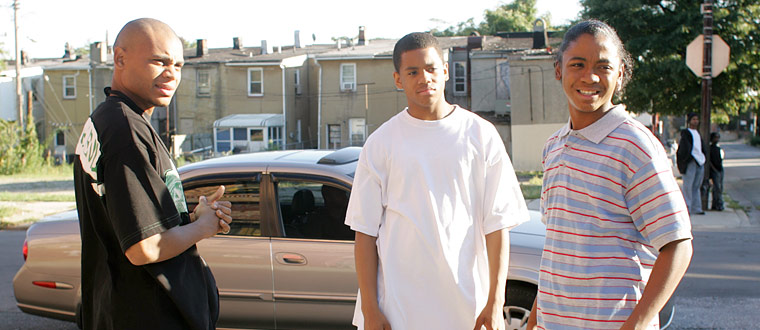
Season 1 starts with a new unit being set up to interdict the drug trade in Baltimore. Season 2 re-unites the team to combat illegal imports and illegal importation of sex slaves out of Eastern Europe and Asia. Season 3, my favorite season of all, is back to the drug trade, but with a difference.
In Season 3, one police district changes the rules. They clean up their neighborhood and send all the drug traders and sex trade workers to one area. The area doesn’t legalize crime – not exactly – but the police leave that area alone. As they explain it to the primary drug dealers, it’s a little like Amsterdam. The homies don’t understand; they call it “Hamsterdam”. I laugh everytime I hear it.
The series doesn’t focus strictly on the police – we get to go inside to watch how the drug dealers organize and divide up the city. We learn how drug lords use big business management modules to streamline their supply and demand, and to stay ahead of the police technology. And they are masters at manipulating the judicial system.
There is brutality. There is sex. There is love and there is betrayal. Sometimes, it isn’t easy to tell who the “good” guys are. There are bad guys who show decent values and there are police and politicians on the take. You get the impression it is probably pretty real stuff. In one season 3 episode, a policeman is shot in the line of duty, and they hold a wake in an Irish pub. They are all very very drunk, and vomiting out in the streets. It isn’t pretty.
And all the same, when each season ends, we can hardly wait for the next one. It is gripping drama, vintage HBO cutting edge production. It keeps you on the edge of your chair. You can read more about The Wire at it’s HBO site, where I just learned that The San Francisco Chronicle calls The Wire “the best television show of the year.”
Recent Comments
intlxpatr on Shampoo Ginger tigerbutterya0c5ff1d… on Shampoo Ginger intlxpatr on British Soldier Kidnapped, Esc… John on British Soldier Kidnapped, Esc… intlxpatr on British Soldier Kidnapped, Esc… Wikipedia Donate Button

Amazina


Early Voting in Florida


