Women Are Women: Abayas and Hijab
One of the questions I get most often when I am back in the US is whether I have to cover, whether I have to wear an abaya, whether I have to cover my hair.
I tell them that in Kuwait, it is still a choice. Many Kuwaiti women do not cover their hair, but most dress modestly and are still traditional and conservative in behavior.
I tell them that in Saudi Arabia, I had to wear the abaya, but that the embassy instructions were to carry a scarf, but only to wear it if the muttawa / religious police made a fuss, as it was not the law of the country. The law stated that Moslem women would be covered, but not non-Muslim women. The Saudi women would tell me all the time that I didn’t have to cover, but when I mentioned the Muttawa – they all just sighed and nodded, and said that some people have a funny idea about religion, but that this was not the real Islam.
What I loved about women in Saudi Arabia is that they have a lot in common with women everywhere. When confined, they have ways to press the envelope. For example, the malls are full of stores with the sexiest shoes I have ever seen – and when feet are one of the few things that CAN be seen, guess where the money gets spent? There were also entire floors devoted to perfumes, and women would pass and you could nearly swoon from the delicious scents, an entire cloud of scents as they passed, cloaked in anonymity. There were glove shops, with the sexiest, laciest gloves you have ever seen. At the time, most of the abayas and scarves in Saudi Arabia were plain black, although occasionally you might see one with a discreet little trim, or a tiny little sparkle.
The kids told me they could tell their family members; they learned to identify posture and voices. They didn’t have any problems picking out their Moms and sisters.
Women would approach me in stores, standing next to me, pretending to examine some goods and whisper “Hi! Where are you from?” and “Do you like it here?” Many times, on planes, husbands would make their wives change places so as not to be contaminated by sitting by the likes of me, a wicked western woman with her hair showing, but the women would smile shyly when the husband was looking the other way. Women are women. We have our ways. We manage to get around restrictions.
On the other hand, I want to share with my Western readers the trend in abayas and scarves in the last few years. They are GORGEOUS, and there are times I am tempted to buy just because they are gorgeous.
On a deserted morning, I found these shop windows to share with you:
These are going-out-calling dresses, worn under abayas

These would probably be worn to an evening event like a wedding

Even the younger girls have special evening clothes
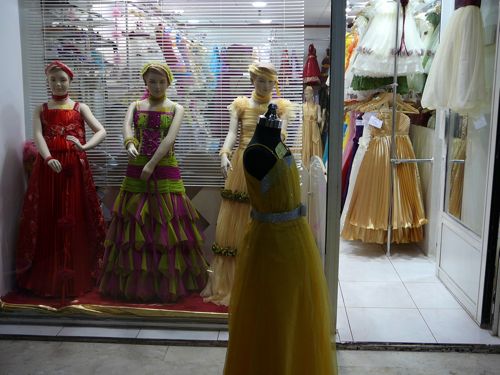
Not your old fashioned abayas

Love these details

Scarves to wear with abaya

Saved by a Scream
This woman had a close call. I am re-assured that the family was taking her to Saudi Arabia to kill her; it implies that the climate in Kuwait does not support honor killings. Another tidbit from the Arab Times:
Screams help officers thwart bid to kill girl for soiling family name
KUWAIT CITY : The Saudi immigration officers manning the Al-Riqei border post are said to have reportedly foiled an attempt by an unidentified GCC family to kill their daughter to save their honor, reports Al-Watan Arabic daily.
According to a security source the parents with the daughter and another sibling traveled to Salmi post and to prevent the ‘victim’ from screaming for help the family’s relative who allegedly works at the post hurried through the process of stamping the passports to help the family cross into Saudi Arabia as the family waited in their car.
When the girl reached the Saudi border post she screamed for help and told the immigration officers that her father planned to kill her.
The family was temporarily detained at the post until the Saudi authorities contacted the authorities in Kuwait. After the family was returned to Kuwait under guard, the relative who helped them at the Salmi post was arrested and detained for interrogation.
The daily said it is a case of ‘honor killing’. The girl was reportedly involved in an affair with an unidentified youth inside an apartment in Salmiya and she became pregnant.
Meanwhile, the Al-Anba daily added, when the girl was in police custody the brother grabbed his younger sister and threatened to shoot her in front of the building of the Criminal Investigations Department.
He was demanding the release of his other sister who was caught having fun with the youth inside an apartment after a missing person report was filed against her.
A police sniper shot the man in the arm and rescued the younger sibling.
I can’t imagine her life will be easy, if she is pregnant, unmarried, and has a family who wants her dead. I can’t imagine that Kuwait has social services that can help her negotiate a path. Life will be difficult, but it sure beats what was about to happen to her in Saudi Arabia.
Who Will Tell the People?
This was the #5 e-mailed article from this week’s New York Times. It is a hard-hitting warning to Americans in an election year, and it has some analogies to election time in Kuwait.
By THOMAS L. FRIEDMAN
Published: May 4, 2008
Traveling the country these past five months while writing a book, I’ve had my own opportunity to take the pulse, far from the campaign crowds. My own totally unscientific polling has left me feeling that if there is one overwhelming hunger in our country today it’s this: People want to do nation-building. They really do. But they want to do nation-building in America.
They are not only tired of nation-building in Iraq and in Afghanistan, with so little to show for it. They sense something deeper — that we’re just not that strong anymore. We’re borrowing money to shore up our banks from city-states called Dubai and Singapore. Our generals regularly tell us that Iran is subverting our efforts in Iraq, but they do nothing about it because we have no leverage — as long as our forces are pinned down in Baghdad and our economy is pinned to Middle East oil.
Our president’s latest energy initiative was to go to Saudi Arabia and beg King Abdullah to give us a little relief on gasoline prices. I guess there was some justice in that. When you, the president, after 9/11, tell the country to go shopping instead of buckling down to break our addiction to oil, it ends with you, the president, shopping the world for discount gasoline.
We are not as powerful as we used to be because over the past three decades, the Asian values of our parents’ generation — work hard, study, save, invest, live within your means — have given way to subprime values: “You can have the American dream — a house — with no money down and no payments for two years.”
That’s why Donald Rumsfeld’s infamous defense of why he did not originally send more troops to Iraq is the mantra of our times: “You go to war with the army you have.” Hey, you march into the future with the country you have — not the one that you need, not the one you want, not the best you could have.
A few weeks ago, my wife and I flew from New York’s Kennedy Airport to Singapore. In J.F.K.’s waiting lounge we could barely find a place to sit. Eighteen hours later, we landed at Singapore’s ultramodern airport, with free Internet portals and children’s play zones throughout. We felt, as we have before, like we had just flown from the Flintstones to the Jetsons. If all Americans could compare Berlin’s luxurious central train station today with the grimy, decrepit Penn Station in New York City, they would swear we were the ones who lost World War II.
How could this be? We are a great power. How could we be borrowing money from Singapore? Maybe it’s because Singapore is investing billions of dollars, from its own savings, into infrastructure and scientific research to attract the world’s best talent — including Americans.
And us? Harvard’s president, Drew Faust, just told a Senate hearing that cutbacks in government research funds were resulting in “downsized labs, layoffs of post docs, slipping morale and more conservative science that shies away from the big research questions.” Today, she added, “China, India, Singapore … have adopted biomedical research and the building of biotechnology clusters as national goals. Suddenly, those who train in America have significant options elsewhere.”
Much nonsense has been written about how Hillary Clinton is “toughening up” Barack Obama so he’ll be tough enough to withstand Republican attacks. Sorry, we don’t need a president who is tough enough to withstand the lies of his opponents. We need a president who is tough enough to tell the truth to the American people. Any one of the candidates can answer the Red Phone at 3 a.m. in the White House bedroom. I’m voting for the one who can talk straight to the American people on national TV — at 8 p.m. — from the White House East Room.
Who will tell the people? We are not who we think we are. We are living on borrowed time and borrowed dimes. We still have all the potential for greatness, but only if we get back to work on our country.
I don’t know if Barack Obama can lead that, but the notion that the idealism he has inspired in so many young people doesn’t matter is dead wrong. “Of course, hope alone is not enough,” says Tim Shriver, chairman of Special Olympics, “but it’s not trivial. It’s not trivial to inspire people to want to get up and do something with someone else.”
It is especially not trivial now, because millions of Americans are dying to be enlisted — enlisted to fix education, enlisted to research renewable energy, enlisted to repair our infrastructure, enlisted to help others. Look at the kids lining up to join Teach for America. They want our country to matter again. They want it to be about building wealth and dignity — big profits and big purposes. When we just do one, we are less than the sum of our parts. When we do both, said Shriver, “no one can touch us.”
Today’s Crack-Up
From today’s Kuwait Times:
Citizen Sneaks
Border police detained a Kuwaiti citizen for attempting to sneak through the Salmi Border on foot to enter Saudi Arabia. They approached the man thinking he was a sheep, as he was wearing sheep wool to disguise himself.
On questioning him, he said he was banned from leaving the country due to alcohol cases pending against him so he planned to sneak into Saudi Arabia.
This cracks me up on so many levels. First, just the visual, the idea of a man wearing a sheep’s pelt to sneak across the border. Second, a man with alcohol problems wanting to sneak into Saudi Arabia, where alcohol is slightly less friendly to alcohol than Kuwait. You have to wonder if he was sober when he donned the sheep’s pelt?
Not New News
Just as the Qatteri Cat monitors traffic in front of our place, I monitor my blog traffic – a lot like Qatteri Cat, sort of lazily, desultory.
Yesterday, I got the most hits – a lot – on MOC bans Porno Film Sites, a post I wrote almost a year ago.
80 hits. That’s a lot for a post almost a year old. Why so much interest? Are there new movements afoot in the Ministry of Communication to ban undesirable content? Are there new technologies available that make that possible?

I knew exactly the kind of photo I wanted to include here, so I googled “saudi censorship image” and found this wonderful blog: Your World Today. I really like his blog.
Saudi Women Only Hotel
From today’s BBC News:
Saudis open hotel for women only
The Middle East’s first women-only hotel has opened in Saudi Arabia.
It will cater primarily to businesswomen, who work completely covered from head to toe in public and have to observe strict segregation.
The hotel, in Riyadh, has 25 rooms and boasts fine dining and conference facilities, as well as a range of health and beauty treatments.
Its executive director said the response to the idea of a hotel just for women had been overwhelming.
The Luthan Hotel & Spa is owned by a group of 20 Saudi princesses and businesswomen.
It hopes to attract expatriates from the nearby diplomatic quarter as well as local women.
It is the first spa hotel in the kingdom available to women all the time – pools in other hotels are only open to women on certain fixed days or hours.
You can read more about the hotel HERE
History of Architecture in Old Kuwait City (5)
One last quote from this wonderful book by Saleh Abdulghani Al-Muttawa, because it summarizes his ideas on what makes house practical for the weather and customs of this region:
Cultural Response
. . .the major critical cultural and customs problems which concern housing are;
1. Privacy for female inhabitants
2. Separation between female and male guests, and separation between guests, in general, and house members.
3. Future family expansion
. . . The approach to solving those critical problems are as follows:
1. To assure privacy for family members, and especially female members. The family part of the house has been pushed all the way to the back; in other words, it is on the north side far away from the street. It is difficult, or impossible, for anyone passing by the house to be able to look through and see the inside, especially with all those trees and plants placed in front of the house. Another conservative step has been taken by separating the family entrance from the guest’s entrance, and placing the family entrance close to the driveway and the garage for easy and private access. All that gave the female members of the family more free and secured mobility inside the house.
2. The prototype design provides a separate quarter for the guests, “Dewania.” The “Dewania” is placed on the southern side of the house away from the family entrance, to provide privacy for both family members and guests. The “dewania” is actually divided into two “dewanias,” female “dewania” and male “dewania.” For more seclusion and privacy of both sexes, the entrance of the female “dewania” is placed on the west side and the entrance of the male “dewania” is placed on the east side. Both entrances are close to the main road to make it more convenient and easy for the guests to come in and out. Each “dewania” has its own bath. There is only one dining room, because most of the time only men stay for dining. (Women have to go home to cook for their families.) If it happens that both sexes stay for dining, women can be accomodated in their “dewania.” A collapsible partition is placed in between the two “dewanias.” In big events like wedding parties or feasts, the partition can be collapsed, so the space would be large enough for a sizable number of people.
In a post last week, How decisions are made in Kuwait we had a long discussion about diwaniyas in the comments section. What I like about al-Muttawa’s concept is that collapsible wall in between the female and male diwaniyya. It could allow the females to listen in on major political discussions – what? You think we aren’t interested? You are wrong! – and participate.
“How can they participate while separated?” my western friends will be asking.
There are emmisaries. When sitting with the women, in Saudi Arabia, I wondered at first how my husband and I would both know when it is time to go. In western society, we have a meeting of the eyes and my husband will give an almost imperceptible nod and I know it is time to begin to make our farewells. As the hour got later and later, and still later, I finally asked one of the women how I would know when my husband wanted to leave.
“You want to leave?” she gasped in horror!
“No, No!” I assured her, “I just don’t know how I will know when my husband wants to leave!”
“Your husband will send for you! The children will tell you!” she laughed, and I stopped worrying. The children were running back and forth from room to room, reporting on the happenings in the men’s diwayya, where a holy man was discussing morality and requirements of morality.
This was one of my favorite places in Saudi Arabia, the house of friends. In the women’s majlis, there was only a TV, and seating around all the walls. There was nothing on the walls, nothing, not a picture, not a calligraphy, nothing, but the furniture was strong and comfortable, and the hospitality never-ending. When dinner time came, we went to an adjacent entirely bare room, bare except for the lavish dinner laid on the floor, where we all sat and ate, and one huge cupboard, full of mattresses. The dining room became one of the sleeping rooms when all the guests departed.
I didn’t get a tour of the house; I only know what I saw from my entrance through the family entrance into the female part of the house, my brief glimpse of the kitchen area – large and utilitarian. What I remember most clearly was the love and joy in the family, and that all the walls were totally devoid of anything decorative.
+ + + + + +
When I came to live in Kuwait, the real estate people showed me 20 villas and one apartment. The villas, each and every one, were HUGE! Most of them were three or four floors, more than one had an elevator, and several had their own swimming pools.
Most of the houses had a large kitchen – separate from the house, outside! Alongside it were the quarters for the maids, the drivers, the guard, etc. Most of the houses had at least five bedrooms, at least two diwaniyyas.
In the newer areas, there was barely two feet between houses, so windows on the sides of the houses were non-existent, or heavily curtained over, making those rooms very dark. In the older houses, the bathrooms were small and the spaces were divided strangely, by western ways of thinking.
Mostly, though, the villas were lovely, full of luxurious materials and beautiful touches. As I would walk though, sounds bounced off the thick cinderblock walls and the marble floors.
AdventureMan works long hours. I would think of me and the Qatteri Cat bouncing around in the huge house like two little peas in a big bowl, and where would I find him if he hid out for a while? The villas were just too much space for our little family, and we opted for the apartment, although the apartment is bigger than many homes in the United States. AdventureMan and the Qatteri Cat still look at me accusingly from time to time; they always enjoyed an hour or two together in the garden on Friday mornings, and now we have no garden. . . all we have (I can’t even keep a straight face as I write this) is that glorious 24-hour-a-day 180° view of the Arabian Gulf. 😉
+ + + + + + +
If I ever see this book for sale, I will come back here and update. If YOU see it for sale, please come back here and let us know!
Saudi Men Arrested for Flirting
This is in today’s BBC News.
Saudi men arrested for ‘flirting’
Relations between the sexes outside marriage is against the law
Prosecutors in Saudi Arabia have begun investigating 57 young men who were arrested on Thursday for flirting with girls at shopping centres in Mecca.
The men are accused of wearing indecent clothes, playing loud music and dancing in order to attract the attention of girls, the Saudi Gazette reported.
They were arrested following a request of the Commission for the Promotion of Virtue and Prevention of Vice.
The mutaween enforce Saudi Arabia’s conservative brand of Islam, Wahhabism.
Earlier in the month, the authorities enforced a ban on the sale of red roses and other symbols used in many countries to mark Valentine’s Day.
The ban is partly because of the connection with a “pagan Christian holiday”, and also because the festival itself is seen as encouraging relations between the sexes outside marriage, punishable by law in the kingdom.
You can read the whole article HERE.
I wonder . . . is this what is going to happen in Kuwait? So like they segregate the university. . . then they segregate all the schools, EVEN THE PRIVATE SCHOOLS, so there is no choice. . . then they start patrolling the malls?
I lived in Saudi Arabia, and I remember the mutawaaeen were NOT police, but sometimes they took on the prerogatives of the police. So I have to wonder, like who made the arrest in the malls? Was it the police? Was it the mutawa hitting the boys with their little sticks? Did they call the boys parents? I have SO many questions!
As It Snows . . .
Catching up with the news, I was looking at the Thursday Kuwait Times when I came across a photo. I am not going to print the photo in my blog, but if you want to look at it, or one like it, you can see it at Yahoo News, just click here on the blue type.
The photo of the execution, titled Iran hangs 13 on a single day is extraordinary enough. I don’t think we print those kind of photos in American newspapers. Maybe in the tabloids; these photos are considered disturbing. I know they disturb me. This one in the Kuwait Times has big white balls in it and the caption reads: QOM, Iran: Three Iranian drug traffickers hang limply from the nooses as it snows in a square in this central city yesterday.
I remember cutting out a similar one from a paper in Saudi Arabia when I lived there. It didn’t have a photo, but the article was about the Taliban hanging of a convicted man in the stadium in Kabul. It stated the man was wearing a blue sharwal khamis. There was no mention of why this man was hung, of what he was convicted.
The Yahoo version of the same hanging of 13 states: Three Iranian drug traffickers hang limply from the nooses after being executed in a square.
To me, the mention of snow falling as people are executed, of the executed man seems . . . maybe poetic? Maybe some way of softening the horror? I don’t know. It’s not something we would do. Bad news is left bare, without a lot of dressing it up. I would love to get your input on this. For me, it’s a different way of thinking.
Saudis Uphold Rape Victim Penalty
Several bloggers have brought this situation to public attention; BBC provides the full update HERE:
Authorities in Saudi Arabia have defended a judicial sentence of 200 lashes for a rape victim.
The justice ministry said in a statement that the sentence was justified because the woman was in a car with an unrelated man.
The case has aroused controversy at home and condemnation abroad.
The 19-year-old, who has not been named, was travelling in a car with a male friend last year, when the car was attacked by a gang of seven men who raped both of them.
She has become known as the “Qatif girl”, a reference to the largely Shia town which she comes from.
Four of the men were convicted of kidnapping – but the court also sentenced the woman and her friend to receive 90 lashes each for the crime of “illegal mingling”.
Last week the court increased the woman’s sentence to 200 lashes and six months in prison.
It also banned her lawyer from the courtroom and took away his licence.
Most of the world was outraged when the penalty was doubled because the victim went public.
Recent Comments
ExpatAlien on What Country am I Living … intlxpatr on Yellowstone: Old Faithful to C… Michelle on Yellowstone: Old Faithful to C… Cathy on No Grown-Ups in Charge intlxpatr on Waiting for Snow Wikipedia Donate Button

Amazina


Early Voting in Florida


 Here There and Everywhere