Camels Source of MERS?

From today’s BBC News:
Mers coronavirus: Dromedary camels could be source
By Rebecca Morelle
Science reporter, BBC World Service
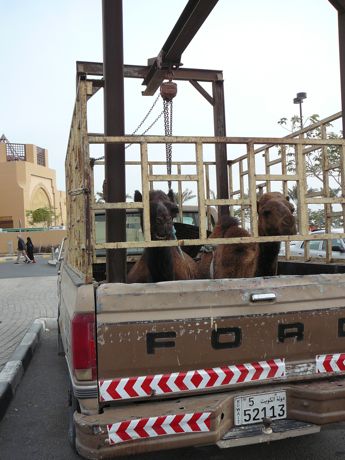
Dromedary camels could be responsible for passing to humans the deadly Mers coronavirus that emerged last year, research suggests.
Tests have shown the Mers (Middle East Respiratory Syndrome) virus, or one that is very closely related, has been circulating in the animals, offering a potential route for the spread.
The study is published in the journal Lancet Infectious Diseases.
But the scientists say more research is needed to confirm the findings.
The Mers coronavirus first emerged in the Middle East last year. So far, there have been 94 confirmed cases and 46 deaths.
While there has been evidence of the virus spreading between humans, most case are thought to have been caused by contact with an animal. But until now, scientists have struggled to work out which one.
‘Smoking gun’
To investigate, an international team looked at blood samples taken from livestock animals, including camels, sheep, goats and cows, from a number of different countries.
They tested them for antibodies – the proteins produced to fight infections – which can remain in the blood long after a virus has gone.
Professor Marion Koopmans, from the National Institute of Public Health and the Environment and Erasmus University in The Netherlands, said: “We did find antibodies that we think are specific for the Mers coronavirus or a virus that looks very similar to the Mers coronavirus in dromedary camels.”
The team found low levels of antibodies in 15 out of 105 camels from the Canary Islands and high levels in each of the 50 camels tested in Oman, suggesting the virus was circulating more recently.
“Antibodies point to exposure at some time in the life of those animals,” Prof Koopmans explained.
No human cases of the Mers virus have been reported in Oman or the Canary Islands, and the researchers say they now need to test more widely to see if the infection is present elsewhere.
This would include taking samples from camels in Saudi Arabia, the country where the virus is the most prevalent.
‘Priority search’
Prof Koopmans said: “It is a smoking gun, but it is not definitive proof.”
Commenting on the research, Professor Paul Kellam from the Wellcome Trust Sanger Institute in Cambridge and University College London, said the research was helping to narrow down the hunt for the source of the virus.
But he told BBC News: “The definitive proof would be to isolate the virus from an infected animal or to be able to sequence and characterise the genome from an infected animal.”
Health officials say confirming where the virus comes from is important, but then understanding how humans get infected is a priority.
Gregory Hartl, from the World Health Organization, said: “Only if we know what actions and interactions by humans lead to infection, can we work to prevent these infections.”
Data suggests that it is not yet infectious enough to pose a global threat and is still at a stage were its spread could be halted.
Saudis Say MERS Virus Not Following SARS Path
What do you think? While ministers in Saudi Arabia seem unconcerned, this virus, which appears to have originated among an as yet unidentified animal in Saudi Arabia, kills about half the people infected with it. And soon, with the Hajj, the Moslem pilgrimage to Mecca, thousands will travel to Saudi Arabia, testing the theory that this virus does not spread easily. . .
Mers: New virus ‘not following Sars’ path’
By James Gallagher
Health and science reporter, BBC News
The new Mers virus, which has killed half of those infected, is “unlikely” to reach the same scale as Sars, ministers in Saudi Arabia say.
Most of the 90 Mers cases reported so far have been in Saudi Arabia.
Mers is from the same group of viruses as the common cold and Sars, which killed 774 people.
However, a detailed analysis of the Saudi cases, published in Lancet Infectious Diseases, did warn of “major gaps” in understanding of the virus.
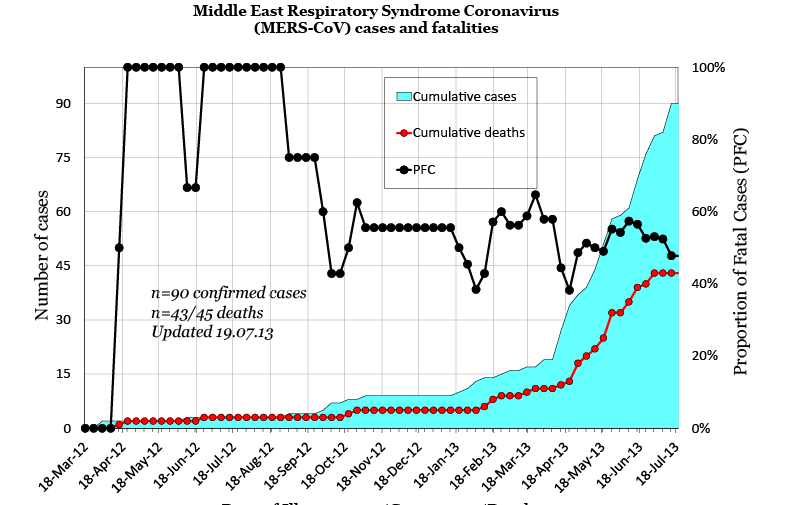
The Middle East respiratory-syndrome coronavirus (Mers) emerged in 2012 and has infected 90 people worldwide, 45 of them have died.
The global concern is that cases could spread much further, echoing the Sars outbreak.
Cases have been centred on the Middle East – with patients in Jordan, Qatar, Saudi Arabia and the United Arab Emirates. Additional cases in France, Germany, Italy, Tunisia and the UK have all been linked to travel to the Middle East.
Researchers in Saudi Arabia have published details of the 47 cases reported in the country.
They suggest a pattern of mostly older men being infected. Most cases were also in people with other medical problems, more than two-thirds of the reported cases also had diabetes.
Low threat
The lead researcher and Deputy Minister for Public Health, Prof Ziad Memish, said: “Despite sharing some clinical similarities with Sars, there are also some important differences.
“In contrast to Sars, which was much more infectious especially in healthcare settings and affected the healthier and the younger age group, Mers appears to be more deadly, with 60% of patients with co-existing chronic illnesses dying, compared with the 1% toll of Sars.
“Although this high mortality rate with Mers is probably spurious due to the fact that we are only picking up severe cases and missing a significant number of milder or asymptomatic cases.
“So far there is little to indicate that Mers will follow a similar path to Sars.”
A report earlier this month showed that the virus struggled to spread in people.
However, it and the latest Saudi investigation both highlighted the need to find where the virus was coming from.
Prof Memish’s report said: “Reducing the rate of introduction of Mers coronavirus into human beings is unpredictable because the source of the virus is not yet known.
“We are searching vigorously for the source.”
Here is a graph from a private report called Virology Down Under, a fascinating read on the identification and development of the MERS Virus by Middle East Respiratory Syndrome Coronavirus (MERS-CoV)..
Last Updated 19-Jul-2013
Written by Ian M. Mackay, PhD on his personal time.
All opinions are his own and do not represent medical advice or the views of any institution.:
“Heavyweight Saudi Arabia” Influence Counters “Over-Stepping” Qatar?
From the Kuwait Times, a fascinating comparative analysis of the influence of Saudi Arabia and Qatar on Islamic countries in transitions:
Qatar losing ground to Saudi diplomacy

DUBAI: Qatar, a key supporter of Islamists who rose to power in Arab Spring countries, is losing ground in regional politics to Saudi Arabia which appears to have seized the reins on key issues, notably Egypt and Syria. The decline in Qatar’s regional diplomacy comes as its powerful emir Sheikh Hamad bin Khalifa Al-Thani unexpectedly abdicated in favor of his son Tamim last month.
The wealthy Gulf state had transformed itself into a key regional player but began to retreat as heavyweight Saudi Arabia re-entered the political arena after lagging behind in the immediate period following the eruption of the Arab Spring uprisings in December 2010. The ouster of Egypt’s Islamist president Mohamed Morsi last week by the army and the election by the Syrian opposition of Saudi-linked Ahmad Assi Jarba as new leader stripped Qatar of strong influence in both countries.
“Qatar had tried to take a leading role in the region but overstepped its limits by openly backing the Muslim Brotherhood in Egypt, Syria, and other Arab Spring states,” said Kuwaiti political analyst Ayed Al-Manna. Jonathan Eyal, head of international relations at Britain’s Royal United Services Institute, argued that Qatar’s regional politics have failed.
“Qatar’s Middle Eastern diplomacy now lies in ruins: it failed to produce dividends in Libya, backfired in Syria and has now collapsed in Egypt,” local Emirati daily The National quoted him on Tuesday as saying. Realizing the damaging effects of their policies, Manna noted, “the Qataris sought to cut down on their commitments” which were already affected by the emir’s abdication and the sidelining of the influential prime minister Sheikh Hamad Bin Jabr Al-Thani.
As a result, “Saudi Arabia, a historical regional US ally, regained its role” in coordination with other oil-rich Gulf monarchies, said Manna. Saudi Arabia’s King Abdullah was the first foreign head of state to congratulate Egypt’s interim president Adly Mansour, hours after he was named to replace Morsi. And on Tuesday, the kingdom pledged $5 billion in assistance to Egypt. The United Arab Emirates, which has cracked down on the Muslim Brotherhood in the past few months, offered Egypt an aid package of $3 billion.
“Saudi Arabia wants to ensure stability in Arab Spring countries, regardless of its ideological interests,” said analyst Abdel Aziz Al-Sagr, head of the Gulf Research Centre. “It had supported the Muslim Brotherhood in Egypt but reconsidered this support after the Brotherhood failed to run the country wisely,” he argued. But the Saudi researcher downplayed the rivalry between Saudi Arabia and Qatar, both of which have been looking to expand their influence during the Arab Spring uprisings and prevent any potential revolt against their own autocratic regimes.
“The Saudi-Qatari harmony still exists and there is no battle for influence between the two countries,” said Sager. And as proof, “Riyadh was the first to be informed of the political change in Qatar, six months before it took place. And it welcomed it.” But the two countries, whose relations have been historically tense or at least marked by mistrust, support two different approaches of political Islam that emerged strongly in the wake of the Arab Spring.
Qatar sides with political parties linked to the Muslim Brotherhood, whose experience was cut short despite the strong media support they enjoyed from the influential Doha-based Al-Jazeera news channel. Meanwhile, Saudi Arabia promotes Salafist groups that focus less on politics and more on implementing Shariah Islamic law on daily life matters such as forcing women to wear a veil and prohibiting the mixing between sexes. Saudi King Abdullah has reiterated his country’s stance against using Islam for political purposes.
“Islam rejects divisions in the name of one party or another,” he said in a statement marking the start Wednesday of the Muslim holy month of Ramadan. The kingdom will never accept” the presence of political parties, that “only lead to conflict and failure.” But regardless of the political agendas of Saudi Arabia or Qatar, the people who rose up during the Arab Spring revolts will have the final word on their own political futures, argued former Bahraini cabinet minister Ali Fakhro. “It is the Arab people, not Qatar nor Saudi Arabia, who will determine the political future of the region.” – AFP
Arabs wary of expressing their opinions online
Fascinating study results published in Qatar’s Gulf Times:

Northwestern University in Qatar has released new findings from an eight-nation survey indicating many people in the Arab world do not feel safe expressing political opinions online despite sweeping changes in the aftermath of the Arab Spring.
From over 10,000 people surveyed in Lebanon, Tunisia, Egypt, Saudi Arabia, Bahrain, Qatar, Jordan and the UAE, 44% expressed some doubt as to whether people should be free to criticise governments or powerful institutions online.
Over a third of Internet users surveyed said they worry about governments checking what they do online.
According to the report, “The implied concern (of governments checking what they do online) is fairly consistent in almost all countries covered, but more acute in Saudi Arabia, where the majority (53%) of those surveyed expressed this concern.”
The study – titled ‘Media Use in the Middle East – An Eight-Nation Survey’ – was undertaken by researchers at NU-Q to better understand how people in the region use the Internet and other media. It comes as the university moves towards a more formalised research agenda and is the first in what will be a series of reports relating to Internet use.
The survey includes a specific chapter on Qatar, the only country where those surveyed regarded the Internet as a more important source of news than television. “We took an especially close look at media use in the State of Qatar – a country with one of the highest Internet penetration rates in the Arab world—and internationally,” said NU-Q dean and CEO Everette Dennis.
These findings follow a preliminary report NU-Q released last April that showed web users in the Middle East support the freedom to express opinions online, but they also believe the Internet should be more tightly regulated. “While this may seem a puzzling paradox, it has not been uncommon for people the world over to support freedom in the abstract but less so in practice,” Dennis explained.
Among other findings, the research shows: 45% of people think public officials will care more about what they think and 48% believe they can have more influence by using the Internet.
Adults in Lebanon (75%) and Tunisia (63%) are the most pessimistic about the direction of their countries and feel they are on the ‘wrong track.’
Respondents were far more likely to agree (61%) than disagree (14%) that the quality of news reporting in the Arab world has improved in the past two years, however less than half think overall that the news sources in their countries are credible.
Online transactions are rare in the Middle East, with only 35% purchasing items online and only 16% investing online.
The complete set of results from the survey is available online at menamediasurvey.northwestern.edu. The new interactive pages hosting the survey on the website have features that allow users to make comparisons between different countries, as well as between different demographics within each country.
Dennis confirmed that the research report is the first in an annual series of reports produced in collaboration with the World Internet Project; one of the world’s most extensive studies on the Internet, in which NU-Q is a participating institution.
NU-Q and WIP signed an agreement earlier in the year, providing a global platform for the current research.
Saudi Arabia Welcomes Friday-Saturday Weekend
From Doha News:
Saudi Arabia’s King Abdullah has issued a royal decree to change the country’s weekend to Friday-Saturday, effective June 29, state news agency SPA reports.
The move, which puts KSA in line with the rest of the GCC countries, was made “for the sake of putting an end to the negative effects and the lost economic opportunities” due to the difference in workdays between the nation and the rest of the world, Riyadh Bureau reports.
It will apply to all government bodies and monetary agencies, including the central bank and stock exchange, SPA said. But schools and educational institutions will maintain the Thursday-Friday weekend until the beginning of the new academic year.
According to Riyadh Bureau:
The change will align banking and business days with most other countries in the region, as well as being closer to the workweek of international financial markets and businesses. Oman was the latest GCC country to shift its weekend to a Friday start last May.
KSA, Qatar’s giant neighbor the west, has been mulling a shift for more than five years, but didn’t move forward previously due to resistance from religious leaders.
New Virus in Middle East Kills 50% Victims
I found this on WeatherUnderground News this morning. What scares me is that there may be more victims, many more, shepherds who work with goats, laborers, people thought to have very bad colds, maybe even pneumonia, who don’t have the kind of money to fly to London to be diagnosed. If one man spread it to two family members, imagine how many people he had contact with on that airplane flying to London.
LONDON, Feb 27 (Reuters) – The emergence of a deadly virus previously unseen in humans that has already killed half those known to be infected requires speedy scientific detective work to figure out its potential.
Experts in virology and infectious diseases say that while they already have unprecedented detail about the genetics and capabilities of the novel coronavirus, or NCoV, what worries them more is what they don’t know.
The virus, which belongs to the same family as viruses that cause the common cold and the one that caused Severe Acute Respiratory Syndrome (SARS), emerged in the Middle East last year and has so far killed seven of the 13 people it is known to have infected worldwide.
Of those, six have been in Saudi Arabia, two in Jordan, and others in Britain and Germany linked to travel in the Middle East or to family clusters.
“What we know really concerns me, but what we don’t know really scares me,” said Michael Osterholm, director of the U.S.-based Center for Infectious Disease Research and Policy and a professor at the University of Minnesota.
Less than a week after identifying NCoV in September last year in a Qatari patient at a London hospital, scientists at Britain’s Health Protection Agency had sequenced part of its genome and mapped out a so-called “phylogenetic tree” – a kind of family tree – of its links.
Swiftly conducted scientific studies by teams in Switzerland, Germany and elsewhere have found that NCoV is well adapted to infecting humans and may be treatable medicines similar to the ones used for SARS, which emerged in China in 2002 and killed a tenth of the 8,000 people it infected.
“Partly because of the way the field has developed post-SARS, we’ve been able to get onto this virus very early,” said Mike Skinner, an expert on coronaviruses from Imperial College London. “We know what it looks like, we know what family it’s from and we have its complete gene sequence.”
Yet there are many unanswered questions.
Spotlight on Saudi Arabia, Jordan
“At the moment we just don’t know whether the virus might actually be quite widespread and it’s just a tiny proportion of people who get really sick, or whether it’s a brand new virus carrying a much greater virulence potential,” said Wendy Barclay, a flu virologist, also at Imperial College London.
To have any success in answering those questions, scientists and health officials in affected countries such as Saudi Arabia and Jordan need to conduct swift and robust epidemiological studies to find out whether the virus is circulating more widely in people but causing milder symptoms.
This would help establish whether the 13 cases seen so far are the most severe and represent “the tip the iceberg”, said Volker Thiel of the Institute of Immunobiology at Kantonal Hospital in Switzerland, who published research this month showing NCoV grows efficiently in human cells.
Scientists and health officials in the Middle East and Arab Peninsular also need to collaborate with colleagues in Europe, where some NCoV cases have been treated and where samples have gone to specialist labs, to try to pin down the virus’ source.
“One Big Virological Blender”
Initial scientific analysis by laboratory scientists at Britain’s Health Protection Agency (HPA) – which helped identify the virus in a Qatari patient in September last year – found that NCoV’s closest relatives are most probably bat viruses.
It is not unusual for viruses to jump from animals to humans and mutate in the process – high profile examples include the human immunodeficiency virus (HIV) that causes AIDS and the H1N1 swine flu which caused a pandemic in 2009 and 2010.
Yet further work by a research team at the Robert Koch Institute at Germany’s University of Bonn now suggests it may have come through an intermediary – possibly goats.
In a detailed case study of a patient from Qatar who was infected with NCoV and treated in Germany, researchers said the man reported owning a camel and a goat farm on which several goats had been ill with fevers before he himself got sick.
Osterholm noted this, saying he would “feel more comfortable if we could trace back all the cases to an animal source”.
If so, it would mean the infections are just occasional cross-overs from animals, he said – a little like the sporadic cases of bird flu that continue to pop up – and would suggest the virus has not yet established a reservoir in humans.
Yet recent evidence from a cluster of cases in a family in Britain strongly suggests NCoV can be passed from one person to another and may not always come from an animal source.
An infection in a British man who had recently travelled to Saudi Arabia and Pakistan, reported on Feb. 11, was swiftly followed by two more British cases in the same family in people who had no recent travel history in the Middle East.
The World Health Orgnisation says the new cases show the virus is “persistent” and HPA scientists said the cluster provided “strong evidence” that NCoV, which like other coronaviruses probably spreads in airborne droplets, can pass from one human to another “in at least some circumstances”.
Despite this, Ian Jones, a professor of virology at Britain’s University of Reading, said he believes “the most likely outcome for the current infections is a dead end” – with the virus petering out and becoming extinct.
Others say they fear that is unlikely.
“There’s nothing in the virology that tells us this thing is going to stop being transmitted,” said Osterholm. “Today the world is one big virological blender. And if it’s sustaining itself (in humans) in the Middle East then it will show up around the rest of the world. It’s just a matter of time.”
“If Her Eyes are Seditious . . . “
Sheik Abdullah Daoud, Saudi Cleric, Says Even Young Girls Should Be Entirely Covered
02/04/13 04:17 PM ET EST AP
RIYADH, Saudi Arabia — A Saudi cleric says even girls who have not yet reached puberty should be covered from head to toe, citing instances of child molestation in the ultraconservative kingdom and elsewhere.
Sheik Abdullah Daoud made the remarks on the satellite channel al-Majd. He says many viewers watching the program had probably come across instances of sexual harassment as children.
He is not affiliated with the government nor considered a senior sheik.
Judge Mohammed al-Jazlani, a senior sheik, said Monday that such talk denigrates Islam and may push non-Muslims to view Islam negatively. He urged Saudis to ignore unofficial fatwas, or edicts.
Separately, a spokesman for Saudi Arabia’s religious police said online that the force can oblige a woman to cover her face “if her eyes are seditious.” He did not elaborate.
Why is no one protecting Saudi Arabia’s child brides?
The support of the Saudi monarchy and its apologists in the west means the barbaric practice of child marriage is unchallenged
Ali al-Ahmed
guardian.co.uk, Tuesday 8 November 2011 05.00 EST
Atgaa, 10, and her sister Reemya, 8, are about to be married to men in their 60s. Atgaa will be her husband’s fourth wife. Their wedding celebrations are scheduled for this week and will take place in the town of Fayaadah Abban in Qasim, Saudi Arabia.
The girls are getting married because their financially struggling father needs the money that their dowries will provide: young girls of this age can fetch as much as $40,000 each.
Many readers might be shocked at this news. How can it be legal? The answer is that Saudi Arabia has no minimum age for marriage, and it is perfectly legal to marry even an hour-old child.
Three Saudi ministries share the blame for allowing and facilitating child marriages. The health ministry is tasked with conducting genetic tests for couples considering marriage. Saudi law requires potential brides and grooms to provide certificates of genetic testing before marriages can officially proceed.
The justice ministry regulates the marriage process and issues licences. And the interior ministry registers families and documents the relationships between family members. It is also the most powerful government agency; it has authority over all other ministries and can direct their activities at will.
As with many pernicious practices, child marriage would not exist without tacit support and approval from the country’s leadership. Far from condemning child marriage, the Saudi monarchy itself has a long history of marrying very young girls.
Sarah, who is now a brilliant Saudi doctor, told me she was barely 12 when the late prince Sultan proposed to her after seeing her walking at a military base where she had lived with her father. Luckily, her father had the wits to claim that she was chronically ill, at which point the proposal was swiftly rescinded.
Camel festivals, held at his time of the year in Saudi Arabia, witness the practice called akheth (“taking”) in which girls aged 14 to 16 are “gifted” to the usually elderly members of the monarchy for a few days or weeks. This practice, reminiscent of the infamous droit du seigneur in medieval Europe, is maintained to this day with the monarchy’s protection.
Saudi Arabia has probably the highest number of child marriages in the Middle East and yet there has been almost no international outrage or objection directed at the practice. I have personally sent two letters to Ann Veneman, the director of United Nations Children’s Fund (Unicef), regarding the Saudi practice and asking her to make her views on the issue public, as she did with Yemen.
Instead, Unicef lauded Saudi efforts to protect child rights and even honoured Prince Naif, whose interior ministry is one of the departments overseeing child marriages. So no wonder the Saudi monarchy feels confident that such a practice can continue.
The US government has been similarly indifferent to the plight of child brides in the kingdom. In April 2009, I wrote to William Burns, the undersecretary of state, regarding the case of Sharooq, 8 – also from Qasim. I never heard back from him.
At a public conference, I asked a former senator, Chuck Hagel (seated next to Prince Turki al-Faisal, a former head of Saudi intelligence), if he personally or the US would accept the friendship and alliance of a family that allows child marriage. The answer was nothing short of shocking: “We cannot decide for other countries what is appropriate or not,” he said.
So far, no UN body, such as Unicef or the human rights council, has issued a single statement condemning child marriages in Saudi Arabia [see footnote]. In fact, not one country has made a statement in the human rights council on this issue, and not a single western government has asked the Saudi monarchy to stop the practice. The ugly tradition of child marriage thus continues with the help of the monarchy and its apologists in the west.
If any governments, especially in the west, are seriously concerned with this barbaric and medieval practice, they should ban the heads of Saudi justice, interior and health ministries from entering their countries. If this action were taken against government leaders facilitating crimes against children we would soon see a resolution of this issue.
Saudi Arabia must be pressured to set a minimum age for marriage and save children like Atgaa and Reemya.
• This footnote was added on 15 November 2011. Unicef would like to make clear that a statement was issued in 2009 by Ann Veneman, then its executive director, expressing deep concern about child marriage in Saudi Arabia.
Kuwait Quilt
There have been some good moments in the course of this nasty cold, good enough to finish my work on a quilt for a baby who is fast making his way into this world, a Kuwaiti baby :-). This is a quilt he can crawl on, snuggle under, take to school for nap time, and then take off to college to put on his wall:

We had some wonderful moments in Kuwait, many of which, for me, were spent in the fabric souks of Kuwait with other quilters from many nations, including Kuwait. Many of those fabrics are quilted into this piece, along with my everlasting gratitude to the friends we had there who made the experience so much the richer for us.
Recent Comments
ExpatAlien on What Country am I Living … intlxpatr on Yellowstone: Old Faithful to C… Michelle on Yellowstone: Old Faithful to C… Cathy on No Grown-Ups in Charge intlxpatr on Waiting for Snow Wikipedia Donate Button

Amazina


Early Voting in Florida


 Here There and Everywhere