Ultrametabolism and Kuwait Diet
I used to be thin. Really thin. Actually, I have been really thin several times in my life, but, *sigh* no longer.
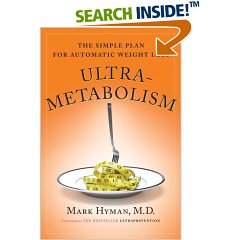
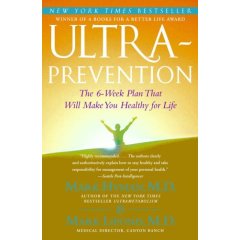
This morning as I was picking up my e-mail, this review on AOL caught my eye. Dr. Mark Hymon is one of the AOL Wellness Coaches, and he has written two books, one called Ultrametabolism, about using your built in genetic strengths to lose weight and maintain the weight loss naturally, and one called Ultraprevention about foods to eat (and not to eat) to contribute to overall wellness and good health.
If you’ve been reading me for a while, you will know that I can be a little cynical.
What I like about Dr. Hymon’s approach is that it makes sense.
Diets that totally eliminate foods you love just aren’t going to work. Give up pasta for the rest of your life? I don’t think so. But what Dr. Hymon asks us to do is to eat mostly non-processed, or minimally processed foods. He says that the processed foods have components that the body doesn’t even recognize as food, and that’s why after eating things like Twinkies, Mars bars, packaged crackers, etc. we still feel hungry – our bodies don’t recognize what we have eaten as food.
Here is what Dr. Hymon suggests (this is from the AOL Health and Fitness section):
How to use what you eat to tell your DNA how to slim you down and live a healthier life.
Day 1. Clean out your cabinets, refrigerator and freezer. Get rid of packaged items filled with processed fats and sugars. Check the lable – if it says “hydrogenated oil” or “high fructose corn syrum” get rid of it.
Day 2. Go shopping for whole foods. Find a farmer’s market in your area for fresh produce and schedule visits in your calendar weekly or biweekly over the next few months. At the grocery, choose items from the “perishable perimeter” of the store, instead of items in the center aisles where processed foods lurk.
Day 3. Change your oil! Throw out old oils, which can become rancid quickly. Replace vegetable oils like safflower and canola with extra-virgin olive oil and make it your primary oil for cooking and salad dressings.
Day 4. Visit a health food sotre. Leave there with 10 new items you’ve never tried before. Bulk-purchase whole grains, legumes and nuts. Look for new whole grain cereals, breads and snacks without processed additives, fats, sugars or preservatives. And remember: just because it’s in a health food store, doesn’t mean it’s good for you. Read the labels of any packaged foods you buy.
Day 5. Choose Eggs! Choose organic eggs farmed with omega-3 fats. Make yourself a spinach omelet for breakfast. Eggs are a good source of protein. You can enjoy as many as eight a week.
Day 6. Become wild about fish. Find a local fishmonger or educate yourself by talking to your local grocer. Or learn more about which fish are best to eat by visiting www. ultrametabolism.com. Print out a primer to bring with you when you shop.
Day 7. Prepare some healthy snacks for when you’re on-the-go. Pack a small zipper bag with a few servings of almonds or walnuts. One handful equals a serving.
Day 8. Don’t go thirsty. By now, you’ve tossed the sodas. Bring out the blender and learn to make high protein, no sugar smoothies. Experiment with crushed ice and fresh fruits. You can even make frozen nut cubes by soaking nuts overnight, blending them and then freezing them with a bit of water or milk in ice cube trays. Your smoothie will be creamy and full of good fats and proteins.
As I did his online mini-seminar, I found myself thinking “everything this Dr. Hymon is recommending is the way Kuwaitis USED TO eat.” And I also found myself thinking what a wealth of opportunity we are living amidst, here in Kuwait, where we can go to any market and buy FRESH fish, really fresh, right off the boats, in the local fish markets. We can buy fresh meats, and fresh vegetables, lots of them grown right here in Kuwait. We can buy fresh eggs. even fresh chicken when not under threat of Avian Flu. Kuwait is a paradise for exactly this kind of diet.
Not only do we have access to fresh, locally grown foods, but the cost is so much less than processed foods on the shelves. He is talking about lentils and grains commonly available here in those big sacks, down in the Souk Mubarakiyya, as well as in the co-ops and the Sultan Centers.
This isn’t anything new, eating low on the food chain, eating fresh, but it does strike me as a diet that particularly works in Kuwait, and a kind of diet that you can live with for the rest of your life, because it doesn’t make changes in your life that you can’t live with. Like he does tell us to give up soda, one of the main contributors to obesity in the world today. As you get older, carbonated beverages aren’t that hard to give up because they also give you heartburn, so just another reason to steer clear of all those unwanted calories the body can’t identify as food.
He didn’t say anything about chocolate . . . but I have ordered both books from Amazon.com hoping that the dark, semi-sweet, barely processed chocolate that I love will also be “just what the doctor ordered.” Meanwhile . . . I hear a spinach omelet calling my name!
“Woh ist der bahnhof?”
One of our family jokes is about how when you go to live in Germany, for some reason, one of the first phrases you learn isn’t “guten tag” or “Wiegehts” (hello! / how are you?) but “where is the train station?” And it is particularly hilarious because even if you ever say it exactly right (or so you think) no one can understand what you are saying. And if they DO understand – they start giving you directions with elaborate hand signals.
Germans are very precise. They won’t just point in a general direction, they will use all kinds of words for left, right, straight ahead, and my personal favorite “gegenuber” which means catty-corner, or diagonally across from something, all words that the beginner doesn’t have a clue. So even if you successfully ask for directions, you can’t understand the answer.
Most of the time, however, you will ask “woh ist der bahnhof” several times, as the response is continually “wie, bitte?”, the polite way of sayinh “WHAT??” and then finally they will get this “aha!” and they will say “Oh! Woh ist der bahnhof?!” and it sounds exactly like what you have been saying for the last five minutes.
I had a “woh is der bahnhof” experience here in Kuwait. I was searching for a souk I had heard about. I asked some of my friends – where is the souk Watiniya? I experienced that two seconds of total blank non-response that always feels like two days, and then one of them laughed and said “oh, she means the souk Watiya” and they told me where it was.
But I’m getting smarter. It wasn’t the part where I added the extra syllable that confused them. It was the fact that I used the soft “t” and not the hard “t”. It’s a small thing, but enough to make me dance for joy – I can hear the difference!
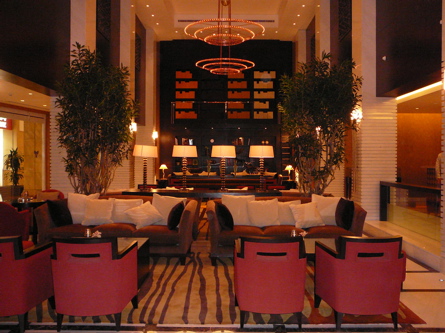
Manshar Mall: Rotana Hotel Open
One day it was not open – and then it was! I haven’t seen any announcements for the Rotana, but it is indeed open for business. There are signs all over Fehaheel indicating the Rotana Hotel’s whereabouts, but those have been up for months.
And – the Villa Moda signs are back up, indicating they will be opening soon. Interesting. Wonder when “soon” will be?
Last but not least – Al Kout and Al Manshar appear to be related, at least architecturally. Why have they not connected the two with a walking bridge from the top floor? Crossing that road is deadly! And parking in the Al Manshar Mall parking lot is severely limited.
And why so much security? There are security guards everywhere, and they are very very firm (my big smile did not sway them) about NOT taking photos.
The very cool thing about Al Manshar Mall is that there are a lot of small shops; it has a very souk-y feel about it, and they aren’t the shops you find in all the usual (ho hum) malls.
And there is a small but very very busy Chili’s.

Offices Full of Germs: Women the Worst
From – I am not kidding – The Nigerian Tribune.
(A recent) study pointed out that for a woman, her office desk may harbour far more bacteria than the workplace restroom and the office desk of men. In fact, women have three to four times the number of bacteria in, on and around their desks, phones, computers, keyboards, drawers and personal items than men do, the study by University of Arizona Professor Charles Gerba found. Gerba, a Professor of Soil, Water and Environmental sciences, tested more than 100 offices on the UA campus and in New York, Los Angeles, San Francisco, Oregon and Washington, D.C. in a study commissioned by the Clorox Co.
The researchers swabbed the offices of 59 women and 54 men in New York City, Los Angeles, San Francisco, Oregon, and Washington, D.C. They sampled eight sites in each office: the phone, desktop, computer mouse, computer keyboard, exclamation key on the computer keyboard, pen, bottom of desk drawer, and handle of desk drawer. The researchers also swabbed workers’ personal items at the office, including personal digital assistants (PDAs), women’s purses and makeup cases, and men’s wallets and found women have more germs on their office desks than men.
“I thought for sure men would be germier,” Gerba said. “But women have more interactions with small children and keep food in their desks. The other problem is makeup.” The tendency is high to doubt this statement. But much as a woman’s desks may typically look cleaner, the germs are likely to be more abundant. Cosmetics and hand lotions make prime germ-transfer agents, Gerba said. Makeup cases also make fine germ homes, along with phones, purses and desk drawers. Food in desk drawers also harbour lots of microorganisms, and it is more abundant among female office workers to have food in their desks and munch while on an assignment, on the computer or even picking a call.
Then, they tend to be around children more often than men, and we all know how easily kids transmit germs. And finally, they use makeup, which tends to absorb germs. Then it rubs off the face or gets scattered by brushes and sponges. The news was not all negative for females though. Gerba in the study found the worst office germ offender is men’s wallets. The back pocket is nice and warm; it’s a great incubator for bacteria. Another hot spot for bacteria in men’s offices: the personal digital assistant.” Men tend to play with their palm pilots more, thinking they’re playing video games or something,” Gerba said.
The top three bacteria hot spots in women’s offices, in order of germs amount : Makeup case, phone, and purse and in men’s offices starting from the highest to the least: Wallet, personal digital assistant and phone. Though a similar study by the Clorox Company, a manufacturer of disinfectant in February 2006, reported that in a study of nine office-based jobs, teachers had the work space with the highest amount of germs and lawyers had the least, Gerba said everyone should arm their office with a germ arsenal that includes: disinfectant wipes, disinfectant spray, paper towels and fruit (for drawer).
According to Gerba, people should clean cell phones and desk phones to get rid of bacteria. “You need to use a disinfectant wipe, or spray disinfectant on a paper towel, and clean the phone off. Never directly spray disinfectant cleaner on phone,” he said. “Do not use soap and water — that just pushes the germs around.” “We recommend that you use a wallet or purse that can be easily wiped off — like leather. A fabric bag is harder to clean and just holds more germs.”
Finally, Gerba said office knickknacks and accessories should be given the same thorough cleaning as everything else , explaining that “people tend to touch and pick up the germs on their desks. It’s a vicious cycle of germs transferring from hands to objects to desks. Hand sanitizers are great in eliminating the transfer of germs from your hands.” The level of germs on office desktops and telephones came in gender neutral; women had three to four times more germs on their keyboards and computer mice than their male counterparts. Desk drawers at women’s desks contained seven times more germs than men’s. Surprisingly, the research showed that the average office desktop has 400 times more bacteria than the average office toilet seat.
What Gerba found among the bacteria was coliform — intestinal bacteria generally found in human waste — on the restroom handles and faucets, in the kitchen sink and sponge, and even in candy basket. That “indicates to me somebody’s not washing his or her hands after coming back from the bathroom,” Gerba said.
That’s why Gerba found hundreds of thousands of bacteria on hot spots like a printer button and the button for the first floor in the elevator, touched by hundreds of fingers each day. Even though none of the bacteria Gerba found was life-threatening, they could lead to more colds and flu.
Prof Oluwole Adebo, a cardiothoracic surgeon commenting said this is a study Clorox, maker of a disinfectant commissioned and is motivated at helping them sell more of their products.” Without being in an office, the surface of our hand picks up germs throughout the day, but you don’t get infected by them because the skin is a barrier against germs. Some of the germs are not in a state to infect, especially in places that are dry and hot, but where humid, it can incubate bacteria. So when you are to eat, wash your hands because there are bacteria on your hands. These bacteria are not in a position to harm us and therefore these is no reason to clean with disinfectants.
“America is full of studies like that. They study everything and make money out of it. The fact is this, in the air you breathe in, there are bacteria in it. Do you sterilize it? No, the body is sufficient to keep the germs at bay. It is all out to pursue people to buy their product”, he concluded.
My Comment: Remember Lies, Damn Lies and Statistics where we talked about who structures the survey? It works the same for studies. The sponsor of this study is Clorox, who make Clorox bleach and multiple cleaning disinfectants. It is in their interest for Professor Gerba to find a very germy environment. The more disinfectants we buy, the higher their profits soar. Prof Oluwole Adebo is right! Germs are everywhere, and we survive, and even develop immunities to them. This study is purely to sell more Clorox products by convincing us we have an epidemic of uncleanliness.
On the other hand . . . it may be time to clean out the make up case and throw away that candy bar . . . 🙂
Bringing in the Harvest, Kuwaiti Style
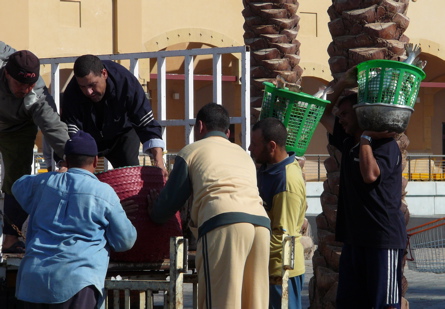
Fresh seafood is one of the great blessings of living in Kuwait. Visiting Fehaheel with a friend one morning, I was delighted to see a boat docked, and fish being loaded into trucks.
You have this old old style boat, and everything they are doing is state-of-the-art in terms of hygiene. The fish are all iced as soon as they are caught, and transported with more ice. Some of the fish is delivered straight to the fish market in Fehaheel, where auctions are held almost daily.
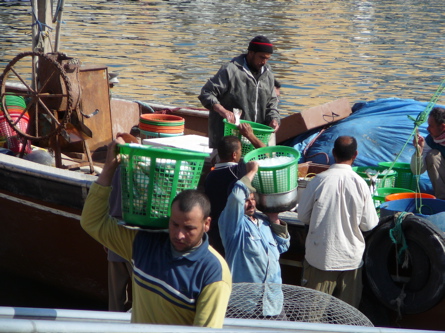

I am only missing Kuwaiti shrimp, which is now out-of-season, to protect the shrimp production for future needs. I am willing to sacrifice for the long-term greater good, and besides, I can still find fresh-frozen Kuwaiti shrimp in my local co-op.
Yesterday I had a new treat – hammour kufte. Have you tried it? I saw it at the Sultan Center, and decided to try it. I sauteed it gently, not sure how it would respond, until it was cooked almost through, then flipped it and cooked the other side. Total WOW. I am a believer! If you haven’t tried it, you are in for a treat. How can anything taste that good AND be good for you?
(Segue) Have you visited the Al Kout Mall in Fehaheel recently? I often take visitors there – it is SO different from Marina Mall and Sharq Mall. There aren’t the bands of teenage marauders there, children are kept under control by their caring parents, and the cafes and restaurants along the fountains are busy day and night, mostly with families and quiet people, not the people who are more concerned with being seen. The stores often have things that are already shopped out at the other malls. There is a serenity in the architecture, and the way it incorporates the waterfront location, and a feeling of everything coming together as it ought.
Sometimes I am the only Westerner I see, outside the Sultan Center.
I took a friend there who had lived in Kuwait a long time ago. She was astounded when I took her there. “This is FEHAHEEL?” she exclaimed. She was in wonder and in shock. She remembered Fehaheel as being at the end of the earth, and a dangerous place to be.
It can still be a dangerous place to be, on a Thursday or Friday night, in competition for a parking place. It will get worse, once the Rotana Hotel opens in the Manshar complex. And the signs for the Villa Moda at the Al Manshar Mall are now disappeared – is Villa Moda NOT coming to the Manshar Mall?
ALASKAN Smoked Salmon
For a girl who grew up in Alaska, smoked salmon is as good as it gets. I’m not talking about the refined kind of smoked salmon that they farm in Scotland and serve in cold slices in posh restaurants. I am talking about the kind of salmon that used to be smoked in everyone’s backyard in Alaska. Each family had it’s own smokehouse, and excess fish was heavily smoked to eat through the long winters. And so far, salmon is thought to be very good for your health.
We didn’t have a smokehouse. But our neighbors on both sides did. 🙂
When a friend told me the Sultan Center (no, I am not taking money from them, but really, they SHOULD pay me!) was carrying Alaskan Smoked Salmon, I could scarce believe it. She was right! My heart is full!
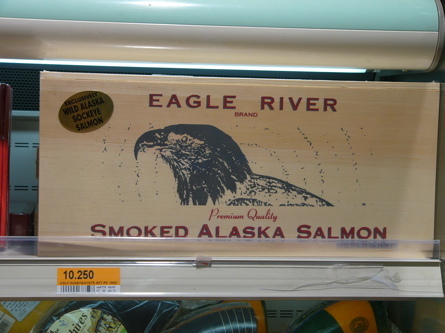
These packets actually hold much more than a can of smoked salmon, which is about the size of a can of tuna. So you can make BOTH of the recipes below, and have some left over for Smoked Salmon Fettucine!
Warning: Alaska smoked salmon has a very strong flavor. Not everyone likes it. Maybe you have to grow up eating it, but most of my friends love these two (very very easy) recipes below:
Smoked Salmon Spread
Sometimes one small can of smoked salmon has to go a long way. This helps, and is one of the all-star recipes. Another one that after you have made it a few times, you don’t have to look at the recipe any more – it is all guesswork!
1 can smoked salmon
2 8 oz. packages cream cheese
2 green onions, chopped (white and green parts)
1 Tablespoon chopped fresh cilantro
1 Tablespoon pickle relish
Salt
pepper
optional: a couple chopped capers
Mix all together and serve with crackers.
Smoked Salmon Mousse
1 can tomato soup
1 8 ounce package cream cheese
2 envelopes Knox Gelatine
1 cup finely chopped onion
1 cup finely chopped celery
1/2 cup chopped green pepper
1 cup mayonnaise
1 cup (or one can) smoked salmon
1/4 cup cold water
Heat soup and add cream cheese, stir until it becomes all smooth and creamy. Remove from heat. Dissolve Knox Geletine in 1/4 cup cold water, add to soup and cream cheese mix. Let cool and add mayonnaise, onion, celery and shrimp. Pour into 1 1/2 quart mold and chill in refrigerator until firm. (I use two smaller molds) Unmold and serve with crackers.
Facets of Oman 3
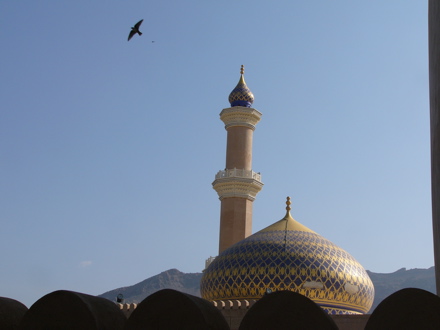
Nizwa mosque shot from Nizwa fortress – even more gorgeous in person. This isn’t the best photo, but I like the bird in it:
The desert weaver had cuffs she had embroidered herself. Cuffs everywhere were a work of art:
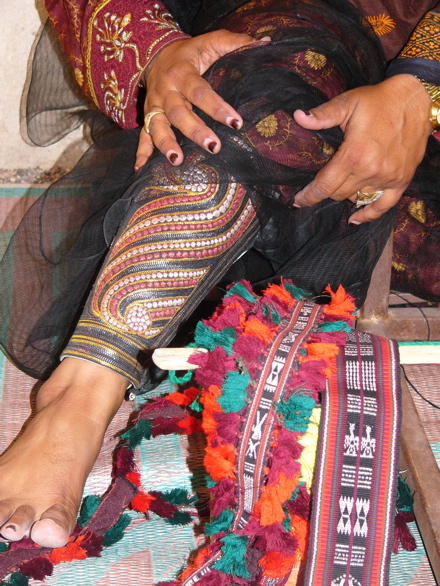
The women welcomed photos – this desert woman was the mother-in-law of the weaver. She was delightful.

Global Terrorist Incidence Map
My husband told me about a website, Global Incident Map.com where terrorist events are entered on the map and refreshed every 300 seconds (sometimes a little faster and sometimes a little slower.)
You first see a map of the world with flashing incidence icons – explosions, planes, some I am still figuring out. You can click on any one incident to get more information. You can also zoom in and out a la Google Earth – same kinds of controls, to get a closer look at any one part of the globe.
As you scroll down the page, you find a listing of the 25 newest events, listed by country. Scrolling down a little further, you find a search feature, and just below that, events divided into categories (airport/aviation, arson/fire, biological incidents, threats, bomb threats, chemical events, etc.)
The one drawback I have is that every now and then as the maps and incidents refresh, the program hangs up for a matter of seconds to a minute. It clears up faster if you just sit there and do nothing, but I am not good at sitting and doing nothing.
The map is worth a slot on your favorite places list, just for it’s astonishing relevance. Today, for example, in Kuwait, it says:
Kuwait increases security alert
“Officials said authorities did not rule out the prospect that Al Qaida insurgents from Iraq would seek to infiltrate Kuwait and conduct attacks during Hala.”
During HALA????? Strike the desperate bargain and entertainment seekers in Kuwait? We’re that dangerous???
On Wcities.com, HALA is described thus:
“Tourists flock to Kuwait during the period of Hala February. This month-long shopping festival celebrates the beauty of the spring season in the majestic deserts. Whether you come to enjoy the lush springtime greenery and animal life or to purchase items like spices, jewels and ornaments at great discounts, Hala February has it all. The city comes alive with its annual parade, cultural celebrations, entertainment and various organized events. Experience the true, warm Arabian welcome and make your stay a fun-filled experience.”
I don’t think life gets any sweeter than February in Kuwait, but I have a real hard time buying into tourists flocking here for the shopping experience. And a harder time imagining Al Qaeda crazies targeting bargain-crazed shoppers.
Stephen King and Hearts in Atlantis
You can be talking with serious people and watch their eyes change when they find you read Stephen King. I refuse to back down. Yep, I read Stephen King. I think he is a brilliant author, some books better than others, but when I am reading, sometimes I can feel my blood move faster through my veins as I wait for a life-threatening situation to resolve itself.
I can trust Stephen King. He taps into who we really are. I can also trust that most of the good guys will still be standing at the end, and most of the bad guys will meet a truly horrible and well-deserved death. I can trust that when bad things happen to good people, other good people will gather round, band together and the gestalt of all that willingness to help one another will prevail against the darkness.
The scariest book I ever read by Stephen King didn’t have any monsters, per se. It didn’t have the Walking Man, or any Wolves of Calla or any great evil, other than the evil that lurks in the human heart. The scariest book I have ever read by Stephen King was Hearts in Atlantis.
Hearts in Atlantis wasn’t even a novel, it was several shorter stories combined in one book. But the title story, Hearts in Atlantis, was about addiction. Not just any old addiction, either, but an addiction I had experienced.
It was my sophomore year in university. I had sailed through the trauma of freshman year with grace, great grades, I felt very confident. That summer, back home, I had taken bridge lessons, and holy smokes – I loved the game. It all made sense to me, and I loved figuring the probabilities and the possibilities, who had what card, how I could finesse that card, how I could WIN. I loved winning.
During the summer after my freshman year, I played a lot of bridge. So it was no wonder, when I got back to school, that I discovered a whole world of bridge players. Early in the morning, before my first class, I would head for the student union and pick up a coffee – and often a game.
The problem was, if I had a particularly good hand, the little devil on my shoulder would whisper “if you skip your class, you can win this hand!” and the bigger problem was – I would listen. I could afford to skip a class here and there, I did the homework. But through the year, I spent more and more time playing bridge and less and less time in the library. At the end of my sophomore year, my grade point average had fallen one full point.
That got my attention. I really wanted academic success. I spent my junior and senior years desperately working to get my grade point average back up to an acceptable level. Once the GPA falls, however, it only inches back up incrementally. It took almost straight A’s to undo the damage I had done to myself the year of bridge playing.
After graduation, I fell back into bridge playing on the duplicate level. But after a while, I noticed that while I travelled from place to place, it was the same smoke-filled room in every new city where we ended up, surrounded by a vampire-like culture that slept a lot of the day and only came alive at night. I also noticed that most of the conversations were about “the one that got away” – how such and such a hand might have been played best. Yawn. Yawn. Yawn. So one day, I just walked away, and never looked back.
Like all addictions, from time to time I hear bridge calling. From time to time I will enter a friendly game – party bridge, but it is no longer irresistable, no longer so seductive, so attractive. Thank God. Reading Stephen King brings back the terror of addiction.
Doha Souk Transport
As a young military wife, it was hugely shocking to me when people felt sorry for me that I had to move all the time. Yes, it is painful being far away from family. And yes, it is painful leaving good friends. But in expat world, we all leave sooner or later, this contract ends, this posting leads to another – and some of us are just wired to need the stimulation.
My husband walks into each new posting with credentials – people know what he has done and accomplished, he has “gravitas.” I get to seek out the drycleaner who won’t ruin my clothes, the man who sells the best tomatoes, and to try to get the heating fixed when no one wants to talk to a woman, and to try to find the roads that will get us where we need to go. In short, I am staff.
And, in spite of all my griping, I got the life I was meant to have. I love the variety, I love the shock of finding others think differently, perceive differently, and my own assumptions are challenged. And I love taking photos.
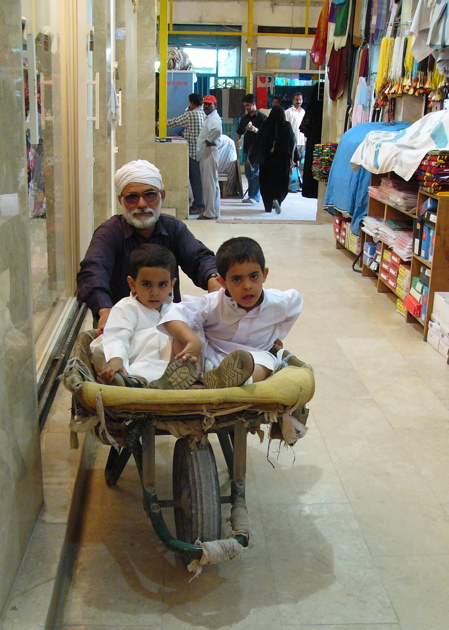
Here is one of my favorites – these wizened old men are always available to carry your excess and heavy packages, and this man was hired to carry the two adorable boys and “nanny” them as mom went from shop to shop. I asked permission before shooting the photo, from a man I assumed to be the father, but the mom came swooping out, asking what I was doing. Fortunately for me, the man calmed her down and all was well.
Recent Comments
intlxpatr on Yellowstone: Old Faithful to C… Michelle on Yellowstone: Old Faithful to C… Cathy on No Grown-Ups in Charge intlxpatr on Waiting for Snow intlxpatr on Waiting for Snow Wikipedia Donate Button

Amazina


Early Voting in Florida


 Here There and Everywhere