Bringing in the Harvest, Kuwaiti Style
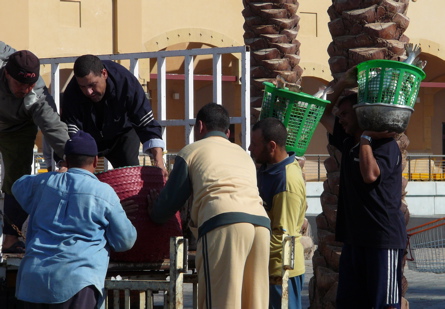
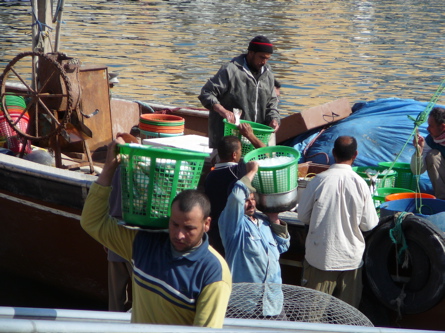
Fresh seafood is one of the great blessings of living in Kuwait. Visiting Fehaheel with a friend one morning, I was delighted to see a boat docked, and fish being loaded into trucks.
You have this old old style boat, and everything they are doing is state-of-the-art in terms of hygiene. The fish are all iced as soon as they are caught, and transported with more ice. Some of the fish is delivered straight to the fish market in Fehaheel, where auctions are held almost daily.

I am only missing Kuwaiti shrimp, which is now out-of-season, to protect the shrimp production for future needs. I am willing to sacrifice for the long-term greater good, and besides, I can still find fresh-frozen Kuwaiti shrimp in my local co-op.
Yesterday I had a new treat – hammour kufte. Have you tried it? I saw it at the Sultan Center, and decided to try it. I sauteed it gently, not sure how it would respond, until it was cooked almost through, then flipped it and cooked the other side. Total WOW. I am a believer! If you haven’t tried it, you are in for a treat. How can anything taste that good AND be good for you?
(Segue) Have you visited the Al Kout Mall in Fehaheel recently? I often take visitors there – it is SO different from Marina Mall and Sharq Mall. There aren’t the bands of teenage marauders there, children are kept under control by their caring parents, and the cafes and restaurants along the fountains are busy day and night, mostly with families and quiet people, not the people who are more concerned with being seen. The stores often have things that are already shopped out at the other malls. There is a serenity in the architecture, and the way it incorporates the waterfront location, and a feeling of everything coming together as it ought.
Sometimes I am the only Westerner I see, outside the Sultan Center.
I took a friend there who had lived in Kuwait a long time ago. She was astounded when I took her there. “This is FEHAHEEL?” she exclaimed. She was in wonder and in shock. She remembered Fehaheel as being at the end of the earth, and a dangerous place to be.
It can still be a dangerous place to be, on a Thursday or Friday night, in competition for a parking place. It will get worse, once the Rotana Hotel opens in the Manshar complex. And the signs for the Villa Moda at the Al Manshar Mall are now disappeared – is Villa Moda NOT coming to the Manshar Mall?
ALASKAN Smoked Salmon
For a girl who grew up in Alaska, smoked salmon is as good as it gets. I’m not talking about the refined kind of smoked salmon that they farm in Scotland and serve in cold slices in posh restaurants. I am talking about the kind of salmon that used to be smoked in everyone’s backyard in Alaska. Each family had it’s own smokehouse, and excess fish was heavily smoked to eat through the long winters. And so far, salmon is thought to be very good for your health.
We didn’t have a smokehouse. But our neighbors on both sides did. 🙂
When a friend told me the Sultan Center (no, I am not taking money from them, but really, they SHOULD pay me!) was carrying Alaskan Smoked Salmon, I could scarce believe it. She was right! My heart is full!

These packets actually hold much more than a can of smoked salmon, which is about the size of a can of tuna. So you can make BOTH of the recipes below, and have some left over for Smoked Salmon Fettucine!
Warning: Alaska smoked salmon has a very strong flavor. Not everyone likes it. Maybe you have to grow up eating it, but most of my friends love these two (very very easy) recipes below:
Smoked Salmon Spread
Sometimes one small can of smoked salmon has to go a long way. This helps, and is one of the all-star recipes. Another one that after you have made it a few times, you don’t have to look at the recipe any more – it is all guesswork!
1 can smoked salmon
2 8 oz. packages cream cheese
2 green onions, chopped (white and green parts)
1 Tablespoon chopped fresh cilantro
1 Tablespoon pickle relish
Salt
pepper
optional: a couple chopped capers
Mix all together and serve with crackers.
Smoked Salmon Mousse
1 can tomato soup
1 8 ounce package cream cheese
2 envelopes Knox Gelatine
1 cup finely chopped onion
1 cup finely chopped celery
1/2 cup chopped green pepper
1 cup mayonnaise
1 cup (or one can) smoked salmon
1/4 cup cold water
Heat soup and add cream cheese, stir until it becomes all smooth and creamy. Remove from heat. Dissolve Knox Geletine in 1/4 cup cold water, add to soup and cream cheese mix. Let cool and add mayonnaise, onion, celery and shrimp. Pour into 1 1/2 quart mold and chill in refrigerator until firm. (I use two smaller molds) Unmold and serve with crackers.
Facets of Oman 3
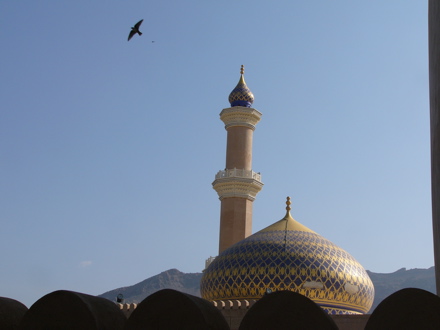
Nizwa mosque shot from Nizwa fortress – even more gorgeous in person. This isn’t the best photo, but I like the bird in it:
The desert weaver had cuffs she had embroidered herself. Cuffs everywhere were a work of art:

The women welcomed photos – this desert woman was the mother-in-law of the weaver. She was delightful.

Global Terrorist Incidence Map
My husband told me about a website, Global Incident Map.com where terrorist events are entered on the map and refreshed every 300 seconds (sometimes a little faster and sometimes a little slower.)
You first see a map of the world with flashing incidence icons – explosions, planes, some I am still figuring out. You can click on any one incident to get more information. You can also zoom in and out a la Google Earth – same kinds of controls, to get a closer look at any one part of the globe.
As you scroll down the page, you find a listing of the 25 newest events, listed by country. Scrolling down a little further, you find a search feature, and just below that, events divided into categories (airport/aviation, arson/fire, biological incidents, threats, bomb threats, chemical events, etc.)
The one drawback I have is that every now and then as the maps and incidents refresh, the program hangs up for a matter of seconds to a minute. It clears up faster if you just sit there and do nothing, but I am not good at sitting and doing nothing.
The map is worth a slot on your favorite places list, just for it’s astonishing relevance. Today, for example, in Kuwait, it says:
Kuwait increases security alert
“Officials said authorities did not rule out the prospect that Al Qaida insurgents from Iraq would seek to infiltrate Kuwait and conduct attacks during Hala.”
During HALA????? Strike the desperate bargain and entertainment seekers in Kuwait? We’re that dangerous???
On Wcities.com, HALA is described thus:
“Tourists flock to Kuwait during the period of Hala February. This month-long shopping festival celebrates the beauty of the spring season in the majestic deserts. Whether you come to enjoy the lush springtime greenery and animal life or to purchase items like spices, jewels and ornaments at great discounts, Hala February has it all. The city comes alive with its annual parade, cultural celebrations, entertainment and various organized events. Experience the true, warm Arabian welcome and make your stay a fun-filled experience.”
I don’t think life gets any sweeter than February in Kuwait, but I have a real hard time buying into tourists flocking here for the shopping experience. And a harder time imagining Al Qaeda crazies targeting bargain-crazed shoppers.
Stephen King and Hearts in Atlantis
You can be talking with serious people and watch their eyes change when they find you read Stephen King. I refuse to back down. Yep, I read Stephen King. I think he is a brilliant author, some books better than others, but when I am reading, sometimes I can feel my blood move faster through my veins as I wait for a life-threatening situation to resolve itself.
I can trust Stephen King. He taps into who we really are. I can also trust that most of the good guys will still be standing at the end, and most of the bad guys will meet a truly horrible and well-deserved death. I can trust that when bad things happen to good people, other good people will gather round, band together and the gestalt of all that willingness to help one another will prevail against the darkness.
The scariest book I ever read by Stephen King didn’t have any monsters, per se. It didn’t have the Walking Man, or any Wolves of Calla or any great evil, other than the evil that lurks in the human heart. The scariest book I have ever read by Stephen King was Hearts in Atlantis.
Hearts in Atlantis wasn’t even a novel, it was several shorter stories combined in one book. But the title story, Hearts in Atlantis, was about addiction. Not just any old addiction, either, but an addiction I had experienced.
It was my sophomore year in university. I had sailed through the trauma of freshman year with grace, great grades, I felt very confident. That summer, back home, I had taken bridge lessons, and holy smokes – I loved the game. It all made sense to me, and I loved figuring the probabilities and the possibilities, who had what card, how I could finesse that card, how I could WIN. I loved winning.
During the summer after my freshman year, I played a lot of bridge. So it was no wonder, when I got back to school, that I discovered a whole world of bridge players. Early in the morning, before my first class, I would head for the student union and pick up a coffee – and often a game.
The problem was, if I had a particularly good hand, the little devil on my shoulder would whisper “if you skip your class, you can win this hand!” and the bigger problem was – I would listen. I could afford to skip a class here and there, I did the homework. But through the year, I spent more and more time playing bridge and less and less time in the library. At the end of my sophomore year, my grade point average had fallen one full point.
That got my attention. I really wanted academic success. I spent my junior and senior years desperately working to get my grade point average back up to an acceptable level. Once the GPA falls, however, it only inches back up incrementally. It took almost straight A’s to undo the damage I had done to myself the year of bridge playing.
After graduation, I fell back into bridge playing on the duplicate level. But after a while, I noticed that while I travelled from place to place, it was the same smoke-filled room in every new city where we ended up, surrounded by a vampire-like culture that slept a lot of the day and only came alive at night. I also noticed that most of the conversations were about “the one that got away” – how such and such a hand might have been played best. Yawn. Yawn. Yawn. So one day, I just walked away, and never looked back.
Like all addictions, from time to time I hear bridge calling. From time to time I will enter a friendly game – party bridge, but it is no longer irresistable, no longer so seductive, so attractive. Thank God. Reading Stephen King brings back the terror of addiction.
Doha Souk Transport
As a young military wife, it was hugely shocking to me when people felt sorry for me that I had to move all the time. Yes, it is painful being far away from family. And yes, it is painful leaving good friends. But in expat world, we all leave sooner or later, this contract ends, this posting leads to another – and some of us are just wired to need the stimulation.
My husband walks into each new posting with credentials – people know what he has done and accomplished, he has “gravitas.” I get to seek out the drycleaner who won’t ruin my clothes, the man who sells the best tomatoes, and to try to get the heating fixed when no one wants to talk to a woman, and to try to find the roads that will get us where we need to go. In short, I am staff.
And, in spite of all my griping, I got the life I was meant to have. I love the variety, I love the shock of finding others think differently, perceive differently, and my own assumptions are challenged. And I love taking photos.
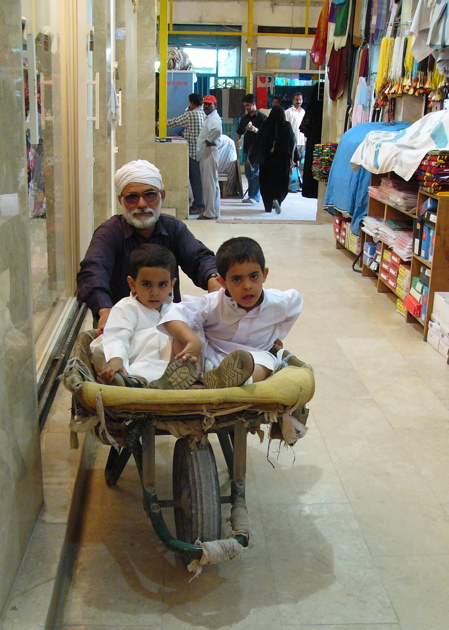
Here is one of my favorites – these wizened old men are always available to carry your excess and heavy packages, and this man was hired to carry the two adorable boys and “nanny” them as mom went from shop to shop. I asked permission before shooting the photo, from a man I assumed to be the father, but the mom came swooping out, asking what I was doing. Fortunately for me, the man calmed her down and all was well.
Mobissimo
Have you heard about Mobissimo? It is one of the best sites for comparing airfares from one place to another. I owe this to a good friend, now working in Afghanistan. He makes his reservations through Mobissimo and shared the information with me.
You can include multiple destinations, something many of the travel sites don’t handle well, and you can see where you would be connecting and how long that connection will be.
I don’t always book through Mobissimo, but it is usually my first stop to get a glimpse of price comparisons and connections.
Alison’s Clam Chowder
This is one of the first recipes in my collection. My very best friend from college taught me how to make it and gave me the recipe. You can get all the ingredients in Kuwait, and can buy Kuwaiti clams in the fish markets and at the Sultan Center.
Alison’s Clam Chowder
This is still one of our very favorite soups – especially on a cold winter’s day. Serve with a baguette (French bread, not a diamond!) and a green salad. It’s all you need.
2 strips bacon (beef or turkey bacon in Kuwait)
1 large onion, chopped
2 cans clams and juice (drain the juice, but save it)
2 cups water
4 cups milk
1 large potato
Sautee bacon slowly, so it releases lots of grease. Take out bacon, chop it up, and reserve it.
Sautee onion in bacon grease until soft. Cool, add water and clam juice, and chopped potato. Cook until potato is no longer hard, but not too soft.
Add milk and warm to serving temperature, add canned clams and reserved bacon pieces. Sooooooooo EASY!
Kitchen Souk?
A reader wrote asking about where to find a cast iron skillet in Kuwait. I brought mine with me (if you use a cast iron skillet, you’ll understand*) so I haven’t been paying any attention to cast iron skillet availability here. I’m pretty sure I haven’t seen any in the local co-ops, and I can’t remember seeing any cast iron pans in the Sultan Center. City Center?
Is there a Kitchen souk in Kuwait, a place with lots and lots of pots and pans?
(A cast iron skillet is heavy metal, and a shiny grey when you buy it. You season it by rubbing it with oil and putting it in an oven on low heat for hours, even overnight. You never wash the skillet with soap, only with water and scouring pads, so you don’t lose the seasoned coating. When you have a well-seasoned pan, you carry it with you so you don’t have to start the process over! You can see a photo of my skillet at Cornbread and Chili)
Germany’s culture of shopping slowly changing
Little Diamond forwarded this to me from the Chicago Tribune. The battle to extend shopping hours in Germany has been going on for years. As the hours increase, the annual birthday celebrations described in the preceding blog entry will pass into “olden day traditions.”
By Tom Hundley
BERLIN – Unlike America, Germany has not yet adopted the shop-till-you-drop lifestyle, but things are starting to change.
Even in bustling cities like Berlin and Frankfurt, retailers used to roll up the sidewalks at 6:30 p.m. On weekends, Germans had to scramble to get their shopping done by 2 p.m. on Saturday. Sunday shopping was strictly verboten.
But a long battle over longer store hours is slowly being won by retailers who believe that more hours mean more money in the cash register. They are opposed by Germany’s powerful trade unions whose leaders say workers’ rights must be protected.
The gradual loosening of strict rules governing store hours also reflects a larger battle to loosen up a German economy that suffers from sluggish growth and 9.6 percent unemployment. Chancellor Angela Merkel’s government says it is eager for reform, but it has decided to leave the issue of store hours to local governments.
These days, the Galeria Kaufhof, a newly renovated department store in the heart of the former East Berlin’s shopping district, is crowded with customers until 10 p.m.
“Seven years ago we started a small revolution here in Berlin when we said we are opening on Sundays,” said Detlef Steffens, the store manager.
“We discovered a loophole: according to the law, you could open on Sunday if you were selling souvenirs, so we put stickers that said `souvenirs’ on all the merchandise,” he said.
“We were sued by other store owners. But that started an avalanche.”
Steffens’ store took its case to Germany’s federal constitutional court. The court rejected its arguments but said the particulars of Sunday shopping hours should be regulated by local authorities.
The Berlin city government decided to allow stores to open on six Sundays a year. Last year, it extended the number to 10, plus three extra Sundays during the World Cup soccer tournament.
Last November, Berlin threw caution to the wind and adopted a modified version of America’s 24/7 consumer ethos. Call it 24/6 – non-stop shopping for six days of the week and 10 Sundays.
The Galeria has opted to stay open until 8 p.m. Monday through Wednesday and until 10 p.m. Thursday through Saturday. The extra hours have increased revenue and enabled the store to hire 50 more employees, for a total of 1,080.
Steffens says his employees have generally been supportive of the longer hours.
“It’s an East-West thing,” he said, referring to the lingering psychological divide that still separates Germans who grew up in prosperous West Germany from those who experienced communist East Germany.
Almost all of Steffens’ employees are from the East. Those from the West, he said, are more likely to resist changes proposed by management.
“The trade unions are not so different from East to West, but worker councils in the East are more realistic. Here there’s more of a collective mentality: We are one team; it means our jobs,” he said.
Cornelia Hass, a spokeswoman for Ver.di, a large trade union that represents service employees, says the union’s position is that “everyone should have the liberty to work (non-traditional hours), but nobody has to work these hours.”
Hass disputes the argument that more hours mean more revenue and more jobs.
“People don’t buy more just because they can do it 24 hours a day. You can only spend the euro in your pocket once,” she said.
While acknowledging that store hours have to reflect people’s changing lifestyles, she said Germany already has “more square meters of shopping opportunity per consumer than Europe or the United States” and that fierce competition among retailers was forcing them to trim personnel.
There’s also a quality-of-life issue.
“I really believe that Sunday is the day when everyone who doesn’t need to work, shouldn’t work,” Hass said. “Society needs to lay back for one day, to find time for friends and family.” She also noted that of the 3 million retail workers represented by Ver.di, 80 percent were women, and most had families.
“They need their Sundays,” she said.
The union is supporting three retail workers who have filed a lawsuit challenging Berlin’s new Sunday opening hours.
But most of Germany’s 16 federal states appear to be following Berlin’s example and extending store hours.
Some small merchants are worried, fearing that extended hours by large retailers will force them to attempt the same.
“It’s a problem for us,” said Michael Turberg, who owns a Berlin toy store famous for model trains.
“We are rather specialized and we need staff of high quality. When you are open longer, you need more staff of high quality. It’s not easy to find staff, and it’s not easy to pay them.”
That’s not a problem for Mohamed Wehbe and his family. Immigrants from Lebanon, they run a small shop that sells snacks, groceries, cigarettes and newspapers. It’s open 365 days a year.
When they started their business a few years ago, and kept it open until midnight, they got a polite letter from Berlin authorities advising them to observe the legal opening hours.
“We didn’t know about such laws,” said Wehbe.
Under the new law, the shop is open from 6 a.m. until midnight.
For Wehbe and many other immigrant entrepreneurs, there are scarcely enough hours in a day for earning money.
“This summer,” he said, “we’re going 24/7.”
Recent Comments
Kitchen on Isiais: Winding Down intlxpatr on Shampoo Ginger tigerbutterya0c5ff1d… on Shampoo Ginger intlxpatr on British Soldier Kidnapped, Esc… John on British Soldier Kidnapped, Esc… Wikipedia Donate Button

Amazina


Early Voting in Florida


