Indian Village Bans Cell Phones – For Women
LOL – what about those cheating, eloping MEN? Ban only women from using cell phones? What about calls from mothers who need you to run an errand? What about calls from the children’s school? Women – and man – who are going to cheat are going to cheat, whether or not you take their cell phone away. Found this on AOL/Huffpost via Reuters:
PATNA, India – (Reuters) – A village council in the eastern Indian state of Bihar has banned the use of mobile phones by women, saying the phones were “debasing the social atmosphere” by leading to elopements – a move that set off outraged protests from activists.
In addition to the ban, the Sunderbari village council in a Muslim-dominated area some 385 kilometers (239 miles) east of Patna, the capital of Bihar, has also imposed a fine of 10,000 rupees ($180) if a girl is caught using a mobile phone on the streets.
Married women would have to pay 2,000 rupees ($36.60).
“It always gives us a lot of embarrassment when someone asks who has eloped this time,” said Manuwar Alam, who heads a newly-formed committee tasked with enforcing the ban, referring to queries from neighboring villages.
He said the number of elopements and extramarital love affairs had risen in the past few months, with at least six girls and women fleeing their homes.
“Even married women were deserting their husbands to elope with lovers. That was shameful for us,” Alam said. “So, we decided to tackle it firmly. Mobile phones are debasing the social atmosphere”.
Local officials have begun investigations, saying that such bans cannot be allowed in a healthy society, while women’s rights activists called it an assault on freedom that could potentially end up harming women by stripping them of one source of protection from trouble, such as unwanted advances by men.
“Girls and women are capable enough to protect themselves,” said activist Suman Lal during a debate on local television. “Technology is meant to be used, not to be banned…The order is nauseating.”
Fellow activist Mohammad Islam said it was “disappointing” that the village council ignored the many advantages of mobile phones before placing a ban on them for one reason.
“I want every girl to be given a mobile phone so that she could call up family members if she has a problem”, he said. ($1 = 54.6400 Indian rupees)
(Reporting by New Delhi newsroom, editing by Elaine Lies)
Saudi Government Informing ‘Responsible Male’ When Women Leave Saudi Arabia
Thank you, John Mueller, for this fascinating article from FRANCE 24:
Electronic tracking: new constraint for Saudi women – FRANCE 24
AFP – Denied the right to travel without consent from their male guardians and banned from driving, women in Saudi Arabia are now monitored by an electronic system that tracks any cross-border movements.
Since last week, Saudi women’s male guardians began receiving text messages on their phones informing them when women under their custody leave the country, even if they are travelling together.
Manal al-Sherif, who became the symbol of a campaign launched last year urging Saudi women to defy a driving ban, began spreading the information on Twitter, after she was alerted by a couple.
The husband, who was travelling with his wife, received a text message from the immigration authorities informing him that his wife had left the international airport in Riyadh.
“The authorities are using technology to monitor women,” said columnist Badriya al-Bishr, who criticised the “state of slavery under which women are held” in the ultra-conservative kingdom.
Women are not allowed to leave the kingdom without permission from their male guardian, who must give his consent by signing what is known as the “yellow sheet” at the airport or border.
The move by the Saudi authorities was swiftly condemned on social network Twitter — a rare bubble of freedom for millions in the kingdom — with critics mocking the decision.
“Hello Taliban, herewith some tips from the Saudi e-government!” read one post.
“Why don’t you cuff your women with tracking ankle bracelets too?” wrote Israa.
“Why don’t we just install a microchip into our women to track them around?” joked another.
“If I need an SMS to let me know my wife is leaving Saudi Arabia, then I’m either married to the wrong woman or need a psychiatrist,” tweeted Hisham.
“This is technology used to serve backwardness in order to keep women imprisoned,” said Bishr, the columnist.
“It would have been better for the government to busy itself with finding a solution for women subjected to domestic violence” than track their movements into and out of the country.
Saudi Arabia applies a strict interpretation of sharia, or Islamic law, and is the only country in the world where women are not allowed to drive.
In June 2011, female activists launched a campaign to defy the ban, with many arrested for doing so and forced to sign a pledge they will never drive again.
No law specifically forbids women in Saudi Arabia from driving, but the interior minister formally banned them after 47 women were arrested and punished after demonstrating in cars in November 1990.
Last year, King Abdullah — a cautious reformer — granted women the right to vote and run in the 2015 municipal elections, a historic first for the country.
In January, the 89-year-old monarch appointed Sheikh Abdullatif Abdel Aziz al-Sheikh, a moderate, to head the notorious religious police commission, which enforces the kingdom’s severe version of sharia law.
Following his appointment, Sheikh banned members of the commission from harassing Saudi women over their behaviour and attire, raising hopes a more lenient force will ease draconian social constraints in the country.
But the kingdom’s “religious establishment” is still to blame for the discrimination of women in Saudi Arabia, says liberal activist Suad Shemmari.
“Saudi women are treated as minors throughout their lives even if they hold high positions,” said Shemmari, who believes “there can never be reform in the kingdom without changing the status of women and treating them” as equals to men.
But that seems a very long way off.
The kingdom enforces strict rules governing mixing between the sexes, while women are forced to wear a veil and a black cloak, or abaya, that covers them from head to toe except for their hands and faces.
The many restrictions on women have led to high rates of female unemployment, officially estimated at around 30 percent.
In October, local media published a justice ministry directive allowing all women lawyers who have a law degree and who have spent at least three years working in a lawyer’s office to plead cases in court.
But the ruling, which was to take effect this month, has not been implemented.
By Secret Ballot
I hear people talking back and forth; feeling one another out. Most assume their friends will vote Republican; it’s Republican country up here in the westernmost part of Florida. Yards are littered with Romney – Ryan signs, with a few timid Obama signs here and here in a yard or on a car fender.

My Dad taught us, when we were very young, that the only appropriate answer when asked how one would vote is “I am voting by secret ballot.” He taught us how precious the right is to cast your vote and to know that no one can intimidate you into voting for someone else, because we vote by secret ballot. No husband can command his wife, no father can command his family, no minister can command his church. We each vote our individual conscience.
So we have the luxury of worrying whether we will vote the right candidates into office. We can only do the best we can with the information we have. I don’t want opinions, I want to see where a candidate stands on the issues that are important to me. And, in the end, I trust in the Lord:
Psalm 20
Now this I know:
The Lord gives victory to his anointed.
He answers him from his heavenly sanctuary
with the victorious power of his right hand.
7 Some trust in chariots and some in horses,
but we trust in the name of the Lord our God.
8 They are brought to their knees and fall,
but we rise up and stand firm.
9 Lord, give victory to the king!
Answer us when we call!
When I hear people moaning in the locker room, or jeering in the parking lot, I walk right by. It’s not my problem. I vote my conscience, and I leave the outcome in the Lord’s hands.
Daily Readings on Gossip
I grew up in a culture that thrives on gossip and speculation. Today’s reading from The Lectionary reminds me to gurd my tongue; never to repeat a conversation, unless not to repeat it would be a sin, as in murder or abuse.
Sirach 19:4-17
4 One who trusts others too quickly has a shallow mind,
and one who sins does wrong to himself.
5 One who rejoices in wickedness* will be condemned,*
6 but one who hates gossip has less evil.
7 Never repeat a conversation,
and you will lose nothing at all.
8 With friend or foe do not report it,
and unless it would be a sin for you, do not reveal it;
9 for someone may have heard you and watched you,
and in time will hate you.
10 Have you heard something? Let it die with you.
Be brave, it will not make you burst!
11 Having heard something, the fool suffers birth-pangs
like a woman in labour with a child.
12 Like an arrow stuck in a person’s thigh,
so is gossip inside a fool.
13 Question a friend; perhaps he did not do it;
or if he did, so that he may not do it again.
14 Question a neighbour; perhaps he did not say it;
or if he said it, so that he may not repeat it.
15 Question a friend, for often it is slander;
so do not believe everything you hear.
16 A person may make a slip without intending it.
Who has not sinned with his tongue?
17 Question your neighbour before you threaten him;
and let the law of the Most High take its course.*
It’s Demographics . . .
I never thought I would see this day:

I remember when we lived in the Tampa area, we had a mortgage at 8%. We were selling the house, and I got a lot of calls from people who wanted me to take my next mortgage with them. I remember one guy, when I laughed at the rate he offered me, he asked what rate I thought I could get. I said 6% – and I told him, it’s demographics. The baby boomers are aging and are going to start selling or downsizing. There isn’t going to be the same market for housing that there used to be. He laughed at me and wished me luck before hanging up.
I think I got the next mortgage around 7%. We only had it five years and paid it off, and when we got the next mortgage, it was at 5.5% and we laughed every time we made a payment.
When we bought this house, we had a mortgage at 4%. To me, I had thought 6% was about the lowest mortgages could go, I was so so so so wrong.
Now, when I see these mortgage rates, I feel like I SHOULD buy something, but we are all paid off and we don’t need anything more. It sure is tempting, but it’s like Sam’s Club, where you get a great deal on nutmeg, if you need 10 lbs of nutmeg, but who can use ten pounds of nutmeg in a lifetime? It just doesn’t make sense, but the low rate is SO tempting . . .
Discover Relaxing Riyadh
I still get ads from Jazeera airlines, although I no longer live in Kuwait and have asked them for three years to take my name off their mailing list. I have unsuccessfully unsubscribed like fifteen times; now I just have it all sent to spam.
But today, as I was looking over the spam to be sure I wasn’t emptying my box of anything important, I saw this:
Discover Relaxing Riyadh – استمتع بعطلتك في الرياض

LOL – Relaxing Riyadh. A group of the ad guys must have been rolling on the floor when they created that one . . . Or maybe they meant that apart from the spine-tingling traffic, there isn’t a whole lot going on in Riyadh, especially on the social scene . . .
Your Vote – The Power of We (Blog Action Day 2012)
This year, in the United States we are going through a vicious process, that of choosing one candidate over another for political office. Many people are so put-off by the mechanics of the process that they opt out of the choosing altogether. Others are just too busy to vote, beset by the needs of family, job, car pool, church, social activities, etc. in spite of the ease with which one can ask for and receive an absentee ballot.
You need only live in a country where people have no meaningful vote to quickly learn the value of your vote. Your vote may be just one, but in a democracy, where just one vote can turn an election – your vote counts. Together, with other voters of your persuasion, your vote counts.
There has never been a country where women have the vote and men don’t. Sadly, the opposite is true; there are still countries where women are not considered fully qualified to vote. Less than 100 years ago, our own country was one of them. Yes, it’s true, we didn’t get the vote until 1920. I reprint the following from a post I wrote several years ago, a post I have never forgotten, because it was so shocking to me when I read the price these women paid that I might freely vote today.
“The doctor admonished the men: ‘Courage in women is often
mistaken for insanity.’”
We may have different preferences for who gets elected; that doesn’t matter to me. What matters to me is the power of we – that we care enough about our country and its policies to exercise our right as citizens, to get out there and vote.
This is reblogged from July 17, 2008:
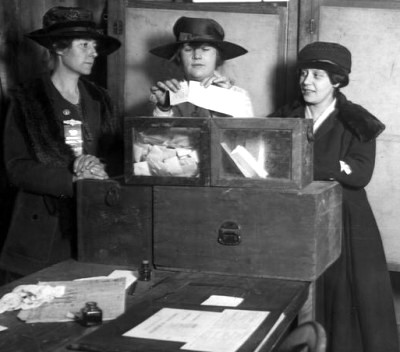
WHY EVERY WOMAN SHOULD VOTE
This is the story of our Grandmothers, and Great-grandmothers, as they
lived only 90 years ago. It was not until 1920 that women were granted
the right to go to the polls and vote.
Thus unfolded the ‘Night of Terror’ on Nov. 15, 1917, when the warden at
the Occoquan Workhouse in Virginia ordered his guards to teach a lesson
to the suffragists imprisoned there because they dared to picket Woodrow
Wilson’s White House for the right to vote. The women were innocent and
defenseless. And by the end of the night they were barely alive. Forty
prison guards wielding clubs and their warden’s blessing went on a
rampage against the 33 women wrongly convicted of ‘obstructing sidewalk
traffic.’
They beat Lucy Burn, chained her hands to the cell bars above her head
and left her hanging for the night, bleeding and gasping for air. They
hurled Dora Lewis into a dark cell, smashed her head against an iron bed
and knocked her out cold. Her cell mate, Alice Cosu, thought Lewis was
dead and suffered a heart attack. Additional affidavits describe the
guards grabbing, dragging, beating, choking, slamming, pinching,
twisting and kicking the women.
For weeks, the women’s only water came from an open pail. Their
food–all of it colorless slop–was infested with worms. When one of the
leaders, Alice Paul, embarked on a hunger strike, they tied her to a
chair, forced a tube down her throat and poured liquid into her until
she vomited. She was tortured like this for weeks until word was
smuggled out to the press.
So, refresh my memory. Some women won’t vote this year because–why,
exactly? We have carpool duties? We have to get to work? Our vote
doesn’t matter? It’s raining?
Last week, I went to a sparsely attended screening of HBO’s new movie
‘Iron Jawed Angels.’ It is a graphic depiction of the battle these women
waged so that I could pull the curtain at the polling booth and have my
say. I am ashamed to say I needed the reminder.
All these years later, voter registration is still my passion. But the
actual act of voting had become less personal for me, more rote.
Frankly, voting often felt more like an obligation than a privilege.
Sometimes it was inconvenient.
My friend Wendy, who is my age and studied women’s history, saw the HBO
movie , too. When she stopped by my desk to talk about it, she looked
angry. She was–with herself. ‘One thought kept coming back to me as I
watched that movie,’ she said. ‘What would those women think of the way
I use–or don’t use–my right to vote? All of us take it for granted
now, not just younger women, but those of us who did seek to learn.’ The
right to vote, she said, had become valuable to her ‘all over again.’
HBO released the movie on video and DVD. I wish all history, social
studies and government teachers would include the movie in their
curriculum. I want it shown on Bunco night, too, and anywhere else women
gather. I realize this isn’t our usual idea of socializing, but we are
not voting in the numbers that we should be, and I think a little shock
therapy is in order.
It is jarring to watch Woodrow Wilson and his cronies try to persuade a
psychiatrist to declare Alice Paul insane so that she could be
permanently institutionalized. And it is inspiring to watch the doctor
refuse. Alice Paul was strong, he said, and brave. That didn’t make her
crazy. The doctor admonished the men: ‘Courage in women is often
mistaken for insanity.’
Please, if you are so inclined, pass this on to all the women you know.
We need to get out and vote and use this right that was fought so hard
for by these very courageous women. Whether you vote democratic,
republican or independent party – remember to vote.
History is being made.
Mediterranean Plus Doors Closed and Driving and Texting
Sigh. We went for lunch at our favorite local ‘Mediterranean’ food restaurant, the Mediterranean Plus, only to see a big “This Space For Rent” sign on the door. So sad. The last time we were there, we talked with the owner, who said that Chow Time (a Chinese Food Buffet), which had opened near by, was killing him. It is just so sad. We are hoping he is only looking for a more propitious location. We’d love for him to find another location closer to downtown.
On our way to church last night, we looked over at the guy in the blue pick-up next to us, who was texting. He was only going about 20 mph, but when the car three cars up slowed to make a right turn, he didn’t notice, and crashed right into the much bigger pick-up in front of him. CRASH! It made a horrible crunching sound, and his hood got all crinkled up.
Even if Florida doesn’t have any laws against texting, his entire front-end is all smashed to pieces, glass and plastic everywhere, sharp shards. Having to pay for all that damage will be a big penalty. I wonder if it will make any difference in his behavior?
Big Brother Exploring Crowd Control

I find this terrifying, on the lines of those loud, destructive aliens in that Tom Cruise movie about an invasion from outer space. Have you ever heard a noise so loud you couldn’t think? Couldn’t hear? Now imagine that noise in your mind! The potential applications for this technology whether for crowd control or warfare are appalling.
Microwave Ray Gun
Under a research contract from the U.S. Navy, microwave ray guns are being developed by Sierra Nevada Corp. that are designed to beam sounds directly into people’s heads at a distance of up to several hundred yards away. The device—dubbed MEDUSA (Mob Excess Deterrent Using Silent Audio)—exploits the microwave audio effect, in which short microwave pulses rapidly heat tissue causing a sound effect “loud” enough to cause discomfort or even incapacitation. While
supposedly intended for non-lethal use in crowd control, future military uses for this type of technology are sure to arouse the imagination.
Recent Comments
ExpatAlien on What Country am I Living … intlxpatr on Yellowstone: Old Faithful to C… Michelle on Yellowstone: Old Faithful to C… Cathy on No Grown-Ups in Charge intlxpatr on Waiting for Snow Wikipedia Donate Button

Amazina


Early Voting in Florida


 Here There and Everywhere