Just Say No – to Gossip
From today’s Lectionary readings:
Sirach 19:4-17
4 One who trusts others too quickly has a shallow mind,
and one who sins does wrong to himself.
5 One who rejoices in wickedness* will be condemned,*
6 but one who hates gossip has less evil.
7 Never repeat a conversation,
and you will lose nothing at all.
8 With friend or foe do not report it,
and unless it would be a sin for you, do not reveal it;
9 for someone may have heard you and watched you,
and in time will hate you.
10 Have you heard something? Let it die with you.
Be brave, it will not make you burst!
11 Having heard something, the fool suffers birth-pangs
like a woman in labour with a child.
12 Like an arrow stuck in a person’s thigh,
so is gossip inside a fool.
13 Question a friend; perhaps he did not do it;
or if he did, so that he may not do it again.
14 Question a neighbour; perhaps he did not say it;
or if he said it, so that he may not repeat it.
15 Question a friend, for often it is slander;
so do not believe everything you hear.
16 A person may make a slip without intending it.
Who has not sinned with his tongue?
17 Question your neighbour before you threaten him;
and let the law of the Most High take its course.
Food Shortages?
My friends in Kuwait are complaining about the price of tomatoes. The price of tomatoes in Kuwait?? Can a Kuwaiti cook without tomatoes?? 😉
I remember when suddenly, rice, a reliable cheap staple, suddenly went through the roof, and then, disappeared from the shelves when India announced a shortage and refused to export Indian rice. Kuwait, and other Gulf countries, announced they were buying unused farmland in other countries to insure their food supplies. But tomatoes? I thought everyone in Kuwait grew tomatoes, at least in winter.
And then, today, I saw this article on creeping food shortages:
Another lackluster monthly jobs report took center stage Friday. Stocks rallied, and government bond yields remained at rock-bottom levels as investors anticipate more action soon by the Federal Reserve to drive down interest rates even further.
Reports about how much slack the U.S. economy still needs to work through — like unemployment — understandably get the spotlight. But investors may be overlooking an even bigger story as the developing world stages a sharp rebound: Shortages of items like food and commodities are once again becoming a major concern.
Prices for agricultural commodities spiked so much on Oct. 8 that they triggered daily movement limits on the Chicago exchange. Options markets saw prices for commodities like corn soar more than 13% during the day following reports of supply shortages around the world.
Commodity-oriented exchange-traded funds like the PowerShares DB Agriculture (DBA) leaped as well. The ETF surged almost 10% over the previous week, with more than 6% of the gains registered on Friday alone.
Supply and Demand Discrepancies
A sharp shortfall in the U.S. Department of Agriculture’s corn production forecast, due to poor weather patterns, also helped set prices soaring around the world. U.S. corn crop yields would come in 4% short of prior estimates and drop to their lowest levels in 14 years, the Agriculture Department said.
Fears of commodity shortages in the face of surging global demand are leading to export-slashing. Ukraine announced a sharp cutback in the amount of commodities like wheat and barley it would allow to be shipped out of the country. The likelihood of a major discrepancy between supply and demand have led to surging prices worldwide. European wheat prices rallied 10%, with other commodities, such as soybeans and cotton, climbing as well.
Still, investors should be cautious because commodity prices are known to be extremely volatile and difficult to put a price on.
Fundamental Forces
Nevertheless, rising prices are creating alarm about humanitarian concerns. Morgan Stanley (MS) and the U.N. have warned about the prospects of a rerun of the 2007 food crisis that slammed the developing world.
See full article from DailyFinance: http://www.dailyfinance.com/story/poor-crops-soaring-demand-currency-wars-a-recipe-for-food-sho/19667693/?icid=sphere_copyright
As we drove across the United States this summer, we saw acres and acres of US farmland, unworked, for sale. Farming is a tough life, and fewer and fewer families are still farming. It’s scary and sad.
What Women Did For Fun
Several weeks ago, AdventureMan presented me with two (large) piles of files, saying that they were mine and needed to be gone through. I spent the day today tossing out old term papers, old manuscripts, old resumes – lots and lots of things that were worth saving, and now, not so much.
One thing I came across was a file with copies of work my departed aunt Helen had done to gain entrance into the DAR, Daughters of the American Revolution (Revolutionary War for America’s Independence). It was like a game, only when she started playing, there was no e-mail, only snail mail. Long distance telephone calls were expensive, and she was a Navy wife, so it was all done by hand.
Genealogy work, too, was painstakingly done, and family histories, cemetery records, lists of people arriving and departing on ships and who married who – all lovingly compiled and typed on manual typewriters by people with a passion for making connections, solving the mysteries of who married whom and for how long:
(“no need to mention the divorce” one correspondent wrote, “it happened in my family, too, and it isn’t relevant so we just won’t mention it” she wrote about a marriage that ceased to exist over a hundred years before)
My aunt had a sure thing, and she had a unique entry, so she was tracking three entries at the same time, trying to prove a new connection, while knowing she had in her pocket an already proven entry.
I lost a couple hours of my life, reading through all the correspondence, trying to decipher her notes and the arcane charts of relationships stretching back to 1690, when one line of the family arrived on these shores. I grinned, thinking how we document our bloodlines, leaving out the pirates and the horse thieves, and (legend has it) the French aristocrat who left his first family in France and started our branch here, without having divorced his first family, LOL.
My aunt must have been a little younger than I am when she started on this search, and I know that she served proudly in the DAR for many years, along with several civic committees, library committees and planning commissions in Santa Barbara, California. I still miss her.
Chase Ends with Suspect Trying to Drown Police and Police Dog
I loved reading the papers in Kuwait. What criminals could be so incredibly STUPID, I would wonder. (Here is my all time favorite Kuwait story.)
This morning, AdventureMan asked “Have you read the paper? Some guy had a high speed chase, then he tried to drown the policeman AND the policeman’s dog!”
No, I hadn’t read it. It is almost to stupid to be believed. What I do love is that the idiot is named in the Pensacola News Journal story and, of course, that his mother says he couldn’t have done it, LOL.
Chase Ends With Officer Fighting To Save His Life
Gulf Breeze Police Department Sgt. Stef Neff knows things can go bad in just a few seconds in his line of work.
That’s what happened in Gulf Breeze early Saturday morning when a traffic stop ended with Neff fighting for his life with a suspect in Hoffman Bayou.
“There is no lonelier feeling than that,” said Neff, a 15-year veteran who survived the fight without serious injuries. “I didn’t have any way to call anybody else. It was me and him.”
The suspect — Kyle Estes, 21, of Navarre — was eventually captured but it took more than an hour as he struggled in the water with two other officers and a police dog.

Estes remains in Santa Rosa County Jail today under $111,000 bond. He is facing a long list of charges related to Saturday’s fracas:
• Fleeing and eluding law enforcement officers.
• Obstruction of police.
• Aggravated battery.
• Resisting an officer.
• Driving while license is suspended or revoked.
• Hit and run.
• DUI with property damage.
The suspect’s mother hasn’t talked to him since the early morning battle, but she insists he is not violent by nature.
“It was totally out of character for Kyle to get violent like that,” Michelle Estes said today. “It was a very desperate and extreme attempt to get away from the police. I just think he didn’t want to get in trouble.”
The incident began when Gulf Breeze Police Officer Greg Baker tried to stop Estes at about 2 a.m. after seeing him speeding south on the Pensacola Bay bridge at about 95 mph, Neff said.
Baker followed Estes to Chanteclaire Circle, where Estes lost control of his vehicle and hit a cement wall, a mailbox and a tree, Neff said.
Estes jumped out the vehicle and ran. Neff and Gulf Breeze police officer Daylyn Wilson went to help Baker.
As Neff drove on Chanteclaire Circle, Estes ran by. Neff said he jumped out his vehicle, ran between some houses and pursued Estes to Hoffman Bayou.
Estes fell into the bayou from a rock embankment. Neff said Estes pulled him into the water.
“He tried to push me under the water,” Neff said. “He tried to drown me.”
Neff had no way to tell anyone where he was because his radio was disabled after being dunked in the water.
The Pensacola Police Department and Santa Rosa County Sheriff’s Office dispatched officers to help look for Neff.
Neff said he hit Estes in the head a few times with his flashlight as the two struggled in the water. He said Estes let him go after he hit him and started to swim across the bayou toward Laura Lane.
As Neff was coming out of the water, Wilson arrived. Neff told Wilson to head toward Laura Lane.
At first, Estes couldn’t be found after he swam away.
“He kind of hunkered down in some saw grass,” Neff said. “He just tried to wait us out.”
When Pensacola Police Officer Shawn Thompson made it to the area, he let his dog, Bandit, off his leash to search for Estes.
The dog found Estes hiding in the saw grass. Estes grabbed Bandit.
“Then he tried to drown the dog,” Neff said. “He was pulling the dog out into the bayou, holding him under the water.”
Thompson and Wilson jumped in to save Bandit. Estes started to swim away after taking some hits to the head with a flashlight, Neff said.
It wasn’t long before Estes was spotted under a pier. Neff and Santa Rosa County Sheriff’s Office Sgt. Judd White went into water and pulled Estes onto the pier.
None of the officers involved in the incident suffered serious injuries.
Estes was taken to Gulf Breeze Hospital, where he was treated for his injuries, and transported to jail.
Bandit was taken to a veterinarian.
“I think he’s doing fine now,” Pensacola Police Chief Chip Simmons said.
This story illustrates why police and fire crews and teachers and emergency room personnel are, to me, everyday heroes. Every day, they never know what might be out there to bite them.
Show Me the Money
Two themes came together, early this Sunday morning in Pensacola, first, as Father Harry spoke to us at Christ Church this morning on stewardship, and giving generously, and then later, as I was reading my Sunday Pensacola News Journal, an article on our elected officials, and their finances, their net worth and where their money is coming from.
Father Harry spoke about the rich man, at whose gate Lazarus begs, covered with sores, and then, at death, how the rich man asks God to send Lazarus to wet his lips, as he burns in the eternal hellfires, and Lazarus sits with God. He also asks God to send Lazarus to warn his rich family members that their choices, their lack of generosity, will have consequences, but God says (I paraphrase here) that Moses already told them, and earlier prophets, and that if the rich didn’t listen to them, they are not going to listen to Lazarus.
To me, it seems a given, that if you are blessed with plenty, then you have an obligation to help those who struggle. It isn’t necessarily money, it can be food, it can be time, it can be expertise, or – in my case – it can even be fabric. 🙂 We learn it in pre-school and kindergarten, don’t we? Share what you have, and everyone gets along.
It totally boggles my mind that many of our good friends, government and military people, have excellent health care under a highly socialized system – that’s what the military health care system is all about, we all have access to the same treatment. Many of the people who have access to medical treatment become rabid about supporting health care for those who don’t. Part of it seems to be “I earned it, and those lazy bums expect it for nothing.”
Most of my life, I’ve worked with ‘those lazy bums’ and have grown to have a lot of understanding and compassion for the circumstances that can make an entire family bone poor. Sometimes, it is poor choices – but how do people learn to make better choices without help? How do people aspire to more when they think that the ‘more’ is inaccessible to them?
The face of our nation changed after World War II when many more Americans gained access to higher education as a veteran’s benefit; prior to the GI Bill, higher education was only available to those comfortable people who could afford it.
Also in today’s Pensacola News Journal is an article about Study: Educating Women Saves Millions of Children which is an Associated Press Story about a study published this month in Lancet. “Educated women tend to use health services more and often make better choices on hygiene, nutrition and parenting,” the study (funded by the Bill and Melinda Gates Foundation) concludes.
And last, in the Pensacola News Journal, is an article that makes my heart sing, that makes me proud to live in a democracy, the article about how much our elected officials are worth, and where there money is coming from. I love it that we hold our leaders accountable, and that their wealth is (theoretically) transparent to us.
I’m a great advocate of wealth. I admire people who create wealth, who invest, who work hard for their money. The best of these people, and I mentioned Bill and Melinda Gates (above) for a reason, give back generously. Many people don’t start out rich, they start from little or nothing and build slowly slowly until they have reached a comfortable level. Sometimes, even in hard times, if you have built a strong foundation, that money just keeps multiplying, especially if it is invested with some diversity.
“It’s called the law of the harvest,” my Mormon friends told me when we were discussing how what you give comes back to you multiplied. It was so graphic, I’ve never forgotten it. There is nothing wrong with money. Money is just another tool, like a computer, or a hammer. It’s what you do with your money (tool) that makes the difference. Money is kind of like a seed, you plant and you harvest, but it is also like fertilizer – you spread it around, and amazing things happen.
Having money is a blessing, and giving it away is even more of a blessing. When you give, good things come back to you, multiplied. It’s the Law of the Harvest.
Pat Conroy and South of Broad
I don’t know where to start, telling you how much I like this book. I couldn’t wait for reading time to read it. It never flagged, every page kept me glued. I want you to read it, I want to be able to talk about it with you, but there is so much in this book that I don’t want to spoil it for you.
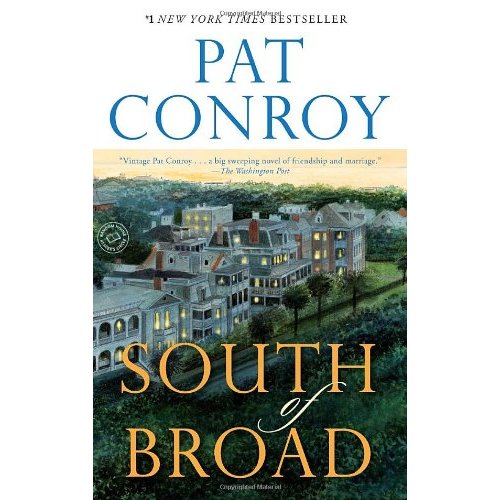
There are huge themes. There are some very bad people. There are some very good people. Sometimes the very good people can do very bad things, and sometimes the bad people can have some redeeming moments.
We meet the main character as he is about to begin his senior year in college. On the day we meet him, his life changes. Several new people come into his life. Two orphans. A beautiful sister and equally beautiful brother. A black football coach and his son. Three rich kids kicked out of the best private school in town for doing dope.
There are two ‘characters’ who are not people. One is the city of Charleston, SC, and there are entire paragraphs in this book which will make you fall in love, through Pat Conroy’s eyes, with this complicated, beautiful city. Another is Hurricane Hugo, which is as destructive as Charleston is beautiful.
South of Broad covers a time of tumult and change, and you see it through the eyes of of Conroy’s endearing characters. Times changes, society changes and change comes hard for those who stand to lose the most. Conroy deals with segregation, integration, child abuse, suicide, gay sex, economic discrimination, and psychiatric illness, a psycopathic criminal, who happens to be the father of two of this friends, and a hurricane.
For me, what was most engrossing was the complicated question of who is righteous? It’s what I want to talk about with you. Who is most like Jesus? (LOL, give examples) Which characters would you expect think themselves closest to God? Do you think they are? (Be prepared to defend your opinion.) What is a good parent? In this book, who do you think was the best parent?
If you decide to buy this book, please buy a copy with the Reader’s Guide in the back – an interview with Pat Conroy and questions that help you think about the book. I’d like to share with you a segment of the interview which I found so brightly illuminating:
. . . . I found the Parisians rarified, vigilant, hypercritical and fabulous. They had made themselves worthy of the great city they lived in. They oozed style and they ate like kings. . . . The Parisians seem special to both the world and themselves. Then it hit me: My God, they are like Charlestonians.
As I see it, you can take out Charlestonians and substitute Kuwaitis. Or New Yorkers. Or Romans. In fact, just about every society I have visited have their elite, who consider themselves rarified and special, and fight to keep themselves so.
So not only is the book dealing with spiritual righteousness, but also with themes of entitlement and deprivation, bullies and the bullied, parenting, self-fulfillment, and the very real and over-arching theme of friendship and the power of a close circle of friends.
I don’t want to tell you too much. I loved this book. I’m still thinking about it. I hope you’ll read it and think about it, too, and then come back and tell me what you’re thinking. 🙂
Why People Give
An urgent message came out today asking us to help the homeless people in Pensacola – and there are a lot of them, thanks to the warm climate. With all the rain recently, sleeping rough has been doubly rough, and it has been made worse by a sudden humidity-moisture related surge in the mosquito population.
As I talked with AdventureMan about our donation, he laughed. I was in fund-raising for a while, and was unexpectedly good at it. One thing I learned, there are a lot of ways to persuade people to donate, and then again, sometimes people will donate and you haven’t a clue as to why they felt this urge to be generous.
AdventureMan laughed; he totally got it. I used to work with a homeless, a long time ago, so I have a soft spot where they are concerned. Mosquitos also love me, and I get these horrid great but huge itchy bumps any time I am anywhere near a mosquito, AdventureMan always says he keeps me nearby because they head straight for me and ignore him.

Of course we donated. Wet homeless people and mosquitos, it was a golden combination. If you would like to donate, too, you can, through the EscaRosa Coalition on the Homeless (Working to Eliminate Homelessness). They will hold an Annual Fundraiser on Saturday September 11th from 7pm – 11pm at The Garden Center.
This is the Way We Wash Our Clothes . . . Wash our Clothes . . .”
We grew up, in America, singing a song about washing clothes:
“This is the way we wash our clothes, wash our clothes, wash our clothes,
This is the way we wash our clothes, all on a Monday morning.”
Tuesday we iron our clothes, Wednesday we mend our clothes. You can read the entire week at Mulberry Bush. Just click the blue type.
Today, Letitia Long will be named as head of the US National Geospatial-Intelligence Agency. It makes me smile to think that these two news articles appear on the same day. Women used to die young, worn out from bearing too many babies, and working themselves to the bone to keep their houses and clothes clean. Just washing clothes was an entire day event, heating huge pots of water, using a washing board, drying clothes by laying them over bushes and rocks, only the very luckiest had a clothesline.

These humble machines save hours of time. You can read the entire story of the earliest washing machines Here, At AOL News.
(Aug. 8) — “Thor” has been the name of several powerful forces in history, including a Norse god and a Marvel Comics superhero. But the strongest Thor might just be an electric-powered machine born 100 years ago that brought laundry into the modern era.
The first known washing “machine” is thought to be the scrub board, created in 1797. New-fangled hand-powered washers were introduced in 1851, but it wasn’t until a century ago that a drum-type machine with a galvanized tub and an electric motor, dubbed Thor, revolutionized the way people deal with dirty clothing.
Invented by Alva J. Fisher and introduced by Chicago’s Hurley Machine Co., the washing machine — which was patented on Aug. 9th, 1910 — is important for three distinct reasons, according to Thor Appliances vice president of marketing Michael Lee.
“First, it celebrates the birth of one of the oldest and most innovative brands/companies in home appliances,” Lee told AOL News. “Second, it represents the beginning of the washing machine industry. And third, it marks the date that clothes washing was transformed from an arduous physical task to an automated task.”
Zeitoun by Dave Eggers
Do you remember being in university, and how when it came time to buy textbooks, the new ones were really, really expensive, and sometimes you couldn’t find it used and you just had to bite the bullet? Especially in political science and international relations, it didn’t take me long to figure out that many of the authors had one little idea, and they stretched it, kneaded it, elaborated upon it, made each different iteration a new chapter – but essentially, they took this one little idea, stretched it into a book and charged $30-$40 bucks for what might have made a good essay in Foreign Affairs or the New Yorker.
I often felt so cheated. I often find that when I look at the New York Times list of Best selling Non Fiction, most of the books look just like that.
When I bought Zeitoun, that day I just needed an escape, I didn’t know it was non-fiction. I had seen Zeitoun mentioned, even advertised in my very favorite magazine, The New Yorker. I fell in love with The New Yorker when I was a kid, even though I didn’t understand half of the comics, I thought they were hilarious. I still do. 🙂 When my New Yorker arrives, I read it cover to cover, and I often order books reviewed or recommended there.

I started Zeitoun shortly after watching the HBO series Treme´ about life just after Hurricane Katrina, so this book was timely and relevant. Zeitoun, a Syrian immigrant to the US whose wife is a Moslem convert, has a thriving painting and contracting business. When Katrina threatens, his wife and kids leave town, but he stays to watch over his multiple properties and businesses.
He survives the hurricane, and actually finds the change of pace enjoyable. He has a canoe he bought at a yard sale, and he rows around the neighborhood feeding dogs locked inside his neighbors houses, checking on his friends, rescuing stranded people or notifying rescue services where people need their help – he has a feeling he is exactly where he is meant to be, that he stayed on in New Orleans as part of God’s purpose for his life. He feels valuable and useful.
Then, one day, as he is checking on one of his rental properties, he is arrested, along with three friends, in the one house they know has water for showers and a working land line, which they all use to call their families. It is Zeitoun’s property. They are arrested by the National Guard.
One of Zeitoun’s friends, Nassar, has ten thousand dollars with him. Any of us who are expats can laugh – every expat has his cache of emergency escape money. Nassar, on hearing the hurricane was coming, withdrew his savings from the bank so it would be safe. The National Guard arrests them and takes all their money, wallets, identification and sends them off to jail, and in the chaos of post-Katrina New Orleans/ Louisiana bureaucracy, there is no paperwork and their families have no idea where they are.
Nassar and Zeitoun come into the worst of it, because they have Arab names, because of the large amount of cash Nassar has, and Homeland Security advisory that terrorist organizations could try to take advantage of the post-disaster confusion. It is seriously Kafka-esque; they are good men who are just in the wrong place at the wrong time with the wrong last names. Most of the meals served in the prison contain ham or bacon or pork. The system just stops working, and they never even get to telephone people who could clear their names and get them out.
I couldn’t stop reading. Eggers captures the sensual aftermath, the sewage, the foul water, the stink of rotting food and rotting bodies, and the bureaucratic nightmare of trying to prove you are innocent when you don’t even know the charges against you, and people are being picked up on mere suspicions.
While Zeitoun is eventually released from prison, and his construction and painting business flourishes, his family is not left untouched by the post-traumatic stresses the events surrounding Katrina. Every life resounds with the impact of Katrina and the damage inflicted on New Orleans. His friend Nassar never got his ten thousand dollars back.
I love books about people who come to America, create a business, and make a go of it. Zeitoun is one of the best – he isn’t afraid of hard work, and he loves his life and family. His story is well worth a read.
Zeitoun is available from Amazon.com for a mere $10.85 plus shipping, and while I own stock in Amazon, I don’t get any kind of payment for mentioning them in reviews. 🙂
Woe to You!
We had a priest in Germany, a priest we dearly loved. He told us about how growing up, he would go to church with his Mom and after the sermon, she would say “I hope all those sinners were listening this morning!” AdventureMan and I sometimes say that after church, knowing full well that ‘those sinners’ is us.
It’s hard to read the scriptures for this morning, because Jesus is talking to religious people, and telling us that often the better we think we are, the farther we have to go.
Lord, clean us from the inside!
Matthew 23:13-26
13 ‘But woe to you, scribes and Pharisees, hypocrites! For you lock people out of the kingdom of heaven. For you do not go in yourselves, and when others are going in, you stop them.* 15Woe to you, scribes and Pharisees, hypocrites! For you cross sea and land to make a single convert, and you make the new convert twice as much a child of hell* as yourselves.
16 ‘Woe to you, blind guides, who say, “Whoever swears by the sanctuary is bound by nothing, but whoever swears by the gold of the sanctuary is bound by the oath.” 17You blind fools! For which is greater, the gold or the sanctuary that has made the gold sacred? 18And you say, “Whoever swears by the altar is bound by nothing, but whoever swears by the gift that is on the altar is bound by the oath.” 19How blind you are! For which is greater, the gift or the altar that makes the gift sacred? 20So whoever swears by the altar, swears by it and by everything on it; 21and whoever swears by the sanctuary, swears by it and by the one who dwells in it; 22and whoever swears by heaven, swears by the throne of God and by the one who is seated upon it.
23 ‘Woe to you, scribes and Pharisees, hypocrites! For you tithe mint, dill, and cummin, and have neglected the weightier matters of the law: justice and mercy and faith. It is these you ought to have practised without neglecting the others. 24You blind guides! You strain out a gnat but swallow a camel!
25 ‘Woe to you, scribes and Pharisees, hypocrites! For you clean the outside of the cup and of the plate, but inside they are full of greed and self-indulgence. 26You blind Pharisee! First clean the inside of the cup,* so that the outside also may become clean.
Recent Comments
ExpatAlien on What Country am I Living … intlxpatr on Yellowstone: Old Faithful to C… Michelle on Yellowstone: Old Faithful to C… Cathy on No Grown-Ups in Charge intlxpatr on Waiting for Snow Wikipedia Donate Button

Amazina


Early Voting in Florida


 Here There and Everywhere