Somali Pirate Code of Conduct
Ever since I was a kid, I found pirates interesting and exotic and adventurous. The truth is probably that those olden day pirates had bad teeth, scurvey – they had lived hard and fast and they probably aged quickly.
Of course, today we have Johnie Depp and the Pirates of the Caribbean series, which makes pirating look mostly like a lot of fun.
So a year or so ago, I wrote a post on the Somali pirates, and got an interesting response. It got me started looking more deeply into what is going on with the pirates there.
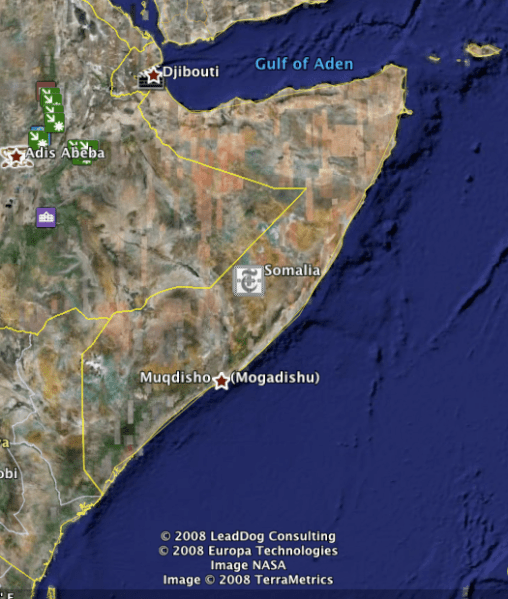
Yesterday, in the paper was an article about the Somali pirate code of conduct – with fines and punishments for infractions. I found a complete article in Newsweek, April 27.
What is bothering me now is that the one pirate captured by the US when it retook the captured US freighter (in the report filed by one BBC reporter) said he was just a frail teenager, a kid, and that the pirates had already agreed to surrender when they were blown out of the water. You could hear her attempting to control her rage.
I know it is a thorn in the side for all shippers and freighters and passenger ships who travel through waters anywhere near to Somalia. And yet . . . I kind of ask myself what the options are? Somalia is a for sure failed-nation. They haven’t been able to cobble together a government for over twenty years. Deadly, long lasting poisons have been dumped along their shoreline – and major industrial nations paid Somalis a pittance to dump their wastes there. Their coastline has been overfished. Families are starving, live is – or was – dismal.
I think it is pretty cool that they developed an enforceable – and enforced – code of conduct.
Here is the article from Newsweek:
It was a hit with the U.S. public, but president Obama’s decision to authorize the Pentagon to kill three Somali pirates who took an American sea captain hostage sent shudders through the world’s shipping and insurance industries. Because the pirates are motivated chiefly by money, maritime experts say, they have—at least until now—taken good care of the crews they hold captive. A document retrieved from a ship hijacked last year contained a “list of written rules” of conduct pirates had to follow, according to a maritime security expert who requested anonymity when discussing sensitive material. The document included a series of “punishments” to be imposed on any hijacker who struck a hostage.
Shipping companies and insurers are far more likely to fork over large ransoms if they have confidence that their personnel and cargo will be released unharmed, and while the scourge of piracy has been disruptive, so far there have been virtually no casualties among innocent people. According to estimates, there were 111 pirate attacks off the Somali coast in 2008; 42 were successful, resulting in the capture of 815 seamen. As of last week, according to one estimate, all but 37 had been released, and two had died—one reportedly of illness. Experts say the rate of attacks has increased sharply this year, and “the more [authorities] shoot, the more the pirates will shoot back,” says Tom Wilson, a Somalia analyst for the British consulting firm Control Risks.
Protecting the 23,000 merchant vessels sailing annually near the Horn of Africa would require a naval fleet of at least 60 ships, according to U.S. government and private experts; the existing international antipiracy task force has about 20. And attacking the Somali coastal villages where the pirates are based could potentially radicalize generations of Somalis. “That would be a 19th-century solution,” says Neil Roberts, a marine insurance expert with Lloyd’s Market Association in London. Industry experts say the only solution to piracy is the creation of a viable Somali government back on dry land.
According to industry officials, ransom demands have ranged as high as $25 million—but in most cases they are negotiated down to about $2 million to $3 million, and insurers then pay out claims to the shipping companies. As hijackings have increased in frequency, pirates have become fussier about how their money gets delivered. Initially, said a shipping-industry source who also asked for anonymity, ransoms were often handed off to shady Somali expats in places like Kenya. After Kenyan authorities cracked down, the pirates began insisting on airdrops via parachute into the ocean near Somali coastal villages, where they have cash-counting machines ready. Until the U.S. opened fire, one of the pirates’ biggest headaches had been dealing with the sheer volume of money they’ve collected. Last year, according to an insurance-industry official, one pirate’s boat capsized because he had overloaded it with cash.
I found this on National Post dated April 30, 2009; it is a copy of what I had read in the newspaper:
MOGADISHU — A mobile tribunal, a system of fines and a code of conduct: the success of Somali pirates’ seajacking business relies on a structure that makes them one of the country’s best-organised armed forces.
A far cry from the image conveyed in films and novels of pirates as unruly swashbucklers, Somalia’s modern-day buccaneers form a paramilitary brotherhood in which a strict and complex system of rules and punishments is enforced.
They are organized in a multitude of small cells dotting the Indian Ocean and Gulf of Aden coastline. The two main land bases are the towns of Eyl, in the breakaway state of Puntland, and Harardhere, further south in Somalia.
“There are hundreds of small cells, linked to each other,” Hasan Shukri, a pirate based in Haradhere, told AFP in a phone interview.
“We talk every morning, exchange information on what is happening at sea and if there has been a hijacking, we make onshore preparations to send out reinforcement and escort the captured ship closer to the coast,” he explained.
Somali piracy started off two decades ago with a more noble goal of deterring illegal fishing, protecting the people’s resources and the nation’s sovereignty at a time when the state was collapsing.
While today’s pirates have morphed into a sophisticated criminal ring with international ramifications, they have been careful to retain as much popular prestige as possible and refrain from the violent methods of the warlords who made Somalia a by-word for lawlessness in the 1990s.
“I have never seen gangs that have rules like these. They avoid many of the things that are all too common with other militias,” said Mohamed Sheikh Issa, an elder in the Eyl region.
“They don’t rape, and they don’t rob the hostages and they don’t kill them. They just wait for the ransom and always try to do it peacefully,” he said.
Somalia’s complex system of clan justice is often rendered obsolete by the armed chaos that has prevailed in the country for two decades, but the pirates have adapted it effectively.
Abdi Garad, an Eyl-based commander who was involved in recent attacks on U.S. ships, explained that the pirates have a mountain hide-out where leaders can confer and where internal differences can be solved.
“We have an impregnable stronghold and when there is a disagreement among us, all the pirate bosses gather there,” he told AFP.
The secretive pirate retreat is a place called Bedey, a few miles from Eyl.
“We have a kind of mobile court that is based in Bedey. Any pirate who commits a crime is charged and punished quickly because we have no jails to detain them,” Mr. Garad said.
Some groups representing different clans farther south in the villages of Hobyo and Haradhere would disagree with Mr. Garad’s claim that Somalia’s pirates all answer to a single authority.
But while differences remain among various groups, the pirates’ first set of rules is precisely aimed at neutralizing rivalries, Mohamed Hidig Dhegey, a pirate from Puntland, explained.
“If any one of us shoots and kills another, he will automatically be executed and his body thrown to the sharks,” he said from the town of Garowe.
“If a pirate injures another, he is immediately discharged and the network is instructed to isolate him. If one aims a gun at another, he loses 5% of his share of the ransom,” Mr. Dhegey said.
Perhaps the most striking disciplinary feature of Somali “piratehood” is the alleged code of conduct pertaining to the treatment of captured crews.
“Anybody who is caught engaging in robbery on the ship will be punished and banished for weeks. Anyone shooting a hostage will immediately be shot,” said Ahmed Ilkacase.
“I was once caught taking a wallet from a hostage. I had to give it back and then 25,000 dollars were removed from my share of the ransom,” he said.
Following the release of the French yacht Le Ponant in April 2008, investigators found a copy of a “good conduct guide” on the deck which forbade sexual assault on women hostages.
As Ilkacase found out for himself, pirates breaking internal rules are punished. Conversely, those displaying the most bravery are rewarded with a bigger share of the ransom, called “saami sare” in Somali.
“The first pirate to board a hijacked ship is entitled to a luxurious car, or a house or a wife. He can also decide to take his bonus share in cash,” he explained.
Foreign military commanders leading the growing fleet of anti-piracy naval missions plying the region in a bid to protect one of the world’s busiest trade routes acknowledge that pirates are very organised.
“They are very well organized, have good communication systems and rules of engagement,” said Vice Admiral Gerard Valin, commander of the French joint forces in the Indian Ocean.
So far, nothing suggests that pirates are motivated by anything other than money and it is unclear whether the only hostage to have died during a hijacking was killed by pirates or the French commandos who freed his ship.
Some acts of mistreatment have been reported during the more than 60 hijackings recorded since the start of 2008, but pirates have generally spared their hostages to focus on speedy ransom negotiations.
With the Robin Hood element of piracy already largely obsolete, observers say the “gentleman kidnapper” spirit could also fast taper off as pirates start to prioritize riskier, high-value targets and face increasingly robust action from navies with enhanced legal elbow room.
They have warned that the much-bandied heroics of a U.S. crew who wrested back control of their ship and had their captain rescued by navy snipers who picked off three pirates could go down as the day pirates decided to leave their manners at home.
I used to read science fiction novels about a diplomat named Retief, I think they were by Keith Laumer. He would find himself in an alien environment with a horrible unsolvable problem and he would find a great solution, where everyone walked away OK. I wish there were a Retief who could negotiate a win/win out of this situation.
Rola Dashti Tackles Sensitive Issues
“Why are you looking so sad?” AdventureMan asked me as we sat down to dinner.
(Sigh) “There are people in Kuwait who don’t believe change is possible, and there is a movement afoot to WITHHOLD their votes as a protest.”
“Why do you care? It’s not your country?”
We call it “falling on your sword,” when a person does something fatal to self, to career, to family or to country, choosing an issue and staking everything on it. Rarely does it pay. The world moves on, life goes on and you are left behind bleeding on your sword.
Withholding your vote gives more power to those who are good at stirring up the rabble with irrational and selfish issues. Those who get the votes are those who make grandiose – and general – promises, those who refuse to be held accountable.
If you are a person who cares deeply about Kuwait – Please, do not withhold your vote. Do the hard work of listening to the candidates, and exploring their reputations for truthfulness and accountability. Think beyond your own needs, think of the greater good of Kuwait.
This is from today’s Al Watan; a candidate tackling some very sensitive issues, bringing them out in the open.
Ghenwah Jabouri
Staff Writer Al Watan
KUWAIT: In pursuit of winning enough ballots to secure a seat in the National Assembly, Dr. Rola Dashti, who is believed to be a potential woman candidate, delivered an emotive speech Monday evening to announce her parliamentary agenda if elected.
Dashti touched on sensitive and delicate issues which aroused the emotions of the audience, resulting in heated engagements later on in the evening.
Dashti mainly focused on family related issues, germane to women issues.
In an attempt to recoup the cynicism manifested by citizens toward parliament, Dashti urged the audience to not ponder on who is wrong or right.
“We need to move on; seeking to blame parliament, government, MPs, etc., is not going to serve us justice. We need to focus on developing Kuwait, rather then pointing our fingers at the wrongdoers, ” Dashti said.
She stressed that whether it was the parliament, the government, or the citizenship who committed the mistakes is not important; “what is important is that we learn from such mistakes.
“Individuals who have the cultural habituate of blaming, attacking and are cynical, do not want to move toward the future; rather, they want to travel back in time. Allow me to give you an example: last year, thirty percent of citizens in my constituency did not cast their ballot. These people are like you and me: their heart is burning for Kuwait, and they observed nothing positive, and they are in immense suffering.
“They gave up on hope and decided to ultimately not vote. Had half of them voted (nine thousand), ten people who would have succeeded in the Third Constituency elections would have determined a better fate for those that abstained from voting.” She further lamented that society should consider first and foremost Kuwait, and that the children, the youth and coming generations “deserve this.”
Dashti, further illustrating her point, noted: “For example, if soـandـsoـperson does not vote, who is going to protect their rights and so forth?”
Dashti stressed that Kuwait is experiencing “tumultuous times” and that the country is on the verge of a major collapse.
“Kuwait cannot afford political arguments and political confrontations and commotions. It is in our hands to save Kuwait. If we take responsibility, vote and call on those who did not vote to cast their ballot, change might have a chance of survival.
“Hundreds of people did not cast their votes because they lost their confidence in parliament. However, many families are suffering, and so, it is pivotal to acquire each and every vote; we need to give back what Kuwait bestowed us with.
“We need to give a little back to those who lost their lives to protect Kuwait during the Iraqi invasion in 1990; many people lost their lives during the invasion who fought for our liberty. Women were raped and families were torn apart. We need to give back a little, we need to continue to believe, and fight for our children and future generations,” Dashti added.
“Does Kuwait not deserve for us to stand in the cue for fifteen minutes to cast our votes?”
Talking more about women”s issues, Dashti noted that there are many things that need to be considered where women’s issues are concerned.
“Women have many burdens that they shoulder; the divorced, the widowed, the one who is married to an expatriate, and housing for women, all are issues the Kuwaiti woman suffers from.”
She pointed out that not every family is living happily, “although this is something I would love to achieve.
“Today, the Kuwaiti family has to wait fifteen years for (government) housing. Where will the divorced woman go during this lengthy period?
“This woman could be my sister, my mother, or our daughter; where does she go?”
Dashti noted that the law stipulates that a woman who is over forty years of age and both of whose father and mother are deceased and is unassisted by a guardian “is entitled to receive a housing allowance.”
“However,” Dashti said challenging the law, “what about other women in a somewhat parallel situation where the father is deceased but is not receiving allowance from her guardian ـ what can she do? Shall the woman take her guardian to court to sue him?
“Why does the law in pursuit of helping women insist on punishing them, even insulting her?
“This law is one of many that are flawed and need to be amended,” Dashti stressed.
She further said that “neither Kuwait or the people of Kuwait can tolerate empty words and useless slogans. Today we need to put many things on the table and take action in tackling them.
“Let”s now have a look at the children of some Kuwaiti women who are married to expatriates: we need to look at their educational, health, and employment and social needs and treat them with justice, like other children are treated who have Kuwaiti fathers.
“This is their country, why are we abusing them? These are our cousins, our brothers and sisters, and have to be treated with equality when their mother is a citizen of the country.”
She further added that citizens have been “fooled” enough; “vote for someone who knows what they can do, someone who can save us from the financial burden.” Touching on an issue that has become central in campaigns, Dashti noted, “We should not allow people who do not understand finance to tamper with the budget.
“Nor should we allow individuals who are responsible in dealing with the financial budget to use the financial budget for personal gains.”
“Why should we follow those who damage our financial budget, and steal the money of the public? There is another option: choose someone who will protect the public financial budget and enhance the budget!”
Dashti further stated that there is an “internal bleeding” in the country and that she is not going to offer an “aspirin to silence your pain to only kill you” as a member of parliament.
“I will opt for a long term alternative and choose to cure you.”
During the question and answer session following her address, particularly passionate but enraged voices emerged, where some expressed their frustration with the old faces of parliament.
One woman said she was “fed up with the old faces and that it is about time new faces took over.”
She further said, “We have been deceived, fooled and cheated by the old MPs,” and stressed, “We are suffering and are in desperate need of MPs who will promote social and financial justice.
“Kuwait has hit a plateau and something”s got to give,” she noted.
Another woman made a remark about Dashti”s strong foreign accent.
She noted: “Society often criticizes you (Dashti) for speaking in a Lebanese accent.
“I don”t understand why you come under scrutiny for such a reason. After all, people have television at home and typically watch the satellite channels, all of which speak in foreign accents.”
The woman”s comment was understood to be a positive comment, where she welcomed Dashti”s candidacy and believes that the candidate will be a forceful vehicle towards righteous deeds toward society.
Another frustrated woman spoke about property and about people whose houses was taken from them by the banks. She said that she read an article in Al Watan newspaper that there are many withdrawn properties and houses for sale.
“The inheritors are crying blood and are traumatic, because their houses are being taken from them. Other citizens are staying in small apartments after they used to occupy villas,” she said.
Another woman who was virtually in tears pled to the people “to opt for change and choose new faces, even if the new members of parliament will do nothing.
“The former parliament has tormented and killed me; please, give your votes to new faces, in the name of God, please, vote for change.”
Free Speech in Fiji
It was prime drive time in Kuwait, and I almost laughed so hard that I might have been a danger on the road. A brief news article on BBC News featured the national leader in Fiji saying “free speech is nothing but trouble.” The news reporter was saying that the only real news in Fiji right now is from the bloggers. Here is a fragment of an article on BBC April 15th:
Free speech ‘trouble’
In an interview with Radio New Zealand, Mr Bainimarama said he was determined to carry out what he described as reforms.
He defended the introduction of emergency regulations that include an edict that the local Fijian media publishes only positive news, saying Fiji does not need free and open public discussion about current issues.
“That was how we ended up with what we came up with in the last couple of days,” he told Radio New Zealand.
“The circumstances have changed. We [the government] now decide what needs to be done for our country, for the reforms that need to be put in place for us to have a better Fiji,” he said.
Fiji’s Court of Appeal ruled last Thursday that the Bainimarama regime, in power since staging a 2006 coup, was illegal under the country’s 1997 constitution.
In response, the country’s ailing President Josefa Iloilo sacked the judges, dissolved the constitution and reappointed Mr Bainimarama, who then said there would be no democratic elections until 2014.
Jodi Picoult: Handle With Care
I just finished the latest Jodi Picoult novel, Handle with Care. I was uncomfortable with it at the beginning, as I often am with Jodi Picould novels. She’s like that guest who brings up topics no one else brings up, and sometimes you wish she would stop, but the conversation gets rolling and everyone has an opinion, and the party would be much duller if she weren’t there.
She’s also the friend you would go to if you had an embarrassing problem you couldn’t discuss with anyone else. We all need that kind of friend, an honest sounding board, not afraid to deal with the grit and grime of everyday life.
I know the reason her books make me uncomfortable is that sometimes I see things I don’t like about myself in her characters.

The subject of the book is a disease called osteogenesis imperfecta (OI), and Willow, the youngest daughter, has Type III, which means she was born with broken bones, her bones would break if you picked her up wrong, changed her diaper the wrong way, even if she rolled over. Her bones were brittle, and the slightest thing could cause a break. She is also very smart, and a delightful character.
Picoult takes us inside many heads – the mother, Charlotte, a former pastry chef (Picoult includes some of her very best recipes, YUMMMM), Sean, the fiercely loving father, Amelia, a troubled pre-teen who hides her bulemia and cutting, and Marin, the lawyer, searching for her own birth mother. When Charlotte files a wrongful birth suit against her best friend – and obstetrician – Piper, her life starts to fall apart. It’s hard to believe things could get worse than having a child whose bones break all the time, but things definitely get worse.
What I hated about Charlotte, who has learned to anticipate her damaged child’s needs, is seeing myself through her eyes. Frequently, she shows us our insensitivity to the disabled, how we patronize, how we are oblivious to the simplest needs. Charlotte is a little angry at the world, so protective that she bites back scathing words to outsiders – or doesn’t. People without disabilities – visible disabilities, we all have disabilities, don’t we, just some are visible and some are not? – can be so smug, so unaware of the hardships others face. I cringe when I read this book. I see myself, and I don’t like what I see.
I admire Jodi Picoult. I will read just about anything she has written, because of the courage she has to tackle the most sensitive subjects. This is not a comfortable book to read, but it is a worthwhile book to read.
Income Tax Blessing
You didn’t think those words could all be used in the same sentence, did you? AdventureMan and I have to pay something called “quarterly estimated taxes” and this year, I guess because our investment income went seriously down, we overpaid our taxes. I know, I know, that doesn’t sound like good news to you, but it sure beats the pit-in-the-stomach of learning that you owe more to Uncle Sam. We overpaid, and we will go ahead and apply it to next year’s taxes and hope that everything works out well next year, too.
We used to talk to my father about ways he could pay less tax on his income and savings. He would look at us and say “But the government was always good to me!” (he worked for the government) “They paid my salary! They pay my retirement! They help pay my medical bills! Why would I not want to pay them taxes?”
It was an extraordinary attitude; I have never forgotten it.
More-on Bullying
The bullies have always been there – Jodi Picoult in 19 MInutes says that the worst part about being the bully is that nagging insecurity that if you stop trying for even a short time, your popularity will fall. So even the bully is struggling with nagging self-doubts, and those doubts compel his/her behavior – taunting someone “different”, smaller, weaker, more vulnerable, in order to make oneself look bigger. It’s pitiful, but how do we stop it?
This is a tragic article – so tragic I didn’t really want to publish it. It happens in every society, world-wide; the strong – but insecure – pushing around those who are weaker, to make themselves feel better.

April 16, 2009, 9:02 PM
Dude, You’ve Got Problems
by Judith Warner
From The New York Times
Early this month, Carl Joseph Walker-Hoover, an 11-year-old boy from Springfield, Mass., hanged himself after months of incessantly being hounded by his classmates for being “gay.” (He was not; but did, apparently, like to do well in school.)
In March, 2007, 17-year-old Eric Mohat shot himself in the head, after a long-term tormentor told him in class, “Why don’t you go home and shoot yourself; no one will miss you.” Eric liked theater, played the piano and wore bright clothing, a lawyer for his family told ABC news, and so had long been subject to taunts of “gay,” “fag,” “queer” and “homo.”
Teachers and school administrators, the Mohats’ lawsuit now asserts, did nothing.
We should do something to get this insanity under control.
I’m not just talking about combating bullying, which has been a national obsession ever since Columbine, and yet seems to continue unabated. I’m only partly talking about homophobia, which, though virulent, cruel and occasionally fatal among teenagers, is not the whole story behind the fact that words like “fag” and “gay” are now among the most potent and feared weapons in the school bully’s arsenal.
Being called a “fag,” you see, actually has almost nothing to do with being gay.
It’s really about showing any perceived weakness or femininity – by being emotional, seeming incompetent, caring too much about clothing, liking to dance or even having an interest in literature. It’s similar to what being viewed as a “nerd” is, Bennington College psychology professor David Anderegg notes in his 2007 book, “Nerds: Who They Are and Why We Need More of Them”: “‘queer’ in the sense of being ‘odd’ or ‘unusual,’” but also, for middle schoolers in particular, doing “anything that was too much like what a goody-goody would do.”
It’s what being called a “girl” used to be, a generation or two ago.
“To call someone gay or fag is like the lowest thing you can call someone. Because that’s like saying that you’re nothing,” is how one teenage boy put it to C.J. Pascoe, a sociologist at Colorado College, in an interview for her 2007 book, “Dude, You’re a Fag: Masculinity and Sexuality in High School.”
The message to the most vulnerable, to the victims of today’s poisonous boy culture, is being heard loud and clear: to be something other than the narrowest, stupidest sort of guy’s guy, is to be unworthy of even being alive.
It’s weird, isn’t it, that in an age in which the definition of acceptable girlhood has expanded, so that desirable femininity now encompasses school success and athleticism, the bounds of boyhood have remained so tightly constrained? And so staunchly defended: Boys avail themselves most frequently of epithets like “fag” to “police” one another’s behavior and bring it back to being sufficiently masculine when someone steps out of line, Barbara J. Risman, a sociologist at the University of Illinois at Chicago, found while conducting extensive interviews in a southeastern urban middle school in 2003 and 2004. “Boys were showing each other they were tough. They were afraid to do anything that might be called girlie,” she told me this week. “It was just like what I would have found if I had done this research 50 years ago. They were frozen in time.”
Pascoe spent 18 months embedded in a Northern California working-class high school, in a community where factory jobs had gone south after the signing of Nafta, and where men who’d once enjoyed solid union salaries were now cobbling together lesser-paid employment at big-box stores. “These kids experience a loss of masculine privilege on a day-to-day level,” she said. “While they didn’t necessarily ever experience the concrete privilege their fathers and grandfathers experienced, they have the sense that to be a man means something and is incredibly important. These boys don’t know how to be that something. Their pathway to masculinity is unclear. To not be a man is to not be fully human and that’s terrifying.”
That makes sense. But the strange thing is, this isn’t just about insecure boys. There’s a degree to which girls, despite all their advances, appear to be stuck – voluntarily – in a time warp, too, or at least to be walking a very fine line between progress and utter regression. Spending unprecedented amounts of time and money on their hair, their skin and their bodies, at earlier and earlier ages. Essentially accepting the highly sexualized identity imposed on them, long before middle school, by advertisers and pop culture. In high school, they have second-class sexual status, Pascoe found, and by jumping through hoops to be sexually available enough to be cool (and “empowered”) yet not so free as to be labeled a slut, they appear to be complicit in maintaining it.
Why – given the full array of choices our culture ostensibly now allows them – are boys and girls clinging to such lowest-common-denominator ways of being?
The strain of being a teenager, and in particular, a preteen, no doubt accounts for much of it; people tend to be at their worst when they’re feeling most insecure. But there’s more to it than that, I think. Malina Saval, who spent two years observing and interviewing teenage boys and their parents for her new book “The Secret Lives of Boys,” found that parents played a key role in reinforcing the basest sort of gender stereotypes, at least where boys were concerned. “There were a few parents who were sort of alarmist about whether or not their children were going to be gay because of their music choices, the clothes they wore,” she said. Generally, she said, “there was a kind of low-level paranoia if these high-school-age boys weren’t yet seriously involved with a girl.”
It seems it all comes down, as do so many things for today’s parents, to status.
“Parents are so terrified that their kids will miss out on anything,” Anderegg told me. “They want their kids to have sex, be sexy.”
This generation of parents tends to talk a good game about gender, at least in public. Practicing what we preach, in anxious times in particular, is another thing.
Re-Igniting the Romance with Date Night
Good news – doing new and exciting things together help keeps a relationship fresh and intense. AdventureMan and I have always wanted to take dance lessons together, but have never had the time. I can hardly wait! Snorkeling in a new and exotic site . . . an African safari . . . trying a new restaurant, a new cuisine . . . finding new places to explore . . . novelty helps keep a marriage fresh and engaging.
From The New York Times. You can click this blue type to read the entire article.
Long-married couples often schedule a weekly “date night” — a regular evening out with friends or at a favorite restaurant to strengthen their marital bond.
But brain and behavior researchers say many couples are going about date night all wrong. Simply spending quality time together is probably not enough to prevent a relationship from getting stale.
Using laboratory studies, real-world experiments and even brain-scan data, scientists can now offer long-married couples a simple prescription for rekindling the romantic love that brought them together in the first place. The solution? Reinventing date night.
Rather than visiting the same familiar haunts and dining with the same old friends, couples need to tailor their date nights around new and different activities that they both enjoy, says Arthur Aron, a professor of social psychology at the State University of New York at Stony Brook. The goal is to find ways to keep injecting novelty into the relationship. The activity can be as simple as trying a new restaurant or something a little more unusual or thrilling — like taking an art class or going to an amusement park.
The theory is based on brain science. New experiences activate the brain’s reward system, flooding it with dopamine and norepinephrine. These are the same brain circuits that are ignited in early romantic love, a time of exhilaration and obsessive thoughts about a new partner. (They are also the brain chemicals involved in drug addiction and obsessive-compulsive disorder.)
Most studies of love and marriage show that the decline of romantic love over time is inevitable. The butterflies of early romance quickly flutter away and are replaced by familiar, predictable feelings of long-term attachment.
. . . . . .
Dr. Aron cautions that novelty alone is probably not enough to save a marriage in crisis. But for couples who have a reasonably good but slightly dull relationship, novelty may help reignite old sparks.
And recent brain-scan studies show that romantic love really can last years into a marriage. Last week, at the Society for Personality and Social Psychology conference in Albuquerque, researchers presented brain-scan data on several men and women who had been married for 10 or more years. Interviews and questionnaires suggested they were still intensely in love with their partners. Brain scans confirmed it, showing increased brain activity associated with romantic love when the subjects saw pictures of their spouses.
It’s not clear why some couples are able to maintain romantic intensity even after years together. But the scientists believe regular injections of novelty and excitement most likely play a role.
Facebook Hurts your Grades?
From CNET News
Yes, researchers at Ohio State University have delved deep into the habit that is Facebook and concluded that those who express their membership regularly do worse in school tests.
In fact, they say, the majority of those who Facebook daily do worse by as much as one whole grade.
Aryn Karpinski, one of the Ohio State education department researchers, was quoted in the Times of London as saying: “Our study shows people who spend more time on Facebook spend less time studying. “Every generation has its distractions, but I think Facebook is a unique phenomenon.”
Ms. Karpinski will be presenting her findings this week at the annual meeting of the American Educational Research Association.
Some 68 percent of the Facebookers among the 219 young things questioned enjoyed a significantly lower GPA than those who eschewed friending and poking.
William Dalrymple: The Age of Kali
Having read and loved In Xanadu: A Quest by William Dalrymple, and having received recommendations by friends who say they read ALL of William Dalrymple, I started on this second book, The Age of Kali. I didn’t like it, not one bit. I am proud to say I read it all the way to the end, because often if I don’t like a book, I will say to myself “I don’t need this!” and toss it, but I didn’t, I stuck with it. I am proud because it isn’t easy to stick with a book you don’t like, and I didn’t like this book.

In Xanadu, Dalrymple was wryly funny, hilariously funny, and most of the humor was directed at himself. In The Age of Kali, there is nothing funny.
The Age of Kali is a series of interviews and adventures in India and Pakistan. The author did these interviews and took notes (some are published in slightly different forms as magazine articles) over a period of ten years and then strung them all together to form this book. There is little or no linkage from one to the other. They are grouped geographically.
Here is what I like and admire – this man achieves the most amazing interviews, many times just by asking the right person at the right time. He insinuates himself, asks easy questions, and then sticks in a hard question. He doesn’t seem to flinch from putting himself in danger, and he doesn’t stand on respect when asking his questions. I admire that he went difficult places, interviewed difficult people, and wrote the interviews up without fawning over the celebrity status of his interviewee.
What I don’t like is that he doesn’t seem to like anybody very much. There are no funny anecdotes. By the end of the first interview, I began to get an impression that he doesn’t like India very much (and I believe that is NOT true, as he lives part-time in Delhi) and that India is not a place I want to visit. He interviews corrupt politicians, descendants of the moghuls, Benazir Bhutto – and her mother, Imran Khan (the cricket player) and many others. In each and every interview, he maintains a distance that tells us he doesn’t like these characters very much.
Here are some quotes from early in the book:
These days Bihar was much more famous for its violence, corruption and endemic caste-warfare. Indeed, things were now so bad that the criminals and the politicians of the state were said to be virtually interchangeable: no fewer than thirty-three of Bihar’s State Assembly MLAs had criminal records, and a figure like Dular Chand Yadav, who had a hundred cases of dacoity and fifty murder cases pending against him, could also be addressed as the Honorable Member for Barth.
As he interviews Bihar politician Laloo Prasad Yadav:
I asked Laloo about his childhood. He proved only too willing to talk about it. He lolled back against the side of the plane, his legs stretched over two seats.
‘My father was a small farmer,’ he began, scratching his balls with the unembarrassed thoroughness of a true yokel.
OK, that was funny. I had to read it aloud to AdventureMan. One of the things that still unnerves me living here is that the men are always touching themselves – something so totally forbidden in my culture as to be simply unthinkable.
In his section about Pakistan:
These people – the Pathans – have never been conquered, at least not since the time of Alexander the Great. They have seen off centuries of invaders – Persians, Arabs, Turks, Moghuls, Sikhs, British, Russians – and they retain the mixture of arrogance and suspicion that this history has produced in their character. History has also left them with a curious political status. Although most Pathans are technically within Pakistan, the writ of Pakistan law does not carry in to the heartland of their territories.
These segregated areas are in effect private tribal states, out of the control of the Pakistan government. They are an inheritance from the days of the Raj: the British were quite happy to let the Pathans act as a buffer zone on the edge of the Empire, and they did not try to extend their authority in to the hills. Where the British led, the modern Pakistani authorities have followed. Beyond the checkpoints on the edge of the Peshawar, tribal law – based on the institutions of the tribal council and the blood feud – rules unchallenged and unchanged since its origins long before the birth of Christ.
When I read this, I think of recent headlines about the problems Pakistan is having maintaining order, fighting the status of “failed-nation”, and the chaotic administration of tribal “justice.” The old ways have endured – but as we learned in Three Cups of Tea, there are villages where villagers are eager to have modern schools, eager to educate their daughters, and they, too, are victims of the fanatics who burn the schools and throw acid on women attending school.
The author is told, time and time again by Indian citizens, that India has entered The Age of Kali, “the lowest possible throw, an epoch of strife, corruption, darkness and disintegration.” The book reflects the darkness, corruption and disintegration the author found. I only wish there were some moments of relief, of lightness, hope or humor to encourage the reader on his/her way, but the documentation of this lowest throw was relentless.
Diwaniyya Where No Candidates are Welcome
LOL, he is making his point in such a gentle and delightful way!
Staff Writer
From today’s Al Watan

KUWAIT: Kuwait”s newspapers have been covering the opinions of various former MPs and candidates about the elections and their programs, but the real news and discussions are available in one Kuwait”s oldest traditions, the diwaniya.
Diwaniyas are frequently targeted by political hopefuls to discuss various issues of concern. However, not Bu Hamad”s diwaniya, a retired Kuwaiti customs official who worked at the Salmi and Abdali ports.
Bu Hamid says that that politics is no longer a concern of his after so much disappointment, so it is little wonder that in his own diwaniya in Bayan, Bu Hamid has a large poster clearly saying” “Welcome honorable guests and apologies for not receiving any candidates. May God bless Kuwait. Bu Hamid”s Diwaniya.”
One cannot ignore the sign and equally not be intrigued by its curious message.
Asked about the reasons behind his ban of candidates, Bu Hamid said that in the previous election he discussed an issue of traffic safety near his home, which many candidates promised to sort out.
“I had previously asked candidates who became MPs later to set up speed bumps and traffic lights in front of my diwaniya which overlooks the highway in Bayan, which is notorious for traffic accidents.
“None had carried out their promise after they became MPs. They were only seeking their own interests and the interests of their close circle,” he explained.
“They are good for nothing. They are good for nothing,” he declared.
Bu Hamid expressed his amazement at the MPs whom he has voted for since the 1960’s that continually failed to meet the public’s demands. He is now “fed up with them and their tactics,” adding that when candidates need the voters they are available, “but the minute they become MPs they hardly recognize voters or even bother to meet them, as if they don”t remember them.”
He therefore decided to keep away from candidates and their campaigns.
“I will not cast my vote. I will never vote for any candidate. I have been casting my vote since 1960 and I have seen nothing from them.”
Last updated on Monday 6/4/2009
Recent Comments
intlxpatr on Yellowstone: Old Faithful to C… Michelle on Yellowstone: Old Faithful to C… Cathy on No Grown-Ups in Charge intlxpatr on Waiting for Snow intlxpatr on Waiting for Snow Wikipedia Donate Button

Amazina


Early Voting in Florida


 Here There and Everywhere