Kuwait: Women Leading? Not Permitted!
In today’s (17 January 2007) Kuwait Times is an article entitled MPs still divided over no-confidence motion. You’d think this issue would be put to rest by Minister of Education Nouriya al-Sabeeh’s stellar presentation, meeting her “grillers” with calm dignity and restraint, and with facts and figures. After the grilling, her accusers admitted to newspapers that they didn’t have the votes for a no-confidence resolution, and many spoke of her in admiring tones.
In today’s paper, this issue once again rears its ugly head, and buried deep in the article (read it for yourself by clicking on the blue type above) is this paragraph:
“The Secretary General of the Thawabit Gathering Mohammad Hayef Al-Metairi asked Islamist MPs to support voting for a no-confidence motion because women MPs are not permitted to hold leading positions according to Islamic principals.“
Women not leading is an Islamic principle?
Kuwaiti Women, Minors from Cradle to Grave
In an article in today’s Kuwait Times sure to raise discussions throughout Kuwait, staff writer Ahmad Al-Khaled brings up the laws requiring Kuwaiti women to have a husband /father/ guardian present to apply for a passport and other legal papers:
Published Date: January 15, 2008
By Ahmad Al-Khaled, Staff writer
KUWAIT: The issue of gender equality under the law has come under fire of late after an exasperated Kuwaiti woman wrote to a local Arabic newspaper telling the tale of her frustrated quest to renew her passport and was told the law required her to be accompanied by her male guardian. “It is frustrating that we are not considered equipped to act as our own guardians in 2008,” said a middle-aged Kuwaiti wife and mother of five, Um Talal, who read the woman’s letter describing how she was denied the right to renew her passport unless her husband accompanied her to the ministry.
While Kuwait is a Muslim nation, Kuwaiti law is not solely Sharia based, although it uses Sharia as a primary source of legislation according to the Constitution. Adult-aged Kuwaiti women are required under the law to be accompanied by their husband or father to renew their passports. If their father and husband are deceased or should they be divorced from their husband, they may be required to provide authorities with proof of their male guardian’s death or proof of their marital status.
“Why should we be required to offer such proof. It is insulting to be treated as if we Kuwaiti women are in need of guardianship. Shame on the government for continuing to allow such a law to remain in the books,” said a 30 something Fala Jassem. “It is not Islamic to treat women poorly, we are not children! Shame on anyone that calls this law Islamic,” said 65-year-old Bedour Bader.
While Kuwaiti women speaking to Kuwait Times were staunchly against the law, Kuwaiti men were divided with some going so far as to call the law a necessary requirement to keep their women protected. “It is a husband’s duty to act as a guardian for his wife. We must lead our families and this includes the wife,” said 53-year-old father of four Abdullah Nasser.
You can read the rest of the article HERE.
Inheritance of Loss
Most of the time, if I don’t like a book, I won’t even bother telling you about it. This book, The Inheritance of Loss, by Kiran Desai, is an exception for one reason – it IS worth reading.
Inheiritance of Loss showed up on the book club reading list for the year, and I ordered it. I read the cover when the book came, and it didn’t sound that good to me, so I read other books instead. The next time it came to mind was when a friend, reading the book, said she was having trouble with it, and asked me if I had started it. This friend is a READER, and a thinker. It caught my attention that she would have problems reading a book, so I decided to give it a try.
This is a very uncomfortable book. The characters live in the shadow of the Himalayan mountains. The most sympathetic character is a young orphaned girl, sent to live with her grandfather. With each chapter, we learn more about all the characters, how they came to be here, what they think, what their lives have looked like.
The author of this book has a very sour look on life. She has snotty things to say about every character. You can almost feel her peering around the corner, eyes slit with evil intent. She is that vicious neighbor who comes by and never says anything nice about anybody, and when you see her talking with your neighbor, you get the uneasy feeling she could be saying something mean about you, and she probably is.
The book covers a wide range of topics – Indian politics, Ghurka revolts, English colonization, Indian emigration to the US and UK, everyday vanities and pride in petty things, how people destroy their own lives, how people can be cruel to one another, oh it’s a great read (yes, that is sarcasm).
At the same time, this vicious unwelcome neighbor has a sharp eye for detail. You may not like what she is telling you, but you keep listening, because you can learn important tidbits of information from her. In my case, I learned a lot about how life is lived in a small mountain village in India, the struggles of illegals in America and how class lines are drawn, ever so finely, when people live together. I learned a lot about the legacy of colonialism, and the creep of globalization. This unwelcome neighbor has a sharp tongue, always complaining, and yet . . . some of her complaints have merit.
I don’t believe there was a single redeeming episode in the book. There was not a paragraph to feel good about. I am glad to be finished with the book – but, yes, I finished it, I didn’t just set it aside in disgust, or give it away without finishing.
Here is the reason I am telling you about this book – as uncomfortable as this book is to read, I have the feeling, upon finishing, that ideas and images from this book will stick with me for a long time. I have the feeling that it contributes to my greater understanding of how things work, how people think differently from other people, and on what levels we are very much the same.
Here is an excerpt from the book, at a time during which the Judge is a young Indian, studying in England:
The new boarding house boasted several rooms for rent, and here, among the other lodgers, he was to find his only friend in England: Bose.
They had similar inadequate clothes, similar forlornly empty rooms, similar poor native’s trunks. A look of recognition had passed between them at first sight, but also the assurance that they wouldn’t reveal one another’s secrets, not even to each other.
. . . Together they punted clumsily down the glaceed river to Grantchester and had tea among the jam sozzled wasps just as you were supposed to, enjoying themselves (but not really) as the heavy wasps fell from flight into their laps with a low battery buzz.
They had better luck in London, where they watched the changing of the guard at Buckingham Palace, avoided the other Indian students at Veeraswamy’s, ate shepherd’s pie instead, and agreed on the train home that Trafalgar Square was not quite up to British standards of hygiene – all those defecating pigeons, one of which had done a masala-colored doodle on Bose. It was Bose who showed Jemubhai what records to buy for his new gramophone: Caruso and Gigli. He also corrected his pronunciation: Jheelee, not Giggly. . . .
This it was that the judge eventually took revenge on his early confusions, his embarrassments gloved in something called “keeping up standards,” his accent behind a mask of a quiet. He found he began to be mistaken for something he wasn’t – a man of dignity. This accidental poise became more important than any other thing. He envied the English. He loathed Indians. He worked at being English with the passion of hatred and for what he would become, he would be despised by absolutely everyone, English and Indians both.
I consider this a review, and not particularly a recommendation. I read the book, I finished the book and I learned from the book. I didn’t like the book. I recommend it only as a challenge, for people who like to read and stretch their minds in new directions.
Get Moving!
We all know that we need to get more exercise. This report from excerpted from BBC Health News tells us that if we don’t get moving, we are more subject to depression and later, to dementia. Get moving!
Inactivity link to mental decline
A lack of physical activity leads to depression and dementia, evidence presented at the British Nutrition Foundation conference shows.
It comes as new research from the University of Bristol found that being active cuts the risk of Alzheimer’s disease by around a third.
Currently only 35% of men and 24% of women reach the recommended weekly amount of physical activity.
Professor Nanette Mutrie, an expert in exercise and sport psychology at the University of Strathclyde, told the conference that mental health was not a trivial issue.
“It’s only recently that people have begun to see the link between physical activity and mental health,” says
Professor Nanette Mutrie.
“It’s important for increasing people’s self esteem, general mood, coping with stress and even sleeping better.
“And we now have very strong evidence that physical activity can prevent depression.”
She said inactive people had twice the risk of becoming depressed and there was also very good evidence that exercise is a useful treatment for depression.
Dementia risk
Researchers at the University of Bristol carried out an analysis of 17 trials looking at the effects of physical activity on dementia and Alzheimer’s disease.
They found that in both men and women physical activity was associated with a 30-40% drop in the risk of Alzheimer’s.
It is unclear why there is such a great effect but it could be associated with benefits to the vascular system as well as release of chemicals in the brain.
Professor Mutrie added: “It could be a simple case of use it or lose it.
. . . . . .
“There has already, justifiably, been a lot of emphasis on good nutrition but we must also find ways of helping people to be more physically active to ensure that they maintain health and quality of life in later years.”
Department of Health figures show the majority of adults do not do the recommended 30 minutes of moderate activity at least five times a week.
Read the entire article HERE.
Salary Belongs to Husband?
Muna al-Fuzai had a column yesterday in the Kuwait Times entitled Kuwaiti Women Accept Discrimination. (You can read the whole article by clicking on the blue type.)
In this article is one small paragraph that sends shivers down my spine:
A religious Islamic ruling was made recently to approve the husband’s right to take his wife’s salary because the time she spent outside was his own and thus he is entitled to take her salary, which she has worked so hard to earn.
It doesn’t sound to me as if it has the weight of law – like the first question I ask is:
• “do all Islamic religious rulers believe this to be true, or is this one guy’s opinion?”
• is it possible for this ruling to receive enough support to make it law?
• if it becomes law in Kuwait, does this law apply to all people living in Kuwait, or just to Kuwaitis?
This, to me, is a very scary ruling.
I’ve been married to AdventureMan for a long time. We’ve always discussed finances together, and we’ve both agreed on how to allocate our money and salaries. Sharing is very different from my earnings being controlled by someone else, no discussion. Or maybe discussion, but not necessarily.
But I am not Kuwaiti. If you are working, have ever worked, or intend to work, how does this ruling strike you?
Naughty or Nice?
Blogger N. at One or the Other asks readers and visitors to vote on whether they are naughty or Nice? Blogger Fourme, rightly comments that we don’t have any definition of naughty or nice by which to define ourselves and that she will refrain from voting.
Most of the voters are naughty, by the way.
It gave me a big grin.
Isn’t “naughty” or “nice” greatly in the mind of the beholder?
Once, when I was the young wife of a young army officer, I got up my courage and wrote a letter to the editor. It turned out to be a controversial letter; I got one very sarcastic response from the authority I questioned, and then, a week later, all hell broke loose as readers from all over Europe bombed the one who replied. I felt scared, but a little proud to have raised the issue.
I was working in the library. THE COLONEL’S WIFE (that is how we thought of her) walked in and said to me “we don’t get our names in newspapers. It isn’t done.” And then she walked out.
Then I really felt scared. And I really felt naughty. And at the same time, I wouldn’t change a thing.
Sometimes, don’t you have to say something? When you see something that is not right? And is that really naughty?
Freecycle
There was an article within the last few days in the Kuwait Times about Freecycle but this is not the recent article. It was the only article I could fine, from April 2007. The important thing is that it exists, and that setting up a Kuwait freecycle would be of benefit to many.
In the expat community, we do a lot of Freecycle on an informal basis. When we come, people help us out with things, and when we leave, we pass our things along. Sometimes we sell them, but often as not, we give them away and would love for them to fall into the right hands. We all hate waste.
(Oh my gosh! I just went to the Freecycle Website and found the Kuwait group and it has 122 members! Holy Smokes!) Click on the blue type and you can join the Kuwait group, too!
Don’t throw it away, someone might want it
Published Date: April 25, 2007
By Pete May
Our houses are full of them: old computers, fax machines, video players, fridges in the garage, vinyl records, unwanted armchairs – things we don’t want but still work. Research by gumtree.com reveals the British dispose of over £5.6bn worth of usable household items a year, including 1.35m working fridges and freezers, and 2.6m sofas. People out there want our redundant stuff – but how do we find them? A few weeks ago, I tried to shift a 10-year-old Apple Power Mac and a similarly ancient (in computer terms) Mac laptop. Both worked, so to throw them in a skip would have been wasteful and created toxic waste (computers can contain heavy metals and chemicals). I’d checked the likes of Computer Aid International (computeraid.org) and the Community Recycling Network (crn.org.uk). Both accepted PCs, but the words “10-year-old Apple Mac” resulted in polite rejection.
So I tried Freecycle, an online forum where people give away and pick up unwanted stuff, free of charge. It has 4,009 communities worldwide and, according to its online counter, 3,401,532 users. I joined my local group and tentatively posted my message: “Offered: Power Mac with printer and Powerbook laptop, bought in 1997 but working fine, need to be collected.” Within three hours I’d had 30 replies. Suddenly my Macs were seen as a valuable resource. Jenny wanted the laptop for her 11-year-old son who was “a Mac fanatic”, while Julie wanted it for her soon-to-be daughter-in-law; Ben needed computers for his charity in Zimbabwe. It wasn’t easy to decide whom to give them to.
Freecycle etiquette dictates that you don’t necessarily give things to the first emailer – and you must reject anyone you suspect wants to sell the goods. I opted for friendly sounding people who could collect immediately: Andy, who’d been on disability benefit for three years, and Ruth, a cash-starved student. Since then I’ve used Freecycle to shift two fax machines, a Zip drive, an office desk, a child’s desk, a malfunctioning Hoover, some kitchen shelves, a washing machine and my local vicar’s sofa bed. Our fridge-freezer went to a woman with cancer who was on a special diet and needed it for her store of juices. Our rubbish was helping someone fight for life. Then I visited SwapXchange, which offers items to swap from all over the country via its website (swapxchange.org). I exchanged a juicer and a Kenwood mixer for a bottle of organic wine apiece.
(Read the rest of the article by clicking on the BLUE Kuwait Times type, above.)
Pass it along. . . !
Christian vs Christian
This is just purely sad. You can read the whole story at BBC World News.
Unholy dust-up at Nativity church
Members of rival Christian orders have traded blows at the Church of the Nativity in Bethlehem, with four people reported wounded in the fray. Greek Orthodox and Armenian Apostolic priests were sweeping up at the church following the Christmas rites of the Western churches earlier in the week.
Reports say some Orthodox faithful encroached on the Armenian section, prompting pitched battles with brooms.
Intense rivalries at the jointly-run church can set off vicious feuds.
The basilica, built over the grotto in the West Bank town that is the reputed birthplace of Jesus Christ is shared by Roman Catholic, Greek Orthodox and Armenian religious authorities.
Palestinian police formed a human cordon to separate the battling dark-robed and bearded priests and deacons, said to number about 80, so that cleaning could continue.
Read the rest of the story here.
What Will Matter?
I am thinking about all the people who are making resolutions for the coming year. I don’t do resolutions – for me, it’s too depressing, I fail so often. I do try to change my behaviors, small changes that I hope will lead to grander changes in the long run. I try to keep things in perspective. I try to make good choices.
AdventureMan shared this writing with me, it is a writing by Michael Josephson called What Will Matter sent out by an organization called Character Counts.org.
What Will Matter
by Michael Josephson
Ready or not, some day it will all come to an end.
There will be no more sunrises, no minutes, hours or days.
All the things you collected, whether treasured or forgotten, will pass to someone else.
Your wealth, fame and temporal power will shrivel to irrelevance.
It will not matter what you owned of what you were owed.
Your grudges, resentments, frustrations and jealousies will finally disappear.
Soon, too, your hopes, ambitions, plans and to-do lists will expire.
The wins and losses that once seemed so important will fade away.
It won’t matter where you came from or what side of the tracks you lived on at the end.
It won’t matter whether you were beautiful or brilliant.
Even your gender and skin color will be irrelevant.
So what will matter? How will the value of your days be measured?
What will matter is not what you bought, but what you built,
not what you got but what you gave.
What will matter is every act of integrity, compassion, courage or sacrifice that enriched,
empowered or encouraged others to emulate your example.
What will matter is not your competence but your character.
What will matter is not how many people you knew,
but how many will feel a lasting loss when you’re gone.
What will matter is not your memories, but the memories of those who loved you.
What will matter is how long you will be remembered, by whom, and for what.
Living a life that matters doesn’t happen by accident.
It’s not a matter of circumstance but of choice.
Choose to live a life that matters.
Pathetic and Divorce
When I saw this cartoon in the New Yorker, I laughed out loud. I have a friend whose husband is leaving her. No, that is not a laughing matter. He wants to be young again, he seeks (to no avail) younger girlfriends, and she has discovered he has a page on MySpace where he tries to make himself younger and cooler than he really is.
He is about to be wifeless, desperate to regain his lost youth, and pathetically eager to attract young women who really prefer hot young men. The “EEEEEEWWWWWWWWW Factor” is just too horrendous to contemplate.
He also has two teen aged sons. I can’t imagine how they must feel when they see Dad is leaving Mom, and has his own MySpace page.
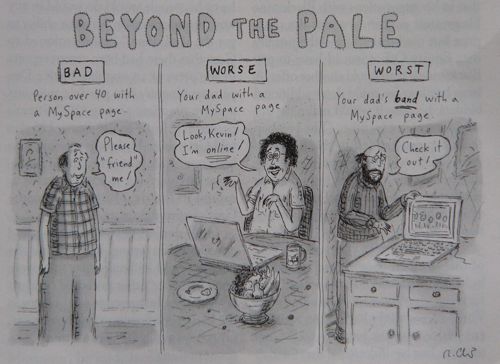
Ya gotta love the The New Yorker.
Recent Comments
ExpatAlien on What Country am I Living … intlxpatr on Yellowstone: Old Faithful to C… Michelle on Yellowstone: Old Faithful to C… Cathy on No Grown-Ups in Charge intlxpatr on Waiting for Snow Wikipedia Donate Button

Amazina


Early Voting in Florida


 Here There and Everywhere