Beryl Markham and the EPIC Book Club
When the EPIC Book Club met this month, we were discussing Paula McLain’s Circling the Sun. Several of us had enjoyed her book about Ernest Hemingway, The Paris Wife, and had thought this one, about the famous early aviator, would be another great book. I was so impressed with The Paris Wife that I immediately read Hemingway’s The Movable Feast, his novel about the same period of time, and loved the way the books “danced together”. I think good historical fiction needs to stick to known facts.
It was a lively discussion; Beryl Markham was an unusual woman in an unusual culture in a time of transition. She grew up in Kenya as the British were beginning to colonize just after the first world war. Her mother abandoned the family, taking her frailer younger brother and leaving her, with no explanation. Some other woman moved in with her father; Beryl greatly raised herself with the indigenous people. Her father loved her, but was distant. He was first and foremost a horse breeder, and Beryl worked closely with him in breeding and training the horses.
She made a disastrous first marriage, leaving it to pursue a certificate – the first ever for a woman – as a horse trainer. She was spectacularly good at it, and worse (when it comes to the opinion of other women) she looked terrific in riding breeches. Men liked her. She liked men. She was not particular about boundaries, like marriage to other people or being the consort of her good friend, Karen Blixen. Later, she set records as one of the earliest female aviators.
It was also a time when women had few options, and most of the options required a man to take care of her. Beryl Markham had skills, and had more options.
So as we are discussing her behavior, which could be self-defeating and self-destructive, we discussed it in the context of Kenyan colonial society. Then one of the EPIC members mentioned that the same behaviors in the very church where we meet have been the spice of Pensacola gossip for more than a couple centuries; that people don’t change much. We were laughing, and another member mentioned being forbidden to read Peyton Place, many years ago when it was a banned book, and his wrestling coach told him “All the world is Peyton Place.”
I think of all the places I’ve lived and I am inclined to agree.
Drunk Drivers on the Road
Looks pretty dark blue from Pensacola across to Austin, all the way on I-10. Hmmm, used to be one of my favorite roads . . .


Drunk driving is always dangerous and a problem across the country and the world, but certain places have a knack for attracting drunk drivers. In the US, those places tend to be rural western states.
Avvo, a legal services company, crunched the National Highway Traffic Safety Administration’s road fatalities stats for an in-depth look at drunk driving across the country. The company sifted through the data and found that between 2004 and 2013 there were a total of 94,550 drunk driving deaths in the US. A deeper dive revealed which roads are the most dangerous for drivers.
The findings indicated that the most dangerous roads for drunk driving crashes tend to be in mountainous states out west. These roads cut through vast stretches of nearly empty territory to connect a few smaller towns and cities. There’s no one clear reason for the increase in drunk driving deaths in these states, but the study does offer some possibilities. The roads in question have high speed limits with few side streets, and in areas with little to no public transportation, increasing the likelihood of partiers driving home after a few too many. The study also says that the variable terrain and drivers unfamiliar with the winding roads and sudden weather shifts might contribute to the high rate of crashes.
Montana, Wyoming, New Mexico and South Dakota all top the list. Interstate 90 in Montana is the most dangerous road in America, with 6.4 drunk driving deaths per 100,000 people. However, Wyoming appears three times in the top ten, making it the most dangerous state. New Mexico and South Dakota also appear twice in the top ten. The only area in the top ten that isn’t a rural Western state is Washington DC, which often finds its way on to any list of worst car accidents, congestion and road deaths. To see more information about the deadliest roads in America check out the full study here.
American Heroes: “With Your Bare Hands”
I started this Monday with a great big smile. American Heroes! Our three young men, off to explore Amsterdam and Paris, and without giving it a second thought they tackle an armed man who has already shot and injured one passenger and intends to kill as many more as he can? They disarm him, and they tie him up, and deliver him, relatively unharmed, to the authorities.
They don’t behead him. They don’t beat him once they have him subdued. They don’t treat him with gratuitous cruelty. No. They turn him over to the authorities. One hero seeks out the Frenchman who has been shot and plugs his throat wounds with his own fingers to staunch the flow of blood until he can be treated by medical professionals.
And I love what French President says to these khaki and polo-shirt clad All-Americans (from The Guardian):
“Awarding them the Légion d’honneur, Hollande said: ‘The whole world admires your sangfroid. With your bare hands, unarmed, you were able to overcome a heavily armed individual, resolved to do anything.’
Hollande praised the soldiers, saying: “In France you behaved as soldiers but also as responsible men. You put your life in danger to defend the idea of freedom.”
Referring to the bravery of Sadler and Norman, he said they did not have military training and had “doubtless never seen a Kalashnikov in their life”. He added: “They stood up and fought, they refused to give in to fear or terrorism.”
Leaving the ceremony, Norman told TV crews: “I just did what I had to do.”
That’s exactly what true heroes say 🙂
I smile, too, seeing these young men being presented their medals with everyone else in dress uniforms and suits, and they are in their polos and Khakis; polos provided, I am guessing, by the US Embassy, with French and US flags intertwined.
I imagine they are going to have a wild time in France, and I can imagine they won’t be able to buy their own wine or meals. It all makes me smile.
“Just Kill them All!!”
We were in the kitchen at the church, setting out some refreshments, when I told my friend I was expecting houseguests from Saudi Arabia.
My friend, who is educated, and, most times, level headed, said with exasperation “I can’t believe you are doing that! They are destroying everything, beheading people, raping and selling off women! Just kill them all!”
I was dumbstruck.
Who are we? We are in a church, where our leader told us to love God, and to love one another. He told us to love our enemy. And, just as one crazed fanatic shooting up a bible study does not make all South Carolinians hateful racists, neither does ISIS and Al Shebab make all Muslims fanatic killers. She knows this.
“I’m so shocked that you would say that, I don’t even know where to start,” I said, numbly.
“Why is it we make so many allowances and excuses for their behavior and they get different rules, but they don’t make any allowances, just kill all those who do not agree with their beliefs!” she responded.
You can’t really have a discussion with someone when they are worked up, and I didn’t even try. It’s been weeks now, and every time I think of this discussion, I get a pit in my stomach. I am guessing that she, my good friend, is expressing her frustration with me for my positive views toward Muslims and Islam. I struggle with whether it is to speak or not to speak, knowing my views are very different from the majority around me.
One of the most influential books I have read was Rick Warren’s The Purpose Driven Life, where he begins with the premise that God creates us each uniquely, individually, no two of us the same, and that we have a reason for our unique creation. From the life I’ve been given, I can only assume part of my purpose was to have all my assumptions challenged, to observe and to learn to think differently, and that, returning to my own culture, it is to gently share what I have learned, that we are more alike than unalike, and that we worship the same God.
I know I must continue to share what I know, and I pray for the courage to do so effectively, gently, not alienating people I care about.
Ramadan Kareem and Pope Francis
“God bless the work of your hands!” was one of the Moslem sayings I most loved as I lived my daily life in various countries in the Middle East. So, Pope Francis, God bless the work of your hands yesterday in your encyclical saying we are all responsible for the price we pay for progress. You are a brave man, and you don’t hesitate to name corruption when you see it, and to do your best to correct us, and straighten the path of the Lord.

“Everything is related, and we human beings are united as brothers and sisters on a wonderful pilgrimage, woven together by the love God has for each of his creatures and which also unites us in fond affection with brother sun, sister moon, brother river and mother earth,” he writes.
It is not entirely a happy message for me. One of the items he castigates is air conditioning, and as Pensacola hits the nineties every day, I hate to think of how I would live without air conditioning. I think I would turn into a slug, swinging in my hammock for hours every day reading a book. My house would be full of dirty dishes and dust. And I remember living in Tunis, and in Jordan, without air conditioning. We managed, by the grace of God.
Meanwhile, during the hottest months of the year, yesterday, our Moslem brothers and sisters began Ramadan, the holy month of fasting and personal purification. Imagine, going all day without water and without food, breaking the fast only as the sun goes down. I wonder if the Pope made his world-changing address on the eve of Ramadan on purpose, as he clearly made it to all mankind, not only to his Catholic followers.
Ramadan Kareem, my Moslem brothers and sisters, whom I cherish, and who taught me so much. May your fasting bring you great insights and purity of spirit.
A Harsh Ruler
Today’s Gospel reading from The Lectionary brings up so many questions! Jesus gives a parable, a story to help explain what he is saying, but what, exactly, is the parable saying?
Luke 19:11-27
11 As they were listening to this, he went on to tell a parable, because he was near Jerusalem, and because they supposed that the kingdom of God was to appear immediately. 12 So he said, ‘A nobleman went to a distant country to get royal power for himself and then return. 13 He summoned ten of his slaves, and gave them ten pounds,* and said to them, “Do business with these until I come back.” 14 But the citizens of his country hated him and sent a delegation after him, saying, “We do not want this man to rule over us.” 15 When he returned, having received royal power, he ordered these slaves, to whom he had given the money, to be summoned so that he might find out what they had gained by trading. 16 The first came forward and said, “Lord, your pound has made ten more pounds.” 17 He said to him, “Well done, good slave! Because you have been trustworthy in a very small thing, take charge of ten cities.” 18 Then the second came, saying, “Lord, your pound has made five pounds.” 19 He said to him, “And you, rule over five cities.” 20 Then the other came, saying, “Lord, here is your pound. I wrapped it up in a piece of cloth, 21 for I was afraid of you, because you are a harsh man; you take what you did not deposit, and reap what you did not sow.” 22 He said to him, “I will judge you by your own words, you wicked slave! You knew, did you, that I was a harsh man, taking what I did not deposit and reaping what I did not sow? 23 Why then did you not put my money into the bank? Then when I returned, I could have collected it with interest.” 24 He said to the bystanders, “Take the pound from him and give it to the one who has ten pounds.” 25 (And they said to him, “Lord, he has ten pounds!”) 26 “I tell you, to all those who have, more will be given; but from those who have nothing, even what they have will be taken away. 27 But as for these enemies of mine who did not want me to be king over them—bring them here and slaughter them in my presence.” ’
We know, by his own words, this was a harsh man and we know many of his citizens – not slaves – did not want him to rule over them. Why did Jesus use this man to illustrate his point? What about the other seven slaves who were given the money; how did they invest or protect the money? When I look at this parable, I am not so sure I would want to be one who was given more to administer over; the master is harsh. Perhaps those who protected the talent and kept their heads down fared better in the long run under this harsh man’s rule? What if one had taken the money and used it to make the lives of the people better – provided medical care or built a safe-haven for abused women? I shudder to think what the harsh ruler might have done with a slave who used the funds for the good of the people.
Female ISIL Recruits Surprised and Disappointed
They sign up for Hunger Games and get domestic drudgery and uber-control:
From Associated Press via Huffpost
PARIS (AP) — When three British schoolgirls trundled across the Syrian border; when a pregnant 14-year-old ran away from her Alpine home for the second time; when a sheltered girl from the south of France booked her first trip abroad — they were going to a place of no return.
Only two of the approximately 600 Western girls and young women who have joined extremists in Syria are known to have made it out of the war zone. By comparison, as many as 30 percent of the male foreign fighters have left or are on their way out, according to figures from European governments that monitor the returns.
In interviews, court documents and public records, The Associated Press has compiled a detailed picture of European girls and young women who join extremists such as the Islamic State group — a decision that is far more final than most may realize.
The girls are married off almost immediately, either in Turkey or just after crossing into Syria. With an estimated 20,000 foreign fighters — among them 5,000 Europeans — in Syria, there is no shortage of men looking for wives. That number is expected to double by the end of the year. Once among the jihadis, the women are not permitted to travel without a male chaperone or a group of other women and must remain fully covered outside, according to material published by Islamic State and researchers who follow the group. Otherwise, they risk a lashing or worse.
European women who blog about their lives under Islamic State tend to be chipper about the experience, but reading between the lines of an e-book of travel advice shows a life that will be radically circumscribed, with limited electricity, lack of even the most basic medicine, and practically no autonomy. Women do not fight, researchers say, despite the Hunger Games-like promises of recruiters.
“The lives of those teenage girls are very much controlled,” said Sara Khan, a British Muslim whose group Inspire campaigns against the dangers of extremist recruiters. “I don’t think that discussion ever comes up. It’s so romanticized, the idea of this utopia. I don’t even think those young girls have necessarily considered that there’s no way back now.”
The two exceptions to the rule of no return are perhaps most revealing in the very paucity of details about their journey — driving home how murky life is behind the Islamic State curtain.
Sterlina Petalo is a Dutch teenager who converted to Islam, and came to be known by the name Aicha. She traveled to Syria in 2014 to marry a Dutch jihadi fighter there and managed to return months later — apparently making her way to the border with Turkey, where her mother reportedly picked her up and brought her back to the Netherlands. Back home, she was immediately arrested on suspicion of joining a terror organization.
Her family, lawyers and prosecutors refuse to discuss the case. She was released from custody last November and has not been formally charged.
The second woman known to have made it out of the grip of Islamic State reconsidered after just a few weeks. The 25-year-old Briton, whom police have not named, had taken her toddler son all the way to Raqqa, the group’s stronghold, when she decided she had made a mistake and called home. She made her way back into Turkey and her father met her there. How she was able to travel the 250 kilometers (150 miles) from Raqqa to the Turkish border city of Gaziantep is not clear. Back in Britain, she was detained and is now free on bail pending formal charges.
Without knowing how the two escaped, it is difficult to say whether other girls and women could follow their path out of Syria, said Joana Cook, a researcher at King’s College London who studies the links between women and jihad.
“There are clearly many human smugglers working within Syria right now, helping Syrian civilians escape the violence, and I wonder if there is a similar, perhaps even growing market, for those trying to escape after joining ISIL,” Cook told The Associated Press in an email, using one of the acronyms for the Islamic State group. “There is great disillusionment for many who have traveled to Syria to join ISIL and you’ll find many stories of those who went abroad noting ‘this isn’t what we signed up for.'”
The question is whether the girls understood from the beginning how limited their choices would be once they crossed the frontier.
The case of a 15-year-old Avignon girl exemplifies such doubts. The girl hid her second Facebook account and Islamic veil from her moderate Muslim family, thereby managing to join a jihadi network, according to the family’s lawyer. Once within a unit of the al-Qaida offshoot Nusra Front, she was not permitted to leave, according to her brother, who went into Syria to fetch her and was turned away by the extremists. A French boy who joined the group around the same time was allowed to go home.
“I think they understand the premise of that, but not that they understand it in reality,” said Melanie Smith, another researcher at King’s College ICSR.
The networks that bring the women into Syria are increasingly organized around the extremists’ dream of building a nation of multinational jihadis, meaning European girls are particularly prized. Each new Facebook post, each new cheerleading Twitter account — and they pop up by the hour — helps them subvert government efforts to prevent young people from radicalizing and leaving.
The doggedness of jihadi methods for recruiting girls can be seen in the case of Amelia, a 14-year-old girl from France’s Alpine Isere region.
Amelia was first contacted on Facebook by a French fighter on Jan. 14, 2014 and within a month agreed to go to Syria and marry the man, who identified himself as “Tony Toxiko.” After she was turned back by airport border police in Lyon on her first attempt, “Tony Toxiko” persuaded another French adolescent girl to join him in Syria.
Amelia, meanwhile, ran away from home to Belgium, where an imam performed a religious ceremony that wed her to a different man, an Algerian jihadi. She returned to France homesick and pregnant, just long enough to speak to investigators building a case against a middleman who helped her run away. This winter, Amelia managed to deceive her family and left again — making it to Syria with the Algerian fighter, who is more than twice her age.
“It’s particularly difficult for these families. For them, radicalization is happening on the Internet and outside the family sphere,” said Sebastien Pietrasanta, a French lawmaker working on a program to de-radicalize young people. “For a girl of 14, I believe we can clearly save her from herself and save her from these barbarians.”
A French journalist got dangerously close to jihadi recruitment methods by creating a fake Facebook account that attracted a marriage proposal from a fighter in Syria.
Under the pseudonym Melodie, the journalist shared a video on the account, almost immediately getting a message from a man identified as Bilel, who asked how she’d liked the montage of him showing off in a 4X4 and with his weapons.
“I passed myself off as a 20-something, not stupid but a little lost, who suddenly found a huge response from a man in Syria,” said the journalist, who wrote a book “In the Skin of a Jihadist” under a pseudonym.
Bilel’s doubts about her began to grow as her reluctance to join him became clear. She ended up getting threats that she said would likely frighten a bewildered young woman into submission. As it was, the journalist, who never met Bilal in person, remains under constant police protection a year later.
“We’ll find you, we have the best operators here, you don’t know what you’re getting into, you’re messing with a terrorist group, you and your family will pay,” the woman said, recounting the litany of threats she received after returning to France. “If they were speaking to a 20-year-old, it would be very hard for her.”
___
Associated Press writer Mike Corder in Amsterdam contributed.
Small Glimpses of North Seattle
“As Sallam wa alaikum!” I smiled at the Sudanese women coming in to their jobs in our hotel.
They stopped still in their tracks.
“You speak Arabic!” they said, astonishment clear on their faces.
“Only a little!” I smiled back.
I had a whole squad of new friends.
Now that financial times are easing, many hotels we have visited over the last few months are renovating and getting new mattresses. This was a real bonus for our Sudanese friends, and all of their friends.
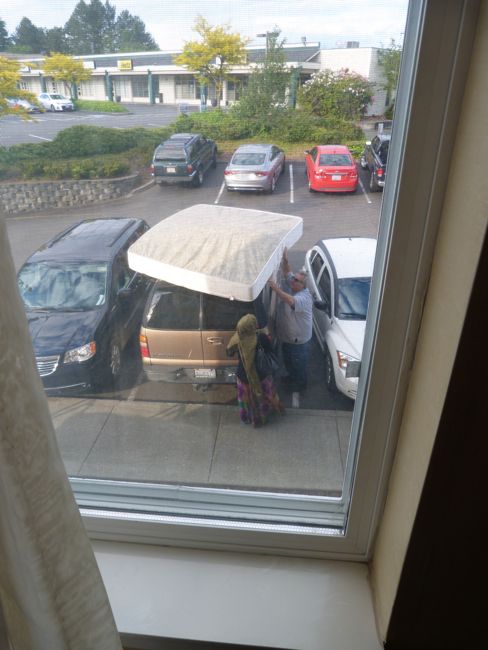

Have you ever tied a mattress on the top of your car and tried to drive? It is a wild and dangerous adventure; the wind lifts and pushes the mattress toward the back as you drive. Unless the mattress if firmly and thoroughly tied down, you are in for a wild ride.
And then again, if you are new in a country, and in need of a mattress, a wild ride is a small price to pay.
On our way back to the hotel, we see protestors in red shirts at every corner. This is not protestors Ferguson style, these are Seattle style protestors, making a big demonstration for fully funding public education, and all the signs are grammatical 🙂

We are so full from lunch that we just want a small dinner. We find a good Ethiopian restaurant listed near our hotel, and head there, but when we arrive, there is plywood over two windows and a sign saying “Sorry, dear customers, but due to car accident our restaurant is closed until it is fixed.”
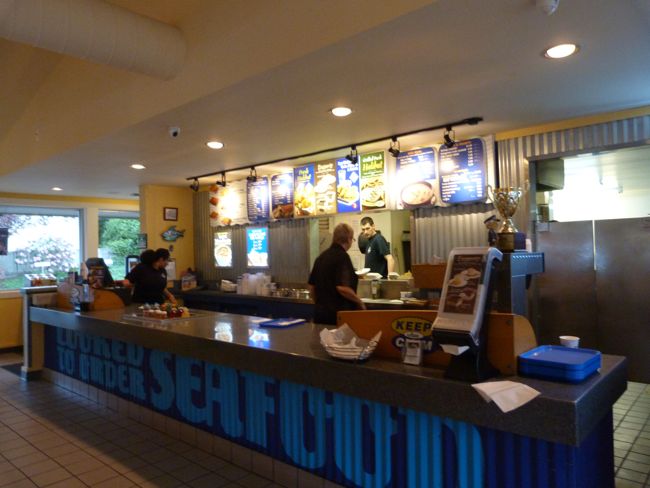
We end up at Ivar’s Seafood Bar, which is quick food, but not cheap food, and very very good food. We are greeted by an older man as we enter, he says “Welcome to Ivars! I hope you have a great meal.” We thought he might be an official greeter, but no, he was a customer like us. We ended up sitting in a booth next to his, so he stopped on his way out to see what we had ordered (halibut and chips, smoked salmon chowder, Dungeness crab cocktail) and just to chat. It’s an Edmonds kind of thing, neighborliness and civility.
Security Check
I’ve never seen this before in the United States. We used to go through checks like this in Germany, in Doha, in Kuwait, but not in the United States. This trip, we went through several, all across our southern border.
All the trucks, and all the cars, pulled over to go through security checks, dogs sniffing the cars, men going through an entire truck here and there, or having a family stand to one side as they thoroughly inspect the car.
I love our retired military id’s.
The sign on the left tells us they have caught more than 7,000 illegal immigrants so far this year, and have confiscated more than 12,000 something. . . dollars worth of goods? Individual goods, like cars? I know if you get caught doing something illegal, you lose your property, even if it is a car or a house.

Homeland Security: Your Tax Dollars At Work
This is a difficult post to write. I’m a patriot. We served our country many years, Cold Warriors. We believe in the United States of America.
What I saw on our southernmost border on the Rio Grande makes me uncomfortable. We have put a lot of money into making sure illegal aliens don’t get through.
I can see a lot of good reasons for good border security. And having said that, what I saw stepped right over the line of “good border security” and teetered precariously on “oppressive.”
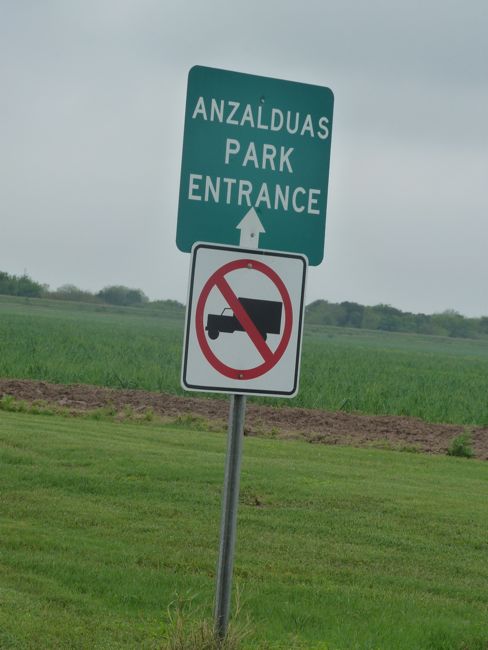
One of the Benson-Rio Grande Valley Park employees told us that if we want to see the Rio Grande, go to (some restaurant that has a view of the Rio Grande) or to this County Park called Anzalduas Park, and he told us how to get there. We drove and drove, couldn’t find it, but there was a cop parked on the road, so we asked him and he told us we were almost there.
As we reached Anzalduas Park (which is right under the Anzalduas Bridge, which goes over into Mexico; no, we didn’t have our passports, so we didn’t cross, maybe next time) and approached the park, it was a very odd park. It’s all excavated out, with a very very bare landscape, and some steep climbs. At the gate are some really heavy duty sliding guard gates. It’s not a very welcoming park.
We got down into the park, drove down to the boat landing, and there were about twenty cars parked there, and they were all security vehicles. There was a big party going on, it was a Friday and some families and children were playing and the loudspeaker was all in Spanish. I couldn’t see any Homeland Security guards, only the cars, maybe the guards were sitting inside. Maybe they were at the party 🙂

The Park employee at Benson – Rio GRande Valley Park had told us that on weekends, across the Rio Grande, is a swim club, and the Mexicans are swimming all the time, just feet away from the American side, but there are all these signs saying the waters are dangerous. The waters seemed very calm, but sometimes there are dangers that are not so obvious.

That’s just a lot of cars providing border security in this park.

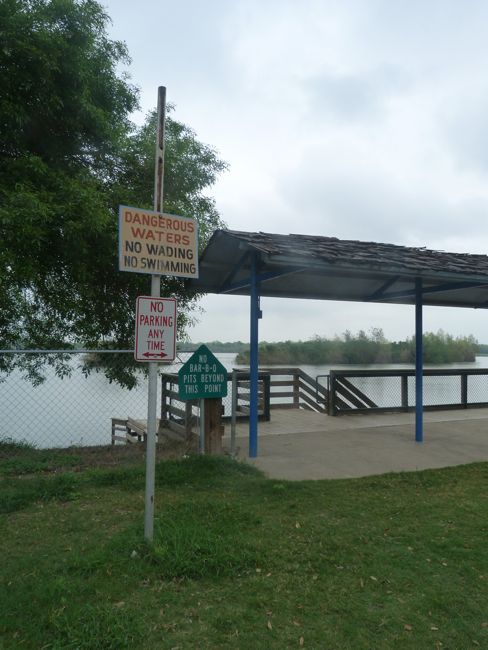

You can see the Mexican side swimming club; just yards across a very narrow Rio Grande:
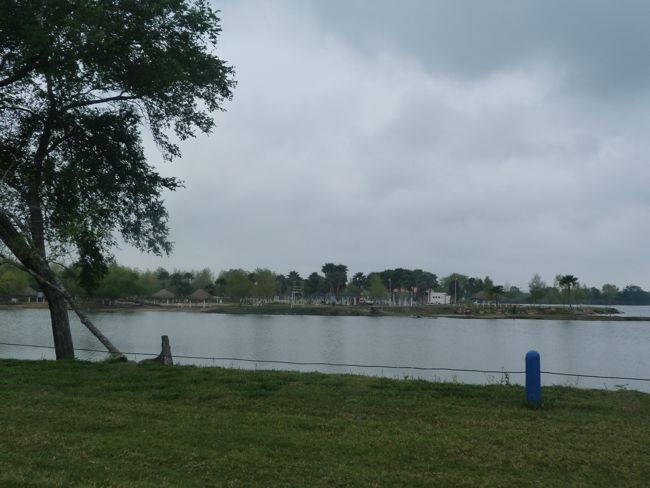
Here is another view of those heavy gates that bar the park in off hours.

We had been told this is a very popular park, full of people all the time. I am glad to hear it, glad that people are not intimidated, and use this beautiful little park for parties and celebrations, just as we use parks all over the USA.
Recent Comments
ExpatAlien on What Country am I Living … intlxpatr on Yellowstone: Old Faithful to C… Michelle on Yellowstone: Old Faithful to C… Cathy on No Grown-Ups in Charge intlxpatr on Waiting for Snow Wikipedia Donate Button

Amazina


Early Voting in Florida


 Here There and Everywhere