Rape in Kuwait
This is a very difficult post. Rape is a terrible subject. Coolfreak in his blog IheartKuwait wrote a heartbreaking post about a young woman raped recently in Kuwait, and I haven’t been able to stop thinking about it.
Rape has been the subject of several editorials in the Kuwait Times. Rape of children, abduction and rape of young women, abduction and rape of domestic servants, rape of domestics on the job site, abduction and rape of young men. . . rape is prominent DAILY in the crime column. Rape is epidemic in Kuwait, so common that people seem to think that there is nothing that can be done.
People can wring their hands. People can moan about how wrong it is. But what is being done for the victims of rape?
In California, volunteers put together rape crisis centers. At first, these centers were totally staffed and funded by volunteers and volunteer fund raising. The volunteers, with their own funds, established a 24 hour hotline, with an answering service, that rape victims could call and reach a rape counselor.
Counselors would accompany victims to the hospital, explain procedures, and explain the victim’s options. Counselors would help the victim on the long journey to feeling safe once again, and to feeling some remnant of control over their lives.
Members of the rape crisis centers created education programs, and worked with both police and hospitals to establish procedures working with rape victims. Police were counselled on how to work with the traumatized victims, and police worked with the crisis workers to create new, enforceable laws against the rapists. It was the beginning of the victim advocacy program that is now common in most western countries. Most law enforcement agencies now have paid staff to work with crime victims en route to criminal procedings against the “perp” and subsequent counselling. Victims can testify at parole hearings against probation.
Rape is an outrage – against the individual, and against the community. Rape is less about sex than about power and humiliation. Have you noticed when serial rapists are caught, they turn out to be pathetic losers? They carry a huge burden of inadequacy combined with feelings of entitlement. The most appropriate penalty is their exposure through the court systems, and imprisonment, with those who, like themselves, think like predators.
But we must do what we can do to help the victims, to provide them with counselling and resources to speed their recovery. To create strong laws which protect the community by keeping the predators off the streets. To create procedures where evidence can be gathered and stored, and DNA samples compared so that offenders can be charged, and tried, and convicted.
Hats off, by the way, to the young man Coolfreak with the courage to first blog about this outrage. I find his blog brave and creative and refreshing and amusing and stimulating. Check it out.
Kuwaiti Drugged, Robbed in Thailand
Today in the Kuwait Times:
“Thailand/Kuwait. A Kuwaiti claims he was drugged and robbed at a hotel in Thailand. The 45 year old man stumbled from his room at the Marine Palace Hotel in South Patayya, Thailand yesterday morning, telling the reception staff that two women had stolen 10,000 Baht (around KD 82) in cash, a digital camera and a mobile phone.
The women had earlier entered the hotel, telling reception that they were going to the room occupied by the victim. They allowed the reception staff to take photocopies of their civil ID’s, reported local press yesterday. Arrest warrents for both the women, a 20 year old from Bangkok and a 21 year old from Nhakon Sawan Province were issued.”
Comment: I would love to know the rest of THIS story.
Time Magazine Person of the Year
Time Magazine announced it’s person of the year – it’s YOU! It’s me! Here is what they had to say:
TIME Magazine’s Person of the Year: You
NEW YORK (Dec. 16) – Congratulations! You are the Time magazine “Person of the Year.”
The annual honor for 2006 went to each and every one of us, as Time cited the shift from institutions to individuals _ citizens of the new digital democracy, as the magazine put it. The winners this year were anyone using or creating content on the World Wide Web.
You can read the rest of the article
here.
Virginia Hall: A Modest Heroine
The Good Shepherd, a new movie with Angelina Jolie, and Matt Damon, directed by Robert DeNiro (!), will open Friday, a story of the beginnings of the American intelligence services, the OSS and the CIA. I can hardly wait.
Earlier this week, there were some small news articles about Virginia Hall, who served her country risking her life time and time again, fighting the Nazis in the allied clandestine services, facing the possibility of torture and death if she were caught. Hall didn’t let anything hold her back. She believed that what she was doing was worth doing, and when WWII ended, she continued working quietly for the greater good. I would have loved to meet this woman. What a pistol!
Here is what Wikipedia has to say about her:
Virginia Hall MBE DSC (April 6, 1906 – July 14, 1982) was an American spy during World War II. She was also known by many aliases: “Marie Monin,” “Germaine,” “Diane,” and “Camille.”[1]
She was born in Baltimore, Maryland and attended the best schools and colleges, but wanted to finish her studies in Europe. With help from her parents, she traveled the Continent and studied in France, Germany, and Austria, finally landing an appointment as a Consular Service clerk at the American Embassy in Warsaw, Poland in 1931. Hall hoped to join the Foreign Service, but the loss of her lower leg was a terrible setback. Around 1932 she accidentally shot herself in the left leg when hunting in Turkey, it was later amputed from the knee down, which caused her a limp.[2]
The injury foreclosed whatever chance she might have had for a diplomatic career, and she resigned from the Department of State in 1939.
The coming of war that year found Hall in Paris. She joined the Ambulance Service before the fall of France and ended up in Vichy-controlled territory when the fighting stopped in the summer of 1940. Hall made her way to London and volunteered for Britain’s newly formed Special Operations Executive, which sent her back to Vichy in August 1941. She spent the next 15 months there, helping to coordinate the activities of the French Underground in Vichy and the occupied zone of France. When the Germans suddenly seized all of France in November 1942, Hall barely escaped to Spain.[3]
Journeying back to London (after working for SOE for a time in Madrid), in July 1943 she was quietly made a Member of the Order of the British Empire. The British had wanted to recognize her contribution with a higher honor but were afraid it might compromise her identity as she was then still active as an operative.
Virginia Hall joined the U.S. Office of Strategic Services (OSS) Special Operations Branch in March 1944 and asked to return to occupied France. She hardly needed training in clandestine work behind enemy lines, and OSS promptly granted her request and landed her from a British MTB in Brittany (her artificial leg kept her from parachuting in).
Code named “Diane,” she eluded the Gestapo and contacted the French Resistance in central France. She mapped drop zones for supplies and commandos from England, found safe houses, and linked up with a Jedburgh team after the Allied Forces landed at Normandy. Hall helped train three battalions of Resistance forces to wage guerrilla warfare against the Germans and kept up a stream of valuable reporting until Allied troops overtook her small band in September.
For her efforts in France, General William Joseph Donovan in September 1945 personally awarded Virginia Hall a Distinguished Service Cross — the only one awarded to a civilian woman in World War II. (emphasis mine)
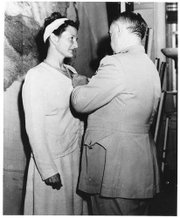
In 1950, she married OSS agent Paul Goillot. In 1951, she joined the Central Intelligence Agency working as an intelligence analyst on French parliamentary affairs. She retired in 1966 to a farm in Barnesville, Maryland.
Virginia Hall Goillot died at the Shady Grove Adventist Hospital in Rockville, MD in 1982.
Her story was told in “The Wolves at the Door : The True Story of America’s Greatest Female Spy” by Judith L. Pearson (2005) The Lyons Press, ISBN 1-59228-762-X
She was honoured in 2006 again, at the French and British embassies for her courageous work.[4]
Cross Cultural Flummox
Scanning through the blogs yesterday, I saw one I almost didn’t check. It seemed to be a no-brainer. LaialyQ8 asked if you would share your password with your husband/wife.
Sheerly out of idle curiousity, I checked. And I was stunned to see the responses. Almost every person said they WOULD.
I’ve thought about it all day. It has to be a cultural difference. Hands down, I bet most of my friends would say “no way!” It isn’t a question of how much you love someone, to me, I just need some areas of my life that are private. I don’t keep secrets from my husband – I share things with him gladly.
But do I think he needs access to my correspondence with old girlfriends, friends I knew before I knew him? If they confide details of some crisis to me, does he need access to that information?
He trusts me. He should! And he would never, never ask me for my password, and I wouldn’t ask for his. Of course we share passwords for financial records and access, but not for our e-mail accounts.
It never for a heartbeat occurred to me there was another way of thinking about it. I was flummoxed (that’s for you, Zin!) And it is good information; I need to think about this and integrate it and try to understand it. That’s one of the things I love about living in a foreign country; challenges my assumptions and forces me to think differently, outside the box.
The Kuwait Beauty Sisterhood
We love the Kuwait Airport. I love it that you can get a cup of coffee and just sit and wait for your arrivals to make that long long walk as you exit customs and head toward the exit. We love watching the families so excited to see one another. We make up stories for ourselves to explain what we are seeing. Sometimes, we cry, too, because it is so moving. We love it when the women ululate on seeing a new arrival, when brides arrive with their husbands, when Moms come back from Hajj.
A few nights ago, my husband was meeting late arrivals at the airport and he saw something we have NEVER seen before. He saw four women, all with identical bandages over their noses. He figures they must have gone somewhere for plastic surgery. All four at the same time? We figure they must be sisters, or cousins, or very very good friends, all having their noses trimmed at the same time. He said they weren’t at all self-conscious about it, rather they were grinning with pride. I think when there are four of you with the same big bandage, it must take the self-conscious factor WAAAAAYYYYY out.
We’re always laughing at what we call “buying hope in a bottle.” For me, it might be the next luxury face cream that promises me “visible results in 7 days”. For my husband, it is always the next super camera. For some, it is the hot motorcycle, or the next hot car. For some, it is the hottest new computer, or the tiniest, biggest gigabyte iPod with all the bells and whistles. We’re all looking for a little hope. It just gives me a big grin thinking of those four brave girls going under the knife together for better noses.
Africa’s Oldest Pupil
This is a story I saw in last week’s Kuwait Times, but I can’t get it out of my mind. This humble man, with his ongoing search for knowledge, is an inspiration to me.
Source: Reuters
(This story is part of a special report on education in Africa, issued on Nov. 15)
By Andrew Cawthorne
ELDORET, Kenya, Nov 15 (Reuters) – With his stubbly grey beard and walking stick at his side, 86-year-old Kimani Maruge looks a little out of place among the rows of children sitting behind wooden desks at Kapkenduiywo Primary School. Yet classmates 10 times his junior would be hard-pressed to match the enthusiasm of Maruge, a farmer and veteran of Kenya’s 1950s anti-colonial Mau Mau revolt, who has the distinction of being the oldest pupil on the planet.
“I will only stop studying if I go blind or die,” Maruge says at the crowded school in a poor neighbourhood outside Eldoret in Kenya’s western farmlands.
The illiterate great-grandfather – who has outlived 10 of his 15 children — jumped at a belated chance to educate himself when President Mwai Kibaki introduced free primary schooling in the east African nation in 2003.
Enrolment across Kenya shot up overnight, with 1.2 million more children going to school. Kapkenduiywo had 375 pupils before Kibaki’s measure, and now has 892.
But there are none quite like Maruge. He says his inspiration came from listening to a preacher in church and suspecting he was misinterpreting the Bible.
“I wanted to go to school to be able to read the Bible for myself,” he says, tucking his long legs under a tiny, shared desk at the front of his overcrowded classroom of 96 pupils. “And in case there is ever any compensation for us Mau Mau, I would like to be able to count my money properly at the bank,” he adds with a large grin.
PERSISTENCE PAID OFF
When he first turned up at the school gates in regulation knee-length socks, cut-off trousers and navy blue jumper, Maruge was greeted with laughter. Teaching staff tried at first to direct him to adult education classes. But when he returned again and again, they realised he would not be deterred, and anyway there is no legal age-limit for primary school entrance in Kenya.
“Inside me, when I saw him there, I felt he was serious,” says headmistress Jane Obinchu. “And look at him now. Nearly three years later, he’s still here. He’s over the most difficult part, he won’t drop out now.”
In the classroom, Maruge’s favourite subjects are Swahili and maths, but he struggles with English which is new and strange to him. He is treated like any other schoolboy except for one privilege: tea at break. Fellow pupils treat him with care and respect, and love to listen to his tales of Kenyan history between classes.
“He tells us about the Mau Mau,” says Ireen Wairimu, 11. “And about the time when white kids used to go to school under a roof while African kids sat under trees.”
Hobbling on a foot he says was disfigured when he was tortured by British colonial captors during the Mau Mau revolt, Maruge cannot keep up with all the playground games. But he watches with relish and is always surrounded by chattering kids.
“They are my friends, they love me, they help me walk home,” he says. “I want to break the barriers between old and young.”
INTERNATIONAL POSTER-BOY
Known in his neighbourhood as “Mzee” – a Swahili term of respect for an elder – Maruge is happy to show off his new knowledge, reading passages of the Bible slowly and clearly in front of his house after school. Although still living humbly, Maruge has become a national celebrity and something of a poster boy for free education campaigners worldwide. Last year, he was feted at the United Nations in New York. This year, a Hollywood crew are working on a film about him.
“School has changed him. He looks younger and happier, rejuvenated by getting a second chance in life,” says headmistress Obinchu. “He calls me his mother, but I am the age of his daughters. He is an inspiration to all of us.”
Despite his advanced years, Maruge has plenty of dreams for the future. “I won’t stop. I want my name one day to be Professor, Doctor Kimani!,” he says, holding his books close to his chest. “Liberty is learning, you know.”
Bahrain Censors Google Earth
This morning my nephew from GE sent me an e-mail with an article from the Financial Times on Mahmoud’s Den and Google Earth in Bahrain. When Google Earth upgraded the resolution on Bahrain, Bahrainis started recording the discrepancy in properties, and circulating copies of residencies, luxury cars, boats, etc. in contrast to the poor, crowded villages. The Bahraini government banned the use of Google Earth in Bahrain. You can guess what happened next – downloads shot through the roof. It’s just human nature.
The article in Financial Times gives more information.
When are governments going to figure out that when you ban a technology, you only make it more attractive? Google Earth downloads for free, it is available to everyone with a computer and adequate bandwidth. No matter what safeguards you put in, there are ways around it. That’s just the nature of technology.
Mahmoud’s Den sports a button that says “No Sunni, No Shiia, Just Bahraini”.
Secret Santa Unveils
I found this story on AOL news this morning. I am printing the whole story, with full credit to AOL, because I am afraid if I just put in a “click here” thingy, you won’t go to the trouble. This complements a recent blog entry by Jewaira on opportunities for charitable giving locally . . . this man made a career of secretly giving back.
Grave Illness Unmasks Generous ‘Secret Santa’
Man Who Gives Money to the Needy Reveals Himself to Pass Mission on to Others
KANSAS CITY, Mo. (Nov. 17) – The answer to one of the happiest mysteries in the Kansas City area is being revealed this year. A man who has given away millions of dollars and become known as Secret Santa for handing out Christmas cash to the needy is allowing his name to be publicized after 26 years.
In April, doctors told Stewart that he had cancer of the esophagus. It has spread to his liver and he is undergoing treatment.
But the reason for the revelation is an unhappy one. Secret Santa has cancer. He wants to start speaking to community groups about his belief in random acts of kindness, but he can’t do that without telling people who he is.
The man who has spread cheer for 26 years is Larry Stewart, 58, of Lee’s Summit, who made his millions in cable television and long-distance telephone service.
Stewart told The Kansas City Star that he was the man who would walk up to complete strangers, hand them $100 bills, wish them “Merry Christmas” and walk away, leaving astonished and grateful people in his wake. He handed out money throughout the year, but he said it was the Christmas giving that gave him the most joy.
Now, he wants to inspire others to do the same. He said he thinks that people should know that he was born poor, was briefly homeless, dropped out of college, has been fired from jobs, and once even considered robbery.
But he said every time he hit a low point in his life, someone gave him money, food and hope, and that’s why he has devoted his life to returning the favors.
Stewart grew up in Bruce, Miss., reared by his elderly grandparents, who survived on $33 a month and welfare staples. They heated water on the stove for baths and used an outhouse.
After he left home and college, he found himself out of work in 1971. After sleeping in his car for eight nights and not eating for two days, Stewart went to the Dixie Diner in Houston, Miss., and ordered breakfast. When the bill came, he acted as if he’d lost his wallet.
The diner owner came to him.
“You must have dropped this,” the owner said, slipping a $20 bill into the young man’s hand.
He paid, pushed his car to the gas station, and left town. But he vowed to remember the stranger’s kindness, and to help others, when he could.
He arrived in Kansas City because he had a cousin here. He got married and started his own company, with money from his father-in-law.
But the company failed in 1977 and he couldn’t pay the bills. It was the lowest point in his life.
“I was a failure in business. I was a failure as a husband. I was a failure as a father,” he remembers thinking.
He got into his car with a handgun and thought about robbing a store. But he stopped and went home – and got a call from his brother-in-law, offering him money to tide him over.
After being fired from two jobs on two successive Christmases, Stewart stopped at a drive-in. Although he had little money himself, Stewart gave a cold and miserable carhop the change from a $20, much to her delight.
That’s when Stewart’s mission to secretly give away money at the holidays began.
Eventually, Stewart became a success and started Network Communications in 2002. The firm used independent sales agents to enroll customers for Sprint long-distance service.
In 1996, an arbitration panel ordered Sprint to pay Network and its sales agents $60.9 million in commissions it owed. Stewart got $5.2 million.
The poor boy from Mississippi now had a family, lived in a nice house and drove nice cars.
So, he started giving away more money, to dozens of causes. The Negro Leagues Baseball Museum. The Salvation Army. The National Paralysis Foundation. The ALS Foundation. He supports the Metropolitan Crime Commission’s Surviving Spouse and Family Endowment program.
And, all along, he gave away money to needy strangers.
But Christmas was special. He’d distribute thousands of dollars during visits to coin laundries, thrift stores, barbershops and diners.
People shouted with joy, cried, praised the Lord, and thanked Stewart repeatedly.
But Secret Santa moved on quickly to avoid attention.
He did sometimes invite newspaper and TV reporters along, if they promised not to reveal his identity. It was reporters who dubbed him “Secret Santa.”
In 1989, after some people chased his car when they saw the cash he carried, he decided he needed protection. He called Jackson County Sheriff’s Capt. Tom Phillips.
“I thought, ‘OK, this guy’s nuts,”‘ recalls Phillips, now the Jackson County sheriff. “But at the end of the day, I was in tears – literally – just seeing what he did to people.”
Eventually, Secret Santa took his sleigh ride to other places.
In 2001, after the terrorist attacks, he went to New York. The New York cop who accompanied him said he’d never forget the experience.
In 2002, Secret Santa was in Washington, D.C., victimized by the serial snipers. In 2003, it was San Diego neighborhoods devastated by wildfires. And in 2004, he was in Florida, helping thousands left homeless by three hurricanes.
Last Christmas, Secret Santa went back to Mississippi after Hurricane Katrina battered the Gulf Coast.
He stopped in Houston, Miss., where the diner owner had helped him so many years ago. On a previous visit he had surprised the owner, Ted Horn, with $10,000. This time, they stamped $100 bills with the name “Ted Horn,” and gave Horn money to distribute. And Horn took money from his own bank account to give away, too.
Stewart has enlisted “elves” for years – George Brett, the late Buck O’Neil, Dick Butkus. He’s already inspired copycats.
Four other Secret Santas plan to distribute a total of $70,000 of their own cash this year.
And Secret Santa plans to give away $100,000 this year. Since he started, he estimates he’s given out more than $1.3 million in Christmas cash.
But this will likely be the last Christmas for Stewart’s tradition. In April, doctors told Stewart that he had cancer of the esophagus. It had spread to his liver. He needed treatment, fast.
With help from Brett, he got into a clinical trial at the M.D. Anderson Cancer Center in Texas. Doctors tell him the tumors have shrunk, but they can’t say whether the cancer is in remission.
“I pray for that man every single day,” former Kansas City Chiefs star Deron Cherry – one of Stewart’s elves – says. “There’s a lot of people praying for him.”
Bloggers and Productivity
A teeny note found at the bottom of page 36 in the October 9th
-
New Yorker
(yeh, I’m a little behind in my reading . . .)
“A report last week by Advertising Age Editor at Large Bradley Johnson noted that about 35 million workers – or one in four people in the U.S. labor force – spend an average of 3.5 hours, or 9% of each work day reading blogs.”
I’m not all that great in math, but wouldn’t 3.5 hours of a work day be more than 9%? Depending on whether you work a fairly standard seven – eight hour day, that would be nearly HALF your working day. They must have meant 9% of the work week . . . still, significantly cutting into productive working time.
Recent Comments
intlxpatr on Shampoo Ginger tigerbutterya0c5ff1d… on Shampoo Ginger intlxpatr on British Soldier Kidnapped, Esc… John on British Soldier Kidnapped, Esc… intlxpatr on British Soldier Kidnapped, Esc… Wikipedia Donate Button

Amazina


Early Voting in Florida


