Dharfur: We can No Longer Pretend We Don’t Know
Today, in his blog, Ogle Earth, which discusses new developments with Google Earth, Stefan Geens says the following about the new hi-res maps of the Sudan made public today in Google Earth:
Those circles aren’t animal pens. They’re burned-down gottias, circular mud huts that had straw roofs, and they’re what’s left of Dalia, a village in Sudan’s Darfur region, one of hundreds of villages that have been destroyed by the Janjaweed in a program of depopulation that has killed perhaps 400,000 civilians since 2003.
Today, Google added recent high resolution imagery of Darfur to Google Earth, taken by DigitalGlobe in January-March 2006. It serves as an unequivocal indictment of the Janjaweed, and of the Sudanese government whose implicit support it has enjoyed, because in these new images each and every burned-out gottia is visible. This is the kind of evidence that puts paid to the claims still coming out of Khartoum that the ethnic cleansing is not widespead, and that accusations of genocide are a mere pretext to wrest sovereignty away from Sudan with the deployment of UN peacekeepers.
Read the blog entry for yourself here.
He goes on to say “we can no longer pretend we don’t know.”
He’s right. It’s there, in high resolution, for all to see.
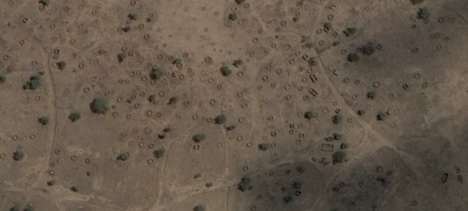
Props to the hard working young man at Google Earth who has been slaving to get all the detailed maps together. It’s a fine mission, ibn uckti, and we are all so proud of you and the hours you put in to make this possible.
Mining the Kuwait Times: 4 October 2006
Ya gotta love the Kuwait Times. I admire their spirit so much, I forgive their weak editing and poor grammar.
Six KAC Officials Quit
Six officials were transferred from their posts by the operations manager at Kuwait Airways, so they submitted their resignations, which were accepted without any investigation, so says the Kuwaiti Times (and also the Arab Times). Appearantly, they were transferred because they refused to recommend for promotion two unqualified candidates for captain, and were horrified to discover that these assistant pilots were promoted – verbally – to full airplane captain flying A310 aircraft in spite of most of the training officers having (previously) rejected this decision.
(This is actually a compilation from both Arab Times and Kuwaiti Times. They seem to be saying these six men resigned because unqualified pilots will be flying planes they are not qualified to fly, and the Director of Operations and his deputy know this and promoted them anyway. Arab Times adds that the director and his deputy are also jeopardizing KAC’s reputation in the international community when they refuse to investigate technical flaws found recently in some KAC aircraft. )
Think I’ll pass flying Kuwait Air for a while . . . .
Driving Sheepish
I actually speak English fairly well, and I don’t have a clue what “driving sheepish” is. The article states:
Policemen suspected a motorist driving sheepishly in Kabd. They ordered the Kuwaiti to stop his car and found a hunting rifle and a number of drug tablets inside. Police registered a case and referred the man to authorities.
Non-Halal Meat
“While residents of Kuwait are still reeling from shock, where cases of contaminated fish imported from Iran were allowed in by the municipality’s food imports division, a new scandal has just appeared on the horizon, reported Al-Seyassahl. A report indicates that one of the officials in the same department tried to cover up a crime he was involved in, by permitting some local foodstuff companies to import frozen meat without being slaughtered in accordance to the Islamic law. They presumed they could get away with the deceit, as, since no one was aware of the fact, could get away with murder.”
This is buried way down near the bottom of page 4. In most countries, it would be at the top of the first page, and heads would roll.
And last, but not least, to the tune of “La Vie en Rose” . . . French Smokers Fume as Public Ban Looms
My husband and I hate breathing second hand smoke so much that we will request another table in a restaurant if someone should be so gauche as to light up near us, disregarding the no-smoking signs in a restaurant, or pay our bill and go. It just isn’t worth it, not for our health, not for our state-of-mind. And all the same, it is very hard to imagine a France with a smoking ban in public places.
French cigarettes just smell different. French smoke reminds me of early mornings at the flea markets, picking up a cup of cafe au lait and a fresh buttery croissant, watching the early risers through a haze of smoke tossing back shots of Pernod to get their day started. I guess, because they are French, I can forgive them just about anything.
Building New Kuwait
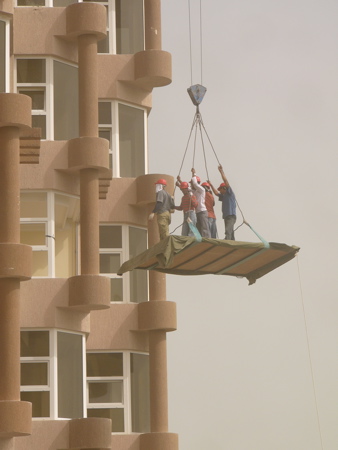
I have a thing about safety. When living in Doha, we watched buildings go up with no discernible regards to building codes. I don’t even know that codes exist, or perhaps they are still being written. At least one construction worker per week “fell to his death”. Workers worked round the clock, trying to get the skyscrapers up before a deadline. People who scouted buildings for major corporations would shake their heads, and turn buildings down with serious foundation problems, girding problems, unbelievable structural faults.
Here in Kuwait, maybe things are minimally better. I had to stop shooting these workers when they started waving and only holding on with one hand. They are standing on a plate of glass being taken up to be installed.
I love these scaffolds. I hope you can see how this one curves in and out as it scales up the building.
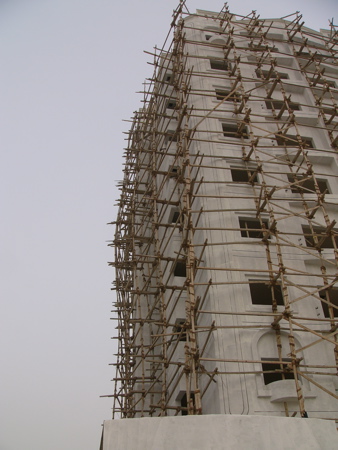
The high tech joints close up:

DWP – Driving While Poor – to Be Outlawed in Kuwait
I’ve been watching the blogs, and I haven’t seen a mention of this, not a whisper. In yesterday’s Kuwait Times, front page, is an article about the proposal that all cars over ten years of age be taken off the road. The intention is to reduce congestion on the road.
I am guessing this will not apply to collectors of classic cars. I imagine this is aimed at the poorest of the poor, driving what they can afford, and holding their car together with prayer, shoestrings and chewing gum.
If Kuwait had a good public transportation system, this might be part of a solution. As it is – do you ever see a woman on a public bus? Taxis are available, but expensive. Domestic workers tell us that when they have any control over their transportation, they only go with a driver they know and trust.
I would guess that most of the cars 10 years and older on the road are owned by people who really need them, to get their children to school, to get to work, and to get groceries, etc. Legend has it that all these old cars on the road were brought in after the 1st Gulf War and sold – at great profit – to people who previously had been unable to own cars. For the working poor, cars give a smattering of dignity and luxury to a life full of scraping by and saving as much as you can. Yeh, the POS car puttering along in front of you is inconvenient, but have a heart – people need their cars, unless there is a good, reliable, decent and reasonably priced public transit system available to men and to women, which there is not.
I am also hearing friends telling me about the rules about driver’s licenses being enforced – you must be working, or you must have a college degree . . . but it is only applied to some, not to all. . .
We Need to Talk About Kevin
This morning on BBC, as part of the coverage on the horrorific murders in the peaceful Amish country of Pennsylvania, they interviewed Lionel Shriver, author of the award winning book “We Need to Talk About Kevin.”
This is not a recommendation. Shriver’s book, which has won several awards for literary excellence, is not for the faint-hearted. It is a tough, muscular, bleak examination of a similar, fictional incident, written after the Columbine High School massacres.
My best friend and I read this book at the same time – it was a book club selection, paired with another book on a similar theme, “Early Leaving.” We ended up exchanging horrified e-mails every morning, discussing events in the book as if they were a part of our daily life, and speculating on where this was all going.
It is from a mother’s point of view, written to her husband, from whom she is separated after . . . .something . . . We don’t know what that something is. The book unfolds steadily and relentlessly. You want to stop. Truly you do, I am not exaggerating. The book rolls on, so dark, so ominous, you know it is leading up to something truly horrible. You don’t want to look. And you can’t stop reading.
“Why are we reading this???” we asked each other in agony. And we didn’t stop.
“Why did you want me to read this?” your friends will say, as you pass this book along, and then, shell shocked, they will come to you to discuss it. Most often, I didn’t even recommend the book, but friends would overhear other friends talking about it in hushed, horrified voices, and would insist.
The book is the scariest, most real book I have ever read. It hits at the heart of every mother’s secret fears – what if we have done something wrong while raising our child? What if our child turns into a monster? Do we ever really know anyone – our children? Our husbands? Ourselves? We are all so vulnerable in our mothering skills, so quick to blame ourselves for our children’s failings, and this book bravely explores that fear, that vulnerability, without taking the easy way out and giving easy answers.
If you read this book you will find yourselves talking about it months – even years – after you read it. It is a terrifying book.
And after you read it you will understand why my heart is breaking for everyone involved in this unthinkable killing in Pennsylvania. Were I some superstitious person, it would be so easy – it is clearly the devil’s work. I can’t imagine what this man could have been thinking, but he chose his victims – young, innocent girls – with purpose. My heart aches for his wife and children, who will bear this shame for the rest of their lives, and for his parents, who will wonder where they went wrong. My heart breaks especially for the peaceable Amish, revered throughout America for their simplicity and commitment in living their faith, who must try to find a way to forgive the man who took their innocent daughters’ lives.
The No. 1 Ladies’ Detective Agency, and more
If you enjoyed the trip through Botswana and would like to read more about Botswana, if you think you might go there someday, or if you think you might never go there – you need to read a wonderful series of books by Alexander McCall Smith.
The first book is The No. 1 Ladies’ Detective Agency. You meet the main character, and heroine, Mma Precious Ramotswe, the founder and owner of the only women’s detective agency in Botswana, and her assistant, Mma Grace Makutsi (who can’t resist a handsome pair of shoes), and the love of her Mma Ramotswe’s life, Mr. J. L. B. Matekone. Mma Ramotswe describes herself as “a woman of traditional build” and drives a very old, small white truck. She has a way of looking at things differently – and she solves her mysteries in ways you or I wouldn’t think of.
The books are short, and deceptively simple. They are “feel good” books, giving you smiles and warming your heart as you read. At the same time, you find yourself thinking back to these books, some of the issues, some of the characters, some of the plots – long after you have finished the book. That’s a sign of a good read!
As different as the thinking and culture is, the books are so full of grace and good humor and tolerance and forgiveness that when the book finishes, you can hardly wait to start the next one. You feel like Precious is your sister, a very smart sister, not without her flaws, but a woman to be respected, a woman of good character and who can make tough decisions.
She also makes mistakes, and has to live with the consequences. You will find the books addictive. The entire series is:
The No. 1 Ladies Detective Agency
Tears of the Giraffe
Morality for Beautiful Girls
The Kalahari Typing School for Men
The Full Cupboard of Life
In the Company of Cheerful Ladies
Blue Shoes and Happiness
Jeffrey Deaver’s mysteries, on the other hand, are intricate and woven through with arcane information, but you always learn something. He has a series about a quadriplegic, Lincoln Rymes, a criminologist, who solves cases in a very Sherlock Holmes kind of way, by thinking about the evidence and the patterns that it presents. He has a girlfriend, Amelia, who is a policewoman, and works with him on many of the cases. The books that have these two characters are:
The Bone Collector
The Coffin Dancer
The Empty Chair
The Stone Monkey
The Vanished Man
The Twelfth Card
Last – and least, for The Devil Wears Prada crowd is Linda Fairstein, who almost always has a book on the New York Times best seller list. Her heroine is Manhattan sex-crimes prosecutor (District Attorney) Alexandra Cooper, whose dad made a fortune on an artificial heart device, allowing her to work in the public service sector and still wear fabulous clothes, have weekly manicures and hair stylings at the best salons and eat at the coolest restaurants in town, and she tells you all about them.
They make great airplane reading for the trendy. The plots are formulaic – an astounding, mysterious crime is committed, Alexandra gets involved, along with her detective side-kicks, the criminal involved somehow focuses on Alexandra and she has to spend the night at her friends’ houses. You don’t read these mysteries for the astounding plots, you read them because they are funny and superficial and a quick read that doesn’t require much thinking.
Happy reading!
The Hemingway Safari: Moremi & Nxabexa (Part 8)
On the next morning’s game run, we see TWO cheetas, and oh my, are they lovely. They pose for us, get up and walk around for us. Well, not really for us, but as if we aren’t there, which is what we really like. We watch as long as we can, and then go watch the hippos.
For lunch, Sky has fixed vegetable crepes. Now is this living, or what? That afternoon, we go to the other side of that rickety bridge to game hunt. As we near the Gametrackers lodge, we see two little boys walking along. They stop Godfrey and ask “have you seen lions?” These guys DON’T want to see lions, they are afraid of the lions. Godfrey assures them we haven’t seen anything between them and the village. They are barefoot, and I hope they can run really fast if they see the lion.
When we return, we have a guest for dinner, Natalie, who is taking over the camp site with her crew on the next day, for another touring group. It is fun having a fresh face, and fresh stories to hear around the dinner table. Sky has fixed roast beef with fried rice, a green salad and pears poached in port!
Early the next morning, Godfrey hands us vouchers for our flights and for our stay at Nxebega Lodge. We drive over the rickety bridge one last time (I’m praying my way over this bridge every time we cross) and leave Moremi, heading toward an air strip. We get there a few minutes early, and watch our little plane arrive, with Collin, our pilot. First he shows us on a map where we will be flying, and goes over a few safety rules. We stow our bags and climb in – it is a Cessna 210 and only seats four comfortably, although two more could crowd into the very back.
Collin is one of the happiest people I have ever met – he has a sandwich and soda which Godfrey has offered him, and then we take off. This is the part of the trip I have dreaded, the flight in the small plane, but Collin McAlister is very confidence inspiring. He is small and lean, and one of those people we have met, one of many, who loves Africa and loves what he is doing. Mostly, his air service is like a taxi, taking eco-tourists from remote airstrip to remote airstrip. I’m not at all worried about his competence, but I DO find myself feeling a little claustrophobic once we get in the air. I shut my eyes, lean back, pray for a calm spirit, and within minutes, all is well.
I really love taking photos of the changing landscape. In a mere 45 minutes, we see Nxebexa spelled out in sandbags, and we land. Pick up our bags, say goodbye to Collin and meet Tsabo, who is waiting with the jeep to pick us up and take us to the lodge. At the lodge, we are met with hot washcloths, a refreshing big glass of guava juice, and a warm welcome.
Steve, the manager, takes us to our cabins, we drop our bags and come back for lunch, which, once again, has been held late for us. At this point, however, we understand how very gracious this is, as lunch is most often served at 11:30 and tea at 3 or 3:30, so when they hold lunch late for us, it puts the staff behind on setting up for tea.
Lunch includes pizza! It is breakfast food and lunch food, and there is both a buffet AND they are asking us what we would like from the kitchen. There is so much good stuff on the buffet, pizza, good vegetables, salads, etc, and we are just fine without special ordering anything.
Every now and then, you can look at life and see a pivotal moment. Our time at Nxebega was pivotal on our journey. Until now, we are just awed by the total experience. At Nxebega, we begin to understand more clearly that something unusual is happening in our lives. That “x” after the “n” in Nxebega is actually not an “x” as we say it in English, but a glottal stop. Most English speakers actually pronounce it Na’ah-beh-ha.
As AH and I sit down to eat our lunch, Anne comes by to chat with us, hospitably, as is the custom in these very small, intimate lodges. We ask her to join us, and have a 15 minute conversation. We learned a lot in that 15 minutes. Anne had a grant to study the impact of high end/eco tourism on the environment, and has been comparing that impact in Nepal, Antarctica and Botswana. You can see by her interactions with Steve, the manager, and the staff, that she has fallen totally in love with Botswana, and she has misgivings about eco-tourism.
Botswana’s focus on high end tourism, protecting the game to attract tourists and providing luxurious surroundings to cosset them as opposed to the Kenya model, going for the groups and high volume travel, is enlightened, but Anne has some reservations about the impact on the Botswanan people. For example, she says, none of the tourists take the time to learn even a few words in Setswana. They address all the help in English.
Just the night before, AH had asked Godfrey for a few words, and, thank God, wrote them down. He has even used them – saying hello and thank you in Setswana, but now I try really hard to learn them, too, and feel really really really bad that I haven’t. Other places we go, we speak the languages, or at least a few phrases. How could we have been so rude? Listening to Anne is fascinating.
Steve, the manager of the lodge joins us too (this is one of the amazing things about the hospitality in Botswana, this kind of personal time and attention) and we learn SO much that puts our experiences in perspective. One of the neatest things of all is that almost every time we ask the question “How did you get here?” we got an answer that knocked our socks off. When I asked Steve how he got there, he laughed and said “I fought and clawed my way to be here!” Later, when we had another opportunity to chat, we learned that he has worked in many places around the world, born in South Africa, but loves Botswana and wants to be a part of it’s future. And this is what we are beginning to learn, from Godfrey and his family, from Steve, and Ashleigh, and Anne, from the kitchen workers, from the game trackers, from the gate keepers and the soldiers – they love Botswana, and they believe in the future of Botswana, and will fight and work their bottoms off to be a part of what they believe, with all their hearts, will be Botswana’s future success.
What we didn’t know, until just minutes later, was that this was Anne’s last day. As we were exploring Nxebega, we heard singing, and when we found it, at the entrance to the lodge, we found Anne being seranaded by the Nxebega staff, singing they love her and will miss her. Anne was sitting on the jeep waiting to take her to the air strip, and sobbing. As we watched the very heartfelt farewells, we believed with all our hearts that Anne is another one of the true believers, who will be back to do her part to ensure that Botswana has a positive future.
Physically, let me tell you what Nxebega looks like. It is stunning. It looks a lot like the Florida Everglades, it is swampy and marshy and full of life. In the middle of a hot and arid country, a river flows great volumes until it just disappears. Most rivers run into the ocean; this river flows into a desert and evaporates.
We were visiting at the end of the rainy season, when it is all greatly green and watery, and it is nothing short of stunningly beautiful. Think palm trees and palmettos, think high grasses and lots and lots of wildlife. Herds of elephants, giraffe, baboons, leopards, cheetahs, lions, and oh, that is just the beginning. The area is really known for it’s beautiful birds!
We have a tent with a wooden floor, covered with coir carpeting. To get into the bath area, which is open to the out of doors, you have to unzip the two zippers of the inner flap and the two zippers of the outer flap. If you don’t keep these zipped, you have flies, or snakes or . . . baboons! You might have something else, thirsty or hungry! So you very conscientiously zip zip zip zip every time you need to go into the toilet/shower/sink/ dressing room area.
They have a generator, like at Savute, it is buried and soundproofed with sandbags, so that you can’t hear it. The generator comes on at 5 in the morning and goes off at 11:00 at night. Your bedside lights are run off batteries, so you CAN use them after 11, but you run down the batteries if you do. Besides, we are so exhausted every day that it is lights out for us by 9:30 or 10:00 every night. We have a terrace on our tent, looking out over the swamp. And a beautiful shower, Nxebega is SO clean. No insects in our tent, not a smudge. Lots of great magazines to read, and materials about Botswana, South Africa and Namibia. There is even a very good gift shop, with lots of fun things.
While we are picking up a few things, we talk more with Steve and Ashleigh about eco-tourism, about the politics in an emerging country, and about the difficulty of maintaining a resource intensive luxurious bush lodge way out in the middle of nowhere. All supplies have to be brought in from Maun, a safari jumping off place. Much of the produce is brought into Maun from South Africa. They never know for sure what they will get or not get, so their menu planning has to be flexible, and they have to be able to fix a lot of things themselves. The employees often come from far away, and they live right at the lodge, and go into Maun, or home only every now and then.
Keeping trained employees is a constant concern. One time, Steve, the manager, was going into Maun, 6 hours away, to pick up supplies and had a breakdown with his truck. As it was just a quick go-into-Maun, pick-things-up-and-come-back kind of trip, he didn’t even grab a water bottle on his way out, and ended up passing out from dehydration along the side of the road. Meanwhile, people in Maun had seen a truck a lot like his, and so everyone thought he really was in Maun. By the time someone passed him on the road and got him to a hospital, he was nearly dead. Now, he never goes anywhere without a water bottle! And a radio!
There is no electric fence around Nxebega to keep the animals out, and we are told that sometimes the game trackers go out looking and looking for leopard, and while they are out, a pair of leopards will walk right through the camp. One day recently, a family of monkeys were playing around the swimming pool and a baby monkey fell in. The monkeys were screeching and screaming and they can’t swim, so the baby was just drowning, and Steve fished it out with the skimmer.
Ashleigh, the assistant manager, says they have to keep the menus flexible. They have a two week revolving menu, but she likes to find new recipes to try so that the staff doesn’t get bored and stale. I have four of her recipes; the food at Nxebega was knock-your-socks off good! We went out for a game drive with our guide, Sami, who looked and sounded like a teacher, if teachers looked like Morgan Freeman (American actor).
We had a great time, At sundown, we stopped for drinks – and to watch the giraffes gracefully crossing the setting sun. Later our guard picks us up for dinner and we gather in the lounge, discussing the day, your game drives, etc. with the other guests.
There is a man from South Africa, with his three very lovely college-age daughters, and a South African couple, us, the Italians . . . and that’s it! Nine people. They make drinks or serve wine, and they have big servers full of hot mixed nuts. Then, dinner is served and all go into the dining room where one long table is set with candles. Dinner the first night was parsnip soup, beef sassouie (sort of stew) polenta, grilled peppers and for dessert, a walnut baklava with ginger ice cream. By the end of the ginger ice cream (total WOW) we just want to fall into our beds.
We are handed our wool covered hot water bottles on our way out. In the middle of the night, I wake up and I need to use the toilet, but I can’t find my flashlight. I’m not desperate, but I am a little scared, and I know that AH will wake up eventually, which he does, and when he goes into the bathroom (zip zip zip zip), I go too, but when he leaves he takes the light with him! I do NOT want to be alone in the bathroom with no light! It is very very dark, there is no ambient light in the sky. So I make him come back in, I finish and then zip zip zip zip, back to bed.
Kuwait Times: Today’s Hero Nameless
The Kuwait Times for today (Sunday 17 September 2006) reveals “the Interior Ministry has decided to recall one of it’s airplanes security men in Jeddah, to question him regarding a complaint by a Member of Parliament.
“A security source informed Al Rai Al Aam that an MP complained against one member of it’s airplane’s security because he ill-treated his brother while entering the plane in Jeddah and (emphasis mine) DID NOT CARE THAT HIS BROTHER IS AN MP.)”
At issue is whether or not a person is immune from having a bag searched if he/she is related to an MP.
The security source is quoted as saying that “even if the MP is exempt from checks due to immunity, it does not apply to his family and relatives. He added the security man’s request was justified, as doing his duty.”
Wooo Hoooo for people with the guts to do the job they were hired to do. Big WOOO HOOOO to the security man who insisted on inspecting, and his superior who backed him up; today’s Hero(es) of the Day. BOOOOOO to those who think they are too important to follow the rules that are in place to protect us all, not just in Kuwait, or Saudi Arabia, but wherever we are in the world.
Chicken Nuggets and Big Macs
Brava, Chicken Nuggets, you have taken what was apparently meant to be an insult, and turned it into a badge of honor. And well you should.
Kuwaiti has been a major trading crossroad for centuries. It would follow that there has been a lot of mixing, as traders pass through, people travel to foreign lands, historically, as well as now. As genetic testing becomes more acceptable, we are all bound to discover that we are much more mixed, and much more alike, than we ever knew. And, there are bound to be surprises, as men and women don’t always fertilize within acceptable societal boundaries.
When you walk around, you see Kuwaitis with the faces of India, Iran, Iraq, Africa, even possibly faces from the earliest adventures of Alexander the Greek. This is a good thing, the intermingling of cultures and bloodlines build strength, resilience and flexibility.
There is a wonderful book you will enjoy reading –
-
Third Culture Kids
by David C. Pollock and Ruth E. Van Reken. While the focus is on young people raised outside their own culture – diplomat kids, oil kids, missionary kids, international business kids – the findings apply to all those who learn to function in more than one culture. You learn that feeling alien and weird is NORMAL for TCK’s during adolescence, and well into their 20’s and even their 30’s.
At some point, however, you realize that every culture you understand, every additional language you master, every new experience brings a whole new tool chest to your life, new perspectives and additional ways of thinking through life problems.
You, dear ones, are the hope of tomorrow. You are international citizens, having a larger world view because of your mixed upbringing. You have MORE THAN double the advantages (culture 1 + culture 2) you have the additional advantage of the (C1xC2) blend. (Hearing strains of “We are Nuggets; hear us roar in numbers too big to ignore . . !”)
. . . . So. . . if you are (golden, delicious, juicy) little chicken nuggets, what are the men of mixed Kuwaiti and western heritage – Big Macs?? Burger Kings?? (cracking myself up)
The Hemingway Safari: Part 5 Savute
“Good Morning” you hear, at 6:00 a.m. sharp, and zip zip as Richard and John deliver your hot water for washing off before leaving. At six, the air is quite cold, and the water bottles are no longer hot. I figured out that if I lay out what I am going to wear the night before, I can get dressed really quickly in the morning. I keep heavy socks right by my bed, as occasionally there is a sticker in the tent, but the socks provide a layer of protection. We put on several layers, as not only is it cold, but our vehical is open, and the wind is cold, even though we also have blankets to wrap up in. So a T-shirt layer, a long sleeved shirt layer and a cotton windbreaker layer, and then a sweater layer. Yes, it is that cold.
AH is already out by the campfire with Godfrey, discussing the plans for today, which are to drive to Savute. Although it is a mere 200 km or less, it is all single tracked road, and mostly sand, a very slow drive. Godfrey has a big pot of hot coffee all readyAND we go into the dining tent and get some breakfast. When I started the trip, I was eating the granola cereal, but watching Godfrey and AH eat the hot cereal, I discovered that it is really good, and it warms you up in the cold cold morning..
We are packed and in the truck by 7, and do one last game drive on our way out of Chobe. We noticed, in Chobe, that while we see herd and herds of elephants in the late afternoon game drives, we have never seen one on the morning drives. “Where are they?” we ask Godfrey, who tells us that they are deep in the bushes where we can’t see. Our running joke is that this is all Botswana by Disney, and Godfrey has it all mechanized, animatronics, so that he can thrill us from time to time by scheduling something new.
During the night, over and over I hear a bird, or something, that calls out, and then others answer, and the calls escalate, higher and higher until they crescendo. “What is that?” I ask Paul, who says it is a Scope’s owl, but Godfrey says it is a Pell’s owl.
We have yet to ask Godfrey a question he can’t answer. Most of what he has learned, he tells us, he learned when he went into the army, and found himself in the anti-poaching unit. He credits his knowledge, and his organizational abilities, and his leadership abilities to his time in the army. As tough as it was, he learned a lot about survival, and learned how much he truly loves nature.
We listened with awe as he would tell us about different trees and flowers, how they mingle, how they struggle against one another for survival. We tried to memorize all the names of all the animals and birds he would show us, and he very very patiently told us as many times as we needed to hear them. Best of all, Godfrey would let us just sit and watch and experience as long as we wanted. It was a blessing to be such a small group, and such an agreeable group. We all loved just watching – watching the giraffes feed and drink, watching the elephants wallow and play. Being able to just sit and watch helped us to understand better.
Leaving Chobe game park took most of the morning. When we stopped for mid-morning tea (and Simbaseku’s egg sandwiches, which we grew to love) it was in the midst of a herd of zebra, which we hadn’t seen before.
Godfrey has pointed out a high circling Batteleur eagle, which is the symbol for CCAfrica, Conservation Corps of Africa, which recently bought AfroVentures. Godfrey tells us about the flag of Botswana, that the blue is for the blue of the big sky, and the black and the white are for the people, black and white working together for a new country. He tells us this several times during the trip. He is a true believer.
The more we get to know Godfrey, the more we like him. At first, we know him as a guide, the one who explains how our tent works, what we will do tomorrow and in what order, a teacher. But as we spend more and more time together, we get to know the person inside, and his experiences, and his dreams. And on this day, we are greatly honored, we get to stop and meed Godfrey’s family. Godfrey’s family was originally Namibian – Namibia is just across the river, we can see it while we drive. But when the nations were separated, they chose to live on the Botswana side where they had family.
First, we see the new housing they live in. In Godfrey’s village, there are signs for Habitat for Humanity, who are building new houses, cinderblock houses, in the village. Godfrey’s Mom and Dad and one sister live in one such house, and have a large circular corral for their cattle built out of large sticks. His Mother is sitting in front of the house on the ground, legs straight out in front. She recently became blind overnight, and Godfrey has been taking her to the hospital frequently to see what, if anything, can be done. His Mom and Dad are both in their seventies, a miracle in Botswana where 36% of the people have the AIDs virus and life expectency isn’t much more than 40 years. We also meet his sister, and a sister in law, and several young nephews and nieces.
All I have with me are some cinnamon candies, which we share. If only I had known I would have this opportunity! After leaving Kavimba, we pass the now deserted compound where Godfrey grew up. We can see the circular remains of the housing, of the cattle pens. They are a little farther away from the river now, but the cinder block keeps them safer.
We can understand why the children are SO afraid of the lions and the elephants; lions think of cattle as easy prey, and the elephants take what they need, and just knock over whatever gets in their way. They have memories of where to eat just the right vegetation to provide the minerals they need, and sometimes the villages have been built where they graze on that one particular vegetation. It’s a constrant struggle between the villagers and the wild animals.
We get to see the school, and we see the ambulance, and we can hear the pride in Godfrey’s voice as he points out signs that the life in the village is getting better. As we near Savuti, we pass a herd of male elephants wallowing and drinking, jostling a little for space, and then, thrill of thrills, a pair of honeymooning lions! The lions are just 30 feet from the truck, male and female, lying very mellowly in the warm sunshine (we have stripped down to T-shirts during the morning tea break, as it has become quite warm.) Godfrey explains to us that normally, females hang around together with their young, and young males hang around together, and every now and then, rarely, you see a mating pair. They spend about four days together, mating and just relaxing together. This pair is VERY relaxed, and we photograph them to our heart’s content.
Godfrey tells us that the lions don’t really “see” us, they smell the diesel and the rubber, and think of us and the truck as one animal. So it is important, he continues, to sit still, and not to stick our heads out the top as we watch. At one point, the male lion stands up, looking at us, but he falls back down, as cats do when they are feeling relaxed and not at all threatened. All this stopping and watching makes us run a little late, and we drive up to Savute Elephant Camp about one.
First, Godfrey had to undo the electric fence links and then re-fasten them behind us. As we drove up, a group of about ten chambermaids were standing together, and began singing “you are welcome (clap clap clap) You are welcome (clap clap clap) you are welcome” and it was so lovely, so charming and so unexpected that I found myself getting a little choked up.
Savute Elephant Camp is a mind blowing experience. First, we see our rooms, which are so lovely, so luxurious and so unexpected that our eyes nearly pop out of our heads. But we didn’t have time for anything more than a very quick face and hand wash, as they had held brunch/lunch for us and we needed to be back at the lodge right away.
The lodge is also breathtakingly lovely, all open and airy, with gorgeous leather upholstered furniture and a spacious huge bar. And oh, by the way, there are SO many elephants at the water pit just below the swimming deck, which is just below the dining room.
The food here is fabulous. I have babootie, a South African cassarole dish which I tried to make once but it never tasted THIS good. As we are sitting, some of the local game trackers come and sit with us, and tell us about the camp. After lunch, we meet Liesl, newly wed and the Food and Beverage manager, who usually works at the Eagle River Gametracker’s lodge, but who is filling in for someone else off on vacation, and we meet Freddie, who tells us the way things work at the lodge.
Most important of all is that you NEVER NEVER NEVER go to your cabin or come from your cabin alone after dark. They have escorts, and you set a time when you will be picked up for dinner and then they escort you back to your cabin. There are only a maximum of 24 guests at any one time. We only have a short time back in our “cabin”. Our cabin is huge. Yes, it is a tent, but a tent built over a mahogony platform. There are two 3/4 sized beds together, which makes up a huge king-sized bed, surrounded by white hangings, and with a white cover, so that you sleep totally insect free. There is a reading corner, with two chairs and a table, and a writing table in the other corner.
Behind the sleeping area is a built in mahogany area for hanging your clothes, for your suitcases, for putting things away, and a laundry basket. Anything you want laundered must be in the basket by 7 in the morning and will be back to you by the next evening, washed, dried and ironed. There are fresh bathrobes hanging in the mahogany closet, and a shoe shine kit. And oh, heavenly joy, there is a hair dryer! And a huge walk in shower! Even though I have been showering in the camp, having a huge walk in shower and a hair dryer – oh what luxury. So I quickly shower and wash my hair, but leave it wet and tuck it up under my hat, as we are going on a game drive and it is HOT HOT HOT.
We spend a little time on our huge teak private terrace, watching the elephants amble up to the water hole in front of the lodge, and then ambling past on their way to other watering holes. Only this last month, we learn, have they put up the electric fence. Before that, you might be showering and into the shower would pop an elephant trunk, sucking at the shower water. It had its charm, but having the elephants inside the camp also caused a lot of destruction. They thought long and hard before putting the fence up, and did so reluctantly. It is just too expensive and to resource intensive bringing in materials to repair damage done by the elephants.
On our game drive that afternoon, we see SO much game. In particular, a group of young lions, who also seem to be well fed and very relaxed. They are oblivious to us watching, maybe even hamming it up a little for us. We are SO close to these lions that they are lying on the ground maybe five feet from our open back of the truck. One gets up, heading toward us and our travel companion says “Godfrey, drive!” and the look on her face is pure fear. We laughed, but I was on the other side of the truck.
My wet hair keeps me nice and cool, but as the sun goes down I am glad to have my hat over my hair, as it gets cold quickly once the sun goes down. We drive to an outcropping of rock and AH and I hike up to see the San Bushman carvings. They don’t look very old, to me, but AH dutifully takes a photo and we hike back down.
Back at the lodge, I dry my hair and we wait for Godfrey to escort us to dinner. At dinner, all Godfrey’s friends stop by to talk to him, and we learn that in 1997 Godfrey was voted Guide of the Year, and that no one has been elected since, so he is still it. Dinner is a buffet, with a choice of baked chicken or ostrich shish-kebab with fruits. AH and I both have the ostrich, which is really good. They have funny butter dishes here, designed to prevent the baboons from eating the butter. The butter is in the top, so when the baboons pick up the top, they see an empty plate on the bottom. It never occurs to them to look in the top, where the butter is packed.
People are gathering around the campfire, but we are TIRED, so Godfrey escorts us back to our tent. All night long we can hear the elephants walking to and fro, crashing through the trees. And we can hear other things too, long loud screams in the night.
Recent Comments
ExpatAlien on What Country am I Living … intlxpatr on Yellowstone: Old Faithful to C… Michelle on Yellowstone: Old Faithful to C… Cathy on No Grown-Ups in Charge intlxpatr on Waiting for Snow Wikipedia Donate Button

Amazina


Early Voting in Florida


 Here There and Everywhere