“The Great Day of their Wrath has Come, and Who is Able to Stand?”
It is my very favorite church season of the year, Advent. I’ve always loved the waiting and the hoping, the preparations, the joy of imagining the coming of this little baby. You’d think that our readings would reflect this ummm. . . errr . .. reflective season, but no! It’s all Zachariah and Amos and Revelations with their horrific visions.
When I read today’s reading from Revelations, I wonder if the horses are not already loosed? We know that our time and God’s time are very different, and it seems to me that those fearsome horses have been hanging around for quite a while.
Revelation 6:1-17
6Then I saw the Lamb open one of the seven seals, and I heard one of the four living creatures call out, as with a voice of thunder, ‘Come!’* 2I looked, and there was a white horse! Its rider had a bow; a crown was given to him, and he came out conquering and to conquer.
3 When he opened the second seal, I heard the second living creature call out, ‘Come!’* 4And out came* another horse, bright red; its rider was permitted to take peace from the earth, so that people would slaughter one another; and he was given a great sword.
5 When he opened the third seal, I heard the third living creature call out, ‘Come!’* I looked, and there was a black horse! Its rider held a pair of scales in his hand, 6and I heard what seemed to be a voice in the midst of the four living creatures saying, ‘A quart of wheat for a day’s pay,* and three quarts of barley for a day’s pay,* but do not damage the olive oil and the wine!’
7 When he opened the fourth seal, I heard the voice of the fourth living creature call out, ‘Come!’* 8I looked and there was a pale green horse! Its rider’s name was Death, and Hades followed with him; they were given authority over a fourth of the earth, to kill with sword, famine, and pestilence, and by the wild animals of the earth.
9 When he opened the fifth seal, I saw under the altar the souls of those who had been slaughtered for the word of God and for the testimony they had given; 10they cried out with a loud voice, ‘Sovereign Lord, holy and true, how long will it be before you judge and avenge our blood on the inhabitants of the earth?’ 11They were each given a white robe and told to rest a little longer, until the number would be complete both of their fellow-servants* and of their brothers and sisters,* who were soon to be killed as they themselves had been killed.
12 When he opened the sixth seal, I looked, and there came a great earthquake; the sun became black as sackcloth, the full moon became like blood, 13and the stars of the sky fell to the earth as the fig tree drops its winter fruit when shaken by a gale. 14The sky vanished like a scroll rolling itself up, and every mountain and island was removed from its place. 15Then the kings of the earth and the magnates and the generals and the rich and the powerful, and everyone, slave and free, hid in the caves and among the rocks of the mountains, 16calling to the mountains and rocks, ‘Fall on us and hide us from the face of the one seated on the throne and from the wrath of the Lamb; 17for the great day of their wrath has come, and who is able to stand?’
Who Gets Into Heaven?
Today at Christ Church in Pensacola, when Father Neal Goldsborough gave the sermon, I had a very un-churchlike urge to get up and dance for joy. He was preaching on Matthew 25: 31 – 46, where Christ the King sits in majesty and judges who will have the kingdom of heaven, and who will burn in the lake of fire.
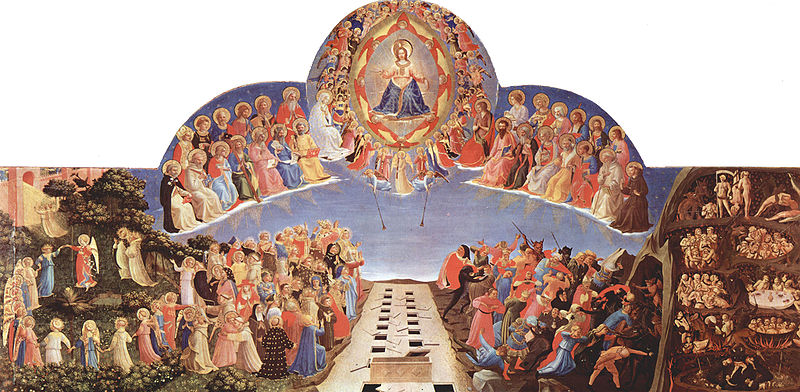
Here was today’s reading:
Matthew 25:31-46
New International Version (NIV)
The Sheep and the Goats
31 “When the Son of Man comes in his glory, and all the angels with him, he will sit on his glorious throne. 32 All the nations will be gathered before him, and he will separate the people one from another as a shepherd separates the sheep from the goats. 33 He will put the sheep on his right and the goats on his left.
34 “Then the King will say to those on his right, ‘Come, you who are blessed by my Father; take your inheritance, the kingdom prepared for you since the creation of the world. 35 For I was hungry and you gave me something to eat, I was thirsty and you gave me something to drink, I was a stranger and you invited me in, 36 I needed clothes and you clothed me, I was sick and you looked after me, I was in prison and you came to visit me.’
37 “Then the righteous will answer him, ‘Lord, when did we see you hungry and feed you, or thirsty and give you something to drink? 38 When did we see you a stranger and invite you in, or needing clothes and clothe you? 39 When did we see you sick or in prison and go to visit you?’
40 “The King will reply, ‘Truly I tell you, whatever you did for one of the least of these brothers and sisters of mine, you did for me.’
41 “Then he will say to those on his left, ‘Depart from me, you who are cursed, into the eternal fire prepared for the devil and his angels. 42 For I was hungry and you gave me nothing to eat, I was thirsty and you gave me nothing to drink, 43 I was a stranger and you did not invite me in, I needed clothes and you did not clothe me, I was sick and in prison and you did not look after me.’
44 “They also will answer, ‘Lord, when did we see you hungry or thirsty or a stranger or needing clothes or sick or in prison, and did not help you?’
45 “He will reply, ‘Truly I tell you, whatever you did not do for one of the least of these, you did not do for me.’
46 “Then they will go away to eternal punishment, but the righteous to eternal life.”
When he started out, I was a little nervous, because I was afraid he was going to talk about the fat sheep and the thin sheep, but that was the reading from Ezekiel:
(Ezekiel 34:11-16
New International Version (NIV)
11 “‘For this is what the Sovereign LORD says: I myself will search for my sheep and look after them. 12 As a shepherd looks after his scattered flock when he is with them, so will I look after my sheep. I will rescue them from all the places where they were scattered on a day of clouds and darkness. 13 I will bring them out from the nations and gather them from the countries, and I will bring them into their own land. I will pasture them on the mountains of Israel, in the ravines and in all the settlements in the land. 14 I will tend them in a good pasture, and the mountain heights of Israel will be their grazing land. There they will lie down in good grazing land, and there they will feed in a rich pasture on the mountains of Israel. 15 I myself will tend my sheep and have them lie down, declares the Sovereign LORD. 16 I will search for the lost and bring back the strays. I will bind up the injured and strengthen the weak, but the sleek and the strong I will destroy. I will shepherd the flock with justice.
20 “‘Therefore this is what the Sovereign LORD says to them: See, I myself will judge between the fat sheep and the lean sheep. 21 Because you shove with flank and shoulder, butting all the weak sheep with your horns until you have driven them away, 22 I will save my flock, and they will no longer be plundered. I will judge between one sheep and another. 23 I will place over them one shepherd, my servant David, and he will tend them; he will tend them and be their shepherd. 24 I the LORD will be their God, and my servant David will be prince among them. I the LORD have spoken.
Since I might be mistaken for one of the fatter sheep, you can understand why I was a little nervous. Also, I had a huge “AHA!” moment living in Jordan, as the shepherd and his sheep and goats passed by my house daily. The sheep were incredibly stupid, but they trusted their shepherd, and the shepherd took good care of them. While they were excavating channels to put in underground pipes in our area, I watched the shepherd carry each sheep across the little wooden walk way, because they were too afraid to do it on their own. The goats would do it, but I still wouldn’t want to be a goat. I don’t really want to be a sheep either.
And I digress.
Here’s what Father Neal said about our gospel reading. He said Jesus doesn’t say you have to have invited him into your heart. He said that if you feed the hungry, give some water to the thirsty, welcome the stranger, clothe the needy, look after the sick and visit those in prison, ypu’re in. You’re righteous.
It’s exactly what I’ve been looking for, something scriptural to support what my heart knows – that there are those who are not Christians who are going to be in the kingdom of heaven, too. It’s not a matter of saying these words or those words, or believing exactly as “they” tell us we must believe, it is a matter of serving the king by tending to and serving his sheep. He LOVES the least of these. It gives me hope; even I might have a chance of inclusion.
Jesus Loves the Little Children
There are many times Jesus speaks obliquely, using an analogy to convey the message, and his disciples have trouble understanding. This time, Jesus speaks very clearly, telling his disciples that the most humble child will enter heaven, and that anyone who causes that child to lose innocence and belief is in big trouble.
I think of my little grandson. Since he was born, I have been singing to him a song I learned in my childhood, “Jesus Loves the Little Children, all the little children of the world, red and yellow, black and white, we are precious in his sight, Jesus loves the little children of the world.”
Matthew 18:1-9
18 At that time the disciples came to Jesus and asked, ‘Who is the greatest in the kingdom of heaven?’ 2 He called a child, whom he put among them, 3 and said, ‘Truly I tell you, unless you change and become like children, you will never enter the kingdom of heaven. 4 Whoever becomes humble like this child is the greatest in the kingdom of heaven. 5 Whoever welcomes one such child in my name welcomes me.
6 ‘If any of you put a stumbling-block before one of these little ones who believe in me, it would be better for you if a great millstone were fastened around your neck and you were drowned in the depth of the sea. 7 Woe to the world because of stumbling-blocks! Occasions for stumbling are bound to come, but woe to the one by whom the stumbling-block comes!
8 ‘If your hand or your foot causes you to stumble, cut it off and throw it away; it is better for you to enter life maimed or lame than to have two hands or two feet and to be thrown into the eternal fire. 9 And if your eye causes you to stumble, tear it out and throw it away; it is better for you to enter life with one eye than to have two eyes and to be thrown into the hell of fire.
Getting Scripture Wrong
As you know, many Christians do readings daily; there are readings recommended for each day from the Old Testament, the New Testament and the Gospels. Technology makes life easier and easier, you can just go online to The Lectionary and it is all right there for you. They have all the readings, every day, and even have write-ups about the Saints days.
This scripture makes me nervous. I attend a bible study where they tell us exactly what to think. They are very clear in their doctrine. Because I need the self-discipline in my studies, and because I believe that they are mostly women like me, trying to serve God to the best of their abilities, I don’t argue a lot, I don’t say “no! that’s not what it says!” or cause a disturbance. I trust God lives in each of us, as the Holy Spirit, and figure the Holy Spirit will guide me through our studies.
In this scripture, the disciples who know Jesus the very best, the ones who travel with him and who listen to him every day are talking about bread when Jesus is talking about hypocrisy. It worries me. What else to we fail to see? What else do we mis-interpret?

Matthew 16:1-12
16:1 The Pharisees and Sadducees came, and to test Jesus they asked him to show them a sign from heaven. 2 He answered them, ‘When it is evening, you say, “It will be fair weather, for the sky is red.” 3 And in the morning, “It will be stormy today, for the sky is red and threatening.” You know how to interpret the appearance of the sky, but you cannot interpret the signs of the times. 4 An evil and adulterous generation asks for a sign, but no sign will be given to it except the sign of Jonah.’ Then he left them and went away.
5 When the disciples reached the other side, they had forgotten to bring any bread. 6 Jesus said to them, ‘Watch out, and beware of the yeast of the Pharisees and Sadducees.’ 7 They said to one another, ‘It is because we have brought no bread.’ 8 And becoming aware of it, Jesus said, ‘You of little faith, why are you talking about having no bread? 9 Do you still not perceive? Do you not remember the five loaves for the five thousand, and how many baskets you gathered? 10 Or the seven loaves for the four thousand, and how many baskets you gathered? 11 How could you fail to perceive that I was not speaking about bread? Beware of the yeast of the Pharisees and Sadducees!’ 12 Then they understood that he had not told them to beware of the yeast of bread, but of the teaching of the Pharisees and Sadducees.
Eid Mubarak

So alike, but a jarring difference . . .
Our Moslem friends are celebration the Great Eid, when God / Allah (remember, the Hebrew word is Yah’weh, sounds a lot alike, doesn’t it?) told Abraham not to kill his son, as his son was lying on the altar, trusting his father – and provided a ram stuck in the nearby bushes. We Christians say that son was was Isaac, son of Sarah; our Moslem friends say it was Ishmael, Abraham’s first born son by Hajar, banished to the desert.
Right now, millions of Moslems from all over the world are making the Hajj. The men are dressed in two snowy white large cotton towels, symbolizing purity. The women are dressed plainly. I think the rules are no veils and no hair coverings, all just as they are, but it may be that the rules are changing from what I have observed and overheard on blogs.
Millions of Moslems, from all over the globe, gathered to fulfill one of the pillars of Islam, to make the Hajj at least once in one’s life. It is a very holy time for our Moslem friends, a time of forgiveness and purity and spiritual renewal.
May you find peace in your hearts, love for your fellow beings, and an overwhelming sense of joy and gratitude for God’s unfathomable mercy.
Eid Mubarak.
The Rule of the Harvest
I was talking about this with a Mormon friend, who told me they call this ‘The Rule of the Harvest,’ that it is one of life’s great – and most obvious – secrets, that what you give comes back to you ten-fold and more.
Pastor Rick Warren is the pastor of Saddleback Church, and sends out these thoughts on a daily basis. The current theme is generosity in giving, as this is stewardship season.
Financial Fitness: Generosity Reaps Generosity
by Rick Warren
The world of the generous gets larger and larger; the world of the stingy gets smaller and smaller. Proverbs 11:24 (Msg)
If I sow generosity, it’s going to come back to me, and I’m going to reap generosity.
Every farmer knows this. A farmer has sacks of seed in his barn and he looks at his empty field. He doesn’t complain, “There’s no crop! I wish there was a crop!” He just goes out and starts planting seed. When you have a need, plant a seed.
It seems illogical that when I have a need, I should give.
Why did God set it up this way? Because God is a giver. He is the most generous giver in the universe, and God wants you to learn to be like him. He wants to build character in you.
The Bible says, “Honor the Lord with your wealth and with the best part of everything you produce” (Proverbs 3:9 NLT). This is the principle of tithing. It’s the principle that says every time I make $100 — the first $10 goes back to God.
Tithing is an act of worship. We’re giving to God. We’re saying, “All of it came from you anyway.” God says, “Put me first in your life and watch what I do.” You may think you can’t afford to tithe, but the reality is, you can’t afford not to tithe.
If you have an interest in receiving his daily message, you can subscribe here.
Josiah; Before Him There Was No King Like Him
It’s been about 11 years that I have done the daily readings in The Lectionary. What started out as a discipline, an offering, has become a blessing, and provides me with food for thought. Many times, I have to talk over the things I read with someone who knows a lot more than I do, or find a commentary (God bless the Internet for all its religious resources!) which gives insight.
As I was reading today’s old testament reading from the book of Second Kings, I came to the end, where it says never before and never after was there a human king who worshipped and followed the Lord with all his heart. If you are interested, read the whole story of Josiah, which spans a couple days. He was ignorant of the law, but a book was found while they were building, and it was a book of the law. Once he knew the law, he tore his clothing, repented profoundly, and he scoured the land of all idols, everything that related to any god but the one true God.
What if there were a Josiah now? In the United States, he would be bound by all the national laws which prohibit religious discrimination, and he wouldn’t get very far. In a country like Afghanistan, he would do what the Taliban did – eliminate all images, all modern music, make sure that women kept covered, regulate all the interactions between people, mostly eliminate anything that distracts us from our focus on God.
For me, it is a troubling thought, and it all goes back to God having given us free will, and the freedom to make bad choices, to know what is right and to choose to do other.
But how can we be moral, and make moral choices, if the morality is imposed from without?

2 Kings 23:4-25
4 The king commanded the high priest Hilkiah, the priests of the second order, and the guardians of the threshold, to bring out of the temple of the Lord all the vessels made for Baal, for Asherah, and for all the host of heaven; he burned them outside Jerusalem in the fields of the Kidron, and carried their ashes to Bethel. 5He deposed the idolatrous priests whom the kings of Judah had ordained to make offerings in the high places at the cities of Judah and around Jerusalem; those also who made offerings to Baal, to the sun, the moon, the constellations, and all the host of the heavens.
6He brought out the image of* Asherah from the house of the Lord, outside Jerusalem, to the Wadi Kidron, burned it at the Wadi Kidron, beat it to dust and threw the dust of it upon the graves of the common people. 7He broke down the houses of the male temple prostitutes that were in the house of the Lord, where the women did weaving for Asherah. 8He brought all the priests out of the towns of Judah, and defiled the high places where the priests had made offerings, from Geba to Beer-sheba; he broke down the high places of the gates that were at the entrance of the gate of Joshua the governor of the city, which were on the left at the gate of the city.
9The priests of the high places, however, did not come up to the altar of the Lord in Jerusalem, but ate unleavened bread among their kindred. 10He defiled Topheth, which is in the valley of Ben-hinnom, so that no one would make a son or a daughter pass through fire as an offering to Molech. 11He removed the horses that the kings of Judah had dedicated to the sun, at the entrance to the house of the Lord, by the chamber of the eunuch Nathan-melech, which was in the precincts;* then he burned the chariots of the sun with fire. 12The altars on the roof of the upper chamber of Ahaz, which the kings of Judah had made, and the altars that Manasseh had made in the two courts of the house of the Lord, he pulled down from there and broke in pieces, and threw the rubble into the Wadi Kidron.
13The king defiled the high places that were east of Jerusalem, to the south of the Mount of Destruction, which King Solomon of Israel had built for Astarte the abomination of the Sidonians, for Chemosh the abomination of Moab, and for Milcom the abomination of the Ammonites. 14He broke the pillars in pieces, cut down the sacred poles,* and covered the sites with human bones.
15 Moreover, the altar at Bethel, the high place erected by Jeroboam son of Nebat, who caused Israel to sin—he pulled down that altar along with the high place. He burned the high place, crushing it to dust; he also burned the sacred pole.* 16As Josiah turned, he saw the tombs there on the mount; and he sent and took the bones out of the tombs, and burned them on the altar, and defiled it, according to the word of the Lord that the man of God proclaimed,* when Jeroboam stood by the altar at the festival; he turned and looked up at the tomb of the man of God who had predicted these things.
17Then he said, ‘What is that monument that I see?’ The people of the city told him, ‘It is the tomb of the man of God who came from Judah and predicted these things that you have done against the altar at Bethel.’ 18He said, ‘Let him rest; let no one move his bones.’ So they let his bones alone, with the bones of the prophet who came out of Samaria. 19Moreover, Josiah removed all the shrines of the high places that were in the towns of Samaria, which kings of Israel had made, provoking the Lord to anger; he did to them just as he had done at Bethel. 20He slaughtered on the altars all the priests of the high places who were there, and burned human bones on them. Then he returned to Jerusalem.
21 The king commanded all the people, ‘Keep the passover to the Lord your God as prescribed in this book of the covenant.’ 22No such passover had been kept since the days of the judges who judged Israel, even during all the days of the kings of Israel and of the kings of Judah; 23but in the eighteenth year of King Josiah this passover was kept to the Lord in Jerusalem.
24 Moreover, Josiah did away with the mediums, wizards, teraphim,* idols, and all the abominations that were seen in the land of Judah and in Jerusalem, so that he established the words of the law that were written in the book that the priest Hilkiah had found in the house of the Lord. 25Before him there was no king like him, who turned to the Lord with all his heart, with all his soul, and with all his might, according to all the law of Moses; nor did any like him arise after him.
Naman: Cured or Pride?
Today’s Old Testament reading is from 2Kings. I like this story. Although it happened so long ago, it still applies to me today – do I want to be right or do I want to be cured?
2 Kings 5:1-19
5Naaman, commander of the army of the king of Aram, was a great man and in high favour with his master, because by him the Lord had given victory to Aram. The man, though a mighty warrior, suffered from leprosy.* 2Now the Arameans on one of their raids had taken a young girl captive from the land of Israel, and she served Naaman’s wife. 3She said to her mistress, ‘If only my lord were with the prophet who is in Samaria! He would cure him of his leprosy.’* 4So Naaman* went in and told his lord just what the girl from the land of Israel had said. 5And the king of Aram said, ‘Go then, and I will send along a letter to the king of Israel.’
He went, taking with him ten talents of silver, six thousand shekels of gold, and ten sets of garments. 6He brought the letter to the king of Israel, which read, ‘When this letter reaches you, know that I have sent to you my servant Naaman, that you may cure him of his leprosy.’* 7When the king of Israel read the letter, he tore his clothes and said, ‘Am I God, to give death or life, that this man sends word to me to cure a man of his leprosy?* Just look and see how he is trying to pick a quarrel with me.’
8 But when Elisha the man of God heard that the king of Israel had torn his clothes, he sent a message to the king, ‘Why have you torn your clothes? Let him come to me, that he may learn that there is a prophet in Israel.’ 9So Naaman came with his horses and chariots, and halted at the entrance of Elisha’s house. 10Elisha sent a messenger to him, saying, ‘Go, wash in the Jordan seven times, and your flesh shall be restored and you shall be clean.’
11But Naaman became angry and went away, saying, ‘I thought that for me he would surely come out, and stand and call on the name of the Lord his God, and would wave his hand over the spot, and cure the leprosy!* 12Are not Abana* and Pharpar, the rivers of Damascus, better than all the waters of Israel? Could I not wash in them, and be clean?’ He turned and went away in a rage. 13But his servants approached and said to him, ‘Father, if the prophet had commanded you to do something difficult, would you not have done it? How much more, when all he said to you was, “Wash, and be clean”?’ 14So he went down and immersed himself seven times in the Jordan, according to the word of the man of God; his flesh was restored like the flesh of a young boy, and he was clean.
15 Then he returned to the man of God, he and all his company; he came and stood before him and said, ‘Now I know that there is no God in all the earth except in Israel; please accept a present from your servant.’ 16But he said, ‘As the Lord lives, whom I serve, I will accept nothing!’ He urged him to accept, but he refused. 17Then Naaman said, ‘If not, please let two mule-loads of earth be given to your servant; for your servant will no longer offer burnt-offering or sacrifice to any god except the Lord. 18But may the Lord pardon your servant on one count: when my master goes into the house of Rimmon to worship there, leaning on my arm, and I bow down in the house of Rimmon, when I do bow down in the house of Rimmon, may the Lord pardon your servant on this one count.’ 19He said to him, ‘Go in peace.’
Lectionary Readings for Today – Forgiveness
Hatred is its own punishment. We are called upon to forgive, and to live lives of goodness and mercy.
Ecclesiaticus, or Sirach 27: 30 – 28: 7 (Roman Catholic)
27:30 (NRSV) Anger and wrath, these also are abominations,
yet a sinner holds on to them.
28:1 The vengeful will face the Lord’s vengeance,
for he keeps a strict account of their sins.
2 Forgive your neighbor the wrong he has done,
and then your sins will be pardoned when you pray.
3 Does anyone harbor anger against another,
and expect healing from the Lord?
4 If one has no mercy toward another like himself,
can he then seek pardon for his own sins?
5 If a mere mortal harbors wrath,
who will make an atoning sacrifice for his sins?
6 Remember the end of your life, and set enmity aside;
remember corruption and death, and be true to the commandments.
7 Remember the commandments, and do not be angry with your neighbor;
remember the covenant of the Most High, and overlook faults.
Genesis 50: 15 – 21 (alt. for RCL)
Gene 50:15 (NRSV) Realizing that their father was dead, Joseph’s brothers said, “What if Joseph still bears a grudge against us and pays us back in full for all the wrong that we did to him?” 16 So they approached Joseph, saying, “Your father gave this instruction before he died, 17 “Say to Joseph: I beg you, forgive the crime of your brothers and the wrong they did in harming you.’ Now therefore please forgive the crime of the servants of the God of your father.” Joseph wept when they spoke to him. 18 Then his brothers also wept, fell down before him, and said, “We are here as your slaves.” 19 But Joseph said to them, “Do not be afraid! Am I in the place of God? 20 Even though you intended to do harm to me, God intended it for good, in order to preserve a numerous people, as he is doing today. 21 So have no fear; I myself will provide for you and your little ones.” In this way he reassured them, speaking kindly to them.
NEW TESTAMENT: Romans 14: 1 – 12 (RCL)
Romans 14: 7 – 9 (Roman Catholic)
Roma 14:1 (NRSV) Welcome those who are weak in faith, but not for the purpose of quarreling over opinions. 2 Some believe in eating anything, while the weak eat only vegetables. 3 Those who eat must not despise those who abstain, and those who abstain must not pass judgment on those who eat; for God has welcomed them. 4 Who are you to pass judgment on servants of another? It is before their own lord that they stand or fall. And they will be upheld, for the Lord is able to make them stand.
5 Some judge one day to be better than another, while others judge all days to be alike. Let all be fully convinced in their own minds. 6 Those who observe the day, observe it in honor of the Lord. Also those who eat, eat in honor of the Lord, since they give thanks to God; while those who abstain, abstain in honor of the Lord and give thanks to God.
7 We do not live to ourselves, and we do not die to ourselves. 8 If we live, we live to the Lord, and if we die, we die to the Lord; so then, whether we live or whether we die, we are the Lord’s. 9 For to this end Christ died and lived again, so that he might be Lord of both the dead and the living.
10 Why do you pass judgment on your brother or sister? Or you, why do you despise your brother or sister? For we will all stand before the judgment seat of God. 11 For it is written,
“As I live, says the Lord, every knee shall bow to me,
and every tongue shall give praise to God.”
12 So then, each of us will be accountable to God.
GOSPEL: Matthew 18: 21 – 35 (all)
Matt 18:21 (NRSV) Then Peter came and said to him, “Lord, if another member of the church sins against me, how often should I forgive? As many as seven times?” 22 Jesus said to him, “Not seven times, but, I tell you, seventy-seven times.
23 “For this reason the kingdom of heaven may be compared to a king who wished to settle accounts with his slaves. 24 When he began the reckoning, one who owed him ten thousand talents was brought to him; 25 and, as he could not pay, his lord ordered him to be sold, together with his wife and children and all his possessions, and payment to be made. 26 So the slave fell on his knees before him, saying, “Have patience with me, and I will pay you everything.’ 27 And out of pity for him, the lord of that slave released him and forgave him the debt. 28 But that same slave, as he went out, came upon one of his fellow slaves who owed him a hundred denarii; and seizing him by the throat, he said, “Pay what you owe.’ 29 Then his fellow slave fell down and pleaded with him, “Have patience with me, and I will pay you.’ 30 But he refused; then he went and threw him into prison until he would pay the debt. 31 When his fellow slaves saw what had happened, they were greatly distressed, and they went and reported to their lord all that had taken place. 32 Then his lord summoned him and said to him, “You wicked slave! I forgave you all that debt because you pleaded with me. 33 Should you not have had mercy on your fellow slave, as I had mercy on you?’ 34 And in anger his lord handed him over to be tortured until he would pay his entire debt. 35 So my heavenly Father will also do to every one of you, if you do not forgive your brother or sister from your heart.”
Sobering Reading on Wealth
It’s a long weekend, Labor Day weekend, and Pensacola awakes to rain-sodden streets and forecasts of a rain soggy three day weekend (bad for hotels and restaurants at the beach who hope for a sell-out Labor Day) and high surf from off-shore storms.
The reading for today from James is equally gloomy. I always think of “Insh’allah” when I read it, because it probably has an equivalent somewhere in the Quran, and my Muslim friends say “Insh’allah” (As God wills, or If God wills it) when they state a planned event.
While we are not rich, we have a large homeless population in Pensacola, sleeping out under the skies in hidden camps, scrounging for food, often with a dog, seeking handouts, seeking scraps. They are a constant reminder, to me, of how comfortable we are, and how comfort wars with the religious spirit. When we are too comfortable, we often fail to keep our focus on God, and are distracted by our toys and interests.
(I told you this would be gloomy.)
On the other hand, I wonder how spiritual I would be if I were hungry, worried about getting enough to eat, worried about my safety sleeping out in one of the camps. I wonder if their community looks after one another, or if it is a brutal and chaotic life. I wonder how you can keep your mind on things of the spirit when the search for basic necessities takes up a large part of your life.
James 4:13-5:6
13 Come now, you who say, ‘Today or tomorrow we will go to such and such a town and spend a year there, doing business and making money.’ 14Yet you do not even know what tomorrow will bring. What is your life? For you are a mist that appears for a little while and then vanishes. 15Instead you ought to say, ‘If the Lord wishes, we will live and do this or that.’ 16As it is, you boast in your arrogance; all such boasting is evil. 17Anyone, then, who knows the right thing to do and fails to do it, commits sin.
5Come now, you rich people, weep and wail for the miseries that are coming to you. 2Your riches have rotted, and your clothes are moth-eaten. 3Your gold and silver have rusted, and their rust will be evidence against you, and it will eat your flesh like fire. You have laid up treasure* for the last days. 4Listen! The wages of the labourers who mowed your fields, which you kept back by fraud, cry out, and the cries of the harvesters have reached the ears of the Lord of hosts.
5You have lived on the earth in luxury and in pleasure; you have fattened your hearts on a day of slaughter. 6You have condemned and murdered the righteous one, who does not resist you.
Recent Comments
intlxpatr on Shampoo Ginger tigerbutterya0c5ff1d… on Shampoo Ginger intlxpatr on British Soldier Kidnapped, Esc… John on British Soldier Kidnapped, Esc… intlxpatr on British Soldier Kidnapped, Esc… Wikipedia Donate Button

Amazina


Early Voting in Florida


