An Old Dented Bucket
THIS IS NOT MY STORY. 🙂 This is from my long time friend Kit Kat who passed it along to me and I loved it so much I want to share it with you:
THE OLD DENTED BUCKET
Our house was directly across the street from the clinic entrance of
Johns Hopkins Hospital in Baltimore . We lived downstairs and rented
the upstairs rooms to out-patients at the clinic.
One summer evening as I was fixing supper, there was a knock at the
door. I opened it to see a truly awful looking man. “Why, he’s hardly
taller than my 8-year-old,” I thought as I stared at the stooped,
shriveled body. But the appalling thing was his face, lopsided from
swelling, red and raw.
Yet his voice was pleasant as he said, “Good evening. I’ve come to
see if you’ve a room for just one night. I came for a treatment this
morning from the eastern shore, and there’s no bus ’til morning.”
He told me he’d been hunting for a room since noon but with no
success, no one seemed to have a room. “I guess it’s my face …. I
know it looks terrible, but my doctor says with a few more treatments
..”
For a moment I hesitated, but his next words convinced me: “I could
sleep in this rocking chair on the porch. My bus leaves early in the
morning.”
I told him we would find him a bed, but to rest on the porch.. I went
inside and finished getting supper. When we were ready, I asked the old
man if he would join us. “No, thank you. I have plenty.” And he held
up a brown paper bag.
When I had finished the dishes, I went out on the porch to talk with
him a few minutes. It didn’t take a long time to see that this old man
had an oversized heart crowded into that tiny body. He told me he
fished for a living to support his daughter, her 5 children, and her
husband, who was hopelessly crippled from a back injury.
He didn’t tell it by way of complaint; in fact, every other sentence
was preface with a thanks to God for a blessing. He was grateful that
no pain accompanied his disease, which was apparently a form of skin
cancer. He thanked God for giving him the strength to keep going…
At bedtime, we put a camp cot in the children’s room for him. When I
got up in the morning, the bed linens were neatly folded and the little
man was out on the porch.
He refused breakfast, but just before he left for his bus, haltingly,
as if asking a great favor, he said, “Could I please come back and stay
the next time I have a treatment? I won’t put you out a bit. I can
sleep fine in a chair.” He paused a moment and then added, “Your
children made me feel at home. Grownups are bothered by my face, but
children don’t seem to mind.”
I told him he was welcome to come again.
And, on his next trip, he arrived a little after 7 in the morning. As a
gift, he brought a big fish and a quart of the largest oysters I had
ever seen! He said he had shucked them that morning before he left so
that they’d be nice and fresh. I knew his bus left at 4:00 a.m. And I
wondered what time he had to get up in order to do this for us.
In the years he came to stay overnight with us, there was never a time
that he did not bring us fish or oysters or vegetables from his garden.
Other times we received packages in the mail, always by special
delivery; fish and oysters packed in a box of fresh young spinach or
kale, every leaf carefully washed. Knowing that he must walk 3 miles to
mail these, and knowing how little money he had made the gifts doubly
precious.
When I received these little remembrances, I often thought of a
comment our next-door neighbor made after he left that first morning.
“Did you keep that awful looking man last night? I turned him away!
You can lose roomers by putting up such people!”
Maybe we did lose roomers once or twice. But, oh!, if only they could
have known him, perhaps their illnesses would have been easier to bear.
I know our family always will be grateful to have known him; from him
we learned what it was to accept the bad without complaint and the good
with gratitude to God.
Recently I was visiting a friend, who has a greenhouse, as she showed
me her flowers, we came to the most beautiful one of all, a golden
chrysanthemum, bursting with blooms. But to my great surprise, it was
growing in an old dented, rusty bucket. I thought to myself, “If this
were my plant, I’d put it in the loveliest container I had!”
My friend changed my mind. “I ran short of pots,” she explained, “and
knowing how beautiful this one would be, I thought it wouldn’t mind
starting out in this old pail. It’s just for a little while, till I can
put it out in the garden.”
She must have wondered why I laughed so delightedly, but I was
imagining just such a scene in heaven.
“Here’s an especially beautiful one,” God might have said when he came
to the soul of the sweet old fisherman. “He won’t mind starting in this
small body.”
All this happened long ago – and now, in God’s garden, how tall this
lovely soul must stand.
The LORD does not look at the things man looks at. Man looks at the
outward appearance, but the LORD looks at the heart.” (1 Samuel 16:7b)
A Prayer for Samuel Occum
I don’t always get a chance to read about a saint of the church on his/her saint’s day, but this morning, while reading The Lectionary readings, I took the time, and was glad I did. These readings tell me about ordinary people who made a difference, Samuel Occum by being Mohegan (Mohican?) and serving his community by raising funds for the establishment of Dartmouth College.
But what I loved was the prayer for his saint’s day, which starts “God, Great Spirit” and talks about his voice in the thundering wind.
PRAYER (contemporary language)
God, Great Spirit, whose breath gives life to the world and whose voice thunders in the wind: We thank you for your servant Samson Occom, strong preacher and teacher among the Mohegan people; and we pray that we, cherishing his example, may love learning and by love build up the communities into which you send us, and on all our paths walk in beauty with Jesus Christ; who with you and the Holy Spirit, is alive and reigns, one God, now and for ever. Amen.
SAMSON OCCUM
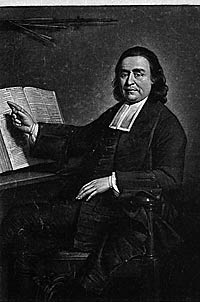
WITNESS TO THE FAITH IN NEW ENGLAND, 1792
The Reverend Samson Occom (1723 – 1792) (also spelled as Occum) was a Native American Presbyterian clergyman and a member of the Mohegan nation near New London, Connecticut. He has the distinction of being the first Native American person to ever publish documents and pamphlets in English.
Born to Joshua Tomacham and his wife Sarah, Occom is believed to be a direct descendant of the famous Mohegan chief, Uncas. In 1740, at the age of sixteen, Occom was exposed to the teachings of Christian evangelical preachers in the Great Awakening. He began to study theology at the “Lattin School” of Eleazar Wheelock in 1743 and stayed for four years until leaving to begin his own career.
Occom served as a missionary to Native American people in New England and Montauk, Long Island, where he married a local woman. It was also on Long Island where he was officially ordained a minister on August 30, 1759, by the presbytery of Suffolk.
Wheelock established an Indian charity school (which became Dartmouth College) with a benefaction from Joshua Moor in 1754, and he persuaded Occom to go to England in 1766 to raise money for the school, along with the Rev. Nathaniel Whitaker. Occom preached his way across the country from February 16, 1766, to July 22, 1767. He delivered in total between three and four hundred sermons, drawing large crowds wherever he went. By the end of his tour he had raised over twelve thousand pounds for Wheelock’s project. King George III himself donated 200 pounds, and William Legge, Earl of Dartmouth subscribed 50 guineas. The friendship between Occom and Wheelock dissolved when Occom learned that Wheelock had neglected to care for Occom’s wife and children while he was away. Occom also took issue with the fact that Wheelock put the funds toward establishing Dartmouth College for the education of Englishmen rather than of Native Americans.
Upon his return from England, Occom lived at Mohegan, then moved in 1786 with some New England and Long Island Indians to Oneida territory in what is known today as New York. He then helped to found Brothertown, and lived among the Brothertown Indians. Occom died on July 14, 1792, in New Stockbridge, New York.
Fourth of July at Christ’s Church in Pensacola
We usually make it to the early service at Christ’s Church, Pensacola, but this Sunday we took it easy, and headed to the second service instead. AdventureMan loves the second service for the music; I love it because sometimes our son and his family are there and we get to sit together.
Father Neil gave a thought-provoking sermon, as usual, incorporating some of the things he learned serving as a chaplain to our American troops in the desert in Kuwait. During communion, the choir sang a song known by some as the Navy Hymn and by others as the Armed Forces Hymn. The last two lines of each chorus pray for our men and women “in peril” on land or sea or in the air. While I am a stoic, that song shakes me to my core, and brings tears to my eyes.
At the end of the service, just after the recessional, our superb music director, Kenneth Keredine, with two fellow musicians on drum and cymbals, played a rousing Sousa march, a joyful and happy way to celebrate the Fourth of July weekend.
Episcopal Reading for the Fourth of July
For those in a hurry, in addition to the daily readings in The Lectionary, there is a small booklet, Forward Day by Day, which prints a short reading for each day.
I love the reading for today:
Today’s Meditation
monday, july 4 independence day
Deuteronomy 10:17-21. For the Lord your God is…the great God, mighty and awesome, who is not partial and takes no bribe…and who loves the strangers.
In the reading from Deuteronomy, Moses charges Israel to love the stranger, because the people of Israel were once strangers in Egypt. In Mark, Jesus entreats us to love our enemies and to pray for those who persecute us because God is not partial. The sun rises on the just and the unjust.
It is easy for us to love friends and people like ourselves. Christians are called to greater challenge: to create a community in which we love the stranger and pray for the one who wants to do us harm.
I remember standing on the Lake Erie shore and reading that during the War of 1812 soldiers died there so that the lake would not belong to the British. The British were the bad guys. A little over a hundred years later, the United States fought two World Wars on the side of Great Britain. The British were good guys. In the intervening years, each country learned to see the other not as evil strangers, but as allies with common interests.
As we give thanks for our country, let us accept the challenge to create a community that includes those who might be our enemies, the people who today don’t seem to be one with us. Our perspective can change.
PRAY for the Diocese of Ottawa (Ontario, Canada)
Ps 145 * 145:1-9; Hebrews 11:8-16; Matthew 5:43-48
Concert Series at St. Paul’s Catholic Church
We had a delightful evening last night at St. Paul’s Catholic Church as several young people presented an evening of Baroque music. It started at seven, while the sky was still full of light, and you could see all the beauty of the renovation. Even though the renovation has been finished for months, it still smells new, and they must have use cedar extensively; it smells wonderful. The stained glass windows are beautiful with the end-of-day light streaming through. St. Paul’s windows are very Catholic; I especially liked the Mary-Queen-of-Heaven window, and the angels flanking the central altar.

As the light outside dwindled and darkened, the church’s interior lighting came more to notice, subtle and enhancing. The performing group also used candles, which contributed to a more intimate feeling in a very large church.
The music was lively, and played with passion and accuracy. Bach, Vivaldi, Rameau – it sparkled with life. They finished up with Bach’s Brandenburg Concerto Number 3 in G Major, and left us all on a music high.
What I really liked, at this concert in a church not my own, is that the players are unashamedly evangelizing, but they keep it light and subtle. There was a really good crowd, as the announcer mentioned, not something that can be counted on in Pensacola on a hot summer evening. The performers participate regularly in the weekly Catholic masses, and gave a plug, but it wasn’t hard core, it was more presentation of an opportunity, a drawing in. I admire their technique, and their devotion. We enjoyed the venue, and the atmosphere, and the sincerity.
We will be going back for further concerts; they are planning one for July and one for August. They advertise frequently and well, in the Pensacola News Journal, which was how we heard about it. There was no charge for the concert, but a donation basket was available at the entry to the concert. 🙂
Freedom Greater Factor than Wealth in Happiness
Fascinating study, I found it today on AOL Health News
Freedom More Important to Happiness Than Wealth, Study Finds
Personal independence, autonomy trump money in data from more than 60 countries.
SUNDAY, June 19 (HealthDay News) — Personal independence and freedom are more important to people’s well-being than wealth, a new study concludes.
Researchers at the Victoria University of Wellington in New Zealand analyzed the findings of three studies that included a total of more than 420,000 people from 63 countries and spanned nearly 40 years.
Their key finding: “Money leads to autonomy, but it does not add to well-being or happiness.”
The studies looked at data from three different psychological tests familiar to therapists:
The General Health Questionnaire, which measures distress in terms of anxiety and insomnia, social problems, severe depression and physical symptoms of mental distress, such as unexplained headaches and stomach aches.
The Spielberger anxiety inventory, which evaluates how anxious respondents feel at a particular moment.
The Maslach Burnout Inventory, which screens for emotional exhaustion, depersonalization and lack of personal accomplishment.
The analysis revealed “a very consistent and robust finding that societal values of [freedom and autonomy] were the best predictors of well-being,” wrote psychologists Ronald Fischer and Diana Boer in an American Psychological Association release.
“Furthermore, if wealth was a significant predictor alone, this effect disappeared when individualism was entered,” they added.
“Our findings provide insight into well-being at the societal level,” the researchers concluded.
The study appears in the Journal of Personality and Social Psychology.
A God of Infinite Mercy
This morning, Father Neal Goldsborough of Christ Church Pensacola gave a sermon that held us all totally spellbound. It had to do with the fundamentalist preacher who – once again – forecast the coming rapture, which he says was scheduled for yesterday. (I wonder what he has to say today? He was wrong once before, in 1994. Or maybe people were raptured yesterday, but all the folk I know are, like me, sinners who didn’t make the cut.)

Father Neal talked about his service in the chaplain corp overseas, and faiths which exclude based on narrow rules, specific rules, churches and religions who say ‘this is the only way and all the rest of you are damned to everlasting fire” whether they use those words or paraphrases. He pointed to Jesus, who broke the rules of his time and flagrantly spent time with sinners, and the unclean, and showed them by his love and by his actions what the infinite love and mercy and forgiveness of Almighty God looks like.
It couldn’t have come at a better time for me.
Soon, I will be meeting up with three women who are particularly dear to me, friends for many years in Qatar, friends who worshipped at the Church of the Epiphany in Doha, Qatar. The new Anglican Church of the Epiphany is being built on land dedicated to church use by His Highness Sheikh Hamad bin Khalifa Al-Thani, the Emir of Qatar, and will be used by many denominations.
My friends and I all returned to the USA within months of one another, and have been sending e-mails with “reply to all” as we struggle with our re-entry into our old church communities. We struggle with the hatreds and prejudices and ignorance about our Moslem brothers and sisters, and we struggle with the narrow strictures imposed by our churches and study groups. I thank God to have these wonderful women among whom we can share our dismay and our hurting hearts, and re-inforce the lessons we learned living in a very exotic, and sometimes alien culture, but which had so many wonderful and mighty lessons to teach us. I often joke that in my life, God kept sending me back to the Middle East (Tunisia, Jordan, Saudi Arabia, Qatar and Kuwait) until he saw that I finally got it. My sisters-in-faith were quicker studies than I was. 🙂
It was a breath of the Holy Spirit I felt this morning, as Father Neal spoke about God’s mercy, his plan to redeem ALL of his creation, God’s desire for our love and our service. I couldn’t help it, it made me weep with relief to know my church is a church that serves God by including, rather than excluding, and which mercifully welcomes sinners like me.
Here is the really cool part. Christ Church Pensacola has recently begun putting the sermons online. If there is one thing Christ Church has, it is great sermons – and if you want to hear Father Neal’s sermon, you can click HERE, in a few days and you can hear his sermon for yourself. 🙂 Look for the May 22 sermon by Father Neal Goldsborough.
Start of Ramadan 2011

The calendars are proclaiming that the first day of Ramadan will be August 1st this year, and the Eid al Fitr will be August 30th.
I cannot imagine Ramadan in August, especially in Kuwait and Qatar. It will be a brutal test of self-denial.
Good Friday for the Non-Christian
When I saw this on AOL News it struck me that if I post Ramadan for Non-Muslims, then it also makes sense to publish Good Friday for Non-Christians.
Different Christian groups have varying traditions on Good Friday. In our church, Good Friday starts on the evening before, Maundy Thursday, with a stripping of the altar. In some churches, there is also a gathering where the priests of the parish wash the feet of members of the congregation, as Jesus washed the feet of his disciples, as a demonstration of the humble spirit required, that we are to serve one another.
Good Friday: Origins, Observances And Fasting Rules
by Neha Prakash
Good Friday is the Christian commemoration of Jesus’ Passion story; specifically his betrayal, trial and crucifixion that are described in the Christian gospels. In the sequence of Holy Week, it follows the rituals marking the Last Supper on Maundy Thursday and precedes the celebration of Jesus’ resurrection on Easter Sunday.
Since Jewish tradition dictates that Friday begins at sundown on Thursday, the events of Good Friday traditionally begin with the betrayal of Jesus by his apostle Judas in the garden of Gethsemane. He is subsequently brought before the Sanhedrin council, the Roman governor Pontius Pilate and King Herod of Galilee with the ultimate outcome being his condemnation to death by crucifixion.
The trial of Jesus and his crucifixion are described in varying detail by all four canonical Gospels, the Jewish historian Josephus and the Roman writer Tacitus. While the specific events and theological implications are widely disputed, the historicity of the occasion is widely accepted.
Good Friday church services generally revolve around the reading of the Gospel accounts of the Passion story. The Catholic liturgy for Good Friday also includes the distribution of the Eucharist that was consecrated during the Mass on Maundy Thursday and special veneration of the cross by inviting individuals to approach the altar and kiss the wood of the crucifix.
Many Christians also mark Good Friday by participating in or watching processions meant to replicate the journey that Jesus took through the streets of Jerusalem while carrying his cross to the site of his crucifixion at Calvary. Two of the largest and most famous of these occasions are Rome’s Way of the Cross that leads to the Colosseum and is presided over by the Pope and the Via Dolorosa in Jerusalem — a procession along the traditionally marked route of Jesus that is attended by thousands of pilgrims each year.

Good Friday is also a day of strict fasting for Catholics and some other Christians. As with all the Fridays of Lent, Catholics are instructed to abstain from eating meat. As with Ash Wednesday, the fasting rules for Good Friday dictate that adherents should eat only one full meal with two smaller meals being permitted as long as no other food is consumed in the interim. The use of other meat-based products such as lard, chicken broth or dairy is not traditionally forbidden, although many individuals elect to make their Good Friday meals entirely vegetarian or vegan.
In many countries with strong Christian traditions such as those in Latin America, Good Friday is observed as a national holiday. Good Friday is not a federal holiday in the United States, but several states observe it as an official state holiday by closing government offices, courts and banks. Many private businesses also choose to close on Good Friday in addition to financial markets.
Holy Week Evensong at Christ Church, Pensacola
My favorite service of all, Evensong. Everything is just moving along, peacefully, penitentially, as we enter Holy Week, when all of a sudden, the choir is singing Gounod, the Jerusalem anthem from Gallia. Oh, WOW! Gounod makes me grin, and he moves me. Gounod . . . Gounod ROCKS!

And here you can here the anthem:
I was introduced to Gounod in Doha. Our priest, Ian Young, led a group called the Doha Singers, and he chose challenging music. We learned Gounod’s Mass for St. Cecelia, and the music is the kind that gets into your blood. I couldn’t get enough of it. I never get sick of it. Gounod is music with a sense of drama and a sense of humor about itself. I think it is his sense of timing, how you hold a note just a little longer than you would expect, and then rollick on to the next. I had never heard this piece before, but Gounod is so individual, so unique – it had to be Gounod.
It was a perfect evening, a lovely service, and the sun shone in through the cross as it set:
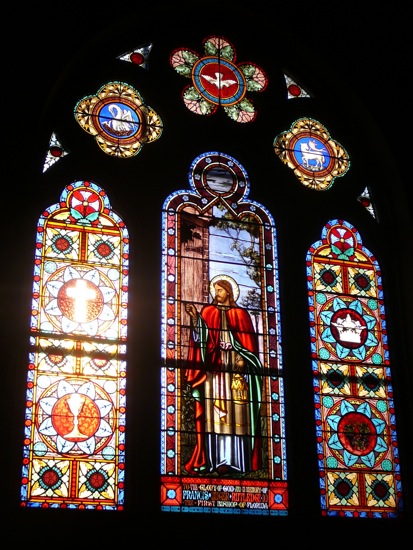
At the end, we sang one of my very favorite hymns, The Day Thou Gavest Lord, is Ended:
I admit it, I am pretty tough, but these words make me weak and weepy:
The day Thou gavest, Lord, is ended,
The darkness falls at Thy behest;
To Thee our morning hymns ascended,
Thy praise shall sanctify our rest.
All in all, a lovely day. Our son joined us for the first episode of The Game of Thrones on HBO. He’s read all the books, I am on book 2, and AdventureMan is reading the first book, the one on which this series is based. Great way to begin our week. 🙂
Recent Comments
ExpatAlien on What Country am I Living … intlxpatr on Yellowstone: Old Faithful to C… Michelle on Yellowstone: Old Faithful to C… Cathy on No Grown-Ups in Charge intlxpatr on Waiting for Snow Wikipedia Donate Button

Amazina


Early Voting in Florida


 Here There and Everywhere