Start your Day with a Smile
My good friend in Kuwait sent me this wonderful film in a market in Spain. Watch all the way to the end, and see the sign. I love creative advertising!
Different Languages, Different Tribes, One God
This is the meditation from yesterday, from Forward Day by Day. I really like it. We all talk about tribalism, as if we were not ourselves from tribes, even self-made tribes. It can be a tribe based on family, or based on nationality, or, in the USA, sometimes on nation-of-origin. It can be a tribe that calls itself Alpha Beta Zeta, or Rotary. Any kind of grouping that distinguishes between “us” and “them” is a kind of tribalism, in my opinion. And it costs us so much, in terms of energy and focus and resources, when, as i see it, we are all one family under God.
Psalm 118. I called to the LORD in my distress; the LORD answered by setting me free.
In the depths of the long civil wars here, the people cried to the Lord in their distress and were set free. The results have been amazing: the crossing of tribal lines to form one people whose most precious commonality is their belief in Jesus. Sitting in church on Sundays, that lesson comes true. When we pray the Lord’s Prayer, or recite the creeds, or sing our favorite hymns, we do so in our own languages, so that a cacophony of voices rises to the heavens. It is not unusual to hear 12 or 13 languages spoken simultaneously, all praying the same thing at the same time.
We are set free when we forget to which human tribe we belong and focus on being members of God’s tribe of beloved children. This is how peace will be achieved, not just in this land, but in all of creation: by ignoring our differences and focusing on the freedom we have in God and from God.
Some days, listening to all the languages and praying in my own, I am moved to tears by the beauty of the holy noise we are making. We are set free in those moments, and our distress falls away.
PRAY for the Diocese of Aguata (Province of the Niger, Nigeria)
Feast of the Epiphany in Doha
Our priest at the Church of the Epiphany has been instructing the children on how the church year differs from the marketing year. While “Christmas” may start in October – or even July! – to merchants eager to sell their wares, for church-going Christians, Christmas starts on Christmas Eve – and is celebrated, each and every day, until the Feast of the Epiphany, celebrating the Three Wise Men traveling to find the Christ Child in Bethlehem.
“I know what I want for Christmas this year,” I said to my startled friend, “I want you to fix my camel. I have all the things, or most of them, but I haven’t a clue where to start.”
My friend is a very busy woman. She has so much on her plate. But there was not a sign of reluctance on her face. “I LOVE doing camels!” she exclaimed!
“I want it to look like a camel coming with the Wise Men to bring gifts to the Christ Child,” I told her, and she got it without any explanation – yep, gold, frankincense, myrrh . . .
The camel is everything I had dreamed of – and more. She made little bags, she created a treasure chest of gifts, she even included my sewing machine and a coffee grinder!
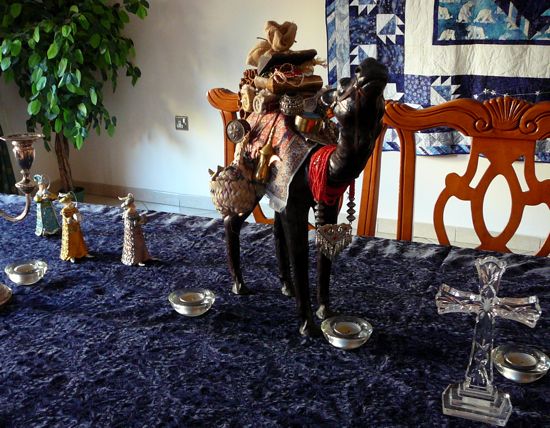
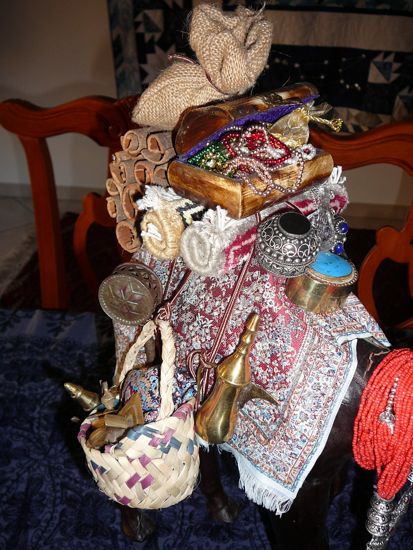
I have three little Wise Men following the camel, bringing gifts. The Qatteri Cat has inflicted some damage; one is missing a foot and I can’t find it anywhere. I was able to glue a head back on, and a feather on another . . . The Qatteri Cat does not get Epiphany.
A lawyer from Texas A&M did a wonderful film, sent to me by my sweet daughter-in-law’s dear aunt, called The Star in which he presents the result of his research to find scientific evidence that a Star might have stood still over the little city of Bethlehem at the the time pinpointed for the birth of The Christ. It’s an amazing and insightful video, the life work of a devoted man.
A Child Is Born!
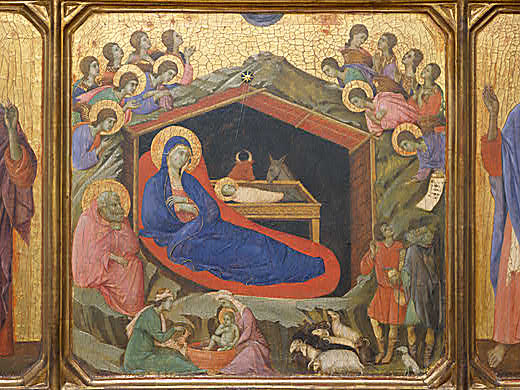
Duccio di Buoninsegna
detail: The Nativity with the Prophets Isaiah and Ezekiel, 1308/1311
Andrew W. Mellon Collection
May the Peace of God fill our hearts with love and compassion, and may it inspire us all to be better neighbors to one another.
Anglican Christmas Services in Doha, Qatar
Children’s Service:
Crib and Christingle Thursday, 24 December 5 pm DESS
Family Services:
Christmas Day Service Friday, 25 December 10:30 am DESS
Christmas Evening Service Friday, 25 December 7:30 pm DESS
If you need additional information, you can email:
epiphany@qatar.net.qa
The church website is:
http://www.epiphany-qatar.org
Peace on Earth, Good Will Towards Men
Today’s reading in Forward Day by Day is a difficult teaching from the prophet Amos, telling us that no, God isn’t on our side. God loves us, and he loves our allies as much as he loves us. And . . . he also loves our enemies – as much as he loves us.
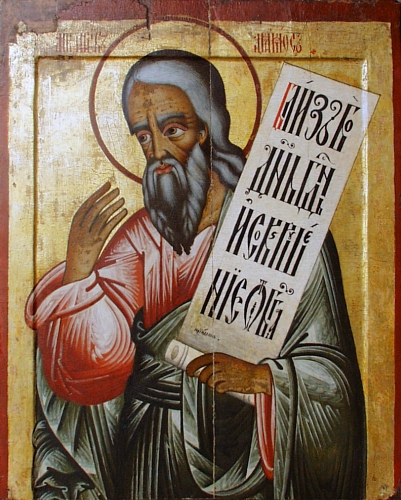
THURSDAY, December 10 International Human Rights Day
Amos 9:1-10. Are you not like the Ethiopians to me, O people of Israel?
Amos is the Bible’s first universalist. Gods in ancient times, including Israel’s god, were seen as localized deities, inhabiting a certain place and exercising power on behalf of the people who lived there, whom they favored over other people. A god’s authority was rather like that of a modern sheriff–one had to pay attention to it, but its jurisdiction was limited by geography.
Then Amos, speaking on behalf of Israel’s god, said the chosen people were no different in God’s eyes than the Ethiopians. If God had done something special for Israel, he had done something special for everyone else, too, including Israel’s sworn enemies. God has no favorites and his authority extends everywhere. In his brusque, in-your-face manner, Amos says one nation is no more precious than another.
In this day of immigration controversy, ethnic suspicion, religious absolutism, xenophobic frenzy, and false patriotism, Amos speaks a sobering word: “You’re no different from anyone else. I love you, but I love your enemy, too, and if you don’t also love your enemy, you are no friend of mine.”
St. Nicholas Eve
I’m putting out a little bit of Christmas, and came across these lovely, Palestinian embroidered towels. I’ve had them for around thirty years, and I still love them:

I’m also thinking – we in the west never hear about Palestinian Christians, of which there are / or used to be (?) many. I know there are groups in Jerusalem, working towards the use of Jerusalem as an inter-faith city, and I know they work closely with Palestinian Christians, but are the numbers of Palestinian Christians as large as they used to be?
Advent is a little like Ramadan, or it is supposed to be. The four weeks leading to Christmas are a time for thoughtful meditation, repentance of wrongful things we have done, and contemplating the birth of that special baby, the Gift of God, in Bethlehem. I love Advent; I love the whole peaceful focus and world-holding-its-breath-waiting-for-this-birth aspect.
A mosaic portrait of St. Nicholas:

He turns a desert into pools of water
One of today’s readings in The Lectionary are these verses from a much longer reading, Psalm 107. When I read these lines, I can’t help thinking how this very dull and flat land, Qatar, this little thumb sticking up into the Gulf, has greened, how the oil and gas have served to green this land, to change its face, and how much money is flowing out from this country to many other countries of the world.
All those of us from far away countries who labor here are benefitting from these springs of wealth, sending money home.
33He turns rivers into a desert,
springs of water into thirsty ground,
34a fruitful land into a salty waste,
because of the wickedness of its inhabitants.
35He turns a desert into pools of water,
a parched land into springs of water.
36And there he lets the hungry live,
and they establish a town to live in;
37they sow fields, and plant vineyards,
and get a fruitful yield.
38By his blessing they multiply greatly,
and he does not let their cattle decrease.
39When they are diminished and brought low
through oppression, trouble, and sorrow,
40he pours contempt on princes
and makes them wander in trackless wastes;
41but he raises up the needy out of distress,
and makes their families like flocks.
42The upright see it and are glad;
and all wickedness stops its mouth.
43Let those who are wise give heed to these things,
and consider the steadfast love of the Lord.
For my Christian readers, Muslims also use the Psalms as holy readings –
“The Qur’an (Surah An-Nisa 4:163) states “and to David We gave the Psalms”. Therefore, Islam confirms the Psalms as being inspired of God.”
Did you know that?
Greeting Your Enemies With a Feast (Elisha)
I love it when I come across a good story I haven’t heard before in my daily readings in The Lectionary and this one is a doozy. I didn’t hear a lot of bible stories about Elisha as I was growing up (Elisha followed Elijah) but this reading includes some amazing stories, including one of the first instances of turning away an enemy with a feast.
2 Kings 6:1-23
6Now the company of prophets* said to Elisha, ‘As you see, the place where we live under your charge is too small for us. 2Let us go to the Jordan, and let us collect logs there, one for each of us, and build a place there for us to live.’ He answered, ‘Do so.’ 3Then one of them said, ‘Please come with your servants.’ And he answered, ‘I will.’ 4So he went with them. When they came to the Jordan, they cut down trees. 5But as one was felling a log, his axehead fell into the water; he cried out, ‘Alas, master! It was borrowed.’ 6Then the man of God said, ‘Where did it fall?’ When he showed him the place, he cut off a stick, and threw it in there, and made the iron float. 7He said, ‘Pick it up.’ So he reached out his hand and took it.
8 Once when the king of Aram was at war with Israel, he took counsel with his officers. He said, ‘At such and such a place shall be my camp.’ 9But the man of God sent word to the king of Israel, ‘Take care not to pass this place, because the Arameans are going down there.’ 10The king of Israel sent word to the place of which the man of God spoke. More than once or twice he warned such a place* so that it was on the alert.
11 The mind of the king of Aram was greatly perturbed because of this; he called his officers and said to them, ‘Now tell me who among us sides with the king of Israel?’ 12Then one of his officers said, ‘No one, my lord king. It is Elisha, the prophet in Israel, who tells the king of Israel the words that you speak in your bedchamber.’ 13He said, ‘Go and find where he is; I will send and seize him.’ He was told, ‘He is in Dothan.’ 14So he sent horses and chariots there and a great army; they came by night, and surrounded the city.
15 When an attendant of the man of God rose early in the morning and went out, an army with horses and chariots was all around the city. His servant said, ‘Alas, master! What shall we do?’ 16He replied, ‘Do not be afraid, for there are more with us than there are with them.’ 17Then Elisha prayed: ‘O Lord, please open his eyes that he may see.’ So the Lord opened the eyes of the servant, and he saw; the mountain was full of horses and chariots of fire all around Elisha. 18When the Arameans* came down against him, Elisha prayed to the Lord, and said, ‘Strike this people, please, with blindness.’ So he struck them with blindness as Elisha had asked. 19Elisha said to them, ‘This is not the way, and this is not the city; follow me, and I will bring you to the man whom you seek.’ And he led them to Samaria.
20 As soon as they entered Samaria, Elisha said, ‘O Lord, open the eyes of these men so that they may see.’ The Lord opened their eyes, and they saw that they were inside Samaria. 21When the king of Israel saw them he said to Elisha, ‘Father, shall I kill them? Shall I kill them?’ 22He answered, ‘No! Did you capture with your sword and your bow those whom you want to kill? Set food and water before them so that they may eat and drink; and let them go to their master.’ 23So he prepared for them a great feast; after they ate and drank, he sent them on their way, and they went to their master. And the Arameans no longer came raiding into the land of Israel.
St. David P. Oakerhater
Another ‘who knew? ‘ I found this in the Lectionary readings for today – a Native-American saint:
DEACON AND MISSIONARY (1 SEP 1931)
David P. Oakerhater (born around 1850) was a warrior and leader of the Cheyenne Indians of Oklahoma, and led a corps of fighters against the United States government in a dispute over Indian land rights. In 1875 he and 27 other military leaders were taken prisoner by the U S Army and sent to a military post in Florida. There, thanks to the efforts of a concerned Army captain, they learned English, were encouraged to earn money by giving art and archery lessons to visitors, and encountered the Christian faith. David and three others were moved to become Christians and to go north to study for the ministry. David was baptized in Syracuse, New York, in 1878, and ordained to the diaconate in 1881. He returned to Oklahoma and there founded schools and missions, and continued to work among his people until his death on 31 August 1931. When he first returned to Oklahoma in 1881, he said:
You all know me. You remember when I led you out to war I went first, and what I told you was true. Now I have been away to the East and I have learned about another captain, the Lord Jesus Christ, and he is my leader. He goes first, and all He tells me is true. I come back to my people to tell you to go with me now in this new road, a war that makes all for peace.
by James Kiefer
Note: the “military post in Florida” is Castillo de San Marcos in St. Augustine, now a National Monument. Should you go there, you can learn more about his imprisonment there.
Recent Comments
intlxpatr on Shampoo Ginger tigerbutterya0c5ff1d… on Shampoo Ginger intlxpatr on British Soldier Kidnapped, Esc… John on British Soldier Kidnapped, Esc… intlxpatr on British Soldier Kidnapped, Esc… Wikipedia Donate Button

Amazina


Early Voting in Florida


