Who Is My Neighbor?
You would think when someone so special is talking, people would listen. You would think that when he is trying to tell us what God expects from us to enter into his kingdom in the after life, people would be listening, and indeed, they listened, many listened. There were others who did not. There were also those closest to him who misunderstood! That always baffles me, that those closest could misunderstand.
Today’s lesson is one of my very favorites in the world. You can substitute any two races who hate one another and the story is equally clear. The man who was asking the question was setting Jesus up, or trying to, and Jesus used the occasion to teach a stunning truth – that love is stronger than hate.
Luke 10:25-37
25 Just then a lawyer stood up to test Jesus.* ‘Teacher,’ he said, ‘what must I do to inherit eternal life?’
26He said to him, ‘What is written in the law? What do you read there?’
27He answered, ‘You shall love the Lord your God with all your heart, and with all your soul, and with all your strength, and with all your mind; and your neighbour as yourself.’
28And he said to him, ‘You have given the right answer; do this, and you will live.’
29 But wanting to justify himself, he asked Jesus, ‘And who is my neighbour?’
30Jesus replied, ‘A man was going down from Jerusalem to Jericho, and fell into the hands of robbers, who stripped him, beat him, and went away, leaving him half dead. 31 Now by chance a priest was going down that road; and when he saw him, he passed by on the other side. 32 So likewise a Levite, when he came to the place and saw him, passed by on the other side. 33 But a Samaritan while travelling came near him; and when he saw him, he was moved with pity. 34 He went to him and bandaged his wounds, having poured oil and wine on them. Then he put him on his own animal, brought him to an inn, and took care of him. 35 The next day he took out two denarii,* gave them to the innkeeper, and said, “Take care of him; and when I come back, I will repay you whatever more you spend.” 36 Which of these three, do you think, was a neighbour to the man who fell into the hands of the robbers?’
37He said, ‘The one who showed him mercy.’ Jesus said to him, ‘Go and do likewise.’
I have seen this in my own life. I have seen hopeless situations, with no solution in sight, totally change because one person chooses to love, instead of to hate. Choosing to love, in the face of hatred, takes a lot more character, a lot more strength. It has the potential for changing everything.
Prayer Reshapes Your Brain
This is a very small excerpt from a much longer article I found on National Public Radio News, a special series on The Science of Spirituality. This article (you can read it all by clicking on the blue type, above) talks about measuring brain activity while a person is praying, how the brain changes. Fascinating stuff.
A Sense Of Oneness With The Universe
Newberg did that with Michael Baime. Baime is a doctor at the University of Pennsylvania and a Tibetan Buddhist who has meditated at least an hour a day for the past 40 years. During a peak meditative experience, Baime says, he feels oneness with the universe, and time slips away.
“It’s as if the present moment expands to fill all of eternity,” he explains, “that there has never been anything but this eternal now.”
When Baime meditated in Newberg’s brain scanner, his brain mirrored those feelings. As expected, his frontal lobes lit up on the screen: Meditation is sheer concentration, after all. But what fascinated Newberg was that Baime’s parietal lobes went dark.
“This is an area that normally takes our sensory information, tries to create for us a sense of ourselves and orient that self in the world,” he explains. “When people lose their sense of self, feel a sense of oneness, a blurring of the boundary between self and other, we have found decreases in activity in that area.”
Newberg found that result not only with Baime, but also with other monks he scanned. It was the same when he imaged the brains of Franciscan nuns praying and Sikhs chanting. They all felt the same oneness with the universe. When it comes to the brain, Newberg says, spiritual experience is spiritual experience.
“There is no Christian, there is no Jewish, there is no Muslim, it’s just all one,” Newberg says.
What did Ezekiel See?
How would our flea-bitten, superstitious ancestors in Europe of the 1100’s describe a car, if it were to appear in their midst? How would they describe a gas stovetop? How would they describe a toilet? How would they describe a mobile phone, or a camera? Would they immediately understand its use, and how it works?
Many times we don’t understand what we see, not at first, sometimes not at all. When I read of Ezekiel’s vision, I wonder what he saw? I wonder if this is his interpretation of something else, something actually very different, but he used the words he had? It’s a mystery to me.
Ezekiel 1:1-14,24-28
1In the thirtieth year, in the fourth month, on the fifth day of the month, as I was among the exiles by the river Chebar, the heavens were opened, and I saw visions of God. 2On the fifth day of the month (it was the fifth year of the exile of King Jehoiachin), 3the word of the Lord came to the priest Ezekiel son of Buzi, in the land of the Chaldeans by the river Chebar; and the hand of the Lord was on him there.
4 As I looked, a stormy wind came out of the north: a great cloud with brightness around it and fire flashing forth continually, and in the middle of the fire, something like gleaming amber. 5In the middle of it was something like four living creatures. This was their appearance: they were of human form. 6Each had four faces, and each of them had four wings. 7Their legs were straight, and the soles of their feet were like the sole of a calf’s foot; and they sparkled like burnished bronze. 8Under their wings on their four sides they had human hands. And the four had their faces and their wings thus: 9their wings touched one another; each of them moved straight ahead, without turning as they moved. 10As for the appearance of their faces: the four had the face of a human being, the face of a lion on the right side, the face of an ox on the left side, and the face of an eagle; 11such were their faces. Their wings were spread out above; each creature had two wings, each of which touched the wing of another, while two covered their bodies. 12Each moved straight ahead; wherever the spirit would go, they went, without turning as they went. 13In the middle of* the living creatures there was something that looked like burning coals of fire, like torches moving to and fro among the living creatures; the fire was bright, and lightning issued from the fire. 14The living creatures darted to and fro, like a flash of lightning. 24When they moved, I heard the sound of their wings like the sound of mighty waters, like the thunder of the Almighty,* a sound of tumult like the sound of an army; when they stopped, they let down their wings. 25And there came a voice from above the dome over their heads; when they stopped, they let down their wings.
26 And above the dome over their heads there was something like a throne, in appearance like sapphire;* and seated above the likeness of a throne was something that seemed like a human form. 27Upwards from what appeared like the loins I saw something like gleaming amber, something that looked like fire enclosed all round; and downwards from what looked like the loins I saw something that looked like fire, and there was a splendour all round. 28Like the bow in a cloud on a rainy day, such was the appearance of the splendour all round. This was the appearance of the likeness of the glory of the Lord.
When I saw it, I fell on my face, and I heard the voice of someone speaking.
Sorry Jesus, I’m Packing Boxes
Our priest in the Anglican congregation is a truly inspired preacher. He knows how to get your attention, and then he tells you something really important.
Yesterday (Yes! I was listening!) he was talking about the importance in our spiritual life of community. While, in Christianity, we have a tradition of worshiping privately and in solitude, one of the things Jesus said over and over was to take care of one another, “feed my sheep”, that we are to be known to the outside world by the way we love one another, and the practice of that kind of brotherly love must be done in community. He gave one example, marriage, as an opportunity to show God how much you love him by loving and taking good care of your spouse, that we are to serve him by loving one another.
Pastor Andy gave the example of the Alcoholics Anonymous community, where they have buddies who can be called any time, night or day, when a crisis comes up and there is temptation to drink. He was saying we all need someone we know we can count on, and encouraged us to find spiritual buddies.
On the way out the door, I heard him ask the guy in front of me if he had plans for lunch. When we shook hands, he asked me the same question, and I laughed and said “Yes, I am packing boxes.”
As I was on my way home, it was like that old light bulb went on in my head and I thought “Oh no! That was a test!” Andy was just telling us we need to be part of a fellowship, we need to visit with one another in relaxed conditions, we need to know one another so we know who we can count on! It was as if Jesus invited me to lunch, and I said ‘Sorry, I have to pack boxes!’
I FLUNKED!
So I started beating myself up (in my mind) about flunking. The good thing is, as you pack boxes, it’s kind of like exercise, once you have two or three done, good endorphins kick in and you feel better about things. Eating lunch helps, too.
Andy Thompson, at the Anglican Church – St. Paul’s Kuwait – is smart, committed and hard working, and also a lot of fun. This post is for you, Andy, to show you that your sermons really do make a difference, even if you don’t see it, and that we take what you say home with us, and mull it over, and, hopefully, like a tiny seed planted, if we nurture it, it will bear fruit. 🙂
Living our Religion
Today’s reflection from Forward Day by Day is a tough one. In the Gulf, there is a tradition of thfadl and thfadli (the second is what you say to a woman) which means, literally, “you are to be preferred.” You are supposed to outwait the other, to allow the other to take precedence.
I have one Kuwaiti friend – you know who you are – who simply cannot be out-thfadle-d. She out-thfadle-s me every time. 🙂
But when I read this passage, and think of how I live in Kuwait, I find myself thinking “Guilty! Guilty as charged!”
When I see a long line in front of me at the health department, and someone comes and ushers me to the front, yes, I have gratefully taken advantage, taken preference over those who continue to wait. I have scowled when people try to shove their basket in front of me in the supermarket. And in traffic – when I “thfadl”, it has nothing to do with politeness and preference, and everything to do with sarcasm and frustration.
Today’s reading reminds me I still have a long road in front of me when it comes to learning to love my neighbor, and put others first.
Romans 12:1-21. Outdo one another in showing honor.
The Episcopal Church (and some other denominations, too) is vexed these days by rancorous disputes about authority and sex. Name-calling, smirking, and thinly veiled anger sometimes characterize church gatherings. The prevailing sentiment seems to be that we ourselves are faithful and true, but those others are faithless and false. We demean and dismiss other Christians. It’s hard to find a Christian today who outdoes others in showing honor (except honor shown to those lined up on one’s own side). Is it any wonder that many people outside the church want nothing to do with us?
I long for the day when we will approach those who differ from us and say: “I agree with almost nothing you are advocating. I see God, the world, and our faith through different lenses than you do. But I know that God loves us both and has sent his Son to forgive and redeem us both. I know that Christ lives within us both. Therefore I honor you and join you in prayer and in worshiping our common Lord. I shall remain silent today so that you may speak and I may learn from you. I thank God for you because I see Jesus when I look at you.”
Wives, be subject to your husbands
This part of today’s reading, among my set and the things we discuss, is one of the most controversial. We can debate this for hours.
What does being subject mean? If we, as wives, are subject to our husband, just as our husbands are subject to God, does it mean we can’t argue? We can’t disagree?
I saw a husband say to a wife the other day “I forbid you.” I think this is more common in Gulf culture than in our culture. I am sorry, but the thought of a husband daring to say this to a wife in the west is unthinkable. What I have also noticed is that when a husband says “I forbid you” here, it is not the end, but the opening skirmish. 🙂
There is a lot of food for thought in this reading, and I publish it to give you insight into what we read, and because I suspect you have similar readings.
Colossians 3:18-4:18
18 Wives, be subject to your husbands, as is fitting in the Lord. 19Husbands, love your wives and never treat them harshly.
20 Children, obey your parents in everything, for this is your acceptable duty in the Lord. 21Fathers, do not provoke your children, or they may lose heart. 22Slaves, obey your earthly masters* in everything, not only while being watched and in order to please them, but wholeheartedly, fearing the Lord.* 23Whatever your task, put yourselves into it, as done for the Lord and not for your masters,* 24since you know that from the Lord you will receive the inheritance as your reward; you serve* the Lord Christ. 25For the wrongdoer will be paid back for whatever wrong has been done, and there is no partiality. 41Masters, treat your slaves justly and fairly, for you know that you also have a Master in heaven.
2 Devote yourselves to prayer, keeping alert in it with thanksgiving. 3At the same time pray for us as well that God will open to us a door for the word, that we may declare the mystery of Christ, for which I am in prison, 4so that I may reveal it clearly, as I should.
5 Conduct yourselves wisely towards outsiders, making the most of the time.* 6Let your speech always be gracious, seasoned with salt, so that you may know how you ought to answer everyone.
Missing Our Muezzin
As we listened to the church bells clinking out the sound of the hours last night, AdventureMan turned to me and said “I miss our muezzin.”

We have a spectacular muezzin. You know how some people TALK about loving God, but when you look at how they behave, you wonder “is that what loving God looks like?”
When we hear our muezzin call out the call to prayer, we can hear his love of God. He was gifted with a glorious voice, and even at the earliest prayer, around 3:30 in the morning, he calls with joy and love in his voice. This man loves God, and he serves God by doing his best with every prayer.
(I did not draw that muezzin above. It is a poster, and you can find it by clicking Allposters here.)
Kuwait: Our History Runs in our Blood (Mohammed Ali Dashti)
Kuwaitis showing new interest in the past; Traditions, culture wiped out by ‘change’
From today’s Arab Times; you can read the entire interview by clicking here
A born artist makes it his life’s mission to chronicle the past of Kuwait using his artistic skills and his academic erudition. His brush strokes have brought to life scenes from a Kuwait straddling a dying hidebound order and a modern state taking birth. His passion drove him beyond the pale of his canvas to physically revive some lost traditions for posterity.
Read on to find out more about Mohammed Ali Dashti’s enchanting four-decade long mission and some of the precious values from the past which we have now lost and which he fears we may never recover.
Q: You are involved in a rather enchanting profession of recreating the past. What is your goal?
A: When oil was discovered in Kuwait, the state underwent a rapid transformation. The change was very sudden and very fast. In a short span of time, Kuwait leapt from an ancient system to a very modern state. This change wiped out many elements from our traditions and culture.
Until sometime ago, the people of Kuwait were disposing of the antiquated paraphernalia from their homes. But now, there is a sudden interest in these items, and now they are buying them back to preserve the past. It is the only way of holding fast to our roots and knowing how our forefathers, not from a distant past, conducted their lives. Kuwaitis are buying doors and furniture used in the old Kuwaiti homes.
We, as an organization, are working to preserve our history for posterity to learn and know. We produce ancient household items like the Mubkhar (incense stand) with which our grandparents used to scent clothes and fan fragrant smoke around the house.
In the old days, we had no airplanes or cars. The only way we were connected with other places in the region was the sea. Kuwait, owing to its geographical advantages, became a center for shipbuilding. Kuwaitis were experts in making dhows for different purposes. Boats were built in a variety of sizes and designs based on their use. There were cargo ships, fishing boats and vessels for pearl diving. The size of boats ranged from a meter to up to 6 meters. This is another aspect of history that we are trying to preserve and we have been recreating many of the original models our ancestors voyaged in.
We showcase our creations at universities, malls, schools and other places. Thus we have been able to generate interest in our past. We take our craftsmen along and explain to the present generation about Kuwait’s history.
Q: What do you think has created this new interest in the past among Kuwaitis? Can this be read as a reemergence of old traditional values?
A: Our history actually runs in our blood. It is very difficult to detach ourselves from our cultural roots. And so whenever any nation travels too far away from its true origins, at some point of time, it stops and tends to recall the past. History is what gives our existence contextual relevance. And we often try to find it by clawing back into our past, by remembering the way we came through.
Q: You said you make old-model boats. Aren’t you specialized in Warjiyas, the simplistic fishing boats from the past? Which is the biggest boat you have ever built?
A: The biggest boat I have ever built so far is 6 meters long. I make Warjiyas because it is most symbolic of our old fishing traditions. These boats were very famous among the people on Failaka Island. They used it for fishing and it is very easy to construct.
The specialties of Warjiya are: it is wholly made of palm tree to the last detail. The body is built with spines of palm leaf, which are trussed using ropes made our of palm fiber. It is very light and so easy to carry.
Warjiyas sort of became extinct about 60 years ago with the advent of oil and the independence of the state’s economy from fishing and pearl diving. We can’t return to those ancient livelihoods, and so we are now planning to start an annual Warjiya race to keep the tradition alive. The first race will be held in September this year.
Q: Do you have any plans of reviving even the tradition of fishing along with these boats?
A: No, as I said, we can’t actually go backwards to keep our original traditions alive. So, these things can only happen in a token manner. The aim is to keep the future generations aware about how their grandfathers and people before them lived. We don’t have to make our children live a similar life to make them appreciate the ancient way of life.
Q: All over the world there is great demand for antique items. Is what we are seeing in Kuwait a similar trend — a fascination for antique pieces — or is it more than that?
A: No. It is not just a fad in Kuwait. The people really care for the past and there are efforts at all levels to preserve relics from the past or have their duplicated versions. These efforts have been sincerely undertaken by Kuwait National Museum and other private museums in the country, and between them they share a vast treasure of valuable relics and information about Kuwait’s past.
The government is also giving due encouragement to all of us to help us in our endeavors. The ministry of information is doing everything within its means to promote our traditional and cultural heritage in other Gulf countries and beyond.
Easter Sunrise and Noah’s Ark
Today is the most beautiful day in the church year, Easter Sunday. Mary and Mary go to the tomb where Jesus was laid, only to find the 2 ton stone rolled away from the entrance, and angels waiting there, telling the women that Jesus was not there, that he had arisen. If you have been reading this blog for any time at all, you will know that it delights my heart that women were the first to know, and that Jesus, resurrected, appeared first to a woman. In the Bible, she tells the men and they don’t believe her. LLOOLL.
It is a glorious Easter morning:

As part of her Easter greeting today, a friend sent the following, which I love. Since all three traditions, Jewish, Christian and Moslem, celebrate Noah (Noh) I thought I would share it with you.
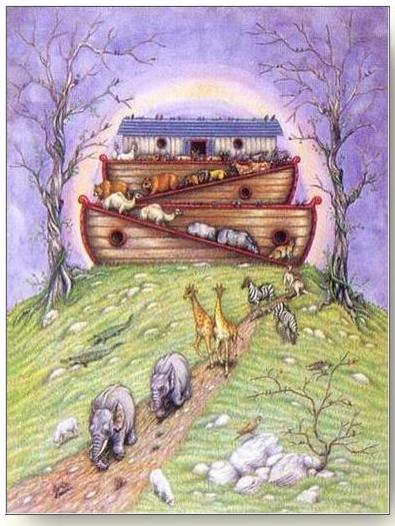
Noah’s Ark
(Everything I need to know, I learned from Noah’s Ark. )
ONE: Don’t miss the boat.
TWO: Remember that we are all in the same boat!
THREE: Plan ahead. It wasn’t raining when Noah built the Ark.
FOUR: Stay fit. When you’re 60 years old, someone may ask you to do something really big.
FIVE: Don’t listen to critics; just get on with the job that needs to be done.
SIX: Build your future on high ground.
SEVEN: For safety’s sake, travel in pairs.
EIGHT: Speed isn’t always an advantage. The snails were on board with the cheetahs.
NINE: When you’re stressed, float awhile.
TEN: Remember, the Ark was built by amateurs; the Titanic by professionals.
ELEVEN: No matter the storm, when you are with God, there’s always a rainbow waiting.
Have a great day, a blessed day, Kuwait.
William Dalrymple: The Age of Kali
Having read and loved In Xanadu: A Quest by William Dalrymple, and having received recommendations by friends who say they read ALL of William Dalrymple, I started on this second book, The Age of Kali. I didn’t like it, not one bit. I am proud to say I read it all the way to the end, because often if I don’t like a book, I will say to myself “I don’t need this!” and toss it, but I didn’t, I stuck with it. I am proud because it isn’t easy to stick with a book you don’t like, and I didn’t like this book.

In Xanadu, Dalrymple was wryly funny, hilariously funny, and most of the humor was directed at himself. In The Age of Kali, there is nothing funny.
The Age of Kali is a series of interviews and adventures in India and Pakistan. The author did these interviews and took notes (some are published in slightly different forms as magazine articles) over a period of ten years and then strung them all together to form this book. There is little or no linkage from one to the other. They are grouped geographically.
Here is what I like and admire – this man achieves the most amazing interviews, many times just by asking the right person at the right time. He insinuates himself, asks easy questions, and then sticks in a hard question. He doesn’t seem to flinch from putting himself in danger, and he doesn’t stand on respect when asking his questions. I admire that he went difficult places, interviewed difficult people, and wrote the interviews up without fawning over the celebrity status of his interviewee.
What I don’t like is that he doesn’t seem to like anybody very much. There are no funny anecdotes. By the end of the first interview, I began to get an impression that he doesn’t like India very much (and I believe that is NOT true, as he lives part-time in Delhi) and that India is not a place I want to visit. He interviews corrupt politicians, descendants of the moghuls, Benazir Bhutto – and her mother, Imran Khan (the cricket player) and many others. In each and every interview, he maintains a distance that tells us he doesn’t like these characters very much.
Here are some quotes from early in the book:
These days Bihar was much more famous for its violence, corruption and endemic caste-warfare. Indeed, things were now so bad that the criminals and the politicians of the state were said to be virtually interchangeable: no fewer than thirty-three of Bihar’s State Assembly MLAs had criminal records, and a figure like Dular Chand Yadav, who had a hundred cases of dacoity and fifty murder cases pending against him, could also be addressed as the Honorable Member for Barth.
As he interviews Bihar politician Laloo Prasad Yadav:
I asked Laloo about his childhood. He proved only too willing to talk about it. He lolled back against the side of the plane, his legs stretched over two seats.
‘My father was a small farmer,’ he began, scratching his balls with the unembarrassed thoroughness of a true yokel.
OK, that was funny. I had to read it aloud to AdventureMan. One of the things that still unnerves me living here is that the men are always touching themselves – something so totally forbidden in my culture as to be simply unthinkable.
In his section about Pakistan:
These people – the Pathans – have never been conquered, at least not since the time of Alexander the Great. They have seen off centuries of invaders – Persians, Arabs, Turks, Moghuls, Sikhs, British, Russians – and they retain the mixture of arrogance and suspicion that this history has produced in their character. History has also left them with a curious political status. Although most Pathans are technically within Pakistan, the writ of Pakistan law does not carry in to the heartland of their territories.
These segregated areas are in effect private tribal states, out of the control of the Pakistan government. They are an inheritance from the days of the Raj: the British were quite happy to let the Pathans act as a buffer zone on the edge of the Empire, and they did not try to extend their authority in to the hills. Where the British led, the modern Pakistani authorities have followed. Beyond the checkpoints on the edge of the Peshawar, tribal law – based on the institutions of the tribal council and the blood feud – rules unchallenged and unchanged since its origins long before the birth of Christ.
When I read this, I think of recent headlines about the problems Pakistan is having maintaining order, fighting the status of “failed-nation”, and the chaotic administration of tribal “justice.” The old ways have endured – but as we learned in Three Cups of Tea, there are villages where villagers are eager to have modern schools, eager to educate their daughters, and they, too, are victims of the fanatics who burn the schools and throw acid on women attending school.
The author is told, time and time again by Indian citizens, that India has entered The Age of Kali, “the lowest possible throw, an epoch of strife, corruption, darkness and disintegration.” The book reflects the darkness, corruption and disintegration the author found. I only wish there were some moments of relief, of lightness, hope or humor to encourage the reader on his/her way, but the documentation of this lowest throw was relentless.
Recent Comments
ExpatAlien on What Country am I Living … intlxpatr on Yellowstone: Old Faithful to C… Michelle on Yellowstone: Old Faithful to C… Cathy on No Grown-Ups in Charge intlxpatr on Waiting for Snow Wikipedia Donate Button

Amazina


Early Voting in Florida


 Here There and Everywhere