Kuwait: Our History Runs in our Blood (Mohammed Ali Dashti)
Kuwaitis showing new interest in the past; Traditions, culture wiped out by ‘change’
From today’s Arab Times; you can read the entire interview by clicking here
A born artist makes it his life’s mission to chronicle the past of Kuwait using his artistic skills and his academic erudition. His brush strokes have brought to life scenes from a Kuwait straddling a dying hidebound order and a modern state taking birth. His passion drove him beyond the pale of his canvas to physically revive some lost traditions for posterity.
Read on to find out more about Mohammed Ali Dashti’s enchanting four-decade long mission and some of the precious values from the past which we have now lost and which he fears we may never recover.
Q: You are involved in a rather enchanting profession of recreating the past. What is your goal?
A: When oil was discovered in Kuwait, the state underwent a rapid transformation. The change was very sudden and very fast. In a short span of time, Kuwait leapt from an ancient system to a very modern state. This change wiped out many elements from our traditions and culture.
Until sometime ago, the people of Kuwait were disposing of the antiquated paraphernalia from their homes. But now, there is a sudden interest in these items, and now they are buying them back to preserve the past. It is the only way of holding fast to our roots and knowing how our forefathers, not from a distant past, conducted their lives. Kuwaitis are buying doors and furniture used in the old Kuwaiti homes.
We, as an organization, are working to preserve our history for posterity to learn and know. We produce ancient household items like the Mubkhar (incense stand) with which our grandparents used to scent clothes and fan fragrant smoke around the house.
In the old days, we had no airplanes or cars. The only way we were connected with other places in the region was the sea. Kuwait, owing to its geographical advantages, became a center for shipbuilding. Kuwaitis were experts in making dhows for different purposes. Boats were built in a variety of sizes and designs based on their use. There were cargo ships, fishing boats and vessels for pearl diving. The size of boats ranged from a meter to up to 6 meters. This is another aspect of history that we are trying to preserve and we have been recreating many of the original models our ancestors voyaged in.
We showcase our creations at universities, malls, schools and other places. Thus we have been able to generate interest in our past. We take our craftsmen along and explain to the present generation about Kuwait’s history.
Q: What do you think has created this new interest in the past among Kuwaitis? Can this be read as a reemergence of old traditional values?
A: Our history actually runs in our blood. It is very difficult to detach ourselves from our cultural roots. And so whenever any nation travels too far away from its true origins, at some point of time, it stops and tends to recall the past. History is what gives our existence contextual relevance. And we often try to find it by clawing back into our past, by remembering the way we came through.
Q: You said you make old-model boats. Aren’t you specialized in Warjiyas, the simplistic fishing boats from the past? Which is the biggest boat you have ever built?
A: The biggest boat I have ever built so far is 6 meters long. I make Warjiyas because it is most symbolic of our old fishing traditions. These boats were very famous among the people on Failaka Island. They used it for fishing and it is very easy to construct.
The specialties of Warjiya are: it is wholly made of palm tree to the last detail. The body is built with spines of palm leaf, which are trussed using ropes made our of palm fiber. It is very light and so easy to carry.
Warjiyas sort of became extinct about 60 years ago with the advent of oil and the independence of the state’s economy from fishing and pearl diving. We can’t return to those ancient livelihoods, and so we are now planning to start an annual Warjiya race to keep the tradition alive. The first race will be held in September this year.
Q: Do you have any plans of reviving even the tradition of fishing along with these boats?
A: No, as I said, we can’t actually go backwards to keep our original traditions alive. So, these things can only happen in a token manner. The aim is to keep the future generations aware about how their grandfathers and people before them lived. We don’t have to make our children live a similar life to make them appreciate the ancient way of life.
Q: All over the world there is great demand for antique items. Is what we are seeing in Kuwait a similar trend — a fascination for antique pieces — or is it more than that?
A: No. It is not just a fad in Kuwait. The people really care for the past and there are efforts at all levels to preserve relics from the past or have their duplicated versions. These efforts have been sincerely undertaken by Kuwait National Museum and other private museums in the country, and between them they share a vast treasure of valuable relics and information about Kuwait’s past.
The government is also giving due encouragement to all of us to help us in our endeavors. The ministry of information is doing everything within its means to promote our traditional and cultural heritage in other Gulf countries and beyond.
Easter Sunrise and Noah’s Ark
Today is the most beautiful day in the church year, Easter Sunday. Mary and Mary go to the tomb where Jesus was laid, only to find the 2 ton stone rolled away from the entrance, and angels waiting there, telling the women that Jesus was not there, that he had arisen. If you have been reading this blog for any time at all, you will know that it delights my heart that women were the first to know, and that Jesus, resurrected, appeared first to a woman. In the Bible, she tells the men and they don’t believe her. LLOOLL.
It is a glorious Easter morning:

As part of her Easter greeting today, a friend sent the following, which I love. Since all three traditions, Jewish, Christian and Moslem, celebrate Noah (Noh) I thought I would share it with you.
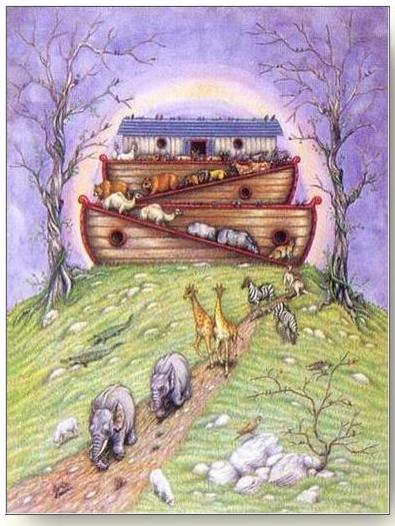
Noah’s Ark
(Everything I need to know, I learned from Noah’s Ark. )
ONE: Don’t miss the boat.
TWO: Remember that we are all in the same boat!
THREE: Plan ahead. It wasn’t raining when Noah built the Ark.
FOUR: Stay fit. When you’re 60 years old, someone may ask you to do something really big.
FIVE: Don’t listen to critics; just get on with the job that needs to be done.
SIX: Build your future on high ground.
SEVEN: For safety’s sake, travel in pairs.
EIGHT: Speed isn’t always an advantage. The snails were on board with the cheetahs.
NINE: When you’re stressed, float awhile.
TEN: Remember, the Ark was built by amateurs; the Titanic by professionals.
ELEVEN: No matter the storm, when you are with God, there’s always a rainbow waiting.
Have a great day, a blessed day, Kuwait.
William Dalrymple: The Age of Kali
Having read and loved In Xanadu: A Quest by William Dalrymple, and having received recommendations by friends who say they read ALL of William Dalrymple, I started on this second book, The Age of Kali. I didn’t like it, not one bit. I am proud to say I read it all the way to the end, because often if I don’t like a book, I will say to myself “I don’t need this!” and toss it, but I didn’t, I stuck with it. I am proud because it isn’t easy to stick with a book you don’t like, and I didn’t like this book.

In Xanadu, Dalrymple was wryly funny, hilariously funny, and most of the humor was directed at himself. In The Age of Kali, there is nothing funny.
The Age of Kali is a series of interviews and adventures in India and Pakistan. The author did these interviews and took notes (some are published in slightly different forms as magazine articles) over a period of ten years and then strung them all together to form this book. There is little or no linkage from one to the other. They are grouped geographically.
Here is what I like and admire – this man achieves the most amazing interviews, many times just by asking the right person at the right time. He insinuates himself, asks easy questions, and then sticks in a hard question. He doesn’t seem to flinch from putting himself in danger, and he doesn’t stand on respect when asking his questions. I admire that he went difficult places, interviewed difficult people, and wrote the interviews up without fawning over the celebrity status of his interviewee.
What I don’t like is that he doesn’t seem to like anybody very much. There are no funny anecdotes. By the end of the first interview, I began to get an impression that he doesn’t like India very much (and I believe that is NOT true, as he lives part-time in Delhi) and that India is not a place I want to visit. He interviews corrupt politicians, descendants of the moghuls, Benazir Bhutto – and her mother, Imran Khan (the cricket player) and many others. In each and every interview, he maintains a distance that tells us he doesn’t like these characters very much.
Here are some quotes from early in the book:
These days Bihar was much more famous for its violence, corruption and endemic caste-warfare. Indeed, things were now so bad that the criminals and the politicians of the state were said to be virtually interchangeable: no fewer than thirty-three of Bihar’s State Assembly MLAs had criminal records, and a figure like Dular Chand Yadav, who had a hundred cases of dacoity and fifty murder cases pending against him, could also be addressed as the Honorable Member for Barth.
As he interviews Bihar politician Laloo Prasad Yadav:
I asked Laloo about his childhood. He proved only too willing to talk about it. He lolled back against the side of the plane, his legs stretched over two seats.
‘My father was a small farmer,’ he began, scratching his balls with the unembarrassed thoroughness of a true yokel.
OK, that was funny. I had to read it aloud to AdventureMan. One of the things that still unnerves me living here is that the men are always touching themselves – something so totally forbidden in my culture as to be simply unthinkable.
In his section about Pakistan:
These people – the Pathans – have never been conquered, at least not since the time of Alexander the Great. They have seen off centuries of invaders – Persians, Arabs, Turks, Moghuls, Sikhs, British, Russians – and they retain the mixture of arrogance and suspicion that this history has produced in their character. History has also left them with a curious political status. Although most Pathans are technically within Pakistan, the writ of Pakistan law does not carry in to the heartland of their territories.
These segregated areas are in effect private tribal states, out of the control of the Pakistan government. They are an inheritance from the days of the Raj: the British were quite happy to let the Pathans act as a buffer zone on the edge of the Empire, and they did not try to extend their authority in to the hills. Where the British led, the modern Pakistani authorities have followed. Beyond the checkpoints on the edge of the Peshawar, tribal law – based on the institutions of the tribal council and the blood feud – rules unchallenged and unchanged since its origins long before the birth of Christ.
When I read this, I think of recent headlines about the problems Pakistan is having maintaining order, fighting the status of “failed-nation”, and the chaotic administration of tribal “justice.” The old ways have endured – but as we learned in Three Cups of Tea, there are villages where villagers are eager to have modern schools, eager to educate their daughters, and they, too, are victims of the fanatics who burn the schools and throw acid on women attending school.
The author is told, time and time again by Indian citizens, that India has entered The Age of Kali, “the lowest possible throw, an epoch of strife, corruption, darkness and disintegration.” The book reflects the darkness, corruption and disintegration the author found. I only wish there were some moments of relief, of lightness, hope or humor to encourage the reader on his/her way, but the documentation of this lowest throw was relentless.
“I Look Deep Inside . . .”
We were at one of those official dinners, and, as is my habit, I found someone even more shy than I am and started asking questions. It’s an old trick; it gets me through the most endless affair. She turned out to be very smart, very witty and entertaining, this Nigerian woman, so elegant, so well-mannered. We were having a great conversation.
“So what do you do in Kuwait?” I asked, almost yawning, I was so ashamed of myself for asking such a boring, common question.
She paused, looking at me like she was measuring me.
“I look deep within people, and I tell them things about themselves they never knew,” she responded.
“Oh no!” I thought to myself, “is she some kind of fortune-teller?” (Fortune tellers are strictly forbidden in my religion.) I’m usually pretty good with the old poker-face, but my eyes probably shifted, looking quickly for a polite exit.
She watched me, her eyes twinkling, grinning like a fisherman with a live one on the hook.
“I’m a radiologist,” she added, and we both cracked up. She really had me: baited me, caught me, hooked me good, and then did the old catch-and-release.
St. Oscar Romero
I didn’t even know we had a St. Oscar Romero, so when it came up on my screen, this morning as I was doing my daily lectionary readings I took a little time to read about him.
What an incredible man – and a modern day saint, too, a man for our times:
OSCAR ROMERO
ARCHBISHOP OF SAN SALVADOR, AND THE MARTYRS OF EL SALVADOR
(24 March 1980)
Óscar Arnulfo Romero y Galdámez (August 15, 1917 – March 24, 1980), commonly known as Monseñor Romero, was a priest of the Roman Catholic Church in El Salvador. He later became prelate archbishop of San Salvador.
As an archbishop, he witnessed numerous violations of human rights and began a ministry speaking out on behalf of the poor and victims of the country’s civil war. His brand of political activism was denounced by the hierarchy of the Roman Catholic Church and the government of El Salvador. In 1980, he was assassinated by gunshot while consecrating the Eucharist during mass. His death finally provoked international outcry for human rights reform in El Salvador.
In 1997, a cause for beatification and canonization into sainthood was opened for Romero and Pope John Paul II bestowed upon him the title of Servant of God. The process continues. He is considered the unofficial patron saint of the Americas and El Salvador and is often referred to as “San Romero” in El Salvador. Outside of Catholicism Romero is honored by other religious denominations of Christendom, like the Church of England through its Common Worship. He is one of the ten 20th-century martyrs from across the world who are depicted in statues above the Great West Door of Westminster Abbey, London.
You don’t have to be perfect to be a saint, in fact in the reading for today, St. Paul writes that “22 For I delight in the law of God in my inmost self, 23 but I see in my members another law at war with the law of my mind, making me captive to the law of sin that dwells in my members. 24 Wretched man that I am! Who will rescue me from this body of death? 25 Thanks be to God through Jesus Christ our Lord!
So then, with my mind I am a slave to the law of God, but with my flesh I am a slave to the law of sin.
We cannot, in our own strength do right all the time, even if we want to choose rightly. Oscar Romero may not have been perfect (because none of us are, it’s not like I know anything scandalous about him) but he dedicated himself to righting a major wrong he saw in society, and his persistence and dedication ended up causing his death.
Icons Challenge, The Locard Principle 2: The Middle East and Me
The best thing, the very best thing about blogging, for me, is what I learn from my commenters. The old Locard’s Exchange Principle is a constant in life – with every interaction, a part of you rubs off on me, and a part of me rubs off on you. It’s why we’re careful about the people, books, movies, blogs and ideas we spend time with. . . we either feel better for hanging around them, or slightly uncomfortable. Sometimes, hugely uncomfortable. The internet is a microcosm, good and evil all mixed in together and we make our choices.
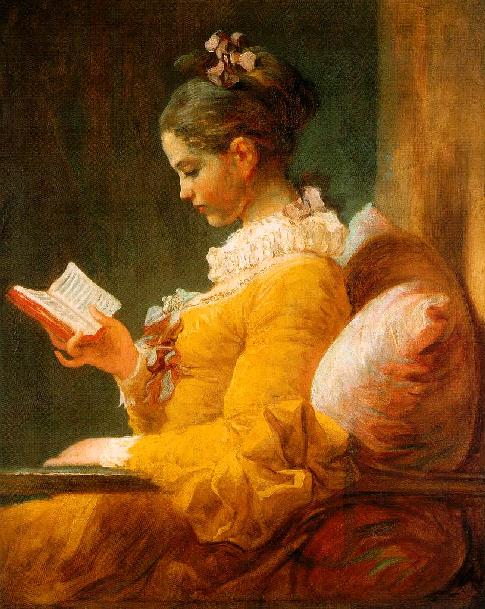
Fragonard: The Reader
Above: that is me. That’s pretty much who I am. I am quiet, I am a reader. I still get input, from newspapers, books, e-mails, the internet, friends, groups, etc.
What I love about blogging is that I throw something out, and you throw something back. Many many times, what I get back is unexpected, and forces me to re-examine my assumptions. Many times, I have to force myself to stop. Not to respond. I have to force myself to let the new information, new point-of-view sink in, percolate, settle. Minds don’t change in an instant, but . . . they do change. New information brings new, often surprising, perspectives. When I find myself getting angry, I have to step back and ask myself “what is going on here? What are you reacting to?” It helps me to know myself better, and it helps me to understand whatever-little-corner-of-the-world-I-am-living-in better, too.
There are about six different blog entries radiating out like a spider’s web from the thoughts I am now thinking, fed by your input and comments, and behind the scenes e-mails back and forth with new thoughts.
So here is my challenge for today. I’ve shown you one of my life icons, this Fragonard paining, The Reader.
Your mission, your challenge – identify / find a piece of art that shows us who you are. Post it on your blog and link here with a comment, or send it to me, and I will publish it.
(No graphic violence or pornography; I won’t publish it and I will break the link if you publish it on your blog and link to me.)
The Wedding at Cana
This is one of my favorite readings in the Gospels, for all it’s humanity. Some scholars theorize that the wedding was close family – from living here, I had to eliminate all the European paintings which show the men and women celebrating together – I am guessing the wedding feast would be more like the ones held here; men and women celebrating separately.
Disaster – there isn’t enough wine for the guests. Mary goes to her son and tells him “there isn’t enough wine.” He responds with “Mom! I’m not ready!” I imagine her giving him a long, level look and then turning to the servants and saying “Do whatever he tells you to do.” She is his Mom, after all. And, ready or not, he honors his Mom, and the wine is good.
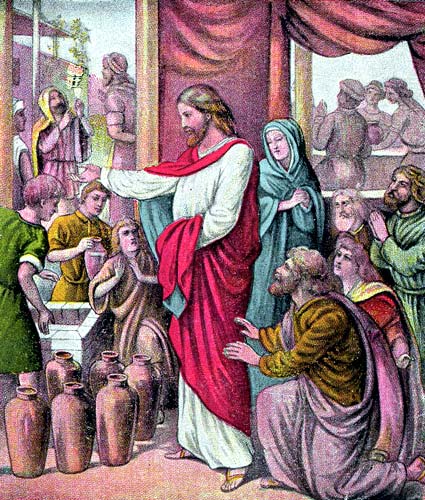
The Wedding at Cana
John 2:1-12
2 On the third day there was a wedding in Cana of Galilee, and the mother of Jesus was there. 2 Jesus and his disciples had also been invited to the wedding. 3 When the wine gave out, the mother of Jesus said to him, ‘They have no wine.’ 4 And Jesus said to her, ‘Woman, what concern is that to you and to me? My hour has not yet come.’ 5 His mother said to the servants, ‘Do whatever he tells you.’ 6 Now standing there were six stone water-jars for the Jewish rites of purification, each holding twenty or thirty gallons. 7 Jesus said to them, ‘Fill the jars with water.’ And they filled them up to the brim. 8 He said to them, ‘Now draw some out, and take it to the chief steward.’ So they took it. 9 When the steward tasted the water that had become wine, and did not know where it came from (though the servants who had drawn the water knew), the steward called the bridegroom 10 and said to him, ‘Everyone serves the good wine first, and then the inferior wine after the guests have become drunk. But you have kept the good wine until now.’ 11 Jesus did this, the first of his signs, in Cana of Galilee, and revealed his glory; and his disciples believed in him.
12 After this he went down to Capernaum with his mother, his brothers, and his disciples; and they remained there for a few days.
“I’m Melting! I’m Melting!”
At our church this weekend, our priest was making a point, using water, and he sprinkled various members of the congregation, to a series of “eeeeekks!”
I was reminded of several years ago – we had bought a new house, and our church has a special ceremony of blessing for a residence. As the priest carefully points out, he/she is not actually blessing the house, but blessing the inhabitants – nonetheless, every room has a special prayer, and the priest sprinkles a little holy water in each room.

more animals
As he sprinkled the water in one room, some hit my youngest sister, Sparkle. I watched her struggle not to do it, but she couldn’t resist.
“Ohhhh, I’m melting, I’m melting!” she cried out, like the Wicked Witch of the West in The Wizard of Oz.
Thank God, the priest was a good friend. He paused, looked at me and said “she is YOUR sister?” I nodded. He sighed, before continuing, and said “why am I not surprised?”
Lenten Challenge
In church this week, our priest spoke of the necessity of listening – and hearing. He spoke of how important it is to be fully present for our spouses, our children, not just listening with half an ear and going “um hmmm, um hmmmm” (ulp! guilty!) He also spoke of how hard it is to truly listen and to hear when our minds are unquiet, and we have a lot going on in our lives.
Lent starts with Ash Wednesday – this week.
I am tempted to give up extra noise for lent – to live a more silent and contemplative life.
Here is the problem – I love silence. I do listen to BBC when I am in my project room or in my car, but other than that, I don’t fill my life with a lot of noise. Silence is my friend. So for me, seeking more silence is not such a good thing, it is more like feeding an addiction. Listening to BBC is, for me, probably a good thing, keeping me more connected to the world, less in my ivory tower. It confronts me with problems in the world, and inspires me with people who seek to make a difference, even in a small way.
But that is not the point. The main point is to be fully present, to listen to those who are speaking and to hear the heart behind the words, and to love them as Christ loves us. I know that silence is not my solution, that paying attention is the real test. Focusing, paying attention – that is a real challenge.
It would be easier to give up chocolate!
Khaled Aljenfawi: Tolerance Begins at Home
An extraordinary article from today’s Arab Times:
Tolerance usually begins at home
By Khaled Aljenfawi
Verbally or physically abusing some domestic servants, stone pelting some expatriate passengers and drivers, lack of patience toward some expatriate doctors and teachers, by some individuals, certainly indicate that tolerance usually begins at home.
Already known for its tolerance toward strangers, foreigners and non-citizens, our Kuwaiti traditional society stands upon certain pillars of morality. These moral ideals usually advocate mercy, compassion and understanding toward others. As such, as Kuwaiti citizens, many of us already understand the importance of such moral ideals and many of us live by them. Therefore, we realize that we are integral parts of a larger human family; many of us in fact continue to refuse anti-social behavior directed toward some expatriates.
This being said yet certain individuals in our society continue to verbally or physically torment some helpless domestic servants. Some youngsters pelt expatriate passengers while they ride in public buses; perhaps just because they believe they can do so!
One can add to this the other negative phenomenon common these days of not being patient with some expatriate doctors and teachers and simply opting for the more reckless behavior: verbally and sometimes physically assaulting these expatriate professionals. Such behavior go against our national law and against the teachings of our national heritage. Such negative behavior in fact go against our Islamic tenets!
As a case in point, borrowing from already accepted international laws about human rights, and relying basically on our genuine Kuwaiti heritage of tolerance, officials in the Ministry of Education continue to update our national curriculum to adapt to a changing world. For example, primary, middle and secondary schooling emphasizes tolerance as a way of life in a modern society. Yet what the younger generations are learning at school about tolerance continues to be threatened by the behavior of some.
Intolerance actually goes against the basic teachings of our Islamic faith. As a Muslim society, Kuwait has been welcoming strangers, foreigners and expatriates for tens of years without apparent conflict. This tolerance toward those who are different springs from our Islamic faith, in addition, it originates from our national heritage. For example, one of the most enduring tenets of Islam is the equality among humans: in the Holy Quran, the Almighty say: “We have created you from male and female, and have made you nations and tribes that ye may know one another. Lo! the noblest of you, in the sight of Allah, is the best in conduct. Lo! Allah is Knower, Aware.” (Al-Hujraat-13).
One cannot instill by force tolerance in the mind of a child unless the whole family believes in the legitimacy of tolerance and its importance to its general wellbeing. If a young child learns about tolerance at school and then encounters daily situations of intolerance at home, he/she will find it hard to believe in tolerance. In other words, tolerance in addition to being a moral concept, which reflects the morality of a whole society, will take its roots if the ordinary family considers it as an accepted code of conduct. A Tolerant young person for example, will subsequently be a tolerant father or mother for these parents are already used to tolerance and will ultimately help shape the mentalities of their children.
A child who is already used to voicing his points freely in a safe family environment will find it much easier to accommodate tolerance and accept it as a way of life. Indeed, a child raised in a Tolerant family will eventually become a good neighbor, a good friend and certainly a Tolerant person toward those who are different from him.
khaledaljenfawi@yahoo.com
Wooo Hooo on you, Khaled Aljenfawi!
Recent Comments
intlxpatr on Shampoo Ginger tigerbutterya0c5ff1d… on Shampoo Ginger intlxpatr on British Soldier Kidnapped, Esc… John on British Soldier Kidnapped, Esc… intlxpatr on British Soldier Kidnapped, Esc… Wikipedia Donate Button

Amazina


Early Voting in Florida


