What is Your Greatest Fear?
Reach down deep. Take your time. Think about this.
A friend sent one of those “getting to know you” e-mails, and this question was on it: What is your greatest fear?

(Photo from Acclaim images)
My first reaction is – whoa! That is a VERY personal question! But I shared my answer with her.
One of the reasons we share when we blog, I think, is to connect with one another, to make this world a less lonely place. When we are going through a hard time – and don’t be fooled, no matter how good, how together, we look on the outside, we ALL go through hard times – it helps to know that we are not the only person in the world who has ever gone through this, whatever this may be.
There are things we don’t talk about. From time to time, you find a friend you can really really trust, and you take a chance. What a relief! You discover, if you are lucky, that maybe he or she has been there, too. At the very worst, you have someone who knows what you have suffered. It can be years down the road that they come back to you and say “I’m there now – can you help me through it?” And two people are less alone, and your suffering has not been for nothing; it has equipped you to walk this path with your friend, and lighten the load a little.
So here is is: my greatest fear is to die a meaningless, stupid death.
I don’t want to die on a Kuwait highway saying “oh sh$t” as I see some doped up, testerone-loaded, out-of-control driver barreling straight into me.
I don’t want to die as a random, unchosen victim of terrorist attack, like 9/11, or Pan Am 103.
I don’t want to trip over my high heels and break my neck falling down the stairs. (My own stupidity!)
I wouldn’t mind dying a heroic death, but my preference is to die quietly, prepared, even eager to meet my Creator. But my terror is to die too soon, for no good reason, as the result of someone’s stupidity.
So. I’ve taken the risk, early on this Thursday morning. Step up to the plate. Take a deep breath. Even if you’ve never commented before, take a risk, here, now. (Regular commenters, welcome!) Share your greatest fear.
What is your greatest fear?
Even After All this Time – Latifi
A good book can make your blood race faster. A good book may even require underlines, turned page corners to mark the places you liked the best. A good book may compell you to tell others about it. Above all, a good book is a book you think about long after you have turned the last page.
Some of my best “good books” come to me through Little Diamond, my neice who lives in Beirut. We share a family culture, but even better, we share a wacky sense of humor. There are times we can’t even let our eyes meet in family gatherings, because we are thinking the same thing and can’t afford to laugh out loud.
She recommended this book to me more than three years ago, and I bought it immediately. And then it sat in my “read me soon” pile(s), languishing, unread, until early this year.
Oh, what a treat this book is! Once I picked it up, I could hardly put it down!

The book is autobiographical, and begins in pre-revolutionary Iran, where Afchineh Latifi’s father is a soldier. You see the early years of her life with her sweet, struggling parents, and you feel like you lived in their home with them, the images are so vivid.
As a military officer, though, her father is suspect once the revolutionaries come into power, and her family’s fortunes fail. Her father is arrested. As Latifi’s mother bravely goes from jail to jail, trying to find her husband, her daughters are often with her. Once she finds him, she brings him comfort items – shaving kit, washcloth, etc. so he can maintain a small amount of dignity while he is being beaten and imprisoned. Latifi’s mother was young when this book opens, maybe in her thirties, with two daughters and two sons, and I am totally blown away by the courage it took to persist as her husband was transferred from prison to prison, increasingly brutalized, and then, immediately after the last visit – shot. So immediately that the family heard the shots.
And then the real nightmare begine. The young mother and her family have no income, and her (now dead) husband’s mother claims her house, even though they bought her a house of her own while her husband was alive. Latifi’s Mom never gives up. She gets her daughters visitor’s visas to Austria and puts them in a convent school, and then gets them to America – again on visitor’s visas – where they are forced to camp – for years – with a relative. Literally, years. Their brave mother eventually manages to get herself and her sons out of Iran, and join them in the US.
Their mother is a pistol. She is brave in the face of obstacles that would deter most of us. She never gives up. I am in total awe of her commitment to the survival – and thriving – of her family.
I love this book for two reasons – the first being the strength and courage of this family, and the second being that they immigrated to America. You will hear a lot of Americans who say terrible things about immigrants, and how they take up scarce resources better meant for “real” Americans. Who are they kidding? We are ALL immigrants, in America, except for the Native Americans! This family, their will to succeed, is the story of us all, and what makes the country great. It is still a country where you can work hard, and succeed, and thrive. It’s an every day story in our country, but a story I never get tired of hearing.
Here are some excerpts from the book:
She looked at me as if I were an alien, which in fact I was. “Yes,” she said, “You get a library card and you can borrow as many books as you want.”
“And it doesn’t cost a thing?” I asked.
“Not a penny,” the woman said. “Unless you bring the books back late. Then we charge you a late fee.”
This was news to me. There were libraries in Tehran to be sure, but we had never frequented them. Mom would come home every two or three weeks with armsful of new books, and we would devour them hungrily. We were much too spoiled to share books with anyone.
The librarian processed my card on the spot. I couldn’t believe it. It felt like the biggest gift of my life. . . . . By the end of the summer I discovered a whole new world. Books. Words. Stories. I got in touch with my inner geek. Reading was not only exciting, it offered escape. When I was reading, my other life didn’t exist. There were days when I didn’t even think of Mom.
Her Mother was still in Iran at this time, and she and her sister are living with relatives who have loud arguments wondering how much longer they will be burdened with these girls. Finally, the two sisters find jobs, as well as going to school, and save every penny, and get an apartment where they live while putting themselves through university. And, one day, their mother and brothers arrive. Life changes. They all live together again.
“It’s almost Norouz,” she said. “Or have you forgotten?”
I had indeed forgotten. She was referring to the Persian New Year, which on the Gregorian calendar falls in late March. About two weeks before the start of Norouz, many Persians take part in something called ‘khane tekani,’ which literally means ‘shaking your house.’ You will see people painting their homes, washing their carpets, sweeping out their attics, cleaning their yards. One could say that it is a form of spring cleaning, but that is only a very small part of it. In Persian ‘no’ means new, and ‘rouz’ means day. The last Wednesday of the year is known as ‘chahar shanbeh suri.’ At dusk, with the cleaning over, people light small bonfires and sing traditional songs, and those who can manage it are urged to jump over flames. Fire, too, is seen as a cleansing, purifying agent: it burns away all the negative things in one’s life – the bad habits, the misfortune, the sorrows. It’s all about cleanliness: clean house, clean soul, new beginnings.
On the “new day” itself, people focus on family and friends, and for the next two weeks there will be much visiting back and forth. In each house, one finds a ‘sofreh eid,’ . . . Laid out on this garment, one will find the ‘Haft Seen’ (Seven S’s) comprised of seven items that begin with the letter S. These are ‘sabzeh’ or sprouts (representing rebirth); samanu, a pudding (for sweetness in life); ‘senjed,’ the sweet, dry fruit of the lotus tree (representing love); ‘serkeh’ or vinegar (for patience); ‘seer’ or garlic (for its medicinal qualities); ‘somaq’ or sumak berries (for the color of sunrise); and ‘seeb’ or red apples (symbols of health and beauty. In addition there are candles laid out on the ‘sofreh eid” one for each member of the household. The lit candles represent the goodness and warmth that enter life with the coming of spring.
(For the first time, this year we are invited to a new year’s celebration, and I thank God that I read this book just at the right time, so I will know even just a little of what this is all about. I am excited to see the ‘haft seen.’ )
Something else happened that November that I will never forget: Our family celebrated Thanksgiving for the first time. We loved the whole idea behind the celebration. It wasn’t about religion, and it wasn’t about gifts; it was about people sitting down to enjoy a meal together and acknowledging everything that they had to be thankful for. And we had a lot to be thankful for.
By the end of the book, all four children have graduated from university with professional degrees. This isn’t a spoiler. The book is about the sacrifice, the hard work and the commitment it took to get them there. Even After All This Time is an inspirational book, a book you won’t soon forget, and a book you will want to share with your friends.
Amazon offers it used from $4.67 and in hardcover around $25.
And Happy New Year to my Persian friends.
Who is St. Patrick?

Saint Patrick is believed to have been born in the late fourth century, and is often confused with Palladius, a bishop who was sent by Pope Celestine in 431 to be the first bishop to the Irish believers in Christ.
Saint Patrick was the patron saint and national apostle of Ireland who is credited with bringing christianity to Ireland. Most of what is known about him comes from his two works, the Confessio, a spiritual autobiography, and his Epistola, a denunciation of British mistreatment of Irish christians. Saint Patrick described himself as a “most humble-minded man, pouring forth a continuous paean of thanks to his Maker for having chosen him as the instrument whereby multitudes who had worshipped idols and unclean things had become the people of God.”
Saint Patrick is most known for driving the snakes from Ireland. It is true there are no snakes in Ireland, but there probably never have been – the island was separated from the rest of the continent at the end of the Ice Age. As in many old pagan religions, serpent symbols were common and often worshipped. Driving the snakes from Ireland was probably symbolic of putting an end to that pagan practice. While not the first to bring christianity to Ireland, it is Patrick who is said to have encountered the Druids at Tara and abolished their pagan rites. The story holds that he converted the warrior chiefs and princes, baptizing them and thousands of their subjects in the “Holy Wells” that still bear this name.
There are several accounts of Saint Patrick’s death. One says that Patrick died at Saul, Downpatrick, Ireland, on March 17, 460 A.D. His jawbone was preserved in a silver shrine and was often requested in times of childbirth, epileptic fits, and as a preservative against the “evil eye.” Another account says that St. Patrick ended his days at Glastonbury, England and was buried there. The Chapel of St. Patrick still exists as part of Glastonbury Abbey. Today, many Catholic places of worship all around the world are named after St. Patrick, including cathedrals in New York and Dublin city
Why Saint Patrick’s Day?
Saint Patrick’s Day has come to be associated with everything Irish: anything green and gold, shamrocks and luck. Most importantly, to those who celebrate its intended meaning, St. Patrick’s Day is a traditional day for spiritual renewal and offering prayers for missionaries worldwide.
So, why is it celebrated on March 17th? One theory is that that is the day that St. Patrick died. Since the holiday began in Ireland, it is believed that as the Irish spread out around the world, they took with them their history and celebrations. The biggest observance of all is, of course, in Ireland. With the exception of restaurants and pubs, almost all businesses close on March 17th. Being a religious holiday as well, many Irish attend mass, where March 17th is the traditional day for offering prayers for missionaries worldwide before the serious celebrating begins.
In American cities with a large Irish population, St. Patrick’s Day is a very big deal. Big cities and small towns alike celebrate with parades, “wearing of the green,” music and songs, Irish food and drink, and activities for kids such as crafts, coloring and games. Some communities even go so far as to dye rivers or streams green!
The above information came from St. Patrick’s Day: About Saint Patrick where you can also find Irish recipes, Irish sayings, more information about how St. Patrick’s Day is celebrated and also information on Irish dancing and Irish shopping.
Lying Hurts the Liar
I came across this post in an old archive. The author was writing to teens about the Monica Lewinski scandal, but as I read through his wise words, I found myself thinking how appropriate the words are for all age groups:
Lying Hurts the Liar
If you lie, it will make things worse for you, too. Oh, you might get away with it once or twice, but you will get caught sooner or later.
How Does Lying Make Things Worse?
Lying makes things worse because it hurts your personal relationships: relationships with friends, brothers and sisters, parents, children, teachers and other adults.
Think of it for a moment. When you lie, it is a burden you have to carry with you. It makes you feel bad inside. You know you hurt your relationship with someone by lying. It violates the trust people have in you. Usually you have to lie again to cover up the first lie, and you feel even worse for doing that.
Have you ever noticed how badly you feel when you discover a friend has told you even a little lie? It hurts a lot. You wonder why a friend would do that to you. You think about it a lot, and you just don’t trust your friend as much after that. It’s not the same.
Then think about how you feel when someone is telling you what a good, good friend he is, and then he goes behind your back and says just the opposite. It destroys all trust.
A Way You Can Understand Lying
When you become a friend to another, you put your life in some small or large way into his cupped hands. You trust the person by putting part of your life in their hands. You want and need your friend to be worthy of that trust. When they lie to you, he lets your life slip through his hands, and is not worthy of your trust. How lonely that feels! How disappointing!
Lying harms not only personal relationships, but business relationships as well. In conducting business we also put ourselves into the hands of others. Our business associates need to be worthy of our trust. Take the simple example of going into a store and buying a box of chocolate chip cookies. The picture of the cookies on the box looks terrific. The chocolate chips look tasty, but you open the box at home and find cookies with no chips. You feel cheated because you believed what you saw. You believed a liar. No wonder you feel cheated. No wonder you’ll probably avoid that brand in the future.
Why Are We Tempted to Lie?
We are tempted to lie because we want something and use a lie to get it . . . That sounds a little selfish, doesn’t it? No wonder lying makes us feel lonely. No wonder the devil is called the father of lies.
We lie because we believe it will make things better. So you shoplift, and when questioned, say: “If I lie I won’t get caught. If I’m caught, they will be mad at me. I want to avoid the pain.”
Once we give into this temptation to lie, we start lying some more by saying: “I want to spare my loved ones the pain of knowing what I did.” So you try to spare them that pain by lying to them. That doesn’t make sense.
It’s like saying: “I’m not going to admit I robbed the bank because it will upset the police.” What kind of nonsense is that?
How Do We Respond When We Are Caught Lying?
Our response is usually to say: “Everybody lies. So what difference does it make?” The trick of a good liar is to attack the accuser. So when another kid accuses you of lying, you say: “Well, I heard you lie once.” It’s the “look who is calling the kettle black.” Attacking the accuser does not make the lie less a lie. It is still a lie. It still hurts relationships.
Your trying to justify lying by saying everybody lies is like saying: “Everybody hurts their loved ones so hurting loved ones must not be so bad.” Do you really believe that since so many people steal, stealing must not be so bad? It’s like saying everyone makes your life miserable so being miserable must not be so bad. This doesn’t make sense.
Why Are These Rationalizations Wrong?
Lies decrease the love we have for one another. They diminish hope. They extinguish trust and belief in one another. Lies are morally wrong.
Why don’t we just say: “Let’s forgive and go on with life?” Forgiveness makes us feel good, and like anything, it can be taken to excess. For example, if a person has no remorse, don’t forgive him just so you can feel good or look good. It mightily confuses the liar. Likewise, don’t forgive someone who has done nothing wrong. It confuses others.
On the other hand, don’t hold onto forgiveness as a form of vengeance. “I won’t forgive you because you need to suffer some more.” That’s like saying until you extract a pound of flesh, the score is not even.
The action of appropriate forgiveness is an action making the situation better . . . it produces a good set of outcomes. Failure to forgive in a situation where forgiveness is warranted makes the situation much worse.
It doesn’t do any good to censure a person who feels no shame, who feels no guilt. He will just make more excuses.
On the other hand, it does a great deal of good to refrain from censuring a person who already has censured himself. This is the person who really feels guilt and tries to make amends. Failure to forgive here is inappropriate.
It’s also good to remember that there is a difference between forgiving and condoning. Condoning diminishes the action. It’s inaccurate and it’s a cop-out. The religious call to forgiveness is not a call to be a sucker. If what was done hurt you, you need to say that, and not pretend it didn’t hurt and it doesn’t matter.
At every point a person has a choice to forgive or not forgive for the right reasons. Conciliatory personalities tend to forgive too much, too quickly. Aggressive personalities tend to forgive too little, too late. We need to strike a balance.
Is it Hard to Forgive After the Lying Has Stopped?
Yes, it is a lot easier to forgive when the person is trying to make up to you for all the lies he told you. Even then, it takes a long time for forgiveness to settle in. Why? Because the hurt is still there.
It is rather easy for a person who lies from time-to-time to quit. It can
be done rather readily if there is determination to do so. What about a person who lies habitually over a period of time and cannot quit easily or without consistent help? A habitual liar will be tempted to believe he just has to say he’s sorry, just as a habitual drinker will tend to believe all he has to say is he’s sorry. It doesn’t work that way. On the other hand, bull throwers, braggarts and exaggerators are a tiresome lot, but they are easier to get along with than habitual liars.
How Is Lying Made Worse?
The bigger the role model, the worse the lie. If someone I hardly know lies to me, it is bad. However, it is much worse if my mother lies to me. She is a much bigger role model in my life. That makes the lie worse.
That’s why the President falls off a mountain when he lies. Yes, he falls a great distance, and if he lies over and over again, he falls an even greater distance.
You may say that if we raise the bar too high, no one will run for public office. Then all we will get is the biggest bully or the guy with the most money. That’s really not our problem. The problem is just the opposite.
We need to raise the bar high enough so better people will run for office. We need to restore the expectation that includes honest behavior. The solution is not to take the bar away. To put it another way, if many people are lying, the solution is not to approve of lying, but rather to rekindle the fires of devotion. Otherwise, human flourishing is diminished.
Every time we see someone shoplifting in the store, we need to cry out: “Thief, thief!” Similarly, every time we see someone lying, we need to call out: “Liar, liar pants on fire!” We will be better off with fewer liars, not more.
These are just some of the reasons why the good Lord tells us not to lie.
Here is the source of the article: Girls and Boys Town.
Lenten Update
As you know, I gave up bad language in my car for Lent. Yes, I could have given up chocolate. It would have been easier.
I’ve done fairly well. I totally slipped up once, my husband was driving. At first I thought, “well it doesn’t count because I am not driving” but – it does. It counts.
I have not succeeded in not thinking the bad word. I ask forgiveness, and I ask for help not even thinking the bad words. He IS helping. My language is getting better. Alhamd’allah.
For my non-Kuwaiti, non-Middle East friends and readers, you can actually get in more trouble here for bad language than you can for crashing a car.
True story: in one country, a man was trying to get into a gated community and was refused. He was angry and wanted to back up, rather than going forward and turning around, so he put his car in reverse and gunned the engine and smashed into the car behind him. The woman driver was shocked, and just sat there. So he moved forward, and gunned the car in reverse, and hit her again! He did it a third time. She got out of her car and screamed at him “What are you doing, you a$$####???” and he had HER arrested for bad language. He stoically paid for the damage to her car, but SHE had to go to court and through a lengthy humiliating process of finding a lawyer, etc. She also had to pay a huge fine and listen to a lecture from the judge.
A wise person NEVER makes any hand gestures, either.
Giving up bad language on the highway is not only a spiritual improvement, it could also save me a lot of trouble down the road.
Good Omens
When our son asked me what I might like for Christmas, I told him “find three really good books that I probably wouldn’t buy for myself.” I can trust him to do a great job because:
1. He has alwasy spent a good amount of time hanging out around books.
2. He has a good idea what I buy for myself.
3. He has a whacky sense of humor.
Good Omens, by Niel Gaiman and Terry Pratchett was one of the books he and his bride gave me, and it was a riotous good read.
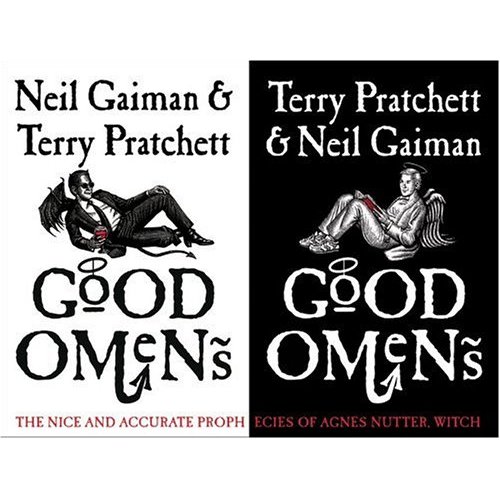
This book is not heavyweight – you can read it on one leg of an airplane trip or two or three nights before falling asleep. It treats a very heavy topic – The End of Days/ the Apocalypse in a very irreverant, very funny way. It treats the characters of good and evil – angels and devils – as real characters. In spite of the lightweight plot, there are some interesting – and hysterical thoughts.
Crowley, the demon/devil who was placed on earth to torment and tempt humans, hopes the end of the world will be a long way off . . . through the centuries, he has grown to rather like people.
Oh, he did his best to make their short lives miserable, because that was his job, but nothing he could think up was half as bad as the stuff that they thought up themselves. They seemed to have a talent for it. It was built into the design, somehow. They were born into a world that was against them in a thousand little ways, and then devoted most of their energies to making it worse. Over the years Crowley had found it increasingly difficult to find anything demonic to do which showed up against the natural background of nastiness. There had been times, over the past millenium, when he’d felt like sending a message back Below saying Look, we may as well give up right now, we might as well shut down Dis and Pandemonium and everywhere and move up here, there’s nothing we can do to them that they don’t do themselves, and they do things we’ve never evey thought of, often involving electrodes. They’ve got what we lack. They’ve got imagination. And electricity, of course.
The Anti-Christ is born, and cosmic events get underway. But . . .this being Earth, and bureacracies being as they are, things get screwed up. I’m not going to get specific; it’s part of the droll fun these authors have with us as they write this book. The Four Horsemen appear, but they ride motorcycles, and Pestilence has been replaced by Pollution.
As the situation heats up and the end of the world as we know it nears, Crowley ends up with an unlikely ally, the angel Aziraphale.
Now as Crowley would be the first to protest, most demons weren’t deep down evil. In the great cosmic game they felt they occupied the same position as tax inspectors – doing an unpopular job, maybe, but essential to the overall operation of the whole thing. If it came to that, some angels weren’t paragons of virture; Crowley had met one or two who, when it came to righteously smiting the ungodly, smote a good deal harder than was strictly necessary. On the whole, everyone had a job to do, and just did it.
Now, throw into the mix an ancient book of totally accurate prophesies that are sufficiently oblique to be disasterously mis-interpreted, The Nice and Accurate Prophesies of Agnes Nutter, Witch. “Nice” in this case refers to its oldest meaning, exact. And, while the prophesies ARE exact, finding out their exact meaning is another hilarious exercise.
All in all, a great read, a lot of fun . . . and underneath the fun, some little pinpricks of thought about human beings, the human condition, and our treatment of our world and one another that needle you long after you finish reading. Son, thanks, you chose a great book.
Dying Laughing: Al Qaeda in Seattle
My niece, Little Diamond has found a SATIRICAL article (I can’t figure out where, it is not The Onion ) on Al-Qaeda buying property in Seattle. If you know Seattle, and the pride Seattleites take in civility, friendliness, and neighborliness, then you, too, will die laughing. Click on A Diamond’s Eye View of the World for your grin to start the week.
And a part of me thinks – isn’t this what we are supposed to be doing? Be kind to our neighbors? Isn’t it the only way to interrupt the spiraling cycle of hatred and violence? Sometimes, an unexpected kind word changes everything – I know it has in my own world.
Isn’t Sodomy Considered Perversion?
Two articles from the Kuwait Times crime pages, but a daily occurrence:
February 27, 2007
Kuwaiti boy Sodomized
A Kuwaiti living in the Jaber Al-Ali area recently filed a complaint that a man offered his younger brother a lift while he was walking in the Mubarak Al-Kabeer area. He said the man then drove into the desert where he sodomized the boy after threatening him with a knife and also shot nude pictures of him.
February 28, 2007
Bedoons, Kuwaitis scuffle over attempted ‘sodomy’
Kuwait: Two bedoons travelling in a car in Riqqa spotten an eleven-year-old Kuwaiti boy standing in front of his house, and decided to kidnap and sodomize him. One of them alighted and tried to force the boy to get inside the car, but the boy started screaming; alerting other boys in the neighborhood who wrestled with the bedoons and managed to pin them down until the police arrived. However, the boy’s father when informed on the situation along with his relatives rushed to the police station where they encountered the bedoons’ relatives. Both groups were then involved in a scuffle. The boy’s father then stabbed one of the bedoons several times. The victim had to be admitted to the intensive care unit at Adan hospital. Police arrested the boy’s father and referred him to the relevant authorities.
My comment and question: In our holy book, Jesus says that the very worst punishment in the afterlife is for anyone who harms one of the little ones, one of the “innocents,” who damages that innocence in any way. I am betting the Qu’ran says something similar. (I welcome your feedback on this, because I would like to know the sura’a.)
And aren’t Bedoon’s MORE religiously conservative than other Kuwaitis? How does this track?
In western culture, men who ‘bugger’ other men are considered less than manly. Is this not also true in Islam?
Is sodomy not considered a perversion in Islam?
What is the penalty for sodomy in Kuwait, and how is the penalty enforced?
Donna Leon: Read and Savor
When I tell you about Donna Leon, I am really introducing you to a friend. I can’t remember when we met, but I can tell you that I seek her out whenever I can. Just listing her books, I realized there were several I hadn’t seen and I ordered them immediately, from the Amazon re-sellers.
“Why the resellers?” you are asking. Donna Leon is not that easy to find, in the United States. Some of the books in her series seem to have been printed only in the UK, which is a pity, because The Donna Leon books really need to be read in order.
While they can be a quick read, they are better read slowly and savored. It’s not that hard. Her humor is subtle, sometimes even sly. Commissario Guido Brunetti, her main character, lives in Venice. He has a family, a sweet wife – Paola, and a daughter and a son. He eats Venetian meals, he lives in an illegal Venetian apartment, he has a glass of wine or two with his lunch. It helps to read the books in order, as his children grow from childhood to teen-agers, and to grow older with him as he solves his cases.
But in Donna Leon’s books, solving the cases is not the goal. As often as not, even while Brunetti solves the case, justice is not served. The books are about the living conditions and social realities of life in Venice, and in Italy. The books are about painful subjects – child prostitution, traffic in women, blood diamonds and African immigrants, and about art fraud and Mafia crime and big business. And the book is about Venetian and Italian interconnections, so that some crimes just disappear, some evidence just disappears, and Brunetti’s dunderhead of a boss tells him to just look the other way.
While each book is deceptively short, and written in clear, simple language, the books are richly complex, weaving a myriad of details into each page.
Thanks to Donna Leon, I know what it is like on a cold, rainy day in Venice, when the water rises and you have to try to walk on raised boards to get where you are going. I know what it is like to have a family emergency and the police vaporetto is in use elsewhere and to try to figure out the fastest way to run home, crossing bridges, grabbing a taxi, complicated by the canal system and tourist infestations in Venice. I know when policement get together for lunch in Venice, you don’t talk business until AFTER you have finished your exquisite pasta with truffles, accompanied by a glass or two of the fabulous house wine. Donna Leon has taken me there.
In Death and Judgement, the book I just finished, Brunetti is called by a police sergeant who has arrested a former police sergeant and wants Brunetti to come to the station. Brunetti’s conversations with the arresting sergeant always require a lot of patience:
(Brunetti) “Did the people in Mestre tell you to make out an arrest report?”
“Well, no, sir,” Alvise said after a particularly long pause. “They told Topa to come back here and make a report about what happened. The only form I saw on the desk was an arrest report, so I thought I should use that.”
“Why didn’t you let him call me, officer?”
“Oh, he’d already called his wife, and I know they’re supposed to get one phone call.”
“That’s on television, officer, on American television,” Brunetti said, straining towards patience.
We’ve all been there. Dealing with those who think they understand, and their understanding is . . . imperfect.
In another part of this book, in which the major issue is the big business of trafficking in women for prostitution, Brunetti is having a conversation with his wife:
Paula pulled gently on his hand. “Why do you use them?”
“Hum?” Brunetti asked, not really paying attention.
“Why do you use whores?” Then, before he could misunderstand, she clarified the question. “Men, that is. Not you. Men.”
He picked up their joined hands and waved them in the air, a vague, aimless gesture. “Guiltless sex, I guess. No strings, no obligations. No need to be polite.”
“Doesn’t sound very appealing,” Paola said, and then added “But I suppose women always want to sentimentalize sex.”
“Yes, you do.” Brunetti said.
Paola freed her hand from his hand and got to her feet. She glanced down at her husband for a moment, then went into the kitchen to begin dinner.
If you are reading that interchange too quickly, too superficially, you will totally miss the significance of the last sentence. If you have been married a long time, you will totally understand that a whole lot happened. This is one of the things I love about Donna Leon.
Death at La Fenice
Death in a Strange Country
Dressed for Death
A Venetian Reckoning
Acqua Alta
The Death of Faith
A Noble Radiance
Fatal Remedies
Friends in High Places
A Sea of Trouble
Willful Behavior
Uniform Justice
Doctored Evidence
Blood From a Stone
Through a Glass Darkly

Giving it Up for Lent
Lent started today, our own holy season of repentance and fasting. When I was a little girl, children would gather and figure out what they were going to give up, like chocolate, or coca cola, or candy. Mostly, in truth, it didn’t last too long. We meant well, we took it seriously, but we didn’t have the capacity for that kind of long term commitment – 40 days (and 40 nights, too; we don’t get time off from sunset to sunrise.)
As adults, we can be equally wacky, but in different ways. We can give up something that is too easy to give up. We can give up something and then obsess about it until it makes up a major focus of our day. If we are very fortunate, with prayer and God’s help, we can truly give up something meaningful and stick to it, offering it up as a spiritual sacrifice to God.
I had a blessing this week. It didn’t feel like such a blessing at the time, but a great deal of the time this week I was driving, and I had riders in the car.
I had no idea my language in the car had deteriorated so far. I’m a pretty good driver, but this is Kuwait. There are things that are out of my control. And I discovered that occasionally, bad words pop out of my mouth.
I can only guess that it happens when I am alone, too, but I am not conscious of it. All of a sudden, when some bad word pops out of your mouth and you are NOT alone, you become VERY conscious of it.
I’m giving it up for Lent.
At first, I was going to allow myself non obscene words like “Idiot!” “Imbecile!” and “What are you thinking??????” but after lengthy thought, I think it defeats the purpose. No. I am going cold turkey, no obscenities, no outraged exclamations.
Perhaps an elaborate “I forgive you” from time to time. . . . Pray for me!
Recent Comments
Kitchen on Isiais: Winding Down intlxpatr on Shampoo Ginger tigerbutterya0c5ff1d… on Shampoo Ginger intlxpatr on British Soldier Kidnapped, Esc… John on British Soldier Kidnapped, Esc… Wikipedia Donate Button

Amazina


Early Voting in Florida


